What Shall Be The Sign Of Thy Coming?
Reading edition
Verse 21: “For then shall be great tribulation, such as was not since the beginning of the world to this time, no, nor ever shall be.”
It is not surprising, perhaps, that upon a casual reading some should conclude that this verse had its fulfillment at the siege of Jerusalem by Titus. It was a time of great suffering, and the verse follows so closely those which relate to the destruction of the city, that this explanation suggests itself readily enough. But for good reasons we cannot accept that application of this verse. Jesus is giving a [pg 035] continuous prophecy. The narrative proceeds from verse to verse along the line of the entire dispensation.
The “great tribulation” mentioned in verse 21 is that of the church of Christ, and not the tribulation of the Jews at the destruction of Jerusalem. We offer the following reasons for so deciding:—
1. It is a fact that the tribulation of the Christian church, especially under the reign of the papacy, was greater than God's people had suffered before “since the beginning of the world.” The tribulation of the Christian church has been greater than it will ever be again. True, a time of trouble “such as never was,” spoken of in Dan. 12:1, is coming upon the wicked; but we find in the same verse this blessed promise, “And at that time thy people shall be delivered.” The tribulation of the Jews at the destruction of Jerusalem was not greater than the world will ever witness. The vials of Jehovah's unmingled wrath are yet to be poured out, not upon the people of one nation only, but upon the guilty people of all nations.
“The slain of the Lord shall be at that day from one end of the earth even unto the other end of the earth; they shall not be lamented, neither gathered, nor buried.” Jer. 25:33.
2. If the tribulation be applied to the Jews, or to any other class of unbelieving men, it cannot be harmonized with Dan. 12:1, which speaks of the time of trouble such as never was, when Michael shall stand up. Certainly there cannot be two times of trouble at different periods, greater than ever was or ever would be. Therefore the “tribulation” spoken of in Matt. 24:21, 29, applies not to the Jews, but to the church of Christ, extending through the 1260 years of papal persecution; and the “trouble” mentioned in Dan. 12:1, to the unbelieving world, to be experienced by them in the future.
[pg 036]
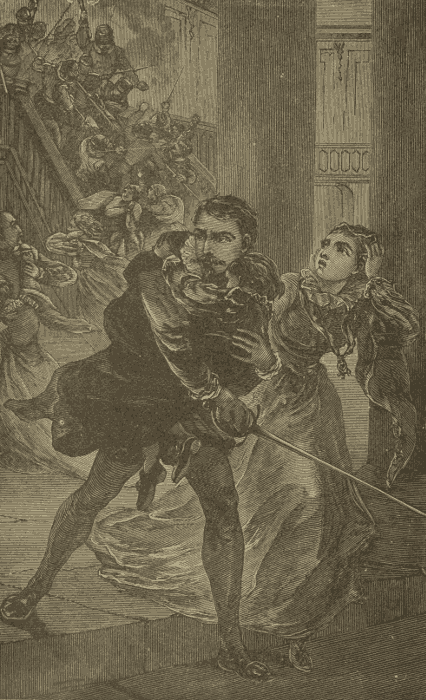
St. Bartholomew Massacre.
[pg 037]
3. The period of tribulation was shortened for the elect's sake. This cannot refer to the Jews, for their house had been pronounced desolate. They were left of God in their hardness of heart and blindness of mind. Says Paul, “Lo, we turn to the Gentiles.” The elect were the followers of our Lord Jesus Christ. And where were they when tribulation was upon the Jews?—They had fled to the mountains. It is absurd, then, to say that the days of tribulation of the Jews in the city of Jerusalem, were shortened for the sake of the elect, who had fled from the place of tribulation. Moreover the tribulation that came upon Jerusalem was not restrained or modified, but continued until the city was destroyed and its people were given to the sword and to captivity.
4. The connection between verses 20 and 21 shows that the tribulation was to commence with those Christians who were to flee out of the city. “But pray ye that your flight be not in the winter, neither on the Sabbath-day; for then shall be great tribulation.” Our Lord here speaks of the tribulation which his people would suffer from the time of their flight onward. We follow them in their flight to the mountains, and then pass along down through the noted persecutions of the church of God under pagan Rome, and we see, indeed, tribulation. And when we come to the period of papal persecutions, we see them suffering the most cruel tortures, and dying the most dreadful deaths that wicked men and demons could inflict. This last period is especially noted in prophecy.
The prophet Daniel saw the papacy, its blasphemy, its ignorance, its work of death on the saints, and its duration as a persecuting power, under the symbol of the little horn.
[pg 038]
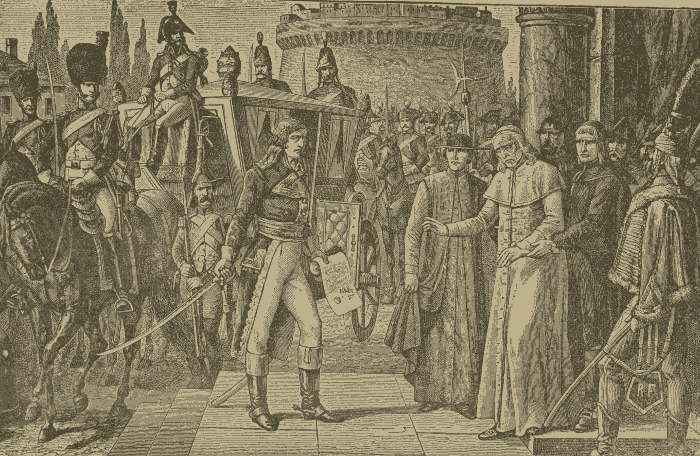
Taking the Pope Prisoner. 1798.
[pg 039]
“And he shall speak great words against the Most High, and shall wear out the saints of the Most High, and think to change times and laws; and they shall be given into his hand until a time and times and the dividing of time.” Dan. 7:25.
It is generally admitted that “a time and times and the dividing of time” is 1260 years. The proof of it may readily be seen by comparing Rev. 12:14, 6; 13:5, with the scripture just quoted. In these passages we learn that “time, times, and the dividing of time” is equivalent to a thousand two hundred and threescore days, which equals three and one half Biblical years, or “forty and two months.” Applying the scriptural rule of interpretation, a day for a year (Eze. 4:6), we have 1260 years.
This period is to cover the supremacy of the papacy. The beginning of it will be the point of the establishment of the power of the papacy. This was the year 538 a. d. Justinian, emperor of Rome, with his capital at Constantinople, espoused the cause of the bishop of Rome; and in 533 a. d. issued a decree which constituted that prelate head of all the churches. But the Arian Ostrogoths had possession of Rome, and it was not until they had been rooted up that the city was accessible to the bishop. This was accomplished in 538, by Belisarius, Justinian's celebrated general. For a concise and clear account of this occurrence we refer the reader to the “Two Republics,” by A. T. Jones, pp. 551-553.
Commencing the 1260 years a. d. 538, they reach to a. d. 1798, when Berthier, a French general, took possession of Rome. The pope was made a prisoner and carried with violence away from his palace and out of Italy. The papacy was stripped of its civil power. Here ended the days of tribulation spoken of by our Lord, which were—
[pg 040]