“And The Stars Shall Fall.”
Reading edition
How this sign can be fulfilled is a query with some people, who, perhaps captiously, remark that it would be impossible, since the earth itself is but a small body compared with many of the vast worlds of space. But all such queries are out of date now since the sign itself has already been witnessed. On the night of November 13, 1833, the grandest display of celestial fireworks ever beheld took place. From works of accepted authority we take the following descriptions of this remarkable event:—
“But the most sublime phenomenon of shooting stars, of which the world has furnished any record, was witnessed throughout the United States on the morning of the 13th of November, 1833. The entire extent of this astonishing exhibition has not been precisely ascertained; but it covered no inconsiderable portion of the earth's surface.... The first appearance was that of fireworks of the most imposing grandeur, covering the entire vault of heaven with myriads of fire-balls, resembling sky-rockets. Their coruscations were bright, gleaming, and incessant, and they fell thick as the flakes in the early snows of December. To the splendors of this celestial exhibition the most brilliant sky-rockets and fire-works of art bear less relation than the twinkling of the most tiny star to the broad glare of the sun. The whole heavens seemed in motion, and suggested to some the awful grandeur of the image employed in the Apocalypse, upon the opening of the sixth seal, when ‘the stars of heaven fell unto the earth, even [pg 051]as a fig-tree casteth her untimely figs, when she is shaken of a mighty wind.’ ”—Burritt's “Geography of the Heavens,” p. 163, ed. 1854.
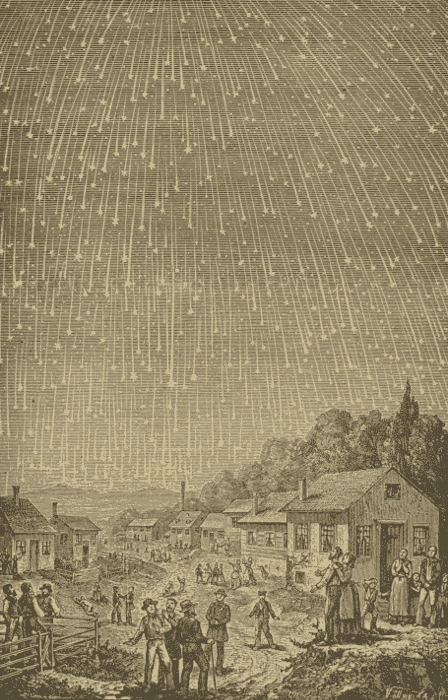
The Falling Stars.
A celebrated astronomer and meteorologist, says:—
“Those who were so fortunate as to witness the exhibition of shooting stars on the morning of Nov. 13, 1833, probably saw the greatest display of celestial fire-works that has ever been since the creation of the world, or at least within the annals covered by the pages of history.
“In nearly all places the meteors began to attract notice by their unusual frequency as early as eleven o'clock, and increased in numbers and splendor until about four o'clock, from which time they gradually declined, but were visible until lost in the light of day. The meteors did not fly at random over all parts of the sky, but appeared to emanate from a point in the constellation Leo, near a star called Gamma Leonis, in the bend of the Sickle....
“The extent of the shower of 1833 was such as to cover no inconsiderable part of the earth's surface, from the middle of the Atlantic on the east to the Pacific on the west; and from the northern coast of South America to undefined regions among the British possessions on the north, the exhibition was visible, and everywhere presented nearly the same appearance. This is no longer to be regarded as a terrestrial but a celestial phenomenon, and shooting stars are now to be no more viewed as casual productions of the upper regions of the atmosphere, but as visitants from other worlds, or from the planetary voids.”—Prof. Olmstead, of Yale College.
“No philosopher or scholar has told or recorded an event, I suppose, like that of yesterday morning. A prophet 1800 years ago foretold it exactly, if we will be at the trouble of understanding stars falling to mean falling stars; or ‘hoi asteres tou ouranou epesan eis teen geen,’in the only sense in which it is possible to be literally true.”—Henry Dana Ward, in Journal of Commerce, Nov. 14, 1833.
Not only here in Matthew 24 is attention directed to these signs as premonitory of the coming of Christ. The Lord through the prophet Joel says:—
“The sun shall be turned into darkness, and the moon into blood, before the great and the terrible day of the Lord come.”
[pg 053]
Under the sixth seal, as given in Rev. 6:12-17, we have the following language:—
“And I beheld when he had opened the sixth seal, and, lo, there was a great earthquake; and the sun became black as sackcloth of hair, and the moon became as blood; and the stars of heaven fell unto the earth even as a fig tree casteth her untimely figs when she is shaken of a mighty wind. And the heaven departed as a scroll when it is rolled together; and every mountain and island were moved out of their places.”
That the fourth and fifth seals apply to the papal persecution there can be no reasonable doubt. If so, then the great earthquake with which the sixth seal opens would be that of Lisbon, in 1755, which agitated the greater part of the earth and destroyed many thousands of lives, 60,000 in Lisbon alone.
The darkening of the sun and moon follows in 1780, and the falling of the stars in 1833. Consequently the next event which we are to expect under this seal is the departing of the heavens as a scroll. This being future, we may say that we are living between the thirteenth and fourteenth verses of Revelation 6.
In the gospel as written by Luke, however, we have at this point some additional specifications given, which are of such interest at the present juncture. And they rightfully belong to this exposition, since both Matthew and Luke are giving versions of the same discourse. The passage from Luke to which reference is made is the following:—
“And there shall be signs in the sun, and in the moon, and in the stars; and upon the earth distress of nations, with perplexity; the sea and the waves roaring; men's hearts failing them for fear, and for looking after those things which are coming on the earth: for the powers of heaven shall be shaken.” Luke 21:25-27.
[pg 054]
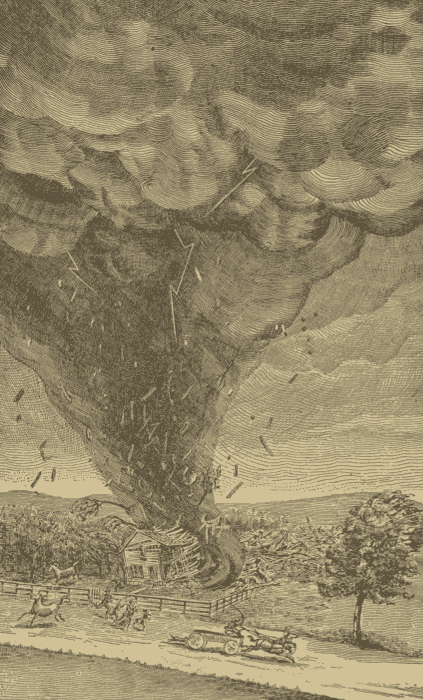
Modern Cyclone.
[pg 055]
The signs in the sun, moon, and stars are here spoken of less specifically than by Matthew, while other features of the times, which Matthew does not notice, are introduced between those signs and the shaking of the powers of heaven. These are of peculiar interest to us because we are living in the very days when the things that Luke speaks of are coming to pass. The signs here predicted consist of violent commotions upon earth which cause anxiety, perplexity, and distress among nations and in the hearts of men. We may refer the expression, “the sea and the waves roaring,” to unusual disturbances of the natural elements, and we have the most abundant evidences of its fulfillment in the storms and convulsions of nature that are occurring by sea and land, filling the heart with dread at the sight of every dark cloud that arises. The tidal waves and volcanic upheavals at sea have, in the last two or three decades, been marked with extraordinary violence. On land, cyclones and earthquakes have carried on a fearful work of destruction. Many instances might be cited to substantiate this statement, but the events are too familiar to require it. Hardly a week passes but some great calamity of this kind is recorded.
But the expression referred to is probably susceptible of another application in which it will be found to be as forcible and pertinent to the present state of affairs as in the one just noticed. This would be to give the term “sea and waves” its symbolic meaning. The prophet of old said: “And behold the four winds of heaven strove upon the great sea.” Dan. 7:2. We are told that the sea represents “peoples, and multitudes, and nations, and tongues.” Rev. 17:15. Taking the words in this sense, the meaning and fulfillment are still as apparent as before; and the expression joins its force to that of the remainder of the passage—“upon the earth distress of nations, with perplexity; [pg 057] the sea and the waves roaring; men's hearts failing them for fear and for looking after those things which are coming on the earth.” In this sense the expression in question would indicate commotion and violent disturbance in the social and political world. In this meaning all will at once see the vivid force of the text as applied to our times.
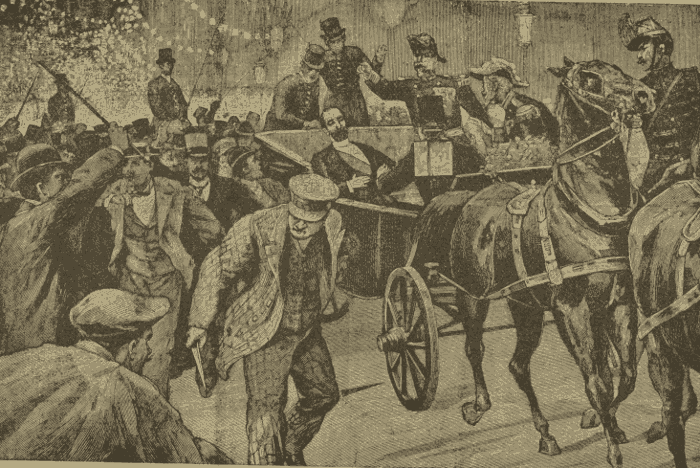
Assassination of Carnot.
The times we live in are anomalous to any that have ever preceded us. For some years there have been universal and active preparations for war, and almost universal peace. To secure the greatest efficiency of armed forces for defensive and offensive purposes, has been the prime consideration of government, especially so, as far as the Old World nations are concerned. Europe echoes to the tread of vast hosts of war while the nations are driven to their wits' end to provide for their support. It is well known that these costly preparations are not for show; and the hearts of men quail in view of the culmination which, though delayed, must soon be reached.
But while the temple of Janus is closed as far as international strife is concerned, and angel hands are holding the winds of war (see Rev. 7:1-3), internal strife and dissension are rending the vitals of the great nations of earth. Within the confines of its own border, each of these nations is cherishing elements of the deadliest nature. Trouble is brewing that has for the people far more terror than foreign complications. For some time the ominous mutterings of an oncoming storm have been heard in every land, and it requires no remarkable acumen to discern the rapid approach of the crisis.
The apostle James strikes directly at the matter in a prophetic glance and exhortation in the following language:—
[pg 058]
“Go to now, ye rich men, weep and howl for your miseries that shall come upon you. Your riches are corrupted, and your garments are moth-eaten. Your gold and silver is cankered; and the rust of them shall be a witness against you, and shall eat your flesh as it were fire. Ye have heaped treasure together for the last days. Behold, the hire of the laborers who have reaped down your fields, which is of you kept back by fraud, crieth; and the cries of them which have reaped are entered into the ears of the Lord of Sabaoth. Ye have lived in pleasure on the earth, and been wanton; ye have nourished your hearts, as in a day of slaughter. Ye have condemned and killed the just; and he doth not resist you.” James 5:1-6.
The apostle locates the circumstances he here refers to in the last days. He denounces the rich men who have heaped together treasures, the rust and canker of which will be a witness against them. They live in pleasure and wantonness while the cries of those whose wages they have kept back enter into the ears of the Lord of Hosts.
There is a universal cry of hard times in all the world. It is hard to obtain money; and yet, there never was so much money as at present. But it is being collected—gathered in heaps—by the powerful few, while the limited means of the masses are dwindling lower and lower. The poorer classes witness the absorption of wealth by the money-kings, with feelings that are being aroused to the point of desperation by the sense of their inability to secure what seems to them a more equitable distribution of the things of this world. The laborers cry, and God hears their cry.
That these things are taking place to-day as the most prominent feature of our social life no one will for a moment deny. Such colossal fortunes the world has heretofore at most but dreamed of. There are men living to-day who have risen in wealth from obscure stations to become lords [pg 059] of untold millions. Their wealth passes the bounds of just computation, for it includes the power of oppression by which it may be indefinitely increased. The lavish expenditure of these means for selfish pleasure often amounts to wantonness.
Well then, what is to be done? It is a difficult and delicate matter to frame and secure legislation by which this or any other class of men shall be deprived of the management of their own business as long as that business is legitimate and is legitimately conducted. Shall anarchy and violence be resorted to? Shall the laborer seize the torch and the weapons of death? Shall the country be devastated by strikes, strife, and civil war? Shall our communities be rent with murder, arson, treason, and intense personal hatred and enmity? No one possessing the natural instincts of humanity could contemplate such a condition of affairs except with horror. There are ghouls of society who gloat in blood; but such are not true citizens, they are not neighbors, they certainly are not Christians.
But what shall we do as citizens, neighbors, and Christians? This is a question of great importance just now. Inspiration long ago foresaw our situation. The pitying Saviour long since anticipated the sufferings that are to come upon this generation; and having, through his servant, outlined the present condition of affairs so closely, he certainly would not leave his followers uninformed as to the course he would have them pursue. We have to read only two verses farther in James's letter to find the counsel we need.
“Be patient therefore, brethren, unto the coming of the Lord. Behold, the husbandman waiteth for the precious fruit of the earth, and hath long patience for it, until he receive the early and latter rain. Be ye [pg 061]also patient; stablish your hearts; for the coming of the Lord draweth nigh.” James 5:7, 8.
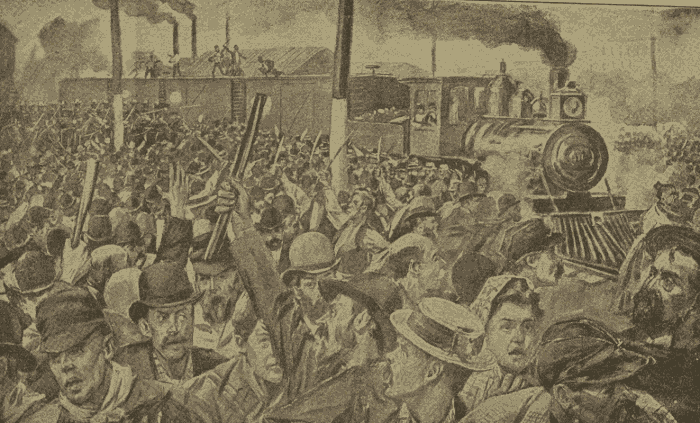
Chicago Riot.
Oppression and revolt, combination and intrigue, strife and bloodshed, never will cease until the supreme selfishness, which in the absence of divine grace controls all men, gives place to true philanthropy, and a brotherhood that is not outlined by class or sectional interests. This happy time is coming. When Jesus comes, he will take to himself his power and reign in righteousness. Then will the hills be brought low, the valleys exalted, the crooked be made straight, and the rough places smooth.
Those who are weary of strife, those who through misfortune or oppression have been made to feel their need of relief will find rest to their souls in looking for the coming of the Lord. It is vain to match evil with evil or to try to cure wrong with wrong. The gospel of Christ is the only remedy for these ills. And all that we can really do to counteract the annoyances of this life must be done through the gospel of peace. In this time of perplexity, distress, and fear, let every Christian hold up Christ. Let his patient suffering be exemplified in whatever circumstances may come. Just a little beyond, there is relief.
Strikes, boycotts, lock-outs, trusts, unions, or any other human device or demonstration only augments the trouble, as the experience of the past few years shows. For there never was so much of these things as now, and never was capital so insecure, business so uncertain, and labor in such distress as at present. The employment of arbitrary force provokes greater efforts on the opposite side, and thus the breach is widened and the strife becomes more bitter. We do not argue the merits or demerits of the case. That there is deep wrong involved, the fruits plainly show. It is our task only to point out the one remedy available alike to [pg 062] either and all. That remedy is the gospel of Christ, which is soon to close in a glorious triumph for those who have patiently and faithfully wrought his will.