PART SECOND (continued 5)
Henri Roberts translation
Warcolier was not annoyed, for he felt certain that he had angered the former minister, and he was delighted. It was a kick from an ass. The witticism of a fool.
Vaudrey regained his place, much dissatisfied at having come and furious at this pretentious imbecile, when, on leaving the wings, he ran against Lissac who was entering a sort of hall where Louis sat writing the names of the entrances on the sheet.
Guy flushed slightly on seeing him.
"In order to see you, one has to meet you here," said Sulpice. "Why have you not called on me? Is it because I am no longer a minister?"
"That would be a reason for seeing me more frequently," said Lissac. "But it is not that. What do you want me to tell you? You know my sentiments. I don't care to become a bore, as it is called, or a ceaseless prater of morality, which is the same thing. Besides, morality to me is something like the Montyon prize to a harlot! Then, too, I am keeping in my corner and I shall stick to it hereafter closer than ever. I have put the brake on. I am getting old, and I shall bury myself in some suburb and look after my rheumatism."
In Lissac's tone there was an unexpected melancholy.
"Then you will not call on me again?"
"What is the use of worrying you?—Reflect for yourself, my good man! You don't need me to emphasize your blunders. By the way, you know, our mad mistress?—She is in the theatre."
"I have seen her!" said Vaudrey, turning very pale.
"She is not yet a duchess, but that will be patched up in four days. If one were only a rascal, how one could punish the hussy! But what is the use? And this devilish Rosas, who is mad enough over her to tie himself to her and to overlook everything he ought to know, would be capable of marrying her all the same! Much good may it do him!"
"But, tell me," continued Lissac, whose cutting tone suddenly became serious, "have you read the paper?"
"No! What is there in it?"
They were then in the corridor of the Opéra, and heard the prelude to the curtain-raising. Guy took the Soir from his pocket and handed it to Vaudrey:
"Here, see!—That poor Ramel!—You were very fond of him, were you not?"
"Ramel!"
Vaudrey had no need to read. He knew everything as soon as Guy showed him the paper and mentioned Denis's name in a mournful tone.
Dead!—He died peacefully in his armchair near the window, as if falling asleep.—"The death is announced," so read the paragraph, "of one of the oldest members of the Parisian press, Monsieur Denis Ramel, who was formerly a celebrated man and for a long time directed the Nation Française, once an important journal, now no longer in existence."—Not a word beyond the brief details of his death. No word of praise or regret, merely the commonplace statement of a fact. Vaudrey thought it was a trifling notice for a man who had held so large a place in the public eye.
"What do you think of it?" he said to Lissac. "People are ungrateful."
"Why, what would you have? Why didn't he write operettas?"
They parted after exchanging almost an ordinary grasp of the hand, though, perhaps, somewhat sad. Sulpice wished to cast a last look at Rosas's box. Marianne was standing, her outline clearly defined against the brightly-lighted background of the box. She was holding a saucer in her hand, eating an ice. He saw her once more as she stood near the buffet at Madame Marsy's, stirring her sherbet, a silver-gilt spoon smoothly gliding over her tongue. He closed his eyes, and with a nervous start quickly descended the grand stairway, where he found himself alone.
In order to forget Marianne, he turned his thoughts to Ramel.
Denis had been suffering for a long time. He smiled as he felt the hour of his departure draw near. He wished to disappear without stir, and in a civil way as he said, without attracting attention, à l'Anglaise. Poor man! his wish was accomplished.
Vaudrey threw himself into a carriage and was driven to Batignolles. On the way he thought of the eternal antitheses of Parisian life: the news of the death of a friend communicated to him at the Opéra while a waltz-tune was being played!
And thinking to himself:
"From the Opéra to the Opéra! That, moreover, is the history of my ministry—and that of the Granet administration, probably!"
The portress at Rue Boursault led him to Denis Ramel's apartment. Lying on his bed with a kindly smile on his face, the old journalist seemed as if asleep. The cold majesty of death gave a look of power to his face. One might almost believe at times, from the scintillating light placed near his bony brow, that its rigid muscles moved.
Denis Ramel! the sure guide of his youth and his counsellor through life! He recalled his entry on public life, his arrival in Paris, the first articles brought into the old editorial rooms of the Nation Française! If for a moment he had been one of the heads of the State, it was due to the man stretched out before him now!
He gently stooped over the corpse and pressed a farewell kiss on the dead man's brow.
As he turned round, he saw a man whom he had not at first seen and who had risen.
The man was very pale and greeted him with a timid air.
Vaudrey recognized Garnier, the man whom he had seen previously at Ramel's, a cough-racked, patient, dying man.
The consumptive had nevertheless outlived the old man.
"It is good of you to have come, monsieur," said the workman. "He loved you dearly."
"He died suddenly then?"
"Yes, and quite alone, while reading a book. He was found thus. They thought he was sleeping. It is all over, he is to be buried to-morrow. Will you come, monsieur?—I did not know who you were when—you know—I said—In fact, it is kind—let us say no more about it—I beg your pardon—There will be a vast gathering at Denis Ramel's funeral, if there are present only a quarter of those whom he has obliged."
Vaudrey was heartbroken the next day. Behind Ramel's coffin, not a person followed. Himself, Garnier, and one or two old women from the house on Rue Boursault, who did not go all the way to the cemetery of Saint-Ouen because it was too far, were all that were present. At the grave Sulpice Vaudrey stood alone with the grave-digger and the workman Garnier. They buried Ramel in a newly-opened part close to the foot of a railway embankment.
For years Ramel had been forgotten, had even forgotten himself, he had let ambitious men pass beyond him, ingrates succeed and selfish men get to the top! He no longer existed! And those very men who had entreated him and called him dear master in the old days, soliciting and flattering him, now no longer knew his name. Had he disappeared, or did he still live, that forerunner, a sort of Japanese idol, an ancient, a useless being who had known neither how to make his fortune nor his position, while building up that of others? Nobody knew or cared. Occasionally when circumstances called for it, they laughed at this romantic figure in politics, living like a porter, poor, lost, and buried under a mass of unknown individuals, after having made ministers and unmade governments. Yet, at the news of his death, not one of those who were indebted to him for everything, not a single politician who was well in the saddle, and for whom he had held the stirrup, not a comedian of the Chambers or the theatre who had pleaded with him, urged and flattered him, was to be found there to pay the most ordinary respects of memory to the man who had disappeared. That fateful solitude, added to a keen winter's wind, appeared to Sulpice to be a cruel abandonment and an act of cowardice. Two men followed the cortége of that maker of men!
"Follow journalism and you make the fame of others," said Vaudrey, shaking his head.
"After all," answered Garnier, "there are dupes in every trade, and they are necessarily the most honest."
When this man, who had been a minister, left the grave above which the whistling trains passed, a freezing rain was falling and he passed out of the cemetery in the company of the poor devil who coughed so sadly within the collar of his overcoat that was tightly drawn up over his comforter.
Before leaving him, Vaudrey, with a feeling of timidity, desired to ask him if work was at least fairly good.
"Thanks!" replied Garnier. "I have found a situation—And then—" he shook his head as he pointed out behind the black trees and the white graves, the spot where they had lowered Ramel—"One has always a place when all is over, and that perhaps is the best of all!"
He bowed and Vaudrey left in a gloomy mood. It seemed to him that his life was crumbling away, that he was sowing, shred by shred, his flesh on the road. The black hangings of Ramel's coffin—and he smiled sadly at this new irony—recalled to him the bills of the upholsterers that he still owed for the furnishing of that fête at the ministry on the last day of his power and his happiness. The official decorations of Belloir and the Gobelins were not sufficient for him. He had desired more modern decorations. He gave the coachman the upholsterer's address, Boulevard des Capucins. He hardly dared to enter and say: "I have come to pay the account of the furnishing supplied at the ministry!" It still seemed like a funeral bill he was paying. This upholsterer's account, paid for forgotten display, seemed to him a sort of mortuary transaction.
When he paid the upholsterer, the latter seemed to wear a cunning smile.
On finding himself again outside, he felt a sensation of relief; being cold, he was inclined to walk with a view to warming his chill blood.
On hearing his name spoken by some one, he turned round and perceived before him his compatriot Jéliotte, the friend of his childhood, the comrade, who, with a smile, cordially extended his hands toward him.
"I told you that you would always find me when I should not appear before you as a courtier! Well, then, here I am," said Jéliotte. "Now you may see me as much as you please!"
"Ah!" said Vaudrey.
Jéliotte took his arm.
"Probably you are going to the Chamber?"
"Yes, exactly."
"Well, I will accompany you!—Ah, since you are no longer minister, my dear friend, and that one does not appear to be a flatterer or a seeker of patronage, one can speak to you—You have faults enough!—You are too confident, too moderate—It is necessary to have a firm hand—And then that could not last. Those situations are all very fine but they are too easily destroyed!—They are like glass, my old friend!—A place is wanted for everybody, is it not?—Bah! must I tell you?—Why, you are happier! I like you better as it is!"
Vaudrey felt strongly inclined to shake off this pretentious ninny who was clinging to his arm.
"That is like me!" continued Jéliotte. "I like my friends better when they are down! What would you have? It is my generous nature. By the way, do you know that the reason I have not seen you before is because I have not been in Paris! I have returned from Isère!"
"Ah!" said Vaudrey, thinking of Adrienne.
"Well, you know, I have still some good news for you. If you have had enough of politics, you can retire at the approaching election!"
"How?" asked Sulpice.
"Why, Thibaudier is stirring up Grenoble. He has got the whole city with him. He is very much liked and is a model mayor. He is a very mère—mother—that mayor!—Jéliotte laughed heartily, believing that he was funny.—If there is a list balloted for, and there certainly will be, Thibaudier will head the list. If they had maintained the scrutin d'arrondissement, he would have been capable of passing muster, all the same!"
"Against me?"
"Against you. Thibaudier is very popular!—And as firm as a rock!—He thinks you moderate, too moderate, as everybody else does!"
"He?—He was a member of the Plebiscite Committee under the Empire!"
"Exactly! He is an extreme Republican, just as he was an extreme Bonapartist. Oh! Thibaudier is a man, there is no concession with him. Never! He is always the same. He will beat you. Moreover, in Isère, they want a homogeneous representation—"
"Again!" said Vaudrey, who felt that he was pursued by this word.
After all, what did Thibaudier matter to him, or the deputation, the election or politics? Denis Ramel had sounded its depths in his grave in the cemetery of Saint-Ouen.
"Let us drop Thibaudier. By the way," said Jéliotte, "I saw your wife at Grenoble."
Vaudrey grew pale.
He again repeated: "Ah!"
"She is greatly changed. She doesn't leave the house of her uncle, the doctor, nor does she receive any one."
"Is she sick, then?"
"Yes, slightly."
"And you are separated, then?"
"No," replied Sulpice.
Jéliotte smiled.
"Ah! joker, I understand!—Your wife was too strict!—Bless me, a provincial! Bah! that will come right! And if it doesn't, why, you will be free, that's all! But, say, then, if you are not re-elected, you will rejoin her at Grenoble. Oh! your clients will return to you. You are highly esteemed as an advocate, but as a minister, I ought to say—"
"I shall be re-elected," said Vaudrey, in a decisive tone, so as to cut short Jéliotte's interminable phrases.
He was exceedingly unnerved. This man's stupidity would exasperate him. He would never come across any but subjects of irritation or disheartenment. He felt inclined to seek a quarrel with some one. He would have liked to wrench Marianne's wrist with his fingers.
As he entered the hall leading to the assembly, he unwittingly stumbled against a gentleman who was walking rapidly and without saluting him, although he thought that he recognized him.
"Yet I know him!"
He had not gone three steps before he perfectly recalled this eternal lobbyist, always bending before him and clinging to the armchairs of the antechambers, like an oyster to a rock, and whom the messengers, accustomed to his soliciting, bowing and scraping for years past, called Monsieur Eugène—out of courtesy.
It was too much! And, in truth, this strange fellow's impoliteness was ill-timed.
Sulpice suddenly turned round, approached Renaudin, and said to him sharply:
"You bowed more obsequiously to me a short time since, monsieur! It seems to me that you were in the ministerial antechambers every morning!"
He expected a haughty reply from Renaudin, and that this man would have compensated him for the others.
Monsieur Eugène smiled as he answered:
"Why, I am still there, monsieur!"
Vaudrey looked at him with a stupefied air, then in an outburst of anger, as if he conveyed in the reply that he hurled at this contemptible fellow, all the projects of his future revenge upon the fools, the knaves, the dull valets and the ungrateful horde, he said, boldly:
"Well, you will salute me again, for I shall return there."
He turned on his heels away from this worthless fellow, and entered the Chamber.
He heard an outburst of bravos; a perfect tempest of enthusiasm reached him. He looked on and bit his lips.
Lucien Granet was in the tribune, and the majority were applauding him.
IX
Marianne Kayser had the good taste, and perhaps the good sense not to desire a solemnized marriage. It mattered little to her if she entered her duchy surreptitiously, provided she was sovereign there. She would have time later to assume a lofty air under her ducal coronet; meanwhile, she would act with humility while wearing the wreath of orange blossoms. She had discharged Jean and Justine with considerable presents, thinking it undesirable to keep any longer about her people who knew Vaudrey. She had advised Justine to marry Jean.
"Marriage is amusing!" she had said.
"Madame is very kind," answered Justine, "but she sees, herself, that it is better to wait sometimes. There is no hurry, one does not know what may happen."
The future duchess showed that she was but little flattered by the girl's reflections. It was scarcely worth while not to put on airs even with servants, to meet such fools who become over-familiar with you immediately. So, in future, she would strive to be not such a kind-hearted girl. She would keep servants at a distance. They would see. Meanwhile, she was delighted to have made a clean sweep in the house, she could now lie to Rosas as much as she pleased.
Besides, the duke, who was madly in love and whose desire was daily whetted by Marianne, would have been capable, as Lissac said, of accepting everything and forgetting all, so that he might clasp the woman in his arms. She held him entirely in her grasp, under the domination of her intoxicating seductiveness, skilfully granting by a kiss that kindled the blood in José's veins the promise of more ardent caresses. In this very exercise, she assumed a passionate tenderness like a courtesan accustomed to easy defeat who resists her very disposition so that she may not be too soon vanquished. She had ungovernable impulses that carried her toward Rosas as to an unknown pleasure.
The ivory-like pallor of this red-haired man with sunken eyes and trembling lips, almost cold when she sought them under his tawny moustache, pleased her. She sometimes said to him that under his gentle manner he had the appearance of a tiger. "Or of a cat, and that pleases me, for I am myself of that nature. Ah! how I love you!" She felt herself tremble with fear of that being whom she felt that she had conquered and who was entirely hers, but she was strangely troubled in divining some of his secret thoughts.
She was in a hurry to have the marriage concluded. Secretly if it were desired, but legally and positively. She dreaded José's reawakening, as it were. She did not know how, perhaps an anonymous letter, a chance meeting with Guy, an explanation, who knows?
"Although, after all," she thought, "I have been foolish to trouble myself about this Guy. Word threats, that's all!"
The duke had treated her as a virtuous girl, requiring her to declare that she had never loved any but him, or that, at least, no living person had the right to say that he had possessed her. She had sworn all that he desired, saying to Uncle Kayser: "Oaths like that are like political promises, they bind one to nothing!"
The uncle began to entertain an extravagant admiration for his "little Marianne." There is a woman, sure enough! Wonderful elegance! She had promised to have a studio built for him, in which he could, instead of painting, take his ease, stretched on a divan, smoking his pipe, and pass his days in floating to the ceiling his theories of high and moral art! An ideal picture!
He also was in favor of prompt action in respect to the marriage. As little noise as possible. The least hitch and all was lost. What a pity!
"Do you wish me to tell you? It seems to me that you are walking to the mayor's office on eggs!"
"Be easy," Marianne replied, laughing heartily, "there will be none broken."
The marriage was celebrated. At last! as Kayser said. It was a formality rather than a ceremony. Marianne, ravishingly beautiful, was exultant at realizing her dream. Her pale complexion took on tints of the bloom of the azalea pierced by the rays of the sun. Never had Rosas seen her so lovely. How stupidly he had acted formerly in yielding to appearances and flying from her, instead of telling her that he loved her. He had lost whole years of love that he would never recover, even in the blissful fever of this union. Those joys, formerly disdained, were, alas! never to be restored.
Ah! how he would love her now, adore her and keep her with him as his living delight! They would travel; in three days they would set out for Italy. The baggage already filled the house in the Avenue Montaigne, their nuptial mansion. Marianne would take away all the souvenirs that she had preserved in the grisette's little room at Rue Cuvier, where Rosas had so often seen her and where he had said to her: "I love you!"
"People took their pénates," she said, "but I take my fetishes!"
Rosas was wild with joy. The possession of this woman, sought after as mistress, but more intensely ardent than a mistress, with her outbursts of tears and kisses, threw him into ecstasies and possessed him with distracting joy. Something within him whispered, as in the days of early manhood, at the ecstatic hour of sunrise. Already he wished to be on the way to Italy with Marianne, far from the mire and mists of Paris.
"These rain-soaked sidewalks on which the gaslight is reflected seem gloomy to me," he said. "Let us seek the blue skies, Marianne, the orange groves of Nice, the stars of Naples."
She smiled.
"The blue again!" she thought. "They all desire it, then?"
She desired to remain a few days longer in Paris, delighted to proclaim her new name in its streets, its Bois and its theatres, where she had been known in her sadness, displaying her desperate melancholy. It seemed to her that, in her present triumph, she crushed both men and things. What was Naples to her? She had not miserably dragged her disillusions and her angers along the Chiaja. Florence might take her for a duchess, as well as any other, but Paris, every corner of which was familiar to her, and where every scene had been, as it were, a frame for her follies, her hopes, her failures, her heartbreaks, her deceptions, all her sorrows of an ambitious woman, which had made her the daring woman that she was,—those boulevards, those paths about the Lake, those proscenium boxes at the theatre, she would see them in her triumph, as she had seen them in her untrammelled follies or in the moments of her ruin and abandonment.
"Two days more! One day more," she said. "After the first representation at the Variétés, we will leave, are you willing?"
"Ah! you Parisienne! Hungry Parisienne!" José replied.
She looked at him with her gray eyes sparkling, and smiling.
"The Variétés?—Don't you know the old rondel?—The one you hummed when you were sick, you know?—It seems to me that I can hear it yet:
Do you see yonder That white house, Where every Sunday Under the sweet lilacs—"
Uncle Kayser, ever prudent, advised a speedy departure. He feared he scarcely knew what. He feared everything, "like Abner, and feared only that." Every morning he dreaded seeing some indiscreet articles in the papers respecting the Duke and the Duchesse de Rosas.
"These journalists disregard, without scruple, the wall of private life! It is a moral wall, however!"
At last, they would leave in two days, so it was determined. Rosas had wished to see Guy again for the last time. At Rue d'Aumale they informed him that Monsieur de Lissac was travelling. The shutters of the apartment were not, however, closed. The duke had for a moment been tempted to insist on entering; then he withdrew and returned home without analyzing too closely the feeling of annoyance that came over him. The weather was splendid and dry. He returned on foot to Avenue Montaigne, where he expected to find Marianne superintending her trunks.
On entering the house, the doors of which were open, as at the hour of packing and removing, giving the whole house the appearance of neglect and flight, he was astonished to hear a man's voice, which was neither that of Simon Kayser nor that of the valet, and evidently answering in a violent tone the equally evident angry voice of Marianne.
He did not know this voice, and the noise of a bell-rope hastily pulled, in a fit of manifest anger, made him quicken his steps, as if he instinctively felt that the duchess was in danger.
In the shadow of a dull December evening, the house, with its disordered appearance that resembled a sacking, assumed a sinister aspect. José suddenly felt a sentiment of anguish.
He quickly reached the salon, where Marianne was in a robe de chambre of black satin, and was standing near the chimney with an expression of anger in her eyes, holding the bell-rope, whose iron chain had struck against the wall.
Before her stood a young man with a heavy moustache, his hat tilted over his ear, whom Monsieur de Rosas did not know.
His manner was insolent and he looked thick-set in his black, close-buttoned frock-coat. His style was vulgar, and, with his hands in his pockets, he appeared both low and threatening.
Marianne rang for a servant. She was flushed with rage. She became livid on seeing José.
"What is the matter, then?" asked Rosas coldly, as he stepped between the duchess and the man.
The man looked at him, took off his hat, and in a loud voice that was itself odoriferous, said:
"You are Monsieur le Duc de Rosas, doubtless?"
"Yes," said José, "and may I know—?"
"Nothing! it is nothing!" cried Marianne, running hastily to José and taking his hands as if she desired to drag him away.
"How, nothing?" the man then said, as he took a seat, holding his hat in his hand and placing his fist on his left hip, in the attitude of a fencing-master posing for an elegant effect. "To treat a gentleman as you have just treated me; you call that nothing?"
He turned to Rosas and said, as he saluted him with the airs of a sub. off. on the stage:
"Adolphe Gochard! You do not know me, Monsieur le duc?"
"No," said José.
"What do you want?—"
"Ah! pardon me," said Gochard, as he interrupted Marianne. "You rang, you wished to have the presence of the servants. You threatened to have me pitched out of the door by the shoulders. Since you have called, they shall hear me."
The servants, hurrying to the spot, now appeared in the indistinct shadow of the doorway.
"Be off!" cried Marianne.
"Why?" asked the duke severely, and astonished.
"Because madame prefers that I should only tell you what I have to say to you," said Gochard. "Ah! you claimed that I wanted to extort blackmail. I, an old brigadier, extort blackmail? Well, so let it be! Let us sing our little song!"
"Monsieur," said the duke, who had become pallid and whose clenched teeth showed beneath his red beard, "I do not know what Madame la Duchesse de Rosas has said to you, or what you have dared to say to her, but you will leave this place instanter!"
"Is that so?" said the man, as he shrugged his shoulders, which were like those of a suburban bully.
"Just so!"
"That would surprise me!" said Gochard. "But, saperlipopette, you are not very polite in your set!"
"Not very polite with boors! You are in my house!"
"Oh! you can't teach me where I am!" said the Dujarrier's lover, with a wink of his eye. "But, madame has been perching at my cost for a long time at Rue Prony and it is upon my signature, yes, my own signature, if you please, that she has obtained the means of renting the Hôtel Vanda. She has not so much to be impudent about!"
"Your signature?—The Hôtel Vanda?"
The duke looked at Marianne, who, as white as a corpse, instead of becoming indignant, entreated and tried to lead her husband away from this man, as if they were in the presence of grave danger.
"Ah! bless me!" cried José, "you will explain to me—!"
"That is very easy!—I was in want of money. The Dujarrier furnished me with a little for that affair. She is too niggardly. I ask madame for some. She assumes a haughty tone, and, instead of comprehending that I come as a friend, she threatens to have me put out of doors. Blackmail! I?—I?—What nonsense!"
A friend! This man dared to say before her who bore the name of Duchesse de Rosas that he came to her as an intimate. This alcoholic braggart had assisted Marianne in sub-renting, he knew not what hôtel, from a wanton!—Rue Prony!—Vanda!—What was there in common between these names and that of the duchess? And the Dujarrier, that Dujarrier whose manner of living was known to the Castilian, how had she become associated with Marianne's life?
Ah! since he had commenced, this Gochard would make an end of it. He would tell everything! Even if he did not wish it, he would speak now. Rosas, frightened himself, and terrified at the prospect of some unknown baseness and doubtful transaction, felt Marianne's hand tremble in his, and by degrees, as Gochard proceeded, the duke realized that Marianne wished to get away and it was he who now retained her; holding the young woman's wrist tightly within his fingers, he forcibly prevented her from escaping, insisting that she should listen and hear everything.
"Ah! if you think that I am afraid of speaking," said Gochard, "you will soon see!"
And then with a sort of swaggering air like that of a fencing-master or tippler, searching for some droll expressions, cowardly avenging himself by jests ejected like so many streams of tobacco, against this woman who had just insulted him, who spoke of blackmail and the police, and of thrusting the miserable fellow out of doors, he told everything that he knew; Marianne's neediness, her weariness, her loves, the Dujarrier connection, the renting of the Hôtel Vanda, the Vaudrey paper and its renewals, his own foolishness as a too artless and tender, good sort of fellow, relying on Claire Dujarrier's word, and not reserving to himself so much per cent in the affair!
Rosas listened open-mouthed, his ears tingling and his blood rushing to his temples, while he sunk his fingers into Marianne's arms, she, meanwhile, glaring at Gochard.
When he had finished, she disengaged herself from Rosas's clutch by an extreme effort, and ran to the rascal and spat in his face.
He lifted his hand to her and said:
"Ah! but!—"
"Begone!" said the duke. "You wish to be paid?"
"The money is not all. I demand respect!" replied Gochard, as he wiped his cheek.
He placed his card on the mantelpiece.
"Adolphe Gochard! there is my address. Besides, Madame knows it. With the pistol, the sabre, or the espadon, as you please! I am afraid of no one."
"You will be paid, you have been told, you shall be paid!" cried Marianne, absolutely crazy and ready to tear him with her nails. "Be off! ruffian! begone, thief!"
"Fiddle-faddle!" replied Adolphe, as he replaced his hat on the side of his bald head. "I have said what I have to say. I do not like to be made a fool of!"
He disappeared, waddling away like a strolling player uncertain of his exit.
Rosas did not even see him go.
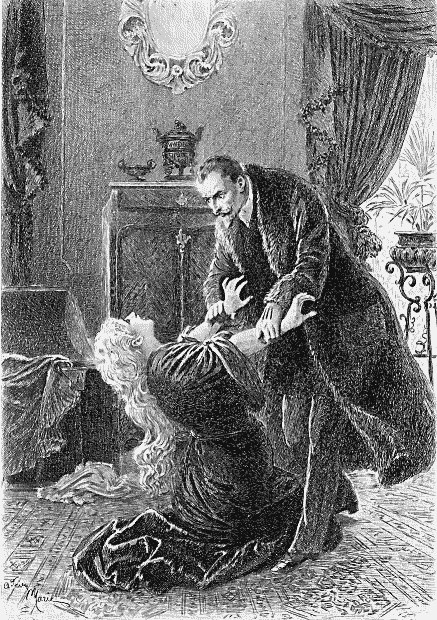
He had seized Marianne by both hands and was dragging her toward the window, through which the daylight still entered, and convulsed with rage he penetrated her eyes with his glance, his face looking still more pallid, in contrast with his red beard.
She was terrified. She believed herself at the point of death. She felt that he was going to kill her.
She suddenly fell on her knees.
He still looked at her, leaning over her with the appearance of a madman.
"Vaudrey?—Vaudrey? The man whom I saw at your uncle's?—The man whom I have elbowed with you?—Vaudrey?—This man was your lover, then?"
She was so alarmed that she did not reply.
"You have lied to me, then? But, tell me, wretched woman, have you not lied to me?"
"I loved you and I desired you!" said Marianne.
"Nonsense!" said Rosas, in a strident, deep-chested voice. "You wanted what that rascal wanted: money! You should have asked me for it! I would have given you everything, all my fortune, all! But not my name! Not my name!"
He roughly repelled her.
She remained on her knees. Her hands hung down and rested on the carpet. She looked at it stupefied, hardly distinguishing its rose pattern.
She was certain that she was about to die. José's sudden anger had the fitfulness of a wild beast's. He crushed her with a terrible glance from his bloodshot eyes.
Then he began to laugh hysterically, like a young girl.
"Idiot! Idiot! Idiot!—In a wanton's house yonder in Rue Prony, at Vanda's! Vanda's! At Vanda's, in a harlot's bed, she gave herself, sold herself!—A Rosas, for she is a Rosas! A Duchesse de Rosas now! Idiot! Idiot that I am!"
Marianne would have spoken, entreated, but fear froze her, coming over her flesh and through her veins. She realized that an implacable resolution possessed this trusting man. She found a master this time.
"José!" said Marianne softly, in a timid voice.
He drew himself up as if the mention of this name were an insult.
"Come!" he said calmly, "so let it be. What is done, is done. So much the worse for the fools! But listen carefully."
This little, pale, blond man seemed, in the growing darkness, like a portrait of former days stepped forth from its frame.
His hand of steel again seized Marianne's wrists.
"You are called the Duchesse de Rosas?—You were ambitious for that name, you eagerly desired and struggled hard for that title, did you not? Well, I will not, at least, suffer you to drag it like so many others into intruders' salons, under ironical glances, before mocking smiles and lorgnettes, in view of the papers, and into the gossip of the Paris whose gutter-odor tempts you so strongly that you have not yet been able to leave it. Parbleu! you have another lover in it, I wager!—Vaudrey!—Or Lissac and many others!—Is it as I say?"
"I swear to you—"
"Ah! you have lied to me, do not swear! We are about to leave. Not for Italy. It is good for those who love each other. You do not know Fuentecarral?—You are about to make its acquaintance. It is your château now. Yours, yours, since you are a Rosas!"
He again broke into laughter, such as a judge might indulge in who should mock at a condemned man.
"We are about to leave for Toledo. You asked me, one day, about the castle in which I was born. It is a prison, simply a prison. It is habitable nevertheless. But when one enters it, one rarely leaves it. The device that you will bear is not very cheerful, but it is eloquent, you know it: Hasta la muerte!—"Until death!"—What do you say about it?—We shall be at Toledo in three days. There are Duchesses de Rosas who will look on you, as you pass, over their plaited collars, and as there were neither adulteresses nor courtesans among them, they will probably ask what the Parisian is doing among them. Well, I will answer them myself, that she is there to live out her life, you understand, there, face to face with me, as you have desired, as you said, and no one will have the right to sneer before the Duc de Rosas, who will see no one. Oh! yes, I know that I belong to another period! I am ridiculous, romantic!—I am just that!—You have awakened the half-Arab that lurks in the Castilian. So much the worse for you if you have made me remember that I am a Rosas!"
She remained there, thunderstruck, hearing the duke come and go, his heels ringing in spite of the muffling of the carpet, like the heels of an armed man.
At times, when he passed quite close to her, his attenuated shadow was cast at full length over her and she was filled with terror.
She experienced a feeling of fear, as if she were before an open tomb, or that a puff of damp air chilled her face, or that she was suddenly enveloped by the odor of a cellar. She shuddered and wished to plead with him, murmuring:
"Pity!—Pardon!—"
"Madame la duchesse," Rosas replied coldly, "I am one of those who may be deceived, no one is beyond the reach of treason; but I am not one of those who pardon. I have been extremely foolish, ridiculous, credulous! So much the worse for me! So much the worse for you! Rosas you are, Rosas you will be! I have been your victim, eh? Exactly, that is admitted: you shall be mine! Nothing could be juster, I think! I wish no scandal resulting from a lawsuit or the notoriety of one or more duels. I should become ridiculous in the eyes of others. But in my own and your eyes, I do not propose to be! I did not desire to be your lover, I have hardly been your husband. Now I am your companion forever. Hasta la muerte! For me, the cold of an Escurial has no terror. I am accustomed to it. If it makes you quake, whose fault is it? You willed it. A double suicide! We leave this evening!"
"This evening!" repeated Rosas, terribly, while Marianne, terrified, felt stifled under the crushing weight of that name: Duchesse de Rosas!
Simon Kayser came to dine. He was deeply moved when he learned that the housekeeping was upset.
What! the devilish duke knew all then?
And he has taken the matter up in a dramatic fashion?
"Folly!"
"It is a serious matter, all the same!" said the uncle, after debating with himself as to where he should dine. "He will break her heart as he said, immured yonder within his four walls!—Ah! it was hardly worth while to handle her affairs so cleverly for a Gochard to come on the scenes and spoil everything, the rascal! For myself, I pity the little Marianne!—Her plan of battle was excellently arranged, well disposed and admirably put together! It was superb! And it failed!—Come, it amounts to this in everything: it is said that the pursuit of a great art is to ply the trade of a dupe! Destiny lacks morality! We should perhaps be happier, both, if she were simply a cocotte and I engaged in photography!—But!" the brave fellow added: "one has lofty ideas, as-pi-ra-tions, or one has not!—One cannot remake one's self when one is an artist!"
Paris, 1880-1881.
Part Second Chapter IX
This little, pale, blond man seemed, in the growing darkness, like a portrait of former days stepped forth from its frame.
His hand of steel again seized Marianne's wrists.