PART FIRST (continued 4)
Henri Roberts translation
He thanked Ramel profusely and sincerely. This visit would not be his last, he would often return to this Rue Boursault where he knew that a true friend would be waiting.
"And you will be right," said Denis. "Nowhere will you find a love more profound, or hear truths more frankly spoken. You see, Vaudrey, the walls of the ministerial apartments are too thick. There, neither the noise of carriages nor the sound of street-cries is heard. I have passed a few days in a palace—in '48,—at the Tuileries, as a national guard: at the end of two hours, I heard nothing. The carpets, the curtains, stifled everything, and, believe me, a cannon might have been fired without my hearing anything more than an echo, much less could I hear the truth! Besides, people do not like to pronounce truth too loudly. They are afraid."
"I swear to you that I will listen to everything," replied Sulpice, "and I will strive to understand everything. And since I have the power—"
Denis Ramel shook his head:
"Power? Ah! you will see if that is ever taken in any but homoeopathic doses! Why, you will have against you the bureaux, those sacrosanct bureaux that have governed this country since bureaucracy has existed, and they will cram more than one Warcolier down your throat, I warn you."
"Yes, if I allow it," said Vaudrey haughtily.
"Eh! my poor friend, you have already allowed it," said the veteran.
He had risen, Vaudrey had taken his hat, and he said to the minister, leaning on his arm, with gentle familiarity, as he led him to the door:
"Power is like a kite, but there is always some rascal who holds the thread."
"Come, come," said Vaudrey, "you are a pessimist!"
"I confess that Schopenhauer is not unpleasant to me—sometimes."
Thereupon they separated, after a cordial grasp of the hand, and Denis Ramel resumed his pipe and his seat at the window corner, while the minister carried away from this interview, as if he had not already been in the habit of a frank interchange of opinions, an agreeable though perhaps anxious impression.
He felt the need of mentally digesting this conversation: the idea of going back, on this beautiful February day, to his official apartments did not enter his mind. He was overcome by a springtime hunger.
"To the Bois! Around the Lake!" he said to the coachman, as he re-entered his carriage.
The air was as balmy as on an afternoon in May. Vaudrey lowered the carriage window to breathe freely. This exterior boulevard that he rolled along was full of merry pedestrians. One would have thought it was a Sunday afternoon. Old people, sitting on benches, were enjoying the early sun.
Sulpice looked at them, his brain busy with Ramel's warnings. He had just called him a pessimist, but inwardly he acknowledged that the old stager, who had remained a philosopher, spoke the truth. Woman! Why had Ramel spoken to him of woman?
This half-disquieting thought speedily left Sulpice, attracted as he was by the joyous movement, the delight of the eyes which presented itself to his view.
In thus journeying to the Bois, he felt a delightful emotion of solitude and forgetfulness. He gradually recovered his self-possession and became himself once more. He drew his breath more freely in that long avenue where, at this hour of the day, few persons passed. There was no petition to listen to, no salutation to acknowledge.
Ah! how easy it would be to be happy, to sweetly enjoy the Paris that fascinated him instead of burning away his life! Just now, at the foot of the Arc de Triomphe, he had seen people dressed in blouses, sleeping like Andalusian beggars before the walls of the Alhambra. Little they cared for the fever of success! Perhaps they were wise.
An almost complete solitude reigned over the Bois. Vaudrey saw, as he glanced between the copsewood, now growing green, only a few isolated pedestrians, some English governesses in charge of scampering children, the dark green uniform of a guard or the blue blouse of a man who trimmed the trees.
The coachman drove slowly and Sulpice, enjoying the intoxication of this early sun, lowered the shade and breathed the keen air while he repeated to himself that peaceful joy was within the reach of everybody at Paris.
"But why is this wood so deserted? It is so pleasant here."
He almost reproached himself for not having brought Adrienne. She would have been so happy for this advanced spring day. She required so little to make her smile: mere crumbs of joy. She was better than he.
He excused himself by reflecting that he would not have been able to talk to Ramel.
And then it would have been necessary to talk to Adrienne, whereas the joy of the present moment was this solitary silence, the bath of warm air taken in the complete forgetfulness of the habitual existence.
The sight of the blue, gleaming lake before him, encircled with pines, like an artificial Swiss lake, compelled him to look out of the window.
The coachman slowly drove the carriage to the left in order to make the tour of the Lake.
Vaudrey looked at the sheet of water upon which the light played, and on which two or three skiffs glided noiselessly, even the sound of their oars not reaching his ears.
At the extremity of the alley, a carriage was standing, a hackney coach whose driver was peacefully sleeping in the sunshine, with his head leaning on his right shoulder, his broad-brimmed hat, bathed in the sunshine, serving him as a shade.
It was the only carriage there, and a few paces from the border of the water, standing out in dark relief against the violet-blue of the lake, a woman stood surrounded by a group of ducks of all shades, running after morsels of brown bread while uttering their hoarse cries.
Two white swans had remained in the water and looked at her with a dignified air, at a distance.
At the first glance at this woman, Sulpice felt a strange emotion. His legs trembled and his heart was agitated.
He could not be mistaken, he certainly recognized her. Either there was an extraordinary resemblance between them, or it was Mademoiselle Kayser herself.
Marianne? Marianne on the edge of this Lake at an hour when there was no one at the Bois? Vaudrey believed neither in superstitions nor in predestination. Nevertheless, he considered the meeting extraordinary, but there is in this fantastic life a reality that brings in our path the being about whom one has just been thinking. He had frequently observed this fact. He had already descended from his carriage to go to her, taking a little pathway under the furze in order to reach the water's edge. There was no longer any doubt, it was she. Evidently he was to meet Mademoiselle Kayser some day. But how could chance will that he should desire to take that promenade to the Lake at the very hour that the young woman had driven there?
As he advanced, he thought how surprised Marianne would be. As he walked along, he looked at her.
She stood near a kind of wooden landing jutting out over the water. Over her black dress she had flung a short cloak of satin, embroidered with jet which sparkled in the sunlight. The light wind gently waved a black feather that hung from her hat, in which other feathers were entwined with a fringe of old gold bullion. Vaudrey noted every detail of this living statuette of a Parisian woman: between a little veil knotted behind her head and the lace ruching of her cloak, light, golden curls fell on her neck, and in that frame of light, this elegant woman, this silhouette standing out in full relief against the sky and the horizon line of the water, with a pencil of rays gilding her fair locks, seemed more exquisite and more the "woman" to Sulpice than in the décolleté of a ball costume.
When she heard the crushing of the sand by Sulpice's footsteps as he approached her with timid haste, she turned abruptly. Under her small black veil, drawn tightly over her face, and whose dots looked like so many patches on her face, Vaudrey at first observed Marianne's almost sickly paleness, then her suddenly joyous glance. A furtive blush mounted even to the young girl's cheek.
"You here?" she said—"you, Monsieur le Ministre?"
She had already imparted an entirely different tone to these questions. There was more abandon in the first, which seemed more like a cry, but the second betrayed a sudden politeness, perhaps a little affected.
Vaudrey replied by some commonplace remark. It was a fine day; he was tired; he wished to warm himself in this early sunshine. But she?—
"Oh! I—really I don't know why I am here. Ask the—my coachman. He has driven me where he pleased."
She spoke in a curt, irritated tone, under which either deception or grief was hidden.
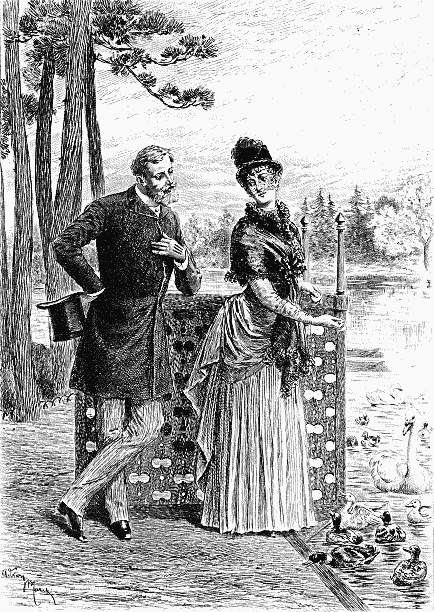
She was still mechanically throwing crumbs of bread around her, which were eagerly snatched at by the many-colored ducks, white or gray, black, spotted, striped like tulips, marbled like Cordovan leather, with iridescent green or blue necks, whose tone suggested Venetian glassware, all of them hurrying, stretching their necks, opening their bills, or casting themselves at Marianne's feet, fighting, then almost choking themselves to swallow the enormous pieces of bread that were sold by a dealer close at hand.
"Ah! bless me! I did not think I should have the honor of meeting you here," she said.
"The honor?" said Vaudrey. "I, I should say the joy."
She looked straight into his eyes, frankly.
"I do not know what joy is, to-day," she said. "I come from the Continental Hotel, where I hoped to see—"
"What is that?"
"Nothing—"
"If it were nothing, you would not have frowned so."
"Oh! well! a friend—a friend whom I have again found—and who has disappeared. Just so,—abruptly—No matter, perhaps, after all! What happens, must happen. In short—and to continue my riddle, behold me feeding these ducks. God knows why! I detest the creatures. The state feeds them badly, Monsieur le Ministre, I tell you: they are famished. Well? well?" she said to a species of Indian duck, bolder than the others, who snapped at the hem of her skirt to attract attention and to demand fresh mouthfuls.
She commenced to laugh nervously, and said:
"That one isn't afraid."
She threw him a morsel that he swallowed with a greedy gulp.
"Do you know, Monsieur le Ministre, that the story of these ducks is that of the human species? There are some that have got nothing of all the bread that I have thrown them, and there are others who have gorged enough to kill them with indigestion. How would you classify that? Poor political economy."
"Oh, oh!" said Vaudrey. "You are wandering into the realms of lofty philosophy!—"
"Apropos of that, yes," said Marianne, as she pointed to the line of birds that hurried on all sides, left the water, waddled about, uttering their noisy cries. "You know that when one is sad, one philosophizes anent everything."
"And you are sad?" asked Sulpice, in a voice that certainly quivered slightly.
She threw away, without breaking it, the piece of bread that was left, brushed her gloved fingers, and, turning toward the minister, said with a smile that would make the flesh creep:
"Very sad. Oh! what would you have? The black butterflies, you know, the blue devils."
He saw her again, just as she had appeared before him yesterday, with arms and shoulders bare, lovely and seductive, and now, with her shoulders hidden under her cloak, her face half-veiled and quite pale, he thought her still more disquietingly charming. Moreover, the strangeness of the situation, the chance meeting, imparted something of mystery to their conversation and the attraction of an assignation.
Ah! how happy he felt at having desired to breathe the air of the Bois! It now seemed to him that he had only come there for her sake. Once more it appeared to him that some magnetic thought led to this deserted spot these two beings, who but yesterday had only exchanged commonplace remarks and who, in this sunbathed solitude, under these trees, in the fresh breeze of the departing winter, met again, impelled toward each other, drawn on by the same sympathy.
"Do you know what I was thinking of?" she said, smiling graciously. "Yes, of what I was thinking as I cast the brown bread to those ducks? An idyll, is it not? Well! I was thinking that if one dared—a quick plunge into such a sheet of water—very pure—quite tempting—Eh! well! it would end all."
Vaudrey did not reply. He looked at her stupidly, his glance betraying the utmost anxiety.
"Oh! fear nothing," she said. "A whim! and besides, I can swim better than the swans, there is no danger."
He had seized her hands instinctively and he experienced a singular delight in feeling the flesh of Marianne's wrists under his fingers.
"You are feverish," he said.
"I should be, at any rate."
Her voice was still harsh, as if she were distressed.
"The departure of—of that friend—has, then, caused you much suffering?"
"Suffering? No. Vexation, yes—You have built many castles of cards in your life—Come! how stupid I am!" she said bitterly. "You still build many of them. Well! there it is, you see!"
She had withdrawn her hands from Sulpice, and walked away slowly from the border of the lake, going toward the end of the path where her coachman awaited her, his eyes closed and his mouth open.
"Where are you going on leaving the Bois?" asked Vaudrey.
"I? I don't know."
He had made a movement.
"Oh! once more I tell you, don't be afraid," she said. "I want to live. Fear nothing, I will go home, parbleu."
"Home?"
"Or to my uncle's."
"But, really, Monsieur le Ministre," she said, "you are taking upon yourself the affairs of Monsieur Jouvenet, your Prefect of Police. I know him well, and certainly he asks fewer questions than Your Excellency."
"That, perhaps," said Vaudrey, with a smile, "is because he has less anxiety about you than I have."
"Ah! bah!" said Marianne.
She had by this time got close to her hackney coach and looked at the coachman for a moment. "Don't you think it would be very wrong to waken him?" she said. "Will you accompany me for a moment, Monsieur le Ministre?"
Vaudrey paled slightly, divining under this question a seductive prospect.
Marianne's gray eyes were never turned from him.
They walked along slowly, followed by the coupé whose lengthened shadow was projected in front of them along the yellow pathway, moving beside the lake where the swans floated with their pure white wings extended and striking the water with their feet, raising all around them a white foam, like snow falling in flakes. The blue heavens were reflected in the water. The grass, of a burnt-green, almost gray color, looked like worn velvet here and there, showing the weft and spotted with earth.
Side by side they walked, Vaudrey earnestly watching Marianne, while she gazed about her and pointed out to him the gray, winter-worn rocks, the smooth ivy, and on the horizon some hinds browsing, in the far distance, as in a desert, the bare grass as yellow as ripe wheat, around a pond, in a gloomy landscape, russet horizons against a pale sky, presenting a forlorn, mysterious and fleeting aspect.
"One would think one's self at the end of the world," said Sulpice, with lowered voice and troubled heart.
A slight laugh from Marianne was her only reply, as she pointed with the tip of her finger to an inscription on a sign:
"To Croix-Catelan!" she said. "That end of the world is decidedly Parisian!"
"Nevertheless, see how isolated we are to-day."
It seemed as if she had divined his thought, for she took a path that skirted a road and there, in the narrowest strip of soft, fresh soil, on which the tiny heels of her boots made imprints like kisses upon a cheek, she walked in front of him, the shadows of the small branches dappling her black dress, while Vaudrey, deeply moved, still looked at her, framed as she was by trees with moss-covered trunks and surrounded with brambles, a medley of twisted branches.
And Sulpice felt, at each step that he took, a more profound emotion. Along this russet-tinted wood, stood out here and there the bright trunks of birch-trees, and far above it, the pale blue sky; the abyss of heaven, strewn with milky clouds and throughout the course of this pathway arose like a Cybelean incense, a healthful and fresh odor that filled the lungs and infused a desire to live.
To live! and, thought Sulpice, but a moment ago this lovely, slender girl spoke of dying. He approached her gently, walking by her side, at first not speaking, then little by little returning to that thought and almost whispering in her ear—that rosy ear that stood out against the paleness of her cheek:
"Is it possible to think of anything besides the opening spring, in this wood where everything is awakening to life? Is it really true, Marianne, that you really wished to die?"
He did not feel astonished at having dared to call her by name. It seemed as if he had known her for years. He forgot everything, as if the world was nothing but a dream and that this dream presented this woman's face.
"Yes," she replied. "Upon my honor, I was weary of life, but I see that most frequently at the very moment when one despairs—"
She stopped suddenly.
"Well?" he asked, as he waited for her to continue.
"Nothing. No, nothing!"
She commenced to laugh, calling his attention to the end of the path, to a broader alley which brought them back to the edge of the lake, whose blue line they saw in the distance.
"Blue on blue," she said, pointing to the sky and the water. "You reproach me for not liking blue, Monsieur le Ministre, see! I am taking an azure bath. This horizon is superb, is it not?"
Vaudrey debated with himself if she were jesting. Why should she give him that title which here and at such a moment, had such an out-of-place ring?
She glanced at him sidelong with a little droll expression, her pretty mouth yielding to a smile that enticed a kiss.
"We shall soon have returned to my carriage," she said. "Already!"
"That already pleases me," said Sulpice.
"It is true. This short promenade is nothing, but it suffices to make one forget many things."
"Does it not?" exclaimed Vaudrey.
The shadow of his coupé was still projected between them along the ochre-colored road.
"Do you come to the Bois often?" asked the minister.
"No. Why?"
"Because I shall frequently return here," he said in a trembling voice.
"Really!—Then, oh! why then, it would be love-making?" said Marianne, who pierced him with her warm, tender glances.
He wished to seize this woman's hand and print a kiss thereon, or to press his lips upon her bare neck upon which the golden honey-colored ringlets danced in the bright sunlight.
"On these clear, fine days," she said in an odd tone, emphasizing every word, "it is very likely that I shall return frequently to visit this pathway. Eh! what is that?" she said, turning around.
She was dragging a dry bramble that had fastened its thorns to the folds of her satin skirt and she stopped to shake it off.
"Stop," said Sulpice.
He desired to tread on the russet-colored bramble.
"You will tear my gown," said Marianne. "The bramble clings too tightly."
Then he stooped, gently removed the thorn, and Marianne, her bosom turned toward him and half-stooping, looked at that man—a minister—almost kneeling before her in this wood.
He cast the bramble away from him.
"There," he said.
"Thanks."
As he rose, he felt Marianne's fresh breath on his forehead. It fell on his face, as sweet as new-mown hay. He became very pale and looked at her with so penetrating an expression that she blushed slightly—from pleasure, perhaps,—and until they reached the carriage where her coachman was still sleeping, they said nothing further, fearing that they had both said too much.
At the moment when she entered her carriage, Sulpice, suddenly, with an effort at boldness, said to her, as he leaned over the door:
"I must see you again, Marianne."
"What is the use?" she said, keeping her eyes fixed on his.
"Where shall I see you?" he asked, without replying to her question.
"I do not know—at my house—"
"At your house?"
"Wait," she added abruptly, "I will write to you."
"You promise me?"
"On my word of honor. At the ministry, Personal, isn't that so?"
"Yes!—Ah! you are very good!" he cried, without knowing what he was saying, while Marianne's coachman whipped his horses and the carriage disappeared in the direction of Paris.
It seemed to Vaudrey, who remained standing, that little gloved fingers appeared behind the window and that he caught glimpses of a face hidden under a black, dotted veil.
The carriage disappeared in the distance.
"To the ministry!" said the minister, as he got into his carriage.
He stretched himself out as if intoxicated. He looked at all the carriages along the drive of the Bois de Boulogne, the high life was already moving toward the Lake. In calèches, old ladies in mourning appeared with pale nuns, and old men with red decorations stretched out under lap-robes. Pretty girls with pale countenances pierced with bright eyes, like fragments of coal in flour, showed themselves at the doors of the coupés, close to the muzzles of pink-nosed, well-combed, white-haired little dogs. Vaudrey strove to find Marianne amid that throng, to see her again. She was far away.
He thought only of her, while his coupé went down the Avenue des Champs-Élysées, bustling with noise and movement and flooded with light. The coachman took a side street and the carriage disappeared through an open gateway between two high posts surmounted by two lamps, in a passage leading to a huge white mansion whose slate roof was ablaze with sunlight. An infantry soldier in red trousers, with a shako on his head, mounted guard and stood motionless beside a brown-painted sentry-box that stood at the right. Above the gateways a new tricolor flag, in honor of the new ministry, waved in the sunshine.
Against the ministerial edifice were two gas fixtures bearing two huge capital letters: R.F., ready to be illuminated on important reception nights.
Two lackeys hastily opening the door, rushed up to the halted carriage and stood at its door.
"Adieu! Marianne," thought Sulpice, as he placed his foot in the antechamber of this vast mansion as cold as a tomb.
Part First Chapter VII
She was still mechanically throwing crumbs of bread around her, which were eagerly snatched at by the many-colored ducks ...
VIII
Marianne Kayser was superstitious. She believed that in the case of compromised affairs, salvation appeared at the supreme moment of playing the very last stake. She had always rebounded, for her part,—like a rubber-ball, she said—at the moment that she found herself overthrown, and more than half conquered. Fate had given some cause for her superstitious ideas. She thought herself lost, and was weary of searching, of living, in fact, when suddenly Monsieur de Rosas reached Paris from the other end of the world. That was salvation.
The duke did not prove very difficult to ensnare. He had yielded like a child in Sabine's boudoir. Marianne left that soirée with unbounded delight. She had recovered all her hopes and regained her luck. The next day she would again see Rosas. She passed the night in dreams. Light and gold reigned upon her life. She was radiant on awaking.
Her uncle, on seeing her, found her looking younger and superb.
"You are as beautiful as a Correggio, who though a voluptuous painter, must have been talented. You ought to pose to me for a Saint Cecilia. It would be magnificent, with a nimbus—"
"Oh! let your saint come later," said Marianne, "I haven't time."
Simon Kayser did not ask the young woman, moreover, why "she had not time." Marianne was perfectly free. Each managed his affairs in his own way. Such, in fact, was one of the favorite axioms of this painter, a man of principle.
Marianne breakfasted quickly and early, and after dressing herself, during which she studied coquettish effects while standing before her mirror, she left the house, jumped into a cab and drove to the Hôtel Continental. With proud mien and tossing her head, she asked for the duke as if he belonged to her. She was almost inclined to exclaim before all the people: "I am his mistress!"
But she suddenly turned pale upon hearing that Monsieur de Rosas had left.
"What! gone?"
Gone thus, suddenly, unceremoniously, without notice, without a word? It was not possible.
They were obliged to confirm this news to her several times at the hotel office. Monsieur le duc had that very morning ordered a coupé to take him to catch a train for Calais. It was true that he had left some baggage behind, but at the same time he notified them that they would perhaps have to forward it to him in England later.
Marianne listened in stupid astonishment. She became livid under her little veil.
"Monsieur de Rosas did not receive a telegram?"
"Yes, madame."
"Ah!"
Something serious had, perhaps, suddenly intervened in the duke's life. Nevertheless, this abrupt departure without notification, following the exciting soirée of the previous day, greatly astonished this woman who but now believed herself securely possessed of José.
"Nonsense!" she thought. "He was afraid of me—Yes, that's it!—Of course, he was afraid of me. He loves me much, too much, and distrusts himself. He has gone away."
She commenced to laugh uneasily as she got into her carriage again.
"Assuredly, that is part of my fate. That stupid Guy leaves for Italy. Rosas leaves for England. Steam was invented to admit of escape from dangerous women. I did not follow Lissac. What if I followed the duke?"
She shrugged her shoulders, and gnawed her cambric handkerchief under her veil, her head resting on the back of the coach, while the driver waited, standing on the sidewalk in front of the hotel, ignorant of the direction in which the young woman wished to go.
Marianne felt herself beaten. She was like a gambler who loses a decisive game. Evidently, Rosas only showed more clearly by the action he had taken, how much he was smitten; she measured his love by her own dismay; but what was the good of that love, if the duke escaped in a cowardly fashion?—But where could she find him? Where follow him? Where write to him?—A man who runs about as he does! A madman! Perhaps on arriving at Dover he had already re-embarked for Japan or Australia.
"Ah! the unexpected happens, it seems," thought Marianne, laughing maliciously, as she considered the ludicrousness of her failure.
"Madame, we are going—?" indifferently asked the coachman, who was tired of waiting.
"Where you please—to the Bois!"
"Very good, madame."
He looked at his huge aluminum watch, coolly remarking:
"It was a quarter of twelve when I took Madame—"
"Good! good!—to the Bois!"
The movement of the carriage, the sight of the passers-by, the sunlight playing on the fountains and the paving-stones of the Place de la Concorde fully occupied Marianne's mind, although irritating her at the same time. All the cheerfulness attending the awakening spring, delightful as it is in Paris, seemed irony to her. She felt again, but with increased bitterness, all the sentiments she experienced a few mornings previously when she called on Guy and told him of her burdensome weariness and distaste of life. Of what use was she now? She had just built so many fond dreams on hope! And all her edifices had crumbled.
"All has to be recommenced. To lead the stupid life of a needy, lost, harassed woman; no, that is too ridiculous, too sad! What then—" she said to herself, as with fixed eyes she gazed into the infinite and discovered no solution.
She was savagely annoyed at Rosas. She would have liked to tear him in pieces like the handkerchief that she shredded. Ah! if he should ever return to her after this flight!
But perhaps it was not a flight—who knows? The duke would write, would perhaps reappear.
"No," a secret voice whispered to Marianne. "The truth is that he is afraid of you! It is you, you, whom he flees from."
To renounce everything was enough to banish all patience. Yesterday, on leaving Rosas, she believed herself to be withdrawn forever from the wretched Bohemian life she had so painfully endured. To-day, she felt herself sunk deeper in its mire. Too much mire and misery at last! However, if she only had courage!
It was while looking at the great blue lake, the snowy swans, the gleaming barks, that she dreamed, as she had just told Vaudrey, of making an end of all. Madness, worse than that, stupidity! One does not kill one's self at her age; one does not make of beauty a valueless draft. In order to occupy herself, she had bought some brown bread, which she mechanically threw to the ducks, in order to draw her out of herself. It was then that Sulpice saw her.
"Assuredly," she thought, as she left the minister, "those who despair are idiots!"
In fact, it seemed that chance, as her fingers had cast mouthfuls of bread to the hungry bills, had thrown Vaudrey to her in place of Rosas.
A minister! that young man who smiled on her just now in the alleys of the Bois and drew near her with trembling breath was a minister. A minister as popular as Vaudrey was a power, and since Marianne, weary of seeking love, was pursuing an actuality quite as difficult to obtain—riches, Sulpice unquestionably was not to be despised.
"As a last resource, one might find worse," thought Marianne, as she entered her home.
She had not, moreover, hesitated long. She was not in the mood for prolonged anger. She was at an age when prompt decisions must be made on every occasion that life, with its harsh spurs, proposed a problem or furnished an opportunity. On the way between the Lake and Rue de Navarin, Marianne had formed her plan. Since she had to reply to Vaudrey, she would write him. She felt an ardent desire to avenge herself for Rosas's treatment, as if he ought to suffer therefor, as if he were about to know that Sulpice loved her.
Had she found the duke awaiting her, as she entered the house, she would have been quite capable of lashing his face with a whip, while making the lying confession:
"Ah! you here? It is too late! I love Monsieur Vaudrey."
She would, moreover, never know any but gloomy feelings arising from her poverty in that house. The thought suggested itself to her of at once inviting Vaudrey to call on her. But surrounded by the vulgar appointments of that poor, almost bare, studio, concealing her poverty under worn-out hangings, indifferent studies, old, yellowed casts covered with dust—to receive Vaudrey there would be to confess her terribly straitened condition, her necessities, her eagerness, all that repels and freezes love. In glancing around her uncle's studio, she scrutinized everything with an expression of hatred.
It smacked of dirty poverty, bourgeois ugliness. She would never dare to ask Vaudrey to sit upon that divan, which was littered with old, torn books and tobacco grains, and which, when one sat upon it, discharged a cloud of dust whose atoms danced in the sunlight.
"What are you looking at?" asked Kayser, as he followed his niece's glances about the room. "You seem to be making an inspection."
"Precisely. And I am thinking that your studio would not fetch a very high figure at Drouot's auction mart."
"Lofty and moral creations don't sell in times like these," gravely replied the old dauber. "For myself, I am not a painter of obscene subjects and lewd photography."
Marianne shrugged her shoulders and went out, coughing involuntarily. Old Kayser passed his time steeped in the odors of nicotine.
"I am lost, if Vaudrey comes here," she said to herself.
She knew well enough that caprice, the love of those who do not love, lives on luxury, intoxicating perfumes, shimmering silk, and all the mysterious surroundings of draperies which are the accompaniment of the adventure. Vaudrey would recoil before this Bohemian studio. The famous "nimbus," of which Kayser spoke, was the creature of his tobacco smoke. What was to be done, then? Receive the minister yonder in that remote apartment where, all alone,—it was true—she went to dream, dream with all the strange joys attending isolation? Draw this man to a distant corner of Paris, in the midst of the ruins of former luxury, as mean as the wretch's studio?—Eh! that was to acknowledge to Vaudrey that she was intriguing for a liaison with the single object of quitting the prison-walls of want. She realized that this man, full of illusions, believing that he had to do with perhaps a virtuous girl, or, at least, one who was not moving in her own circle, who was giving herself, but not selling herself, would shrink at the reality on finding himself face to face with an adventuress.
"Illusion is everything! He must be deceived! They are all stupid!" she mused.
But how was she to deceive this man as to her condition, how cloak her want, how cause herself to pass for what she was not? With Rosas it would have been a simple matter. Poor, she presented herself to him in her poverty. He loved her so. She could the better mislead him. But with Vaudrey, on the contrary, she must dazzle.
"Two innocents," Marianne said to herself, "the one thirsts for virtue, the other for vice."
Should she confess everything to Sulpice as she had done to Rosas? Yes, perhaps, if she discovered no better way, but a better plan had to be found, sought, or invented. Find what? Borrow? Ask? Whom? Guy? She would not dare to do so, even supposing that Lissac was sufficiently well off. Then she wished to keep up appearances, even in Guy's eyes. Further, she had never forgiven him for running off to Italy. She never would forget it. No, no, she would ask nothing from Guy.
To whom, then, should she apply? She again found herself in the frightful extremity of those who, in that almost limitless Paris, involved in the terrible intricacies of that madly-directed machine, seek money, a loan, some help, an outstretched hand, but who find nothing, not an effort to help them in all its crowd. She was overcome with rage and hatred. Nothing! she had nothing! She would have sold herself to any person whatsoever, to have speedily obtained a few of the luxuries she required. Yes; sold herself now, to sell herself more dearly to-morrow.
Sold! Suddenly from the depths of her memory she recalled a form, confused at first, but quickly remembered vividly, of an old woman against whom she had formerly jostled, in the chance life she had led, and who, once beautiful, and still clever and rich, it was said, had been seized with a friendly desire to protect Marianne. It was a long time since the young woman had thought of Claire Dujarrier. She met her occasionally, her white locks hidden under a copious layer of golden powder, looking as yellow as sawdust. The old woman had said to her:
"Whenever you need advice or assistance, do not forget my address: Rue La Fontaine, Auteuil."
Marianne had thanked her at the time, and had forgotten all about it till now, when in the anguish of her pursuit she recalled the name and features of Claire Dujarrier as from the memories of yesterday. Claire Dujarrier, a former danseuse, whose black eyes, diamonds, wild extravagance, and love adventures were notorious formerly, had for the last two or three years buried herself in a little house, fearing that she would be assassinated; she kept her diamonds in iron-lined safes built in the wall, and had a young lover, a clerk in a novelty store, who was stronger than a market-house porter, and who from time to time assumed a high tone and before whom she stood in awe.
"Claire Dujarrier! The very thing!—Why not?" thought Marianne.
She had been introduced to the ex-danseuse by Guy de Lissac. He was considered as one of Claire's old lovers. They quarrelled when the old dame had heard one of Guy's bons mots that had become familiar at the Club:
"When I see her, I always feel a slight emotion: she recalls my youth to me!—But alas! not hers!"
Claire was well-off and perhaps miserly. Marianne instinctively felt, however, that she would get help at her hands.
Money!
"I will return her all! It is usury. Her pledge is here!"
With brazen front, Kayser's niece struck her bosom, looking at the same time at the reflection of her fine bust and pale face in the mirror.
The next day she went straight to the former danseuse's.
Claire Dujarrier lived in that long Rue La Fontaine at Auteuil which partook of the characteristics of a suburban main street and a provincial faubourg, with its summer villas, its little cottages enclosed within gloomy little gardens, railed-off flower-beds, boarding-schools for young people, and elbowing each other as in some village passage, the butcher's store, the pharmacy, the wine-dealer's shop, the baker's establishment,—a kind of little summer resort with a forlorn look in February, the kiosks and cottages half decayed, the gardens full of faded, dreary-looking leaves. Marianne looked about, seeking the little Claire house. She had visited it formerly. A policeman wandered along sadly,—as if to remind one of the town,—and on one side, a gardener passed scuffling his wooden shoes, as if to recall the village.
However, here it was that the formerly celebrated girl, who awoke storms of applause when she danced beside Cerrito at the Opéra, now lived buried in silence,—a cab going to the Villa Montmorency seemed an event in her eyes,—forgotten, her windows shut, and as a diversion looking through the shutters at the high chimneys of some factory in the neighboring Rue Gras that belched forth their ruddy or bluish fumes, or yellow like sulphuric acid, or again red like the reflection of fire.
Marianne rang several times when she arrived at the garden railing of the little house. The bells sounded as if they were coated with rust. An ancient maid-servant, astonished and morose, came to open the door.
She conducted the young woman into the salon where Claire Dujarrier sat alone, eating cakes, with her terrier on her lap.
The dog almost leaped at Marianne's throat while Claire, rising, threw herself on her neck.
"Ah! dear little one!—How pleased I am! What chance brings you?"
Marianne looked at the Dujarrier. She might still be called almost lovely, although she was a little painted and her eyes were swollen, and her cheeks withered; but she knew so perfectly well all the secrets for rejuvenating, the eyebrow preparation, the labial wash, that she was a walking pharmaceutical painting done on finely sculptured features. The statue, although burdened with fat, was still superb.
She listened to Marianne, smiled, frowned and, love-broker and advisory courtesan that she was, ended by saying to the "little one" that she had a devilish good chance and that she had arrived like March in Lent.
"It is true, it has purposely happened. Vanda, you know her well?"
"No!" answered Marianne.
"What! Vanda, whom that big viper Guy called the Walking Rain?"
"I do not remember—"
"Well! Vanda has gone to Russia, she left a month ago. She will be there all the winter and summer, and part of next winter. Her general requires her. He is appointed to keep an eye on the Nihilists. So she wishes to rent her house in Rue Prony. That is very natural. A charming house. Very chic. In admirable taste. You have the chance. And not dear."
"Too dear for me, who have nothing!"
"Little silly! You have yourself," said Claire Dujarrier. "Then you have me, I have always liked you. I will lend you the ready cash to set yourself up, you can give me bills of exchange, little documents that your minister—pest! you are going on well, you are, ministers!—that His Excellency will endorse. Vanda will not expect anything after the first quarter. Provided that her house is well-rented to someone who does not spoil it, she will be satisfied. If she should claim all, why, at a pinch I can make up the amount. But, my dear,"—and the old woman lowered her voice,—"on no account say anything to Adolphe."
"Adolphe?"
"Yes, my husband. You do not know him?"
She took from the table a photograph enclosed in a photograph-case of sky-blue plush, in which Marianne recognized a swaggering fellow with flat face, large hands, fierce, bushy moustache, who leaned on a cane, swelling out his huge chest in outline against a mean, gray-tinted garden ornamented with Medicis vases.
"A handsome fellow, isn't he? Quite young!—and he loves me—I adore him, too!"
The tumid eyes of Claire Dujarrier resembled lighted coals. She pressed kiss after kiss of her painted lips on the photograph and reverently laid it on the table.
Marianne almost pitied this half-senile love, the courtesan's terrifying, last love.
She was, however, too content either to trouble herself, or even to reflect upon it. She was wild with joy. It seemed to her that a sudden rift had opened before her and a gloriously sunny future pictured itself to her mind. What an inspiration it was to think of Claire Dujarrier!
She would sign everything she wished, acknowledge the sums lent, with any interest that might be demanded. Much she cared about that, indeed!—She was sure now to free herself and to succeed.
"You are jolly right," said the ancient danseuse. "The nest is entirely at the birds' disposal. Your minister—I don't ask his name, but I shall learn it by the bills of exchange—would treat you as a grisette if he found you at your uncle's. Whereas at Vanda's—ah! at Vanda's! you will have news to tell me. So, see this is all that is necessary. I will write to Vanda that her house is rented, and well rented. Kiss me and skip! I hear Adolphe coming. He does not care to see new faces. And then, yours is too pretty!" she added, with a peculiar significance.
She got the old servant to show Marianne out promptly, as if she felt fearful lest her husband should see the pretty creature. Claire Dujarrier was certainly jealous.
"It is not I that would rob her of her porter!" Marianne thought, as she walked away from Rue La Fontaine.
Evening was now darkening the gray streets. A faint bluish mist was rising over the river and spreading like breath over the quays. Marianne saw Paris in the distance, and her visit seemed like a dream to her; she closed her eyes, and a voice within her whispered confusedly the names of Rosas, Vaudrey, Vanda, Rue Prony; she pictured herself stretched at length on a reclining chair in the luxurious house of a courtesan, and she saw at her feet that man—a minister—who supplicatingly besought her favor, while in the distance a man who resembled Rosas was travelling, moving away, disappearing—
"Nonsense!" the superstitious creature said to herself, "it was one or the other! The duke or the minister! I have not made the choice."
Then looking at the confused image of herself thrown on the window of the cab, she threw a kiss at her own pale reflection, happy with the unbounded joy of a child, and cried aloud while laughing heartily:
"Bonjour, Vanda! I greet you, Mademoiselle Vanda."