The Opera, in Full Blast Showing That Things Are Sounding Much as Usual At the Opera This Year
Reading edition
AN OPERATIC DUET
For upward of a generation, now, operatic and musical matters have gone along much as usual at our opera house. It’s always dangerous to be different, or original, or diverting. Literally, the only novel thing that has happened at the opera this season is that the director’s box, which has always been empty, was, at one performance last week, tenanted by a young gentleman in our best society, along with a tiny little friend of his. To see this usually dim, untenanted cave so decoratively occupied was a welcome change in the monotony of a somewhat uneventful season.
HOME, SWEET HOME
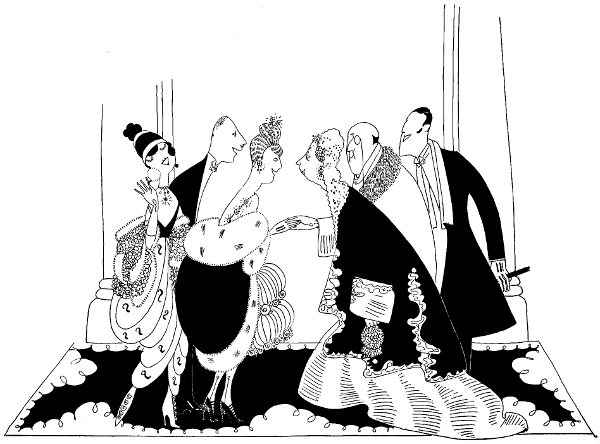
Below, you will behold a little scene in Pneumonia Alley otherwise known as the lobby of the opera. It is here that all of our best people gather, after the opera, and wait for hours for their flunkeys and limousines. Fashionable personages are really much cleverer than mere people are wont to suppose. After twenty years of hard study, they have finally devised a system by which—after the opera—they can wait around in the lobby for their motors and reach their houses only an hour later than they would if they left by the main door and picked up a passing taxi.
HEARTS AND FLOWERS
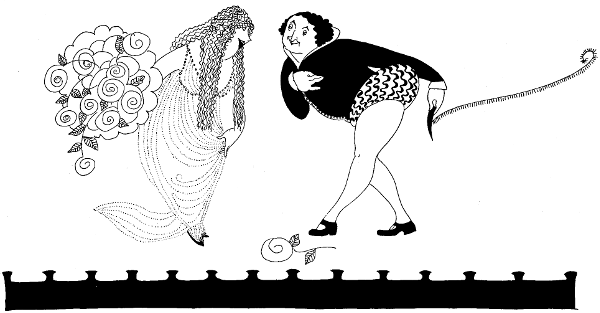
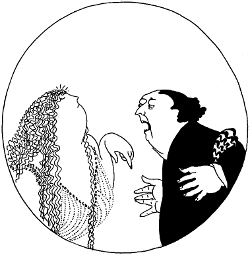
One of the great tragedies of life is that men and women have a way of saying pleasant things to your face, and truthful things behind it. Nowhere is this practice more prevalent than in grand opera. Above, for instance, you will observe a portrait of Signor Enrico Scottinelli, buttering with fair words the bewitching soprano. Nothing could exceed the sweetness of his remarks to her, during the opera. You know the remarks we mean: “Your eyes are radiant arrows in my soul. Your lips are torments to my heart. Look at me, and an eagle lifts my feet; kiss me, and pansies blossom in my breast.” It’s all very operatic and charming, but, back of the scenes—oh my!—what a difference!—“You call yourself an artist! You, who paid a press agent for every line you ever got in a newspaper! You who were hissed at Monte Carlo. You, who are only kept on here at the opera in order to save storage charges on your body at the warehouse! A singer! Ha! ha! ha! Why don’t you go back to washing? An artist! Corpo di Bacco! Why don’t you go back to scrubbing floors? You, who stand there dressed up like Marguerite! Where is your fur, where are your claws, where are your shiny yellow eyes, cat that you are!” All of this, disheartening and saddening as it is, only proves that social amenities at the opera are very much as they are with us all in real life.
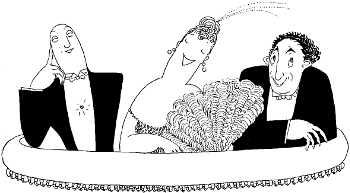
THE SPELL OF MUSIC
Why is it, we wonder, that the people in the first tier boxes at the opera always seem like human beings. Even their tiaras, feathers, and red Indian facial accoutrements, fail wholly to remove them from the category of living creatures. But the inhabitants of the second tier boxes are, somehow, a race apart. Their faces, figures, fans, hair, and bodily habiliments all somehow take on a strange, wild note. “Are they human?” we ask ourselves, “or are they merely some wax figures which we, as children were wont to admire?” In the sketch we see a group of these second-tier creatures suffering intensely under the spell of the director’s baton.
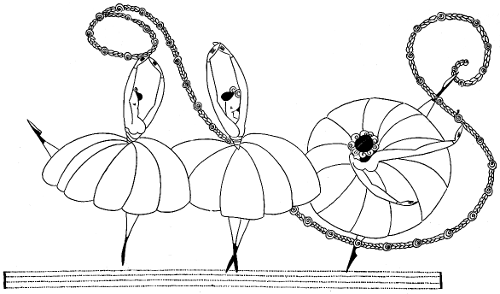
LES TROIS CORYPHÉES
Above is pictured a bright moment from the Ballet of the Rosebud—one of the lighter, sweeter forms of ballet. The plot concerns the love of the Rosebud for the South Wind—the sex interest is always developed early in these little dramas—and it shows how he subsequently leaves her ruthlessly—as it’s against the rules for any ballet to end happily. This scene shows a Trio of Spring Flowers, in action.
THE EIGHT HOUR NIGHT
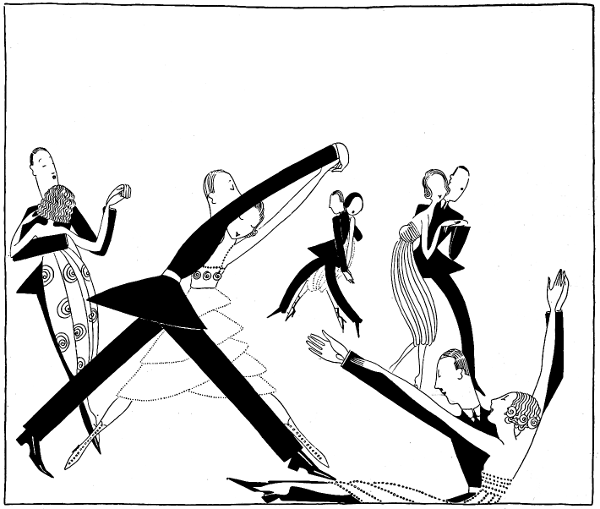
Below is an intimate glimpse of any gathering any evening, anywhere in the, broadly speaking, civilized world. Now that the war is really over, something had to be found to keep all the men interested,—so the dance habit has come back more strongly than ever. If he can only have seven or eight hours of fox-trotting every evening, a young man will get so that he hardly misses his bayonet practise at all.