Keeping on With the Dance You Will Certainly Be Considered a Social Pariah if You Don’t Dance the Night Out
Reading edition
In spite of sporadic outbursts of protest from non-dancing editors of hearth-side magazines, the dance craze is still going strong. In fact, it’s more violent than it ever was; it is no longer a mere craze—it has reached the point of frenzy. Any kind of dance goes (whether in Rome, Madrid, New York, Paris or London) from the intricacies of the Russian ballet on the stage of the opera, to the simple little fox trot in the privacy of your own home. Joy has never been so completely unconfined as it is this season; everybody is going on—and on—with the dance. You simply can’t get away from it. No matter where you go, some form of dancing is sure to come into your life, someone is certain to appear suddenly and dance with, beside, in front, or all over you.
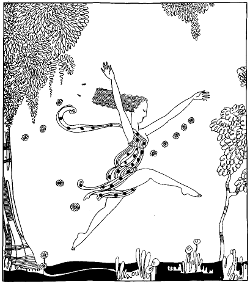
MORNING—IN THE PARK
Somebody once got all worked up about dancing and called it the poetry of motion; if you want to go right along with the idea, you might speak of barefoot dancing as the vers libre of motion. No one is quite certain of what it’s all about. The lady in this sketch, a disciple of the art, has left home to run wild in the park at dawn, in a little dance called “The Birth of the Crocus.”
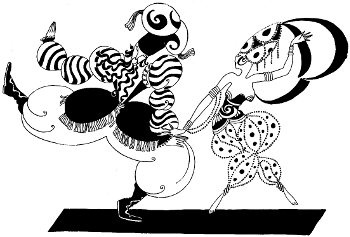
A LEGEND OF RUSSIA
A quiet corner of the Ballet Russe—one of the calmest moments in the company’s entire repertory. Both the lady and gentleman are, of course, stars of the Imperial Ballet of Moscow—they always are. Any male dancer wearing trick red boots, and any female dancer whose costumes are designed by Bakst, instantly becomes a star of the Imperial Theatre of Moscow. This is a scene from “The Golden Vodka,” a drama all about the love of the Princess Soviet for Nikailovitch, the handsome samovar.
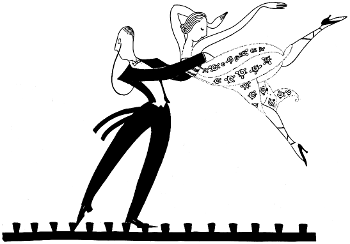
THE SOCIETY DERVISHES
This is what some euphemist has delicately called “ballroom dancing.” It occurs at least once in the course of every musical comedy and variety show. The male half of the cast seems forever looking for an opportunity to toss his partner out into the orchestra. Perhaps it’s the element of uncertainty about this sort of dancing that makes it so popular with the public; you never know at just what moment it’s going to prove too much of a strain for the male member of the team, or when the lady in the case is going to land, with a pretty informality, in your lap.
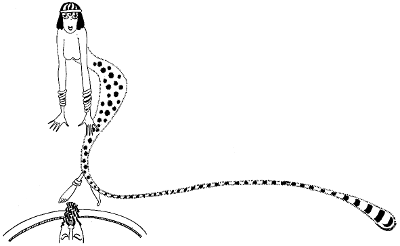
THE DAUGHTER OF HERODIAS
The Dance of Salome seems never to lose its popularity—perhaps the secret of its appeal is the sweet, wholesome joyousness of it all. It requires very few properties. All a girl needs, to give her own version of Salome’s famous specialty, is a plated silver platter, a papier maché head, and the usual lack of costume.