DESCRIPTION OF PLACES IN HERTFORDSHIRE ARRANGED ALPHABETICALLY
Reading edition
Abbreviations of architectural terms:— E.E. = Early English. Dec. = Decorated. Perp. = Perpendicular.
Abbots Langley (1½ mile S.E. of King’s Langley Station) is a village on prettily wooded high ground near the river Gade. It is famous as the birthplace of Nicholas Breakspeare, who, having vainly endeavoured to be admitted as a monk in the great Benedictine monastery at St. Albans, studied at Paris and eventually became Pope Adrian IV. He died in 1158 at Anagni; tradition states that he was choked with a fly whilst drinking. The village probably owes its name, first, to its length, “Langley” signifying a long land; second, to the fact that in the days of Edward the Confessor it was given to the Abbots of St. Albans by Egelwine the Black and Wincelfled his wife. An entry in Domesday records that there were two mills on this manor, yielding 30s. rent yearly, and wood to feed 300 hogs. The Church of St. Lawrence has nave, aisles and clerestory; a chancel with S. aisle, and square embattled tower. The windows are mostly Perp., but those of the S. aisle are Dec. Note (1) the monument to Lord Chief Justice Raymond, died 1732; (2) the brasses in nave to Thos. Cogdell and his two wives, 1607, and to Ralph Horwode and family, 1478. Late in the reign of Henry VIII. the vicarage was rated at £10 per annum. An inscription in the chancel, copied in Chauncy, reads “Here lieth Robert Nevil and Elizabeth his wife, which Robert deceased the 28th of April in the year of our Lord God 1475. This World is but a Vanity, to Day a man, to Morrow none.” Prince Charles held a Court at Abbots Langley during the Reign of James I.
Albury (3½ miles E. of Braughing Station) is a village near the river Ash. The church, dedicated to St. Mary, dates from the fourteenth century; it was recently restored. There was an earlier structure so far back as the days of Stephen, in whose reign Robert de Sigillo gave the profits of the church at Eldeberei to Geoffery, first Treasurer of St. Paul’s Church, London. An interesting will, dated 4th November, 1589, records that Marmaduke Bickerdy, Vicar of Aldebury, gave an acre of land in the neighbourhood to provide a sum for distribution among the poor on every Good Friday. In the chancel the mutilated effigies of a man and woman are said to represent Sir Walter de la Lee and his wife. Sir Walter sat in nine Parliaments in the interests of the county—at Westminster, Northampton and Cambridge, and was Sheriff of Herts and Essex. He died during the reign of Richard II. Albury Hall, close by, is a fine old mansion, where the “Religeous, Just and Charitable” Sir Edward Atkins, Knight, and Baron of the Exchequer, died in 1669. The village is usually a quiet spot, with little business, but it is pleasantly situated; the proximity of the river and some scattered cottages and farms enhance its attractiveness.
Albury End is a small hamlet about 1 mile S.W. of Albury.
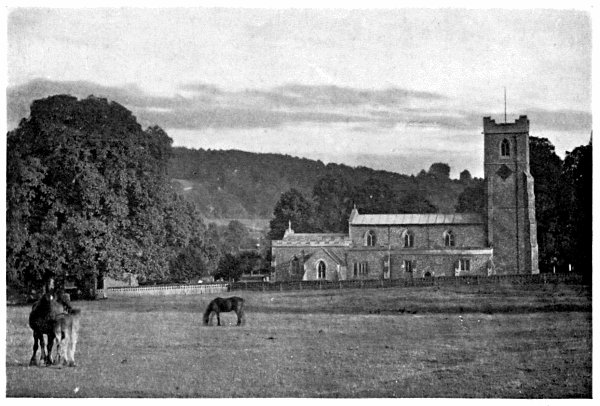
THE PARISH CHURCH, ALDBURY
Aldbury (1½ mile E. from Tring Station) is a village on the Buckinghamshire border, nestled in a beautiful valley close to Ashridge Park (q.v.). It is the “Clinton Magna” of Bessie Costrell, and the author of that story, Mrs. Humphrey Ward, lived at Stocks, a few minutes’ walk from the village. On the Tring side Aldbury is sheltered by swelling fields and to the E. beech woods cover the hillside, which is topped by the “Aldbury Monument,” a granite column about 100 feet high erected to the memory of Francis, third Duke of Bridgewater, whose labours and enterprise for the extension of canals earned for him the well-known title “the father of inland navigation”. As a village of the Old English type Aldbury has perhaps no equal in the county. In the centre is the green and pond, under the shadow of an enormous elm; close by stand the stocks and whipping-post, recently in excellent preservation. The Church of St. John the Baptist is E.E.; it was restored in 1867. Visitors should notice the old sundial on a pedestal in the churchyard, and the Verney Chapel, which is separated from the nave by a screen of stone, and contains a monument to Sir Robert Whittingham, who was slain at the battle of Tewkesbury. The church also contains memorials of the Hides and Harcourts, families who left several charities to the poor of the parish. In the days of Edward the Confessor the manor of Aldeberie was held by one Alwin, the king’s thane. The ascent of the wooded slope towards the Bridgewater monument takes the visitor through one of the most beautiful districts in the county, and a noble prospect stretches before him as he looks back through the beeches towards the village in the valley beneath.
Aldenham (2 miles S.W. from Radlett Station M.R.) is a village pleasantly situated near the river Colne, reached by way of Berry Grove at the W. end of the village. The churchyard is locally famous for the tombs of a man and woman named Hutchinson, which, singularly enough, have been riven apart and almost destroyed by three sycamore trees about a century old. The Church of St. John the Baptist is largely Perp. with earlier portions, and is worth a visit, if only for the oaken nave-roof, believed to date from about 1480, and for the font of Purbeck marble, probably 750 years old. An object of greater interest in some eyes is the fine parish chest, formed from one massive piece of oak nearly ten feet in length, and furnished with iron clamps and hinges of great size; there are few finer old parish chests in England. Note also (1) the triple sedilia in chancel; (2) the many brasses dating from 1450, several of which are to the Cary family; (3) two palimpsest brasses in the vestry, one of which bears a portion of a mutilated inscription to one Long, an alderman of London, who died in 1536. The church was restored in 1882 by Sir A. W. Blomfield, F.S.A. Aldenham House, property of Lord Aldenham, dates from the days of Charles II., and stands in a park of about 300 acres.
Aldenham Abbey, once known as Wall Hall, stands close to the parish church; it is about a century old, and belongs to the Stuart family.
Aldwick Farm is 1 mile N.E. from Marston Gate Station, L.&N.W.R.
Allen’s Green, a hamlet 2 miles N.W. from Sawbridgeworth, contains little of interest.
Almshoebury (1½ mile W. of Stevenage Station, G.N.R.) is about fifteen minutes’ walk from the ruins of Minsden Chapel (q.v.).
Amwell is a tiny hamlet 1 mile S.W. of Wheathampstead Station, G.N.R.
Amwell, Great, a parish and village 1½ mile S.E. of Ware Station, G.E.R., is very prettily situated near the New River, and is known by name to many who have never visited the neighbourhood, for the village is frequently mentioned in the essays and letters of Charles Lamb. The church stands on a wooded slope; near by are the village stocks, the tiny island upon which stands a monument to Sir Hugh Myddelton, the projector of the New River, and the stone bearing some lines written by John Scott, the Quaker. The grotto constructed by the poet may still be seen near the railway station at Ware. The church is an architectural conglomeration, with several stained windows, one of which was contributed by the children of the parish as an Easter offering nearly seventy years ago. The structure was restored in 1866. There is a piscina in the chancel, and one in the S. wall of the nave; there are also two hagioscopes. “The chancel arch,” writes Canon Benham, “seems to me Anglo-Saxon, and the chancel is a most curious apse.” Thomas Warner, a friend of Shakespeare, and Isaac Reed, a Shakespearian commentator, were both buried here.
Amwell End, once at the N.W. extremity of the parish of Great Amwell, is now a part of Ware (q.v.).
Amwell, Little (about 1½ mile S.W. from Great Amwell), was formerly a liberty in the parish of All Saints, Hertford; it has formed a separate civil and ecclesiastical parish since 1864. The Church of Holy Trinity is E.E. in style; it was erected in 1863. The district is now usually called Hertford Heath. An interesting, pleasant ramble may be enjoyed by walking from Hertford to Little Amwell, Great Amwell, and thence to Ware, or vice versa.
Anstey (about 4½ miles N.E. from Buntingford Station, G.E.R.) has a cruciform church of mixed styles: the nave is Dec., the transepts E.E., the S. porch Perp. The tower rests upon four Norman arches; the font also is Norman. The church was restored in 1871; many features of architectural interest being wisely retained. The recumbent effigy in the recess in S. transept is thought to be that of Richard de Anestie, who founded the church in the fourteenth century. We learn from Domesday Book that at the time of the Great Survey there was “pannage” (i.e. acorn woods) at Anestie sufficient to feed fifty hogs, and that the manor was worth fourteen pounds a year. There was once a castle here, built soon after the Conquest, the site of which is supposed to be marked by the remains of a moat still to be traced in the grounds of Anstey Hall. The churchyard is entered by a covered lich-gate.
Appleby Street is a hamlet 3 miles N.W. from Cheshunt Station, S.E.R., and about 2 miles N.W. from the village.
Apsley End (about 1½ mile S. from Hemel Hempstead Station, M.R., and 1¼ mile S.E. from Boxmoor Station, L.&N.W.R.) is an ecclesiastical parish near the river Gade. The church, dedicated to St. Mary, was built in E. Dec. style in 1871, and is well furnished and decorated. One of the prettiest prospects in the neighbourhood is that from Abbot’s Hill, a fine private residence, flanked by woods. The Gade and Bulbourne Rivers unite, a little N.W. from the village, at a place called Two Waters (q.v.).
Archer’s Green is on the river Maran, about ½ a mile S.E. from Tewin Church and 1¾ mile N.W. from Cole Green Station, G.N.R. It adjoins Panshanger Park (q.v.).
Ardeley, otherwise Yardley (6 miles S.W. from Buntingford Station, G.E.R.), is a village and parish in a purely agricultural district. It is famous through its connection with the Chauncy family, who resided at Ardeley Bury for many generations; one of them, Sir Henry Chauncy, was the author of a well-known history of Hertfordshire. The family monument is outside of the church of St. Lawrence, some existing portions of which date from the thirteenth century. The roofs of nave and aisles are noticeable for the angels which they bear, of Tudor character; visitors should observe, too, the early window in the restored chancel. Ardeley Bury, in the days of Sir Henry Chauncy, was an Elizabethan manor-house dating from about the year 1580, surrounded by a moat; it was almost entirely rebuilt of brick in 1815-20, when it became a castellated, imposing mansion. The manor of Erdeley was owned by a succession of Saxon kings until Athelstan bestowed it upon the church of St. Paul, London, as recorded in Dugdale’s Monasticon Anglicanum; it was of the Dean and Chapter that the Chauncys rented their estate. The river Beane rises near here. A stroll around Ardeley and Ardeley Bury leads the visitor into some of the quietest spots to be found in the county. The windmill on the hill above Cromer, near by, is useful as a landmark when threading the many winding lanes in the neighbourhood.
Arkley (1 mile W. from High Barnet) consists chiefly of a few small houses at a spot once called Barnet Common. The view is extensive in every direction, the village (strictly speaking the chapelry) lying on high ground. The chapel of St. Peter was erected in 1840, the style being a variety of Low Gothic; a chancel (E.E.) was added in 1898, and has a good groined roof.
Ash, river; see Introduction, Section VI.
Ashbrook consists of a few cottages and a beer-shop, 1 mile N.E. from St. Ippollit’s village, and midway between Hitchin and Stevenage Stations, G.N.R.
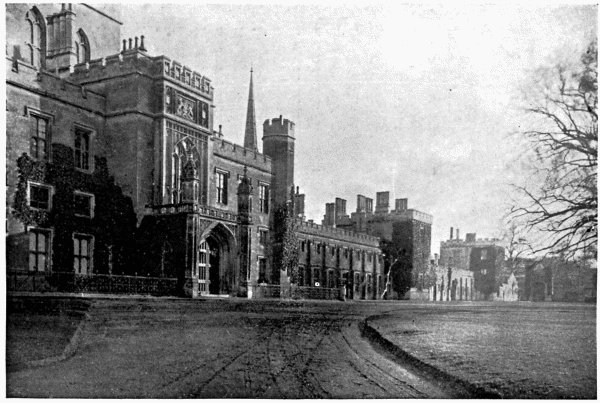
ASHRIDGE HOUSE
Ashridge is in a beautifully undulating district, immediately N. of Berkhampstead Common, 1 mile E. from Aldbury Church and about 2 miles E. from Tring Station, L.&N.W.R. The present house, the seat of Earl Brownlow, stands in a park of about 1,000 acres, well known for the deer which are kept there; it was built by the first Earl of Bridgewater, or rather by his architect, Wyatt, in 1808-14. It is a huge structure, its greatest width being 1,000 feet; conspicuous portions are the turreted centre, some good arched doorways and the large Gothic porch. The site was formerly occupied by the palace of Edmund Crouchback, Earl of Cornwall, and by the monastery which he built, adjoining the palace, for the monks of the Order of Bonhommes, an Order which he himself brought to this country from France. The earl died here, but his bones were subsequently removed to Hailes Abbey in Gloucestershire. The house contains some fine pictures, including, in addition to works by modern masters, Rubens’ “Death of Hippolytus,” Luini’s “Holy Family” and Titian’s “Three Cæsars”. In the chapel is a fine brass to John Swynstede, Prebendary of Lincoln, 1395. It was brought here from Edlesborough Church.
Ashwell is a village of considerable size on the Cambridgeshire border. The village is 2½ miles N.W. from Ashwell Station, G.N.R. The parish is very ancient, and is believed to have been the site of a British settlement and of a Roman station. The former theory is considered proved by the existing entrenchments, S.W. from the village, called Arbury Banks; the latter theory is supported by the fact that very many Roman relics, especially coins, have been discovered in the neighbourhood. That it was formerly a place of importance has been mentioned in the Introduction (Section V.); it was a town in Norman times, and held four fairs each year. The Rhee, a tributary of the Cam, rises in this village, at a spot surrounded by ash trees, and to this fact the parish is thought to owe its name. When Sir H. Rider Haggard was at Ashwell recently he was unable to say much for its agricultural prosperity and outlook; but in Chauncy’s day the district produced “all sorts of excellent Grain, especially Barley, which has greatly encouraged the trade of Malting in this Borrough”. The same writer mentions the stone quarry, from which he tells as that several neighbouring churches had been built or repaired. The Church of St. Mary the Virgin is mostly E.E. and is conspicuous for its spire-topped western tower, 176 feet high, being equal to the length of the church. Note (1) the large ambry in the S. aisle, once the lady-chapel, where is also a fragmentary reredos; (2) the curious inscriptions on the inner side of the tower walls, mostly undecipherable, one of which refers to the plague that attacked the town in the fourteenth century; (3) the really fine oaken pulpit, dating from the year 1627. There was formerly a small monastic house in the town, a cell to Westminster Abbey. From the village it is an open, breezy walk N. to Ashwell Common or S.E. to Ashwell Field, between the village and the station.
Aspenden (1 mile S.W. from Buntingford Station, G.E.R.) may be reached from the Old North Road by turning to the left before entering Buntingford. It is a small, quiet, unimportant village; but much of it is picturesque and interesting. Readers will remember that Macaulay was at school here, and that it was the birthplace of Seth Ward, mathematician and bishop, a contemporary and antagonist of Thomas Hobbes. The church is a flint structure,—a conglomeration of many styles. Notable features are the Easter sepulchre in the N. wall of chancel, the Norman window close to it, the piscina, ambry and credence table, discovered during the restoration of the church by Sir A. W. Blomfield in 1873. There are also memorial windows to members of the Lushington family, and an altar tomb, under a canopy of marble, to “Sir Robert Clyfford” (d. 1508), who built the church porch in 1500, and to his wife Elizabeth. The tomb bears brass effigies of these worthies, which were once in the Church of St. Michael, Cornhill, but were brought to Aspenden at the time of the fire of London. The aisle (S.) was built by Sir Ralph Jocelyn in 1478. This Sir Ralph was lord of the manor; he is remembered in history for his sally against Thomas Nevill, when that adventurer attempted to rescue Henry VI. from the Tower. He was twice Lord Mayor of London (1464 and 1476). He died in 1478 and was buried at Sawbridgeworth.
Aston (2¼ miles N.E. from Knebworth Station, G.N.R.) has an ancient church restored in 1883. There is E.E. work in parts of nave and chancel, but other portions are largely Perp., especially the tower, which is embattled. The alabaster reredos and several memorial windows are worth notice; nor should visitors overlook the brass at the foot of the chancel steps to one John Kent, his wife and ten children. This worthy died in 1592; he was a servant of Edward VI., Mary and Elizabeth. The village is scattered upon a hill a little W. from the river Beane, and dates from Saxon times. The manor was once owned by three men under the protection of Archbishop Stigand; afterwards by the Abbot of Reading. It fell to the Crown at the Dissolution, like so many other properties.
Aston Bury is a fine manor house of red brick, about ¾ mile S. from the village, formerly the property of the Boteler family. The prospect from the N. windows is a noble one, the district being varied and undulating.
Aston End, a hamlet 1 mile N.W. from Aston, may be reached from Stevenage Station, G.N.R., about 2½ miles. There is little here of interest, but the neighbourhood is very pleasant and largely agricultural.
Astrope Hamlet (½ mile E. from Puttenham) is midway between the village of Long Marston and the Aylesbury Canal. It is close to the Bucks border.
Astwick Farm is 2 miles N.W. from Hatfield Station, G.N.R.
Attimore Hall is 1½ mile S.W. from Welwyn Station, G.N.R.
Aubrey Camp (¾ mile S.W. from Redbourn) is conjectured to be the site of an early British encampment.
Austage End lies in the parish of King’s Walden, in a purely agricultural district.
Ayot Green is about ½ mile S.E. from and in the parish of Ayot St. Peter’s (q.v.).
Ayot St. Lawrence (2½ miles N.E. from Wheathampstead Station and about the same distance N.W. from Ayot Station, G.N.R.) has a new and an old church. The former is in Ayot Park, and was designed by Revett in a classical style. Note (1) the Eastern portico, with colonnade on either side; (2) the memorial to Sir Lionel Lyde, Bart. (d. 1791), and to the architect of the church (d. 1804). The earlier structure, still in ruins near the middle of the village, was Dec. of an early period, with several singular features; the tower, however, was Perp. “The Windows ... have been adorn’d with curious Pictures, in stained and painted Glass, beyond many other Churches.” The village has at different times been styled Eye, Aiot, Great Aiot, and Ayot St. Lawrence, and was a parcel of the property of Harold Godwin. Ayot House, standing in a beautiful park of 200 acres, was once the property and residence of Sir William Parr, brother to Catherine Parr, Queen of Henry VIII. A room in an older building in the rear of the present mansion was once, according to local tradition, the prison of Catherine Parr. There are shoes at Ayot House which belonged to Anne Boleyn and a hat of Henry VIII.
Ayot St. Peter’s (¼ mile N. from Ayot Station, G.N.R.) lies in a pretty district watered by the rivers Maran and Lea. The village is small, but has a commodious Parish Room, containing a small library. There was a mill here in the time of the Great Survey, the rent of which was three shillings and 200 eels from the mill-pool per annum. A church, bearing “a short spire erected upon the tower,” stood on the hill-top in Chauncy’s day; in 1751 an octagonal structure of red brick was built by the rector (Dr. Freeman) some distance from the village. This church was demolished in 1862 and a new one built upon its site; in 1874 this was in turn destroyed by lightning, and in 1875 the present church of St. Peter, E.E. in style, was erected much nearer to the village. It contains a very fine pulpit, carved by Miss Bonham, of Norwood, upon which the figures of SS. Alban and Helen are conspicuous among others. There are several memorial windows, tastefully designed, one of which, to the memory of Mrs. I. A. Robinson, was designed by the architect (J. P. Seddon). A delightful stroll may be taken from the village, westwards to Wheathampstead or Lamer Park, or northwards to Codicote or Kimpton. Nightingales are plentiful in the neighbourhood; the numerous thickets, dense and secluded, affording excellent shelter to this shy songster.
Baas Hill is ¾ mile W. from Broxbourne Station, G.E.R.
Babb’s Green (nearly midway between Mardock and Widford Station, G.E.R.) is a small hamlet.
Baker’s Grove is 1½ miles S.W. from Stevenage Station, G.N.R.
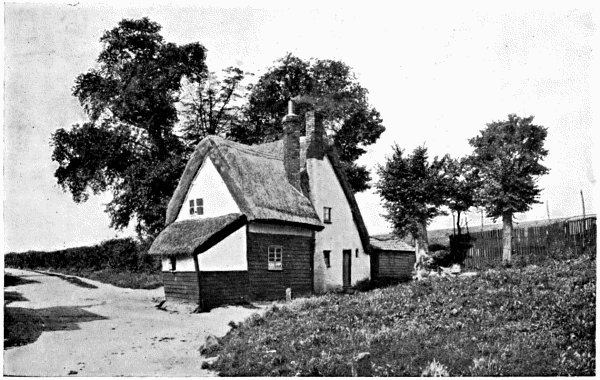
OLD COTTAGE, BALDOCK
BALDOCK, a small town in the northern extremity of the county, lies between the chalk hills at the junction of the Great North Road and the Roman Icknield Way. The malting industry is still busily pursued, although the town is not so exclusively devoted to it as formerly. Very fine barley was grown in the district before the reign of Elizabeth, and the horse fairs, of which there are several annually, are well attended. The township was founded by the Knights Templars, in whose time there stood a Lazar-house a little eastwards from the town. The church, dating from the fourteenth century, is large, and of considerable architectural interest. The chancel and adjoining chapels are Perp. and contain sedilia and piscinæ; the nave has eight bays and a lofty clerestory. The rood-screen is co-extensive with the width of the entire church; the octagonal font is of great antiquity (probably not less than 700 years); there are several brasses, two of which are of the early part of the fifteenth century. Note also (1) the defaced slab, with Lombardic inscription to Reynaud de Argenthem, (2) the piscina-like recess in the N. chapel, (3) the Dec. pillars and arches of nave, (4) the fine old chest near rood-screen (N. chapel). Baldock has been the recipient of many bequests; existing charities are in the name of Roe, Wynne, Pryor, Cooch, Clarkson, Smith, Parker, and a few others, the whole aggregating a considerable annual sum. The Wynne Almshouses are in the spacious High Street, where are also the fine town hall and fire station, erected in 1896-7. Some side streets between the church and station are noticeable for the variety of cottage architecture which they display.
Barkway (4 miles S.E. from Royston station, G.N.R.) was a village of some importance in the old coaching days, for it is on the main road from Ware to Cambridge. It was partly burnt in 1592. There are many quaint houses in the neighbourhood, and one or two inns seem to still retain something of the atmosphere of the old régime. Near the village, at a spot called Rokey Wood, a small bronze statue of Mars was discovered some years ago. It is of Roman workmanship and is now in the British Museum. Cyclists riding northwards or eastwards from Barkway will find many hills to test their powers; but the air is exceptionally good and the district decidedly worth visiting. The church (flint, with stone quoins) is Perp. with embattled and pinnacled western tower; it was restored in 1861. Several memorials are worth noticing: (1) marble sarcophagus, with bust by Rysbrach, to Admiral Sir John Jennings (d. 1743); (2) brass on N. wall, found in the flooring during restoration, to Robert Poynard (d. 1561), his wives Bridget and Joan, and his four daughters; (3) monuments to Chester and Clinton families in chancel. The once annual Pedlars’ Fair has been discontinued; as has also the Tuesday market, which dated from the days of Henry III. In Saxon times the village was called Bergwant, i.e., the way over the hill.
Barley, a village on the Essex border, is 2 miles N.E. from Barkway, and lies on the same high road. The Church of St. Margaret was restored in 1872, in fourteenth century Gothic, but the tower, which is Norman, still stands. During the restoration some curious jars, of ancient make, were found in the chancel walls, but were broken in the efforts to dislodge them. There is a brass to Andrew Willet, D.D., rector of the parish and author of Synopsis Papismi (d. 1621).
Some interesting data for a book on the antiquities of Barley are preserved in the pre-Reformation “Parish Hutch”. I may mention the “towne house ... tyme out of mynde used and employed for the keeping of maides’ marriages,” and the “Playstoe” or “common playinge place for the younge people and other inhabitants of the said towne”. This “towne house” may still be seen near the church.
Barleycroft End is S.E. from Furneaux Pelham (q.v.). It almost adjoins that village.
BARNET, EAST (½ mile from Oakleigh Park Station, G.N.R.) is surrounded by Middlesex except to the N.W. where it adjoins New Barnet. The old village is situated at the meeting of the roads from High Barnet, Southgate and Enfield. The Church of St. Mary the Virgin is very interesting; it stands on the hill-top, at a sharp bend in the road, about ½ mile S. from the village. It is said to have been founded about the year 1100 by an abbot of St. Albans; if this date is approximately correct this abbot must have been Richard d’Aubeny or de Albini, who ruled the great monastery from 1097 to 1119, and in whose day the whole manor (including Chipping or High Barnet) belonged to the Abbey of St. Albans. The structure is Early Norman, with a western tower of brick, through the lower portion of which the church is entered. The N. wall is probably the most ancient church wall in this part of the county. There is a lich-gate at the N. entrance to the churchyard. A son of Bishop Burnet, the historian, was once rector here, and is buried in the church. Tradition states that Thomson the poet was tutor to the son of Lord Binning when that nobleman lived at the old Manor House, the site of which is now a part of the rectory garden. Near the church, too, stood once a house in which Lady Arabella Stuart was confined. Belmont House (C. A. Hanbury, Esq., D.L., J.P.) marks the site where stood Mount Pleasant, once the property of the Belted Will Howard, Warden of the Western Marches, referred to in the “Lay of the Last Minstrel”. Little Grove, a house on Cat Hill (Mrs. Stern), stands where stood formerly the house of the widow of Sir Richard Fanshawe, Bart., Ambassador to Spain in the reign of Charles I. The whole neighbourhood is varied and undulating; the eastern extremity of the parish touched the confines of Enfield Chace until late in the eighteenth century.
BARNET, HIGH (formerly “Chipping Barnet” from the market granted by Henry II. to the Abbots of St. Albans, which was held every Monday), stands on the hill-top about 11 miles N.W. from London, and 9 miles S.E. from St. Albans. As stated above, the manor belonged to the Abbots of St. Albans, and Chauncy tells a story in this connection which is worth repeating: “Anno 18, Edw. I., the Abbot of St. Albans (Roger de Norton, 24th Abbot) impleaded several Persons for prostrating his Ditch and burning his Hedges and Fences in the Night at Bernet; Richard Tykering, one of the Defendants, said, that because the Abbot enclosed his Pasture with Hedge and Ditch, so that he and the Tenants there, could not have their common, as their Ancestors were wont to have, they did lay open the same. The Abbot answered that they ought not to have Common there; but ’twas found by the Jury that the Tenants ought to have Common; and Judgment was given against the said Richard Tickering only for that he burnt the Hedge.” Other squabbles between abbot and peasant are referred to in this book, in the section on St. Albans. The Parish Church of St. John the Baptist stands at the junction of the roads from London, Enfield and St. Albans. It has known many changes. A church stood upon the spot so long ago as circa 1250, to which a detached tower was added about a century later. The body of this structure was almost wholly replaced by a new building, reaching to and including the tower, near the end of the abbacy of John de la Moote (1396-1401). The present church is the result of the restoration and enlargement under the direction of Mr. W. Butterfield, in 1875; it is of flint and worked stone, partly Dec. and partly Perp. The old tower was lowered sufficiently to form a portion of the nave and a new embattled tower was built, now a conspicuous landmark for many miles round. The present N. aisle is entirely new. The nave is clerestoried, with eight bays; most of the windows are of stained glass. The Ravenscroft mortuary chapel, adjoining the S. transept, contains many monuments, the most conspicuous being the altar-tomb and recumbent effigy in marble to Thomas Ravenscroft (d. 1630), which was formerly in the chancel. Other memorials are to James Ravenscroft (d. 1680) who founded and endowed the almshouses in Wood Street near by, called Jesus’ Hospital, and to John Ravenscroft (d. 1681). Note (1) the beautifully carved font screen, pinnacled and crocketted; (2) the pulpit, adorned with carved figures of men famous in English Church history; (3) the four ancient ledgers of stone, two in the chapel and two in the tower-basement, all inscribed to members of the Ravenscroft family. The church was formerly a chapel-of-ease to that at East Barnet. A Roman Catholic church, dedicated to SS. Mary the Immaculate and Gregory the Great, stands in Union Street: it was built in 1850.
On Barnet Common there was formerly a medicinal spring known widely as “Barnet Wells”; its chalybeate waters are referred to in Pepys’ Diary, and more fully praised in The Perfect Diurnall (1652) and The Barnet Well Water (1800). These waters were in such repute that one John Owen, an alderman of London, provided £1 to be spent yearly in keeping the well in fit condition. Barnet Fair, which is held annually early in September, is attended by cattle dealers from all parts of England and Scotland, and by showmen and adventurers of all kinds. It is certainly one of the most famous horse fairs in the country. The ordinary cattle market is held each Wednesday.
Battle of Barnet.—Of this engagement, so familiar by name, very little is known accurately. Early in the spring of 1471, Edward IV., assisted in his schemes by the Duke of Burgundy, quitted Flanders, whither he had fled when the Earl of Warwick landed in the S. of England with reinforcements from Louis XI.; touched, after a difficult passage, at Cromer, where he heard of the resistance organised by Warwick, and finally landed at Ravenspurgh on the Humber. Having been joined by further followers at Nottingham he entered London on Holy Thursday, the Lancastrians offering little resistance. Warwick collected his forces, and the two armies met on Easter Sunday on Gladmore Common or Gledsmuir Heath, to the N.W. of what is now Hadley Wood. The engagement was desperately contested for five or six hours, with such varying success that some accounts relate how messengers rode to London during the day with the news that Edward was losing the battle. This, as it proved, was not the case. Chauncy repeats the old tradition that a fog gathered over the battle-field, that the Lancastrians slew one another in the mist and confusion, and that this led to the death of Warwick. It is supposed that the “King Maker” fell close to the spot now marked by Hadley High Stone. This obelisk was erected a little distance off in 1740; but was removed nearer to what is now thought the right position. Montacute, brother to Warwick, was slain at the same spot.
BARNET, NEW, is a residential extension of High and East Barnet, being situated between the two. Indeed, the whole of “Barnet” is now almost merged into one; there being houses or shops almost from Hadley High Stone to a little S. from Cat Hill. The Station Road is a wide pleasant thoroughfare stretching from New Barnet Station, G.N.R., to the main road from London to High Barnet. The whole district is excellent ground for the student of modern domestic architecture, the examples of diverse schools and styles being endless. The stretch of valley between the railway and High Barnet, now largely built upon, is a new civil parish called Barnet Vale. On a gentle slope in the centre, off Potter’s Road, stands the new Church of St. Mark, in which services have been held for twenty-four years, but which is still incomplete. Lyonsdown, an ecclesiastical district founded in 1869, is scattered over high ground S.W. from the station; it is almost wholly comprised of detached residences and is considered exceedingly healthy. There is here a good view, overlooking the stretch of hill and dale towards Cockfosters, New Southgate, and the Alexandra Palace. The Church of the Holy Trinity, erected in 1864, is Dec. and contains fine lancet windows to W. C. M. Plowden, killed in Abyssinia. There are N. and S. porches, good of their kind, and the apsidal chancel is well designed.
Barwick Ford is on the river Rib, about 2½ miles N.W. from Hadham and 3 miles S.W. from Standon Stations, G.E.R.
Bassett’s Green (1 mile S.E. from Walkern Church) is a small hamlet between Walkern Hall and Walkern Bury. There is no railway station nearer than 5 miles, Buntingford, G.E.R., and Stevenage, G.N.R., being each about that distance.
Batchworth is a hamlet close to Rickmansworth Station, L.&N.W.R., at the N.W. extremity of Moor Park (q.v.).
Batchworth Heath, 1½ mile S.E. from Rickmansworth, is on the Middlesex border.
Batlers Green (¾ mile from Radlett Church, and 1 mile S.W. from the station, M.R.) is in a pretty district, but contains little more than a few scattered cottages and farms.
Bayford (3 miles S.W. from Hertford) is a parish and village on rising ground, near the river Lea. It has a cruciform church, E.E. in design, with facings of Kentish rag-stone, erected by W. R. Baker, Esq., in 1870-1. In the chancel are seven fine lancet windows of stained glass. Note also (1) altar tomb and marble effigy to Sir George Knighton (d. 1612); (2) two palimpsest brasses, one bearing a figure in half-armour and the other a figure in plate-armour and ring-mail skirt, of which the age is conjectural; (3) the fine lich-gate. In the churchyard lies William Yarrell, the great ornithologist (d. at Yarmouth, 1856).
Bayfordbury stands in a beautiful park, famous for its fine cedars and pines, a little N. from the village. It is the seat of the lord of the manor, H. W. Clinton-Baker, Esq., J.P. The house was originally erected by an ancestor of the present owner, about 1760. Here are the portraits of most of the members of the Kit Cat Club, painted by Sir Godfrey Kneller; the MS. of the first book of Paradise Lost, and a collection of letters of great literary interest, were recently sold to America.
Bedmond, or Bedmont, together with Sheppeys, forms a large hamlet 1 mile N. from the village of Abbots Langley, and nearly 2 miles N.E. from King’s Langley Station, L.&N.W.R.
Bedwell Plash is a hamlet 1 mile S.E. from Stevenage.
Beeson’s End is pleasantly situated near the S. extremity of Harpenden Common, and about 1¾ mile nearly due E. from Redbourn Station, M.R.
Bell Bar, a hamlet in the parish of North Mimms, is near Brookman’s Park, and about 2½ miles N. from Potter’s Bar Station, G.N.R. (Middlesex).
Bendish lies on high ground, 2½ miles S.W. from St. Paul’s Walden (q.v.). The nearest station is at Luton Hoo (Beds) about 4 miles S.W.
Bengeo (¾ mile N. from Hertford) is a village between the rivers Beane and Rib; Ware Park is close by (N.E.). It is now in the borough of Hertford. The old church dedicated to St. Leonard, is Early Norman; there are very few churches of older foundation in Hertfordshire. It was restored at several times between 1884 and 1893. The bell in the wooden cote bears date 1636; a small Norman arch divides the nave from the chancel; there are lancets and a Perp. window in the apse. The monuments are mostly to local gentry. Eric, seventh Baron Reay, is buried in the tiny churchyard. The new church, erected on the hillside in 1855, is of Kentish rag. There are terra-cotta panels by Tinworth in the reredos. The walk from Bengeo to Hertford, past the sandy warren-hills, so beautifully clad with fir, larch, etc., with the Lea winding through the low meadows on the left, is one of the finest in the county.
Bengeo (Rural) was formerly a part of the same parish as the above. Near by, at Chapmore End, is the Hertford County Reformatory for boys.
Bennett’s End is the name of two small hamlets, one near Leverstock Green (q.v.) and the other near Hemel Hempstead (q.v.).
Bennington (4½ miles N.E. from Knebworth Station, G.N.R.) was once the residence of Mercian kings. The village and neighbourhood are picturesque; the roads from Walkern, Hertford and Knebworth meet where a tiny triangular green is shaded by fine elms. The river Beane is 1 mile to the W. The church is at the S. end of the village; it dates from the fourteenth century. The nave is wide, with clerestory; the narrow chancel has a chapel on the N. side. The tower is embattled, and contains a ring of eight bells. There are triple sedilia, and stalls of carved oak in the chancel; what was once a holy water basin is in the porch. Note also (1) the oaken rood-screen, surmounted by a large cross; (2) the memorial to the Cæsar family (1622-61); (3) the (supposed) tomb of Sir John de Benstede (1432), a baron who sat in Parliament in the time of Edward II., as we learn from Dugdale’s Monasticon; (4) Carved oak reredos. Near the churchyard a large house of red brick stands on the site of the castle of the Benstedes, in ruins when Chauncy wrote two centuries back. Bertulf, King of the Mercians, held a council here in 850. Bennington Park (1¼ mile E.) is one of three deer parks in Hertfordshire which figured in Domesday Book.
BERKHAMPSTEAD (Great) an interesting town in the W. of the county, is situated on the little river Bulbourne, and is chiefly famous as the birthplace of William Cowper, who was born in the rectory on 26th November, 1731. The Grammar School was founded by Dr. John Incent in 1541. The castle, of which there are still ruins close to the L.&N.W.R., dates from before the Domesday Survey. Visitors must not expect to find a castle here such as those at Carisbroke or Lewes. The ruins, although of considerable extent, are fragmentary, and little more than the plan of this stronghold can now be traced. The moats are double to the N.W., but triple elsewhere. Henry II. held a court here; and the castle was at times the residence of many monarchs, particularly Edward III. The Black Prince was a visitor here during his father’s reign. The Church of St. Peter, on the N. side of the High Street, is by local authorities claimed to be larger than any parish church in the county, saving only St. Albans Abbey; but this distinction is also claimed for St. Mary’s, Hitchin. The original structure was of great antiquity, dating from pre-Norman times; but it was wholly rebuilt early in the reign of Henry III. There are chantry chapels on either side of each transept; that called “St. John’s Chantry” dates from about 1350. Among many other features of interest note (1) fine groined roof of northern chantries; (2) lancet windows in the chancel, containing fourteenth century glass; (3) the E. window, a memorial to the poet Cowper; (4) tablet to Ann Cowper, the poet’s mother; (5) brass to John Raven, Esquire to the Black Prince; (6) altar tomb to John Sayer, head cook to Charles II.; (7) mosaic reredos; (8) altar tomb and effigies of Richard Torrington (d. 1356) and Margaret his wife, in N. transept. During the restoration of this transept in 1881 a portion of an ancient arch was discovered.
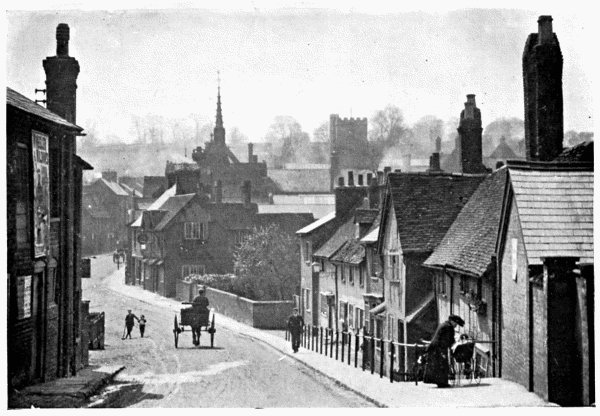
CASTLE STREET, BERKHAMPSTEAD
The Grand Junction Canal is close to the river Bulbourne, and partly for this reason many small industries are pursued in the town, such as the making of straw plait, scoops and shovels of various sorts, army tent-pegs, etc. The present rectory is on a small hill near the church, to the S. of the High Street; it stands on the site of the former house, in which Cowper was born, and the old well-house, called “Cowper’s Well,” may still be seen. There is a good library in the Mechanics’ Institute. The almshouses, for six widows, were founded in 1681, by the John Sayer mentioned above. The Kings of Mercia are known to have resided and held courts here; King Whithred summoned a council to meet at Berghamstedt in 697.
Berkhampstead, Little (3 miles S. from Cole Green Station, G.N.R.), has a stone church erected early in the seventeenth century. It has a wooden belfry and spire. The building was restored in 1856-7, but contains little of architectural or historical interest. There are, however, several memorials, notably the altar table in memory of Bishop Ken, born in the parish in 1637. On a hill N.E. from the church stands the tall red-brick observatory erected by John Stratton in 1789, in order, as it is said, that from its summit he might watch his ships in the Thames. The tower has been called “Stratton’s Folly”.
Bernard’s Heath. (See St. Albans.)
Betlow is a lordship of Long Marston (q.v.)
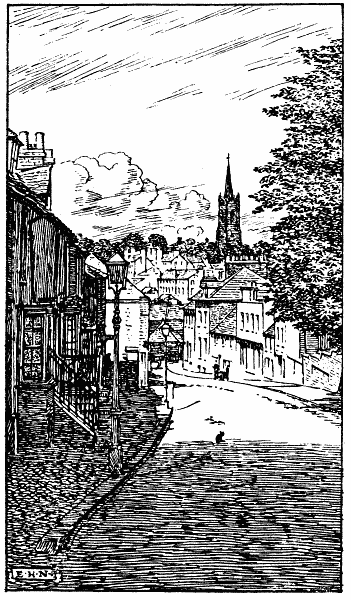
BISHOP’S STORTFORD
BISHOP’S STORTFORD is in the extreme E. of the county and on the Essex border. It is an ancient town, deriving its name from the ford over the river Stort, and from the fact that William I. gave the town to Maurice, Bishop of London. It is famous for its Grammar School, at which the late Cecil Rhodes, a native of the town, was educated. The site of Waytemore Castle, built by William I., is on a mound near the road to Hockeril, where a low, wide flint wall is partly surrounded by a moat. The church of St. Michael on Windhill is Perp.; it was restored in 1859. There was a former church on the same site; the present structure dates from say 1420-40. The nave has six bays; the tower is pinnacled and has a ring of ten fine bells. Chauncy’s book has an interesting paragraph about this church. “Three Gylds and a Chantry were founded in this church; the Gyld of St. Mary; the Gyld of St. Michael; and the Gyld of St. John Baptist; to which, An. 1476, Elizabeth Spycere gave Legacies, viz., to the two former 13s. 4d. a piece, to the last 40s. These Saints had their altars, and St. Michael his Tabernacle, on which much Cost had been bestowed; but the Chantry was founded in the time of Richard III. and the Settlement thereof cost much Money.” Chancel and nave are separated by a screen of carved oak; the font (Norman) was discovered during the restoration of the church; there is a piscina in the S. aisle. The clerestory was added and the chancel restored in 1884; on the chancel floor is a brass to Lady Margaret Denny (d. 1648), “a maid of honour in ordinary for five years to Queen Elizabeth of blessed memory”. There is also a memorial to Sir George Duckett, Bart. (d. 1822), who increased the facilities for the navigation of the Stort, which is now navigable by barges to the town. A cattle sale is held every Thursday, which is market-day. The trade in malt is still very large. We read that in old times a cross was erected on each of the four roads leading from the town. The main thoroughfares are still in the form of a cross; going down Windhill the visitor will find a bridge over the Stort before him, and a main street on either side. The town can boast several of the finest old inns in Herts.
Boreham Wood (1¼ mile N.E. from Elstree) is a large and rather prettily situated hamlet.
Bourne End, 1 mile W. from Boxmoor Station, L.&N.W.R., contains little more than an inn, a coffee-room, and a few cottages standing beside the Grand Junction Canal.
Bovingdon (2½ miles S.W. from Boxmoor Station) is a large village, built on the slopes of two hills, the centre of the village being in the depression between them. The church dates from the end of the eleventh century, but was rebuilt in 1846 in a Gothic style, with pinnacled W. tower. Note (1) the effigy of an armoured knight under the tower, dating from perhaps the middle of the fourteenth century; (2) brasses to the Mayne family (1621-42). Some traces of a Roman encampment and villa are shown on inquiry at a spot near the village.
Bowman’s Green (¼ mile N.E. from London Colney and 2 miles S. from Smallford Station, G.N.R.) is a tiny hamlet near the river Colne and the high road from Barnet to St. Albans.
Boxmoor is a village about 1½ mile S.W. from Hemel Hempstead. The Grand Junction Canal flows between the village and the town. From the station, L.&N.W.R., a motor car plies to and from Hemel Hempstead. Many Roman remains have been found in the neighbourhood, particularly some remains of two Roman villas, and many coins of the period of Diocletian. The church, erected in 1874, is E.E. in design, and was planned by Mr. Norman Shaw. It has N. and S. aisles and porches. There was an earlier structure on the same site. Private residences are increasing so rapidly that the place is now almost a suburb of Hemel Hempstead.
Boydon’s Hill adjoins the village of Aldenham.
Bragbury End (1¼ mile E. from Knebworth Station, G.N.R.) is a hamlet on the Great North Road.
Bramfield or Braintfield (3½ miles N.W. from Hertford Station, G.N.R.) is a parish and village. The church is E.E., standing on the site of an earlier edifice; the present tower and spire were built in 1840, and the church itself restored in 1870. We learn from Matthew of Westminster that Thomas Becket held the living here as his first charge; a pond near the church is called “Becket’s Pond”. Queen Hoo Hall, N.W. from the village, is now a farmhouse, but was formerly an Elizabethan residence, and gave the title to a romance partly written by Sir Walter Scott. The neighbourhood is pleasant, and a pretty stroll may be taken either N.E. to Woodhall Park or S. to Panshanger Park.
Brandley Hill is 1 mile N.W. from Aston.
Braughing has a station ¾ mile S.W. from the town, on the Buntingford Branch of G.E.R. It is an ancient parish, the “Brachinges” of Domesday Book, and was a Roman station. The church and few streets of which the village consists are very picturesquely scattered on the S.W. slope of a hill overlooking the river Quin, at the intersection of the Roman Ermine Street and the road from Bishop’s Stortford to Baldock. There was formerly a market each week, dating from the reign of Stephen; also an annual fair, abolished many years ago. The church, close to the hand-bridge over the river, is largely Perp., and contains a few brasses, none of which are important. It has been partially restored on several occasions during the last eighty years, and some of the modern workmanship is very good. Note (1) open tracery in carved oak screen; (2) oak pulpit; (3) finely carved font of Caen stone; (4) old font outside, near the tower. At Cockhampstead (1½ mile E. from the church) was once an Augustinian priory.
Breachwood Green (about 3½ miles N.E. from Luton Hoo Station, G.N.R., and 1 mile S. from King’s Walden Church) is a village on high ground rather more than a mile from the Bedfordshire border. Pretty walks may be taken S.E. to Bendish or S.W. to Chiltern Green.
Brent Pelham (1 mile from Essex border and 5 miles E. from Buntingford) is an interesting village, formerly called Burnt Pelham because, as tradition states, both village and church were destroyed by fire during the reign of Henry I. Traces of the fire existed in the days of Norden (circa 1548-1626). The church—near which the old stocks may still be seen—is E.E., with the embattled western tower so frequent in Herts. It is locally famous for a tomb in the N. wall, said to mark the resting-place of one Piers Shonkes, a serpent slayer who lived in the time of William I. The tomb bears some allegorical figures, which have been the subject of diverse interpretations. Pelham Hall (E. E. Barclay, Esq.), “a slight but well contrived House in this Mannor, near the Church,” was built in 1620 by one Edward Newport. It was once owned by the Floyers or Flyers, a family to whose memory there are several memorials in the church.
Brickendon is now partly included in the borough of Hertford. There are some imposing residences in the neighbourhood.
Bricket Wood is almost exactly midway between St. Albans and Watford; it consists of some cottages scattered around an extensive wood and common, crossed by L.&N.W.R. The station is ½ mile from the “wood,” which is much frequented by picnic parties, school treats, etc. The district is good ground for the field botanist and entomologist.
Broadfield (2¼ miles N.W. from Buntingford) is a hamlet near Cottered, on the hill N. from that village. The hall was once a much larger structure (engraved in Chauncy, vol. i.); it was in part rebuilt in 1882, but still retains a portion believed to date from the fifteenth century.
Broadwater is a hamlet at the meeting of the roads from Stevenage, Hatfield and Hertford. The nearest station is Knebworth (1¼ mile S.).
Broadway (1½ mile S.E. from Berkhampstead) has a Dec. chapel-of-ease to the parish church. It was erected in 1854. A short walk takes one to the ruined chapel of St. Mary Magdalen on the Bucks border.
Bromley (1½ mile S.E. from Standon Station, G.E.R.) is a small hamlet.
Broomin Green (¾ mile S.W. from Stevenage Station, G.N.R.) is a hamlet near the railway and ½ mile from the Six Hills. (See Stevenage.)
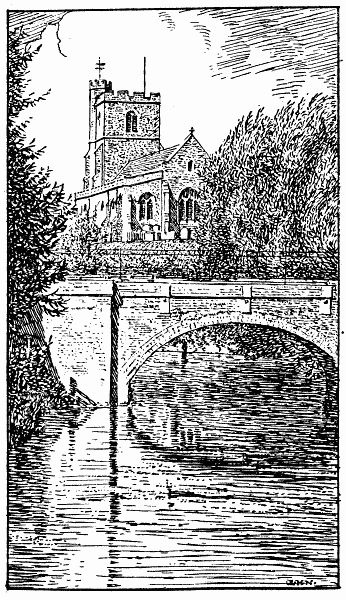
BROXBOURNE CHURCH
Broxbourne, a large village near the river Lea and New River, is a favourite fishing resort. The church stands on high ground overlooking the mill-leat; it is a fine Perp. structure, dating from early in the fifteenth century. The N. chancel-chapel was built by Sir William Say, “in honor a ye Trenete the yere of our Lord God 1522”; his tomb is in the chancel. The church was restored in 1857; the roof is of fine oak panelling; the font, on eight pillars, is probably Early Norman. There are brasses to a priest holding a chalice (circa 1470); to another priest in robes (circa 1510); to Sir John Borrell, mace bearer to Henry VIII. (d. 1521); to Sir John Say (d. 1478), and his wife (d. 1473). Note also (1) holy water basin near door; (2) marble effigies of Sir Henry Cock (d. 1609), and his wife and family; (3) shield of arms in centre of nave, with verses in English, bearing date 1630. From the church a very picturesque walk may be taken through the village, to Hoddesdon, by way of “Admiral’s Walk,” or beside the Lea past the grounds of the Crown Hotel. Broxbournebury (Major G. R. B. Smith-Bosanquet, J.P.) is in the beautiful park, 1 mile W., and is a large imposing mansion in Jacobean style. In Church Fields and on the London Road are large rose-nurseries, producing an immense number of roses yearly. The neighbourhood is one of the most pleasant in the county.
Buckland (3 miles N. from Buntingford, on the Royston Road) has an E.E. church, built by Nicholas de Bokeland in 1348. The piscina at the E. end of the S. aisle marks the site of what was formerly the lady-chapel. The font is very possibly anterior to the Conquest; it is a roughly hewn mass of Barnack stone. The low window in the S. wall of the chancel was opened out during some renovations, and is thought to have been connected with a confessional, as a coloured figure of the Virgin was discovered on the wall. The theory, however, may be dismissed as purely mythical. There is a brass to William Langley, a rector of the church (d. 1478); a low-relief medallion by Chantrey to William Anthony (d. 1819), and a brass to one of the Boteler family (1451). The interior was restored in 1875; the new W. door, of oak, was added in 1881.
Buck’s Hill (2 miles S.W. from King’s Langley Station, L.&N.W.R.) is a pretty hamlet. The nearest parish church is about 1¼ mile N.E. at Chipperfield (q.v.).
Bulbourne, river. (See Introduction.)
Bull’s Green is 2¼ miles N.E. from Welwyn Station, G.N.R.
Bull’s Mill is 2½ miles N. from Hertford.
BUNTINGFORD, a small town on the river Rib, on the Royston-Cambridge Road, consists chiefly of the long High Street and of a few small by-ways, E. by the river side, and W. on the roads to Aspenden and Cottered. Standing across the High Street is the cruciform church of St. Peter, built in 1614-26 as a chapel-of-ease to Layston (q.v.). An old brass tablet still preserved represents the holding of a Divine service in the church before completion. There is also a portrait of Seth Ward (see Aspenden); the almshouses a few yards W. were founded by him in 1684. “This town,” wrote Chauncy, “is of small antiquity, for there is no mention of it in Domesdei Book, neither can I find anything of it before Anno. 21. Edwd. III., when that King did grant one Market every Week, and one Fair every Year in Buntingford, to Elizabeth de Burgo and her Heirs, reserving the Yearly Rent of 6d.” At the N. end of High Street is the old pound. Corney Bury (½ mile N.) is a fine old manor house. Little of historic importance is to be gleaned in the town, but a ramble from end to end is interesting by reason of the many quaint inns and cottages, of all ages and styles, which meet the eye at every turn.
Burnham Green is a hamlet 1¼ mile N.E. from Welwyn Station, G.N.R.
Bury Green (1½ mile W. from Cheshunt Station, G.E.R.) is a small hamlet near Theobald’s Park; also
Bury Green, a hamlet 2½ miles W. from Bishop’s Stortford.
Bury Hill and Bury Mill. (See Hemel Hempstead.)
Bury Stede. (See Hexton.)
Bush Barrow is 1¼ mile N. from Wallington, on Metley Hill, midway between the village and the Icknield Way.
Bushey is a large village, now practically the S.E. suburb of Watford. The station (L.&N.W.R.) is in the hollow between the village itself and High Street, Watford; cyclists must be careful of the descent towards that town. Near the centre of the village is a small green and pond, and here stands the partly Dec. church of St. James, rebuilt in 1871 by Sir Gilbert Scott. The E.E. window, triple lancet, is to the memory of Edwards Marjoribanks of the Hall (d. 1879) and his wife. Silas Titus, whose name is remembered for his supposed authorship of the notorious pamphlet Killing noe Murder, was born at Bushey and buried in this church; there is a headstone to his daughter in the graveyard.
Bushey Heath (1 mile S.E. from the above) is on the Middlesex border. It is now an ecclesiastical district, formed in 1889; the church, an E.E. brick structure, dates from 1838; the porches were added in 1882. The district is very healthy.
Bushey, Little, is E. from Bushey Heath, which it almost joins.
Bushey Mill is on the river Colne, ¾ mile N.E. from Watford Junction.
Butchery Green. (See Hertford.)
Bygrave (1¾ mile N.E. from Baldock Station, G.N.R.) has a small church built of clunch from the Ashwell pits near by. It dates from perhaps 1320. Note (1) octagonal font (about 1420-40), (2) slab on floor to a former rector, a Huguenot (d. 1725), and (3) the piscina in chancel. Close by, at the Manor House, are the remains of some moats constructed five centuries ago by the resident knight, Sir John Thornbury, because of the many marauders that infested the neighbourhood. The place was once a market-town; the market, granted by Henry III., was held each Monday. The village lies on high ground, a few minutes’ walk N. from the Icknield Way.
Caldecote (about 3 miles N.N.E. from Baldock Station, G.N.R.) has a Perp. church of rubble, containing a few memorials, a very finely canopied holy water basin, and a font dating from, say, 1480.
Caldicot Hill is 1 mile E. from Bushey Heath, on the Middlesex border.
Cassiobury Park. (See Watford.)
Catlip is a hamlet near Chorley Wood Station, Met.R.
Chandler’s Cross (2½ miles S.W. from King’s Langley Station, L.&N.W.R.) is a small hamlet.
Chapmore End is 2½ miles N. from Hertford.
Chelsing is near the river Rib, 3 miles N. from Ware.
Cherry Green (1 mile S.W. from West Mill Station, G.E.R.) is a small hamlet.
Cheshunt, according to Grose’s Antiquities, the Durolitum of Antoninus, is a large parish which contains much of interest. Its ancient names, Cestre, Ceaster, Cestrehunt, leave little doubt that it was a Roman station.[3] At Roman Urn Inn, near the station, G.E.R., is an urn imbedded in the wall; it was discovered close by some years ago, and is probably of Roman manufacture. Cheston, yet another old name of this spot, has been thought to be derived from the chestnut trees once plentiful in the neighbourhood, of which many of the houses were built. William I. gave the manor to Alan the Red, Earl of Brittany, and it remained an appendage to that earldom for a long time. Edward III. granted a weekly market to be held in the town every Monday. The Church of St. Mary the Virgin was built in 1420 by Nicholas Dixon, who held the living of Cheshunt for thirty years. It is Perp., entirely embattled; the W. tower has an octagonal cupola. Restoration was carefully effected during 1872-4, under Mr. G. F. Bodley. The rood-screen, lectern and pulpit are of carved oak, all comparatively new. The memorials are very numerous; amongst them may be noted (1) brass on chancel floor to the above-mentioned Nicholas Dixon (d. 1448); (2) brass to William Pyke (d. 1449); (3) two female effigies, 1500-20; (4) altar tomb in chancel to Robert Dacres, Privy Councillor to Henry VIII. There are windows of stained glass to a former vicar (d. 1858); to General Miles (d. 1860), and, in the tower, to one Robert Archer, for thirty-six years parish clerk. N. from the main street, near the river Lea, stood a small Benedictine nunnery. It originally belonged to the Canons of Cathele, but Henry III. turned them out and gave the property and rights to the “Prioress and Nuns of Cesthont”. The college, a famous institution, stands near the church; it was founded in 1768 by Selina, Countess of Huntingdon, at Trevecca, near Talgarth, S. Wales, and removed to Cheshunt after her death. A few years ago it was bought by the Church of England, for use as a theological college. Close by, too, is the site of Pengelly House, once the home of Richard Cromwell. Cheshunt Park (1 mile N.) is full of memories of the Cromwells and the Russells. The Great House, near Church Gate, was one of the many residences of Cardinal Wolsey. Both the house and the moat are still preserved.
Chess, river. (See Introduction.)
Cheverell’s Green (1½ mile N.W. from Flamstead, and about 4 miles N.W. from Redbourn Station, M.R.) is a small hamlet and green adjoining Beechwood Park.
Childwick Green is 1 mile S. from Harpenden Common, and 2½ miles N. from St. Albans.
Chipperfield (2½ miles W. from King’s Langley Station, L.&N.W.R.) was made an ecclesiastical parish in 1863. The small church on the common, E.E. in style, built in 1837, is of little interest. There is a good lich-gate at the N. entrance to the churchyard. The neighbourhood is pleasant and varied.
Chipping (2 miles N. from Buntingford) is a small village on the Royston Road.
Chivesfield (or Chesfield) is 2 miles N.E. from Stevenage Station, G.N.R. It is locally famous for its ruined church. One John Wykins was rector here as early as 1323. The windows were partly destroyed in 1642. Some interesting memorials were extant in Chauncy’s day, and are mentioned in the second volume of his Antiquities.
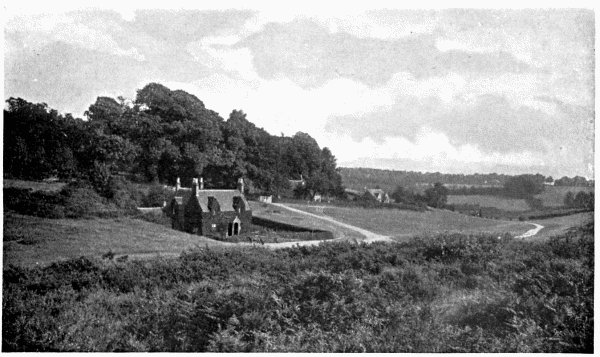
CHORLEY WOOD COMMON
Chorley Wood, a village 2½ miles N.W. from Rickmansworth, has a station on the Met.R. near the Amersham Road. The church, E.E. in style, dates from 1845, but was largely rebuilt in 1870. William Penn, the Quaker, was married here. There are many pretty walks through the Valley of the Chess, which flows between the village and Sarratt (q.v.).
Church End is a small hamlet in the parish of Albury, 3 miles E. from Braughing Station, G.E.R.
Clapgate, a hamlet on the river Ash, is close to Church End.
Clay End (1½ mile S.E. from Walkern) is about equidistant—5 miles—from Stevenage or Westmill Stations.
Clay Hill is on the high road between Bushey and Bushey Heath (q.v.).
Clothall (2¼ miles S.E. from Baldock) has an interesting church, chiefly Perp., on a gentle hill. There is a good brass in the chancel to John Vynter, first rector of the church (d. 1404), and one to John Wright, Master of Trinity College, Cambridge, also rector here (d. 1519). On the S. of the church is a small Dec. chantry chapel. Note also a sixteenth century brass to the wife and sixteen children of William Bramfield of Clothall. The Saxons are said to have called the spot Cley Hall, because it stood on a hill of clay. Clothall Bury is a little to the E.
Cockernhoe Green is 2½ miles S.W. from Offley, and 2½ miles N.E. from Luton Station (Beds).
Cockhampstead (2 miles N.E. from Braughing Station, G.E.R.) is near Albury Hall.
Codicote (3 miles N.W. from Welwyn Station, G.N.R.) is a large village on the Welwyn-Hitchin Road, with a pleasant heath a little W. The Church of St. Giles is an ancient structure, E.E., restored in 1853; it stands in a field ½ mile N. from the village. The S. chapel dates from 1312. The embattled W. tower is a fine structure. There are several memorial windows, comparatively modern.
Cole Green has a station on the G.N.R. branch line from Hatfield to Hertford. From the station little is to be seen except the Cowper’s Arms and a few cottages.
Coleman’s Green (1½ mile S.E. from Wheathampstead Station, G.N.R.) is prettily situated near the “Devil’s Dyke” and Brocket Hall. John Bunyan sometimes preached in a cottage here; a large chimney-stack, bearing an inscription, still marks the spot, unless quite recently removed.
Collier’s End is on high ground, on the Old North Road, 2 miles S.W. from Standon Station, G.E.R. It is a very typical English hamlet.
Colne, river. (See Introduction.)
Colney Heath (1 mile S. from Smallford Station, G.N.R.) is an ecclesiastical parish. The brick church (1844) is in Byzantine style; it has an apsidal chancel, and small N. porch and tower. The new West Herts County Asylum is close by.
Colney Street, on the main road from Radlett to St. Albans, forms an almost equilateral triangle with Park Street and Bricket Wood Stations, L.&N.W.R. It is only a few minutes’ walk from the pretty church at Frogmore (q.v.).
Common Moor may be visited from Croxley Green (¾ mile N.E. from Rickmansworth) for an inspection of its large paper mill.
Cooter’s End is a tiny hamlet close to the M.R. on the Bedfordshire border.
Corey’s Mill, a hamlet 1 mile N. from Stevenage Station, G.N.R., is named from an old mill, burnt in 1878.
Cottered (3 miles W. from Buntingford) has a fine old church (Perp.). There is a chapel on the N. side of the chancel erected by Edward Pulter; the W. tower is embattled and carries a lofty spire. Several memorials to the Pulter and Forester families are of the seventeenth century. The church was restored in 1886. In the days of William I. the vill of Chodrei belonged to Walchelin, Bishop of Winchester. Cottered Lordship, a farmhouse near the village, is one of the very oldest dwellings in the county. The writer is assured by an expert that the front door dates from 1450-80!
Cromer, a hamlet 5 miles S.W. from Buntingford, is prettily situated in a valley, in a purely agricultural district.
Cromer Hyde (1½ mile S. from Ayot Station, G.N.R.) consists of a farmhouse, the Chequer’s Inn, and a few old and picturesque cottages. The nearest church is ½ mile S.E. at the corner of Brocket Hall Park.
Croxley Green (¾ mile N.E. from Rickmansworth) is an ecclesiastical parish near the river Chess. The church, built fifty years ago, is late E.E. in style and has some good memorial windows.
Cuffley is a small hamlet about midway between Cheshunt and Potter’s Bar (Middlesex) Stations, but a little N. from the straight line. The Church of St. James at Goff’s Oak (q.v.) is 1 mile E.
Cumberlow Green is 4 miles N.W. from Buntingford.
Currants Bottom, on the Bucks border, is close to Chorley Wood Station, Met.R.
Dane End, or Munden Street, is 4 miles S.W. from Standon Station, G.E.R. The nearest church (½ mile N.) is at Little Munden.
Dane End, 4 miles S. from Royston, is close to the Old North Road. There are a few cottages and two farms.
Dassells is a hamlet on the Old North Road, 1 mile E. from Westmill Station, G.E.R. The little river Quin flows close by.
Datchworth (1½ mile S.E. from Knebworth Station, G.N.R.) has a church with some Norman portions. Its spire is conspicuous for miles round. The larger portion is, however, Dec. Note (1) some good stained glass windows in chancel; (2) chalice dated 1630. The church was restored in 1869-70. The place is very ancient; we read that four hides of land at Decewyrth were granted by an early Saxon king to the Monastery of St. Peter at Westminster, and that in the reign of Edward III. Thomas de la Mere, Abbot of St. Albans, transferred the patronage of this church to the king.
Dean End (¾ mile S. from Redbourn Station, M.R.) is a small hamlet.
Delamore End is ½ mile E. from Flamstead, and near the high road to Dunstable. The nearest railway station is Redbourn, 2½ miles S.E.
Digswell, a village on the river Maran, is ½ mile S.W. from Welwyn Station, G.N.R. Looking E. the visitor will notice the Great Northern Viaduct over the Maran Valley—a truly magnificent structure of forty arches. The church, beautifully situated on the hill, is E.E. It contains a large but much mutilated brass to John Perient, Master of the Horse to Joan of Navarre and Esquire to Richard II., Henry IV. and Henry V. This interesting inscription being much defaced I will transcribe from Chauncy: “Hic jacet Johannes Perient, Armiger pro corpore Regis Richardi Secundi, et Penerarius ejusdem Regis, et Armiger. Regis Henrici Quarti, et Armiger etiam Regis Henrici Quinti et Magister Equitum Johannæ, filiæ Regis Navarr, et Regiæ Angliæ qui obiit—et Johanna uxor ejus quondam capitalis Domicilla—quæ obiit 24 Aprilis Anno Dom. 1415.” Note also brasses (1) to John Perient, son of the above (d. 1442); (2) William Robert, auditor of the diocese of Winchester (d. 1484); (3) to a civilian, his wife, and ten children (circa 1530); (4) to Thomas Hoore, a mercer of London, his wife, and twelve children. The church was restored in 1872.
Digswell Water is a hamlet ½ mile E. from Digswell Church, and close to Welwyn Station.
Down Green is ½ mile W. from Wheathampstead Station, G.N.R.
Driver’s End, a hamlet 2 miles W. from Knebworth Station, G.N.R., is on the S.W. confines of Knebworth Park. One mile S. is the village of Codicote. The neighbourhood is very pleasant.
Dudswell, a few cottages on the Grand Junction Canal, is ½ mile N.W. from Northchurch village, and 2 miles N.W. from Berkhampstead Station, L.&N.W.R.
East End (1 mile S.E. from Cole Green Station, G.N.R.) is between Panshanger Park and the River Lea. There is also a hamlet of the same name on the Essex border, about 5 miles N.E. from Braughing Station, G.E.R.
Eastwick (1 mile N.W. from Burnt Mill Station, G.E.R.) is a parish near the Essex border, on the river Stort. The church, rebuilt in 1873, is in E.E. style. It is locally famous for its recumbent statue of a knight in chain armour, resting on a raised slab; the legs are crossed. There is neither date nor name; but it has been surmised (1) that the crossing of the legs shows that he was probably a crusader, (2) that the effigy dates from early in the thirteenth century and represents a member of the De Toni or De Ros family. The former conjecture is undoubtedly erroneous. There is a piscina in the chancel.
Elstree, formerly Idlestree, is a large village beautifully situated on the Middlesex border; the station (M.R.) is to the N.E. at Boreham Wood. At the N. end of the street a fine view stretches in the direction of Radlett and St. Albans. The Church of St. Nicholas was founded by the Benedictine monks of St. Albans in the fourteenth century; the present structure is Dec. and dates from 1853. The monuments are unimportant; but the wrought-iron chancel screen, designed by Sir A. W. Blomfield, is worthy of careful scrutiny, as is also the vestry screen of carved oak. The five-light E. window was presented by the pupil of a former rector, John Morris, D.D. (d. 1848), to whom it is a memorial. In the old churchyard, closed some years ago, was buried the notorious robber and reputed murderer William Weare, who was murdered by Thurtell on Gill’s Hill, 2½ miles N.W., in 1823. Here, too, was buried Martha Reay, whose life was a chronicle of crime; she was mistress to the Earl of Sandwich, and was killed on leaving Covent Garden Theatre, in 1779. There is excellent fishing to be had at Elstree Reservoir, a little W., in Aldenham parish. Some archæologists have thought that the Roman city Sulloniacæ occupied (approximately) the site on which Elstree stands, and Norden lent his authority to this hypothesis; but there is little doubt that Brockley Hill near Edgware more closely corresponds in position with the city mentioned in the Itinerary of Antoninus.
Epping Green, a hamlet 1 mile S.E. from Little Berkhampstead, is at the N. end of Punsborne Park. The nearest station is Cole Green (G.N.R.), nearly 4 miles N.W.
Essendon is a pretty village on rising ground overlooking the Valley of the Lea, 2 miles S. from Cole Green Station. The church, standing in the park, was rebuilt in 1883; it was probably founded as early as the twelfth century. It is now of flint, dressed with ancaster stone. Note (1) alabaster monument to William Priestly (d. 1664); (2) brass and effigy of William Tooke, auditor of the Court of Wards and Liveries (d. 1588); (3) shields from the tomb of Henry Courtenay, son of Henry, Marquess of Exeter; (4) chalice bearing date 1570, given to the church by Elizabeth Reynes; (5) Baskerville Bible presented by the First Marquess of Salisbury. During restoration several slabs to the Tooke family (1635-55) were discovered. Essendon Place (David Citroen, Esq.) is a fine house in a park of 100 acres; and Bedwell Park (C. G. Arbuthnot, Esq.) should be visited, by special permission, to view the Belvedere Collection, including one of Murillo’s many “Assumptions”.
Exnells, near the river Ash, is a small hamlet 2 miles N.E. from Hadham Station, G.E.R.
Fanham Hall is 1 mile N.E. from Ware.
Fisher’s Green (½ mile N.W. from Stevenage) is a small hamlet.
Flamstead (2½ miles N.W. from Redbourn Station, M.R.) lies on high ground near the river Ver. The name is a corruption of Verlamstead, the river having formerly been called the “Verlam”. The church is in the centre of the village; it is a large Dec. structure dating from the fourteenth century; the nave is of six bays, with fine octagonal pillars. The tower is very large and massive. Note (1) piscina in W. wall of vestry, once a chapel; (2) piscina in chancel; (3) finely carved oak chancel screen, dating from fifteenth century but restored in 1893; (4) mutilated altar-tomb in nave, carved and crocketted, but bearing no inscription, it is probably not later than 1400-20; (5) marble monument, with Ionic columns, to Thomas Saunders of Beechwood; (6) brass to John Oudeby, rector of the church (d. 1414); (7) effigy in armour to Sir Bartholomew Fouke, Kt., for many years Master of the Household to Queen Elizabeth (d. 1604). At Beechwood Park, so called because of the many fine beeches in the neighbourhood, was once a Benedictine Nunnery. The walk from Flamstead to Great Gaddesden, by way of Beechwood Park (about 6 miles), is very picturesque.
Flamstead Bury is 1 mile W. from Redbourn Station, M.R., and midway between the N. end of the village and a spot called Heaven’s Gate.
Flamstead End (1½ mile N.W. from Cheshunt Station, G.E.R.) is a considerable hamlet.
Flaunden (4 miles S.W. from Boxmoor Station, L.&N.W.R.) is a village and parish on the Bucks border, with the river Chess 1¼ mile S. The present church is modern, and local folk claim that it is the first built by the late Sir Gilbert Scott. The font, and a few tiles, etc., were brought here from the old church at Flaunden Bottom near Chenies, some ruins of which still remain. Chauncy tells us that Flaunden belonged to the manor of Hemel Hempstead, that it was granted to one Thomas Flaunden, who built a small church in the valley near the river (Chess) with a small tower of timber at the W. end. Spiritual offices were performed by a curate supplied from Hemel Hempstead, who served Bovingdon and Flaunden by turns as duty required.
Folly, The (a small hamlet 1 mile N.W. from Wheathampstead Station, G.N.R.), is passed on the way to Harpenden or Mackery End. A little farther W. is Batford Mill on the river Lea.
Frithsden (or Friesden), a hamlet 2 miles N.E. from Great Berkhampstead, stands in a beautiful district, with Ashridge Park to the N.W. The nearest church is at the pretty village of Nettleden (q.v.) ½ mile N.E. High Park Road, Evesden Wood, Marigold Wood, Holly Bush Wood and Frithsden copses are all adjacent and may be visited during an hour’s ramble.
Frogmore (¾ mile S.E. from Park Street Station, L.&N.W.R.) is a hamlet between the villages of Park Street and Colney Street. The church is modern, in late Norman style; it stands close to the high road from Radlett to St. Albans. There are several memorial windows to local persons. The village flower show has been held for many years in July, and is well patronised and widely known. The river Colne flows between this hamlet and Park Street Station.
Furneaux Pelham (4 miles N.E. from Braughing Station, G.E.R.) has an interesting E.E. and Perp. church. One of the six bells in the embattled W. tower dates from before the Reformation; it bears, in black-letter, the words “Sancta Katarina ora pro nobis”; upon the clock in the tower are the words: “Time flies. Mind your business.” Note (1) piscina and sedilia in chancel; (2) piscina in each aisle; (3) Newport Chapel adjoining S. aisle, built by the Robert Newport whose brass and effigy is in the nave (d. 1518); (4) brass (mutilated) in chapel, representing two figures, temp. Richard II.; (5) ambry (lancet headed) in chancel; (6) three ancient stone coffins, discovered during restoration, one bearing the words: “Simonis de Furneaux Filius”. The De Furneaux were a Norman family, to whom the village owes its name: Simon de Furneaux was lord of the manor in the reign of Edward I. Close to the church is Furneaux Pelham Hall (recently unoccupied), a fine Elizabethan mansion whose owners suffered several misfortunes during the civil wars.
Gaddesden, Great (3 miles N.W. from Hemel Hempstead), is a village on the river Gade at the foot of the hill that leads to Nettleden. The church is close to the river side, and immediately behind the Cock and Bottle Inn. It is an ancient structure of “Roman bricks” and flint (E.E.), believed to date from, say, 1290; the tower was rebuilt in 1862. There are many memorials to the Halsey family, but few others of any interest. Gaddesden Place, in a park ½ mile E., is the seat of Rt. Hon. T. F. Halsey, Esq., D.L., J.P. It was built from designs by Wyatt, in 1774, in an Italian style.
Gaddesden, Little (4 miles N. from Berkhampstead Station, L.&N.W.R.), is a straggling village on the confines of Ashridge Park. Pretty cottages and tastefully planned gardens meet the eye everywhere. The church is Perp. and contains many monuments to the Egerton family, Earls of Bridgewater: (1) Sir John Egerton, Kt. (d. 1649); (2) Lady Frances, Countess of Bridgewater (d. 1635); (3) John, Viscount Brackley, Lord of the Privy Council (d. 1686); (4) Elizabeth, Countess of Bridgewater, a “transcendently virtuous lady” of “beauty so unparallel’d that ’tis as much beyond the art of the most elegant pen, as it surpasseth the skill of several of the most exquisite pencils ... to describe and not disparage it” (d. 1663); (5) Ann, Lady Egerton (d. 1625); (6) Francis, third Duke of Bridgewater (d. 1803). The latter was styled the Father of British Inland Navigation; and the tall column near Ashridge Park, 1¾ mile W. from the church, was erected to his memory in 1832.
Gaddesden Green is practically one with the above, the marble cross and fountain to the memory of Lady Marian Alford (d. 1888) being between the village and the Green. Gaddesden Hoe is 2 miles E. from the S. end of the Green.
Gaddesden Row (3 miles N. from Hemel Hempstead Station, M.R.) is a straggling hamlet equidistant (about 2 miles) from Flamstead and Great Gaddesden.
Gade, river. (See Introduction.)
Gallows Hill (½ mile S. from King’s Langley Station, L.&N.W.R.) is a hamlet. The Booksellers’ Provident Retreat is here. It is also the name of a hill between Hertford and Ware, on which stands the Joint Isolation Hospital for the two towns.
Gannock Green is 2½ miles S. from Ashwell Station, G.N.R. The nearest church is at Sandon. Gannock Farm is ½ mile E.
Gardener’s End (3½ miles W. from Buntingford) is a hamlet in the parish of Ardeley.
Garston is 1¼ mile S.W. from Bricket Wood Station, L.&N.W.R.
Gibraltar, on the road from Harpenden to Luton, is on the Bedfordshire border, close to Luton Hoo Park and Station, G.N.R.
Gilston (2 miles N. from Burnt Hill Station (Essex) and about 2 miles S.E. from Widford village) is a scattered parish. Chauncy says it was probably waste ground at the time of the Conquest, as there is no mention of it in Domesday Book. The church was very probably erected by Geoffrey de Magnaville, who was Earl of Essex and Lord of the Manor of Sabriesword (Sawbridgeworth) during the reign of Stephen. It is E.E. and stands on the hill about ¼ mile N. from the Park. There is a fine double piscina in the chancel, and some heraldic glass in the windows, showing the coats of Astley, Bassett, Eastfield and Engayne. The monuments to the Gore family are numerous; amongst those buried in the church are (1) Sir John Gore, Kt. (d. 1659); he was twice sheriff of the county, and a member of Cromwell’s second Protectorate Parliament; (2) Dame Dorothy Gore (Kempe), second wife to the foregoing (d. 1645); (3) Dame Persis, wife to Sir Humphrey Gore, Kt. (d. 1665); (4) in churchyard, John, eldest son of the said Sir Humphrey (d. 1691). The Feathers, a fine old inn (circa 1680), still stands in this village; an excellent photograph of it was reproduced in the Home Counties Magazine (Oct. 1901). Gilston Park, beautiful but not very extensive, should be visited; for the mansion (A. S. Bowlby, Esq., M.A., J.P., etc.) stands near the site of New Place, successively the home of the Chauncys, Gores and Plumers. The house was enlarged and beautified by Sir Humphrey Gore, who was knighted at Whitehall in 1660. In 1701 it passed into the hands of Col. John Plumer, whose family is so well known to readers of the Essays of Elia. It was his grandson William (d. 1822) whom Lamb calls “a fine old Whig”. This William left no family, so the house at Gilston Park and his other house, the famous “Blakesmoor in H——shire” of Lamb’s essay, passed to his widow (and cousin) Jane Hamilton, a daughter of Hon. George Hamilton, Canon of Windsor.
Goff’s Oak (2½ miles W. from Cheshunt Station, G.E.R.) is a hamlet which owes its name to the fine oak, a part of which still stands near the Goff’s Oak Inn at the S. extremity of Cheshunt Common.
Gorhambury. (See St. Albans.)
Gosmore (2 miles S.W. from Hitchin Station, G.N.R.) is a small village. The nearest church is at Ippollitts (q.v.).
Gossoms End is on the road from Berkhampstead to Tring, ¼ mile S.E. from Northchurch.
Graveley (1½ mile N.E. from Stevenage Station, G.N.R.) is a village off the Great North Road. By walking from Stevenage towards Little Wymondley a pretty view over Graveley may be obtained from a gateway near some cottages on the right. The ancient church of brick and flint is late Norman with embattled tower; it was restored in 1886-7. The carved oak chancel-screen is ancient; there are windows of stained glass to the memory of local rectors. The present N. aisle was added during restoration. The manor of Graveley is of great antiquity; it was given by William I. to William, Earl of Ewe. Graveley is perhaps Saxon for “the Reeve’s land,” and Norden thinks the place took its name from a Reeve of the county in pre-Norman times. Near the village a beacon was employed “once upon a time” to give warning of the approach of enemies. One mile N. from the church is Jack’s Hill, once the haunt of a robber, “Jack o’ legs,” the hero of many a legend known in the district. His grave is shown in Weston churchyard, 2 miles E. from Jack’s Hill.
Gravesend (3½ miles N.E. from Braughing Station, G.E.R.) is a hamlet on the road from Little Hadham to Furneaux Pelham. Albury church is 1 mile S.
Green End is the name of three hamlets, (1) in the parish of Little Munden, about 4 miles W. from Standon Station; (2) in the parish of Sandon, about 4 miles N.W. from Buntingford Station (both stations G.E.R.); (3) ½ mile N. from Boxmoor Station, L.&N.W.R.
Green Street.—There are two hamlets of this name in Herts, (1) 2½ miles N.W. from Bishop’s Stortford; (2) 1½ mile N.E. from Boreham Wood Station (M.R.).
Green Tye is 1½ mile N.E. from Hadham Station, G.E.R.
Grub’s Barn (2 miles S.E. from Welwyn Station, G.N.R.) consists of a farmhouse and several cottages on open breezy ground between Hatfield and Tewin.
Grub’s Lane is near the outskirts of Hatfield Park, 3 miles S.E. from the town.
Gubblecot (3 miles N.W. from Tring) is near the Aylesbury Canal. The Tring reservoirs, famous for the rare waterfowl shot on those waters on many occasions, are a little to the S.
Gustard Wood (1 mile N. from Wheathampstead Station G.N.R.) may be visited for its golf links, of which there are few in the county.
Hadham (Great or Much) is an ancient village and parish near the river Ash. The station, G.E.R., is 1¼ mile S.W. We read that the Manor was given by King Edgar to the Bishops of London, several of whom have resided at the old manor house. Katherine, mother of Henry VI. and wife of Owen Tudor, gave birth to a son here, known as Edmund of Hadham. The church of St. Andrew, near the river, is E.E., dating from about 1300. It has been much altered and restored. The very fine S. porch is thought to be the work of Bishop Kemp (1459-89); the massive, embattled W. tower is probably by Bishop Braybroke (circa 1400). Note (1) floriated cross and inscription to Simon Flambard, Rector of Hadham Magna in 1331, and chaplain to Edward III.; (2) brass to one Alban, also rector here (d. 1372); (3) monument in chancel to Judith Aylmer, widow of John Aylmer, Bishop of London (d. 1618); (4) fourteenth-century glass in E. window, a memorial to Thomas Randolph, a recent rector; (5) three brasses in nave to members of the Newce family (1579-1610); (6) fine oak chancel screen; (7) two piscinæ in chancel. The old House, or Palace, dated from about 1400. Close to the village (S.W.) lies Moor Park, which readers or tourists must not confound with Moor Park, Rickmansworth (q.v.). The present mansion dates from about 1780; its predecessor was an Elizabethan structure, once the property of Sir John Gore, Kt. (see Gilston), and previously of Sir Garratt Harvey, in whose day Archbishop Usher was a guest at “Moore Place”. At Perry Green, 1 mile E. from Hadham Station, is a chapel-of-ease, in E.E. style, erected in 1853. Hadham Cross is beautifully situated in the valley, S. from the village and partly hidden among trees.
Hadham Ford (3 miles E. from Standon Station, G.E.R.) is on the river Ash, 1 mile S.W. from
Hadham (Little) formerly Hadham Parva. The parish enjoys considerable historic importance through its connection with the Capel family, Earls of Essex. The present earl owns large properties in the neighbourhood, and has the title of Baron of Hadham. The church stands between the village and the river, and is widely known for its fine S. porch of timber, which it possibly owes to the proximity of Essex, in which county such porches are comparatively common. The building is mostly E.E., probably late twelfth century, but the tower, embattled and pinnacled, is Perp. (circa 1380). Note (1) brass to Rd. Waren, a rector of Great Hadham (circa 1470); (2) brass to a knight, his wife and daughters (circa 1485); (3) Perp. chancel screen of oak; (4) on S. side of chancel, memorial stone to “Arthur Lord Capel, Baron of Hadham, who was murder’d for his loyalty to King Charles the First, March the 9th, 1648”. This was the Lord Capel whose heart was preserved in a silver box and given to Charles II. at the Restoration, the earl having wished his heart to be “buried with his master”. The chancel was restored by Sir A. W. Blomfield in 1885. Hadham Hall (½ mile E. from the church) is late Elizabethan, and has a magnificent corridor extending the entire length of the house (135 feet) with finely mullioned windows. Little Hadham Place (½ mile W. from the church) is prettily situated. The manor of Hadham Parva formed part of the revenue of Saxon Kings until King Edgar gave it to the monks of Ely.
Haileybury College (2 miles S.E. from Hertford) was founded at Hertford in 1805 as the training college of the East India Company. It is now one of our most famous public schools. The house, conspicuous from the S.E., stands on high ground, and commands beautiful views over the valley of the Lea, and, looking S.E., the neighbourhood of Epping Forest. Note (1) the noble chestnut avenue towards the W. entrance; (2) the great size of the quadrangle; (3) the beautifully decorated chapel (by A. W. Blomfield), surmounted by a lofty dome; (4) the library, containing some good portraits of former masters, one of which, Canon Bradby, was painted by Herkomer.
Hall’s Green (4 miles N.E. from Stevenage) is on the hillside, 1 mile S.E. from Weston church. A little farther S. note the fine view over Cromer and Cottered, with windmill to the left.
Hammond Street is between Cheshunt Common and Flamstead End. The nearest Station is Cheshunt, G.E.R., 2½ miles S.E.
Hammond’s End, on the outskirts of Rothamstead Park, is in the centre of the pleasant varied scenery between the M.R. and the St. Albans-Dunstable road. The nearest station is Redbourn, 1¼ mile S.W.
Handside (Upper and Lower) is the name of two hamlets in Lemsford parish, both near Brocket Hall Park. Hatfield (about 3 miles S.) is the nearest station, G.N.R.
Hare Street.—There are two places in the county bearing this name: (1) a small hamlet partly in Ardeley and partly in Cottered parish; (2) a large village on the Cambridge Road, 2 miles E. from Buntingford. The village has several quaint old cottages, and is by no means unpicturesque; but it contains little of historic importance. It affords, however, a good centre from which to visit several old and interesting churches (described elsewhere in these pages); Layston, Wyddial, Anstey, and Great and Little Hormead being all within a short walk.
Harmer Green (½ mile N.E. from Welwyn Station) is a small hamlet N. from the Maran Valley.
Harpenden is well worth a visit and may be easily reached from St. Pancras (24 miles), or from King’s Cross by changing at Hatfield. Visitors wishing to inspect the church, or to ramble through the large village, beautifully situated at the N. end of Harpenden Common, should be careful not to choose the day of the annual races, the Friday before Epsom week. The church was rebuilt (except the tower) in 1862, in E. Dec. style; prior to 1859 the old structure had been a chapel-of-ease to Wheathampstead (3 miles E.). It probably dated from say 1140 (temp. Stephen) and was originally cruciform and late Norman. The first tower is believed to have been destroyed by fire about 1470, after which the present W. tower was built. Many alterations were made during the seventeenth and eighteenth centuries; the original Norman clerestory, in particular, being superseded by one of Low Perp. Note (1) Norman font; (2) brass to William Cressye Esq. (d. 1558) and Grace (Johnson) his wife (d. 1571); (3) brass to William Annabull (d. 1456), and Isabella his wife. Chauncy quotes an inscription to one William Seabrooke (d. 1462) and Joanna his wife, which is of some interest from the fact that the name of Seabrooke is common to-day in this part of Herts; (4) E. window of stained Munich glass; (5) window in N. transept to the family of the late Sir J. B. Lawes of Rothamstead. Rothamstead (1 mile S.W.), formerly the seat of the above, is in a finely wooded park. Erected about 1470, it has been almost rebuilt at different times. From the grand entrance, under the clock tower, there is a fine view looking S. There is an annual Flower Show in the park. Harpenden Bury is 1 mile N.W. from Rothamstead, on the river Ver.
Hatching Green is a hamlet on Harpenden Common, 1 mile S.W. from the station, M.R.
HATFIELD may be visited by fast train from King’s Cross, G.N.R. (17 miles), the station being opposite the W. gates of the park. The older parts of the town lie on the western slope of a hill close to the railway; at the top stand the church and portions of the old palace, beyond which, in the park, stands the fine mansion of the Cecils. The town is of great antiquity; the Saxon Kings, who called it Heathfield (the Hetfelle of Domesday Book), owned the manor until it was given by Edgar to the monks of Ely. After Ely had been converted into a bishopric by Henry I., the bishops made Hatfield one of their several residences, which gave rise to its former name of Bishop’s Hatfield. Their palace became a royal home during the reign of Henry VIII., and was at one time occupied by his children Edward, Mary and Elizabeth. It was to this old palace that Elizabeth was brought from the Tower soon after her removal from Ashridge; whilst here she was in the custody of Sir Thomas Pope, who treated her with kindness not always shown even to royal prisoners. The story of her reception of the news that she was Queen, of her first Council, held here in the palace, and of her subsequent journey to London, has been too often narrated to need repetition. Immediately after her death James I. paid a visit to Theobalds Park, and had an interview with Sir Robert Cecil, a younger son of Lord Burleigh, whom he presently created first Earl of Salisbury. The exchange by the King of his manor of Hatfield for that of Theobalds has been mentioned in the Introduction (Section X). The King promised to build for Sir Robert a new house at Hatfield; the work was carried out on a magnificent scale, and was completed sometime in 1611. The new house stood a little E. from the old palace. To this house James paid an early visit; one of its most stately apartments is called “King James’s Room”.
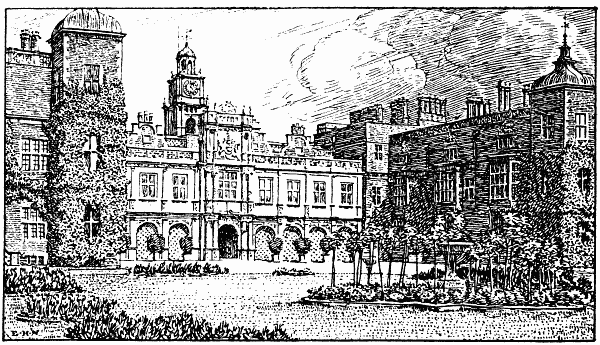
HATFIELD HOUSE
Hatfield House is still a fine example of early Jacobean architecture. To be appreciated it must certainly be seen: any adequate account of its architecture, its history and its treasures would fill such a volume as this. In shape it is a parallelogram, about 280 feet long by 70 feet wide, with two wings on the S. front. The centre between the two wings is Italian Renaissance in style; the central tower, pierced by the great gate, being of rich Elizabethan design. On the face of the third storey of the tower are the armorial bearings of the Earl of Salisbury. This S. front and the two wings enclose on three sides a quadrangle about 130 feet wide by 100 feet deep, beautifully laid out with flower beds and lawns. The extremities of each wing take the shape of square, three storeyed towers, surmounted by cupolas 20 feet high. Between the wings runs a basement arcade, of eight arches on Doric pilasters, four on each side of the gateway below the armorial bearings. The entire floor above the arcade is occupied by the long gallery, 160 feet by 20 feet, and 16 feet high. At the W. end of this gallery is the library, at the E. end is King James’s Room. The aspect of the house from the N. is not so imposing; but there is a noble view over the grounds from the N. terrace, and the central clock tower is a conspicuous object from the most distant spots in the park. The library, graced by Zucchero’s portrait of Robert, Earl of Salisbury, contains one of the most valuable collections of MSS. in the country, but the State Papers have recently been lodged in a room of greater security. A few of the treasures of these two rooms may be mentioned: (1) more than 12,000 autograph letters of the early Cecils; (2) the Diary of the “great Lord Burleigh”; (3) the forty-two articles of Edward VI. with his autograph attached; (4) a vellum MS. with miniature of Henry VII.; (5) the Norfolk correspondence; (6) the Council Book of Mary Tudor; (7) early MS. of the Chronicle of William of Malmesbury; (8) autograph MS. by Ascham.