DESCRIPTION OF PLACES IN HERTFORDSHIRE ARRANGED ALPHABETICALLY (continued 2)
Reading edition
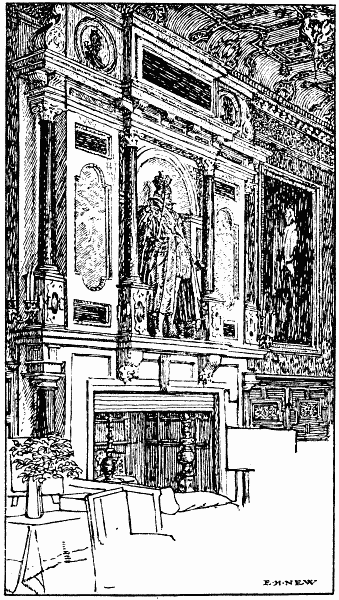
KING JAMES’S DRAWING-ROOM, HATFIELD HOUSE
King James’s Room has three fine oriel windows and is profusely decorated. The great chimney-piece of marble mosaic, 12 feet wide, is supported on black Doric columns, and surmounted by a statue in bronze of James. Note the costly candelabra and gilt-framed furniture.
The Grand Staircase is hung with portraits of many Cecils, by Lely, Vandyck, Kneller, Reynolds and other masters. Note the huge dimensions of the carved balustrade; the strange rustic figures portrayed thereon; and the lions grasping shields bearing heraldic devices. There are five landings.
Among other apartments the following should be visited: (1) The Chapel, with its fine Flemish windows representing scriptural stories, marble altar-piece, and open stalls; (2) the Winter Dining Room, looking out upon the N. terrace, about 30 feet square; this room contains many valuable pictures, including Wilkie’s Duke of Wellington, Van Somer’s James I. and Charles I., and Kneller’s Peter the Great; (3) Great Banqueting Hall; (4) Summer Dining Room, near the foot of the great staircase; the bust of Burleigh, in white marble, is above the door; (5) the Armoury, full of treasures “rich and rare,” suits of armour, relics of the Spanish Armada, various arms, etc. Other pictures in various parts of the house include (1) William III., and Lady Ranelagh, by Kneller; (2) half-length of Elizabeth with jewelled head-dress and grotesquely embroidered gown; Mildred Coke, mother of the first earl; Thomas Cecil, Earl of Exeter: all by Zucchero; (3) fine whole-length of Mary, first Marchioness of Salisbury, by Reynolds.
The Park is the largest in the county, being about 9 miles in circumference; it is undulating and beautifully wooded. There are some superb avenues. Of Queen Elizabeth’s oak, N.E. from the N. terrace, little is left saving a portion of trunk, railed round; but the Lion Oak, between the house and the great W. gates, still puts forth leaves in its season. The maze close to the house is only less famous than that at Hampton Court.
The Church of St. Ethelreda is cruciform, largely Dec. and one of the largest in the county. A Norman arch in the S. transept is thought to be a portion of the original structure. It was completely restored, indeed almost rebuilt, in 1872. The nave is 102 feet by 20 feet; the chancel about 40 feet by 20 feet. There are N. and S. porches; the former looks almost directly upon the great gate-house of the old palace. The most important among many features of interest is the—
Salisbury Chapel, N. side of chancel, from which it is divided by an arcade of three arches on Ionic granite columns. The whole is enclosed by beautifully designed iron gates, the work, probably, of an unknown Italian. Note the marble wainscotting, and the finely conceived and executed allegorical paintings and mosaics on walls and roof. At the E. side, on a slab of black marble supported by four kneeling figures in white marble (representing the cardinal virtues) lies the recumbent effigy of Sir Robert Cecil, first Earl of Salisbury, Lord High Treasurer of England (d. 1612). The effigy is in robes, with official staff in hand. Beneath the slab is a skeleton in white marble. Note also in this chapel mezzo-relievo effigy to William Curll, Esq. (d. 1617), with inscription, almost illegible, to the effect that he was a most Christian knight who died in hope of a joyful resurrection.
On the opposite (S.) side of the chancel is the Brockett Chapel, containing monuments to the Reades and Brocketts of Brocket Hall (see below). Among them note (1) two recumbent female figures, above them the arms of the Brockett family and beneath an inscription to Dame Elizabeth Brockett (d. 1612) and an epitaph to Dame Agnes Saunders (d. 1588); (2) medallion of a female by Rysbrack (1760); (3) bust of Sir James Reade, Bart. (d. 1701), and of Sir John Reade, Bart. (d. 1711); (4) helmet of Sir John Brockett on wall. There are piscinæ in the chancel and N. transept, both discovered during restoration. The reredos, alabaster and mosaic, has a fine crucifixion group, with SS. Alban and Etheldreda on either side, carved by Earp, who also carved the pulpit of Caen stone. Note the beautiful clustered shafts of marble on the font of Tisbury stone, the gift of the late Marchioness of Salisbury.
Three miles N.N.W. is Brocket Hall. The Great North Road skirts the park on the E. and the river Lea flows past the house from N.W. to S.E. The present edifice was designed by Paine for Sir Matthew Lamb, Bart., whose son, Sir Peniston Lamb, Bart., became Viscount Melbourne in 1780. By this nobleman the Prince Regent was sometimes entertained here, and here, as stated in the Introduction, Lord Palmerston died in 1865. The drawing-room and grand staircase have always been admired, but, as a whole, the house is large and stately rather than beautiful. Elizabeth is said to have visited here before she became Queen, and in the park, as at Hatfield, an oak is shown as the one under which she loved to sit. From the Hall the most charming walks may be taken in any direction; e.g., through the park S.E. to Lemsford Mill, or S.W. to Cromer Hyde, N.W. to Water End, or N.E. to Ayot Green. More charming still is the ramble—permission should be requested—beside the winding Lea towards Old Marford and Wheathampstead.
Hatfield Hyde (1¾ mile N.E. from Hatfield) is a hamlet in a pretty district, with the river Lea and Hatfield Park a little S.
Haultwick lies 3 miles W. from the Old North Road; it is a hamlet 1 mile N. from Little Munden. The nearest station is Braughing, G.E.R. (about 3½ miles E.), passing the S. side of Hamel’s Park.
Heavensgate (2 miles W. from Redbourn Station, M.R.) consists of a few cottages in the centre of a district of small hamlets. The walk (2 miles N.) to Flamstead through Trowley Bottom is pleasant.
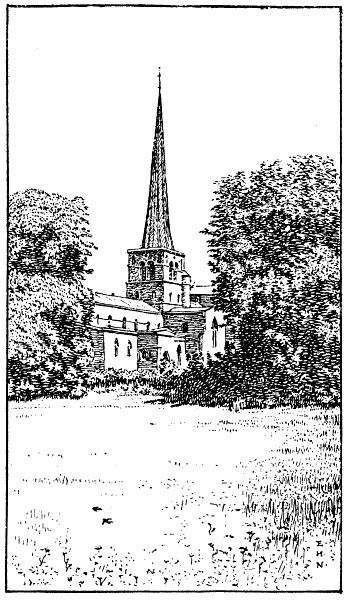
HEMEL HEMPSTEAD
HEMEL HEMPSTEAD.—Visitors from London should book to Boxmoor (L.&N.W.R.) and walk N.E. over the little common or take the motor-bus through Marlowes to the town (1½ mile). From St. Albans it is a pleasant walk by way of Gorhambury and the village of Leverstock Green; from Redbourn it is but a few minutes’ journey (M.R.). The town, until recently an old “Bailiwick,” is on a hill, with central market place, town hall and corn exchange. The church is very ancient; it is cruciform, of flint and clunch stone. The oldest portions can hardly be less than 750 years old; the nave, arcade and W. doorway are fine examples of the period. Note (1) groined roof and Dec. windows S. side of chancel; (2) transept roof, fourteenth century, restored in 1880; (3) nave roof, fifteenth century, restored 1885; (4) great height of octagonal, leaded spire, conspicuous for miles round (see illustration). Among monuments note (1) figured brass, representing an armed man, to Robert Albyn and Margaret his wife (1480); the inscription I transcribe from Chauncy:—
“Robert Albyn gist icy Et Margareta sa femme oubike luy Dieu de lez almes eyt mercy”;
(2) monument to Sir Astley Paston Cooper (d. 1841).
Hemel Hempstead, according to Norden, owed its name (Heanhamsted) to the high hemp-land on the E. side of the town. Offa, King of the Mercians, gave six houses at Hemelhamstede to the Abbey of St. Albans; but the remainder of the vill remained in the hands of Saxon Kings until it was given to Earl Moreton by William I. The entry in Domesday Book is in this case unusually interesting; the property held by Earl Moreton is thus described: “Earl Moreton held Hamelhamstede in Treung hundred, it was rated for 10 hides ... there are two Frenchmen born, with thirteen Bordars, ... there are eight Servants, and four Mills of seven and thirty Shillings and four Pence Rent by the Year, and three hundred Eels wanting five and twenty, Meadow four Carucates, Common of Pasture for the Cattle, and two Shillings Rent by the Year, Wood to feed one thousand and two hundred Hogs; in the whole value it is worth two and twenty Pounds, when he received it five and twenty Pounds, and Rent in the time of King Edward (the Confessor). Two were Brethren, Men of Earl Lewin, they held this mannor.” From Priory Hill, W. from the church, a fine view may be obtained of the town below and the cornfields beyond. Bury Mill is on the river Gade, at the foot of the hill. Gadesbridge Park is on the left as you pass from High Street to Piccott’s End; the House is on a beautifully wooded slope, W. from the Gade; it is the residence of Sir Astley Paston Paston Cooper, Bart., J.P., etc. A good deal of straw plait is still made by the women of this neighbourhood.
Heronsgate (3 miles W. from Rickmansworth) is a hamlet on the Bucks border, with a small chapel-of-ease to St. Peter’s, Mill End, 1¼ mile E. The building is modern, with one window of stained glass.
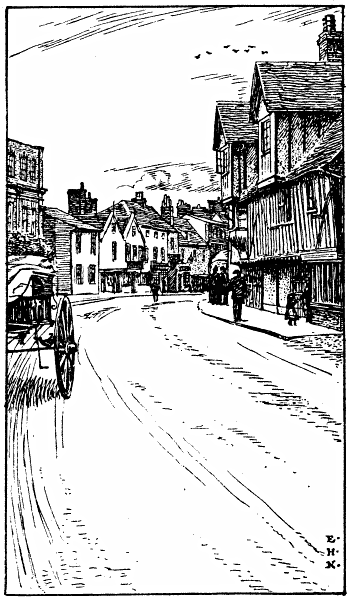
HERTFORD
HERTFORD, the county town, is of immemorial antiquity. The origin of the name has elicited much learned conjecture, and Hertford is one of several places held to be the Durocobrivis mentioned by Antonine. It is the Herudsford (i.e. red ford) of the Venerable Bede. That it was a town of some importance on the river Lea even in the days of the Trinobantes seems indisputable. Norden conjectured that the true name of the town was Hartford, so called because in Saxon times, when the surrounding country was densely wooded, the harts crossed the river by a natural ford at this spot. However this may be, the old borough seal, three or four centuries ago, bore as a device a hart in shallow water. The rivers Rib, Beane, and Maran all unite with the Lea in the immediate neighbourhood. Some reference may be here made to the doings of Alfred the Great in this neighbourhood. By putting together what is recorded by William of Malmesbury, Henry of Huntingdon, Asser and others we learn that in the twenty-third year of Alfred’s reign the Danes infested the Thames with their ships, sailed up the Lea in the lighter of their crafts, and built a fort about 20 miles from London, at or near what is now the town of Ware. Presently, in the course of their many foraging excursions, they sailed farther up the river towards Hertford, stripped the people in the town and burnt down many houses. They afterwards established a garrison near the town. Alfred brought his army down to the river side the following year and made a careful survey of the Danish fort and of the character and position of their ships. He is said to have passed from place to place in a boat, drawn by a horse, and to have carefully ascertained the depth of the water at different points. The precise nature of his subsequent operations is not well known, but he is said to have diverted the course of the river, to have erected a dam (Shass) at Blackwall, and by these means to have grounded the Danish fleet. The Danes held a treaty, and eventually withdrew into Cambridgeshire and Gloucestershire; the Londoners came down to the scene of Alfred’s ingenuity and destroyed or appropriated the Danish ships.
Of the castle, built by Edward the Elder in 905, there still remain several large fragments of an embattled wall, partly Norman, and a postern gate. Of its history only a few leading facts can be mentioned here. William I. entrusted it to the keeping of Peter de Valoignes; it was besieged by Louis the Dauphin, and capitulated on the Feast of St. Nicholas in 1216; it was granted, together with the town, to John of Gaunt, Earl of Richmond, in whose time Kings John of France and David of Scotland were prisoners within its walls, and after the Earl had been created Duke of Lancaster he held a court in the castle for three weeks. It was the last prison house of Isabella, widow of Edward II. Henry IV. gave the castle to his wife Joan; Henry V. to his wife Katherine of France; and Henry VI. to his wife Margaret of Anjou. Elizabeth and James I. are both said to have visited this castle. Charles I., on 3rd May, in the sixth year of his reign, transferred it to William Earl of Salisbury. It was seized by the Parliament during the Great Rebellion.
The Roman Catholic Church in St. John Street stands on or near the site of the old Priory, founded during the reign of William I. by Ralph Limesy and by him conveyed to the Abbot of St. Albans, who placed here six Benedictine monks under Ralph, who became their first prior. The Priory was dissolved in the twenty-sixth year of Henry VIII.; but the church was rebuilt by Thomas Willis in 1629. It was “demolisht by order of the Bishop of Lincoln” towards the end of the seventeenth century. The church of All Saints, on high ground E. from the town, was destroyed by fire in 1891, when almost everything perished. It was immediately rebuilt as a Perp. structure of Runcorn stone, and consecrated in 1895. In the main, the plan of the old church has been followed, but the aisles are longer than formerly; note the fine clerestoried nave of five bays, and hexagonal N. porch. The old building contained monuments to Sir John Harrison, Kt., Farmer of Customs to Charles I. (d. 1669);[4] to Isabel Newmarch, maid of honour to Isabella, daughter of Charles VI. of France and second wife to Richard II.; and to Johannes Prest, “porter” (janitor) to Katherine, wife of Henry V. The two latter monuments were removed more than 200 years ago. Note the beautiful chestnut trees in the avenue near the church, and the many quaint epitaphs on the tombstones in the extensive graveyard. The Church of St. Andrew is modern; it occupies the site of an older Perp. edifice, originally founded before the Conquest. Close by in the market place is the Shire Hall, a large brick building of “questionable shape” erected towards the close of the eighteenth century. Malting, brewing and general trade in corn and its products form the larger part of the industries of Hertford. Between this town and Ware is the spot where Cromwell put a summary period to the insurrection of the “Levellers” by shooting a ringleader named Arnald.
Hertford Heath. (See Amwell, Little.)
Hertingfordbury may be visited from Hertford, the station (G.N.R.) being 1½ mile S.W. The village is pleasantly situated on the river Maran, on the S. confines of Panshanger Park. The church, partly rebuilt by Earl Cowper in 1890-3, was founded during the fifteenth century. It contains little of architectural interest, but the monuments are numerous: (1) marble mosaic altar tomb to Sir W. Harrington, with alabaster effigies of himself and wife and inscription in rhyme; (2) slab to Thomas Ellis (d. 1608) and Grace his wife (d. 1612); (3) recumbent effigy in marble to Lady Calvert, wife of Sir George Calvert, Kt., who died in 1622; (4) to Dr. Jonathan Browne, Dean of Hertford (d. 1643); (5) very ancient brass inscription beneath chancel arch to two daughters of Robert de Louthe, and one of similar age to Robert de Louthe and his wife. The Cowper Chapel, N. side of chancel, contains many monuments to that family, particularly a fine alto-relievo by Roubeliac to Spencer Cowper (d. 1727), chief Justice of Chester in 1717.
Hexton (about 6 miles N.W. from Hitchin Station, G.N.R.) lies on a tongue of the county surrounded W., N. and E. by Bedfordshire. The Church of St. Faith, W. from the village, was rebuilt, with the exception of the embattled tower, in 1824, as a Perp. edifice. The St. Nicholas Chapel, N. side of chancel, takes the place of the chapel bearing the same name in the former church. There is a memorial to Peter Taverner (d. 1601), who was, I suppose, father to that Francis Taverner, Esq., who compiled a record of the antiquities of Hexton and set it in the chapel. Little space can be spared for excerpts in this volume, but the details which Taverner brought together are so interesting that I transcribe a part of them from a copy in my possession:—
“Near unto the Roman military Way called Icknild or Ikenild-Street, which passeth by this Parish upon a very high Hill is to be seen a warlike Fort of great Strength, and ancient Works, which seemeth to have been a Summer standing Camp of the Romans: And near it on the Top of another Hill called Wayting-Hill, a Hillock was raised up, such as the Romans were wont to rear for Souldiers slain, wherein many Bones have been found. The Saxons call’d this Fort Ravensburgh, from a City in Germany, whereof the Duke of Saxony beareth the Title of Lord at this Day. And this Town, which the Britains perhaps call’d Hesk of Reed, which doth abound much in this Place; the Sazons call’d Heckstanes-Tune, that is the Town of Reed and Stones, if not rather Hockstanes-Tune, that is, the Town of Mire and Stones, for old Englishmen, call deep Mire, Hocks: Or may be from Grates set in Rivers or Waters before Floodgates, which are call’d Hecks; neither is it unlikely but that the Danes made some Use of this Fort, for a Parcel of Ground near thereunto is called Dane-Furlong to this Day. Some of these Conjectures may be true, but this is certain, that Offa, a Saxon King, of the Mertians about 795, founded the Monastery of St. Albans, in Memory of St. Alban, and that Sexi an honourable and devout Dane (as it is in the Chartulary of the Abby) about Anno Dom. 1030, gave to the said Monastery the Town of Heckstane-Tune and the Abbot of St. Albans held this Mannor in the time of King William the Conqueror.
“This Vill at that time did lie in the Half-hundred of Hiz, and from that time during the Space of 510 Years, the Abbots of St. Albans were Lords of the Mannors now call’d Hexton. They were also Patrons of this Church (dedicated to St. Faith, which Saint had her Statue erected over a Fountain near this Church Yard, call’d St. Faith’s Well) for John de Hertford, the 23d Abbot, did appropriate this Church of Hexstoneston to the said Monastery. The Cellarers of which Monastery kept the Court Leet and the Court Baron, and received the Rents of the Demeasnes and Customary Tenants of this Mannor; and the Sacrists had the disposing of the Profits of the Rectory.
“The said Fort, which the common People call Ravensborough Castle, is cast up in the Form of an Oval, and containeth sixteen Acres, one Rood, and fifteen Poles of Ground, and is naturally strengthened with mighty deep and very steep Combs, which the inhabitants call Lyn.
“The Town of Hexton is seated at the Foot of the Mountains, whence issue many Springs of Water; the Mountains are a continued Rock of Stone.”
High Cross (3 miles N. from Ware) is a village and parish on the Old North Road. It has a modern Dec. church of grey stone, containing several good stained-glass windows, but little of architectural interest. Youngsbury, a beautiful but small park, S. from the village, has a fine Georgian residence (C. B. Giles-Puller, Esq.). The little river Rib skirts the park on the S. side. There is a small hamlet of the same name 1¼ mile S.W. from Radlett Station (M.R.).
High Street is a small hamlet on the Cambridge Road, near the river Quin. Braughing Station (G.E.R.) is 1¼ mile S.
High Wych (2 miles N. from Harlow Station, Essex) has an E.E. church, built in 1861; the marble reredos, finely worked, was added in 1871. The trade in malt is large for so small a place.
Highley Hill (1 mile S.W. from Ashwell Station, G.N.R.) is on the Cambridgeshire border.
Hinxworth, formerly Hamsteworde and Henxworth (4 miles N. from Baldock), is close to the Bedfordshire border. The parish is very ancient. The church of St. Nicholas was erected about 1400 on the site of an earlier structure. It is a mixture of several styles, partly restored in 1881. Note (1) two canopied Perp. niches in S.E. angle of nave, where was formerly the lady-chapel; (2) brass to John Lambard, a master of the Mercers’ Company (d. 1487), and Anne his wife; (3) oak roof in chancel, added in 1892; (4) rood-stairs. William I. divided the vill between three Normans, Peter de Valoignes, Hardwin de Scalers, and William Earl of Ewe, who owned much other property in Hertfordshire. The vill was subsequently divided into two manors, one of which belonged to William de Cantilupe, a Steward and Councillor to King John, and the other, during the reign of Henry VII., to John Lambard mentioned above. This manor was called Pulter; and the old house (now Hinxworth Place, ½ mile S. from the village) was once inhabited by some Cistercian monks of the Monastery of Pipewell (Northants). Note the clunch walls and mullioned windows, in one of which, designed in stained glass, are the armorial bearings of three former owners. Two hundred years ago the village consisted of thirty-five dwellings, three of which were almshouses.
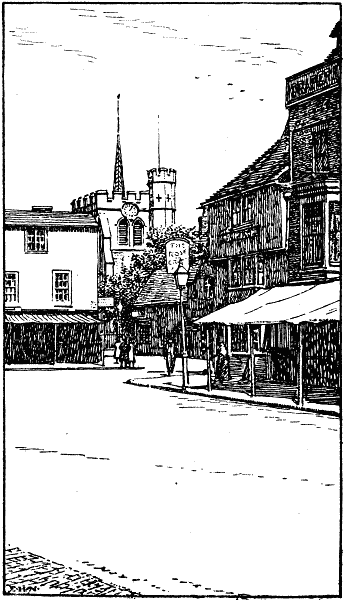
HITCHIN
HITCHIN is an ancient town, full of interest, 32 miles N. from King’s Cross, G.N.R. It was formerly called Hitche, very probably from the little river Hiz, which rises at Well Head, about 1½ mile S.W. from the centre of the town. Roman coins and pottery, and even prehistoric implements have been found in great quantities in the neighbourhood, and there are traces of a prehistoric lake bed, to the S.E. The Priory, immediately S. (R. H. J. Delmé-Radcliffe, Esq., J.P.), occupies the site of a Carmelite monastery and Conventual church founded in the reign of Edward II.; and the Biggin Almshouses, close to the church, still preserve some of the old fabric of the Gilbertine Nunnery, founded in the reign of Edward III. The Church of St. Mary (formerly St. Andrew), just off the N.E. corner of the market-place, is thought to be the largest parish church in the county, the other claimant for that honour being St. Peters, Great Berkhampstead. The whole structure is embattled. The square W. tower is of unusual size, but low in proportion. Entering by the fine old S. porch we notice the niches for statues, none of which remain, and the vaulted roof, badly battered and marred by—as is supposed—the zealous iconoclasts of Cromwell’s army. Opposite, over the N. porch, hangs a painting of the Adoration of the Magi, believed to be by Rubens; it was formerly over the communion table. The church has been restored at intervals since 1858; but the fine Perp. aisle-roofs still remain. The font, of Ketton stone, is ancient, and formerly had statues of the twelve Apostles in niches; these, however, have been mutilated almost beyond recognition; the beautiful oak canopy is new. Note the effigy in stone lying in the recess of the first window of the N. aisle, believed to be that of Bernard de Baliol, founder of the Preceptory of Knights Templars at Temple Dinsley (3 miles S.), and the mosaics of the reredos, representing the Last Supper, Christ and the woman of Samaria, Moses striking the rock, and other subjects from Scripture. The screens of carved oak, between the aisles and chancel aisles, are among the finest in the county. Memorials are numerous; some ancient brasses having been brought to light during restoration. Among the brasses are one (1) to John Beel, Margary his wife, and their eight children (1477); this is near the pulpit; (2) to James Hert, B.D. (d. 1498); (3) to John Pulter, a draper (d. 1421), and his wife Alice, the effigies almost obliterated; (4) to Nicholas Mattok, and his wife Elizabeth (d. 1485); this Nicholas was a fishmonger of London, and a merchant of the staple of Calais; (5) portion of a brass, near the chancel steps, to John Sperehawke, D.D., Canon of Wells (d. 1474).
Adjoining the W. end of the churchyard is Golden Square, once the residence of Eugene Aram, from which we may pass into Bancroft, one of the widest thoroughfares in the county. Close by is Tilehouse Street; the Baptist Chapel, on the left, some way up the street, was restored in 1894: it stands on the site of the building in which Bunyan preached; a chair which he gave is still shown in the vestry. It may here be mentioned that George Whitefield and George Fox are both known to have visited Hitchin during their missionary wanderings. A little farther W. is Mount Pleasant, thought to be the birthplace of George Chapman, the translator of Homer. That he finished his translation in this neighbourhood is matter of knowledge; but what is told of his family connections with Hitchin is little more than conjecture.
Between the town and the station, G.N.R., stands a modern church of red brick, dressed with Bath stone, E. Dec. in style. There are good oak stalls and a sedile in the chancel.
Hitchin was noted during the sixteenth century for its trade in wood and malt. There were at one time tan-yards beside the Hiz, and the buckle-makers of Bucklersbury gave that street its name. The malting-yards occupied much of the ground on both sides of Bancroft. The making of lavender water in the town is referred to in the Introduction.
Hockeril is now the E. suburb of Bishop’s Stortford, the bridge over the Stort, near the Old Black Lion, connecting it with the town. It has a modern Gothic church. The E. extremity of Hockeril is almost on the border line between Hertfordshire and Essex.
HODDESDON (1½ mile N. from Broxbourne Station, G.E.R.) is an ancient market town, lying on high ground among beautifully diversified surroundings. It is known, at least by name, to all readers of The Complete Angler; but the old Thatched House, to which Izaak Walton often resorted, has long been a thing of the past. The Bull Inn still remains where it stood in the time of Prior, whose allusion to it in his Down Hall is invariably quoted in local handbooks:
“Into an old inn did this equipage roll, At a town they call Hod’sdon, the sign of the Bull, Near a nymph with an urn that divides the highway, And into a puddle throws mother of tea”.
The stone figure to which Prior refers is no longer to be seen. At the S. end of the High Street, on the right when entering the town from Broxbourne, stands Rawdon House, an embattled Jacobean mansion of red brick, built by Sir Marmaduke Rawdon in 1622. It was restored in 1877, and the stucco with which it was formerly coated was removed. A tower, with cupola roof, is at the rear of the house, which is now a convent for Augustinian nuns.
The Church of St. Catherine, close to the site of the old Thatched House, but W. from the opposite side of the High Street, dates from 1732; the tower was added in 1888. It is a large building of red-brick, in mixed styles, with small windows of stained glass in the chancel. It is not interesting.
Hollesmore End (2 miles W. from Redbourn Station, M.R.) is a small hamlet.
Holwell is a village and parish transferred from Bedfordshire to Hertfordshire in 1897. It is about 1½ mile N.E. from Pirton (q.v.); the nearest station is Henlow, M.R., 2 miles N. The Church of St. Peter, very much restored, was originally Perp. There is a xii century holy water basin, and a very curious old brass to Robert Wodehouse, a priest (1515), with figures of two wodehowses (wild forest men) and of a chalice and paten.
Hook’s Cross (2 miles E. from Knebworth Station, G.N.R.) is a hamlet on the main road from Hertford to Stevenage. Frogmore Hall stands in a small park ½ mile E.; it is a large modern mansion of red brick and stone facings. The grounds are very picturesque, and are divided by the river Beane.
Hormead, Great (2½ miles E. from Buntingford), has a restored fifteenth century church, perhaps 1400-20, containing a brass to a benefactor, one William Delawood (1694) and a mural monument to Lieut.-Col. Stables, killed at Waterloo. The village is close to the river Quin, which flows between the church and Hare Street on the Cambridge Road.
Hormead, Little (½ mile S. from the above), has a quaint little Norman and E.E. church on the hill crest overlooking Hare Street. Leaving the Cambridge Road at the S. end of that village, and crossing the river Quin, the rounded arch of the Norman doorway on the N. side of the nave catches the eye as we approach the village. The door itself is partly of wrought iron work, seventeenth century; an engraving of it is in Cussans’ History of Hertfordshire. There is excellently preserved work in the Norman nave. It has been surmised that “Hormede” was formerly one vill, that it was divided soon after 1100, and the two churches built on the hill less than ½ mile apart. Ralph Baugiard and Eustace, Earl of Boulogne, together held the manor of “Hormede” at the time of the Great Survey, and the names Hormead Magna and Hormead Parva are of later origin.
Horse Shoes (½ a mile N. from Smallford Station, G.N.R.) is a hamlet in the parish of Colney Heath.
Howe Green, a small hamlet, is 1¼ mile S. from Cole Green Station, G.N.R. Pretty walks may be taken S. to Bedwell Park, or N.W. to the mill on the Lea, Rye Croft, and Mill Green.
Hunsdon (2 miles N.E. from Roydon Station, Essex) is a very ancient village. The E. Perp. church of flint is thought to date from 1400, and the N. porch of oak is probably coeval with the main structure. Note the finely carved Jacobean screen which divides the Cary Chapel in the S. transept from the nave, and, in the chapel, the imposing monument and alabaster effigies to Sir John Cary (d. 1617) and his wife. The monument is built into the wall; behind it is a rather long, but historically important inscription:—“Here resteth in Peace Sir John Cary, Knight, Baron of Hunsdon (being the fourth Son to the Right Honorable Henry Baron of Hunsdon) and the Lady Mary Hunsdon his Wife, Daughter to Leonard Hide of Throcking in the county of Hertford, Esq.; The Said Sir John Cary was sent to Barwick by the late Queen Elizabeth of Famous Memory, in the Year of our Lord, 1593, to be Marshall of the Town of Barwick, and Captain of Norham; afterwards he was made Governor of the said Town and Garrison of Barwick, and Lord Warden of the East Marches of England,... Scotland, and so he remained until he returned into England with the most famous King James, where he entered into the Possession of the Crown of England; and so having two Sons and two Daughters ended this transitory Life, in an assured Hope to rise again in Christ.” In the chancel windows are some white roses, and a badge of the House of York; note also the canopies in these windows, and the figures of Apostles in the W. window. On the N. wall of nave is a fine brass to James Gray, showing a man shooting at deer with a crossbow; this Gray was gamekeeper for thirty-five years at Hunsdon House. Bishop Ridley preached from the pulpit on several occasions.
Hunsdon House stands between the church and Gilston Park. During the reign of Edward IV., Sir John Oldhall “built here a fair House after the mode of a Castle ... which building, ’tis said, cost £7,222”. This would be an enormous sum of money in those days. The original structure had a high tower and large courtyard. Henry VIII. made the house a palace, and in so doing appears to have almost rebuilt it; it is known that his children were often here, as the King had a high opinion of Hertfordshire air. Queen Elizabeth gave the estate to Sir Henry Cary, Kt., her cousin, and created him Baron Hunsdon. The “palace” was surrounded by a moat, crossed by two bridges; the grand entrance and lofty clock tower, the outhouses and grounds are elaborately depicted in a print in Chauncy’s History. The present house was erected at the beginning of this century, partly on a fresh site, but some portions of what was the W. extremity of the old palace are built into the E. wing. Two fine Jacobean chimney-pieces still remain; but little else is left of the old Tudor home, and the moat has been levelled. The present house, however, is an imposing, even noble structure of red brick, and its position, backed by the grand old elms in the park, is very picturesque. N.E. stood Hunsdon Lodge, the hunting lodge of Queen Elizabeth.
Hunton Bridge is a pleasant little village at the meeting of the roads from Watford, King’s Langley, and St. Albans, on the Grand Junction Canal. The nearest station is King’s Langley (L.&N.W.R.), 1¼ mile N. There is a good modern inn and many pretty cottages, and folk in search of rest and quiet might journey farther and find less suitable retirement. The nearest church is at Langleybury (q.v.).
Ickleford, formerly Ickleton, is a village on the Roman Icknield Way, which at this spot fords the little river Hiz; hence its name. It is 2 miles N. from Hitchin. The church was restored in 1860; but portions of the ancient fabric have been carefully retained, and a small chapel added to the chancel. The tower is Norman, as are also part of the nave arcade and the S. doorway. The chancel arch, pointed, is finely carved; the stairs to the rood-loft still remain; there is a piscina in the chancel. Note brass to Thomas Somer and his wife (circa 1400). S. from the church is Ickleford Manor, in a small park, for some years the residence of Commander H. C. Dudley Ryder, R.N. It is not of historic interest.
Ippollitts or St. Ippolitts (2 miles S.E. from Hitchin) was formerly called Hippolits, Eppalets or Pallets, according to the taste of the speaker. It was thought by Norden to owe its name to Hippolits, a supposed Saint, who was very skilful in the treatment of horses. After the Saint’s death a shrine was placed to his honour in the parish church, and to this shrine near the high altar divers persons brought their ailing steeds to be healed by the attendant priest with the help of relics of the Saint. The relics were of efficacy commensurate with the gifts of those who desired the Saint’s blessing! “The horses,” says one writer, “were brought out of the North Street, through the North Gate, and the North Door of the Church, which was boarded on purpose to bring up the horses to the Altar.” The church was restored in 1878; it is of flint and rubble, and is now chiefly Perp. and Dec. with a few older portions. Note (1) ambry and double piscina in the chancel; (2) brass in N. transept to Robert Poydres (d. 1401); (3) brasses in chancel, with effigies, to the Hughes family, one of whom, Alice, was daughter of Thomas Bybsworth, “an ancient dweller in this parish”; she died 1594. There is a tumulus about 1 mile S.
Kelshall (2½ miles S.E. from Ashwell Station, G.N.R.) has a restored, but interesting church, dedicated to St. Faith, partly Perp. and partly Dec. Over the S. porch is a small chamber, and in the N. aisle is a recess, the nature of which is not quite understood, but it was probably used for the safe-keeping of banner-staves, crosses and other pre-Reformation ornaments. There is a brass with two effigies to “Rychard Adane and Maryon his Wyff” (d. 1400 and 1435 respectively). In the churchyard is an old sundial on the shaft of a stone cross. John Janeway, a young divine of astonishing spirituality, whose Life, by his brother James, was subsequently prefaced by Robert Hall, was buried here in 1657: Richard Baxter was one of his admirers. The Manor of Chelesell was the property of the Abbot of Ely at the time of the Conquest, having been given to that ancient foundation by the father of Edward the Confessor.
Kensworth was transferred to Bedfordshire in 1897.
Kimpton (about 2¾ miles N. from Wheathampstead Station) lies between the hills that lead N. to Whitwell and S.E. to Ayot St. Lawrence. The village is very ancient, and was called Kimeton in Saxon days. The church, a little N. from the centre of the village, has been much restored: the N. aisle was added in 1861; the tower and the N. porch (over which is a parvise, as at Kelshall) were restored in 1887-8; the chancel in 1890, when the reredos was added. The building is E.E. Note the finely carved oak screen separating the S. aisle from the Dacre Chapel, formerly the rood screen, the piscina in the chapel itself, and the stained glass in the E. window to Thomas, twenty-second Baron Dacre (d. 1890), to whom the reredos is also a memorial. Kimpton Hoo, in a beautiful park of about 250 acres, is 1 mile N.E. from the village. It is the seat of Viscount Hampden. Pretty walks may be taken E. viâ Kimpton Mill to Codicote, N. to Bendish and Whitwell, W. to Peter’s Green, or S. to Lamer Park.
King’s Langley is a large and interesting village. The river Gade flows between the main street and the station, L.&N.W.R. Paper and straw plait are both made largely. The village owes its name to the fact that Henry III. built a palace on a spot still marked by a few fragments of ruin a little W. from the church, and the royal manor became known as Langley Regis, whereas the Langley on the E. side of the river belonged to the Abbey of St. Albans, and was called Abbot’s Langley (q.v.). Edmund de Langley, fifth son of Edward III., was born in this palace in 1344. He became Duke of York, Earl of Cambridge and Lord Tivedale, and married Isabel, a younger daughter of Don Pedro of Castile. In 1392 Richard II., with his first Queen, Anne of Bohemia, and many bishops, earls, lords and ladies, kept Christmas at King’s Langley Palace.
Near the palace was founded, by one Roger Helle, a priory of Dominican monks, which was enriched by Edward II. and several successive monarchs. The body of Piers Gaveston was brought from Oxford and buried in the church of this priory in 1315—he was beheaded on Blacklow Hill in 1312—and what was then believed to be the body of Richard II. was brought to the same spot in 1400 for temporary sepulture. The priory was dissolved, like most priories, in the days of Henry VIII.; but it was restored by Mary. It was finally suppressed soon after the accession of Elizabeth. The church, at the S.E. extremity of the village street, is a Perp. structure of flint and Totternhoe stone; the W. tower is embattled and has an angle turret. It has been partially restored. On the N. side of the chancel stood formerly the tomb of Edmund de Langley and Isabel of Castile (both mentioned above) which was brought from the priory church at the Dissolution; it is now in the chapel at the end of the N. aisle. There is, I believe, no absolute proof that this is the tomb of Edmund and Isabel, but the evidence that it is so is very strong. Chauncy, two centuries back, wrote: “On the north side of the chancel there is a Monument raised about five foot, with the Arms of France and England, with three Labels upon it, also the Arms of Peter, King of Castile and Leons, by which Coats it seems to be the Tomb where Edmond de Langley, the Fifth Son of Edward III. and Isabel his Wife, one of the Daughters of Don Pedro, King of Castile, was [were] interr’d”. During the removal of the tomb to its present position the bones of a male and two females were discovered; they are presumably those of Edmund and Isabel, and of Anne Mortimer, the wife of Edmund’s second son, Richard, Earl of Cambridge. The tomb is covered by a slab 7 feet 3 inches long; the sides are embossed with Plantagenet shields within cusps. Note the beautifully carved open screen between chapel and chancel, and the reredos, partly of marble, erected in 1877. The oaken pulpit is Perp. There are several other monuments: (1) to Hon. Sir W. Glascocke of Aldamhowe, Kt., Admiralty Judge in Ireland under Charles II. (d. 1688); (2) brass to John Carter, “late of Gifres” (d. 1588); the inscription states that he had two wives, that the first bore him four sons and five daughters and the second five sons and four daughters; (3) brass to William Carter and Alice his wife, 1528.
Sir John Evans, in 1862, found an almond-shaped river-drift flint implement on a heap of stones in this neighbourhood.
King’s Walden (about 5 miles S.W. from Hitchin) has an ancient church, carefully restored in 1868. It stands in the park of The Bury, a large mansion, Elizabethan in style. The embattled tower has masonry probably older than fourteenth century, and much of the nave arcade is Norman. Note the sculptured capitals of pillars, curiously similar to those at Old Shoreham. The chancel arch is E. Perp.; probably substituting its E.E. predecessor on very close lines; the corbels bear busts thought to resemble Henry VI. and Margaret of Anjou. In the chancel are a double piscina, and two E.E. lancet windows. The chancel screen is a really wonderful piece of work, in excellent preservation. In the N. aisle is an ambry, and in the S. aisle a sedile and two piscinæ, and on the N. side another ambry. The font stands at the E. end of S. aisle, formerly the Chapel of the Virgin Mary.
Kinsbourne Green is on the Bedfordshire border, 2 miles N.E. from Harpenden. The Kennels of the Hertfordshire Hunt are here. The hamlet is close to Luton Hoo Park.
Kitter’s Green is a hamlet 1 mile S.E. from King’s Langley Station (L.&N.W.R.). Abbot’s Langley old church (q.v.) is ½ mile N.
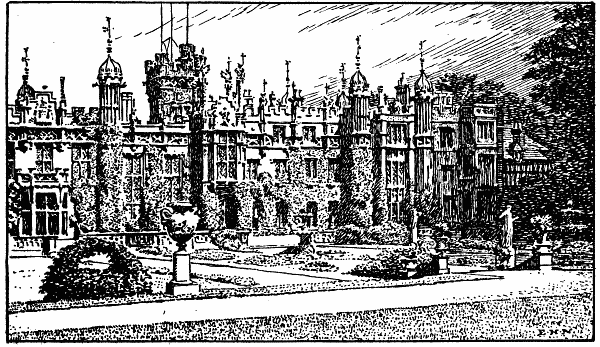
KNEBWORTH PARK
KNEBWORTH, famous as the home of Bulwer Lytton, lies on high ground 1 mile W. from the station (G.N.R.). The village is small, and in itself of little interest; it was formerly called Chenepeworde, and Knebbeworth. It is, however, ancient, and was valued in Domesday Book.
Sir Thomas Bouchier, K.G., who fought for the Earl of Richmond at Bosworth Field, sold the manor of Knebbeworth to Robert Lytton, Esq., Keeper of the Wardrobe to Henry VII., whose son William was buried in this parish. This Sir Robert began to erect a huge Tudor mansion on the site of a fortress which had stood since the days of the Conquest; it took several generations to complete it. The present house is the result of the work of demolition and reconstruction in the days of the novelist’s mother, and of the enlarging of 1883, when the S. wing and entrance were added; it is pseudo-Gothic. The castellated parapet, cupola-topped turrets, griffins upon pinnacles and many mullioned windows are noticeable features from the grounds. Within, the finest sight is the grand old banqueting hall, with its gallery for minstrels, its Elizabethan oak-screen, and wainscots by Inigo Jones. Around, on all sides, are suits of armour, some dating from the days of Henry VII. The room is associated with memories of Elizabeth, who was sometimes entertained at Knebworth by Sir Rowland Lytton, whom she knighted; he was buried in the chancel of the little church in the park (see below) in 1582. The room in which Elizabeth slept on these occasions is still shown as “Queen Elizabeth’s Chamber,” and contains a finely carved over-mantel (oak) and an oaken bedstead of colossal proportions. Among the distinguished guests so often entertained here by Bulwer Lytton were Dickens, Forster and Jerrold.
The grounds are nearly perfect, art and nature seaming to strive to out-do one another. Well-kept lawns are figured by flower-beds of all shapes and sizes; the rosery is very large; the great variety of evergreens imparts every hue and shade to the extensive walks stretching W. from the house. The lawns are divided here and there by stone balustrades and overlooked by statues of classical and modern figures. There are many nooks, pleasure houses and alcoves. A long avenue of limes leads to the lake.
The church, a little N. from the house, is approached through lodge gates. It is for the most part E.E. The oaken pulpit is octagonal; the finely carved panels represent scenes in the life of Christ, one of them bears the date 1567. At the N. side of the chancel, which has a piscina, is the Lytton Chapel, “a little Chapel or Burying Place, built by the Family of the Lyttons”. Among the members of the family buried in the chapel were (1) Dame Judith Barrington, daughter of Sir Rowland Lytton, and wife to Sir Thomas Barrington of Hatfield Broad Oak (d. 1657); (2) Sir William Lytton, Kt. (d. 1660); (3) Sir Rowland Lytton, Kt. (d. 1674). To the Sir Rowland Lytton who died in 1582 (see above) there is a fine brass with effigy, which also commemorates his wives Margaret and Anne, and his three children. There are other memorials both in the church and Lytton Chapel, among which note (1) brass to Simon Bache, Treasurer of the Household to Henry V. and Canon of St. Paul’s (d. 1414); (2) brass to John Hotoft, who filled the same office in the Household of Henry VI. (d. circa 1430). This brass formerly showed effigies of Hotoft in armour with his wife beside him. Note also, near the S. porch, two headstones with interesting inscriptions to servants of the Lytton family, and close by, in the park, the mausoleum erected by the mother of the novelist, who was buried within its walls. The epitaph to her memory on the exterior was written by her son. Passing out at the lodge gates we may turn left and reach a pretty dip, from whence a walk of 3 miles N. over open country leads to Stevenage.
Knebworth Green skirts the S. side of the park.
Langley, a hamlet on the Hatfield-Hitchin road, is 2 miles S.W. from Stevenage Station (G.N.R.). Langley Bottom is a few minutes’ walk N.
Langleybury (1 mile S. from King’s Langley Station, L.&N.W.R.) is practically part and parcel of Hunton Bridge, the church standing W. and the village E. of the main road from Watford to Hemel Hempstead. The church is modern, a Gothic structure; on the S. is a good lich-gate. Close to the S. porch is the large cross of Sicilian marble, by the Florentine sculptor Romanelli, to the memory of the late W. J. Loyd, at whose expense the church was erected. The walk from Langleybury to Buck’s Hill (W.), by way of West Wood, leads through some lovely bits of scenery, and should on no account be omitted. At the outset the confines of Grove Park are on the left and the road dips up and down as the woods are passed, and is shaded by fine beeches in many spots.
Layston was a village in Saxon times, but nothing now remains save the ruins of the church, still almost intact, at the meeting of two lanes, 1 mile N.E. from Buntingford. It is a flint structure, E.E. and Perp. The S. porch is in part demolished. There are monuments to the Crowch family of seventeenth and eighteenth centuries.
Lea, river. (See Introduction, Section II.)
Leavesden (about 2½ miles N. from Watford) is a village in the pretty district between Grove Park and Bricket Wood. The ecclesiastical parish was formed seventy years ago from the parishes of Watford and St. Albans. The huge brick building on high ground a little N. is the Metropolitan District Asylum for Idiots; it was erected in 1869. The church dates only from the formation of the parish and is situated at Garston, 1 mile E. It was designed by Sir Gilbert Scott and is E.E. The Grove, a large mansion of red brick, was erected in 1760 by one of the Villiers family, but has been restored and altered. The house contains a part of the pictures collected by Clarendon; comprising portraits by Vandyck, Lely, C. Janssens, Zucchero, Van Somer, Kneller, Hogarth, etc. The park is extensive and beautiful.
Lemsford is another modern ecclesiastical parish, formed sixty years ago. It is nearly 3 miles N. from Hatfield, on the S.E. side of Brocket Hall Park. It is widely known for its large mill on the river Lea. The church, erected in 1859 as a memorial to the sixth Earl Cowper, is E.E. and Dec., with a good E. window, also to the memory of the earl. The tower (W.) is lofty and embattled.
Letchmore Heath (1½ mile S.W. from Radlett Station, M.R.) is a small village.
Letchworth (2 miles N.E. from Hitchin) has a small Perp. church, containing a curious old brass to Thomas Wyrley, an early Rector (d. 1475). The effigy represents him with a heart in his hands. Another brass, much defaced, dates from circa 1400; it is to William Overbury and Isabel his wife. The village, which almost adjoins that of Willian (q.v.), is ancient, and was once the property of Robert Gernon, a Norman warrior who fought at Hastings. There was a church at Leceworth at least as early as temp. Henry I., for during the reign of that monarch it was given “with all its appurtenances and twelve acres of land” to the monastery at St. Albans. Letchworth Hall, now a manor house containing some good carved oak, was built by Sir William Lytton (circa 1620), and still bears on the S. front the arms of that family.
Letty Green is close to Cole Green Station, G.N.R.
Levens Green (1 mile S. from Great Munden) has a tiny chapel-of-ease erected in 1893. The nearest station is Standon, G.E.R., 2½ miles E., between which and the hamlet lies the Old North Road.
Leverstock Green (1½ mile S.E. from Hemel Hempstead Station, M.R.) is in a pleasantly diversified district, at the junction of the roads from St. Albans and Abbot’s Langley. It has a modern church, Gothic in style, erected just before the district was constituted an ecclesiastical parish in 1850.
Ley Green is a hamlet 1 mile N. from King’s Walden Church, and about 4 miles S.W. from Hitchin. It is on high ground.
Lilley, a village on the Bedfordshire border, is 4 miles N.E. from Luton (Beds). It was formerly called Lindley, and Lilly Hoo, and the old manor, like so many others, was given to a Norman (Goisfride de Bech) for services rendered at Hastings. The church is of ancient foundation, but was rebuilt, in E. Dec. style, in 1870-71. Several old memorials are still preserved, notably those to the Docwra family, early seventeenth century. Putteridge Bury (1 mile S.) is in the centre of a park of 450 acres; on or near the site of the house built by Thomas Docwra, J.P. and High Sheriff of Herts, who died there in 1602. The present mansion dates from the beginning of last century.
Little Heath is on the Middlesex border, 1 mile N.E. from Potter’s Bar Station. The Dec. church, just off the Barnet-Hatfield road, is new.
London Colney, a village on the main road from Barnet to St. Albans, is on the river Colne. The nearest station is that of the G.N.R. at St. Albans, 2¼ miles N.W. The church, built by the third Earl of Hardwicke in 1825, is a plain brick structure of Gothic character. Half a mile E. is Tittenhanger Park, a large brick mansion with tiled roof and dormer windows, built by Sir Henry Blount in 1654. The manor had belonged to the Abbots of St. Albans, who had a residence on the same spot, commenced during the abbacy of John de la Moote and completed during that of John Wheathampsted. Henry VIII. and Catherine of Arragon stayed here during the “sweatinge sicknesse” (1528).
Long Lane is a hamlet near the river Chess, 1½ mile S.W. from Rickmansworth.
Long Marston, 1 mile N. from the Aylesbury Canal, is a village and ecclesiastical parish in the extreme W. of the county. The nearest station is Marston Gate, 1 mile N. The old church, a small Dec. structure, was pulled down twenty years ago with the exception of the tower, which stands in the disused graveyard. The new building, adjoining the present burial ground, is Gothic, and contains some portions of the old structure, and its two piscinæ.
Lower Green. (See Tewin.)
Ludwick Hyde is in the parish of Hatfield, 3 miles N.E. from that town.
Luffenhall, a little hamlet, is in the hollow between Weston and Cottered, 5 miles W. from Buntingford Station. The district is one of winding lanes and field footpaths so characteristic of the county.
Lye End, 2 miles S. from Sandon Church, is a hamlet lying W. from the Buntingford-Royston road.
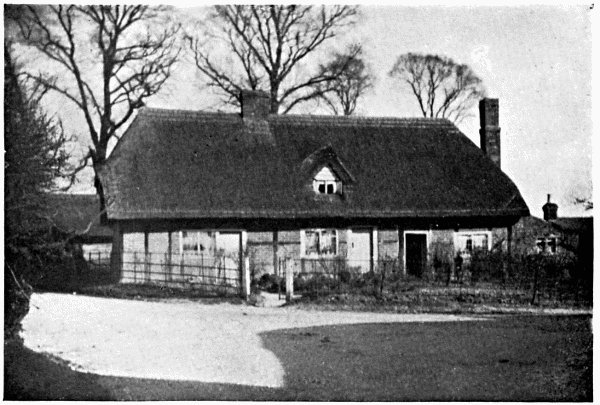
OLD COTTAGES NEAR MACKERY END
Mackery End, 1½ mile N.W. from Wheathampstead Station, G.N.R., is close to Batford and Pickford mills on the river Lea. Charles and Mary Lamb had talked about the place “all their lives” and the essay by the former entitled “Mackery End in Hertfordshire” need only be named here. The place, as Lamb mentions, was also called Mackarel End. John Wheathampsted, who became thirty-third Abbot of St. Albans in 1420, was the son of Hugh Bostok or Bostock of the village from which he took his name; his mother was the daughter of Thomas Makery, “Lord of Makeyrend”.
Mangrove is a hamlet, partly in Offley and partly in Lilley parishes; Mangrove Green is on the S. outskirts of Putteridge Bury Park, on the Bedfordshire border. The nearest station to the latter is Luton (Beds).
Maple Cross, a hamlet 2½ miles S.W. from Rickmansworth, is near the river Chess. It lies between Mill End and West Hyde, on the road to Uxbridge.
Maran, or Mimram, river. (See Introduction.)
Marford, Old and New, are hamlets on the river Lea. The latter adjoins the E. side of Wheathampstead village; the former lies ¼ mile farther E.; the cress-beds, the hand-bridge over the river, and some dilapidated cottages render it a picturesque spot. On the opposite side of the road from Hatfield to Wheathampstead lies The Devil’s Dyke, a long, narrow gorge most beautifully wooded. It is a favourite haunt of the nightingale, as the writer can testify.
Market or Markyate Street (3½ miles S.W. from Luton, Beds) is a village on the high road from St. Albans to Dunstable. The church, a little N. from the village, in Cell Park, is small and uninteresting, with a chancel added in 1892. The mansion called Markyate Cell, a little farther N., is old, and occupies the site of the old Benedictine nunnery built by Geoffrey de Gorham, sixteenth Abbot of St. Albans, at the instigation of Roger the Monk, the church of which was consecrated in 1145. Cowper the poet was at school in the village, at the house of Dr. Pitman.
Marlowes is a suburb of Hemel Hempstead (q.v.).
Marsh Moor lies between Hatfield Park and Mimms Park. It is a hamlet in the parish of North Mimms, 2 miles S. from Hatfield.
Marston Gate is little more than the station (L.&N.W.R.) for Long Marston, 1 mile S. It is nearly the extreme W. point of the county.
Mayden Croft, or Maiden Croft, is near the source of the river Hiz, with the hamlet of Gosmore adjoining (S.E.). Some remains of a moat may be traced, which are supposed to mark the site of a nunnery. The manor is ancient; in the time of Edward III. it belonged to Sir Robert Nevill, Kt.
Meesdon (6½ miles N.E. from Buntingford) has a very ancient flint church, probably erected in the thirteenth century, but restored in 1877. The S. porch is Jacobean. The pavement of the Sacrarium is a mosaic of many coloured, vitrified tiles; it is almost unique in the county and is undoubtedly of great age. There is also in the chancel a curious monument and inscription to Robert Young, gent. (d. 1626). Most of the population are to be found at Meesdon Green, ½ mile W. from the church.
On Metley Hill, between the Icknield Way and the village of Wallington, may be seen Bush Barrow, one of the many ancient mounds in the county concerning which so little is known.
Micklefield Green (½ mile E. from Sarratt Church) is near the river Chess and the Bucks border. The nearest station is Chorley Wood (Met. R.) 2 miles S.W. The district is varied and undulating.
Mill End (1 mile S.W. from Rickmansworth) is on the Middlesex border, close to the river Colne. The church (modern) is late Dec. in style, and has several good stained windows. The village and parish were only formed in 1875. There is also a hamlet of this name 1½ mile S.W. from Buckland, on the Royston road.
Mill Green, at the N. end of Hatfield Park, is a pretty hamlet on the Lea, near the old paper mill.
Mimms, North (3 miles N.W. from Potter’s Bar Station, G.N.R.), is in one of the prettiest districts in the county, although so close to Middlesex. The church and parsonage are in the park, ½ mile from the village. Dedicated to St. Mary the Virgin, the church is Dec., unusually pure in style. It is said to have been built by Sir Hugh de Magneville (temp. Stephen); I should think it more probable that Geoffrey de Magneville, then Lord of the Manor, was the real founder, as stated by Chauncy. However this may be, the structure is now almost wholly of later date. The monuments and brasses are numerous and very interesting; several of the latter, now in the chancel, were moved from their original positions on the floor during the restoration sixty years ago. Among them we may note (1) large black marble monument in chancel surmounted by a figure of justice, to John Lord Somers, Baron of Evesham (d. 1716); (2) altar tomb in N. aisle, with Elizabethan effigy, to a Derbyshire family named Beresford; the inscription is only in part decipherable; (3) mutilated brass to Sir Robert Knolles (d. 14—), and to Elizabeth his wife (d. 1458); (4) brass to Sir Henry Covert (d. 1488); (5) fine old brass to Richard Boteler and Martha (Olyff) his wife (circa 1560); (6) brass, probably of Flemish workmanship, thought to be a memorial to William Kesteven, vicar (d. 1361). This effigy is closely described in Murray. “It is apparently Flemish, and resembles in style that of Abbot de la Mare at St. Albans. He is vested in a chasuble and stole, has a chalice on his breast, and over him is a rich canopy, with, on the dexter side, St. Peter, and underneath SS. John the Evangelist and Bartholomew, and in corresponding places on the sinister SS. Paul, James the Great, and Andrew, with their respective emblems. Above is the Almighty holding the soul of the deceased; at the sides are two angels swinging censers.” Separated from the chancel by an oaken screen is the chantry-chapel of St. Catherine, dating from early fourteenth century.
North Mimms Park surrounds the fine Jacobean manor house of red brick, recently in part restored, but originally built about 1600 by Sir Ralph Coningsby; it is very extensive and can show some good carving, and a chimney-piece dating from sixteenth century. E. from this park is Potterels, a modern house standing in another but smaller park, and E. again from Potterels is the more famous Brookman’s Park, where, in 1682, Andrew Fountaine erected the mansion soon afterwards purchased by the great Lord Somers who died here in 1716. The house was completely burnt down thirty years ago and has only in part been rebuilt. The further stretch of park adjoining Brookman’s on the S. is Gubbins, or more correctly Gobions, where formerly stood the old manor house in which Sir Thomas More lived awhile with his family. The walks in each of these parks are very fine, and most beautifully wooded; they command distant views in many directions, and, in the autumn, are a perfect study in colour. No London cyclist should fail to visit this picturesque and interesting neighbourhood.
Mimms, South, recently included in the administrative county of Herts, has a restored, E. Perp. church, with fine massive W. tower. The Frowyk chantry, at E. end of N. aisle, contains a very ancient tomb with recumbent effigy of a knight in armour, under a richly designed canopy. The knight was a Frowyk, and there are also some mutilated brasses to this family. The village is prettily situated on rising ground, 1½ mile W. from Potter’s Bar Station, G.N.R. (Middlesex).
Moneybury Hill is on the Bucks border, close to the Bridgewater Column, 2 miles S.W. from Tring Station.
Moor Green (3 miles W. from Buntingford Station, G.E.R.) is a hamlet in Ardeley parish.
Morrell Green is a hamlet 2 miles E. from Barkway on the Essex border. The nearest station is Buntingford, nearly 6 miles S.E.
Mortgrove, on the Beds border, is little more than a modern house, 1½ mile S. from Hexton.
Munches Green lies in the centre of that quiet district of villages and hamlets which stretches between the G.N.R. and G.E.R. It is a hamlet a little S.E. from Ardeley Bury and nearly 4 miles W. from Westmill Station, G.E.R.
Munden, Great, formerly Mundon Furnival, from Gerrard de Furnival, who was Lord of the Manor in the time of Richard I., is a village 2 miles W. from Braughing Station, G.E.R. There is a Norman doorway on the N. side of the church, and a small Perp. reredos which was discovered during restoration in 1865. There is a brass in the chancel to John Lightfoot, Canon of Ely (d. 1675). The hamlet of Nasty, a little N.E. from the church, now takes Munden Furnival as its alternative name, but the older historians give that title to the district around the parish church.
Munden, Little, or Munden Frewell, is 2¼ miles S.W. from the above, and 4 miles W. from Standon Station, G.E.R. The church, conspicuously placed on the hill, dates from the thirteenth century; it was restored in 1866-68. It is a structure of many parts, consisting of nave of three bays, chancel, N. chapel, N. aisle, N. and S. porches, and W. tower. Note the two altar tombs beneath the chancel arcade, at the S. side of the chapel, each supporting the stone effigies of a male and female, presumably man and wife. They bear no inscriptions, but from the arms and shields figured on one of them it is conjectured to be the tomb of Sir John Thornbury, Kt., and his lady; whilst the other is probably that of his son Philip Thornbury and his wife: the former dates from about 1340-50. Early in the fourteenth century the manor belonged to a Knight named Frewell or de Freville, hence the old adjunct of the village. Rowney Abbey, now a modern mansion, takes its name from Rowenea Priory, founded by Conan, Duke of Brittany, about 1164, and occupied for several generations by a Benedictine prioress and nuns. At Munden Street, or Dane End, ¼ mile S. from Little Munden, were formerly two or three large tumuli, long since levelled.
Nash Mills, on the river Gade, is a hamlet in the parish of Apsley End, 2 miles S. from Hemel Hempstead. The House was the seat of Sir John Evans, K.C.B., F.R.S., etc., the great archæologist, who had a rich collection of coins, prehistoric flints, implements, etc., some of which were discovered in the neighbourhood.
Nettleden was formerly in Bucks, but was transferred to Herts a few years ago. The village is beautifully situated at the foot of a wooded hill, at the meeting of the roads from Great Gaddesden and Little Gaddesden. The small parish church is a Perp. structure of stone, with a N. porch; it was partly rebuilt by the last Duke of Bridgewater, and was restored in 1887. Note the carved oak pulpit, which, like that in Little Gaddesden Church, was the gift of Lady Marian Alford (d. 1888). Sir John Cotton, Vice-Chamberlain to Edward VI., was buried here. The nearest station is Berkhampstead, L.&N.W.R., 2½ miles S.W.
New Mill is 1 mile N. from Tring, between the hamlets of Little Tring and Tring Grove. The famous reservoirs, often the resting-place of rare water-fowl, are within a short walk.
Newgate Street, a small hamlet in Hatfield parish, is, however, 6 miles S.E. from that town. It is in a prettily wooded district, close to Ponsbourne Park.
Newnham (2½ miles N. from Baldock) is a village lying on high ground, with an E.E. battlemented church on a little knoll above a brook. It consists of chancel, nave of four bays with clerestory, S. aisle and porch, and W. tower. The interior can show little of interest, but there are brasses, (1) on chancel floor, to Sir William Dyer, Bart. (d. 1680); (2) to a family, the man in civic costume (circa 1490); (3) to Joan, wife of James Dowman (d. 1607), and her eight children.
Newsell, a hamlet 1 mile N. from Barkway, lies a little W. from the Cambridge Road. The nearest station is Royston, G.N.R., 3½ miles N.W. Newsell Park is a modern mansion S. from the hamlet.
No Man’s Land is a large tract of common, partly covered by furze, stretching left from the road between Sandridge and Wheathampstead. Some years ago a farmer close by collected quite a museum of stuffed birds, etc., shot in the neighbourhood, which many persons visited, but I understand the collection is now dispersed.
In 1884 Sir John Evans showed to Mr. W. G. Smith “a good white ovate palæolithic implement,” one of two found on No Man’s Land Common. In December, 1886, Mr. Smith visited the gravel pits there and found a somewhat similar implement in situ; this latter is engraved in his Man the Primæval Savage. At the same time Mr. Smith found two neolithic celts on the common.
Nobland Green (1¼ mile N.W. from Widford Station, G.E.R.) is little more than a farm and a few cottages.
Northaw (2 miles E. from Potter’s Bar Station, G.N.R.) is a village on the Middlesex border, near the source of the river Colne, and a place of considerable interest. In the wood N. from the village there lived a hermit named Sigar, the subject of some monkish legends. He lived about the time of Henry I., and was buried beside Roger the Monk (see Markyate Street) in the S. aisle of the Baptistery of St. Alban’s Abbey. There was originally a small church close to the village, E.E. or perhaps late Norman; this was replaced by the cruciform church of St. Thomas Becket, a pseudo-Perp. structure, destroyed by fire in 1881; the present cruciform building of Ancaster stone is Dec. with a conspicuous W. tower carrying four pinnacles. Note the piscina, three sedilia and credence table in chancel; also the finely carved font of Ancaster stone, on marble pillars, presented by the children of the parish. There are several memorial windows, of only local interest; but the pulpit and reredos are both good, the former showing the four Evangelists in canopied recesses. Unfortunately, only a portion of the old registers were saved from the fire of 1881.
Northchurch, or Berkhampstead St. Mary, forms one long street with Great Berkhampstead, but is a separate village, 1 mile W. from Berkhampstead Station, L.&N.W.R. The cruciform church is Dec.; it stands in a small graveyard close to the high road to Tring. The most curious memorial is the brass near the porch to Peter the Wild Boy, who was found wild in a forest in Hanover in 1725 and brought to England at the desire of Queen Caroline. He lived at a farm at Broadway (q.v.) and died in 1785. There is also a curious sentence about this church in Chauncy: “Henry Axtil, a rich Man starved himself, and was buried here April 12, 1625, 1 Car. I.” The church was entirely restored in 1883, when the present N. aisle was added.
Northfield, a small hamlet, is a little S. from Ivinghoe (Bucks).
Norton, near the tiny river Ivel and the Roman Icknield Way, is 1 mile W. from Baldock. The large building on the hill-top close by is the Three Counties Asylum. The manor belonged to the Abbot of St. Albans at the time of the Conquest; and in the year 1260 Roger de Norton, who took his name from this village, became the twenty-fourth abbot of that monastery. The church, E.E., is of great antiquity, some parts of it having been little altered; it is of flint, and stands at the N.E. end of the village. It contains two or three old memorials, but none of historic interest. A pretty walk from the church leads through Norton Bury and beside the Ivel to Radwell Mill.
Norton Green, between Knebworth Park and Stevenage, is ½ mile W. from the Great North Road. It is a small hamlet.
Nup End (1½ mile W. from Knebworth Station, G.N.R.) is almost one with Knebworth Green. Codicote church is 1 mile S.W.
Nuthampstead (about 5 miles N.E. from Buntingford Station, G.E.R.) is a large hamlet on the Essex border. The parish churches of Barkway (W.), Anstey (S.W.), and Meesdon (S.E.) may all be reached within a short walk.
Offley or Offley St. Leger (3 miles S.W. from Hitchin) is a village at the meeting of the ways from Hitchin, Temple Dinsley, and Lilley. It owes its name to Offa, King of the Mercians, who had a palace here, as we learn from his life by Matthew Paris, and its adjunct to the St. Legiers, who became Lords of the Manor soon after the Conquest. Miss Hester Salusbury, who became Mrs. Thrale, and afterwards Mrs. Piozzi, used as a child to visit at Offley Place, in the park close to the church. The old mansion was built by Sir Richard Spencer in 1600, and in part rebuilt early last century, when its style was changed from Jacobean to a form of Gothic.
The church (restored Perp.) stands in the park, close to the road. Note (1) monument in chancel to Sir H. Penrice, Kt. (d. 1752); a figure of Truth standing on a sarcophagus of black marble, the whole finely executed; (2) monument in white marble, by Nollekens, to Sir Thomas Salusbury, Kt. (d. 1773), and Sarah his wife (d. 1804); (3) brass with effigy, to John Samwell (d. 1529), and his wives Elizabeth and Joan; (4) brass to a civilian and his family (circa 1530); (5) well carved Perp. font.
Offley, Little, is a hamlet 1¼ mile N.W. from the above.
Offley Green is 4 miles N.W. from Buntingford Station, G.E.R. The walk beside Julians Park to Rushden, 1 mile S.W., is very pleasant.
Offley Holes (2½ miles S.W. from Hitchin) is a small hamlet. Offley Grange, Offley Hoo, Offley Cross and Offley Bottom are all in the immediate neighbourhood, W. and N.W.
Old Hall Green (1½ mile W. from Standon Station, G.E.R.) lies W. from the Old North Road. It is a small hamlet.
Oxhey (2 miles S. from Watford) is a hamlet on the Middlesex border. It has a good modern church, E.E. in style. N. lies Oxhey Place, on the site of the old home of the Heydon family, rebuilt by Sir William Bucknall in 1668, and again by Hon. William Bucknall in 1799. The chapel, close to the old mansions, was spared by both those renovators, but has since been repeatedly restored. It contains many interesting monuments, conspicuous among which is that on the S. wall to Sir James Altham (d. 1617) who had built the chapel on the site of an earlier structure in 1612. The old judge is represented kneeling in his robes between two pillars, beneath a canopy of alabaster; behind him is the effigy of his third wife Helen (Saunderson). Note the carved oak seventeenth century reredos, occupying the whole of the E. end of the chapel. It is divided into three compartments by two columns, massive and twisted, with Corinthian capitals; these support a frieze, with cornice and pediment. Note also the oak ceiling, and the five Tudor windows (replaced). Oxhey Hall, N.W. from the chapel, is now a farm; but can still show the wonderful ceiling of carved oak, in sixteen panels, which must be very ancient.
PANSHANGER PARK, Lord Desborough, K.C.V.O, should be visited by all who love an historic home surrounded by beautiful scenery. It lies almost midway between Hatfield and Ware Parks; the house itself is 1½ mile N. from Cole Green Station, G.N.R. The park is very extensive (about 900 acres); the river Maran flows through it from W. to S.E., opening into a lake S. from the house. It is famous for its splendid timber; the wonderful “Panshanger Oak,” one of the very largest in England, stands W. from the house.
Panshanger is not a “correct” structure from an architectural standpoint; the writer of Murray’s Handbook describes it well as “a stucco-fronted, semi-castellated Gothic mansion of the Walpole-Wyatt type”. Most ramblers, however, are not architects, and the grey stone mansion and its surroundings are, as a whole, as picturesque as they can well be. The greater part of it was built by Peter, fifth Earl Cowper, in 1801; but the picture gallery, overlooking the terrace and gardens, was a later addition. The house was partially burnt in 1855. The older home of the family stood at Cole Green—then called Colne Green.
The famous Cowper Collection is largely the result of the taste and perseverance of the third earl, who resided for some years at Florence. Only a few of the pictures can be named here: Madonna, by Raphael (1508); Holy Family, by Fra Bartolommeo; Mountainous Coast (fishermen in foreground), by Salvator Rosa; Nativity, by Carlo Dolce; Virgin Enthroned, by Paul Veronese; Third Earl Cowper and His Family; First Earl Cowper, by Sir Godfrey Kneller; Francis Bacon, by Van Somer; Turenne, by Rembrandt; Charles Villiers, Duke of Buckingham, by Janssens. The whole collection is worth careful study. Permission to view may be obtained when the family are away.
Park Street, a large hamlet with station 1/3 mile W. (L.&N.W.R.), is on the river Colne, 2 miles S. from St. Albans. The parish church is at Frogmore (q.v.).
Parker’s Green (4 miles S.W. from Westmill Station, G.E.R.) is a hamlet adjoining Wood End.
Patient End may be reached from Braughing Station, G.E.R., 4 miles S.E., the road being more direct than that from Westmill Station, about the same distance as the crow flies. The hamlet lies between Albury and Furneaux Pelham.
Patmore Heath is 1 mile S.E. from the above.
Pepperstock, a hamlet on the Beds border, is a little W. from the Harpenden-Luton road, and close to Luton Hoo Park.
Perry Green (1¼ mile S.E. from Hadham Station, G.E.R.) is a small scattered hamlet.
Peter’s Green, on the Beds border, lies at the meeting of several roads; the Half Moon and Rising Star with a few cottages comprise the hamlet. The descent W. towards Chiltern Green Station, M.R., commands a fine view, looking towards Luton Hoo Park. The several ways (one is hardly more than a lane) lead S.E. to Kimpton, S. to Harpenden, N. to Lawrence End Park, and N.E. to Breachwood Green and Bendish.
Piccotts End is passed when going from Hemel Hempstead to Great Gaddesden. It is on the river Gade, at the N.E. extremity of Gadesbridge Park.
Pin Green (1½ mile E. from Stevenage Station, G.N.R.) lies between the Great North Road and the river Beane.
Pirton (3½ miles N.W. from Hitchin) is an ancient village on the Beds border, said to owe its name to one Peri, who possessed it in Saxon times. William I. gave it to Ralph de Limesie, or Limesy, who founded the church and gave the tithes of it to the Abbey of St. Albans. The site of the castle built by Ralph is thought to be at Toot Hill, W. from the church, where a moat may be traced. The church was originally cruciform, but the transepts have long disappeared; the tower, massive and embattled, still standing between nave and chancel. Restoration has been carefully carried on recently; the tower was rebuilt in 1877, but some Norman work may still be traced in its arches. Note (1) monument and curious inscription to Jane, wife of Thomas Docwra (d. 1645); (2) double piscina, fourteenth century, in S. wall of chancel.
Pirton should be visited for the fine old houses in its neighbourhood. High Down, S. from the church, is Elizabethan, with gables, twisted chimneys and mullioned windows; it was formerly the home of the Docwras. Pirton Hall, on a hill N.W. from the village, is also Elizabethan, and the Rectory Manor House and Hammond’s Farm are both ancient. In the latter is some fine old carved oak.
Plummers is 1½ mile S.W. from Knebworth Station, G.N.R. It consists of a few cottages.
Ponfield lies between Bedwell and Bayfordbury Parks. It is a small hamlet nearly 2 miles S.E. from Cole Green Station, G.N.R.
Poplar’s Green is on the river Maran, on the W. edge of Panshanger Park. The old church at Tewin is less than 1 mile N.W. The station is Cole Green.
Potten End (2 miles N.E. from Berkhampstead Station, L.&N.W.R.) has a modern chapel-of-ease to Nettleden (1 mile N.). The hamlet is prettily situated between the rivers Gade and Bulbourne.
Preston (4 miles W. from Stevenage Station, G.N.R.) is a hamlet beautifully situated on high ground. The Church of St. Martin is a small building a few yards W. from the green, a modern erection; close by is the Bunyan Chapel, and ½ mile N. is Bunyan’s dell, where the author of the Pilgrim’s Progress often preached. Temple Dinsley, a manor house a little E. from the Red Lion, stands on the site of the preceptory of the Knights Templars, founded by Bernard de Baliol in the reign of Stephen.
Primrose Hill is a hamlet in King’s Langley parish, ½ mile N. from the station, L.&N.W.R.
Puckeridge, a village on the Old North Road, nearly 1 mile S.W. from Braughing Station, G.E.R., was visited by Pepys on more than one occasion. Here, at the White Hart Inn, the road divides, going left nearly due N. to Royston and right to Cambridge. The village lies partly in Standon and partly in Braughing parish. The nearest church is at Standon, 1 mile S.E., but divine service is conducted in the church schoolroom.
Puddephats (3 miles N.W. from Redbourn Station, M.R.) is a hamlet in Flamstead parish.
Purwell Mill, on the river Purwell or Pirrel, 1 mile E. from Hitchin, stands near the spot where the tesselated pavement of a Roman villa was discovered many years ago, in excellent preservation.
Puttenham (1½ mile S. from Marston Gate Station, L.&N.W.R.) lies near the Clinton chalk hills, in the extreme W. of the county, on the Bucks border. The church, close to the village, is of several periods, parts of the structure being E.E. and other portions Perp. and Tudor. Several portions should be carefully noted: (1) very large embattled W. tower, built of blocks of Ketton stone with flints laid in squares between each block; (2) roof of nave, thought to date from temp. Edward IV.; with two shields under the ridges, one bearing the arms of Zouch, the church having belonged to the Priory of Ashby; (3) solid oak pews, probably coeval with nave roof. The S. porch was rebuilt in 1889. The vill of Puteham belonged to Leofwin, brother to Harold Godwin; William I. gave it to his half-brother, Odo, Bishop of Bayeux.
Queen Hoo Hall. (See Bramfield.)
Rabley Heath (1 mile S.W. from Knebworth Station, G.N.R.) adjoins Sallow Wood. Knebworth and Codicote churches are about equidistant (1¼ mile), N.W. and S.W. respectively.
Radlett, with station on M.R. (main line), is about 5 miles S. from St. Albans, on the high-road from the Marble Arch to that city. Seen left from the train the neighbourhood is very pretty, the spire of the church showing among the trees some distance before the station is reached. The cruciform church is modern (1864), E. Dec. in style, with several good windows of stained glass. A picturesque ramble may be taken by turning into any lane in the vicinity, especially towards the Valley of the Colne, W. A potter’s kiln of the Roman Age was discovered here.
Radwell, on the Beds border, is in a charming district, threaded by the little river Ivel, 1½ mile N.N.W. from Baldock. The mill is reached by turning left after passing The Compasses, a quaint old inn, where a story is told of the “Maid of the Mill,” a local beauty, who captured many hearts in days long past.[5] Between The Compasses and the mill stands the little Perp. church, very ancient, but in part restored on several occasions. It has no tower, the two bells hanging in a small turret at the W. end of nave. Here, as at Norton, there are several memorials to the Pym family; and a few others worth noting: (1) brass, with effigies, to John Bell, Gent. (d. 1516), and his two wives; this was discovered during restoration, about twenty-five years ago, but the inscription was copied by Chauncy, so it must have been hidden by some alterations effected after, say, 1690; (2) marble monument to John Parker, Kt. (d. 1595), and Mary, his wife (d. 1574); the latter was buried at Baldock. There is also a small brass to Elizabeth (Gage or Cage), wife of John Parker (d. 1602). The font is fourteenth century. Radwell, formerly Reedwell, is said to owe its name to the many reeds that grew by the river-side. There are plenty of moor hens, coots and dab-chicks on the lake-like expansion of the Ivel near the mill.
Red Heath is in the parish of Croxley Green, 2 miles N.N.E. from Rickmansworth.
Red Hill, 4 miles E. from Baldock, is a small hamlet in a very quiet neighbourhood. The nearest church is at Wallington, ¾ mile N.W. Julians, a substantial house in the park, ½ mile S., was built early in the seventeenth century.
Redbourn (i.e., the road by the burn) lies on the old Watling Street, 4 miles N.W. from St. Albans. The river Ver, here a small stream, skirts the E. side of the village. The old manor, like that of Abbots Langley, was given to the Abbey of St. Albans by Egelwine the Black and Wincelfled, his wife, in the days of Edward the Confessor. St. Amphibalus was probably buried here after his martyrdom; his barrow was on the Common, and the story of the removal of his bones to St. Albans is narrated in Matthew Paris, and is referred to in the Introduction (Section IX.). The church of St. Mary, at Church End, ¾ mile W. from the station (M.R.), dates from Norman times; the only existing portions of the ancient structure are the three columns of the N. aisle arcade, but much thirteenth and fourteenth centuries work still stands. It was largely rebuilt by Abbot John Wheathampsted (temp. Henry VI.). Note (1) almost unique carved oak rood screen, double canopied; (2) pointed arches of S. side of nave, replacing those defaced during the Commonwealth; (3) Eastern sepulchre and sedilia in chancel; (4) piscinæ in N. aisle and lady-chapel; (5) brass in chancel, with eight kneeling effigies, without date; (6) brass in chancel to Richard Pecock, or Pekok (d. 1512). There are silk and corn mills on the Ver, close by.
Reed lies on the chalk range, midway between Buntingford and Royston, about 3½ miles S. from Royston Station, G.N.R. The village lies right from the Old North Road. One of the best Norman doorways in the county is on the N. of the little church, which also contains good Dec. portions. The tower alone was untouched during the restoration of sixty years ago. Some remains of two moats are a little E. from the village; Reed End, Reed Green and Reed Wood, are in the vicinity. The neighbourhood is less wooded and picturesque than most of the county.
Revel End (1½ mile S.W. from Redbourn Station, M.R.) is a hamlet.
RICKMANSWORTH is in the extreme S.W. of the county; the rivers Colne, Chess, and Gade unite here, close to the Grand Junction Canal; and it is easy to understand why the place was formerly called “Rykemereswearth,” i.e., the rich moor-meadow. It is a compact little town with many quaint houses and quainter by-paths. The residence now called Basing House, in the High Street, was for some time the home of William Penn, the Quaker; a photograph of it was long since reproduced in the Quiver. The manor was given by Offa to the Abbots of St. Albans, who retained it till the Dissolution, after which Edward VI. granted it to Nicholas Ridley, Bishop of London. Henry III. granted a market to be held in the town every Wednesday; it was subsequently held on Saturday, but has long been discontinued. Paper-making and brewing are now largely carried on in the neighbourhood.
The church, at the S. end of Church Street, was rebuilt (except the tower) in 1826; and again in 1870, from designs by Sir Arthur Blomfield. It is Perp., almost entirely embattled, and is constructed of flints, with stone dressings. Note (1) sedilia, piscina and modern oak stalls in chancel; (2) restored marble altar tomb carrying shield of arms, and inscription to Sir Henry Cary, Baron of Leppington and Earl of Monmouth (d. 1661); (3) brass with effigy to Thomas Day (d. 1613), and his wives Alice (d. 1585), and Joane (d. 1598); a separate inscription in the “Ashbie Chapple” ran—I am not sure if it is still preserved:—
“Here ly byrid undyr this stone Thomas Davy and his two Wyfs Alice and Joan”.
The vicarage is thought to be the oldest in Hertfordshire; it still retains portions dating from the middle of the fifteenth century.
One mile S. is Moor Park (Lord Ebury). The house has undergone many changes. George Nevil, Archbishop of York, built a house in the park in the reign of Edward IV., and sometimes entertained that monarch, and we read of a lodge (was it Nevil’s house?) being here when Cardinal Wolsey owned the manor of “More Park”. The estate changed hands several times before we find it in the hands of the unfortunate James Fitzroy, Duke of Monmouth, who is believed to have built a large mansion on the site of the present house. This mansion was almost rebuilt by B. H. Styles, a man who made a fortune over South Sea Shares, and is said to have spent £130,000 in erecting and adorning his house in this beautiful park, with the assistance of the architect Leoni. The house that Styles built still largely survives in the present structure, after several alterations and much embellishment during eighteenth, nineteenth and twentieth centuries. It is a large and stately mansion of Portland stone, with fine Corinthian portico, the columns of which are about 50 feet high. The vast hall was almost covered with classical and mediæval designs by Sir James Thornhill, who had to sue Styles before he could obtain his remuneration; note the huge statues supporting the five marble doorways. The house may be seen to advantage some distance from the terrace; but it must be remembered that it no longer retains its wings, which were removed when Mr. T. B. Rous lived at Moor Park towards the end of the eighteenth century.
Permission must be obtained before the park, grounds or house can be inspected. The park contains about 500 acres and is famous for its splendid timber, some of its oaks being of almost perfect development and proportions.
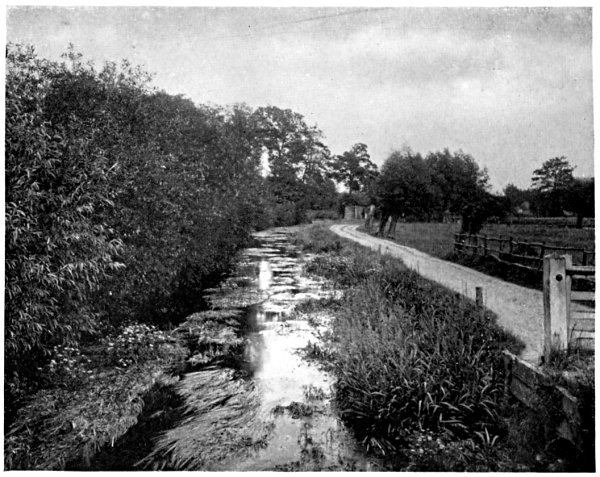
RICKMANSWORTH
Rickmansworth Park, N. from the town, has a modern house well situated. The park stretches nearly to Loudwater Mill on the river Chess, and is, like Moor Park, beautifully wooded.
Ridge (2½ miles S.W. from Potter’s Bar Station, G.N.R.) is on the Middlesex border, close to South Mimms. The village doubtless owes its name to its situation on the hill. The small church is mainly Perp., but the chancel is E. Dec.; it contains several memorials to the Blount family, including one to Charles Blount (1654-93). He was an infidel of more bitterness than ability, as may be seen from his translation of Philostratus’s Apollonius Tyanæus; readers may remember that his Just Vindication of Learning, etc., was stigmatised by Macaulay as “garbled extracts” from Milton’s Areopagitica. On being refused a licence to marry his deceased wife’s sister, he committed suicide—Pope says he “despatch’d himself”. The Blount family resided in the neighbourhood for many generations; Sir Henry Pope Blount, father of the above-mentioned Charles, “built here a fair structure of Brick, made fair Walks and Gardens to it, and died seiz’d thereof”. He was the author of A Voyage into the Levant.
Ringshall is a hamlet on the Bucks border, in the parish of Little Gaddesden.
Roe Green (4 miles S.E. from Ashwell Station, G.N.R.) is in a pleasant and very quiet neighbourhood. The nearest parish church is Sandon, about 1 mile N.E. Roe Wood is a little N. from the hamlet.
Roestock, a hamlet in the parish of North Mimms, is 1 mile N. from the Park. Smallford Station, G.N.R., is 1 mile N.W.
Round Bush consists of a few cottages, 1½ mile S.W. from Radlett Station, M.R.
Row Green (1¼ mile S.W. from Hatfield) lies close to the road from St. Albans to Hatfield. Row Hyde is a little farther S.W.
Rowley Green, on the road from Barnet Gate to Shenley, is nearly 2 miles E. from Elstree Station, M.R.
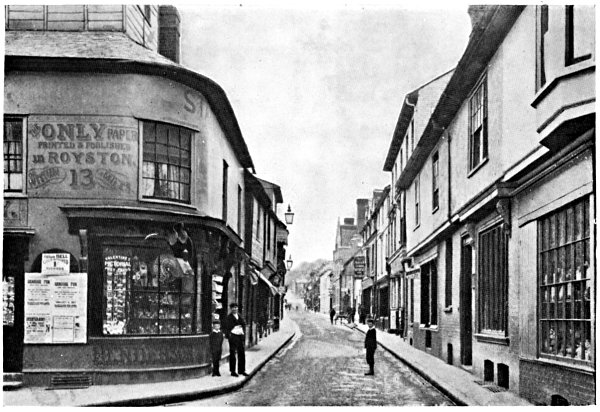
THE HIGH STREET, ROYSTON
ROYSTON, an ancient market town on the Icknield Way at its junction with Ermine Street, was until recently partly in Cambs. It is supposed to owe its name to a Dame Roesia who placed a cross here on the highway, near which spot a monastery of Black Canons was founded by Eustace de Mere and others in the reign of Henry II. Early in the reign of Henry IV. the town was almost destroyed by fire. Royston enjoyed several market privileges in the good old days, and it is recorded that early in the fifteenth century wheat was so plentiful that it was sold in Royston market for 12d. a quarter.
The church was erected close to the monastery late in the thirteenth century, and at the Dissolution was constituted the parish church. Thirty years ago it was restored, and more recently enlarged, and is now an imposing structure of flint and rubble, E.E. in style. The tower (W.) is embattled and carries four pinnacles. The fine lancet windows in the chancel were discovered during restoration in 1872, as were also the fragments of the old screen, since pieced together to form the present pulpit and reading desk. The alabaster effigy in the chancel, of a knight in armour, is believed to represent one of the Scales family. There are several old brasses: (1) to William Taberam, Rector of Therfield (d. 1432), this was large, but only the upper part now remains; (2) to a civilian and his wife (circa 1500); (3) to Father William Chamber, who founded an annual sermon to be preached in the church on Rogation Mondays (d. 1546). There are some good modern windows of stained glass.
James I., who had been entertained at Royston by Robert Chester during his progress from Scotland to London, built a lodge near Royston Heath, to which both he and Charles I. occasionally resorted, the latter being brought here as prisoner in 1647. Some cottages still standing on the outskirts of the Heath are said to have been used for stables when James I. used to hunt in the neighbourhood, and by inquiring for the “Old Palace” visitors will be shown what little remains of his Majesty’s hunting lodge. The Heath is now famous for its fine golf links.
Beneath the old boundary between the two counties, and close to the Post Office, is the famous Royston Cave, which visitors should not fail to see. It was accidentally discovered in 1742 by some men who were digging a hole in the market-place, and is now entered by a specially constructed passage under the street. It was visited by Louis XVIII. Hewn out of the solid chalk, its greatest height is about 25 ft., its diameter about 17 ft. It contains curious, and in some cases uncouth figures and coloured reliefs of saints, kings, queens, etc., of all sizes and ages, and some crucifixes. The late Joseph Beldam, F.S.A., was of opinion that the cave dates from pre-Christian times, that it became in turn a Roman sepulchre and an oratory, and that it was closed during the Reformation.
There are still the traces of several tumuli in the neighbourhood, and ancient coins, etc., have been found, but the evidences of any Roman occupation are not very convincing.
Royston is a somewhat quaint town, with some narrow byways and odd-looking houses, amongst which the Old Plough Inn is not the least noticeable.
Rush Green (1 mile S. from Ware) is a small hamlet.
Rushden, formerly Risendene and Risden (5 miles S.E. from Baldock), has a stuccoed brick church, Dec. and Perp. Chauncy saw in it, “no Inscription, Monument, or other Remark,” but in 1754 the monument of Sir Adolphus Meetkerke, Kt., was brought here from St. Botolph’s, Aldersgate. Meetkerke was Ambassador from Flanders to the Court of Queen Elizabeth, and the author of several volumes. Note the canopy in nave, thought to have covered a statue of the Virgin. In the reign of Henry II. the patronage of the church was given by William Basset, Sheriff of Leicestershire, to the Canons and Church of St. Peter’s at Dunstable.
Rustling Green is midway between Knebworth and St. Paul’s Walden Parks. The district is prettily diversified by small woods. By the shortest way through the park Knebworth Station is about 3½ miles E.
The Rye House, on the W. bank of the river Lea, is a famous resort of fishermen, excursionists and folk wishing to see the Great Bed of Ware, brought here from Ware in 1869. The bed is a huge construction of solid oak, quaintly carved, and large enough to hold twelve adults, as is proved by a story which can readily be found by the curious, but which is unfit for repetition in these pages. It is alluded to by Shakespeare, Byron and other writers. The present Rye House is modern, but attached to it are some remains of the old House, some account of which must be given here.
In his description of the “Mannor of the Rye” Chauncy says, “King Henry VI. granted licence to Andrew Ogard and others, that they might impark the scite of the Mannor of Rye, otherwise called the Isle of Rye in Stansted Abbot, fifty Acres of Land, eleven Acres of Meadow, eight Acres of Pasture and Sixteen Acres of Wood, erect a Castle there with Lime and Stone, make Battlements and Loopholes &c.”[6] The castle built by Ogard passed into the hands of the Baesh family; it was doubtless in part rebuilt at different times, for what remains of it is of brick. In course of time it became the property of Lieut., afterwards Col., Rumbold, known as “Hannibal” among his associates, who had been a private in Fairfax’s famous regiment of 1648. This man was the originator of the Rye House Plot.