ELEANOR.
Reading edition
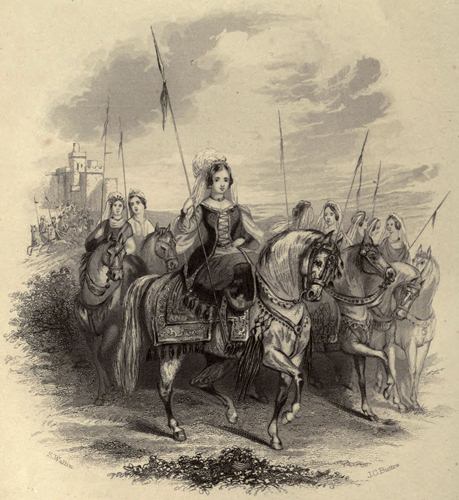
Eleanor of Aquitaine.
CHAPTER I.
“In the midst was seen A lady of a more majestic mien, By stature and by beauty marked their sovereign Queen.”
The southern provinces of France, Poitou, Saintogne, Auvergne, Perigord, Limousin, Angoumois and Guienne, received of the Romans the classic appellation of Aquitaine. This beautiful land, watered by the Garonne and Loire, whose clear and sparkling streams, flowing from vine-clad hills, stretched their silvery arms to irrigate the fairest fields and to enclose the finest harbors in the world, was in the twelfth century, inhabited by the most civilized and polished people on the face of the earth. The arts, and the idealities, and the refinements of life, like the native flowers of its sunny vales, seemed wakened and nourished by the genial airs of a climate, softened by the proximity of the sea, and rendered bracing by the mountain breeze. The numerous and independent sovereigns, whose feudal sway extended over this fair territory, imbibed the spirit of chivalry, and caught the enthusiasm that precipitated the armies of Europe upon Asia. Count Raimond of Toulouse, was one of the first who took the cross, at the council of Clermont. He was styled par excellence the Moses of the expedition. Before leaving for Palestine, on his returnless voyage, he ceded his dominions to his daughter, wife of William IX. of Poitou. The grand-children of William IX. were Eleanor and Petronilla. The father of these fair sisters, William X., left Aquitaine in 1132, with their uncle Raimond, who was chosen prince of Antioch.
The poetical taste of Eleanor was early cultivated and developed by the unrestrained freedom she enjoyed in the queenless court of her minstrel grandfather in Gay Guienne. The language that prevailed all over the south of France, was called Provençal. It was the mother-tongue of Duke William, the grandfather of Eleanor, who was one of the most liberal patrons and earliest professors of that style of composition in which the Troubadours celebrated the feats of love and arms. The matchless charms of Eleanor were enhanced by all the accomplishments of the south. Her fine genius found ample exercise in composing the sirvantes and chansons of Provençal poetry, and her delicate fingers wiled the spirit of music from the echoing harp to accompany her voice adown the tide of song. She inherited from her grandfather the political sovereignty of her native dominions not only, but the brilliant talents and ancestral superiority that made her Empress in the realm of Taste, and Queen of the courts of Love.
When the gay and licentious Duke William felt the infirmities of age coming upon him, he determined to seek the readiest means to rid himself of the burden of his sins. Accordingly, he resolved to resign the most potent sceptre in Europe to the unpractised hand of his youthful granddaughter, and devote the rest of his days to prayer and penitence in a hermitage of the rocky wilderness of St. James de Compostella. Eleanor had not attained her fifteenth year when her grandfather commenced his career of self-denial, by summoning the baronage of Aquitaine to transfer their allegiance to herself; and the child-sovereign exercised the royal functions of her new dignities while the duke visited the court of Louis le Gros and offered her hand to the young prince. The wise lawgiver of France readily accepted the proposal—for the rich provinces which constituted the dower of Eleanor, held allegiance to the crown, only by feudal tenure; and the son, equally impatient for the possession of his fair prize, set off with a noble train for Bordeaux. The light heart of Eleanor was easily won by the unrivalled attractions of Louis le Jeune, whose courtly graces were illuminated by the prospect of the crown of Charlemagne; while the damsels that composed her court, exercised their blandishments with cruel skill upon the too susceptible hearts of the cavaliers that came in the train of the bridegroom. The parliament of Love deliberated day by day in mock solemnity upon the pretensions of the fair rivals, and the discreet decisions of Eleanor, the presiding genius of the conclave, inspired the songs of Trouveres and Troubadours, who vied with each other in celebrating her charms.
A succession of long, bright days, closed the month of July, and on the last evening the court of Love continued its session till the brilliant twilight had faded from the western sky, and the mellow harvest-moon poured a silver flood upon fountains that sprang as if instinct with life to catch and fling the shining radiance upon the gay company that still lingered in the Rose Pavilion. The Queen of the court, attired like Venus, sat upon a throne, canopied with Acaeia, through whose trembling leaves the light fell playfully contending with the envious shadows that seemed striving to hide her smiles. At her feet sat her favorite page, with wings framed of gauze attached to his shoulders, holding a lyre, fashioned to resemble the bow of Cupid, upon which he occasionally struck a few notes to announce a change in the evening’s entertainment. Lovely maidens arrayed as Nymphs and Graces reclined upon verdant couches around the fair arbitress of these amorous debates. Groups of light-hearted girls, representing heathen goddesses, listened encouragingly to their favorite minstrels, and strove, by various subtle arts, to win the meed of praise to the verse that celebrated their charms. Sirventes and Chansons had been recited and sung, still the assembly listened with an air of impatience, as if anticipating matters of more general interest. With a smile that at once excited and baffled curiosity, the Queen touched the cheek of her page with her flowery sceptre, saying, “Why slumbers the harp of my pretty Peyrol? Has he no song for the ear of his lady?”
“Peyrol cannot sing in the Romance Walloon,” said the youth, casting down his eyes with jealous pique.
“Proud one,” replied the queen, “thou knowest that though the lord of oui and non delights our eye, his language charms not our ear. We would hear a pretty faibleaux of Grenada, or wilt thou give us a fitting apostrophe to the court, where Gaiety and Innocence preside.”
“Nay, honored lady,” said the page, “since Gaiety and Innocence parted company on the plains of Pleasure, harmony hath forsaken the lyre, and not even the goddess of Love can heal the discord.”
“Thou pratest, pert boy,” replied the queen, with a stolen glance at Petronilla.
Perceiving from her tone, that he had presumed too far, the page bent over his harp and rapidly swept his fingers across the strings, saying apologetically,
“If my lady will accept a lay of Bretagne, Peyrol is ready to do her bidding.”
“The sweet tones of the langue d’oc little befit the rugged legends of the northern clime,” said the queen, “but tune thy lyre without further parley.” The page needed no second command, but sang:—
1. In a province fair of sunny France, Beside a winding river, Over whose waves in joyous dance, The sunbeams gleam and quiver, Stood a castle tall, a goodly sight, With its broad and rich domain, And therein dwelt a noble knight; I ween he had a lady bright And three sweet babes withouten stain.
2. A generous heart, an open hand, To courtlie companie, And eke as any in the land For beggars of low degree. So gentle his mien in lady’s bower, So full of courtesie, Yet valiant was he in tournament, And a good bow in the greenwood bent, I wot right dextrously.
3. He had been blest in his earthly state With such fair prosperity, That his heart beat high with pride elate, Forgot he the giver good and great And christian humility. Whereat to punish his arrogance, Our Lady sent him sore mischance, And dire adversity.
4. Sir Isumbras to the hunt has gone, Riding so gallantly, With hawk and hound in the dewy morn, When a vision bright above him born, Appeared in the clear blue sky. He saw a maiden meek and fair, An angel I wist was she, A messenger sent to bid him prepare For chill calamity.
5. A woful man was the knight that day, He turned him home in sore dismay, When his good steed fell and died, And hawk and hound of life bereft, Sir Isumbras in the forest left, With no living thing beside. When to him there came his little foot page, As fast as he might hie. My noble master, a sad message, It is that I bear to thee. “Thy proud castell lies in ruins low, Thy lady and children escaped the blow, But and with jeopardy.”
6. The knight bowed meekly to heaven’s decree; A wiser and sadder man was he, And with his lady and children, three, Sir Isumbras boune him o’er the sea— A penitent pilgrim he would be To holy Palestine. Through seven weary lands they went— The strength of the babes was wellnigh spent, For charity, cold was their nourishment. They came to a wood, with flowers besprent— To a rapid river of broad extent, Where never the sunbeams shine.
7. His eldest born, Sir Isumbras bore With tenderest care to the farther shore; But ere he returned again, A lion fierce from the thicket sprang— The little one tore from that cruel strand, Nor him might they regain.
8. He found his lady weeping, full lorn, For in his absence a leopard strong, With a fell and bloody unicorn, The others from her arms had torn.
9. The lady wished that she might die, Or ever this sore calamity, She should have been preserved to see; But the knight with meek humility, To Mary mother a prayer ’gan say, That his penance might soon have end— When wandering through the weary land, The Sultan’s captives they were ta’en Before his face to bend.
10. I trow the Sultan had rarely seen A lady so lovely, in form or mien, Or a knight so bold and true. “Sir knight, I will give thee gold and fee, As much as thou might wish to see, If thou wilt renounce Christianity, And fight for the banners of Paynimrie, And sell thy lady bright to me;” His form to its height he drew.
11. “Our Lady forefend that I should e’er In infidel ranks a standard bear, Or the holy cross betray; And for weal or woe my lady fair, I wed in the face of day; A recreant knight I be when e’er This right I shall gainsay.”
12. They have putten off his scarlet mantell Within the goldis shred; They drove him from that land of Baal, And left him as he were dead. The lady was sent to a far countrie, The bride of the Sultan she should be, When from the wars of Chrisendie In triumph he returned.
13. Asleep in the forest the good knight lay And when he awoke at dawn of day He saw his treasure borne away, By an eagle strong in search of prey— No longer he there sojourned. To the Virgin he made a fervent prayer Invoking for aye her watchful care. Then to Palestine he turned.
14. Through ten long years the knight pursued His weary pilgrimage; Then buckled he on his armor bright, With heart beating free and light, He hath boune him for the fight, A gallant and unknown knight Withouten heritage.
15. Much they marvelled then to see A warrior, unknown as he, Such deeds of valor do. They wist he was no mortal wight, But some weird magician sprite, When in the thickest of the fight The Sultan dread he slew.
16. They have broughten him to the christian king With gladness and great welcoming, And honor and praise had he; But his object fell he did obtain, For his mighty enemy he hath slain. He donned his pilgrim weeds again, And his wanderings pursued.
17. The scorching sun, with a feverish glare, On the burning sands cast radiance clear; When weary and faint the knight drew near, Where stately and tall a castle fair From a green oasis rose. The cool palms waving in golden light, With music of murmuring fountains bright, Beckoning called the fainting knight To bowers of repose.
18. He passed the portals of the hall, And stood ’mong squires and good knights tall, Holding it seemed high festival.
19. A lady beautiful to see, Sat ’neath a gorgeous canopy. She was queen of that countrie, Lady of generous chivalry, And eke of lowly charity. The holy Palmers with reverence, Welcomed she to her residence; Gentle and kind was she.
20. But the knight would not be comforted, For restless recollection shed A sadness over all. In silent mood he wandered Through tower and lofty hall.
21. It fell on a day the Queen with her guest Were seated at the mid-day feast, When entered her favorite page in haste. In the early morning he went in quest Of eaglets’ eyries, and on the crest Of a lofty mountain he found a nest, With golden treasure hid in its breast, Wrapped in a scarlet mantel.
22. No sooner beheld she the page’s prize, Than the tears o’erflowed the ladie’s eyes. My true and loyal knight she cries, (The palmer looked on with mute surprise.) Hast thou Sir Isumbras seen? One moment they gazed in silent survey, The mists of memory rolled away; And locked within his arms she lay— The lost one found again. And there was feast and festival; Resounded then through bower and hall, The lute and joyous madrigal; And joustings there were in tournament, And breaking of lances in compliment, To the beauty of ladies bright; Then over the Sultan’s fair domain, In peace the knight and lady reign; Till the king in all sincerity, Strove with pious zeal to free From the bonds of Infidelity, His Paynim lieges hight.
23. But no one there his cause upheld, Save God and the Queen, I trow; And were they e’er so valorous, Never could they withstand An armament so numerous, As the unbelievers’ band.
24. Then by a chance miraculous, The tide of war was turned. As they might be sent in our Lady’s name, Three knights came pricking o’er the plain, As if the ground they spurned. Came the first on a lion strong; On a leopard the second was borne— The third bestrode a unicorn. Tall men and brave were they; The hosts of the Saracens fled in dismay, And repenting of their disloyalty, Returned they then to their fealty; And the knight and lady peacefully Together with their children, three Restored to them so happily, Reigned in tranquillity, Prosperously and long.
25. They lived and died in good intent; Unto Heaven their souls went. When that they dead were, Jesus Christ, Heaven’s king, Give us aye his blessing, And shield us aye from care.
Rousing herself from the abstraction that had prevented her hearing the song of her page, the queen remarked, “Thy story is somewhat long, and for ourself we would have preferred that the husband had won the holy estate of martyrdom ’neath the sword of the Soldan. But thou hast rhymed it right dextrously, and we opine that the moral of thy lay accords well with the ascetic manners of the north.” She extended her wand. The herald then stood forth, and sounding a few notes on a chalumeaux, cried,
“Comes there no cause of Arrets d’amour, Our gracious liege and sovereign before, From lady, knight, or troubadour?”
The flute-like call was thrice repeated, and then a low response to the challenge issued from a mimic grotto, curiously roofed with overhanging vines.
“The minstrel of our sister Petronilla has leave to present her cause before our court,” said the queen encouragingly, as the troop of the young princess advanced from the shadow into the clear light, and knelt at the footstool of justice.
“The lady Petronilla,” began the Troubadour, “arraigns before the court her recreant knight, Count Rudolph of Vermandois. Cold greeting gives he for her fair looks, scant courtesy for her warm smiles; his ungloved hand returns not the pressure of her slight fingers, and the banderol she sent him flutters not from his gleaming lance.” A slight pause followed this accusation, and the herald again stood forth and demanded if any minstrel or Troubadour could say aught in extenuation of the offence of the accused. Not a voice answered, not a harp string stirred. At the third call the page of Eleanor arose, and with a graceful obeisance begged to be heard.
“Rudolph of Vermandois,” said he, “witnesseth by me, that since he set lance in rest to do his devoir for the fair Adelais of Champaigne, his eye and smile, and heart and hand, as loyal husband and true knight, are due and devote to her alone.”
A general murmur attested the disapprobation of the assembly at this new and strange defence; for it had already become a proverb in Guienne, that “True love cannot exist between married persons.” The importance of the action, however, elicited a brilliant contest among the rival Troubadours, and never was a case more warmly argued, more skilfully enveloped with the subtleties of logic, or more thoroughly transpierced with the sallies of wit, than that which arose from the efforts of the wily granddaughter of Philippa of Toulouse, to fascinate the husband of the granddaughter of Adela, Countess of Blois. The fair jurors finally, like their successors in modern days, rendered their verdict in accordance with preconceived opinions, independent of justice or argument. The defence being thus found invalid, the culprit was put under ban of the court, and all true ladies were forbidden to smile upon him, except by the grace of his slighted lady-love. The fairy camp then adjourned its sitting to receive the royal guests, who were already on the way to meet them. As Eleanor accepted the assistance of her lover to climb the terraced pathway leading to the castle, she said with her most bewitching smile, “We consign our young sister, Petronilla, to the care of our noble cousin of Vermandois.” The count dissembling his reluctance bowed and offered his hand to the sprightly sorceress, and the queen whispered her sister, “The hawk is hooded, it must be thine to bind his jessies.”
CHAPTER II.
Where is the antique glory now become, That while some wont in woman to appear? Where be the bold achievements done by some? Where be the battles, where the shield and spear? And all the conquests which them high did rear Be they all dead, or shall again appear? Spenser.
The first of August, 1137, rose upon a brilliant ceremonial. The princely capital of Bordeaux glittered with all the splendor that Guienne, and its dependent fiefs could supply; for on that day the native subjects of Eleanor assembled to accept the resignation of Duke William, and to give the hand of their liege lady in marriage to the heir of France. Though Eleanor was sufficiently dazzled by the prospect of ruling in the court of Paris, she had the sagacity to accept the proposal of her barons and refuse her consent to the arrangement, till by charter and deed she had secured inviolate the laws and customs of Aquitaine, and the administration of the government to herself alone. Upon the conclusion of the ceremony the duke laid down his robes and insignia of sovereignty, and in presence of his loving subjects and weeping grandchildren, took up the hermit’s cowl and staff and departed on his lonely pilgrimage.
The royal cortege set out the following day for the north, resting only at the principal towns, where the young duke and duchess received the homage of the feudal lords.
At Blois, the Count of Vermandois, who had by circumstances that seemed to him wholly accidental been forced to give his constant attendance upon the artful Petronilla, embraced once more his beautiful Adelais, and pleading her ill health, obtained permission of the prince to absent himself for a time from court. The disappointed Petronilla could scarcely conceal her chagrin at this unlooked-for interruption in her proceedings, and from that moment conceived the most violent hatred of her innocent rival. On their entrance at Paris, instead of the enthusiastic greeting and splendid festivities which Eleanor had anticipated, the bridal party was escorted through silent streets by weeping attendants, who conducted them to the death-bed of Louis VI. The great legislator of France gazed with a look of solemn benignity upon the youthful pair that knelt to crave his parting blessing, and reminding them, that their recent union involved not only their individual happiness, but the peace and prosperity of both the north and the south, added with his expiring breath, “Remember, royalty is a public trust, for the exercise of which a rigorous account will be exacted by Him who has the sole disposal of crowns and of sceptres.”
On the conscientious mind of Louis, the words of his dying father made a deep impression; but his thoughtless partner was no sooner crowned Queen of France, than she entered upon her career of folly, exerting all her talents, and exercising all her influence in the exciting games of court intrigue. The impassioned verse in which Abelard celebrated the beauty and love of the gifted but frail Heloise, furnished employment for Eleanor’s Provençal minstrels, and formed the topic of general remark among the minions of the court. She assisted the persecuted monk in his defence before the Council of Sens, and after his death caused his body to be conveyed to the chapel of the Paraclete, and consigned to the care of the melancholy Heloise. She persuaded Louis that the services of his prime minister Vermandois, were indispensable at Paris, and thus, again, brought that nobleman within the charmed sphere of Petronilla’s attractions. She contrived, at the same time, to secure for herself a devoted admirer in the Count of Ponthieu, who became the agent of her slightest wish. Through his gallantry she succeeded in involving the beautiful Adelais in some matters of court scandal, and thus by exciting the jealousy of the Count of Vermandois, and exposing him to the bewitching spells of her sister, she finally persuaded him to divorce his lovely and amiable wife, and espouse the designing Petronilla.
Adelais sought to hide her sorrow and her wrongs in the seclusion of a convent; but her brother, the valiant Count Thibault of Champagne, was not inclined to suffer the indignity in silence. Such, however, was Eleanor’s power over the plastic mind of her husband, that the count appealed in vain to the sympathy or justice of the king. Finding that his remonstrance could not reach the royal ear, he presented his cause before the pope, who compelled Vermandois to put away the guilty Petronilla, and take back the injured sister of Champagne. The repudiated wife enraged at her own dishonor, and incensed at the undissembled joy with which Vermandois exchanged her dazzling graces, for the long-regretted charms of the weeping recluse, again had recourse to Eleanor. The queen, not less vindictive than her sister, and more practised in diplomacy, succeeded in fanning an ancient feud between Louis and Count Thibault, into the flame of war. The king invaded Champagne at the head of a large army, and commenced a devastating progress through the province. The town of Vitry, strongly walled and fortified, for a long time resisted the royal forces; but the queen, whose apprehensions of the temperate counsels of Suger, prompted her to accompany her husband upon every occasion, privately commissioned a body of Gascons to set fire to the town at the very moment of its surrender. The flames spread from house to house, and finally extended to the cathedral, and thirteen hundred persons who had taken refuge there, were burned to death. The king stung by the cries of his perishing subjects, exerted himself for their rescue, but in vain; and the horrors of the scene made such a fearful impression on his mind, as seriously to affect his health. The vision of his lamented father, repeating in solemn tones, “Remember, my son, that royalty is a public trust, for the exercise of which a rigorous account will be exacted by Him who has the sole disposal of crowns and of sceptres,” haunted his slumbers and destroyed his rest. Queen Eleanor journeyed with him from one holy place to another, to entreat the prayers of pious monks in his behalf, but the dejection of his mind increased to such an extent, that even her insinuating blandishments failed to recall him from his gloomy contemplations. Wearied with fruitless endeavors, she petulantly remarked to Petronilla, who now triumphed in the possession of a new lover, the young Count Maurienne, “Fate has given me the name of queen with the destiny of a nun. Would we were again in our native realm, for I tire of this dull life. Instead of the gay minstrelsy of the sweet southwest, I am jaded with perpetual psalmody, and my attempts to beguile the weary hours with the ‘joyous science,’ are mocked with the mummery of muttered prayers. I have married a monk rather than a monarch;” and the mortified queen burst into tears.
While this state of feeling subsisted between the conscience-stricken Louis and his discontented consort, news of the fall of Edessa and the conquests of Noureddin reached Europe, and the sagacious Eleanor saw, in the general sympathy which the intelligence excited, the means by which she might make the melancholy of Louis the instrument of her own pleasure. She forsook at once her gay amusements, joined her husband in alms, deeds and prayers, expressed the greatest pity for the misfortunes of their royal cousins, and constantly wished that she might be permitted to lead her brave Provençals to restore the gallant Courtenays to their lost principality of Edessa. The gracious change in the character of Eleanor delighted the penitent monarch, and he began to listen with interest and pleasure to her oft-repeated suggestion, that a pilgrimage would prove an acceptable penance for the misdeed at Vitry. Animated by a renewed hope, he called a council of the clergy and nobility of his kingdom to deliberate on the propriety of an expedition to the Holy Land, and by their advice despatched deputies to gain the sanction of Pope Eugenius. The vicar of Christ entered readily into the design, and commissioned the famous St. Bernard, abbot of Clairvaux, to preach the Second Crusade. Louis and his queen, and all their court, attended on the ministry of the holy man, and such crowds flocked to listen to the eloquent saint that no cathedral, however large, could contain them. His auditors were impressed by his sanctity, persuaded by his enthusiasm, and carried away by his zeal. “The cross!” “The cross!” was echoed from every tongue. Louis and his queen were the first to adopt the holy symbol, and as the multitudes that pressed forward to follow their pious example soon exhausted the supply already prepared, the reverend orator tore his monkish garment into small pieces and fixed them to the shoulders of his kneeling converts.
Encouraged by his success, St. Bernard passed into Germany, and every city and village from Constance to Carinthia responded to the call of war. Those who understood not even the language which he spoke, were awed by his gestures, and the dignity of his demeanor, and the miracles that accompanied his presence. The mind of the emperor Conrad III. was moved by his startling delineations of the judgment day, when punishment should be inflicted upon the idle, and heavenly rewards showered upon the faithful, and openly professed that the Lord of the Germans knew and would perform his duty to the church.
The romantic purpose of becoming a female crusader now completely occupied the light head of Eleanor, and as she was in the very plenitude of her charms, and possessed sufficient wealth to practise any extravagance, she soon made it the fashion among all the vain sentimentalists of her court. The absurd arrangements which she made for the campaign, gave little promise of rational conquest. The female recruits sent their useless distaffs and embroidery-frames to all the knights and nobles who had the good sense to suppose that Heaven would be better pleased with their remaining in peace at home, than by their going abroad to destroy their fellow-men; and this ingenious taunt had the desired effect upon the doughty knights, who, fearing a woman’s raillery, joined an expedition to Syria to prove their valor. The fair warriors clothed themselves in helmet and hauberk, having golden crosses tastefully embroidered upon the left shoulder; gilded slippers, glittering spurs, and silver-sheathed falchions suspended from the side completed the equipment, and mounted on richly-caparisoned steeds, they formed a brilliant squadron, caricoled about Paris and performed a thousand fantastic follies in public, calling themselves the body-guard of the Golden-footed Dame.
CHAPTER III.
A voice, a flute, a dreamy lay, Such as the southern breeze Might waft, at golden fall of day O’er blue transparent seas.
Louis took the cross in 1146, and in the following year, having received from the pope the consecrated banner as a warrior, and the staff and scrip as a pilgrim, set out for the general rendezvous at Mentz with his queen and her grotesque cavalcade. Here they were joined by an immense number of nobles and knights and soldiers, among whom were crusaders from England and the remote islands of the northern sea. After the lapse of half a century, the second crusade, consisting of two hundred thousand people, tracked their way along the banks of the Danube by the whitening bones of those who had fallen victims to the blind fanaticism of the first expedition. Manuel Comnenus, who now sat on the throne of Constantinople, adopted the same policy that had distinguished the councils of his grandfather, Alexius. His envoys, bearing letters filled with flattery and fair speeches, met the advancing warriors, but the imperial guides were instructed to conduct the soldiers of the west by difficult and circuitous routes, and the purveyors had secret orders to furnish them with sacks of flour mixed with chalk and lime. Conrad, who was the brother-in-law of Manuel, was so indignant at this breach of hospitality, that he crossed the Bosphorus without meeting or conferring with the emperor—but the splendid city of Constantinople presented too many attractions to the female adventurers to be passed in so hurried a manner.
The wily Comnenus soon perceived that the readiest means to divide the forces of the crusade would be to amuse the fickle Queen of France. All the voluptuous refinements of the Greek court were accordingly put in requisition to detain his unwelcome visitors, and if the avaricious Bohemond was bribed with the contents of a treasure-chamber in the palace, Eleanor might well be excused if her frivolous fancy was captivated by her splendid suite of rooms adorned with all the luxury of eastern magnificence, and the richly-attired slaves that waited her slightest bidding, and when at last they set forward, the Damascene silks, costly jewels, and precious gifts, which Manuel showered upon the finery-loving Amazons, added not a little to the cumbrous baggage with which the thoughtless queen loaded the expedition.
Louis, lulled into security by the flattering assurances of Manuel, had lingered in the Greek empire till the defeat of Conrad at Iconium, when convinced by the report of the discomfited Germans, of the treachery of his royal host, he set forward with his troops along the coast of Asia Minor. They passed Thyatira, Sardis, and Philadelphia without accident, defeated the Turks on the banks of the Meander, and arrived in safety at Laodicea. The freaks of Eleanor and her female warriors were the cause of all the misfortunes that afterwards befell the French army. On the second day after leaving Laodicea, their way led up the mountains, by a winding and difficult ascent. The prudent king sent forward the queen and her ladies, escorted by his choicest troops, under the guard of Count Maurienne, charging them to entrench themselves upon the wooded heights that overlooked the valley of Laodicea. Himself followed slowly with the rearguard, encumbered by the useless baggage, and harassed by the Arabs. The Count Maurienne, with Petronilla by his side, rode gallantly up the steep, and halted at the place appointed, but when Eleanor reached the spot she was so attracted by the appearance of an adjacent valley, cooled by waterfalls, and shaded by thickets, which seemed to beckon them on with an inviting grace, that she insisted upon pressing forward, and forming the bivouac there. The Count Maurienne endeavored to dissuade the queen from her purpose, by representing the danger of abandoning the commanding position designated by the king, but opposition only increased her pertinacity, and aided by the light artillery of Petronilla’s eyes, she soon brought the discomfited knight to terms. The scene that opened before them as they descended into the valley, was sufficient to charm away all fatigue and fear. The rocky heights at the west, behind which the sun was just sinking, veiled their bold fronts in the misty fringes of the opal clouds; the blue Mediterranean circled the horizon on the south; and far to the east stretched every variety of woodland, meadow, and glade, till the Taurus ridge, melting into the sky, shut out the sands of Syria. The happy party soon entered the valley. The sumpter mules were speedily unloaded, the light spars planted, the white canvass of the tents stretched upon them, and a cold collation spread out for their refreshment. When the repast was finished Eleanor caused her couch to be placed at the door of the tent, so that wild roses nodded at its pillow, and flinging herself upon it, as the brilliant stars of that eastern clime looked down upon her, she exclaimed, “Petronilla, my sister, seems not this like our own dear Provence? I could almost fancy myself once more in the Rose Pavilion.”
“Certes,” said Petronilla, “and were it not a fitting time and place to hold the festival of our Court of Love? Methinks yon, count,” with a mischievous glance at Maurienne, “withstood our entreaties to enter this delightful retreat beyond the limits of gallantry.”
“Gra’mercy, fair ladies,” said the count, with mock gravity, “that I fear the frowns of this august tribunal more than the displeasure of my royal master, is perhaps my sin, and it is with unfeigned apprehensions that I surrender to the court.”
“I accuse the count—” began the princess. Maurienne interrupted her, “Petronilla my accuser! Then am I lost indeed. I had hoped to hear her eloquent lips plead my excuse.”
“Nay! nay!” said Eleanor, striking the velvet turf with her tiny foot. “The court forbids these disorderly proceedings. Henry de Blois, arrest thou the Count Maurienne at the complaint of the princess, bind his hands with this string of pearls, and confront him with his accuser. Our brave Warrenne, take thy spear and stand sentinel by yon copse. A prowling Saracen would make an awkward addition to our goodly company. Knights and ladies, recline at ease upon these verdant cushions. When the cause of this culprit shall have received verdict, perchance your own delinquencies may pass review.”
“Heaven forefend!” exclaimed a chorus of voices, mingling ejaculations with merry laughter and gay pasquinade.
The queen, now in her element, succeeded in quelling the tumultuous mirth, though an occasional titter was elicited by the solemn visages of Maurienne and Petronilla, who played their part to admiration.
“Where is the petulant Peyrol?” inquired the queen, looking round the circle, “we can no more proceed with our important affairs without the aid of song than could the prophet without the inspiration of music.”
“Peyrol, my liege, attends upon the king,” replied a Spanish cavalier, who had recently rode so constantly by the side of the queen that the courtiers dubbed him her saddle-beau.
“Gonzalvo,” returned Eleanor, “we have heard that thou stringest a lute upon occasion. Let not our pastime be marred by the defection of this truant boy. Give us a Moorish ballad, if thy memory serves thee with nothing better. Our royal spouse will be here anon and summon us to prayers.”
“I am but a poor pilgrim, and little skilled in the ‘Joyous Science,’” said the Spaniard, with affected modesty; “but the command of my queen must give me the fitting inspiration.” He touched a melodious prelude, and sung in a clear, manly voice:—
1. “I a minstrel of Grenada, Gonzalvo Bercio hight, Once wandering as a pilgrim, found a meadow richly dight, Green and peopled full of flowers, of flowers fair and bright, A place where many a weary man would rest him with delight.
2. “And the flowers I beheld all looked and smelt so sweet, That the senses and the soul they seemed alike to greet, While on every side ran fountains through all this glad retreat, Which in winter kindly warmth supplied, yet tempered summer’s heat.
3. “And of rich and goodly trees there grew a boundless maze, Rich grapes and apples bright, and figs of golden rays, And many other fruits beyond my skill to praise, But none that turneth sour, and none that e’er decays.
4. “The freshness of that meadow, the sweetness of its flowers, The dewy shadows of the trees that fell like cooling showers, Renewed within my frame its worn and wasted powers, I deem the very odors would have nourished me for hours.”
An arrow that pierced the tent, and fell among the strings of the minstrel’s harp, interrupted the symphony, and called forth discordant screams of terror. A moment after the Earl of Warrenne, breathless and bleeding, rushed into the assembly, and communicated the startling intelligence, that the Turks had taken possession of the heights allotted for their encampment, and that the king, unaware of his danger, was proceeding to the snare, spread for his whole army. Maurienne hastily cast away his mimic fetters, and counselling his lovely charge to remain as close as possible beneath the shadow of the trees, stationed a small guard to defend them, and hastened back to the assistance of his sovereign.
The Syrian moon now rose broad and clear in the east, and the frightened females, huddling together like a flock of timid sheep, could distinctly see the heavy-armed troops on which rested all their hopes, toiling slowly up the mountain, in the face of a tremendous shower of arrows and loose masses of stone which the Moslems threw upon them from above. Men, horses and baggage, overborne by the sudden attack, rolled down the precipitous steep, and the expiring cries of familiar voices could be distinctly heard through the still air. Maurienne soon succeeded in putting to flight the Arabs that had attacked the vanguard, but the most dreadful havoc was made among the followers of Louis, and the king himself was only saved by the greatest efforts of personal valor. Seven thousand of the flower of French chivalry paid with their lives the penalty of the queen’s caprice. The baggage containing the fine array of the lady-warriors, was plundered by the Arabs, and the fragments of their dainty supper was the only provision left for their sustenance.
The further progress of the French was beset with dangers and privations. The discipline of the army was broken, and they marched or rather wandered, for they knew not the roads, along the coast of Pamphilia, purchasing or plundering food of the frightened inhabitants; and famine thinned the ranks with such rapidity, and so many horses and other beasts of burden perished by the way, that it was finally determined to turn aside from these scenes of desolation and proceed by sea to Antioch. But upon reaching the coast, a new difficulty occurred. A sufficient number of ships could not be procured to transport them all, and the brave peers of France, with honorable pride, agreed that the simple pilgrims, with the women and children, should alone make their passage with the king, while themselves should continue their route on foot. Louis distributed what money he had among the soldiers, who were left to surmount the higher difficulties of the land route, and engaged a Greek escort and guide to conduct them, and taking leave of the miserable beings who had followed him to their own destruction, went on board the ships. The escort soon deserted the French soldiers, the guide betrayed them, and but few if any ever reached Syria.
The royal party arrived at Antioch in a condition little short of beggary; but Prince Raimond, the uncle of Eleanor, opened his hospitable gates to them, and by the beautiful stream of the Orontes, the distressed warriors of the cross refreshed themselves after their fatigues, and the thoughtless queen regained once more her roses and her smiles. Recent experience had greatly cooled her military ardor, and the gaiety of the court of Antioch presented greater attractions to her fancy than a journey over the sandy plains of Syria. Prince Raimond, wishing to avail himself of the panic which a new arrival of crusaders had spread among the Turks, to extend the limits of his own territories, set himself at once to prevent the immediate departure of Louis for Jerusalem. The prince was the handsomest man of his time, and directly began to pay the most assiduous court to his lovely niece. The queen, flattered by his attentions, commenced such a series of coquetries with him as greatly scandalized and incensed Louis; but it was not till she attempted to persuade her husband to join Raimond in an expedition against Cesarea that she found she had at last irritated the kind monarch beyond the limits of forbearance. Louis left her in anger, and departed with his forces for Jerusalem, where he was received with the greatest joy. Crowds of ecclesiastics and laymen going out to meet him, conducted him within the holy gates, singing, “Blessed is he that cometh in the name of the Lord.”
Disappointed in the assistance of Louis, Raimond determined to secure an ally in Saladin, a young Emir of the Sultan. Eleanor, who was at this time moping with chagrin at the desertion of her husband, first saw the handsome barbarian at a Passage of Arms given by Raimond for her amusement, in which the dark-browed Saracen drove a javelin through the target with such skill and grace as completely pierced her heart. She immediately conceived the idea that if she should convert this powerful Infidel to the Christian faith, she should achieve a greater conquest than all the forces of Christendom. Prince Raimond, who gladly availed himself of any attraction that should detain the Arab chief within the walls of Antioch, smiled upon her pious project. But to bring a follower of the Prophet devoutly to consider the tenets of the Latin church, required more familiar intercourse and a greater exercise of personal influence than the ceremonious observances of Eastern society permitted, or the strictly virtuous deemed quite discreet. The zealous queen, however, scorned to be controlled by such fastidious considerations. Her apartments opened upon a terrace which conducted to a garden filled with every variety of odoriferous shrub and fragrant flower, at the foot of which a clump of olive-trees spread abroad their arms to hide a mossy seat from the intrusive rays of the sun. A little wicket concealed by vines led from the garden into the street, and Eleanor kept the key. Through this wicket she admitted her young disciple, and in this retreat, with missionary zeal, commenced her efforts for the conversion of the Mussulman. It was some time before the European and Asiatic succeeded in coming to a perfect understanding; for though Saladin was tolerably well versed in the Lingua Franca, his vocabulary comprehended little else than those terms used in common intercourse or war. Whether the philosophers of that day had taught that though some languages may be deficient in expressions of abstract ideas, all are replete in the dialect of love, certain it is, that both teacher and pupil became aware of the fact in their own particular case. But it was no part of Eleanor’s religious plan to entangle herself in a mesalliance, and when the fascinated Emir began to stammer forth his admiration, she playfully told him she could understand love only in the Provençal tongue. The Saracen took his departure, and though she watched anxiously for the arrow tipped with the eagle feather, by which he was wont to announce his coming, she saw him not again for twenty days. When the long-wished-for token at length appeared, and the handsome youth in his crimson robe and green baldric stood again before her, his face radiant with joy, and his dark eyes sparkling with delight; when she heard him pour forth his eloquent passion in the loved Provençal, with all the fluency and ease of a native, she almost fancied a miracle had been wrought, and felt convinced that not to lead such talents to the bosom of the church would be a grievous sin. The Saracen soon persuaded her that love for her alone had endowed him with supernatural powers, and the delicate flattery determined her to exercise to the fullest extent the influence that could produce such wonderful effects. The young Emir belted his tunic with a silken girdle several yards in length. Upon this ribbon Eleanor, still intent upon her design, embroidered a cross which the youth accepted with his accustomed gallantry, saying, “I worship the Divinity it represents.” The next day he brought her a casket of diamonds, and an ivory box filled with the sweetest perfumes. As he reclined at her feet she opened the box, and twining his raven hair about her fingers poured the precious liquid upon his head.
Peyrol who from his childhood had regarded the queen with the impassioned devotion of the south, had hardly consented to share her heart with Louis. Since her marriage, her ambition for conquest had kept him constantly in a state of jealous excitement. His interested eyes had been the first to discern her stolen interviews with Saladin; and on the day of her acceptance of the diamonds, he contrived to secrete himself in the garden, and thus witnessed the whole affair. Convinced of her danger, he set off direct for Jerusalem, to advertise Louis of her conduct, and while Eleanor fancied herself doing God service in her efforts to convert the lord of the Saracens, though at some slight sacrifice of personal delicacy, the king arrived at Antioch, and hurried her away with small leave-taking of her uncle, and without even allowing her a parting interview with her heathen convert. Eleanor submitted to this unaccustomed harshness of her husband, with a very ill grace. She attempted to explain to him that she was doing more for the preservation of the Sepulchre than King Baldwin himself. She expressed the most violent anger at being the object of unfounded suspicion, and entered the Holy City in a most indignant mood. The upright mind of Louis could not be made to comprehend the piety that led to such an ebullition of temper, nor could he well appreciate the purity of a motive that induced a wife to exchange presents with a lover; and from this time all confidence between them was at an end. The Queen of France was, notwithstanding, received and entertained at Jerusalem, with all the honors due her rank; but Peyrol was instructed to watch her movements, and prevent any further communication with Raimond.
A council was held at Ptolemais, composed of the christian powers of Syria and Palestine, and the crusaders from Europe, and though the restoration of the Courtneys to their lost principality was the object of the expedition, it was decided that Damascus was a far more dangerous neighbor to Jerusalem than the remote city of Edessa. The decree to march to Damascus was accordingly passed, and the kings Louis VII., Baldwin III., and Conrad III. brought their troops into the field.
The best disciplined parts of the army were the Knights of the Temple, and of St. John. In the early days of pilgrimages, an institution for the care of the sick had been established in Jerusalem. In this friendly hospital the wounded and dying of the first crusade were received and tended with the greatest care. King Godfrey with affectionate gratitude rewarded their pious labors by the gift of an estate in Brabant, whence they derived a steady revenue. The association acquired importance, and finally formed a religious house under the tutelage of St. John the Baptist. They took the usual vows of chastity, poverty, and obedience, and the patriarch of Jerusalem invested them with a black robe, having a white linen cross of eight points upon the left breast.
In A.D. 1113, the Hospital was put under the protection of the Holy See, and their revenues increasing beyond the demands of charity, about A.D. 1130, they determined to draw the sword against the enemies of the faith. The Hospitallers were accordingly arranged into three classes, nobility, clergy, and serving brothers, who divided their duties between making deadly war upon the Infidels, healing the wounds of the Christian soldier, and praying for the souls of the departed. The admirers of valor and piety either joined their standard or enriched their coffers. Great men sent their sons to them for instruction, and the Knights Hospitallers soon became a powerful monastic and military order.
A few years later, some French gentlemen founded the equally honorable institution of the Red Cross Knights. The original design of this order, was to watch the road and keep open the communication between Europe and the Holy Land. At first they were fed and clothed by the Hospitallers, and to indicate their poverty, adopted a seal with the figures of two men on one horse. They bound themselves to the three great monastic virtues, and added some austerities, which were supposed to give them power with God and man. They were originally styled Milites Christi, but when Baldwin I. assigned them a residence in the royal palace, adjacent to the Temple of Solomon, they assumed the title of Templars, or Knights of the Temple. They wore linen coifs with red caps close over them, shirts and stockings of twisted mail, sapra vests and broad belts with swords inserted, and over the whole was a white cloak touching the ground. This order, too, rose into dignity and power; and the military friars of the Hospital, and the Red Cross Knights of the Temple, soon became the bulwark of Christendom, “the nurse of manly sentiment and heroic enterprise.”
Acquainted with the roads, the Templars led the way to Damascus, and accustomed to succor the weak, the Hospitallers brought up the rear of the Christian army. The eastern and southern quarters of the city of Damascus were defended by impregnable walls; but the north and west were faced by fields and gardens, and protected only by towers and ditches. Here the crusaders pitched their camps; and numerous and long-continued were the engagements between the Christians and Moslems. They succeeded in driving in the outposts of the Infidels and seizing several fortifications looked upon Damascus as their own. But now a more serious contest arose. Should Damascus become an appanage of Jerusalem, a fief of the French crown, or a German principality? Days and weeks passed away in fruitless disputes among the crusaders, and at length it was determined that the prize should be given to the Count of Flanders, because he had twice visited the Holy Land. This decision only increased the dissatisfaction. There were rumors of treason in the camp, and the Templars were accused of accepting bribes. A proposition was made to remove the camp to Ascalon, and while debate fostered delay the Saracens had time to repair the fortifications of Damascus, and to summon assistance from the Sultan. The German emperor, terrified with the report that the Emir of Mosul was marching to the city, was the first to abandon the siege; and the other leaders, discontented with themselves and with each other, gloomily retraced their steps to Jerusalem. Conrad, with the shattered relics of the German host, immediately returned to Europe; but the king of the French lingered several months, visiting the holy places, and seeking opportunities to do military service worthy the expedition; till at length learning from Peyrol that Eleanor, through the connivance of Petronilla, had exchanged letters with Saladin, and was meditating a flight to Antioch; he gathered together the miserable remnant of his army, amounting to three hundred persons, and accompanied by his enraged queen and her crest-fallen Amazons, embarked for Constantinople. Here Eleanor found some small consolation in repairing the sad inroads made upon her wardrobe at the defeat of Laodicea. From Constantinople the dissatisfied pair sailed for France.
It was the intention of Louis to put away his wife immediately on his return, but the sagacious Abbot Suger dissuaded him from this course, since he would thus detach from the crown the great duchy of Aquitaine, the probable inheritance of the young Princesses Mary and Alix. She was, however, closely watched, and forbidden to visit her southern domains. In A.D. 1150, Geoffrey Plantagenet, the Count Anjou, came to the court of Louis VII., with his son Henry, a youth about the age of Saladin, whose fine person and literary attainments made him an object of attraction to all the ladies of Paris. To Geoffrey Eleanor confided her troubles, one of the greatest of which was, the refusal of the king to adopt the courtly adornings of the times, particularly the long-toed shoes, fastened to the knee by golden chains; and she was especially vexed that he had, at the suggestion of the clergy, parted with his long curls, handsome beard and mustachios.
“Already,” said she, “he wears the shaven chin and the serge robe, and he needs only the tonsure and cowl to make him a priest.”
The duke repaid her confidence by delineating his own domestic afflictions arising from the haughty demeanor of his consort the Empress Matilda, whose irritable temper had not been improved by her ineffectual struggles with Stephen for the throne of England. Altogether they had a very sympathizing meeting.
Two years after, Henry of Anjou once more visited Paris to do homage for his domains, and the queen with a facility acquired by practice, transferred to him the partiality she had entertained for his father. The young Plantagenet was a noble, martial-looking prince, with a fair and gracious countenance, and eyes that sparkled with intelligence and energy. In the light of this new attachment, Eleanor discovered that King Louis was her fourth cousin, and farther that the divorce he had threatened was a matter of conscience and propriety. Louis for the first time in many years seemed to find happiness in the same plan that pleased his queen. A council of the church was called at Beaugencie, and in the presence of Eleanor and Louis, and a numerous circle of relatives, the marriage was declared invalid on account of consanguinity.
Leaving her daughters in the care of their father, the liberated princess joyfully departed with her sister Petronilla and her Provençal attendants to her own country. On her way southward she stopped some time at the castle of Blois, where the old Count Thibaut, father of Adelais, whose domestic peace she had so selfishly invaded, became enamored of the great Provence dower, and offered his hand to his fair guest. Unabashed by the lady’s prompt refusal, the venerable suitor determined to detain her a prisoner in his fortress till she should comply with his proposition; but Peyrol accidentally learning the design, disguised his mistress and her sister in his own apparel, conducted them through the postern by night, and procuring a fisherman’s boat, escaped with them down the Loire. Here a new danger awaited them. Geoffrey of Anjou, the young brother of Henry Plantagenet, captivated by the charms of the princess, stationed himself with a strong guard, at the Pont de Tas, with the intention of carrying her off. Before the fugitives reached the spot they perceived the ambush, and the royal ladies, each seizing an oar, concealed their faces by bending to their tasks, while Peyrol ingeniously evaded the questions of the sentinel, by displaying the fishing-tackle and turning the boat into a little creek, as if preparing to commence the morning’s sport. Hidden by the willows that shaded the stream, the party pursued their way with the utmost rapidity, and before the count had discovered their escape, they were beyond the reach of capture.
The enthusiastic greetings with which the Provençals hailed the return of their beloved duchess, had scarcely subsided into the quiet demonstrations of affectionate obedience, when the young Henry Plantagenet followed her to Bordeaux, and in that wealthy city, with all the pomp that the luxurious Provençal could command, they were married the first of May, A.D. 1152. Thus the sweet provinces of the south became the appanage of the English crown, and a foundation was laid for those desolating wars that for centuries drained the best blood of both France and England.
CHAPTER IV.
“Imperial being! e’en though many a stain Of error be upon thee, There is power in thy commanding nature.”
Henry immediately conveyed his bride to Normandy, and installed her in the palace at Bayeux, once the residence of the family of William the Conqueror. The marriage of Eleanor, but little more than a month after her divorce, astonished all Europe. Especially was the King of France incensed by a union which made his already too powerful vassal lord of seven more beautiful and wealthy provinces.
He immediately entered into an alliance with Stephen to deprive Henry of Normandy, and incited the baffled Geoffrey to make war upon his brother.
“Let the stupid king do his worst,” said Eleanor to her husband, as she despatched Peyrol to order the vessels of Bordeaux into the English Channel. “The barons of oc and no will raise the banner of St. George and the golden leopards far above the oriflamme of France, and rejoice at having such fair cause of quarrel with the suzerain and jailer of their princess.”
The Provençal fleet that was thus brought to guard the coast of England, was of essential service to Henry in quelling the agitations excited by Louis not only, but in securing his peaceful accession to the throne of his grandfather, Henry I. During the six weeks that elapsed after the death of Stephen, before he was ready to assume his crown, the maritime power anchored in the English harbors preserved the public tranquillity, and kept all foreign enemies in awe. Henry and Eleanor, with a brilliant train, landed on the coast of Hampshire, at the beginning of December, A.D. 1154, and proceeded direct to Winchester. The prelates and nobles gathered round them from every part of the kingdom, and their journey from Winchester to London was a continual triumph.
Their coronation, which took place in Westminster Abbey, was without parallel for magnificence. The silks, brocades, and velvets shot with silver or embroidered with gold, which the new queen had brought from Constantinople, and the jewels which she had hoarded as mementoes of her self-denying efforts in Palestine, served to illuminate this august ceremony. The dark beauty of the south wore her long, black hair closely braided, and bound about her head, like an eastern tiara, from which flashed the diamonds of her Paynim lover like jewels set in jet. Her snowy kirtle, of the finest Indian fabric, confined at the throat by a collar of gems, and fastened by a jewelled belt at the bodice, fell in an amplitude of drapery to her feet, and the same transparent vesture covered, without concealing, the exquisite roundness of her arms. Over this was thrown an elegant pelisson, bordered with fur, having full loose sleeves, lined with ermine. In fine contrast with his sparkling queen, stood Henry, the first monarch of the warlike Plantagenets. The Saxon lineaments predominated in his face and person, the wealth of his brown locks, and his thick, curling mustachios gave an air of manliness to his somewhat boyish visage, but his calm youthful countenance was not at that period marked with the strong and violent passions that afterwards kindled in his eye, and darkened in his frown. He wore a doublet of crimson damask, and a short Angevin cloak, which gained for him the soubriquet of Courtmantle. The ecclesiastics who graced this ceremony also appeared in gowns and cassocks of silk and velvet, another importation of Eleanor from Constantinople. After the celebration of the Christmas festivities, the royal pair took up their residence in Bermondsey, a pastoral village, nearly opposite London, where was an ancient Saxon palace and a priory.
While Eleanor remained in this quiet retreat, Henry devoted his energies to settling the affairs of his government, with a prudence and discretion beyond his years. In one council, he appointed the great officers of the crown; in another he confirmed to his subjects, all the rights and liberties secured under the famous charter of Henry Beauclerk, in a third he induced the barons to do homage to his eldest son William, and in the event of William’s death, to his second son Henry, a child in the cradle. He demolished many of the castles reared by the rebellious barons under Stephen, dismissed the foreign mercenaries or Brabancons, that had long infested the kingdom, and compelled Malcolm, grandson of David and Maude, to exchange three northern counties for the earldom of Huntingdon, which the King of the Scots claimed as the descendant of Earl Waltheof. During the stormy period of Stephen’s reign, the ecclesiastical tribunals had acquired an authority above the judicial courts; and it was the ardent desire of the monarch to reform this abuse. He owed so much, however, to the friendship and constancy of Theobald, archbishop of Canterbury, that he found it difficult to work any innovation upon the jurisdiction of the church so dear to the heart of his venerable friend. Eleanor occupied in her own pleasures, and it is charitably to be hoped in the duties of a mother, took little interest in these affairs; for the death of her eldest boy, and the birth of a daughter, had in some sort awakened her mind to maternal responsibilities. She was particularly solicitous with regard to the tutor to be chosen for her son Henry, and herself made a visit to the archbishop to confer upon the subject. A few days after the king entered her apartments in an unusually facetious mood.
“The good Theobald,” said he, “who suffered banishment for my mother, has parted with his right hand to benefit her son. He has sent us his own archdeacon as a tutor for Henry.”
“And how looks the candidate for our favor; is he fair and wise?” asked Eleanor.
“Nay, for that,” said Henry, “the archbishop, with his wonted sagacity, has shown due regard for the tastes of the family, since the man he has sent is half Saxon, half Saracen.”
“A Pullani,” exclaimed Eleanor, her curiosity at once excited. “I met many of this class in Palestine. Comes he direct from the Holy Land?”
“Nay, he was born in London, and except some of the characteristics of his wily race, is as good a Christian as ever attended mass. His father, Guilbert Becket, was taken captive in the first crusade, and confined in the palace of an emir. The daughter of the Infidel fell violently in love with the young Christian, liberated him by night, and pawned her jewels to a band of roving pirates, to engage them to convey him safe to Europe. Thither she followed him through a great variety of dangers, replying only ‘London,’ ‘Guilbert,’ to all who questioned her. These two magic words brought her to the metropolis, where she found the object of her search. She was baptized by the Saxon name of Matilda, and Becket rewarded her devotion by marrying her. Thomas à Becket was their only son. He passed his childhood under the care of the canons of Merton; he has studied in the schools of Oxford and Paris, frequented the lectures on Philosophy at Bologna, been bred in a thorough knowledge of the civil and canon law, has visited Rome, stands high in the favor of pope and primate, and with all these qualifications,” added Henry, in a tone of exultation, “he is not a priest.”
Eleanor was delighted with the story, and Becket was immediately installed as tutor of Prince Henry. Becket’s romantic origin, affable manners, but more especially his nice tact in exhibiting intelligence or ignorance, according to the demands of delicate emergencies, recommended him at once to the favor of both king and queen. The principal residences of the royal family were Westminster palace, Winchester, and the country palace of Woodstock, the favorite abode of Henry Beauclerk and Matilda the good. In this charming retirement, Eleanor amused herself and the ladies of her court, with mysteries and mummeries, contrived and acted by the priests and parish clerks. Even the miracles of the holy volume were degraded from their sacred character, and made the subjects of clumsy efforts at merriment. Eleanor, who delighted in scenic amusements, on one occasion instructed the master of ceremonies to dramatize the miraculous trials of St. Dunstan. So many characters were necessary for this important play, that new recruits of abbots, clerks and scholars were imported from the neighboring priory, and the queen’s dames d’honneur were enlisted in the choir, and faithfully drilled in the chanting of most unearthly melodies. The usual services in the chapel were for several days omitted. The carpenters displaced the priests, and instead of the sound of matins and vespers, the walls echoed with the noise of workmen’s hammers, preparing a false floor for the mimic purgatory. The trees of the park were robbed of their leafy honors, to fit up a forest over the high altar, which by the removal of a panel, and the addition of dry leaves, pebbles and mosses, answered very well for the hermit’s cave. The eventful night arrived, and expectation, so long on tiptoe, quietly settled itself upon the temporary benches to enjoy the intellectual treat, while an imaginary moon broad as the shield of their Saxon fathers, reflected the light of a supposed invisible torch placed behind a window shutter. Owing to the imperfection of the machinery there was some difficulty in raising the curtain, but the queen was privately informed that the creaking was not intended as part of the play. The learned and gifted Provençal must be pardoned if she exchanged some sly criticisms and satirical smiles, with the witty Peyrol, at the expense of the well-meaning performers.
The scene opened disclosing a barren heath, in the centre of which was a mound of rubbish, strewed with grass and surmounted with a huge stone, which had been transplanted with much care and labor, from an adjacent cromlech. By its side stood a youth, who bashfully hanging his head and awkwardly twirling a wand, thus unfolded the plan of the drama:—
“Here you see this hill and stone, For that you may know anon. The story of the blest St. Dunstan: For dun is hill, and stone is stane, That is what this here shall mean. To the holy Saint was trouble sent, As we here shall represent—”
When young Harlequin had concluded his prologue, he paused in great embarrassment staring up at the curtain, till finding that it refused to fall he stepped to the side of the stage and assisted its descent with all his strength.
A considerable bustle then ensued behind the scenes, during which the audience amused themselves as is usual in such cases, by suppressed titters and whispers.
The reluctant curtain again rose, and instead of the notable hill and stone, the individual typified thereby, St. Dunstan himself appeared, a burly Saxon priest wedged into his altar-cave; an appropriate arrangement admirably adapted to the tradition, since he could neither sit, stand, nor lie down at ease in it. The holy man was professedly engaged at his devotions, rattling off credos and ave maries in a style showing a lamentable want of familiarity with Latin. The arch tempter was a little behind his time, for the saint had evidently exhausted his stock of prayers, and had commenced a repeat when Lucifer appeared in the disguise of a laborer with spade in hand. Approaching the cave, he held out a bag of gold and invited the holy Father to follow him. The hermit impatiently waved his hand and turned his eyes resolutely away from the glittering lure, while the baffled demon walked off the stage. Confused groans and shrieks from the imps beneath followed his departure, while the choir of unseen angels sung with great emphasis—
“With gold he doth the saint assail, But not with this can the devil prevail.”
The next scene was of a more striking character. The monk was this time interrupted by the advent of a beautiful damsel, who, gliding like an apparition of light from the greenwood, stopped before the cave, showered roses upon his missal, and in the most enticing manner sought to win him from his devotions. The saint, however, remained firm, and when she laid hold of his arm, he snatched a pair of pincers, conveniently heated for the occasion, and zealously seized the sorceress by the nose, who first cried piteously and then bellowed most lustily—but the heart of the pious priest was not to be moved. In the struggle, the glittering mask unfortunately fell off, carrying with it the whole apparatus of the flimsy disguise, and a saucy-looking page, thus unexpectedly revealed, scampered off the stage, much to the discomfiture of the players and greatly to the amusement of the spectators. This contre-temps produced a most uncommon roaring among the demons below, while the choir sung with renewed vehemence—
“With love he doth the saint assail, But not with this shall the devil prevail.”
Hardly had the cheering and laughter subsided, when the curtain rose the third time. A sulphurous vapor filled the apartment, and from a trap-door in the staging, amid mimic thunders and faint attempts at lightning, rose his Satanic majesty, in propria persona, with the usual adjuncts of horns, hoofs and tail. As if to strengthen the trembling saint for the final conflict, the choir reiterated with great excitement—
“With fear he doth your heart assail, But not with this shall the devil prevail.”
The fiend advanced with diabolical grimace, and the whole staging trembled beneath his tread, while the terrified devotee shrank to the farthest corner of the cell, and throwing his huge arms round the wooden crucifix, told his beads with startling volubility. It was evidently the fiend’s object, to detach St. Dunstan from the cross; but the broad-shouldered priest was more than a match for the sturdy boor, encumbered as he was with the trappings of his new dignities. A terrible struggle ensued, but such was the desperate energy with which the saint grasped the holy symbol, and so intimately was it connected with the whole design of the performance, that in attempting to drag the priest from its protection, the stout yeoman tore the crucifix from the altar, the forest from its foundations, and while the choir were preparing to vociferate a splendid song of triumph, friar and fiend, angels and apparatus were precipitated into the yawning purgatory beneath. At the same moment, the man with the moon abruptly set, leaving the chapel in total darkness. The musical pitch wavered and quavered, and terminated in shrieks of affright, and the audience, apprehensive that the devil had not yet his due, fled in most undignified haste. It was not until the queen had reached her own apartments, and her tire-women one after another came hurrying to her presence in ludicrous disarray, that she forgot her fright and gave way to a genial burst of merriment. The forlorn damsels at length found it impossible not to join in her mirth, and every fresh arrival was hailed with irrepressible peals of laughter.
“Welcome, my angeliques,” cried the queen. “I feared that your late promotion would unfit you for mortal duties; but I perceive, with pleasure, that a foretaste of the punishment that awaits the unfaithful, has rendered you more than usually alert this evening. For ourself, we feel the necessity for repose, and will gladly be disrobed for our couch.”
Notwithstanding the unsuccessful efforts of her Saxon clerks, Eleanor was not discouraged. She summoned from Blois a celebrated abbot named William, who, under her patronage, and assisted by her genius, brought out his tragedy of Flaura and Marcus, the first appearance of the regular drama in England.
CHAPTER V.
For close designs and crooked counsels fit, Sagacious, bold, and turbulent of wit; Restless, unfixed in principle and place, In power unpleased, impatient in disgrace.
Thomas a Becket had risen rapidly in the royal favor. His calm discrimination and cool judgment had made him the chosen counsellor of his patron, his sedulous attention to his pupil had won the heart of Eleanor, while his courtly qualities and knightly address made him popular with all classes of people. The king conferred upon him the honors of Eye, the wardenship of the tower of London, and made him chancellor of the realm. The versatility of his accomplishments enabled him to adapt himself to Henry’s various moods, and he thus became the monarch’s inseparable companion. The rapidity of his rise was equalled only by the splendor of his course. He rivalled the king in the appointments of his household, exercised the most unbounded hospitality towards those who visited the court, and became the medium through which the subjects communicated with their sovereign. The king was his frequent guest, and the monarch and the favorite seemed bound by ties of real friendship. Queen Eleanor had removed her court from Woodstock, to the palace of Beaumont, in Oxford, where the celebrated Cœur de Lion was born, A.D. 1157. On the receipt of this pleasing intelligence, the king set off with his chancellor and train to join his family. As they rode along, conversing upon terms of the most easy familiarity, a miserable beggar followed them asking an alms. The king carelessly bestowed a few pence, and the chancellor observing the tattered garments of the mendicant, facetiously remarked, that the command was not to feed the hungry alone, but to clothe the naked.
“Thou sayest truth,” said the king, “and art thyself worthy to illustrate thy own doctrine.”
So saying, he seized the chancellor’s cloak, and began pulling it from his shoulders. The favorite resisted this charitable impulse, and put spurs to his horse. The king, however, retained his grasp, and urged his steed to keep pace with that of the close-fisted courtier, and betwixt their struggles and laughter, both had nearly been rolled in the dirt. Becket, finally, released his hold, and the wondering beggar wrapped his shivering limbs in the finest mantle in the kingdom.
As their road wound through the rich meadows of Evenlod, they caught occasional glimpses of the nunnery at Godstow, half-hidden among the trees, and before they reached the outer line of the convent walls, they saw at a short distance before them, crossing a rustic bridge, the figure of a beautiful girl, mounted upon a coal-black steed. The ease and grace with which she reined the mettlesome animal, the exquisite symmetry of her form, set off by the rich drapery of her robe, first attracted the king’s notice. Her hair of a golden brown escaping from a turban-like riding-cap, floated like a veil over her shoulders, and air and exercise imparted a brilliant bloom to a face of lily fairness, and gave additional lustre to eyes, whose mirror-like depths seemed formed to reflect the light of heaven. Henry instinctively drew rein as the beautiful being dashed across their way and struck into a bridle-path, followed by a venerable-looking serving man, in green livery.
“What dazzling vision is this?” said Henry, pausing as if to recall a half-forgotten memory. “I have seen that face before, or my eye is, for the first time, at fault.”
“The appointments of the servant are those of the Clifford’s,” said Becket, coldly.
“And what is the name of the fair creature with the golden locks?” pursued Henry.
“If it be the daughter of Lord Walter de Clifford, her name is Rosamond,” said Becket, little inclined to satisfy the monarch’s inquiries.
“Walter de Clifford!” said the king, with a thrill of recollection. “I mind me now, when the King of Scotland laid the sword of knighthood on my shoulder, it was the Lord de Clifford that buckled on my spurs; and this fair girl, then a child of exquisite beauty, sat among the maids of the queen, who presided at the tournament. A king bred in a foreign land must needs be a sad stranger in his own realm. Canst thou point me to the home of this fair damsel?”
Becket, who perceived that the impetuosity of the monarch would not brook evasion, answered; “Clifford castle is some two days’ distance, on the banks of the Wye. The Lord de Clifford has been a crusader in Palestine this many a year, and his daughter, who after her mother’s death, was in care of the nuns of Godstow, is haply on her way to the convent. The serving man, I see, is old Adam Henrid, her seneschal.”
“Let us push on,” said Henry, “to-night we sup at Godstow. Much I wonder,” he added, musingly, “if the sweet girl holds in recollection the image of the boy knight.”
“Becket,” he added, aloud, “there is little about me to betray the king. I will be to-night, the simple Duke of Maine. Be thou my squire. Our men in attendance may proceed to Oxford.” So saying, the impatient monarch put spurs to his horse, and galloped forward followed by his reluctant courtier, and alighted at the nunnery just after Rosamond had been received within its walls. The sound of the bell brought to the great gate of the convent the portress, summoned from her evening meal, and still holding in her hand the bunch of leeks and slice of brown bread, which formed the repast.
“And what wouldst thou, sir knight?” she inquired, gruffly.
“Rest and refreshment,” said Henry, in French. “We are weary travellers, and seek shelter for the night.”
“Ye are from beyond the sea,” replied the portress, “and we will none of your outlandish tongue. Yonder lies the way to Oxford.”
“Becket,” whispered the king, “let thy ready wit serve us in this time of need, and thou shalt not find thy lord ungrateful.” The wily chancellor, who never lost the opportunity of laying the monarch under obligation to himself, instantly rejoined in Saxon to the nun,
“Open to us, good mother. The Duke of Maine is a zealous patron of the church, and perchance thine own convent will be none the poorer for granting him entertainment.”
The mollified portress immediately admitted them, muttering apologetically, “The wayfarer and benighted are ever received with Christian charity, by the sisters of the blessed St. Bernard.”
The infant Richard was a child of great promise, and his ambitious mother began, at once, to plan for his future advancement. She besought her husband to bestow upon the prince the dukedom of Aquitaine, and to permit her to convey him thither, to receive the homage of the barons, and to arrange a betrothment between him and Philippa, the infant daughter of her sister Petronilla and Raymond of Arragon. To her great joy and surprise Henry acceded at once to the proposal, and co-operated in her scheme for remaining some time as regent in her southern dominions.
Louis VII., King of France, had given his two daughters by Eleanor, in marriage to the Counts of Blois and Champagne; and after the death of his second wife Constantia, conferred the crown matrimonial upon their father’s sister, Adelais of Champagne, widow of the famous Rudolph of Vermandois. He also bestowed upon the Count of Champagne the office of seneschal of his kingdom, which of right belonged to Henry, as Duke of Anjou, who, enraged at this measure, made war upon his liege lord. The affair was finally compromised by the affiancing of Henry’s eldest son with Louis’s third daughter Marguerite. Henry and Eleanor repaired to Normandy to celebrate the nuptials, and Becket was sent to Paris to bring the young bride to Rouen. On this important occasion the chancellor travelled in the greatest state. When he entered a town two hundred and fifty boys singing national airs led the procession, while from wagons covered with skins and protected by guards and dogs the populace were regaled with draughts of English beer. Other wagons, each drawn by five horses, led by servants in splendid livery, followed with the furniture of his chapel, bed-chamber and kitchen, his plate, wardrobe, and attendants. Then came twelve sumpter horses each carrying a groom and monkey; then the esquires, gentlemen’s sons, falconers with hawks upon their wrists, officers of the household, knights and clergymen, and last of all Becket himself in familiar converse with a few friends. The French, when they saw an ambassador affecting a magnificence greater than their own sovereign could command, exclaimed, “What manner of man must the King of England be, when his chancellor travels in such state.” The King of France received Becket with the most distinguishing courtesy, and committed the infant Marguerite to his care. Becket conveyed the little princess to Rouen, where the contract of marriage was solemnized, and the juvenile bride and bridegroom were committed to him for education, and Louis gave to Henry three cities as the dower of his daughter.
But a misunderstanding arising with regard to the matter, a fresh compromise was effected by another match. The death of the little princess of Arragon had left the hand of Richard again at liberty. This hand was given as a pledge of amity to Alice, the infant daughter of France, who was also conveyed to England for education. It was the policy of Henry to strengthen his government by powerful alliances: and these early marriages were followed in quick succession by similar unions between Geoffrey his third son and Constance the heiress of Bretagne, and his eldest daughter Matilda with Henry the lion Duke of Saxony.
In the midst of these domestic and political arrangements Theobald, Archbishop of Canterbury, died; and the king entered upon his long-meditated design of reforming the abuses of the church. He had loaded Becket with every demonstration of favor and affection, and counting confidently upon his co-operation, offered him the vacancy. The chancellor objected that he was not a priest, but Henry insisted that the time required to take orders was only a few hours. Still the chancellor seemed to decline the dazzling gift. He protested that were he once a bishop he must uphold the rights of the church, and solemnly told the king the night before his consecration that the mitre would interpose an eternal barrier between them. Henry persisted, and Becket at last modestly accepted the first office in the kingdom.
Directly on his investment the new archbishop became as much distinguished for his austerity as he had before been for his ostentation. He resigned his office of chancellor, dismissed his knightly train, clothed himself in sackcloth, fed upon the coarsest fare, drank water nauseous with fennel, and daily upon his knees washed the feet of thirteen beggars, whom he afterwards dismissed with alms. On all occasions he defended the rights of the church in opposition to those of the crown. As he was the most learned man in the kingdom, the most eloquent and the best beloved, he possessed unbounded influence with all classes, and Henry soon found in the man whom he trusted as an ally a most powerful adversary.
But the king did not on this account relinquish his plans for reform. A parish priest had been guilty of murder under circumstances that peculiarly aggravated the crime. The judicial courts sought to try the criminal. The bishop contended that degradation from office was the highest punishment that could be inflicted upon a son of the church. The affair created great sensation throughout the kingdom, and Henry finally convened a general council of the nobility and clergy. Several articles, were drawn up called the Constitutions of Clarendon, the drift of which was that no churchman should be entitled to privileges greater than those enjoyed by his peers among the laity. Becket at first refused to sign the articles and the other bishops followed his example. Being threatened with exile or death he at length yielded; but afterwards, learning that the pope did not approve his course, he retracted his consent. The king incensed at the conduct of his favorite, ordered a succession of charges to be prepared, on which the archbishop was cited to trial. Becket declined the jurisdiction of the court and appealed to the pope, finally escaped across the sea and made his way to the King of France.
Troubles in Aquitaine had made it necessary for Eleanor to take up her abode there, where, in company with her children, she remained some time exercising the functions of regent with great ability. To detach Prince Henry, who was enthusiastically fond of his tutor, from the party of Becket, the king sent for him to be crowned at Westminster, and admitted to a share of the government. But when the princess Marguerite found that Becket, the guardian of her youth, was not to place the diadem upon her head, she trampled upon the coronation-robes, and perversely refused to leave Aquitaine for London. King Louis took up his daughter’s quarrel, and entered Normandy at the head of an army. Henry hastened to defend his domains, and hostilities were commenced, but the two monarchs had a private conference, and Henry finally promised to seek an immediate reconciliation with his exiled primate. The archbishop of Rouen and the bishop of Nevers were authorized to arrange an interview, and the King of England awaited the arrival of his rebellious subject in a spacious meadow, on the borders of Touraine. As soon as Becket appeared Henry spurred on his horse, with his cap in hand, thus preventing any formal recognition, and discoursed with all the easy familiarity of former days. At the gracious words of his master, the archbishop descended from his horse, and threw himself at the feet of his sovereign; but Henry laid hold of the stirrup, and insisted that he should remount, saying,
“Let us renew our ancient affection for each other,—only show me honor before those who are now viewing our behavior.” Then returning to his nobles, he remarked, “I find the archbishop in the best of dispositions towards me; were I otherwise toward him I should be the worst of men.” The king, however, adroitly avoided giving the kiss of peace, a circumstance which the primate observed, and made the subject of the most gloomy presage. Having waited in vain for the money which Henry had promised him, Becket borrowed a sum sufficient to defray the expenses of the journey, and contrary to the advice of his friends, returned to his diocese. He despatched a letter to the king at Rouen, which closed thus:—
“It was my wish to have waited on you once more, but necessity compels me, in the lowly state to which I am reduced, to revisit my afflicted church. I go, sir, with your permission, perhaps to perish for its security, unless you protect me; but whether I live or die, yours I am, and yours I shall ever be in the Lord. Whatever may befall me or mine, may the blessing of God rest on you and your children.”
Before the meeting between Becket and the king, the pope had issued letters of suspension against those who had assisted at the coronation of the young prince, and Becket returned to England with those letters upon his person, and immediately proceeded upon the work of excommunication. These tidings were conveyed to Henry by the first ship that sailed for Normandy, and the outraged monarch exclaimed in a fury of passion, “Of the cowards who eat my bread is there not one to rid me of this turbulent priest?” Four knights, at the head of whom was Reginald Fitzurse, immediately set out for England, and proceeding straight to Canterbury, entered the house of the archbishop, and required him, in the king’s name, to absolve the excommunicated prelates. Becket refused, and repaired to the church with the utmost tranquillity to evening vespers. The solemn tones of the organ had ceased, and the archbishop had opened the book and commenced the lesson of the martyrdom of St. Stephen, “Princes sat and spake against me,” when the knights, with twelve companions, all in complete armor, burst into the church. “Where is the traitor? Where is the archbishop?” inquired Fitzurse. “Here am I,” replied Becket, “the archbishop, but no traitor.” He read his doom in the eyes of his pursuers. “Tyrant king,” muttered he, “though I die I will be thy undoing.” He wrote hastily upon a tablet, “Woodstock,” and giving it to his only attendant, whispered, “Deliver this to Queen Eleanor. Tarry not till thou find her.” Then turning calmly to the knights,
“Reginald,” said he, “I have granted thee many favors, what is thy object now? If thou seekest my life, I command thee, in the name of God, not to touch one of my people.”
“I come not to take life,” replied Reginald, “but to witness the absolution of the bishops.”
“Till they offer satisfaction I shall never absolve them,” said the prelate.
“Then die!” exclaimed the knight, aiming a blow at his head. The attendant interposed his arm, which was broken, and the force of the stroke bore away the prelate’s cap, and wounded him on the crown. As he felt the blood trickling down his face, he joined his hands and bowed his head, saying, “In the name of Christ, and for the defence of his church I am ready to die.” Turning thus towards his murderers, he waited a second stroke, which threw him on his knees, and the third prostrated him on the floor, at the foot of St. Bennett’s altar. He made no effort towards resistance or escape, and without a groan expired. The assassins instantly fled, and the people, who had by this time assembled, crowded into the cathedral. The priests with pious reverence took up the body of the dead archbishop, and laid it in state before the high altar. They tore his garments in pieces, and distributed each shred as a sacred relic. The devout wiped up his blood and treasured the holy stains, and the more fortunate obtained a lock of hair from his honored head. Becket was interred with great solemnity in Canterbury cathedral, and all the power he had exercised in life was but a trifle to the influence of the miracles wrought at his tomb.
Henry was celebrating the holidays in Normandy, when the news of this event threw him into the deepest melancholy. The train of calamities, which would inevitably follow the curse of the church, made him tremble for his throne, and the natural horror of the crime alarmed his imagination and partially disordered his reason. He knew not how to receive the murderers, nor yet how to treat with the pope, and finally concluded to give the matter over to the judgment of the spiritual courts. The assassins in consequence travelled to Rome, and were sentenced by way of expiation to make a pilgrimage to Jerusalem. To evade meeting the legates of the pope, Henry determined to seize this opportunity for his long meditated invasion of Ireland.
The same month that witnessed the splendid coronation of Henry and Eleanor, had been signalized by the succession of Nicholas Breakspear, to the throne of the Vatican. This prelate, consecrated under the name of Adrian IV. was the only Englishman that ever sat in the chair of St. Peter; and his partiality for his native sovereign had led him to bestow upon Henry, a grant of the dominion of Ireland. Now when troubles arose in that province and circumstances rendered absence from his own dominions desirable, the king led an army into Ireland.
From the time of the marriage of her daughter Matilda with the Lion of Saxony, Eleanor had not visited England. The arrival of Becket’s messenger in Bordeaux, conveyed to her the first intelligence of the prelate’s death; and the mysterious word Woodstock, immediately revived a half-forgotten suspicion excited by the stratagems of Henry, to prevent her return to her favorite residence. Her woman’s curiosity prevailed over her love of power, and she intrusted the regency to her son Henry, repaired to England, and lost no time on her way to Woodstock. As she approached the palace, her keen eye scanned every circumstance that might lead curiosity or lull suspicion, but with the exception of a deserted and unkept look, the appearance of the place indicated no marked change. Though she came with a small train and unannounced, the drawbridge was instantly lowered for her entrance, and the aged porter received her with a smile of unfeigned satisfaction. The state rooms were thrown open and hastily fitted up for the reception of the royal inmates, and the servants, wearied with the listless inactivity of a life without motive or excitement, bustled about the castle and executed the commands of their mistress, with the most joyful alacrity. Under pretence of superintending additions and repairs, Queen Eleanor ordered carpenters and masons, who under her eye, visited every apartment, sounded every wall, and tore off every panel, where by any possibility an individual might be concealed. She did not hesitate even to penetrate the dungeons under the castle; and whenever the superstition of the domestics made them hesitate in mortal terror, she would seize a torch and unattended thread her way through the darkest and dampest subterranean passages of the gloomy vaults. All these investigations led to no discovery. The pleasance offered little to invite her search. It had been originally laid out in the stiff and tasteless manner of the age, with straight walks and close clipped shrubbery, but so long neglected it was a tangled maze, to which her eye could detect no entrance. Below the pleasance the postern by a wicket gate communicated with a park, which was separated only by a stile from the great forest of Oxfordshire. Mounted on her Spanish jennet, Eleanor galloped through this park and sometimes ventured into the forest beyond, and she soon discovered that the attendants avoided a thicket which skirted the park wall. Commanding the grooms to lead in that direction, she was informed that it was the ruins of the old menagerie, located there by Henry I., overgrown by thorns and ivy and trees, that shut out the light of the sun. The aged porter assured her that no one had entered it in his day, that wild beasts still howled therein, and that the common people deemed it dangerous to visit its vicinity. He added, that one youth who had charge of the wicket, had been carried off and never again seen; and that all the exorcisms of the priests could never lay the ghost. The old man crossed himself in devout horror and turned away; but the queen commanded him to hold the bridle of her horse, while she should attempt the haunted precincts alone. The thick underwood resisted all her efforts, and she found it impossible to advance but a few steps, though her unwonted intrusion aroused the beetles and bats, awakened the chatter of monkeys and the startled twitter of birds, and gave her a glimpse of what she thought were the glaring eyeballs of a wolf. A solemn owl flew out above her head as she once more emerged into the light of day, and the timid porter welcomed her return with numerous ejaculations of thanksgiving to the watchful saints; but he shook his head with great gravity as he assisted her to remount saying,