BERENGARIA OF NAVARRE.
Reading edition
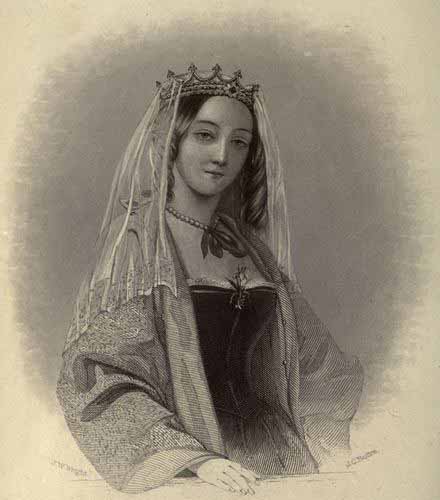
Berengaria of Navarre.
CHAPTER I.
“What thing so good which not some harm may bring? E’en to be happy is a dangerous thing?”
“Sing no more, for thy song wearieth me,” exclaimed the impatient daughter of Navarre, tossing upon her couch with the heavy restlessness of one who courts slumber when nature demands exercise. The Moorish maiden, accustomed to the petulance of the beautiful Berengaria, arose from her cushion and laying aside her lute, murmured despondingly, “The proverb saith truly, ‘’Tis ill-pleasing him who is ill-pleased with himself.’” Abandoning further attempts to soothe her mistress, the attendant retired to the extremity of the long apartment and gazed listlessly from the casement. “Art vexed that my ear loved not the sound of thy lute, peevish child?” inquired the youthful princess. “Read me a riddle, or tell me a marvellous tale of the Genii, such as thou hast learned in thy southern land.” With the air of one who performs an accustomed task while his thoughts are far away, the girl resumed her seat, and recited
A TALE OF ARABY.
Once upon a time three Genii, returning from their missions to mortals rested beside the well Zemzem. And as they sat recounting to each other the things that they had seen, behold they fell into conversation concerning the Eternal One (whose name be exalted), the destinies that reign over the fate of men, the characteristics of the world, and the misfortunes and calamities which happen unto all, both the righteous and the wicked. And one said to another, “Declare unto us now what is thine opinion, and what knowest thou concerning this thing. What is that, diffused in air, dissolved in water or concealed in earth, the subtle essence of which, being bestowed upon one of human mould, shall bring him nearest to the throne of Allah, (blessed be his name), and give him right to eat of the tree that standeth in the seventh heaven by the garden of the Eternal Abode?” And the first said, “It is Beauty,” and the second, “It is Love,” and the third, “It is Happiness.” And there arose a contention among them; and when they found that neither could convince the others, they agreed to depart each on his way, to search the elements of all things for that concordial mixture with which he would nourish a human soul into immortality. So they went their way. And after the lapse of a cycle of years, they returned again and sat by the well Zemzem. And each bore in his hand a phial purer than crystal, sealed with the seal of Solomon the wise, the magnificent. Then spake the first, saying, “Earth hath no form of beauty from the flash of the diamond hidden in its deepest caves, through all the brilliant variety of gems and sands of gold; no delicate pencilling from the first faint tinge upon the rose-bud’s cheek to the gorgeous dyes of the flowers and fruits that deck the vale of Cashmere; water hath no shade of coloring from the sea-green lining of its coral caves, to the splendid iridescence of its pearly shells; air hath no tint of the virgin stars, no ray of parted light; vapor beareth no beauty in its morning clouds and rainbow hues, from which I have not ravished the subtlest source. Whatever form of Beauty can become apparent to the sense, either as breath of fragrance, sweetness of sound, or grace of motion, sublimated to its purest element, lieth here enclosed for the endowment of whomsoever we shall choose.” And he held up the phial, and lo! it contained a liquid having a faint coloring of the rose.
Then spake the second and said, “The Almighty (blessed be he) hath given unto me that mysterious power by which I read the thoughts and purposes of men, even as the Holy Prophet (on whom be benedictions) was wont to read the ‘Book of Life.’
“From the heart of the child that turneth ever to watch the movements of its mother, from the heart of the servant that seeketh the favor of her mistress, from the heart of the sister that exults with pride in the glory of her brother, from the heart of the maiden that beateth bashfully and tenderly at the sound of the footsteps of her lover, from the heart of the bridegroom that yearneth with strong desire towards his bride, from the heart of the father that expands in the fulness of joy at the sight of his first-born, from the heart of the mother that watcheth ever the steps of her child, whether he sporteth in innocence by her side or wandereth with vice in foreign parts; I have gathered the sweetest and purest and truest thought of Love. Its impalpable essence lies hidden in this phial,” and he placed it before them. And lo! it seemed filled with a vapor which flushed in their gaze with the hue of the dawn.
Then spake the third and said, “It is not permitted unto me the servant of Ifraz the Unknown, to declare unto you in what outward manifestations of human hope or desire, in what inward workings of thought and feeling, I have detected and imprisoned the elusive spirit of Happiness,” and he held up his phial before them. And with one voice they exclaimed, “It is empty.” And they laughed him to scorn.
Then spake he in anger and said, “Truly the fool proceedeth upon probability, and the wise man requireth proof.” And they replied, “Go to, now, we will abide the proof.”
And forthwith they took their way to the land of Suristan. And as they passed by the well of Israel, Ben Izak (on whom be peace), they saw a maiden bearing a pitcher of water. And the first said, “Behold, now, immortality is given unto man by the Almighty the Ordainer of fate and destiny (whose name be exalted), but unto woman it is not given except as her beauty shall delight the heart of man.” But the second said, “Except as love gives her a seat by the Well of Life;” and the third, “Except as happiness translates her to Paradise.” Then said the first, “Let us contend no more, but let us take this damsel and bestow upon her, each our separate gift, and she shall be a sign and a testimony concerning these things.” And thus they agreed together.
And when the maiden retired to her couch, and the angel of sleep had laid his finger upon her eyelids, the first genii calling upon the name of God the All-perfect (blessed be he) broke the seal of his phial, and poured a portion of the liquid upon her lips. And the three genii watched her slumbers till the dawn; and thus they did evening by evening. And they beheld her form developing in loveliness, tall and straight as the palm, but lithe and supple as the bending branch of the oriental willow. Her smoothly rounded arms gleamed like polished ivory beneath the folds of her transparent izar, and the tips of her rosy fingers were touched with the lustre of henna. Her lips had the hue of the coral when it is wet with the spray of the sea, her teeth were as strings of pearl, and the melting fulness of her cheek was suffused with the soft bloom of the peach. In her eyes was the light of the stars, and her eyelids were adorned with kohl. Her hair was glossy and black as the plumage of the raven, and when she covered it with her veil, her countenance beamed from it comely as the full moon that walketh in the darkness of the night. Her speech was as the murmur of the waterfall and the clear tones of the nightingales of the Jordan. She was a wonder unto herself and unto her neighbors. Her step had the lightness of the gazelle and the grace of the swan; and when she went forth abroad, the eye that beheld her beauty exclaimed, “Glory be to him who created her, perfected her, and completed her.” But the genii beheld with sorrow and mortification that she became vain, and that foolish thoughts sprang up in her heart; so that it was said of her, “Hath God the High, the Great, put an evil spirit in the perfection of beauty?” Then said the second genii, “Ye shall see what the elixir of love shall do.” And he entered into her chamber, and he broke the mystic seal which was the seal of Solomon Ben David (on both of whom be peace), and a sweet odor was diffused through the apartment. And the lips of the sleeper moved as with a pleasant smile, and there beamed upon her countenance the nameless charm with which the houris fill with delight the dwellers in the Garden of Eternity. And it came to pass that all who looked upon her loved her and said, “There is none among the created like her in excellence of beauty, or in charms of disposition. Extolled be the perfection of the Creator of mankind.” And they strove one with another which should possess the inestimable treasure. And contention and strife arose daily among them; and her heart inclined unto all, and she feared to unite herself with one, lest grievous wars should follow. Therefore her soul was filled with grief, and she ceased not to weep by day and by night, and the tears were on her cheeks. Then said the third genii, “Behold sorrow is of earth, and the beauty and love ye have bestowed have gathered with them the noxious principles inwoven in the basis of human things. Ye shall behold the power of happiness.” Then he took the colorless phial, and he broke the seal thereof, calling upon the name of Ifraz the Unknown, and lo, hour after hour the invisible, impalpable elixir seemed to permeate her being, and the light of her eye was tempered to a holy ray, the color blanched on her cheeks, and the vivacity of love gave place to the serenity of content. And as she walked forth the voluptuous and the wise said, “Behold she is too pure for earth, the Terminator of delights and Separator of companions will soon call for her. Extolled be the perfections of the Eternal in whose power it lieth to annul and to confirm.”
And when the two genii saw that Beauty and Love availed not, they were filled with envy, and they seized the damsel and conveyed her away to the cave of enchantment. And the third genii being transported with grief and disappointment, broke the phial, and that which remained of the elixir of Happiness returned to its primeval source, and entered again into the combinations of human things. But the seal being broken it became known to mortals that the elixir of Life existed in the elements, and hence it is, that those who are skilled in the mysteries of nature have searched its grand arcanum with the powerful agencies of alchemy, and tortured the genii with spells and incantations to wring from them the mighty secret.
Berengaria had listened to the story with unwonted interest, and at its close started up from her couch and eagerly inquired, “What has been the result? Have they discovered the long-sought principle? I have heard wondrous tales concerning these alchemists. Men say they deal in the black art; but were there one in Navarre, I would brave the imputation of sorcery to question him concerning the elixir of beauty.” “A Moorish physician dwells in the suburbs of Pampeluna,” replied Elsiebede, measuring her sentences with timid hesitation, “whom I have often seen in the byways, gathering herbs, it is said he readeth the fates of mortals in the stars.”
“Let us go to him,” exclaimed the princess, “bring me my pelisson and veil.”
The girl obeyed with a trembling alacrity, that to a less occupied observer, would have betrayed that the expedition was the unexpected accomplishment of a long-cherished desire.
“This way,” said Elsiebede, drawing her mistress from the public street, now beginning to be thronged with laborers returning from their toil, “the alchemist brooks not impertinent intrusion, and we must beware that no officious attendant, nor curious retainer find the place of his abode.” Silently and swiftly the two maidens threaded a narrow alley, leading through an unfrequented part of the town, turning and winding among buildings more and more remote from each other, till it terminated on a grassy heath, surrounding a dilapidated mansion. The sun had already set, and Berengaria, never too courageous, began to shudder at the loneliness of the place. With instinctive fear, she clung tremblingly to the arm of her resolute dependent, whispering, “Whither dost thou lead me? There is here no sign of human life. Let us return.” But the spirited slave bent the weak will of the mistress to her purpose; and with alternate assurances of safety and incitements to curiosity, led the way to the rear of the ruined pile, where descending a stone stair, she gave three raps upon a low door. The grating of rusty bolts was heard, the door was cautiously opened, and Berengaria felt herself suddenly drawn within the portal. A glare of dazzling light blinded and bewildered her, and a stifling vapor added to her former terror, almost stupefied her senses.
The voice of Elsiebede somewhat reassured her, and as her eyes became accustomed to the light, she took a survey of the scene before her. The apartment seemed to have been originally the kitchen of the castle, one end being occupied by a wide, large chimney, now built up except in the centre, where a furnace, covered with crucibles, glowed with the most intense heat. A white screen with a small dark screen before it, nearly concealed one side, of the apartment, while on the other side from three serpent-formed tubes connected through the wall with retorts, gleamed tongues of colored flame. Various gallipots, alembics, horologues, diagrams, and dusty manuscripts were deposited upon shelves in angles of the wall.
The principal occupant was a man of a lean, haggard figure, bowed less by age than by toil and privation. A few black, uncombed locks escaping from the folds of a turban, once white, now begrimed with smoke and dust, straggled over a swarthy forehead, marked with lines caused by intense thought, and abortive speculations. He was dressed in Moorish garments, the sleeves tucked above the elbows, revealing his emaciated arms, while his talon-like fingers grasped an immense triangular crystal, through which he was casting refractions upon the screen. His deep, cavernous eyes seemed to gleam with the fires of insanity, yet he spoke in a tone of deep abstraction, though with something like the voice of affection. “Disturb me not, my daughter, but stand aside till I have completed my experiment.” The maidens remained silently by the door, and Berengaria had leisure to note the motions of a dwarf African, who sat diligently blowing the bellows of the furnace, rolling his eyes, and saluting the ladies with smiles which served at once to exhibit his white teeth and his satisfaction at the interruption.
Notwithstanding her fears at finding herself in so strange a situation, the curiosity of Berengaria was so excited by the novelty of the scene, that she waited patiently while the philosopher experimented first with one light and then with another, till apparently becoming dissatisfied with the result, he attempted to change the position of the tubes. Scarce was his purpose accomplished, when a deafening explosion rent the air, followed by sounds as of the falling of the ruin overhead. Profound darkness ensued, and the groans of the wounded alchemist mingled with the demoniac laughter of the African, and the echo of her own shrieks increased the terror of the princess almost to agony. Elsiebede alone retained any share of self-possession. “A light, a light, Salaman,” exclaimed she. Instantly a line of blue flame crept along the wall, and a tiny torch in the hand of the dwarf mysteriously ignited, revealed again his malevolent countenance, and threw his misshapen and magnified image in full relief upon the screen. An odor of brimstone that seemed to accompany the apparition, did not serve to allay Berengaria’s apprehensions. Elsiebede for once forgot her mistress. Hastily snatching the torch from the negro, she lighted a lamp and raising her father from the stone floor, began to examine his wounds. The blood was oozing from a contusion upon the back of his head, one side of his face was dreadfully burned, and his right hand lay utterly powerless. Giving hurried directions in Moorish to the grinning Ethiope, Elsiebede with his assistance placed her father upon a couch behind the screen, and bathed the painful wounds with a balmy liquid from one of the dusty phials, accompanying her soothing appliances with the soft and gentle expressions of affection. Their language was foreign to the ear of Berengaria, but she discovered by the tones of the father, and the tears of the daughter, that he was chiding her as the cause of his misfortune. At length overcome by his upbraiding, Elsiebede drew from her bosom a silken purse, and taking thence a jewel kissed it fervently, and like one resigning her last treasure at the call of duty, put it into his extended hand. The black meanwhile had prepared a cordial, which he intimated would soon give her father rest. The alchemist eagerly swallowed the draught, and soon sank into a heavy sleep.
Berengaria, whose impatience had scarcely brooked the delay necessary for this happy consummation, hurried the reluctant Elsiebede away. “I knew not, Elsie,” said she, when they were at a safe distance from the ruin, “that thy father dwelt in Pampeluna. I thought thou wert an orphan, when my father moved by thy beauty and distress purchased thee of the rude Castilian. Tell me thine history.”
“My father,” replied Elsiebede, “was when young the physician of the Moorish prince, and occupied himself in separating the hidden virtues of nature from the impurities with which they are combined. When walking abroad to gather plants for the prosecution of his inquiries, he met every day a young flower girl, carrying her fragrant wares to the palace of the Alhambra. Attracted by her beauty, he purchased her flowers, and interested himself in her history. He learned that she belonged to a band of Saracens or Gyptianos, that had recently settled in Grenada. He loved her and she became his wife.
“I was their only child. My youth was spent in listening to the wondrous tales of the East, with which my mother delighted me, or in acquiring the elements of science with my father. The sudden illness and death of my mother destroyed all my happiness. My father betook himself again to the most abstruse studies, spent whole nights in watching the stars, practised incantations to the spirits of the air, and pondering continually upon the mystery of death, commenced the search for that mighty principle which is said to prolong human existence. Many wonderful secrets of nature were in this process revealed to his sight; but he became so sad and gloomy, and his eyes beamed on me with such an unwonted fire, that I feared lest grief should dethrone the angel of reason. To divert his mind, I began to lead him forth in his accustomed walks. One day when we had lingered rather later than usual beyond the walls of Grenada, a band of armed Castilians fell upon us, and carried us away captives. The noble Sancho found me singing songs for my cruel master, and redeemed me from my fate.”
“And what became of thy father?” inquired Berengaria. “He was enabled by some of his medicines to heal a long-established malady of his captor, and thus obtained his freedom: since which, until within a few months, he has wandered through Spain in search of his lost child.” “And wherefore didst thou commit to a dying man the precious jewel which I saw in thy hand?” The tears of Elsiebede began to fall fast, and with a choking voice she replied, “Question me not, I entreat thee. Oh, my mistress, concerning the ring, at another time I will tell thee all.” Touched with the instinctive reverence that nature always pays to genuine sorrow, the princess forbore further inquiries, and the two maidens completed their walk in silence.
The terror that Berengaria had suffered took away all desire to prosecute her inquiries with the alchemist, but with unusual consideration, on the following day, she dismissed Elsiebede at an early hour, giving her permission to pass the night with her father. The poor girl returned in the morning overwhelmed with grief. The alchemist was dead. From her self-reproaches and lamentations Berengaria learned, that in his scientific researches he had consumed all his property, and melted every valuable belonging to his daughter, except her mother’s ring. This gem she had steadily refused to give him, both on account of its being a memento and a charm, and the failure of his experiment with its fatal results he had in his dying hour attributed to the lack of the potency of the precious gem. Stung with remorse, Elsiebede declared that if the ring could not save her father’s life, it should at least procure him a grave, and telling her mistress that she could never again look upon the jewel without a shudder, begged her to accept it, and to assist her in burying him according to the rites of the Mohammedan religion. In catholic Navarre this was next to an impossibility; but through the generosity of the princess, and the ingenuity of Salaman, the corpse was secretly conveyed to the Moorish cemetery in Grenada.
CHAPTER II.
“O, such a day So fought, so followed, and so fairly won, Came not till now, to dignify the times.”
It was a gala-day in Navarre. Sancho the Strong, the gallant brother of Berengaria, had proclaimed a tournament in compliment to his friend Richard Plantagenet, Count of Poitou. In the domestic wars which had vexed the south of France since the marriage of Eleanor of Aquitaine with Henry of Anjou, these valiant youths had fought side by side, and from a friendship cemented by intimacy as well as similarity of tastes and pursuits, had become fratres jurati, or sworn brothers, according to the customs of the age. Both were celebrated for their knightly accomplishments and their skill in judging of Provençal poetry, and each had proved the prowess of the other in chivalric encounter, and provoked the genius of his friend in the refined and elegant contests of minstrelsy and song. The brave Sancho had arranged the lists, giving to his friend the first place as knight challenger, reserving the second for himself, and bestowing the third upon their brother in arms, the young Count of Champagne. The gay pavilions were set, a splendid concourse assembled, and Berengaria, proclaimed Queen of Beauty and Love, had assumed her regal state attended by all the beauties of Navarre, when to the infinite disappointment and mortification of the prince, Count Raimond of Toulouse arrived to say, that Richard, having received letters from his mother, had found it necessary to depart suddenly for England; but that the festivities of the day might not be marred by his absence, he entreated that the bearer of the message, Count Raimond, might occupy his pavilion, bestride his war-steed, and do his devoir in the lists. With a courtesy that ill-concealed his chagrin the noble Sancho accepted the substitute, and conducting him to the tent glittering with green and gold, consigned him to the care of the esquires; while himself went to acquaint his sister with the mortifying fact that the spectacle, for which they had prepared with such enthusiastic anticipations, was yet to want the crowning grace expected from the presence of that flower of knighthood, Richard Plantagenet.
To conceal from the spectators the knowledge of this untoward event, their father, Sancho the Wise, who held the post of honor as judge of the combat, decided that Count Raimond of Toulouse should assume the armorial bearings of Richard, and personate him in the lists. These preliminaries being satisfactorily arranged, the heralds rode forth and proclaimed the laws of the tournament, and the games proceeded. The Count of Champagne and the royal Sancho, better practised in the exercises of the lance than the Spanish cavaliers who opposed them, won applause from all beholders; but the crowd seemed to take especial delight in the prowess of Count Raimond, shouting at every gallant thrust, and every feat of horsemanship, “A Richard, a Richard! A Plantagenet!” Notwithstanding the unfavorable auspices under which the tournament commenced, the sports of the day were as gay and animated as the most sanguine could have hoped. The three challengers had overborne all opponents. With a heart fluttering with pride and pleasure, the young Blanche of Navarre had seen her sister confer a golden coronet upon the Count of Champagne, and Sancho had also received from Berengaria a chaplet in honor of his knightly achievements. But the first in honor as in place, was the warrior who had personated Richard. When, however, he laid aside his vizor, to receive the well-won laurel as leader of the victors, the multitude discovered that the hero whom they had greeted with such enthusiastic applause was Count Raimond of Toulouse, and new bursts of acclamations rent the air, while the marshals, and squires, and heralds, forgetting for a moment their duties, gathered round the throne of Love and Beauty to interchange congratulations with the gratified count.
In the general excitement no one had noticed the entrance of a knight adventurous, one of those wandering cavaliers who, to perfect themselves in feats of arms, travelled from province to province, challenging the skill of all comers in chivalrous combat. The appearance of this knight-errant was such as attracted all eyes. He was mounted on a bay horse of spirit and mettle that hardly yielded to the strong rein; his helmet was surmounted with a crest of the figure of a red hound, while his erect form shielded in brown armor, and the firmness with which he maintained his seat gave him the appearance of a bronze statue, borne along in the procession. Disregarding the indications that the fortunes of the day were already decided, the stranger knight rode directly to the pavilion emblazoned with the arms of Richard, and struck his spear with such force upon the shield, as to summon at once the attendants to duty.
“Whom have we here?” exclaimed Sancho, with a hearty laugh. “By our Lady, Count Raimond, this day’s sun shall not set till the heathen hound on the crest of yon crusading knight hath bit the dust. Pardieu, I almost envy thee thy good fortune to tilt against so fair a foe.” The interest which this new-comer gave to the flagging sports was evinced by the eager inquiries and hurried whispers that went round among the spectators. A breathless silence ensued, as Count Raimond couched his lance and started forward to meet his strange challenger. “A Raimond! A Raimond!” cried the crowd, as the two combatants dashed upon each other.
“Long life to the Red Knight,” “Success to the Crusaders,” was echoed by the fickle multitude, with increased satisfaction, as the hero of Toulouse, overthrown by the violence of the shock, struggled beneath his fallen charger, while the stranger applying rein and spur, caused his gallant steed at one bound, to leap over the prostrate horse and rider, then dexterously compelling the animal to caricole gracefully in front of the queen’s galley, and lowering his lance, the victorious knight courteously bowed as if laying his honors at the feet of Love and Beauty. The prizes for the day were already bestowed; but the enthusiastic Berengaria found it impossible to let such prowess go unrewarded. Hastily untying her scarf, she fastened it to the end of his spear, and the Crusader, with the armorial bearings of Navarre streaming from his lance, rode slowly and proudly from the lists.
The squires meanwhile had extricated the vanquished Raimond from his perilous position, and conducted him to his tent, where his bruises were found to require the skill of the leech. All were busy with conjectures concerning the unknown, many sage surmises very wide of the truth were hazarded by those best acquainted with heraldic devices, and arguments were rapidly increasing to animosities, when the slight tinkling of a bell again drew the attention of the concourse.
“A champion! A champion,” exclaimed they again as a second knight, strong and broad-shouldered, sheathed in shining black armor, entered the arena. Glimpses of a ruddy complexion and sparkling eyes, were visible through the jetty bars of his vizor, and a raven with smooth and glossy plumage, its beak open, and a bell suspended from its neck, was perched upon his helmet. His coal-black steed was a war-horse of powerful make, deep-chested and of great strength of limb; his red nostrils distended by his fiery impatience, glowed like the coals of a furnace, while the gauntleted hand that with matchless skill controlled his speed, looked as though it might have belonged to a giant of the olden time. The impetuosity of the black knight left the spectators not long in doubt of his purpose. Count Henry of Champagne was summoned to reassume his armor and make good his claim to his recently won laurels. “Pray heaven thine eye and hand falter not, Count Henry,” exclaimed Sancho, as he personally inspected the armor of his friend, and cautioned the squires to see that each ring and buckle was securely fastened. “The issue of this combat should depend upon thine own right arm, not upon a weak spring or careless squire.” The courtesy of the black knight seemed proportioned to his strength and skill. Reining his horse to the left, he gave the count the full advantage of the wind and sun, and instead of meeting him in full career, eluded the shock, parried his thrusts with the most graceful ease, and rode around him like a practised knight conducting the exercises of the tilt-yard in such a manner, as to develop and display the prowess of an ambitious squire; and when at last Count Henry lost his saddle, it was rather the effect of his own rashness, than from any apparent purpose of his antagonist; for exasperated to the last degree at being thus toyed with, he retreated to the extremity of the lists, put his horse upon its full speed and dashed upon his opponent. The black knight perceiving the intent of this manœuvre, brought his well-trained steed at once into an attitude of perfect repose, and sitting immovable as an iron pillar, received the full shock upon his impenetrable shield. The horse of the count recoiling from the effect of the terrible collision, sank upon his haunches, and the girth breaking, the rider rolled in the dust. Something like a smothered laugh broke from beneath the bars of the stranger’s vizor, as he rode round his vanquished foe, and extended his hand as though inviting him to rise. But his demeanor was grave and dignified, when he presented himself before the admiring Berengaria, who in default of a better chaplet stripped her tiny hand of its snowy covering, and bestowed the embroidered glove as the guerdon of his skill. “Part we so soon, sir knight?” said Sancho, reining his steed, so as to keep pace with that of his unexpected guest. “I would fain set lance in rest against so fair a foe.” Without deigning a reply, the knight put spurs to his horse, and leaping the barriers disappeared in the wood. Rejoining his two friends in the pavilion who were condoling with each other over their inglorious defeat, Sancho burst into a stream of invective. “Ungrateful cravens,” cried he, “to repine at heaven’s grace. I would have given the brightest jewel in the crown of Navarre, for leave to set lance in rest against either of yon doughty knights.” “Thou shouldst have been very welcome,” exclaimed Raimond, laying his hand upon his wounded limb. “Our Lady grant henceforth that dame Fortune send all such favors to thee,” and he laughed in spite of his discomfiture. A startling blast from the wood interrupted the colloquy, and Count Raimond petulantly exclaimed, “Methinks the foul fiends have congregated in the forest! That hath the sound of the last trumpet.”
“Aye, verily,” replied Count Henry, reconnoitering from the door of the pavilion, “and yonder comes Death on the pale horse. Prince Sancho, thine hour has come, prepare to meet thy final overthrow.” There seemed a terrible significance in the words, for upon a snowy charger, whose mane and tail nearly swept the ground, just entering the lists, was seen a knight, dressed in a suit of armor of such shining brilliancy as almost to dazzle the eyes of the beholders. His crest was a white dove with its wings spread, and conspicuous upon his right shoulder appeared a blood-red cross. He carried neither lance nor spear, but an immense battle-axe hung at his saddle-bow. “By my troth,” said Sancho, “be he the angel of death himself, I will dispute his empire, even though he bring twelve legions of his mysterious retainers to back him. It shall not be said that the chivalry of Spain, aye, and of France to boot,” casting a glance at his crest-fallen friends, “are but trophies of the prowess of these unknown demi-gods.” “Heaven grant thou mayest make good thy boast, for truly these demi-gods wield no mortal weapons,” said Count Raimond, with a bitter smile, as the prince anticipating a challenge rode forth to meet the white champion. Unpractised in the use of the mace, Sancho, whose ire was completely roused at seeing the honors of the day borne off by strangers, disregarded the laws of the tournament (which required the challenger to use the same weapons as his adversary), and seizing his spear, attacked his opponent with a fierce energy, which showed that he fought for deadly combat, and not for trial of skill in knightly courtesy. The brilliant figure, at the first rush, bowed his head, till the plumage of the dove mingled with the flowing mane of his courser, and suffered the animal to sheer to the right, thus compelling the prince, in his onward career, to make a similar involuntary obeisance as the result of his ineffectual thrust. Completing the demivolte, the two champions again returned to the onset; and now the mace of the white knight describing shining circles round his head, received upon its edge the spear of the prince, clave the tough oak wood asunder, and sent the spear-head whirling through the air almost to the feet of the spectators. A second, a third, and a fourth spear met with the same fate. The welkin rang with the applause of the beholders. “Bravo, sir white knight!” “Glory to the Red Cross!” “Honor to the crusader!” “Death to the Paynim,” accompanied the flourish of trumpets and the shouts of heralds, which, together with the flutter of pennons and the waving of signals from the galleries of the ladies, showed the exciting interest of the scene. At length the dove-crested warrior, by a skilful manœuvre, brought himself into such proximity as to be able with one blow to strike the helmet from the head of his antagonist; at the same moment, however, he extended his hand and prevented the unbonneted prince from falling prone beneath the feet of his horse. The gallant Sancho thus compelled to yield, with knightly grace accompanied his vanquisher to Berengaria’s throne. “Thy best guerdon, my sister, for thy brother’s conqueror,” said he. “Beside the arm of Richard Plantagenet, I thought there was not another in Christendom that could break the bars of my vizor and leave my skull unscathed. Why dost thou hesitate?” exclaimed he, observing her embarrassment. “The daughter of Sancho the Wise is not wont to be tardy when called upon to honor the brave. Has the same blow that still keeps the blood dancing in the brain of thy brother, paralyzed thy hand?” “Nay,” said Berengaria, while a brilliant blush suffused her cheeks, “but I would fain see the countenance of the brave knight, who carries off the honors of the field from such a competitor,” and drawing the ring of Elsiebede from her finger, she bestowed it upon the victor. Rising from his knees, the knight inclined courteously to the squires, who with a celerity lent by curiosity, unlaced his casque and unfastened his gorget, revealing the face of Richard Plantagenet, beaming fair and ruddy from the bright yellow curls that clustered round it, and eyes that sparkled in the full appreciation of the surprise and merriment that his unexpected apparition occasioned. “Mon cher frère,” exclaimed Sancho, grasping his hand, “I am conquered by Richard, then am I victor. Give me joy, knights, ladies, and squires.” The heralds taking up the word, sounded the tidings through the field, while the spectators shouted, “A Richard! a Richard! Long live the gallant Plantagenet!” The Counts of Toulouse and Champagne, assisted by their attendants, hastened to the scene, and discovering the scarf and glove of Berengaria resting beneath the loosened hauberk, recognized each his conqueror, and found in that circumstance a greater balm for their wounded pride, than all their bruises had experienced from the mollifying appliances of leechcraft. The knights challengers thus all vanquished by the single arm of Richard, left the field with the highest sense of satisfaction, and the ready wit of their champion, pointed the sallies and directed the mirth of the banquet, which followed, and continued long into the night.
CHAPTER III.
“Beshrew your eyes, They have o’erlooked me, and divided me; One half of me is yours, the other half yours, And so all yours.”
In the general excitement attendant upon the discovery of Richard and the breaking up of the tournament, Berengaria had remarked the agitation of Elsiebede, and seized an early opportunity to learn the cause. “Where hast thou known Count Richard?” said she in a tone of feigned indifference. “I have never seen him till to-day,” replied the attendant. “But thou didst start and turn pale when the White Knight disclosed the features of Plantagenet?” “Aye, because I saw my lady bring a curse upon his head.” “A curse upon him? How meanest thou, silly child?” replied the princess, growing pale in her turn. “Pardon, my dear mistress,” continued Elsiebede, falling upon her knees, “I should have told you, the ring bestowed upon a knight, is a fatal gift.” “And why fatal?” inquired Berengaria, somewhat relieved that she had no greater cause for disquiet. “I know not why. The jewel of the ring has been in the possession of my mother’s tribe for many generations, and whenever man has called it his own, sorrow and distress have followed, till this tradition has become a proverb.
“’Twill thwart his wish, and break his troth, Betray him to his direst foe, And drown him in the sea.”
“Thou art too superstitious,” said Berengaria, as her attendant recited the malediction, with an appearance of the most profound sense of its reality; “but to please thee, foolish child, I will regain the toy.” Berengaria secretly determined to lose no time in relieving Richard from his dangerous possession, and accordingly lost no occasion for conversing with the prince; but though he treated her with the most distinguished courtesy, the term of his visit to Navarre expired before their acquaintance had ripened into an intimacy that would warrant her venturing upon the delicate task of reclaiming her gift. Months elapsed before Berengaria again saw the knight who had made such an impression upon her youthful imagination, and she began to fear that the ring had, in reality, conducted him to his predestined sepulchre in the sea, when her brother Sancho returning from a tour in France, brought intelligence of the most gratifying character. “Rememberest thou, my sister,” said he, “the valiant Plantagenet, who so gallantly bore off the honors of our tournament?” “Aye, verily,” replied the princess, casting down her eyes. “He has been wandering through Germany, challenging all true knights to chivalrous combat, and has met with many strange adventures,” continued Sancho. “Recount them,” said Berengaria, “I listen with attention.” “Thou who didst reward his valor, as red, and black, and white knight in one day, canst well appreciate his partiality for disguises,” resumed her brother: “and it seems, that during this expedition, one had nearly cost him his life. Passing through the dominions of the King of Almaine, he assumed the dress of a palmer, but being discovered, was cast into prison. Ardour, the son of the king, learning that a knight of remarkable strength and prowess was confined in a dungeon, brought him forth and invited him to stand a buffet. Richard accepted the challenge, and received a blow that laid him prostrate. Recovering himself, he returned the stroke with so much force, that he broke the cheek-bone of his antagonist, who sank to the ground and instantly expired. The king awakened to fresh transports of fury, at the loss of his son, gave orders that the prisoner should be closely fettered and returned to the lowest dungeon of the castle. But the monarch had, also, a daughter, a princess of great beauty, who became exceedingly interested in the man that had so dexterously slain her brother. Learning that a plan was on foot to make the bold knight the prey of a lion, she found means to enter his cell, and acquaint him with his danger. The bold heart of Plantagenet did not fail him in this extremity. Rewarding the solicitude of the tender Margery with a kiss, he desired her to repair to him in the evening, bringing forty ells of white silk, and a supper with plenty of good beef and ale. Thus fortified in the outer and inner man, he calmly awaited his fate. The next day, as soon as the roar of the monster was heard, he wrapped his arm in the silk, and evading the spring of the animal, gave it such a blow in the breast, as nearly felled it to the ground. The lion lashing itself with its tail, and extending its dreadful jaws, uttered a most hideous yell; but the hero suddenly darted upon the beast, drove his arm down the throat, and grasping the heart tore it out through the mouth, and marched with his trophy, yet quivering with life, to the great hall of the palace, where the king with a grand company of dukes and earls, sat at meat. Pressing the blood from the reeking heart, Prince Richard dipped it in the salt, and offered the dainty morsel to the company. The lords rose from the table, and declaring, that since the days of Samson, no mortal had achieved so wonderful an exploit, dubbed him Cœur de Lion, on the spot. The barbarian finding it impossible, longer to detain a prisoner who seemed to enjoy the especial favor of Providence, bestowed upon him gifts and presents, mounted him on a fleet horse, and with great joy, saw him depart. A herald has this morning arrived, to say that he wends his way hither; therefore, prepare, my sister, to receive the lion-hearted prince, with a state becoming his new honors.”
Berengaria needed no second bidding. She was already more interested in the gallant Plantagenet than she dared confess, even to herself, while the conduct of Richard, upon his arrival, intimated plainly the attraction that had drawn him to Navarre, and the flattering attention with which both the elder and younger Sancho treated him, promised fair speed to his wooing. He was exceedingly fond of chess, and this game served to beguile many hours when the weather precluded more active sports. Though a practised, Richard was often a careless player, and his fair antagonist gained many advantages over him, while he pertinaciously declared himself vanquished by her beauty rather than her skill. The ready blush that followed his compliments gave occasion for renewed expressions of admiration, and often in the midst of triumph the victor found herself covered with confusion. Many gages of trifling value were lost and won between the amicable rivals, but it was not till after repeated defeats that Richard began to suspect there was some article in his possession that his beautiful opponent was particularly anxious to win. He playfully proposed to stake his head against one lock of her hair, and when he lost the game, gravely inquired whether she would accept the forfeit, with its natural fixture, or whether like the vindictive daughter of Herodias, she would require it to be brought in a charger, as was the head of John the Baptist. Re-arranging the pieces before she could interpose a remonstrance, he declared the stakes should next be his heart against her hand. The game was terminated in his favor. Gallantly seizing her hand, pressing his lips upon it, he protested that in all his tournaments he had never won so fair a prize; then suddenly exclaiming, “What magic game is this, in which a man may both lose and win?” he laid his broad palm upon his side, and with an appearance of great concern, continued, “By the blessed mother my heart is certainly gone; and I must hold thee accountable for its restoration.”
Making a strong effort at recovering her composure, Berengaria asserted that she had neither lost nor won the game, since he had arranged the pieces unfairly, and proceeded to capture her queen almost without her knowledge, and certainly without her consent.
The sportive colloquy finally ended in a compromise, Richard agreeing that the affair could justly be accommodated by Berengaria’s staking her heart against his hand, and she playfully avowing that a gamester so unprincipled might expect to lose both body and soul, if he did not commit the arrangements to one of greater probity. The keen eye of Plantagenet soon discovered that this game possessed an interest for his fair rival far beyond the preceding ones, and in doubt whether it arose from her anxiety to gain his hand, or from her desire delicately to assure him that he could never win her heart, he suffered himself to be beaten. The result only increased his perplexity; for the princess, though evidently elated by her success, seriously proposed to relinquish her claim upon his hand, in consideration of the ring that glittered upon his finger. Too much interested any longer to regard the game, Richard pushed aside the chess-board, and fixing his eyes upon her, inquired, “Wherefore wouldst thou the ring?”
The princess more than ever embarrassed by the seriousness of his voice and manner, stammered forth, “The jewel is a charm.” “True,” said Richard, with unaffected warmth, “Berengaria’s gifts are all charms.” “Nay, nay!” said she, with uncontrollable trepidation, “I mean—I mean—it is a fatal possession.”—“Of which I am a most undoubted witness,” interrupted he, “since by its influence I have lost my head, my heart and my hand.” “Have done with this idle jesting, and listen to me,” said Berengaria, earnestly. “It will thwart thy dearest wish, and betray thee to thy direst foe.” “None but Berengaria can thwart my dearest wish,” said Richard, steadily regarding her, “and from my direst foe,” he added, with a gesture of defiance, “this good right arm is a sufficient defence.” Tears shone in Berengaria’s eyes, and she added, “Why wilt thou misunderstand me? I tell thee it will break thy troth.” “Our Lady grant it,” responded he, with a shout of exultation. “Since the day I first received it, I have not ceased to importune King Henry to cancel my engagement with Alice of France.” The baffled princess having no further resource burst into tears. “Nay, weep not, my sweetest Berengaria,” said Richard, tenderly, “the gem is indeed a talisman, since by its aid only have I been able to discover the treasure thou hadst so effectually concealed from my anxious search. Fear no evil on my behalf, my poor life has double value since thou hast betrayed an interest in my fate.” He stooped to kiss the tears from her cheek, and passing a chain with a diamond cross about her neck, left her alone to recover her composure.
CHAPTER IV.
“Ah me! for aught that I could ever read, Could ever hear by tale or history, The course of true love never did run smooth.”
“A long and secret engagement, replete with hope deferred, was the fate of Richard the Lion-hearted and the fair flower of Navare.” The vexatious wars in which Eleanor of Aquitaine constantly involved her husband and children occupied Richard in combats more dangerous than those of the tourney. The heart of Berengaria was often agitated with fears for his safety. She was also compelled to reject the addresses of numerous suitors, attracted by her beauty and wealth, and she thus subjected herself to the imputation of caprice, and the displeasure of her father, when her thoughts were distracted by rumors that Richard was about to consummate his marriage with Alice. An occasional troubadour who sang the exploits of her gallant lover sometimes imparted new life to her dying hopes, and again when a long period elapsed without tidings of any kind, she bitterly reproached herself for permitting him to retain an amulet which she was so well assured would change the current of his affections; and notwithstanding the general frankness of his character, and the unfeigned earnestness of his manner, which more than his words, had convinced her of his truth; she was often tortured with the suspicion that Richard had only amused himself with the artlessness of a silly girl, and had no intention of demanding her of her father. Her only confidant in the affair was her brother Sancho the Strong, who consoled her by violently upbraiding her for the unjust suspicion, and resolutely vindicating the honor of his absent friend. While the mind of Berengaria was thus cruelly alternating between hope and fear, her sister Blanche was wedded to Thibaut, brother of Count Henry of Champagne. On the festive occasion Richard accompanied the bridegroom: and when Berengaria once more read admiration and love in every glance of his speaking eyes, and listened to his enthusiastic assurances of devotion, and above all, when she heard his wrathful malediction against those who interposed the claims of Alice, she wondered how she could ever have distrusted the sincerity of his professions. But though her heart was thus reassured, the first intelligence that she received from Champagne through the medium of Blanche, overwhelmed her with new apprehensions. It was asserted, that an alliance had been formed between Richard and Philip, the young King of France, to wrest Alice from the custody of Henry, and that the two princes, to prove that they looked upon each other as brothers, exchanged clothing, ate at the same table, and occupied the same apartment. The confident Sancho even, was somewhat shaken by this report; particularly as the Gascon subjects of Richard began to prepare for war. Instigated by his own doubts, but more especially by the mute appeals of Berengaria’s tearful eyes, Sancho made a journey to the north to prove the guilt or innocence of his friend. At Bordeaux he learned that Richard had gone to Poictiers. At Poictiers it was said he might be found at Tours. At Tours the rumor was confirmed, that Richard had transferred his allegiance from Henry to Philip, and that Henry, in consequence of his son’s rebellion, had fallen sick at Chinon, and that Richard had been summoned to that place to attend the monarch’s death-bed. Without delay, therefore, Sancho posted forward to Chinon. As he ascended an eminence commanding a view of the road for some distance, he saw a band of armed horsemen riding in advance of him, and thought he discerned, in the van, the crest of Richard Cœur de Lion. Putting spurs to his horse, he joined the rear of the cavalcade, which proved to be the funeral procession of Henry II., led by his erring son to the abbey of Fontevraud. The mournful tones of the bell mingled with the clanging tread of the mail-clad nobles, as solemn and slow they followed the prince up the long aisle of the church. The air was heavy with the breath of burning incense, and the strong and ruddy glare of the funeral torches, revealed with fearful distinctness the deep furrows made by age, and care, and grief in the noble features of the deceased monarch. The walls draped with the sable habiliments of woe, returned the muffled tones of the organ, while drooping banners, that canopied the bier, shook as with a boding shudder, at the approach of the warrior train. One solitary mourner knelt beside the altar, a fair-haired youth, whose features of classic purity, seemed to have borrowed their aspect of repose from the dread presence before him. It was Geoffrey, the younger son of Rosamond. The solemn chanting of the mass was hushed, and the startled priests suppressed their very breath in awe, as heavy sobs burst from the great heart of Cœur de Lion, and shook the steel corselet that was belted above his breast. Geoffrey silently rose, and moving to the head of the bier, left the place of honor to his repentant brother. “My father!” exclaimed Richard, bending over the dead, and lifting the palsied hand, “My father! oh canst thou not forgive?” He stopped in speechless horror, for blood oozed from the clammy lips that till now had always responded to the call of affection.
The sensitive heart of Sancho, wrung with a kindred agony, could no longer brook the terrible spectacle. He left the abbey, and was followed by one and another of the crowd till the self-accusing parricide was left alone with the body of his sire.
When the Prince of Navarre returned to Pampeluna, he forbore to pain his sister’s heart by a recital of the melancholy circumstances that had so affected his own, but he carried to her an assurance that Richard would wed only Berengaria, sealed with the mysterious jewel now reset as the signet ring of the King of England. He described the splendid coronation of his friend, the wealth of his new realm, and the enthusiastic rapture with which his new subjects hailed his accession to the throne. He also informed her that Richard, previous to his father’s death, had taken the cross for the Holy Land, and that all his time and thoughts were now occupied in settling the affairs of the realm for this object; and that the alliance with Philip, which had caused her so much anxiety, was an engagement, not to marry Alice, but to enter with the French monarch upon the Third Crusade.
The prospects of her mistress awakened all the enthusiasm of Elsiebede. She dreamed by night and prophesied by day of long journeys on horseback and by sea, and she interspersed her prognostications with agreeable tales of distressed damsels carried off by unbelieving Afrites, and miraculous escapes from shipwreck by the interposition of good Genii. But though her tongue was thus busy, her hands were not idle. She set in motion all the domestic springs to furnish forth the wardrobe of her mistress and herself with suitable splendor, and amused the needle-women with such accounts of eastern magnificence that they began to regard the rich fabrics upon which they were employed as scarcely worthy of attention.
In the beginning of the autumn of 1190, Queen Eleanor arrived at the court of Navarre to demand of her friend Sancho the Wise the hand of his daughter for her son Richard. The king readily accepted the proposal, for beside being Berengaria’s lover, the gallant Plantagenet was the most accomplished, if not the most powerful sovereign of Europe. Under the escort of the queen dowager the royal fiancée journeyed to Naples, where she learned to her mortification and dismay that her intended lord was not yet released from the claims of Alice, and that the potentates assembled for the crusade were in hourly expectation of seeing the armed forces of Christendom embroiled in a bloody war to decide her title to the crown matrimonial of England.
The forebodings of Elsiebede did not increase her equanimity. “It is all the work of the fatal ring,” said the superstitious maiden. “Did I not tell thee it would thwart his dearest wish?” Berengaria could reply only by her tears. Other circumstances made her apprehensive concerning the fate of the expedition. The Emperor Frederic Barbarossa was among the first of those whose grief arose to indignation at the fall of Jerusalem. He wrote letters to Saladin demanding restitution of the city, and threatening vengeance in the event of non-compliance. The courteous Infidel replied, that if the Christians would give up to him Tyre, Tripoli and Antioch, he would restore to them the piece of wood taken at the battle of Tiberias, and permit the people of the west to visit Jerusalem as pilgrims. The chivalry of Germany were exasperated at this haughty reply, and the emperor, though advanced in age, with his son the Duke of Suabia, the Dukes of Austria and Moravia, sixty-eight temporal and spiritual lords, and innumerable hosts of crusaders, drawn out of every class, from honorable knighthood down to meanest vassalage, set out from Ratisbon for the East. The virtuous Barbarossa conducted the march with prudence and humanity. Avoiding as much as possible the territories of the timid and treacherous Greek Emperor, Isaac Angelus, he crossed the Hellespont, passed through Asia Minor, defeated the Turks in a general engagement at Iconium, and reached the Taurus Ridge, having accomplished the difficult journey with more honor and dignity and success than had fallen to the lot of any previous crusaders.
When the army approached the river Cydnus, the gallant Frederic, emulating the example of Alexander, desired to bathe in its waters. His attendants sought to dissuade him, declaring that the place had been marked by a fatality from ancient times; and to give weight to their arguments, pointed to this inscription upon an adjacent rock, “Here the greatest of men shall perish.” But the humility of the monarch prevented his listening to their counsels. The icy coldness of the stream chilled the feeble current in his aged veins, and the strong arms that had for so many years buffeted the adverse waves of fortune, were now powerless to redeem him from the eddying tide. He was drawn out by the attendants, but the spark of life had become extinct.
The tidings of this melancholy event came to Berengaria, when her heart was agitated by the perplexity of her own situation not only, but by the intelligence that Richard’s fleet had been wrecked off the port of Lisbon, and that he was himself engaged in hostilities with Tancred. Cœur de Lion was indeed justly incensed with the usurper of his sister’s dominions. Upon the first news of the fall of Jerusalem, William the Good had prepared to join the crusade with one hundred galleys equipped and provisioned for two years, sixty thousand measures of wine, sixty thousand of wheat, the same number of barley, together with a table of solid gold and a tent of silk, sufficiently capacious to accommodate two hundred persons. Being seized with a fatal disease, he left these articles by will to Henry II, and settling upon his beloved Joanna a princely dower, intrusted to her the government of the island. No sooner was he deceased, than Tancred, an illegitimate son of Roger of Apulia, seized upon the inheritance and threw the fair widow into prison. The roar of the advancing lion startled Tancred from his guilty security, and he lost no time in unbarring the prison doors of his royal captive. But Richard required complete restitution, and enforced his demands by the sword. He seized upon Messina, but finally through the intervention of the French king, accommodated the matter by accepting forty thousand ounces of gold, as his father’s legacy and his sister’s dower. He also affianced his nephew Arthur of Brittany, to the daughter of Tancred, the Sicilian prince agreeing on his part to equip ten galleys and six horse transports for the crusade. Completely reconciled to the English king, Tancred, in a moment of confidence, showed him letters in which Philip had volunteered to assist in hostilities against Richard. This treachery on the part of Philip brought matters to a crisis. Seizing the evidences of perfidy, Richard strode his way to the French camp, and with eyes sparkling with rage, and a voice of terrible power, upbraided him with his baseness. Philip strongly asserted his innocence, and declared the letters a forgery, a mere trick of Richard to gain a pretext for breaking off the affair with his sister. The other leaders interposed and shamed Philip into acquiescence with Richard’s desire to be released from his engagement with Alice. Some days after the French king sailed for Acre.
But though the hand of the royal Plantagenet was thus free, the long anticipated nuptials were still postponed. It was the period of the lenten fast, when no devout Catholic is permitted to marry. Eleanor finding it impossible longer to leave her regency in England, conducted Berengaria to Messina, and consigned her to the care of Queen Joanna, who was also preparing for the voyage. The English fleet, supposed lost, arrived in the harbor of Messina about the same time, and arrangements were speedily made for departure. As etiquette forbade the lovers sailing together, Richard embarked his sister with her precious charge on board one of his finest ships, in the care of the noble Stephen de Turnham, while himself led the convoy in his favorite galley Trenc-the-mere, accompanied by twenty-four knights, whom he had organized in honor of his betrothment, under a pledge that they would with him scale the walls of Acre. From their badge, a fillet of blue leather, they were called knights of the Blue Thong.
Thus with one hundred and fifty ships and fifty galleys, did the lion-hearted Richard and his bride hoist sail for the Land of Promise, that El Dorado of the middle ages, the Utopia of every enthusiast whether of conquest, romance or religion.
CHAPTER V.
“The strife of fiends is on the battling clouds, The glare of hell is in these sulphurous lightnings; This is no earthly storm.”
Trustfully and gaily as Infancy embarks upon the untried ocean of existence, the lovers left the harbor of Messina, and moved forth with their splendid convoy, upon the open sea. By day the galley of Berengaria chased the flying shadows of the gallant Trenc-the-mere along the coast of Greece, or followed in its rippling wake among the green isles of the clustering Cyclades; by night, like sea-fowl folding their shining wings, the vessels furled their snowy canvass, and with silver feet keeping time to the waves, danced forward over the glassy floor of the blue Mediterranean, like a charmed bride listening to the sound of pipe and chalumeaux that accompanied the spontaneous verse with which the royal troubadour wooed her willing ear.
The treacherous calm that had smiled upon the commencement of their voyage, at length began to yield to the changeful moods of the stormy equinox, which like a cruel sportsman, toyed with the hopes and fears of its helpless prey. Clouds and sunshine hurried alternately across the face of the sky. Fitful gusts of wind tossed the waves in air or plucked the shrouds of the ships and darted away, wailing and moaning among the waters. Then fell a calm—and then—with maddening roar the congregated floods summoned their embattled strength to meet the mustering winds, that, loosened from their caves, burst upon the sea with terrific power.
The females crept trembling to their couches, dizzy with pain and faint with fear. The sickness of Berengaria increased to that state of insensibility in which the body, palsied with agony, has only power to assist the mind in shaping all outward circumstances into visions of horror. She was again in the cell of the alchemist; saw lurid flames, heard deafening explosions, with unearthly shrieks and groans proceeding from myriads of fiends that thronged round her with ominous words and gibing leer. She felt herself irresistibly borne on, on, with a speed ever accelerated, and that defied all rescue, and with all there was an appalling sense of falling, down, down, down, into interminable depths.
The fantasy sometimes changed from herself, but always to her dearer self. Richard contending with mighty but ineffectual struggles against inexorable Genii, was hurried through the unfathomable waters before her, the fatal ring gleaming through all their hideous forms upon her aching sight; and the confused din of strange sounds that whirled through her giddy brain could never drown the endless vibrations of the whispered words,
“’Twill thwart his wish and break his troth, Betray him to his direst foe, And drown him in the sea.”
The capricious winds at length sounded a truce between the contending elements. The baffled clouds, like a retiring enemy, discharging occasional arrows from their exhausted quivers, hurried away in wild confusion, while the triumphant sea, its vexed surface still agitated by the tremendous conflict, murmured a sullen roar of proud defiance.
The Princess of Navarre, relieved from the thraldom of imaginary horrors, became aware of the actual peril which the fleet had encountered. It was in vain that the anxious attendants interposed, she persisted in being conducted to the deck, whence with longing eyes she gazed in every direction for the bark of her lover. Not a vessel was in sight. A wild waste of waters mocked her anxious scrutiny. Her own galley was so far disabled, that it was with much toiling and rowing, the mariners brought it into Limousa, the capital of Cyprus, and no sooner had they cast anchor, than Isaac Comnenus, the lord of the island, assailed the stranger bark with so much violence, that they were forced to row again with all speed into the offing. While the ship lay thus tossing at the mercy of the waves, dismantled fragments of shattered wrecks floated by, the broken masts and spars contending with the waters, like lost mariners struggling for life.
While Berengaria gave way to the harrowing conviction that the Trenc-the-mere, with its precious freight, had foundered in the storm, Richard, whose ship had been driven into Rhodes, was collecting his scattered fleet and scouring the sea for his lost treasure. Arrived off Cyprus, he beheld the royal galley, and learning that it had been driven from the harbor by the pitiless despot, he landed in great wrath, and sent a message to Isaac, suggesting the propriety of calling his subjects from the work of plundering the wrecks to the exercise of the rites of hospitality.
The arrogant Cypriot answered that, “whatever goods the sea threw upon his island, he should take without leave asked of any one.” “By Jesu, Heaven’s king, they shall be bought full dear,” retorted Richard, and seizing his battle-axe, he led his crusaders to the rescue, and soon drove the self-styled emperor, with his myrmidons, to the mountains. Without loss of time, Richard pursued him thither, and guided by the heron of burnished gold that gleamed from the imperial pavilion, penetrated the camp in the darkness, made a great slaughter of the enemy, and brought away all the treasure; Isaac again escaping with much difficulty. Two beautiful Arab steeds, Fanuelle and Layard, fell to the lot of the conqueror.
“In the world was not their peer, Dromedary nor destrère.”
With this magnificent booty King Richard returned, and taking possession of his enemies’ capital, made signals for the entrance of the galley that had so long kept unwilling quarantine without the port. Berengaria, almost overcome with fatigue and fear, and fluttered with joy, was lifted on shore by the strong arms of the conquering Cœur de Lion. As he assisted her trembling steps towards the palace, a Cypriot of beggarly appearance threw himself on his knees before them, and presented to their astonished eyes the talismanic ring! Richard felt his gentle burden lean more heavily upon his arm, and saw in her colorless face, that all her apprehensions were reawakened. Gently whispering her words of encouragement, he turned to the stranger, and bursting into a hearty laugh, exclaimed, “Ha! knave, where got’st thou the bauble? Hast news of my chancellor?” The mendicant replied, that a number of bodies had floated upon the beach, and that from the hand of one he had drawn this ring, which he brought to the English monarch in the hope of ransoming his wife and family, who had been taken prisoners. Richard, rejoiced at the recovery of the valued jewel, readily granted the request of the petitioner, adding as a bounty, a broad piece of gold. Slipping the signet upon his finger, he turned to his fair charge, saying, “Cheer thee, sweet-heart, thy ring has accomplished its destiny. The poor chancellor is ‘drowned in the sea,’ and thou mayest henceforth look upon it with favor, for to-day it shall consummate my ‘dearest wish,’ since the good bishop now waits to crown thee Richard’s queen.”
Relieved, that the ring, after all, boded no evil to Richard, and reassured by his words, Berengaria yielded to the sweet emotions that crowded upon her heart, and joyfully permitted him to conduct her into the presence of the archbishop, who, with the knights and nobles, awaited their coming. “And there,” according to an ancient writer, “in the joyous month of May, 1191, in the flourishing and spacious isle of Cyprus, celebrated as the very abode of the goddess of love, did King Richard solemnly take to wife his beloved lady Berengaria.” The allied crusaders, with the consent of the Cypriots, insisted that Richard should be crowned King of Cyprus, and a double coronal of gems and Fleur-de-lis, was placed upon the head of the bride, as Queen of Cyprus and of England. The daughter of Isaac came soon after to crave the grace of the new sovereigns, and the father, resigning his dominions, was bound in silver chains, and presented a captive to Berengaria.
It was now early summer, and the fleet of Richard, refitted and refreighted from the rich harbors of Cyprus, sailed once more for Acre. As they approached the bay, they descried a large ship laden to the water’s edge, and despatched a light vessel to inquire whither she was bound, and what was her cargo. They were answered by an interpreter, that she came from Apulia, and was laden with provision for the French army. Perceiving only one man, they insisted on seeing the rest of the crew. Suddenly a multitude of Saracens appeared upon deck, and replied by a general shout of defiance. Immediately Richard gave orders to board the stranger. The officers of the light-armed galleys felt some hesitation in assailing the lofty sides of the Turkish vessel. “I will crucify all my soldiers if she escape,” cried Plantagenet. His men, dreading more their sovereign’s wrath than all the arrows of the enemy, bent to the oars with all their strength, and drove the sharp beaks of their galleys into the sides of the foe. After a short contest the Infidels surrendered, and the English found upon the prize great quantities of provision, barrels of Greek fire, arms, and treasures of gold and silver, which they had hardly unloaded when the vessel, scuttled by its despairing crew, sank like lead in the mighty waters.
Elated by this important capture, the Christians proceeded on their way. Just without the port of Acre they were met by a spy, who reported that the harbor was rendered inaccessible by a vast chain of iron, which the Saracens had stretched across the entrance. This formidable obstacle lent new vigor to Richard’s arm. Selecting the largest and strongest galley in the fleet, he filled it with the stoutest rowers, took his station on the bows of the vessel, ordered it to be directed against the middle of the chain, and watching the moment of utmost tension, struck it so violently with his battle-axe, that it gave way, and the whole fleet passed triumphantly into the harbor.
CHAPTER VI.
SELECTED FROM THE CHRONICLE OF VINSAUF, 1191.
“On the Saturday before the festival of the blessed Apostle Barnabas, in the Pentecost week, King Richard landed at Acre with his retinue, and the earth was shaken by the acclamations of the exulting Christians. The people testified their joy by shouts of welcome, and the clang of trumpets; the day was kept as a jubilee, and universal gladness reigned around, on account of the arrival of the king, long wished-for by all nations. The Turks, on the other hand, were terrified and cast down by his coming, for they perceived that all egress and return would be at an end, in consequence of the multitude of the king’s galleys. The two kings conducted each other from the port, and paid one another the most obsequious attention. Then King Richard retired to the tent, previously prepared for him, and, forthwith, entered into arrangements about the siege; for it was his most anxious care to find out by what means, artifice, and machines they could capture the city without loss of time.
“No pen can sufficiently describe the joy of the people on the king’s arrival, nor tongue detail it. The very calmness of the night was thought to smile upon them with a purer air; the trumpets clanged, horns sounded, and the shrill intonations of the pipe, and the deeper notes of the timbrel and harp, struck upon the ear; and soothing symphonies were heard, like various voices blended in one; and there was not a man who did not, after his own fashion, indulge in joy and praise; either singing popular ballads to testify the gladness of his heart, or reciting the deeds of the ancients, stimulating by their example the spirit of the moderns. Some drank wine from costly cups, to the health of the singers; while others mixing together, high and low, passed the night in constant dances.
“And their joy was heightened by the subjugation of the island of Cypruss, by King Richard; a place so useful and necessary to them, and one which would be of the utmost service to the army. As a further proof of the exultation of their hearts, and to illume the darkness of the night, wax torches, and flaming lights sparkled in profusion, so that night seemed to be usurped by the brightness of the day, and the Turks thought the whole valley was on fire.”
CHAPTER VII.
“Out upon the fool! Go speak thy comforts To spirits tame and abject as thyself; They make me mad!” Baillie.
From the port of Acre, the great plain of Esdraelon stretches east to the Lake of Gennesareth, dividing the country into two parts. This plain has been the Aceldama of the nations that have warred in Palestine. There the stars in their courses fought against Sisera, there Saul and his sons fled and fell down slain before the Philistines, there the good King Josiah was conquered by the Egyptians, and there the Christians and Moslems with deadly enmity contended for the sovereignty of the Holy Land. The city of Acre was the possession of the Infidels. Around it the besiegers, gathered out of every nation in Europe, lay in countless multitudes; splendid pavilions, gorgeous ensigns, glittering weapons, and armorial cognizances of every hue and form that individual fancy and national peculiarity could suggest, studding the plain, with all the varied colors that light weaves upon the changing texture of autumn foliage. Beyond the beleaguering forces were encamped the sons of Islam, Turks, Tartars, Egyptians, and Bedouins, covering mountains, valleys, hills, and plains, with white and shining tents, while the black banner of Saladin floated above all in proud defiance of the crimson standard of the cross. The arrival of the English increased the camp of the crusaders, so that it stretched in a semicircle round Acre, from sea to sea, precluding all intercourse between the Soldan and the city, while the Pisans with their light galleys cut off all supplies by sea.
Richard with the money he had brought from Cyprus, liberally rewarded the valor of the soldiers and diffused new courage among the troops. The King of England on the coast of Palestine, did not acknowledge himself the vassal of the King of France. In the council of the chiefs he had equal, if not greater influence, and in matters of general interest the rival sovereigns were usually found upon opposite sides. Sybilla, wife of Guy de Lusignan, was dead. Conrad of Montserrat, Prince of Tyre, having married her sister Isabella, claimed the ideal crown of Jerusalem. Philip supported the pretensions of Conrad, while Richard lent his powerful aid to Lusignan. The Genoese and Templars sided with Philip, the Pisans and Hospitallers with Richard. Philip strove to seduce the vassals of Richard in right of his suzerainship, and offered three pieces of gold a month to each of the Norman knights that would join his standard, while Richard, more wealthy and less parsimonious, offered four pieces to such French feudatories as would be induced to fight under the banner of England.
These factions destroyed the unanimity so essential to success, and embarrassed every enterprise. In this posture of affairs, both monarchs were attacked with the fever incident to the climate, and thus though the garrison of Acre were suffering from famine, the besiegers were not in a condition to press their advantage.
King Richard lay tossing upon his couch, consumed with fever and impatience, and scarcely enduring the gentle endeavors of his beloved queen to win him from the vexing thoughts that disturbed his repose. “Drink, my lord,” said Berengaria, presenting him a cooling draught, “and compose thyself to rest. The leech saith that sleep is the best medicine for these Syrian maladies.”
“Talk of sleep to the steed that hears the war trump, but speak not of rest and quiet to Richard while the banner of Islam floats in sight of the Christian camp. But for this cursed fever I should have stood beside the noble Alberic, and my gallant Knights of the Blue Thong on the walls of Acre.”
Berengaria repressed an involuntary shudder. “Nay then, must I thank God for the fever, since else, we had this night to bewail not the loss of the French count alone, but the destruction of the bulwark of Christendom.”
“Thou reasonest like a woman, as thou art,” said Richard, in a petulant tone. “Thinkest thou the English curtel axe no better weapon than a Gascon’s spear?”
“My woman’s reason follows the fears of my woman’s heart,” said the queen, her eyes filling with tears, “and teaches me were Richard gone, both Palestine and Berengaria would lie at the mercy of the French king.”
“By my halidome thou speakest truth,” said Richard, tossing uneasily upon his side. “Therefore it chafes me to lie here inactive, lest perchance the crafty Philip first plant his standard upon the towers of Acre.”
Feeling her utter inability to select topics in which the irascible monarch would not find causes of irritation, Berengaria summoned his favorite Blondel with the lute. But scarcely had Richard consented to listen to a Provençal chanson when the Earl of Salisbury entered.
“Ha! Longespee,” exclaimed the monarch, “thou hast tidings from the leaders of the christian host.”
At the first entrance of Richard’s warlike brother Berengaria had retired so as to be invisible to her lord, and motioned to silence. Hastily returning Richard’s salutation, William conferred apart for a few moments with the queen and Joanna.
“The malady increases,” said she, in much agitation. “Chafe him not with ill tidings, I do beseech thee. Already the fever burns to the verge of madness. Life depends upon his repose.”
“What whisper ye?” exclaimed Cœur de Lion, startling them by his energy. “I tell you I will know all. Longsword, shamest thou the blood of the Plantagenet by counselling with women and leeches? Speak, man, I command thee.”
Not daring farther to irritate the imperious invalid, the son of Rosamond came forward and stated that the Turks, perceiving the christian army very much dejected at the loss of Count Alberic and his scaling party, had sent to beg a truce of eight days, promising at the same time, if the Soldan did not send them speedy assistance, to give up the city, on condition that all the Turks might be allowed to depart with their arms and property. In consequence of the severe indisposition of Richard, the chiefs had deemed it prudent not to disturb him with these matters; and hence the King of France and the Duke of Austria had taken the responsibility of returning a favorable answer to the proposition.
“By my father’s soul,” exclaimed Richard, “the son of France is more craven than I deemed. To give up the prize when just within our grasp is not to be thought of. Send the ambassadors to me. They shall find that Cœur de Lion will not barter glory for a deserted city. Go,” added he, observing the hesitation of Longsword, “and venture not into my presence again without the envoys.”
“But the leech said—” interposed Berengaria. “The curse of sweet Jesus upon the leech! Am I to be subject to nurses, dosed with physic, and soothed with lullabys, like a muling child? Away! or my chamberlain shall enforce thy absence,” said he, darting his first angry glance at his trembling queen.
Finding all remonstrance vain, the discomfited females yielded to his impetuosity, only obtaining for themselves the grace of being present at the interview. Ill as he was, the monarch was clothed in his robes of state; and with a cheek glowing with fever and eyes sparkling with unwonted brilliancy, was supported by cushions upon a settle, hastily arranged to answer the purpose of a throne. Scarcely were these preliminaries arranged, when the chamberlain ushered in Longsword with the envoys. The swarthy Egyptian Mestoc, with his splendid caftan and white turban, particularly attracted the admiration of the silent females, and seemed to exercise a fascinating power upon Elsiebede, who perused his countenance as though she discerned in it the familiar features of a friend.
The anger which Richard had testified towards his attendants, was modified into a haughty courtesy as he conversed with the noble Saracens. He cut off at once all parley concerning the proposition for permitting the Turks to leave the city without ransom, but he graciously accorded his assent to the truce. Berengaria observed with terror that though Caracois exhibited as lively an interest in the negotiations as the gravity of the Turks ever allowed, Mestoc seemed more occupied in scanning the person of the monarch, and regarded with wonder and curiosity the signet that glittered upon his finger.
The conference was scarcely over, when Richard sank back pale and exhausted from his recent exertion, and the leech being speedily summoned, insisted that the king should be left alone with him for the remainder of the night. Preparing a sleeping draught, and almost forcing it down the throat of his refractory patient, he moved the light into the anteroom of the tent, and giving the chamberlain strict orders not to admit any one, upon whatever pretext, sat down to watch the effect of his remedies. After a few uneasy tossings and muttered ejaculations of vexation and disquiet, the monarch sank into a heavy slumber, broken only by occasional imprecations against the Infidels, whom he battled in sleep with an animosity that would have done credit to his waking vengeance.
As the twilight deepened into darkness, the coolness of the Syrian evening shed the grateful dew of slumber upon the weary eyelids of those who had answered the constant demands of the royal invalid, and brought the happy oblivion of rest to those who had engaged in the more warlike duties of the arblast and mangonel. The sounds of life gradually decreased, and a profound silence reigned throughout the christian camp uninterrupted, save by the tread of the patrol who took his weary round upon the outposts, like the sentinel of a beleaguered city.
In her protracted efforts to quiet the sobbing queen, Elsiebede learned a curious and inexplicable fact, namely, that a greater draft is made upon the patience and energy of the nurse by the over-excited feelings of the sensitive wife, than by the real wants of the sick man himself. Thus the leech had long been dozing upon his watch, ere the anxious Moorish girl had found it possible to leave the bedside of her mistress. At length the incessant calls upon her sympathy subsided into sighs which gradually relaxed into the regular breathing of healthy slumber, and the impatient attendant stealing noiselessly from the apartment sought among the attendants for the wily Salaman.
“Awake, Salaman,” she whispered, softly. The black instantly arose, without salutation or remark, and stood before her rolling his eyes in perfect self-possession, as though to repel the suspicion that a person of his active vigilance could have been detected in the weakness of slumber. Laying her finger upon her lip, Elsiebede led the way among sleeping guards to the little enclosure in front of the tent. “Bring me,” said she, “the signet-ring from the hand of the king.” Salaman, who had long labored under the hallucination that no feat could be beyond his ability, looked absolutely sober at this unheard-of proposition, ejaculating, “It is to put my head into the lion’s mouth!” but instantly recovering his self-complacency, he added, “Nothing can be easier. Remain here till I come.” Skilfully avoiding the tent ropes, he wormed himself under the folds of the pavilion into the outer apartment, where the chamberlain and guard were snoring in melodious concert, and carefully lifting the curtain entered the royal presence. But through the darkness that reigned, he could not readily discern the precise location of the monarch’s couch. Creeping stealthily over the floor, he first laid his hand upon the foot of the physician, which with an instinctive kick warned him of his dangerous vicinity. Finally, as his eyes became accustomed to the darkness, he discovered the sparkle of the jewel upon the hand of the monarch, hanging over the side of the bed. To withdraw the ring from the somewhat attenuated finger was the work of a moment, but the touch, however slight, was sufficient to disturb the slumbering lion. “Ha! the foul fiend!” ejaculated the dreamer, clutching the woolly hair of the negro. “The talisman is safe—cheer—thee—Berengaria—” Inarticulate sounds followed, which finally died away in silence; when Salaman, with practised caution, extricated his head from the lion’s paw, and effected his retreat by the same stealthy and tedious process. Elsiebede awaited his coming with torturing impatience. Grasping the ring, she muffled her face in the veil usually worn by eastern females, and bidding him follow her took her way towards the city. The moon, just dipping its silver rim in the Mediterranean with its parting beam, threw the lengthened shadow of the patrol full across their way. Cowering behind the awning of a tent they paused breathless and terrified, while the sentinel, turning his face towards Jerusalem, shouted above their heads in a tone rendered clear and startling by the stillness of the midnight, “Help! Help! Help for the Holy Sepulchre!” The adjacent sentinel took up the cry, repeating the words to his neighbor, who passed the watchword on, till “Help! Help! Help for the Holy Sepulchre!” echoed in all the languages of Europe, smote upon the ear of every sleeper in the christian camp. When the sounds died away in the distance, the patrol continued his round. The terror of Elsiebede afforded infinite amusement to Salaman, whose irrepressible laughter added to her fears of being discovered, and increased her trepidation.
After this adventure they pursued their course with renewed speed, and arrived without molestation at the outpost, where the guard challenged their advance. Elsiebede presented the monarch’s signet saying, “Delay not our errand,” and the guard muttering, “There is ever some woman’s prank in the light head of the queen,” suffered them to pass. As they took their solitary way between the camp and the walls of Acre, Salaman ventured to inquire, “Whither goest thou, Elsiebede?”
“I scarce know,” replied the girl, in a husky voice, “but this evening there came before King Richard, one who looked upon me with my mother’s eyes; and as he left the pavilion, he whispered me in the language of the Gyptianos, ‘Meet me when the moon sets, at the tower of Maledictum.’”
“This way lieth the tower,” said Salaman, drawing her to the right. They now approached the black and frowning walls of Acre, and turning an angle came close upon a small party of Turks sleeping upon the earth, and were challenged in the Moorish tongue. Salaman readily answered in the same language. Mestoc immediately advanced, and taking the hand of Elsiebede led her apart, and a long and earnest conversation ensued.
When she returned to Salaman, tears were on her cheek, and hiding her face in her veil, with no other explanation than, “He is the brother of my mother,” she led the way back to the royal tent. “Haste thee,” said she, thrusting the ring into his hand. “Should the prince awake, we are lost.” Salaman sped on his errand, and repeated his perilous adventure with success. Not daring, however, to place the ring upon the monarch’s finger, he laid it upon the covering near his hand, and effected a retreat, as far as the anteroom, where he unluckily stumbled against the settle on which rested the guard. The chamberlain instantly started to his feet, and Salaman quick as thought overturned the light, and escaped into the sleeping apartment of the common attendants, but here his progress was arrested by a half-awakened soldier, who seized his ankle and held him fast. Hither as soon as the lamp could be relighted, he was pursued by the chamberlain, but such was the confusion, betwixt the muttering of those unwilling to be disturbed, and the blunders of those who fancied themselves broad awake, such was the cursing of devil, Turk and Infidel, that no one had the faintest idea of what had happened. Scarcely had the chamberlain fixed his eyes upon the real culprit, when with the angry and important air of a responsible person, most unceremoniously wakened, Elsiebede entered, and advancing straight to Salaman, seized and began to shake him with the greatest violence, thus freeing him from the grasp of the guard. “Waken, minion,” said she, “waken, I say. What gambols art thou playing again in thy sleep? I warrant me, thou hast an unquiet conscience. My lady will send thee from her service, if thou dost not confess thy sins, and rest in peace.” The black rubbed his eyes, and stumbling about like one but half awake, succeeded in gaining his pallet, and joyfully ensconced himself beneath the covering.
“Thou seest,” said Elsiebede, turning to the chamberlain, “the knave hath a trick of sleep-walking. Order these that they may remain quiet, for I would not that my mistress should be disturbed.” Thus saying, she quitted the apartment.
“A trick of walking, he certainly hath,” grumbled the chamberlain, “but whether sleeping or waking, misdoubts me. The misshapen unbeliever can bring no good to a christian household.”
In the royal tent, there was still greater clamor. The monarch roused by the first unlucky step of Salaman, and finding himself in darkness, vociferated loudly for a light; but gaining no answer waxed wroth, and seizing the medicine cup as the readiest missile, hurled it in the direction of the snoring physician. The silver coming in contact with the skull of the doctor, animated him to a remarkable degree; betwixt the darkness and the pain, he plunged about the room without knowing for what intent, till he fell prostrate across the couch of the king, who mistaking him for an invading Turk, beat him terribly with the pillows; and roaring for sword, spear and battle-axe, in the name of all the saints in the calendar, defied him to mortal combat.
At this juncture the chamberlain returned with the light, and seeing the king thus inflicting summary justice upon the leech, despite his own vexation burst into a hearty laugh, in which Richard, having already expended the superabundance of his choler, as soon as he comprehended the state of the case, joined with the greatest glee. The doctor meanwhile failed to see the point of the joke, and rubbing his head, declared with professional authority that nothing could be worse for the patient than such immoderate exercise and laughter. Picking up the cup, with a rueful countenance he mixed a fresh potion, which the facetious monarch drank to his health, and so composed himself again to rest.
Cœur de Lion received his ring when it was found upon the floor, without any sign of surprise, and readily accounted for its loss, saying, “Our royal signet is scarcely safe upon this emaciated hand, especially since we are liable to do battle for Christendom without gauntlet or sword.” The castigation which he had given the doctor put him in such high good humor, that he swallowed the necessary nostrums with great facility, and the worthy leech fully appreciating this part of the joke availed himself of the king’s unwonted condescension, to administer those nauseous restoratives which the monarch had before obstinately refused.
CHAPTER VIII.
“Ah, never shall the land forget How gushed the life-blood of the brave, Gushed warm with hope and courage yet Upon the soil they fought to save.” Bryant.
The eight days’ truce was over, and Philip, recovered from his illness, again led the assault to the walls of Acre. Richard, also slowly convalescing, was borne to the scene of conflict, where he directed the operations of his warlike engines, offering a reward for every stone the soldiers dislodged from the tower Maledictum. The French had a machine of great power which they called “Bad neighbor,” and the Turks, on their side, opposed to it a similar one named “Bad brother.” These engines were plied day and night, and the tower became the scene of every variety of fierce attack and resolute defence, both by single combat and united effort. One morning a gigantic Turk, wearing the armor of Count Alberic, showed himself upon the wall in an attitude of defiance, when Richard, who had yielded to the representations of the chiefs, so far as to refrain from personal encounter, seized an arblast and sent an arrow winged with death to the heart of the Infidel. The exasperated Turks ran together to avenge his fall. The Christians met them with equal alacrity, and a slaughter ensued which continued till the darkness of night separated the combatants.
The Christians had commenced undermining the tower, and had proceeded to some distance under the wall, when they encountered a party of Turks who were mining for egress in the opposite direction. The noise of the digging and the uncertain light had prevented each from discovering the other, till the earth, suddenly giving way between them, the foes stood face to face, mattocks and shovels in hand. But when the astonished Turks saw that they had thus assisted the Christians to enter the city, they fled with great precipitation, and at once closed up the entrance. That night a part of the tower Maledictum fell, and the Saracens perceiving that all further resistance would be vain, offered conditions of peace. They agreed to give up the city of Acre with all the treasures contained in it, both in money, arms, and clothing, to pay over two hundred thousand Saracenic talents, and restore the true cross which had been taken by the Moslems in the battle of Tiberias. After much debate the council of chiefs acceded to these proposals, and all the Paynim noblemen in the city were given up as hostages till the conditions should be fulfilled. The preliminaries arranged, the gates were thrown open, and the Turks with grave but cheerful countenance and undaunted demeanor passed out of the city through the Christian camp towards Tiberias.