FAMOUS INVENTORS
Reading edition
HOW ELI WHITNEY MADE COTTON KING
ELI WHITNEY began to make things when he was a small boy. He was called a genius because he was so ingenious. But he was not satisfied with doing things with his hands. He had a strong desire to make the most of his mind. So he went to Yale College and studied philosophy. One day the professor said he could not show a certain method to the class because the machine he kept for the purpose was broken. He could not teach that lesson until a new apparatus could be brought from England or France. But the ingenious student looked at the machine, and said, “Let me fix it.” The professor thought it could do no harm to let him try. Eli made the fine machine work just as well as it did when it was new.
One of the bravest officers in the Revolutionary War, which ended a few years before this time, was General Nathanael Greene. After the war General Greene lived on a beautiful estate near Savannah, Georgia, and died there. When young Whitney finished his college course, he was engaged to teach a school in Savannah; but when he went down there he found that the school was not what he expected. So he acted as tutor in the family of General Greene’s widow.
While he was tutor, Whitney made playthings for the children, and fixed many handy things for Mrs. Greene to use about the house. She told him he ought to make a machine that would take the seeds out of the bolls, or fluffy heads, of the cotton plant. Great machines had been contrived for spinning and weaving cotton, but it took a man or a woman all day to pick the seeds out of a pound of cotton wool.
Eli Whitney, inventor of the cotton gin.

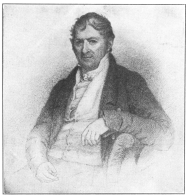
Eli Whitney went to work to make something that would do what in those days seemed impossible. He not only had to invent a cotton-gin, as the new machine was called, but he was obliged to make tools for making the machine itself, and even tools for making the other tools. But within a short time he had invented and built a machine which worked quite well. Still he was not satisfied. He locked himself up in a room and worked day and night until he had built a perfect cotton-gin which would work very fast and would clear out all the fine cotton seeds. This was in 1793, while Washington was President, and Philadelphia was the capital of the United States.
Whitney would not let any one but Mrs. Greene and a friend named Miller see the model, or pattern, of his cotton-gin until he could take out a patent for it. But before he could get money enough to have his gin patented, someone broke into his little shop and carried off his precious model.
Then the poor inventor had to begin again and make another machine, to prove to the officials in the Patent Office that the cotton-gin was his invention, before they could make out for him the patent right, which said he was the only person allowed to make and sell that machine in the United States. Before he could get this patent he found that others were making, selling, and trying to get a patent for machines made like the stolen pattern.
Whitney’s first cotton gin.
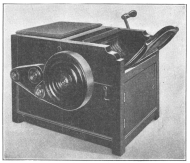
Young Whitney’s friend Miller furnished him money, not only to secure his patent rights and make the machines, but to go into the courts and fight those who were trying to steal his rights as they had stolen his model. These people made him so much trouble and expense that it took thirteen years to beat them by lawsuits. A patent protected an inventor, by keeping others from making and selling that machine, for only fourteen years. When his rivals were beaten, Whitney had but one year left in which he and his friends could sell the machine so as to pay for all his time, labor, and expense. In that year he just made his cotton-gin pay for itself. But he had the great satisfaction of making the land in the southern states known as the cotton belt (because cotton could be grown in those states) worth hundreds of millions of dollars more than before. The raising of cotton grew to be such a great industry that negro slavery became more and more necessary in the cotton-growing states. So, without knowing it, Eli Whitney, by increasing the production of cotton, increased the number of black slaves in the south, and helped to cause the struggle for and against slavery, many years later. But as the inventor did not know that his cotton-gin would make slavery a curse to the United States, he was not to blame.
After his patent had run out and he could make no more money by selling his cotton-gins, Whitney got a government contract for the making of guns. He invented new machinery to make the parts of his guns and was the first to have each part made by a different man according to an exact pattern. When the parts were put together to make a complete gun no special fitting was necessary because each piece was exactly like every other piece for that same part. If a part of the gun was broken it could be replaced with a new one without any difficulty. Before that when one man made an entire gun all the parts were specially fitted and if one got broken a new one had to be made and fitted by hand, which took a long time and made repairs very expensive. His factories and the homes of his workmen formed a suburb of New Haven called Whitneyville.
Eli Whitney furnished hundreds of thousands of men with the weapons they used in putting down the slavery which his cotton-gin had been made the innocent cause of increasing.
“FULTON’S FOLLY”
ROBERT FULTON was a Pennsylvania boy. His father, a Quaker, died when Robert was a baby. His mother was a beautiful Irish lady, whose mind was as lovely as her face. She taught little Robert, and he knew much that was worth while before he began to go to school at the age of eight years.
In those days school teachers were often strict and harsh with young children. Parents seemed to think their children would not learn fast unless they were whipped or beaten with a ruler. Though little Robert was not a bad boy in school, he sometimes seemed to be idle because he was thinking of something else. So his strict Quaker teacher punished him one day by striking his hands with a ferule. Robert’s boyish sense of fairness rose up within him, and he exclaimed, “I came here, sir, to have something beaten into my head—not my hands!”
Robert Fulton, inventor of the steamboat.
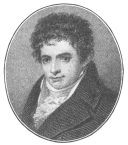
One of the pupils brought some artist’s brushes and paints to school, and Robert, who already showed real talent for drawing, was allowed to use them. He made such fine pictures that the other boy gave him the paints. This was the beginning of young Fulton’s career as a painter. But Robert was not content with painting pictures. He was always trying to make things, or to find ways of doing things more easily.
Robert was eleven when the American colonies went into the War for Independence. During this war, when candles were scarce, people were warned not to waste them in lighting up for the Fourth of July. It was to be a saving rather than a safe and sane holiday. The Fulton boy made up his mind to celebrate the day. So he got some gunpowder and pasteboard and made little tubes with a stick pointing out at one end of each. The neighbors were astonished on the night of the Fourth of July to see these tubes, one after another, go whizzing up in the sky, leaving a trail of sparks behind them. They said to one another, “That Fulton boy’s a genius!” Robert had made the first skyrockets these Americans had ever seen.
Robert Fulton afterward became acquainted with Dr. Benjamin Franklin and learned much from the kind old inventor. When Fulton was a young man he went to London and studied painting with Benjamin West, the greatest American painter up to that time. He went also to France to study art. Meantime he kept on inventing things. The French were at war with many of the countries of Europe at that time. Fulton had always been interested in boats; and we have seen that he knew how to use gunpowder. He planned a new kind of boat, which he thought would help the French in their war. It was a submarine, and was provided with torpedoes which could be shot under water. They would have pierced the wooden sides of the best ships built in those days. Fulton’s diving boat was shown to the French minister of war, but the government experts could not understand its great value in war and refused to make use of it in the war. Shortly after, a British officer remarked that Napoleon’s loss of Fulton’s diving boat was the most important event of the century.
Napoleon, who was then emperor of the French, wrote to one of his own advisers:
“I have just received the project of Citizen Fulton, which you have sent me too late—since it may change the face of the world!”
But, harmful as Fulton’s submarine might have proven to Napoleon’s enemies, the chance which Napoleon missed was not important compared with the results of Robert Fulton’s next invention.
Robert Fulton had, as a lad, gone fishing with some neighbors on a flatboat in the river. This craft they had to push along with poles, which was very slow, hard work. Bob began at once to try to fix something which would make the boat go faster and more easily. He arranged paddles at the stern which worked quite well. Then he improved this by making paddle wheels. After that he attached the wheels to an engine. He went on working with engines and wheels until at last, while he was in Paris, he succeeded in building a boat with a steam-engine to make it go. He tried it on the River Seine, which flows through Paris. The boat did go a little; but the engine was too heavy, and the watching crowds saw Fulton’s queer boat sink to the bottom.
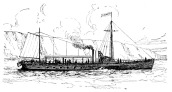
After he returned to America, Fulton went on improving his steamboat until he had built one which he thought would run up the Hudson River from New York City to Albany. He named this odd-looking craft the Clermont, and invited a few of his friends to make the trial trip. A great crowd came down to the wharf in New York City to have a little fun watching “Fulton’s Folly,” as they called the steamboat. People laughed at the idea that a heavy iron engine could make a boat go anywhere but to the bottom.
Even Fulton’s friends, waiting on the deck of the queer-looking vessel, felt foolish and looked anxious. The boat, however, started off, and the people on the shore began to cheer. Out in the river it stopped like a balky horse, and the cheers were turned to jeers. Fulton looked hurriedly at the engine, found out what was the trouble, and soon fixed it. Then the boat went puffing away up the river against the current at the rate of six miles an hour, and the friends on deck thought they were going very fast, as there were no railroads then and this was faster than a sailboat could go. Fulton kept on improving his boats so that within a few years there were steamboats on other rivers of the country. Within a century “ocean greyhounds” were racing across the Atlantic, and “superdreadnoughts,” the largest battleships, were being built for the great navies of the world. Submarines were used by many nations in the World War, but their invention, important as it was, could not well be called the greatest event of the century. It was the sailing of “Fulton’s Folly” which might have been said to change the face of the world, because it was the first step on the way to the wonderful steamships of to-day.
Just as that ingenious little boy tried to help his friends by making their flatboat run faster so Robert Fulton, as a man, had made the people of the world richer, happier, and better for all the ages to come.
The “Clermont,” Fulton’s first steamboat.
HOW MORSE SENT LETTERS BY LIGHTNING
INTO the family of Doctor Morse, a much respected minister living on the side of the hill on which the battle of Bunker Hill was fought, there came a little baby boy. They named him Samuel Finley for his great-grandfather, a president of Princeton College. To this was added Breese, the maiden name of the boy’s mother. When this baby grew up, he was known all over the world as S. F. B. Morse.
This Morse boy had the best kind of schooling at home. His father was a teacher as well as a preacher, and wrote the Morse geographies which were used in the schools of that day. Finley, as he was called at home, showed real talent as a boy for drawing and painting. One of his first pictures showed the Morse family around a table, with the father teaching them from a large globe showing all the countries of the world.
Finley Morse was sent to Yale College, where he was much interested in science and philosophy. But he kept at his drawing and coloring, and became a successful painter. That was years before any one knew how to take photographs; so Mr. Morse painted a great many portraits and did such good work that he received high prices for them. Believing that the artists of America could help one another, he influenced some of them to organize the National Academy of the Arts of Design, and they elected him their first president. When Lafayette, who had been a young officer on General Washington’s staff nearly fifty years before, came to America again as an old man, the people of America wished to have the best portrait that could be painted of the Frenchman who had helped the Americans in the War
S. F. B. Morse, inventor of the telegraph.
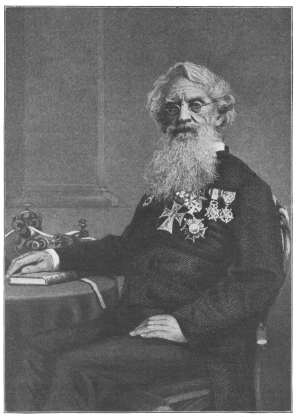
for Independence. Finley Morse was chosen to paint this picture of General Lafayette.
While Mr. Morse was in Washington at work on this picture, he received word from his home in New Haven that his young wife had died suddenly of heart disease. Before he could receive the letter she was buried. People in those days traveled by stage-coach, and it took at least a week for a letter to go from Boston to Washington. When the sorrowing father went home to arrange for the care of his three motherless children, he spoke of the slowness of sending word from place to place, and said he hoped the time would come when news could be sent long distances in an instant. But of course he had no idea then that he would have anything to do with bringing that blessing to mankind.
When Morse was returning from one of his visits to Europe to study art, several of his friends on the ship were talking at the table about what someone had done by way of sending signals like lightning by means of electricity. “If they can do that,” said Mr. Morse, “why could we not write letters in a second or two from New York to Charleston with it?” The others laughed at the idea.
“Why not?” kept ringing in Mr. Morse’s ears. He stayed in his stateroom to study and think. He remembered what he had learned from his professors in college about electricity. With such materials as he could get together on shipboard, he made magnets and electrical appliances. By the time the ship sailed up New York harbor, Mr. Morse had not only a good idea of the way to go to work to make a telegraph apparatus, but he had made up the “dot-and-dash code,” now in use in telegraphy.
The idea took such a hold on his mind that he could no longer paint pictures. But when he talked to others about it, it all seemed impossible—“too good to be true”—and he could not find wealthy men who would lend money enough to enable him to prove that a message could be sent a long distance in a moment of time by telegraph.
While Mr. Morse was waiting and struggling to start “the electro-magnetic telegraph” he made a bare living by taking the first photographic likenesses, called daguerreotypes, in America.
After eleven years of hard work and poverty so keen that he had to go hungry sometimes, Mr. Morse’s friends in Congress passed a bill in the House to furnish him government money enough for a trial line forty miles long. But on the last day of the session, which was to end at midnight, there were over a hundred bills ahead of his in the Senate. Mr. Morse went home that night utterly discouraged.
In the morning Annie Ellsworth, the young daughter of the Commissioner of Patents, came to congratulate him. His bill had been passed just before midnight and the President had signed it, giving Mr. Morse all the money he needed to show how he could “send letters by lightning.”
Morse’s first telegraph sounder
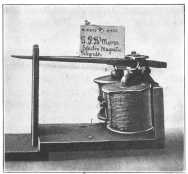
The overjoyed inventor told Miss Ellsworth that when his line was all ready she should send the first message over it.
It was decided that the trial line should be put up between Washington and Baltimore. It was completed before the 24th of May, 1844. One end of it was in the Capitol at Washington and the other at Baltimore. Miss Ellsworth’s first message, flashed by S. F. B. Morse to his partner, Mr. Vail, in Baltimore, was this text of Scripture:
“What hath God wrought!”
The first news sent out to the whole country was that of James K. Polk’s nomination at the Convention in Baltimore as the Democratic candidate for President of the United States.
Mr. Morse’s struggles were now over. The telegraph became a wonderful success and he was honored by presidents, kings, and princes with medals, stars, crosses, and other decorations. The inventor now turned his attention to running telegraph lines under water, and laid a cable under New York harbor. About twenty years later another man, Cyrus W. Field, succeeded in connecting America with Europe by laying a cable beneath the Atlantic Ocean.
So S. F. B. Morse’s words were realized: “If I can make the telegraph work ten miles, I can make it go around the globe.” He really made true these words of Puck, one of Shakespeare’s fairies:
“I’ll put a girdle round about the earth In forty minutes.”
Men soon began trying to talk without connecting wires. Marconi invented the radio-telegraph in 1896 and the radio-phone followed. Now it is possible to send wireless messages almost around the world.
CYRUS H. M’CORMICK AND THE STORY OF THE REAPER
WHEN little Abraham Lincoln was three days old in Kentucky, Cyrus H. McCormick was born in Virginia. When the McCormick boy was seven he used to go out to a shed and watch his father working at a machine to take the place of the scythe which was then used in cutting grain. Father McCormick was never satisfied, the neighbors said. He was “always fussing and trying to invent and improve something.”
After working for years to make a machine to harvest grain, Farmer McCormick gave it up, saying that it could not be done. Meanwhile young Cyrus, who had inherited his father’s inventive turn of mind, went to the fields to work with the men. He found it very hard to keep up with them, so he invented a cradle, or improved scythe, which made his work so much easier that he was able to do as much as a grown man. When he was twenty-two, Cyrus McCormick had invented a plough that would throw up a furrow on whichever side the farmer desired. Two years later he made the first self-sharpening plough.
Although the neighbors had laughed at his father for being so foolish as to wish to invent a labor-saving machine for harvesting, and in spite of his father’s warnings that such a thing could never be made, the idea of a reaper haunted the young man’s mind. He began to work at it as a boy and kept it up until he was a grown man. He had improved the cradle and his two ploughs without much difficulty, but the reaping machine was a hard problem. It was more difficult because the grain is often lodged, or matted down, and it is necessary not only to cut it but to lay it in even rows, so that it can be bound in sheaves ready for threshing.
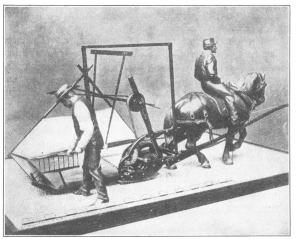
But in 1831, the same year in which he made his double-furrow plough, McCormick built a machine that would reap quite well. He had made every part of it by hand. This machine had vibrating blades which cut against each other in about the same manner as shears. It also had a reel to draw the standing grain within reach of the moving blades, and a platform to catch the grain as fast as it was cut. He first tried the machine by reaping several acres of oats. The next year he harvested seventy-five acres of wheat, to the great astonishment of the neighboring farmers, and his father’s pride.
Cyrus McCormick was not satisfied to let well enough alone. He spent nine more years in making his reaper do everything just right before he was willing to sell it. The farmers admired the clever machine, but they were not ready to buy it, because they thought it would take work from many laborers. The money panic of 1837 occurred during this time, and young McCormick went into the iron-smelting business to make a living during the hard times.
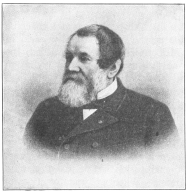
Cyrus H. McCormick, inventor of the reaper.
McCormick’s first reaper. From a model
In 1840 he had put his reaper into more perfect shape and now began to manufacture it, first in Cincinnati, then in Chicago. The farmers in the western prairies could not hire laborers enough to harvest their great fields of grain by hand. So the McCormick reaper began to be used in that part of the country. Cyrus H. McCormick, unlike most inventors, was a successful business man. He had to enlarge his factories. To his harvester he kept adding devices until it gathered the grain into sheaves, bound the sheaves with twine, and tossed them out sideways on the ground. He made them so that they would mow grass also.
After his reapers and mowers became well known in America, the successful inventor and manufacturer went abroad to introduce them in Europe. He showed the machine at the first World’s Fair in London, in 1851. People in England laughed, and the London Times reported that the reaper was a “cross between a chariot, a wheelbarrow, and a flying machine.”
But when the object of their laughter was taken out harvesting in England, the joke was on the men who had made fun of a machine they could not understand. The newspapers then began to praise the inventor they had ridiculed, and Cyrus H. McCormick awoke one morning and found himself famous. He not only received the Great Medal from the World’s Fair, but was elected an officer of the Legion of Honor in Paris, and received the high honor of being made a member of the French Academy of Science.
So the McCormick boy, who did not mind being laughed at and was never content with doing less than his very best, became not only one of the wealthiest men in America, but added many hundreds of millions of dollars to the wealth of his country, and gave an immense benefit to the world.
ELIAS HOWE AND HIS SEWING MACHINE
ELIAS HOWE was the son of a poor miller. He had to go to work when he was six years old. He was a lame, sickly boy and could never do heavy work. When he was old enough he went away to work in the mills. But as he grew up, his health was still so poor that he had to go back and live with his father.
Elias married when he was twenty-one and, within a few years, he had a wife and three children to support. Once when he was ill, his wife took in sewing to support their little family. As the young father lay on the bed watching his wife slowly plying her needle, he thought what a blessing it would be if a machine could be invented to sew much faster and better than by hand. The idea seemed to fill his mind, for he was an ingenious man. He said to himself, “I can’t do heavy work, but perhaps I can invent that machine.” At first he said nothing about it to his wife, but he watched her taking stitch after stitch for hours at a stretch.
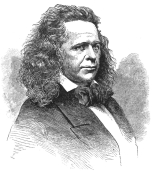
Elias Howe.
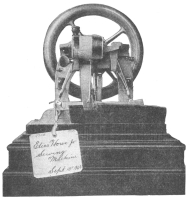
When he was out of bed he made a model of the machine which he had been planning. In this rude affair he first had the needle with an eye in the middle. This needle was pointed at both ends, and worked sideways through the cloth, which was held upright. The stitches on this first machine were made like a chain, and the thread raveled out too easily.
Howe kept patiently at work until he hit upon the idea of laying the cloth to be sewed on a small table, and making the needle go up and down through it. He thought of a way to have the cloth pulled along as it was sewn. But the trouble was to get a stitch that would not rip or pull out. At last he tried a shuttle, which looped another thread with that in the needle so that the two made a lock-stitch. When he had done this, he had invented the sewing machine.
Like most inventors, Elias Howe was poor. He found a coal dealer named Fisher, who agreed to keep Howe and his family, and furnish five hundred dollars to pay for the first machines and have them patented. For this Fisher was to receive a half interest in the patents, and the sewing machine business afterward.
At first no one would buy the machine. Tailors thought it would throw too many men out of work. Mr. Fisher grew tired of his bargain and the Howes had to leave his house. There seemed to be a better chance to sell sewing machines in England; so the family went across the sea to London. But the inventor was again disappointed. He was glad to come back to his father’s house in America with his sick wife and his small children.
Howe’s first sewing machine. Photo. Brown Bros., N. Y.
The wife died soon after their return and the inventor had to do something to support his motherless children. He hired out to help an engineer on one of the first railroads in the United States. While he was working at that, a friend offered to see what he could do in selling sewing-machines in New York City. They found that others were making and selling machines very much like Howe’s.
Money was furnished to sue those dealers. Howe’s rights to his patents were confirmed by the courts in 1846, and all other makers of sewing machines were made to pay him a certain amount, called a royalty, on every machine they sold. In this way Elias Howe soon became a very wealthy man.
After the Civil War broke out, Howe enlisted as a private, and when the government was slow in paying the soldiers’ wages, he lent the money himself for the men in his company. He died before he was fifty years old with medals and honors from many countries. He had brought a great blessing to the women of the world, just as he had wished to do when he lay on his bed watching his tired wife sewing, hour after hour, to support him and their three little children.
EDISON, THE WIZARD OF MANY INVENTIONS
THOMAS ALVA EDISON was born in the little village of Milan, Ohio. His father was a mechanic, who could turn his hand to anything. While Alva, as they called him at home, was a small boy, the family moved to Port Huron. Here the lad was sent to school, but he asked so many questions that the teacher sent him home.
Then Alva’s mother, who had been a school teacher, tried to educate him. She had great patience with his questions, but there were so many that neither she nor his father could answer that he took to reading books. He had the same desire to “know the why” of everything that other great men have shown when they were boys.
Though the Edison boy had no taste for school, he was fond of reading. When he learned how much he could find out from books, he started in, boy-like, to read all the books in a public library. He had worried through several great sets of volumes when he discovered that not all books were of interest to him. After that he chose only those on subjects he liked to read about.
His father was a poor man, and as Alva was not in school he wanted to do his part toward making a living for the family. He began by selling papers around home. Then he had a chance to be train boy on the old Grand Trunk railroad between Port Huron and Detroit. His mother was afraid to have him run on trains and be away from home, but he showed that he could take care of himself. It was during this time that he began taking books from the Detroit Public Library.
He was such a wide-awake, good-natured lad that the trainmen liked him. He found that he had a good deal of time to spare; so he got some old type from a printer and, in a corner of the baggage car, began to print a four-page newspaper about the size of a small handkerchief, which he named The Grand Trunk Herald. The trainmen and their families and friends liked this young Edison’s news. Soon he had about five hundred subscribers, so he made about ten dollars a week from his little paper.
Meanwhile he attended strictly to business. During the Civil War he would find out when there had been a battle and have the telegraph operator send word of the event ahead of the train to the towns where the trains would stop. This brought hundreds of people down to the stations at
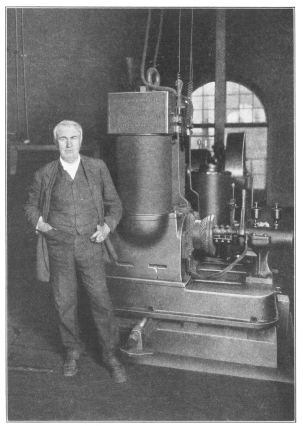
Thomas A. Edison and one of his early dynamos.
train-time to learn the news of the battle. Young Edison would sell hundreds—once he sold a thousand—newspapers at ten to twenty-five cents apiece.
He was always trying to do something new. After his little paper became well known, he began to buy chemicals and keep them in bottles in his printing office in the car. One day the phosphorus jar fell off the shelf and broke. This set fire to the floor of the car. While Alva was putting out the fire the conductor came through. It made him so angry to have a boy around who might burn up the train with his experiments, that he threw out bottles, printing-press, and type, and pushed the boy after them.
Alva did not hold a grudge against that conductor. He only wondered that the trainmen had stood that sort of thing so long. He saved all he could out of the ruins and set up his printing plant in the cellar of his father’s house. He went back to work as though nothing had happened, and attended only to selling papers. One day while waiting on the platform of a station he saw the station agent’s child on the tracks and an express train coming. Throwing down his newspapers he jumped, seized the child, and sprang across the track just in time to save its life and his own.
The station man wept as he seized the heroic newsboy’s hand. “I am a poor man,” he said, “so I can’t repay you for saving my child’s life; but I can teach you telegraphy.”
Edison was delighted. He stopped at that station several times a week and learned very soon to send and receive messages. It is harder to take than to send telegraph dispatches. Young Edison invented a machine which would run more slowly than the telegraph and which gave him time to write out the words while the “dots and dashes” of the telegraph alphabet were clicking away. But sometimes it is impossible to attach this appliance; so young Edison practised till he could receive the fastest news story.
He knocked about the country, hiring out as telegraph operator, but he was always trying to make new machines and improvements. This was more interesting to him than telegraphing. After living in several western cities the young telegrapher and inventor applied for a job in the Western Union office in Boston. Here is Mr. Edison’s own account of his first experience there:
“I had been four days and nights on the road, and, having had very little sleep, I did not present a very fresh or stylish appearance. The manager asked me when I was ready to go to work. ‘Now,’ I replied. I was then told to return at 5.30 P.M., and punctually at that hour I entered the main room and was introduced to the night manager. My appearance caused much mirth, and, as I afterwards learned, the night operators consulted together how they might put up a job on the jay from the woolly West. I was assigned to New York No. 1 wire.
“After waiting upwards of one hour I was told to come over to a certain table and take a special report for the Boston Herald, the conspirators having arranged to have one of the fastest senders in New York send the dispatch and ‘salt’ the new man. I sat down without suspecting and the New York man started slowly. I had perfected myself in a simple and rapid style of handwriting, without flourishes, which could be increased from forty-five to fifty-four words a minute by reducing the size of the lettering. This was several words faster than any other operator in the United States could write.
“Soon the New York man increased his speed and I easily adapted my pace to his. This put my rival on his mettle, and he was soon doing his fastest work. At this point I happened to look up, and saw the operators all looking over my shoulder with their faces shining with fun and excitement. I knew then that they were trying to put a job on me, but I kept my own counsel and went on placidly with my work—even sharpening a pencil now and then, as an extra aggravation.
“The New York man then commenced to slur over his words, running them together, and sticking the signals; but I had been used to this style of telegraphy in taking reports and was not in the least discomfited. At last, when I thought the fun had gone far enough, I opened the key and clicked back to him: ‘Say, young man, change off and send with the other foot!’ This broke the New York man all up, and he turned the job over to another man to finish.”
Young Edison got the greatest benefit he could from the Boston Public Library. The following year he went to New York and found work with the Gold Reporting Telegraph Company, where he invented the “ticker” now so common in stockbrokers’ offices. He was employed at a salary of three hundred dollars a month. He now began to devote all his time to inventing. In a short time he had devised and constructed several machines and improvements for which he was offered forty thousand dollars. This enabled him to begin inventing and manufacturing on a large scale. He built a factory and employed three hundred men to carry out his fast-increasing ideas and make the necessary machines and drawings for securing his patents.
He improved the telegraph so that six messages could be sent at once over the same wire. He made improvements in electric and other motor cars, as well as in the telephone. He also made a delicate instrument to measure the heat of the stars, which he called the tasimeter. Out of more than fourteen hundred different inventions, any one of which would have made him famous, the best known are the incandescent electric light, the phonograph and the moving-picture machine.
Thomas A. Edison is the greatest inventor that ever lived. He has done more for the world’s wealth, comfort, and happiness than any other man save, perhaps, Dr. Benjamin Franklin. Yet he is one of the most modest of men. When he was invited to a dinner at which several distinguished men wished to pay him some of the high honors due him, he said:
“I would not sit and listen to an hour of such talk for a hundred thousand dollars!”
When asked how he gained his great success, Mr. Edison replied:
“By not looking at the clock.”