DISCOVERERS AND EXPLORERS
Reading edition
COLUMBUS, THE MAP-MAKER WHO FOUND A NEW WORLD
IN a tall narrow house in the midst of a block on a narrow street in Genoa, Italy, lived a poor woolworker named Columbus. This slender house was only two windows wide and seven stories high. In the lowest story, in which there were a wide door and a grated window, Signor Columbus stored the bales of wool which he washed and carded, using a tool somewhat like the curry-comb for cleaning horses. He thus prepared the wool to be spun into yarn, which would later be woven and made up into clothing and blankets.
A small boy named Christopher went in and out of this foul-smelling place to play and work. Very little is known of the boyhood of Columbus. As Genoa was a large seaport town, it is supposed that he spent much of his time on the wharves watching the boats-galleys from Venice, with gay-colored sails, and strange-looking craft from Asia and Africa, with long, slim, lateen wings, veering about like swallows of the sea.
There were pirates, or highway-robbers of the sea, in those days. Little Christopher was sure to hear thrilling stories of how they fought hand-to-hand with sabers and axes, and of how the wicked but powerful pirates murdered the men on merchant ships and carried off the women and children to be slaves in distant lands. Young Columbus seems to have been fired with a boyish longing for—
“A life on the ocean wave, A home on the rolling deep,”
for the next that is known of him is that he narrowly escaped from drowning in a shipwreck by swimming six miles to shore on a boat oar.
He landed near a town in Portugal and soon found work in a map-maker’s shop. Here he had a chance to learn all the geography that was known four hundred years ago. Most of the maps he made were drawn as if the world were flat. But there were curious charts with lands and seas outlined on the six sides of a cube, and others drawn as if the world were shaped like a huge section of stovepipe. Young Columbus found the maps very interesting; but what seemed most wonderful of all was the idea that the world was round, as every child now knows.
In those days a man was not allowed to believe anything different from what every one else thought. So when young Columbus began to claim that the earth was round, people laughed at him. They thought he was crazy. Of course, a few astronomers and scientists knew how to prove the roundness of the earth by the shadow it casts on the moon in an eclipse, but most of the people could not understand such things. Columbus himself could notice that the surface of the ocean, within the short distance he could see, was slightly curved. He resolved to miss no chance to prove his theory, by learning all he could about newly-found lands; and he even began planning to sail around the earth to India and Far Cathay, as China was called in the old days.
Travelers had been overland to the Far East and back. Daring sailors had sailed along the coast of Africa. But the great body of water to the west of Portugal was called the Sea of Darkness. People believed that terrible sea-monsters haunted its dark waters, and that if men were to sail far enough westward, their ship would go beyond the brink of the world, as over a giant waterfall, and fall down, down through space forever.
So when Christopher Columbus tried to persuade the king of Portugal and the princes of other countries to fit out a few ships and let him prove the roundness of the earth by sailing west to the Far East, no one would listen to him seriously. But the poor man could not give it up, though he spent many years wandering from country to country to persuade some one rich and powerful enough to supply the ships and men for such a dangerous voyage. Queen Isabella of Spain and her husband, King Ferdinand, listened to him, but when the matter was referred to the royal council, those grave men shook their heads and said such a thing was absurd and unfit for a queen even to think about.
Columbus was in despair. His wife was now dead and he had his little son Diego with him. The two were tramping across the country and came, about sunset, to a monastery on the border of Spain, where the boy asked for a drink just as the monk in charge happened to be passing. This monk spoke to Columbus and, seeing what an interesting man he was, invited the strangers in. Columbus told his strange, sad story. This monk had been a friend and adviser to Queen Isabella. Also he knew two sailors who might be a help in such an undertaking. He wrote at once to the queen, urging her to let Columbus come and talk
Columbus pleading his cause before King Ferdinand and Queen Isabella of Spain.

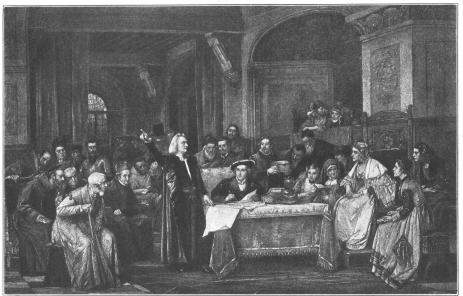
over the matter once more. She wrote back that she would like to hear what her friend the monk might have to say about it. He started the very night he received the queen’s letter, and talked with her about converting to the Christian faith the people of the new lands Columbus might discover. As a result of this talk the good monk wrote to Columbus who, with his young son, was waiting at the monastery:
“Our Lord has heard his servants’ prayers. My heart swims in a sea of comfort and my spirit leaps with joy. Start quickly, for the queen awaits you, and I yet more than she. Commend me to the prayers of my brethren and of the little Diego. The grace of God be with you.”
The queen received Columbus this time with sympathy and kindness. She is said to have pledged her jewels to raise money enough to fit out three ships for his great voyage. Columbus was to command one of these and the monk’s friends were to be captains of the other two. But after making the little fleet ready, they could not induce sailors to man the vessels for their ghastly voyage across the Sea of Outer Darkness. Sailors were always superstitious. Even to-day they will not start out on Friday, and many seafaring men will refuse to sail with a ship if the flag should happen to be raised “union down,” or wrong side up, no matter how quickly it may be set right. At last Columbus had to take convicts out of prison and condemn them to hard labor as sailors for the terrible trial trip. Some of these men were desperate criminals.
The unknown western sea was far wider than Columbus had thought. This showed that the world must be much larger than he supposed. As they sailed on and on, day after day and week after week, across the untraveled sea, the superstitious convict-sailors were half-dead with fear. They planned to murder the Admiral, as Columbus was now called, and his two captains, in order to turn the ship about and go back before they were engulfed in some great whirlpool of disaster. Columbus kept himself well guarded, and coaxed and flattered the frightened creatures, promising them all kinds of wealth and pleasures if they would only keep on a day or two longer. He offered an extra prize to the man who first caught sight of land.
On the night of the 11th of October, 1492, one of the sailors saw a glimmering light to the west. On the morning of the 12th, the Admiral was an early riser. There lay a tropical island, with “gardens of the most beautiful trees I ever saw,” he said afterward. The sea was as deep blue as that along the shores of his native Italy. He and his two captains went ashore, with well-armed men in boats from all three ships. The water was clear and the bottom was white with sand and shells, while strange, bright fish darted about as they paddled along. On the island were parrots and other birds of gay plumage flitting from tree to tree as if startled by the coming of the first white men into their world. Columbus did not need his armed soldiers. After looking a long while he saw naked red men peering at them from behind the strange, tropical plants. After he made signs of friendship, the natives were no longer afraid.
Christopher Columbus was first to set foot on the new-found shore. Falling on his knees, his eyes filled with tears of joy, he bowed his face and kissed the sand of the new world. The happy company repeated prayers and sang a hymn of praise. The naked natives looked on with wonder to see the leader, who was dressed in rich red velvet, set up a red, white, and gold banner—the combined flag of Ferdinand and Isabella—and go through a long ceremony. They did not know that those white strangers were claiming the country in the name of a king and queen far across the sea. Columbus named this island—one of the group now called Bahamas—San Salvador, or Holy Saviour. He still thought he had reached the Far East.
Admiral Columbus returned to Spain to report upon his reaching eastern India by sailing west. With him went ten of the red men he had found, whom he called Indians. He made several voyages after that—only once landing on the continent of South America. Some of his Spanish followers were jealous of their Italian Admiral, and Columbus died in a prison in Spain, after all he had done for that country, without even knowing that it was America, not India, that he had discovered.
MAGELLAN, THE MAN OF THE STRAITS
AMONG the lads in many lands who were thrilled by the stories of Columbus and his discoveries was twelve-year-old Ferdinand Magellan, a Portuguese boy. Like thousands of youths all over Europe, he then made up his mind to sail the seas and seek his fortune.
Portugal, though a small country, was the home of many men of great energy and daring. A Portuguese explorer, Vasco da Gama, had sailed around the Cape of Good Hope, at the southern point of Africa, and discovered that way to India and the Moluccas, or Spice Islands. On these voyages the Portuguese had landed, traded, and taken possession of important parts of Africa. Others had followed in the wake of Columbus, discovering and claiming vast regions in South America.
So young Magellan formed a partnership with another adventurer and started out on voyages of discovery. For nearly ten years he journeyed to and fro between his little homeland and various points in East Africa, India, the Malay Peninsula, and the islands beyond. Frequently he had to fight battles with savage native tribes. In one battle he received a wound that made him lame for life.
Ferdinand Magellan.
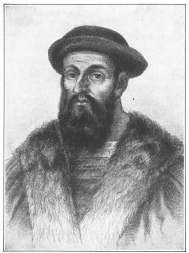
When Magellan came home, he suggested to the king of Portugal that it would be a great thing for Portugal if a passage across or around America could be discovered, which would shorten the distance, time, and expense of going from Europe to the Spice Islands. He hoped the king would equip a fleet for such a voyage of discovery; but the king refused, and he set out for Spain to get help for his great undertaking.
At this time he received a letter from a friend who had settled in the Spice Islands, saying that he had “discovered another new world, larger than that found by Vasco da Gama.” Magellan wrote to this friend that he would soon be visiting those islands himself—“If not by way of Portugal, then by way of Spain.”
After a long wait, the Spanish king consented to furnish five ships with two hundred and thirty-four officers and sailors, and to stock them with provisions to last through a two-year voyage. It was agreed also that Magellan and his partner should receive one-twentieth of the profits of their undertaking; and that they should be governors of the islands they discovered.
At last, after two long years of waiting, Magellan’s fleet was ready to sail. Crossing the Atlantic seemed an easy matter then—twenty-seven years after the first voyage of Columbus. The first land they reached was the mainland of South America. The natives along the northern coast were friendly and ready to exchange enough fish for ten men for a looking-glass, a bushel of sweet potatoes for a bell, and several fowls (or even one of their own children) for a butcher-knife. Those people lived in huts and went almost naked, except for aprons of parrots’ feathers. There were many birds of bright plumage and plenty of monkeys in those regions. Some of the natives were cannibals, cooking and eating the flesh of men they captured or killed in battle.
The little Spanish fleet coasted along toward the south. The wide mouth of the La Plata deceived them so that they sailed in until they found that it was only a river. As they drew nearer to the South Pole it grew intensely cold. The men on the ships begged Magellan to turn round and go home. Some of their number died of exposure and want, and the rest were afraid they could not live through such a winter. Not only did they suffer from the bitter cold, but their ships had been damaged by storms on the way down the coast.
They stayed several weeks at a port in the country now called Patagonia without seeing a person. But one day an Indian giant strode in upon them. He was so tall that the white men’s heads barely came up to his waist. His hair was dyed white, his face colored red, and he had painted wide yellow circles around his little, black eyes. When they let him see himself in a big steel mirror he was so astonished that he jumped backward and knocked down four of the Spaniards standing around him. When he understood that it was himself he saw in the looking-glass, he was pleased and they made him a present of a small metal mirror. They found the Patagonians to be savages of a very low and brutal type, who ate raw meat, and even rats, like beasts of prey. If they felt sick they stuck arrows down their throats, and gashed their foreheads with shell-knives when their heads ached.
Many of Magellan’s men now turned against him, planning to murder him and those who stood by him, and then to sail back to Spain. Though they were the larger number the energetic ship master beat them at their own game. He executed one ringleader, and sailed away leaving another rebel on the shore, where he was, no doubt, soon killed and eaten by the cannibals.
As July and August are the coldest months near the South Pole, the weather began to moderate in October, which is a spring month. January and February are the hot season in that climate. On the 21st of October, 1520, they “saw an opening like unto a bay,” and after sailing through its winding ways they found to their great joy, that it led out at the other end into a vast expanse of water. At last they had discovered the only natural passage from sea to sea through the American continents.
Some of their ships had been lost and their provisions were eaten. Most of the men begged to turn back, now that they could report that they had found a great ocean beyond South America. “No one knows,” they said, “how wide this open sea is, and we may all starve before we reach the Moluccas.”
But Ferdinand Magellan would not turn back. He accused them of having faint hearts, and said that even if they had to eat the leather on the ships’ yards he would still go on and discover what he had promised the King of Spain.
One dark night the commander of the largest ship deserted the others and went back to Spain with the greater part of their provisions. The other ships were thirty-eight days winding their way through the straits to which the great leader’s name was afterward given, the Straits of Magellan. They saw so many fires in the land away to the south of them that they named it Terra del Fuego—Land of Fire.
Brave Magellan’s threat had to be carried out. All their provisions had either been eaten or were wholly unfit to eat. So all they had to live on for a long time was the leather on the ships’ yards. They hung it over the sides of the ship to soak several days in the salt water as they sailed along. Then they cooked it over a coal fire. The wide sea they were now crossing was so free from storms that Magellan named it the Pacific Ocean.
After three months of hunger and thirst, risking their lives in their devotion to leader and country, they discovered a group of islands now named the Marianne or Ladrone Islands. Here they enjoyed the luscious fruits and reveled in plenty of fresh water to drink. From the Ladrones they sailed on and discovered the Philippines, where the natives were friendly and brought them coconuts, oranges, bananas, fowls, and palm wine, which they gladly exchanged for metal looking-glasses, red caps, beads, and trinkets.
Besides his wish to sail round the globe and take possession of new islands for Spain, Magellan’s great desire was to make the savage people Christians. He had the happiness of seeing thousands of dusky islanders kneeling before the crosses he had set up. But in his zeal to show those heathen the power of the Christian’s God, he led the warriors of one island in a fight against some unconverted savages and lost his life.
In three years, lacking twelve days from the time they started out, the ship Victoria returned to the Spanish port from which it had sailed, after making the first voyage around the world. This vessel was loaded with spices from the Moluccas, as Magellan had planned. A faithful lieutenant represented their departed leader at the court of King Charles of Spain, who rewarded the few survivors with high honors and liberal pensions.
CORTES, THE CONQUEROR
AMONG the millions of people who wondered at the strange stories of the new lands discovered by Columbus was Hernando, a seven-year-old son of a Spanish noble family named Cortes. His young mind was filled with longing for adventure. As soon as he was old enough Hernando left home to seek his fortune on the island of Santo Domingo in the new world. The governor of this island was pleased with the manner, pluck, and energy of Cortes, and offered to sell him a large estate on easy terms. But the young Spaniard answered haughtily, “I did not come here to plough like a field laborer; I came to get gold.”
It was not long before young Cortes saw a chance for adventure. He went with a Spanish governor to settle the island of Cuba. He soon became a favorite with this governor also. An adventurer returned from the part of the mainland now called Central America and Mexico with tales of the great wealth of the people called Aztecs, and of the gold mines there.
Hernando Cortes From a painting by Peale, in Independence Hall, Phila.
The governor of Cuba decided to send ships and men to conquer that country, and offered the command to Cortes, who worked like a hero to get ready for the campaign. He equipped eleven vessels with six hundred men. A hundred or more of these were sailors and workmen; and the rest, soldiers, some of whom were armed with muskets and some with crossbows. There were fourteen small cannon and sixteen horses in the outfit.
As Cortes was about to sail, the governor of Cuba changed his mind and sent an order to Havana giving the command of the expedition to another officer. But shrewd young Cortes got wind of this in time, and sailed away before the governor’s messengers arrived.
The soldiers and other men of the expedition agreed to stand by the brave leader and capture the new country for King Charles of Spain in their own name instead of the Cuban governor’s. This was exactly what that governor feared Cortes would try to do.
When the Spaniards landed on the continent the natives were afraid. They had never seen a horse, and they thought the men on horseback were monster human beings with four legs, half man and half horse. Yet they came bravely out of their hiding places to do battle with such frightful invaders. Then the Spaniards fired a cannon volley and shot off their muskets so that several of the Indians fell dead. “They are gods!” shouted the natives in deadly fear. “They have the lightning and thunder in their hands!” It did not take long for Cortes to make terms with these natives, some of whom became allies and interpreters for the Spaniards.
After founding a city at the coast, which he named Villa Rica de la Vera Cruz (Rich City of the True Cross), now called Vera Cruz, Cortes prepared to conquer the empire of the Aztecs with six hundred Spaniards and several thousand Mexican Indians. Montezuma, emperor of the Aztecs, heard of his coming, and tried to make him leave the country by sending rich presents from his capital in the mountains. But that did not stop Cortes.
In order to insure victory, the Spanish general committed a brave though desperate act. Choosing one ship from his fleet he manned it and sent a trusted officer back—to Spain, not Cuba—with some of Montezuma’s rich presents. With these Cortes sent other proofs of the wealth of the country which he was about to conquer and add to the empire of King Charles of Spain. Then, after taking from the other ten ships everything the Spaniards could use in the new country, Cortes ordered those vessels burned and sunk. Thus, having burned their bridges behind them, they had no way of escape but to go forward and fight for their fortunes, their country, and their very lives.
On the march of two hundred miles to Montezuma’s capital, the Spaniards beat the Tlascalans in battle and made friends with those Indians against the Aztec tyrant, as the Indians called Emperor Montezuma.
The Indians of the hot countries of America were not so savage as those who lived in the northern parts of the continent. But they had a terrible religious rite which they had learned from the Aztecs. They offered human lives to appease the sun god. Though the Aztecs were a peaceable people otherwise, they often went to war to take prisoners for these horrible sacrifices.
Cortes broke into a temple at one place on the way and murdered the priests who were killing and offering human beings to the sun god. He set up a cross and invited the people to become Christians or be killed. In that way he gained many converts from among the frightened Indians.
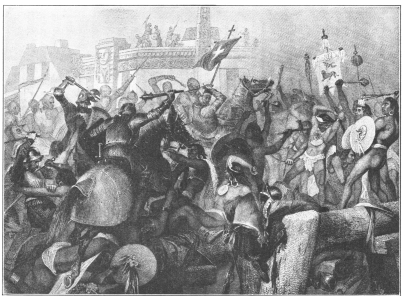
But with Hernando Cortes this kind of conversion was but a step toward gaining gold and power for himself and for the king of Spain. After many terrible battles, in which he massacred the helpless natives by thousands, he and his few hundred white men, with thousands of Indian allies, reached the capital of Montezuma. Built of stone on an island in the midst of a beautiful lake, this civilized city was connected with the mainland by six long stone bridges or causeways. The splendid capital, with its palaces and temples of hewn stone, had much of the beauty of Venice. The city measured twelve miles around. It was then hundreds of years old, and proved that the ancient Aztecs knew how to build great stone houses and bridges.
The capture of the City of Mexico by Cortes From the painting by Alonzo Chappel
Montezuma came out to meet Cortes, borne on a golden throne on the shoulders of Aztec nobles and officials. He wore priceless feathers and his garments were embroidered with many-colored gems. Even his shoes were gold. His courtiers carried carpets to lay down before him, so that his sacred feet should not touch the ground. How the eyes of those greedy Spaniards glittered when they beheld such signs of the great wealth of Montezuma and his people!
The white men were received with great honor. They were served in golden goblets with a strange, rich drink which the Aztecs named chocolatl. This delicious drink is now called chocolate or cocoa. Montezuma told the Spaniards that their coming had been foretold by the priests for hundreds of years, ever since the visit of a pure white man, a son of the Sun who had come down from the skies. This sun-god had told the Aztecs that he would come again with other sun-gods and reign over the empire forever.
Cortes pretended to be the long-expected “fair god” of the Aztecs, and persuaded Montezuma to visit him in the palace assigned to the Spanish leader and his officers during their stay in the city. The people, who had no reason to believe in the Spanish soldiers, crowded around the sedan chair of their king, crying out against him because he was placing himself in the wicked hands of the strangers. Montezuma told them not to fear, for their guests were honorable men and he was sure that all would be well with him. But he soon found that he was not a guest but a prisoner, betrayed by a pretense of friendship. The Mexicans came again and attacked the palace which Cortes and his men had now turned into a fortress. During the months when the Spaniards held Montezuma as a prisoner a fierce war was waged with the Mexicans.
While Cortes and his army were in such desperate straits, word came that the governor of Cuba had sent ships and nearly a thousand men to bring the general and his followers back, to be punished as deserters. Cortes and a picked band crept out of the capital one dark night, marched hundreds of miles to the coast, and surprised and defeated the army the governor had sent. Then he returned, with all those armed men and many more cannon and horses, to relieve the small garrison he had left to hold the many thousands of Aztecs at bay, and capture the city of Mexico.
The Aztecs were frightened when they saw the thousand soldiers Cortes now brought up against them, for it looked as if the new troops had come down from the skies to the help of the Spaniards. When the battle was fiercest, the broken-spirited emperor went out to plead with the natives to stop their fighting. This made them so angry that they hurled stones at him and he died of a broken heart. The hatred of his own people was even harder to bear than Spanish cruelty.
After more fierce fighting, Cortes completed the conquest of Mexico. Years afterward he returned to his old home in Spain, where he was, for a time, treated as a great conqueror. But he suffered in later years from remorse for his treachery and cruelty. When he grew old he was imprisoned through the influence of Spanish enemies.
One day an old, broken man with shaggy gray locks pushed through the crowd around King Charles of Spain, now known as Emperor Charles the Fifth and the most powerful monarch in the world. When the emperor asked the old man who he was, he replied with indignant pride,
“I am Cortes, the man who has given you more provinces than your ancestors left you cities.”
DE SOTO, A GOLD HUNTER IN SOUTHERN SWAMPS
HERNANDO DE SOTO was the Spanish grandee, or noble, appointed governor of Cuba and “the Floridas” about twenty-five years after Florida was discovered. It was Ponce de Leon who landed near the southern point of North America, on Easter Day, 1513, and named that lovely country Florida—Land of Flowers. De Leon had heard a beautiful story that far inland in the heart of the wilderness there was a magic spring that would make young forever all who drank of its sparkling waters. Though he searched long and eagerly, Ponce de Leon discovered no Fountain of Eternal Youth, but he did find endless swamps full of snakes and alligators.
De Soto, the new governor of Florida, made up his mind that Ponce de Leon was a very foolish old man. He ought to have known that there are no such things nowadays as springs of eternal youth. He, Hernando de Soto, was going to show his practical good sense by finding solid, yellow gold—for what good is youth without money to enjoy it with? De Soto was already a very rich man, for he had served under Pizarro, the cruel conqueror of Peru, and he had gone home to Spain one of the wealthiest of its grandees, in those days of wonderful discoveries and marvelous fortunes. Still Hernando de Soto was not satisfied. He wanted to be like Pizarro or Cortes—to conquer a great country and capture from its dusky people gold mines and vast wealth.
Therefore on a bright July day he left Cuba in charge of a high official and sailed away. He and his knights in armor stood on the decks of their nine ships, large and small, and waved farewells to the fair ladies who stood on the castle tower at Havana weeping bitterly, fearing that they would never see their brave lords and knights again.
Governor de Soto and his fleet came to anchor in the harbor now known as Tampa Bay. During the night they were aroused by horrible yells and showers of arrows from the shore. In the morning the Spaniards made a landing, though the natives fought hard to keep them back. Before night they met a man who could be of great use to them. He was a member of a party that, after De Leon’s discovery, had gone to Florida to find gold, but had been driven back. This young man, Juan Ortiz, had been captured and kept by the Indians as a slave. A member of De Soto’s scouting party tells how they met this poor fellow:
“Towards sunset it pleased God that the soldiers descried at a distance some twenty Indians painted with a kind of red ointment that they put on when they go to war. They wore many feathers and had their bows and arrows. And when the Christians ran at them, the Indians fled to a hill, and one of them came forth into the path, lifting up his voice and saying in Spanish,
“ ‘Sirs, for the love of God, slay not me! For I am a Christian like yourselves. I was born in Seville, and my name is Juan Ortiz.’ ”
The Spanish governor received Ortiz as if he were his own long-lost son. He made himself very useful because he knew both the Spanish and the Indian language, and thus could help the Spaniards to talk to the natives.
De Soto now started inland leading a brilliant company of knights and private soldiers, all in bright armor. Over the shining helmets were waving plumes, and many a mailed fist held aloft a rich and beautiful banner. There were hundreds of horsemen and many more men marching on foot. No more richly dressed men and horses ever started out on a Crusade to regain possession of the Holy City. But the object of this Spanish quest was gold. Spanish serving men drove along with this rich and gay procession four hundred fat hogs. De Soto had decided not to risk being starved to death as so many explorers had been. And gamekeepers held in leash, not falcons to catch and kill birds or beasts, but bloodhounds for hunting Indians.
Instead of mountains of rocks from which gold could be mined, De Soto’s men found swamps. The weather was sultry and moist. Insects got inside their knightly armor and stung them to madness, and venomous serpents coiled around their armored legs. Indians shot poisoned arrows at them from the bushes. Their coats of mail were so heavy that stout knights sank deep in the bogs. They advanced very slowly; they wallowed rather than marched, and their days and nights were spent in weariness and torture.
The fame of the white men went on ahead of them. As De Soto advanced he found the savages on the warpath ready to drive back the invaders. All along their line of march they could hear savage threats in the distance. Juan Ortiz told the Spaniards that the Indians were shouting:
“Keep on, robbers and murderers! In Apalachee you will get what you deserve. No mercy will be shown to captives, who will be hung on the highest trees along the trail.”
After the Spaniards had marched through the lands of five different chiefs, they found a great chieftain who seemed to wish to make friends with the white men. De Soto gladly accepted, but Juan Ortiz warned him to look out for treachery. So the white men were secretly prepared; and when the traitor chief gave the signal to his men to attack, the Spaniards raised their battle cry, “Santiago!” and thousands of the savages were killed by a few hundred Spaniards. Hundreds of Indians took refuge in a lake. There five good swimmers would lie side by side, on the surface like logs, forming a human raft on which the best archer would stand and shoot back at the white men. The fight lasted all day and nearly all night. Before morning all the Indians were killed or captured, put in chains, and divided among the Spaniards as slaves.
The Indians, who at first thought the white men were gods, were now sure they were devils. The boasted village of Apalachee was only a few straw huts on a knoll in the center of a great swamp. And the savages who defended it with bows and arrows were no match for armed Spaniards; the white men killed nearly all of them.
Cold weather came on, and the Spaniards went into winter quarters. A beautiful Indian girl-chief in that region came bringing pearls and gems to the Spanish chieftain. But he demanded gold. When she understood this she sent men to a far country for the yellow metal he desired so eagerly. De Soto and his men now rejoiced, for they thought they had found the object of their long and painful search. When the red messengers returned the stuff proved not to be gold. It must have been copper ore or “fool’s gold.”
During the second year of their long march, the Spaniards were led southward to Mabila, which is believed to have stood on the shore of Mobile Bay. This was a huge fortress, the greatest native town the white men had yet seen. Within an immense stockade or wall of tree trunks on end stood a number of houses each of which would hold hundreds of Indians.
Tuscaloosa, the Mabile chief, set a trap for the Spaniards. The battle which took place here was the worst of all. The
De Soto on the bank of the Mississippi From the drawing by H. L. Stephens
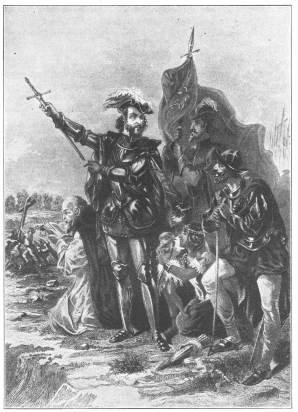
Spaniards lost seventy men and forty horses. Then they set fire to the Indians’ houses, and the savages perished in the flames.
De Soto’s men were heartily sick of fighting. They also despaired of finding gold in southern swamps. The governor heard here that they were plotting to desert him at Mabila and return by boat to Havana. So, instead of waiting for a ship to come from Cuba, he ordered them to march farther into the wilderness. As the prospect of finding gold became more desperate, De Soto seemed to grow more cruel. Indians were beheaded for small offenses; friendly scouts were tortured and sent back with insulting messages to their chiefs.
The farther west the Spaniards went the more bitterly the natives fought and the more successful they were in battle. In one place the Indians burned nearly all the Spaniards’ hogs, and feasted on roast pork for many days. After terrible wanderings, the few remaining Spaniards came to a wide stream at Chickasaw Bluff, a few miles above the present city of Vicksburg.
Though it is often stated that De Soto discovered the Mississippi, he was not the first Spaniard to see that wide and muddy stream. The Great River meant nothing to him. As he wandered up and down its banks he contracted malarial fever and died miserably. Faithful friends placed the body in his heavy armor and wrapped that in blankets weighted with sand. Then, on a dark night, they paddled out into the middle of the stream and sank it in a hundred feet of water, where the Indians could not find it and wreak their revenge upon De Soto’s remains. His followers attempted to go farther west but became discouraged and descended the Mississippi to the Gulf of Mexico.
SIR FRANCIS DRAKE, ENGLAND’S FIRST GREAT SAILOR
AMONG little Francis Drake’s earliest memories was his home in the hulk of an old ship near a navy yard in the south of England. His father was a sort of chaplain to the fleets which kept coming and going there. Francis heard the wild tales of seafaring men about pirates and Spaniards, and seafights, and the wonderful wealth in distant lands.
Young Drake’s soul was fired with a fervent longing for life and adventure on the high seas or the Spanish Main, as the region along the northern coast of South America was called, where wedges of gold and silver from Peru and pearls and precious stones were stored in treasure towns, waiting to be shipped to Spain. But Francis was the eldest of twelve children and his father was poor. So the lad was bound out till he was twenty-one to work for a skipper, or owner of a small trading vessel called a barque. In his work there was plenty of lifting and lugging to do—moving baskets and bales on and off his master’s boat. He had to work long hours—often at night. His food was scarce and coarse and his pay was very small indeed, for his work was thought not worth much more than his learning the sailor trade.
Sometimes they sailed the barque across the Channel to France or Holland and brought back a cargo to England; but that was as far as such a small craft could be trusted to go. Francis often saw great ships riding high on their majestic way to foreign lands, and he felt sure that those lucky sailors would have thrilling times with pirates and Spaniards, and come home loaded down with gold and silver, spices, precious gems, and thrilling stories. Much as he yearned to go on a long voyage, the faithful fellow stayed by his master, worked hard, and learned all the ins and outs of sailing a ship, whether large or small.
Just before Francis was old enough to be his own man the good skipper died. As he had never married and had no near relatives, he left his barque to his faithful apprentice. Young Drake continued the business, running from port to port and market to market for about a year, when he saw a chance to sail on a longer voyage and engage in a larger enterprise. He had a cousin, John Hawkins, who was captain of a vessel. This cousin now had a little fleet of five ships and was about to engage in the slave trade. As Francis had learned to manage a ship, Captain Hawkins offered to put the smallest vessel in his fleet under his young cousin’s command. So Francis sold his barque and became captain of his cousin’s ship Judith.
Now, at the age of twenty-two, Francis Drake was embarking on the voyage of life with the prospect of great adventures, as he had always dreamed of doing. Slave trading was not considered wrong four hundred years ago. The ships would go to Africa and buy or carry off negroes and take them to some foreign country to work in fields and mines. There the blacks would be sold for gold, silver, pearls and other things of great value. Sometimes the owner of a fleet would make a fortune in a single adventure. Of course, there was a great risk to run. Although England and Spain were not then at war, the English and Spanish treated each other as enemies when they met on the high seas.
For this voyage, Captain Hawkins got leave of Queen Elizabeth “to load negroes in Guinea and sell them in the West Indies.” As a sign that the hundred and seventy men on Hawkins’s fleet saw nothing wrong in stealing black men from their homes and selling them to be slaves, here is a motto which that captain had written to govern his soldiers and sailors: “Serve God daily, love one another, preserve your victuals, beware of fire, and keep good company.”
Hawkins and Drake seem to have had no trouble in seizing negroes on the coast of Africa, or in selling their human cargo in the Spanish ports of America. But as these slavers were starting back to England they were caught in a storm and had to go into a harbor in Mexico for safety and to repair damages. While they were there a Spanish fleet five times as large as theirs, loaded with gold and pearls, came in also for repairs. The English agreed to leave the Spaniards without touching their ships if the Spaniards would let them alone. But the Spanish captain did not keep his word and there was a fierce battle. Hawkins and Drake did great damage to the Spanish fleet. They reached England safely with two of their ships, though they had lost nearly all the treasure they had received as pay for the slaves.
Captain Drake complained to the queen of the way in which the Spaniards had deceived them, but she was afraid to go to war with a country which had such a powerful navy as Spain’s was then. So the bold English captain took matters into his own hands. He made one voyage after another, attacking Spanish settlements where gold and silver were stored, boarding Spanish vessels, killing the men or taking them prisoners, and bringing their rich cargoes to England. Within a few years the Spaniards lived in terror of their lives when they heard that Francis Drake was near, and the king of Spain appealed to Queen Elizabeth to stop those attacks, calling Drake “the master thief of the western world.”
On one of these expeditions, Drake landed on the Isthmus of Panama, or Darien, as it was then called. Some of the natives showed him the way across to the South Sea, or the Pacific Ocean, as Magellan had named it, and when they had ascended a mountain about half-way across, Drake climbed a tall tree from which he gazed upon the broad, unexplored ocean.
“May God give me leave and life to sail that sea but once!” murmured Captain Drake to his companions.
But Queen Elizabeth had heard of the terror of the Spaniards and ordered him to stop, lest he plunge her kingdom into a Spanish war before England was ready. So for a while Francis Drake stayed at home and suffered because he was not allowed to fight with the Spaniards.
About five years after his first sight of the Pacific, Captain Drake sailed away from England in command of a fleet of five vessels of which the flagship was the Golden Hind. The object of the voyage was a secret. This was about sixty years after Magellan, the Portuguese master-sailor, had discovered and passed through the straits named for him.
It took five months for the fleet to reach the eastern coast of South America. In due time they found and passed through the Straits of Magellan; but the ocean beyond was more terrific than Pacific, for a fierce storm drove the Golden Hind even farther south than Tierra del Fuego, so that Drake was first to land at Cape Horn, the southern-most point of South America. At the place where the waters of the Atlantic meet those of the Pacific, Drake lay down and embraced the sharp point of rock and exclaimed: “I am the only man in the world who has ever been so far south!”
All the ships in Drake’s fleet but the Golden Hind had either been sunk, broken, or scattered. Now at last he had “leave and life to sail that sea but once”—with one ship alone. The undaunted hero sailed up the western coast of South America to capture treasure from the gold mines of Peru. When he came near Valparaiso, some Spaniards in a ship saw the Golden Hind approach. Never dreaming that an English ship could be in that ocean, they were astonished to see a gun presented through a porthole and to hear an English voice calling on them roughly to surrender. So they stared and cursed under their breath while “the master thief of the western world” took charge of their ship with sixty thousand gold pesos, jewels, merchandise, and a stock of wine.
When the people of Valparaiso heard that the dreadful Drake was in their harbor, they fled from the city. The little English crew entered the town, and stocked up with bread, bacon, and wine, which they enjoyed to the full after many months of famishing. In a day or two the Golden Hind sailed away northward toward Peru.
At another port they waylaid three unguarded barques and captured fifty-seven bricks of silver, each weighing about twenty pounds. When they came to the port of Lima, there were seventeen vessels anchored in the harbor. Not daunted by numbers, Drake sailed right into the harbor, captured them all with his one ship, and made their men prisoners while he plundered the whole Spanish fleet. By this time the alarm had been spread along the coast that Drake was capturing everything in sight, and the
Queen Elizabeth knighting Drake on board the “Golden Hind” From the drawing by Sir John Gilbert, R.A.
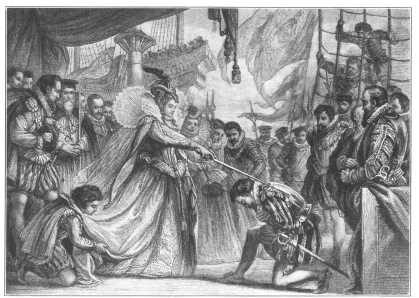
governor of Peru with two thousand men was waiting for him at Callao.
Drake’s good luck seemed now to desert him. In the presence of that waiting army the wind died down and the Golden Hind was becalmed, helpless, and unable to move a yard. The Spanish governor grinned as he went out in boats from the shore with four hundred soldiers, to take back all the precious cargo Drake had lately captured. But before the armed men reached the English ship a gale blew up and Drake sailed away, laughing and waving farewells to his pursuers.
The cargo from the last ship they captured overloaded the Golden Hind with tons of gold, silver and precious gems. It was useless to overhaul any more galleons, for they now had all their ship could carry. Their only thought was to get their treasure home safe and sound. Sailing across the Pacific, they were sixty-eight days without sighting land.
The Golden Hind began to show the strain of her long voyage; so they set up a forge on an island in the South Pacific and spent weeks in making repairs, so that the ship might complete her voyage around the world. After they had sailed more than a month longer, the ship ran on a ledge of rocks. Seeing that they could not get her off, they threw six cannon overboard, then the sugar and spices, then great fortunes in silver. At last they managed to work her off the ledge into deep water. Still it was nearly a year before they reached the harbor of Plymouth, England.
The wildest dreams of the boy Francis Drake were now more than realized. All England buzzed with his astounding exploits. The city bells rang and there was a general holiday, with feasting and dancing. Queen Elizabeth came down from London and dined with the great captain on the Golden Hind. Before she left the deck, the captain knelt before her and she tapped him on the shoulder with his sword, thus knighting him Sir Francis Drake.
After this the greatest of the English knights of the high seas made many voyages, dealing out destruction to Spanish galleons and treasure stores. He attacked cities and burned fleets—reporting to the queen that he had just “singed the Spanish king’s beard.” Drake was one of the four chiefs in command of the English ships that destroyed the Spanish Armada. No one did more than he to take the sea power away from Spain and give it to England, and thus make it possible for the English to begin the settlement of our country.
SIR WALTER RALEIGH, THE FAVORITE OF GOOD QUEEN BESS
A GAY company was waiting before the old palace at Greenwich, beside the River Thames below the City of London, on a summer afternoon in the days of Elizabeth. They were watching for the queen and her intimates to come down the broad steps in front of the palace.
There had been a shower, and the trees, grass, and bright flowers glistened in the sunshine.
“Here comes Her Majesty!” exclaimed some in the waiting throng as a woman in middle life descended the steps, attended by the Earl of Leicester and other nobles and knights whose names are well-known to history. The queen was slender, with her light auburn hair dressed up from her high, pale brow. Her chief mark of beauty was her small, delicate hands with long, taper fingers, of which she was rather vain. She was richly dressed in a heavy silk brocade, and a collar of costly lace stood up from her shoulders behind her slender neck like an open fan.
The boyhood of Raleigh. As he listens to the sailor’s tale of the land beyond the sea, Raleigh resolves to win it for England when he is a man. From the painting by J. E. Millais
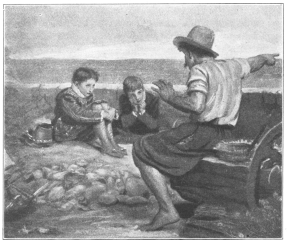
The court, after receiving her gracious greetings, followed the queen in a grand promenade through the park. Elizabeth soon came to a spot where the recent shower had left a shallow pool of water. A quaint writer describes this scene:
“Her Majesty meeting with a plashy place, made some scruples to go on, when Raleigh (dressed in the gay and genteel habit of those times) presently cast off and spread his new plush cloak on the ground, whereon the Queen trod gently over, rewarding him afterwards with many suits for his so free and seasonable tender of so fair a foot-cloth.”
Walter Raleigh was a handsome young man, six feet tall, with curly brown hair and beard. He had been a soldier in France and an officer in Ireland, and had made several voyages of discovery with his gallant half-brother Sir Humphrey Gilbert.
It was the fashion—indeed it seemed necessary then—for men at court to flatter the middle-aged maiden queen, who was foolish enough to believe that she was as lovely as they told her she was. The Earl of Leicester once entertained her at Kenilworth Castle, where he had all the clocks stopped on the moment of her arrival to show that no notice should be taken of the passing of time during her visit there.
So Queen Bess could hardly help feeling flattered when such a gallant and good-looking courtier as Raleigh bowed before her and laid his cloak as a velvet carpet for her to walk upon. Riches, lands, castles, and even happiness go by favor in royal circles. Some time after this, the queen made her favorite a knight, with the title Sir before his name.
One day the queen saw Raleigh taking a diamond ring off his finger and scratching something on a window-pane.
“Fain would I climb, yet fear I to fall.”
Then she took from her own slim hand a diamond and cut in the glass under what he had written, this rhyme:
“If thy heart fail thee, climb not at all.”
Of course, each reigning favorite of the queen became an object of envy to the rest of the court. Lord Leicester, who was now slighted by her Majesty for this new knight, did all he could to injure Raleigh. The young Earl of Essex did his utmost, later, to turn the queen against Sir Walter. But for a long time Raleigh remained high in favor.
Raleigh was the first Englishman to attempt to plant a colony in the New World. By way of compliment to the maiden queen, he named the whole region which he was trying to settle, Virginia. Returning from an early voyage, he introduced into Ireland the potato, first found in South America. He also discovered the pineapple (so named because it is shaped like a pine cone) and imported it to England. Another thing Raleigh is said to have introduced into England was tobacco, which the American Indians raised and “drank,” as they called smoking, in pipes of copper and clay. Raleigh had a silver pipe made for his own use. One day when he was smoking in his library, a manservant came in with a pot of ale, and, thinking his master was on fire, yelled with fright as he poured the ale over him! It is said that the queen asked Sir Walter to smoke in her presence; but when she tried to learn to use tobacco in that way, she stopped because it made her ill.
Sir Walter Raleigh was in active command of a number of English ships in the fleet which defeated the Invincible Armada, sent against England by King Philip the Second of Spain. For her favorite’s part in that great adventure, the queen made him an admiral. Later, he was wounded in a naval battle near Cadiz, Spain. When asked what had been done for him on account of his heroic services there, Admiral Raleigh sadly replied,
“What the generals have got I know least. For my own part, I have got a lame leg and deformed. I have not wanted good words, and exceeding kind and regardful usage; but I have possession of nought but poverty and pain.”
Some one must have told the queen of this speech, for she called Raleigh back to the palace and appointed him once more her captain of the guard.
When Queen Elizabeth died, James Stuart, king of Scotland, became king. James’s mind had been poisoned against Raleigh, whose enemies told the new king that Raleigh plotted to place James’s cousin, Arabella Stuart, upon the throne of England. So Sir Walter was imprisoned in the Tower of London. He was confined there for twelve years, though he proved that the things his enemies had said against him were untrue. One wicked creature who had accused him confessed that his story about Raleigh was made up out of spite.
During the long years of his imprisonment, Sir Walter wrote his “History of the World,” and experimented in a rude chemical laboratory which he had fixed up in his prison. He also wrote beautiful poems and many letters to his friends. For some time Lady Raleigh was allowed to visit him with their son, Carew. The older son, Walter, had been killed in an encounter while on a voyage with his father, seeking El Dorado, or the City of Gold, supposed to lie hidden in northern South America.
At last word came from King James that if Raleigh would go and find those fabled gold mines for his benefit, his high treason would be forgiven. So the white-haired knight, lame from a wound he had received in loyal service of England, started out on another voyage of adventure, to fight the Spaniard to the bitter end.
But Sir Walter was only hoping against hope, for there was no such mine there, and the expedition proved an utter failure. Instead of escaping to another country as he might well have done, he went back and bravely told King James that the “El Dorado” story was only a Spanish lie.
So the disappointed king ordered Raleigh back to prison, and a corrupt judge pronounced him guilty of high treason. For that crime, the Raleigh’s beautiful home estate might legally become the property of the crown, and Raleigh himself condemned to death.
Raleigh made the best even of this terrible experience. He cheered his wife by telling her he was ready and glad to go where she could come too—where they could be happy together always.
On his way to execution, Raleigh noticed a man with a bald head and no hat. Taking off his own cap he tossed it down to the old man with—
“You need this, my friend, more than I do.”
On the scaffold he made a patriotic speech to the assembled crowd. Then he asked to see the axe. He smiled as he tried the edge of it with his thumb, and remarked to the executioner who stood before him, dressed, as was the custom, in black velvet tights, with a black mask over his face,
“This gives me no fear. It is a sharp and fair medicine to cure me of all my troubles.”
HENRY HUDSON, THE MAN WHO PUT HIMSELF ON THE MAP
JUST as Magellan set out to discover a way through America from the Atlantic to the Pacific Ocean, so Henry Hudson determined to find a northwest passage from ocean to ocean. The reason for wishing to cross in the north from one ocean to the other was to save going “round the Horn,” as sailors call the long voyage around Cape Horn, the southern point of South America. We now know that there is no northwest passage; at least, if there is such a waterway it is so near the North Pole that it is always frozen up. But Henry Hudson, like all sailors in his time, thought that it would be a simple matter to sail through the open polar sea and pass from the Atlantic to the Pacific north of North America.
In 1607 this bold British navigator undertook a voyage in the employ, as he wrote in his journal, of “certain worshipful Merchants of London.” The object of this voyage was to explore the coast of Greenland and, as he explained, “for to discover a passage by the North Pole to Japan and China.” His crew numbered only twelve persons, including one boy, his own son John. After sailing about for five months, suffering great hardships, Hudson returned to London without discovering that northern passage. The next year he started out again, this time sailing north-east along the coast of Norway, and returned after four months without finding anything but hardships.
Hudson’s third voyage was made in the employ of the Dutch East India Company. He sailed from Amsterdam, Holland, with a crew of twenty men and his young son, on the Half Moon. He started out a second time for a north-east passage, but he found so many difficulties that he turned his prow westward again, determined to discover the way past North America. About the 4th of July, 1609, he came to the Grand Banks of Newfoundland, where he saw a fleet of Frenchmen fishing for cod. After catching over a hundred of these fish for themselves, the crew of the Half Moon proceeded to the southwest, as Hudson had heard from his friend, Captain John Smith, that there was an open way to the Pacific south of Virginia.
After wandering down the coast and back, the Half Moon entered a broad bay and anchored beside an island which the natives called Manhattan. Hudson took possession of this region in the name of his Dutch employers and named it New Netherland. Here he traded with the Indians and sailed a little way up the beautiful river which now bears his name. “Here,” one of his men wrote in the journal, “the land grew very high and mountainous.” Hudson and his crew were afraid of the Indians. They captured two red men and tried to hold them as prisoners. They thought that the other Indians would treat the white men well for fear that Hudson would kill these two prisoners. But they made their escape through a porthole and swam to the shore. As the Half Moon got under way again, the two Indians and their friends stood on the bank, war-whooping, brandishing tomahawks, and calling for vengeance.
The Half Moon sailed on upstream, and towards night came to anchor near what is now Catskill Landing. “There,” as it is written in the journal of the voyage, “we found very loving people and very old men, where we were well used. Our boat went to fish and caught great store of very good fish.”
The next morning the fishing was not so good, “the
The discovery of the Hudson River From the painting by Warren Sheppard © 1895, by The Woolfall Co.
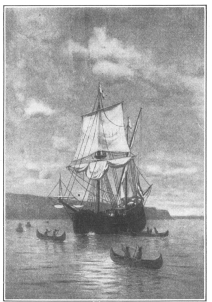
savages having been there in their canoes all night.” In the two days following the ship went only five miles farther up the river. Hudson was kindly received by an old chief who gave him the best cheer he could. The natives came flocking on board the ship, bringing grapes, pumpkins, and beaver and otter skins, which they traded with the sailors for hatchets, knives, beads, and trinkets.
The ship’s “log” states that they gave some of the savages brandy to drink. One of these men fell sound asleep, to the astonishment of the others, who feared he had been poisoned. They took to their canoes and paddled for shore. After a long powwow a few of the Indians returned with a quantity of beads. They wanted to pay the white men to lift the spell which they had put upon the sleeping Indian. The next day the intoxicated Indian was walking about, well and happy, after his first taste of “firewater.” This made his friends believe in the white men again, and the journal goes on to say:
“So, at three of the clock in the afternoon they came aboard, and brought tobacco and more beads, and gave them to our master; and made an oration, and showed him all the country round about. Then they sent one of their company on land, who presently returned, and brought a great platter full of venison dressed by themselves, and they caused him to eat with them. Then they made him reverence and departed, all save the old men that lay aboard.”
Hudson found that it would not be safe to take the ship beyond the site of the present city of Albany; so the Half Moon’s prow was turned down stream. On the way back the sailors were met by the two escaped prisoners with quite a company of savages. More than a hundred braves surrounded the ship. One climbed up the rudder and others swarmed over the sides. The crew fired upon them with their muskets, and with the cannon, blew holes in their canoes. The “thunder and lightning” from the guns frightened the Indians so that they fled to the shore and took to the woods.
Hudson himself had had enough. The Half Moon lifted its anchor and sailed away from the river whose name is Henry Hudson’s most glorious monument. Stopping in England on his way to Holland, he was engaged by the London Company to make another voyage in their behalf the following year. This time the ship he commanded was the Discovery. The course was past Iceland, around the southern part of Greenland, sighting Desolation Island, which he charted as in the northern part of Davis Strait. Through the strait which now bears his name he entered the sea known for all time as Hudson Bay.
This crew was a bad set of men. One young fellow whom Captain Hudson had picked up and befriended in London proved the worst of the gang. They did not face their hardships and sufferings with real courage. When starvation stared them in the face, every man looked out for himself. They hoarded food, and robbed and fought one another like wild beasts. At last they turned against Hudson, saying that he had brought them there to starve.
The young man to whom Hudson had been kindest of all bound his master. The rest tied up the six men who were most loyal to their chief, and Hudson’s son. These eight men were put bound into the ship’s boat. Then the crew hoisted the sail of the Discovery. They towed the little boat for a time, as if they were loath to do the dastardly deed that they had planned. But when they reached the open sea they cut the rope, and the little boat containing Henry Hudson and his son was never again seen by white men.
The ungrateful young man met a fate he richly deserved. In a fight with Arctic savages he was killed, and several of the rest were mortally wounded. Still others died of want before the few remaining deserters were picked up, starving, by a passing vessel. Their names are forgotten, and they are only remembered at all because of their wicked treachery. But the map of North America is a fitting monument to the heroic but ill-fated adventurer and discoverer, Henry Hudson.
LA SALLE AND THE MOUTH OF THE MISSISSIPPI
LITTLE is known now of the early life of Robert Cavelier de la Salle, until, at twenty-five or a little less, he came from Rouen, France, to Montreal. But of his life in America, in those days when the land was still a howling wilderness, there is much to tell. He was born a century and a half after Columbus thought he had found the coast of China; yet this young Frenchman still believed that China was only a little farther west than the land Columbus found, for he had but a narrow idea of the width of America.
The people who were living in Canada, the new country along the River St. Lawrence, were French. They traded with the Indians and trapped and skinned wild animals for their fur. Those were the days of Indian scouts and wigwams, and of war and scalp dances. Many of the French lived like Indians; they played Indian games—running, shooting, snowshoeing, lacrosse—and they learned to hunt and hide, and to travel stealthily through the forests, like real red men.
So the Indians liked the French people better than they liked other white settlers. The French called their scouts wood-runners. These brave, shrewd messengers went out among the Indian tribes and learned their languages and customs. Many of them ran from tribe to tribe, thousands of miles into the wilderness, and came back to the French settlement with skins of the mink, beaver, otter, and other animals. They also had strange stories to tell of meadows, which they called prairies, as level as a floor and hundreds of miles wide, where there were no trees except along the rivers. Down through this thousand-mile prairie region they said there were rivers which flowed together into a wide stream which the Indians called the Mississippi, or Father of Waters, which kept on in a mighty flood to the unknown south country.
These stories fired the fervent soul of Robert La Salle. He believed that mighty river should be used as a water highway to the South Sea—as the Pacific Ocean was still called; and that if they could sail down to its mouth they would find an outlet to China like the outlet which the St. Lawrence gave toward Europe. He was always talking about China and trying in every way he could to raise money for canoes and food and Indian guides to find the way to China through the western wilderness. The French people laughed at his enthusiasm and called some land which he owned beside the rapids above Montreal La Chine—French for China. That suburb of Montreal is still called Lachine, and the rapids are the Lachine Rapids.
Not having wealth enough of his own, La Salle went to France to ask the king to approve his plan, and to provide money for the planting of the lilies of France on the banks of the Mississippi. La Salle’s practical way of planting French lilies was to build and maintain forts at different points through all that great western country. Already Fort Frontenac had been built near the outlet of Lake Ontario, and Father Marquette, a heroic French missionary, accompanied by a trader named Joliet had found the Mississippi and explored that great river for hundreds of miles. On his return to a French settlement Joliet wrote to Count Frontenac, governor of Canada, telling of the dangers of his voyage:
“I had escaped every peril of the Indians. I had passed forty-two rapids; and was at the point of debarking, full of joy at the success of so long and difficult an enterprise, when my canoe capsized, after all the danger seemed over. I lost two men and my box of papers within sight of the first French settlements, which I had left almost two years before. Nothing remains to me but life, and the ardent desire to employ it on any service which you may please to direct.”
When Robert La Salle had permission from the king and his treasurer, and had borrowed money of his rich relatives in France, he returned to Canada and made up a party of brave French and Indian guides, scouts, and interpreters, who were to fight, if need be, to plant the lilies and forts of France in the great western valley of the Father of Waters.
After they had paddled through Lake Ontario and carried their canoes past Niagara Falls and the rapids above the Falls, they built their sailboat, the Griffin. On this ship they sailed through the lakes to the lower end of Lake Michigan. They paddled their canoes down along the shore of that lake to the St. Joseph River, where they built Fort St. Joseph. Canoeing up this river, which flows into Lake Michigan, they carried their barks across to a little stream which led away from the lake toward the greater rivers of the south country. On their way they saw Indians of the Illinois tribes, and smoked the calumet, or peace pipe, with most of these red men. Some tribes were so savage and unfriendly that the white travelers were afraid to shoot game for food, or even to build a fire lest a band of Indians on the warpath should see it and come to kill and scalp them all. But it seems to have been the fate of most discoverers to find their bitterest foes among those who should be their friends. One of La Salle’s own party was caught just in time to keep him from shooting their leader in the back.
Floating down a small stream the travelers came to the Illinois River. On their way, among friendly tribes, they shot plenty of game. Once they captured a huge bison, or buffalo, stuck in a swamp and left behind by the rest of the herd, and feasted on buffalo meat for many days.
At last they came to a place, now called Lake Peoria, where the Illinois is several miles wide. They decided that this would be a good place to build a fort. Seeing smoke, they guessed that it proceeded from the campfire of an Illinois tribe which was said to be hostile to the French. Seeing wigwams in the distance La Salle arranged the canoes in rows, and pulled up to the Indian camp. There was a stir in the Illinois village. The Indian braves came out and received the white men as friends, and there were feasts and games and dances in honor of their French guests.
The Indians said that La Salle and his friends might build a fort there. Built without delay, the fort was named Fort Breakheart, for Robert La Salle had been going through some heartrending experiences. One of these was the loss of the lake boat, the Griffin, with all the supplies and equipments.
When La Salle explained to the Illinois tribe what he was seeking, the chief gave him and his men a solemn warning of perilous falls and precipices, of cannibal tribes and man-eating monsters. He said that if they should get by those awful dangers, the mouth of the river was an awful whirlpool which would engulf them, for no man who had ever gone down into the mouth of the Father of Waters had returned alive. These stories so frightened the men of the party—both red and white—that they deserted their leader. They preferred to endure the ills they had and risk their lives among savages known to be cruel, rather than fly to ills they knew not of.
The ships of France at the mouth of the Mississippi From the painting in the Versailles Collection
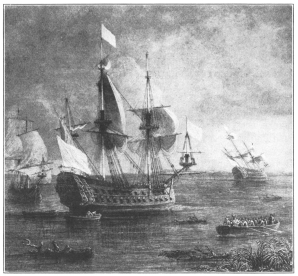
So La Salle had to go hundreds of miles back to Canada for more men, funds, and supplies, before he could venture to make the rest of the trip. After many months’ delay he started out again from Montreal.
There were now fifty-four in his party—twenty-three Frenchmen, eighteen braves, ten squaws to do the cooking, and three papooses. When they got back to Fort Breakheart, La Salle gave up building a ship, as he had decided to make the voyage down the Mississippi in canoes. There was plenty of game along the river, and in its muddy waters they caught catfish six feet long and weighing about two hundred pounds. They saw wild beans along the banks with stalks “as big as your arm,” reminding one of the tale of “Jack and the Beanstalk.” They had varied experiences with the different tribes of Indians—Chickasaw, Arkansas, Natchez—along their course, and found that the “man-eating monsters” described by the Illinois chief were only alligators. When at last they reached the mouth of the Father of Waters, there was no whirlpool to swallow them down; but the river calmly divided into three mouths, each leading into a broad expanse of salt water which, they learned, was not the Pacific Ocean but the Gulf of Mexico. On a hill near by, La Salle raised a wooden pillar on which he nailed the coat-of-arms bearing the lilies of France, and buried near it a leaden plate on which letters were engraved to tell future comers that the whole country drained by the Mississippi belonged to France.
At last, the patient worker and traveler had triumphed. He went back to Paris and reported all he had done in the name of his beloved king and country. Robert Cavelier de la Salle had done a greater thing than he realized. One hundred and twenty years later, Napoleon, Emperor of the French, sold to the United States the territory of Louisiana, claimed by La Salle, which is now half of the great republic. This was an achievement which meant more than the discovery of an outlet to China. Although a boat may be sailed through long rivers and short canals from the mouth of the St. Lawrence to the mouth of the Mississippi, this fact is hardly thought worthy of mention in these days. A far greater benefit to America and the whole world was achieved by Robert La Salle, because he enabled the French government to give to the United States her broad empire of the west.
LIVINGSTONE, THE WHITE MAN OF THE DARK CONTINENT
LITTLE Davie Livingstone was a queer, quiet Scotch laddie. His father was a high-minded man, but he was so poor that he had to take Davie out of the village school when he was ten. In those days, the early part of the nineteenth century, children began to work when they were very young. So Mr. Livingstone sent the lad to work, with other boys of his own age, as a piecer in a cotton mill. David worked from six in the morning till eight at night, stopping only for lunch.
With his first week’s wages the ten-year-old boy bought a Latin grammar. He was so eager to learn that he went to night school from eight to ten at night. He studied till midnight, and even later, when his mother did not take his books away and send him to bed. His great desire was to be a missionary. So he took up other languages besides Latin, and such studies as would fit him for missionary work. As soon as he was able, he went to London and
David Livingstone, the brave Scotch missionary From a photograph taken in 1867
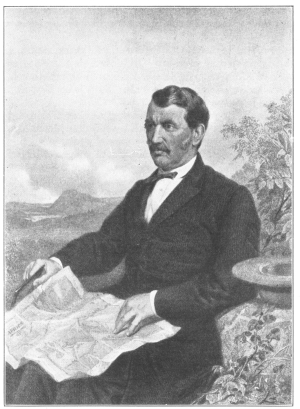
elsewhere to study, working part of the time, to earn enough to pay his way.
On a visit to London Livingstone met Doctor Moffat, a leading missionary in South Africa, and soon decided to work in Africa himself. He had prepared himself to help men’s bodies as well as their souls. So he went first as a medical missionary.
Doctor Livingstone’s first mission station, or center, was seven hundred miles farther north than Doctor Moffat’s, in a region which was dangerous because of savage men, wild beasts, and, worst of all, an unhealthful climate. In this lonely place the new missionary began to tell the ignorant black people about the one true God. He cured them of their illnesses, and showed them how to dig canals and build dams to water their little farms. He also taught them to till these farms in a better way than they had known.
In the region there were many lions. One day, when the missionary was out with a band of natives, he met one of the big beasts. Livingstone and one of his black men shot at the lion, which sprang up with a roar and bounded into the bushes, through the circle the men had made around him. Then two more lions appeared. Before Livingstone could reload his gun, he saw one great brute with bristling mane and angry eyes springing upon him. Its weight bore him to the earth. The lion seized his shoulder with jaws strong enough to carry off an ox. When some one asked him afterward what he thought just then, Doctor Livingstone replied, “I was wondering what part of me he would eat first.” In a letter the doctor described this adventure:
“With his terrible roar sounding in my ear, the lion shook me as a dog does a rat; but, strange to say, I felt neither pain nor fear, though fully conscious of all that passed. As I turned to escape the weight of his paw, which was resting on my head, I saw his eyes turn toward Mebalwe [one of the natives], who was about to fire, but his gun missed fire in both barrels. Instantly the lion quitted his hold of me and leaped on Mebalwe, biting him badly in the thigh; then he dashed at another man who was about to attack him with his spear. But at that moment the previous shots the lion had received took effect and he dropped to the ground dead.”
Livingstone was bitten in eleven places, his arm was badly mangled, and bones were broken in several places. It was many months before he was well. The broken arm was always weak, and he bore the marks of that big lion’s teeth to his dying day.
While recovering from his wounds, Livingstone made the long journey to the home of Doctor Moffat, and married that gentleman’s daughter Mary. Miss Moffat was born in South Africa, so that she knew the language and ways of the people. This made her a true helpmeet to her husband in his noble work.
Livingstone called himself “Jack-of-all-trades.” “I read in journeying,” he wrote, “but little at home. Building, gardening, cobbling, doctoring, tinkering, carpentering, gun-mending, farriering (horse-doctoring and shoeing), wagon-mending, preaching, schooling, lecturing in divinity to a class of three, fill up my time.”
When Livingstone reached the country of one of the black tribes, thousands of miles to the north, all the people of the region, numbering six or seven thousand, poured out to see the white man. The missionary was greatly relieved to find that the chief of this region, who was only eighteen years old, was disposed to be friendly. The white man and his party were well cared for and given plenty of good food, of which they were badly in need. They were nearly starved, because unfriendly natives on the way had refused to sell them food. In regions where the Arab slave-traders had robbed, killed, and carried away and sold many of the natives, the people were afraid of Livingstone, for they thought all white men must be robbers and murderers. But in reality the brave Scotch missionary was a great worker against the slave-trade, writing and saying all he could to make people in Europe and England know how wicked it was.
Although Livingstone journeyed about so much, travel was very hard and dangerous. He and his faithful men often had to go up to their necks in swamps where the hot, moist air was filled with poisonous insects, and to cross rivers in great peril from the crocodile and hippopotamus. Not only did Livingstone have numerous hairbreadth escapes from lions, elephants, and other wild beasts, but he was many times stricken with the terrible African fever. Because of his wonderful recoveries the natives thought his life was charmed, and they were afraid he was a wizard who worked cures by magic from the devil. But the good doctor soon won their friendship by his great kindness to them.
Livingstone traveled thousands of miles by water, in clumsy boats. He wrote to a friend, describing the life on one of these river trips:
“We rise a little before five, when it is daylight. While I am dressing, the coffee is made, and after I have filled my little coffeepot, I leave the rest for my companions, who eagerly swallow the refreshing drink. Meanwhile the servants are busy loading the boats, which done, we embark. The next two hours, while the men row swiftly onward, are the pleasantest of the whole day. About eleven we land and eat our luncheon, which consists of what is left from supper the evening before, or of zwieback with honey and water.
“After resting for an hour we enter the boats again, and take our places under an umbrella. The heat is oppressive, and as I am still weak from my recent attack of fever, I cannot go ashore and hunt. The rowers, who are exposed to the sun without cover, drip with sweat and begin to tire by afternoon. We often reach a suitable spot to spend the night two hours before sundown, and as we are all tired, we gladly make a halt.
“As soon as we are ashore the men cut grass for my bed and poles for my tent. The bed is then made, the boxes with our supplies piled on each side of it, and lastly the tent is stretched above. Four or five paces in front of it a huge fire is lighted, beside which each man has his own place, according to the rank he occupies. Two of the Makololos are always at my right and left, both in eating and sleeping, while Machana, my head boatman, lies down before the door of my tent as soon as I go to bed.
“A space beyond the fire is staked out for the cattle, in the shape of a horseshoe. The evening meal consists of coffee and zwieback, or of bread made from maize or Kaffir corn, unless we are lucky enough to shoot something to supply us with a pot of meat. We go to bed soon after, and silence descends upon the camp. On moonlight nights the fire is allowed to go out.”
While Livingstone was exploring to the northward, he discovered the great cataracts of the Zambesi, which are even higher and wider than Niagara. He named them Victoria Falls in honor of the queen of England. He also found the lakes from which the Zambesi flows into the eastern sea and the Congo into the western, on opposite sides of the continent of Africa. The two rivers are like two long watersnakes with their tiny tails close together, but their wide-open mouths thousands of miles apart.
Doctor Livingstone had sent his wife to England for the benefit of her health and to educate their children. The people there were greatly pleased with the results of Livingstone’s labors in Africa, for all of the country discovered by him would belong to Great Britain. So the British government gave him its support and paid him a small salary for the work he was doing for science and for the world. By this time other missionaries had come to help save the Dark Continent. The wives of two of these were coming out from England with Mrs. Livingstone when she returned. There was great joy on both sides—that of the three husbands in the heart of Africa, and that of the three wives on their way to join them. But Livingstone and both his friends were seized with African fever, and, when their wives came, the two men missionaries had just died. Even Mrs. Livingstone, although she had been brought up in Africa, took the disease and died. The two missionaries’ wives soon returned to England, but Doctor Livingstone could not even then be persuaded to leave the needy people to go to England to rest awhile and see his now motherless children.
Besides all these labors, and besides the exact reports he made on the animal life, flowers, trees, rocks, and geography of that new land, he wrote books about his adventures and experiences which had an immense sale. This made him a man of considerable wealth; but, after providing well for his family and for the education of his children, he spent the greater part of his fortune—ten to thirty thousand dollars at a time—for the benefit of his black “children.”
When Livingstone did go to England, it was only for a short visit. While absent from Africa he seemed always to hear those millions of poor, ignorant people calling him. Once he purchased the parts of a little steamer and brought it back to Africa. The boat was put together and was run on some of the lakes and rivers he had discovered. The vessel proved to be a poor affair, which ran very slowly and was always breaking down. But the natives were astonished, and would have worshipped it if he had let them. As time went on, larger and better boats were sent out to him. Once he had to discharge his engineer, but he ran the steamboat himself. He found it easier, of course, to make his journeys with the help of steam, though he had to go to many places where the boats could not be taken. A writer has described a trip Livingstone and his friends made in July:
“It was now the African mid winter and the nights were very cold. The tsetse flies were more troublesome than ever. Wild beasts became more numerous every day in this uninhabited region. Herds of elephants, buffaloes, zebras, and many kinds of antelopes were frequently seen, which allowed the head of the caravan to approach within two hundred feet of them. The wild boars, of which many were seen, were very shy; while, on the contrary, troops of monkeys hastily retreated into the jungle at the sight of the travelers, chattering angrily about the coming of the white man. Guinea fowl, doves, ducks, and geese were also plentiful.
“With the darkness a new and even more numerous world of living creatures awoke. Lions and hyenas roared and howled about the camp. Unknown birds sang sweetly or screeched as if in fear, and all sorts of strange insect noises were heard.
“One day Livingstone narrowly escaped losing his life from the attack of a two-horned rhinoceros. This beast was strangely quick, in spite of its great bulk, and very savage, being one of the few animals which will attack a man without being first attacked.
“While making their way through a dense thicket Livingstone had become separated from the others, and was stooping to gather some specimen, when a black rhinoceros made a furious charge at him; but, strange to say, it suddenly stopped short, giving him time to escape. In his flight, his watch and chain became entangled in a branch and, stopping to loosen it, he saw the beast still standing in the same spot, as if held back by an unseen hand. On reaching a safe distance he uttered a shout of warning, thinking some of the party might be near; at this the rhinoceros rushed away, grunting loudly.”
While Dr. Livingstone was in England he was welcomed with highest honors. He was invited to visit Queen Victoria and her husband, the Prince Consort. But so strong was the missionary spirit in him that he preferred talking to cotton spinners and the people in the slums of the East End of London. He was quite glad to go back to Africa and escape from the medals, degrees, and other great honors showered upon him.
After his return to the Dark Continent for the last time, he went farther than ever into the interior in an attempt to discover, or at least to prove, where the great river Nile begins. When he had nearly reached the goal, he was driven back by hostile tribes which had recently suffered from attacks of slave traders. At this time the Arabs who carried Livingstone’s letters down to the coast to be sent to England destroyed them all, for fear he had written to England about the slave outrages they had committed. For this reason nothing was heard of him for years. It was thought that he had been murdered by savages or had died of African fever.
At last the publisher of The New York Herald sent Henry M. Stanley, the newspaper’s foreign correspondent, with all the money he needed, to find Dr. Livingstone; or, if he were no longer living, to get any records that could be found. After a long search the American newspaper man heard of a white man hundreds of miles farther in the interior. Trace and trail grew more and more distinct and at last the American company, with the American flag flying, marched up to Livingstone’s camp on the shore of one of the great lakes he had discovered. Of this meeting Stanley wrote:
“As I advanced slowly toward him I noticed he looked pale and weary. He had a gray beard, and wore a cap with a faded gold band on it. I could have run to him and embraced him, only I did not know how he would receive me; so instead I walked up to him and said, ‘Dr. Livingstone, I presume?’
“ ‘Yes,’ said he with a kind smile. We both grasped hands.
“ ‘I thank God, Doctor, that I have been permitted to see you!’ said I, and he answered, ‘I feel thankful that I am here to welcome you.’
“I found myself gazing at the wonderful man at whose side I now sat in the heart of Africa. Every hair of his head, every line of his face, his pallor and the wearied look he wore, all told me what I had longed so much to know.”
The two explorers spent months together talking over their discoveries and experiences. Stanley had much to tell of what was going on in the world outside. Nearly all Livingstone’s store of supplies had been stolen, but Stanley had prepared for that. He insisted on providing the old missionary with everything he might need. Of Stanley’s tenderness Livingstone wrote to his daughter:
“He laid all he had at my service, divided his clothes into two heaps, and pressed one upon me, then his medicine chest, his goods and everything he had, with true American generosity. To coax my appetite he often cooked dainty dishes for me with his own hands. The tears often started to my eyes at some fresh proof of his kindness.”
As Dr. Livingstone was again recovering from a very severe attack of fever Stanley begged him to go home to England with him for a year of rest, but the aged missionary shook his head sadly. Stanley returned to the outside world.
About a year after this, David Livingstone was found kneeling beside his bed in a hut built of bamboo poles and coarse grass. He had died while praying. Millions of natives in the heart of the Dark Continent were heartbroken when they heard of the medical missionary’s death. They spent months in wailing and mourning, for they had lost their “White Father.”
Two devoted black men carried the body of their beloved master hundreds of miles through the swamps and jungles of Africa, and placed it on shipboard, to be taken back to England. That ship was met at the English seaport by a special train heavily draped in mourning, which carried the honored remains up to London. Great Britain had strong reasons for honoring David Livingstone. He had added a million square miles to the known world, and put great lakes, rivers, mountains, and countries on the map of Africa.
There was a magnificent funeral in Westminster Abbey, where the great missionary and explorer was buried beside the sacred ashes of kings, queens, princes, and statesmen. Thus he received the highest honors England can bestow upon her most illustrious dead. On the black marble slab which marks David Livingstone’s final resting place are the last words he is known to have written. They are about the cruel slave trade:
“All I can say in my solitude is, may Heaven’s rich blessing come down on every one—American, English, Turk—who will help to heal this open sore of the world.”
PEARY, A HERO OF THE GREAT WHITE NORTH
FOR hundreds of years after Columbus, explorers sought the Northwest Passage through the frozen seas of North America. It was not until 1853 that such a channel was actually traced. Even then it was so filled with ice that no sailor, however brave and skilful, could make his way through. Long ago the search for the Northwest Passage gave place to the great desire and purpose to reach the North Pole.