Chapter XIII · TUDOR AND LATER HERALDRY
Reading edition
Decorative Heraldry of the Reign of Henry VIII; The Decadent Change in the Quality of Heraldry; Examples of Elaborated Arms; Survival of Tradition in Heraldic Art; Elizabethan Heraldry; Heraldry in the Seventeenth Century and under the Commonwealth; Post-Restoration Heraldry.
In the foregoing chapters practically nothing has been said or any illustration given of heraldry later than the reign of Henry VIII, chiefly because little that is artistic can be found afterwards. There are however certain points about both Elizabethan and Stewart heraldry that are worthy of notice, especially when the old traditions have been followed.
In the second quarter of the sixteenth century decorative heraldry may be said to have reached its climax, and such examples as can be seen at Hengrave Hall, Hampton Court, Athelhampton House, Cowdray House, St. George's chapel in Windsor Castle, King's College chapel at Cambridge, and Henry VII's Lady chapel at Westminster, or in the beautiful panel of Henry VIII's arms at New Hall in Essex (fig. 189), are quite the finest of their kind. Then comes a falling off, and though sporadic cases in continuation of tradition may be found, with the advent of the Renaissance English heraldry underwent a complete change.
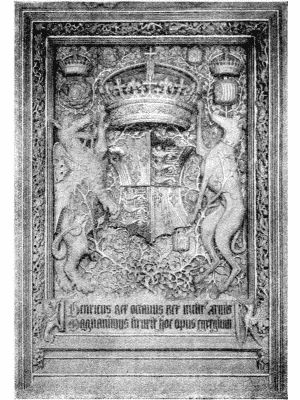
Fig. 189. Carved panel with the crowned arms, supporters, and badges of King Henry VIII at New Hall in Essex.
One of the most notable differences between the older and the later heraldry is in the quality of the heraldry itself.
In the days when men devised arms for themselves these were characterized by a simplicity that held its own all through the thirteenth and fourteenth centuries and well down into the fifteenth century. But following upon a privilege that had hitherto been exercised by the King as a mark of special honour, and in some rare cases even by nobles, the heralds then began to assign arms to such of the newly-rich who came to the front after the Wars of the Roses and were willing to pay for them. Henceforth the artistic aspect of heraldry entered upon a continuous decadent course.
The beginning is visible in the extraordinary compositions devised and granted to all sorts and conditions of men during the reign of Henry VIII. Such arms as had been granted by Henry VI or Edward IV, or even by the kings-of-arms in the fifteenth century, still followed ancient precedent, but the Tudor members of the newly incorporated Heralds' College seem to have struck out a line for themselves.
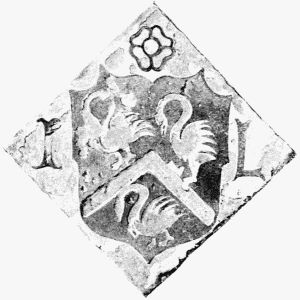
Fig. 190. Paving tile with arms and initials of John Lyte (c. 1535), from Marten church, Wilts.
A notable example is furnished by the arms devised for cardinal Thomas Wulcy. These, in token of his Suffolk origin, have for basis the engrailed cross upon a sable field of the Uffords (to whom he was not related), charged with the leopards' heads of the de la Poles and a lion passant (perhaps for England); to which is added a gold chief, with a red Lancastrian rose, and two of the Cornish choughs from the posthumous arms of St. Thomas of Canterbury in allusion to his Christian name!
The arms granted by Christopher Barker, Garter, in 1536 to the city of Gloucester afford another example. They consist of the sword of state of the city, with the sword-bearer's cap on the point, set upright on a gold pale, and flanked on either side by a silver horseshoe and a triad of horsenails on a green field; there is also (as in Wulcy's arms) a chief party gold and purple, with the silver boar's head of Richard III (who granted a charter to the city) between the halves of a Lancastrian red rose and of a Yorkist white rose, each dimidiated with a golden sun!
A reference to Bedford's Blazon of Episcopacy will show that the arms of a considerable number of the bishops appointed during the reigns of Henry VIII and Edward VI were characterized by overcharged chiefs like those just described, and these may be taken as typical of the arms then being granted by the kings-of-arms. The same passion for crowding the shield is seen even in many of the less elaborate arms that were occasionally granted.
Things did not improve under Mary and Elizabeth. Simple arms continued to be issued from the College, but mixed with such extravagant bursts as that of Laurence Dalton, Norroy, who granted in January 1560-1 to the famous physician doctor John Caius these arms:
Golde semyd w^{th} flowre gentle in the myddle of the cheyfe, sengrene resting uppon the heades of ij serpentes in pale, their tayles knytte to gether, all in proper color, resting uppon a square marble stone vert, betwene theire brestes a boke sable, garnyshed gewles, buckles gold, and to his crest upon thelme a Dove argent, bekyd & membred gewles, holding in his beke by the stalke, flowre gentle in propre color, stalked verte, set on a wreth golde & gewles.
This precious composition is further described in the grant as
betokening by the boke lerning: by the ij serpentes resting upon the square marble stone, wisdom with grace founded & stayed upon vertues stable stone: by sengrene & flower gentle, immortality yt never shall fade, etc.
The way in which matters went from bad to worse is shown by the case of the Company of 'Barbours & Chirurgeons' of London, to whom had been granted in 1561
paly argent and vert, on a pale gules a lyon passant gardant golde betweene two Spatters argent on eche a double rose gules and argent crowned golde.
The united genius of Garter, Clarenceux, and Norroy 'improved' these arms in 1569 into:
Quarterly the first sables a Cheveron betweene three flewmes argent: the second quarter per pale argent and vert on a Spatter of the first, a double Rose gules and argent crowned golde: the third quarter as the seconde and the fourth as the first: Over all on a Crosse gules a lyon passant gardant golde.
Such compositions as these could not but fail to bring heraldry into contempt, and men soon ceased to revel in and play with it in the same delightful way as before. Here and there, as in Sir Thomas Tresham's market house at Rothwell, or in Sir Henry Stafford's great mansion of Kirby Hall, tradition has been held fast, and play is made upon the former with the Tresham trefoils, and in the latter with Stafford knots and with crests treated as badges in quite the old style. At Kirby Hall, despite its date (1572-5), and at Cadhay in Devon, sitting figures of beasts with shields of arms were set upon the gables, and at Kirby upon the pinnacles that surmounted the pilasters about the court. A good panel with the arms and badge apparently of Sir John Guldeford (ob. 1565) is to be seen in East Guldeford church, Sussex (fig. 191).
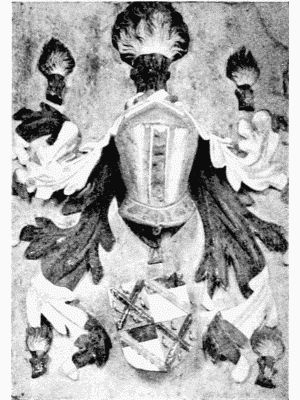
Fig. 191. Arms, with crested helm and badge (a blazing ragged-staff) of, apparently, Sir John Guldeford of Benenden (ob. 1565) in East Guldeford church, Sussex.
A remarkably fine specimen of Elizabethan heraldic decoration is also to be seen in the great chamber of Gilling castle, Yorks, as finished by Sir William Fairfax about 1585. Here the beautiful inlaid wall-panelling is surmounted by a frieze nearly four feet deep, painted with hunting scenes and a series of large trees, upon which are hung according to wapentakes the shields of arms of Yorkshire gentlefolk. The chimney piece displays the armorial ensigns of the builder, with those of his Queen above, and four other shields, and between the frettings of the plaster ceiling are the Fairfax lions and goats, and the Stapleton talbot. The rich effect of the whole is completed by the contemporary heraldic glazing with which the windows happily are filled.
But in Elizabethan buildings generally, heraldry made but a poor show. Supporters and other creatures had descended from the gables to stand or squat upon gateposts, and occasionally a square panel filled with heraldry was inset above a doorway or a porch; or the family crest, divorced from its helm, was carved upon the spandrels of the entrance. But the former glory had disappeared, and shields of arms were often replaced by initials and dates of owners and builders, presumably because they were 'non-armigerous persons.'
Within doors matters were somewhat better. Such gorgeous rooms as the great chamber at Gilling were quite exceptional, and heraldic display was usually confined to the elaborately carved overmantels of the chimneys, which served as a frame for the family arms and crested helm with grand flourishing of mantlings. These were often repeated upon the cast-iron fire-backs. The art of the plasterer was extended to the inclusion of crests and other devices among the ornaments of the moulded ceilings, and the glazier continued to fill the windows with beautiful coloured shields of alliances. Occasionally too the family arms were woven into carpets or table covers; or embroidered by the ladies of the house on the hangings of the state bed, within charming wreaths of flowers copied from those in the garden (fig. 192).
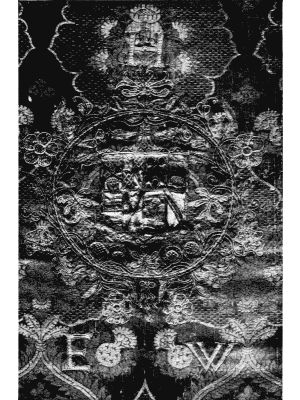
Fig. 192. Part of a bed-hanging embroidered with the arms of Henry and Elizabeth Wentworth, c. 1560, formerly in the possession of Sir A. W. Franks, K.C.B.
The monuments of the dead continue as before to be adorned with heraldry, but in a different way, and for the beautiful simple arms and devices of the medieval memorial began to be substituted the concentrated shield of the family quarterings, with crest and mantled helm, and such supporters as the College of Arms allowed or approved.
Despite the inevitable consequent formality, there is often much that is good about the treatment of Elizabethan and Jacobean heraldry, and it would not be easy, even at an earlier date, to beat the delightful lions upon the shields on the Lennox tomb at Westminster (fig. 194), or to fill up more satisfactorily a shield like that above the monument of Sir Ralph Pecksall (fig. 195). The effective way in which the shield itself is treated in this case is also praiseworthy, and both shields are models of heraldic carving in low relief.
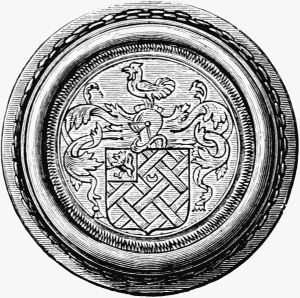
Fig. 193. Arms of Cotes, from a mazer print of 1585-6.
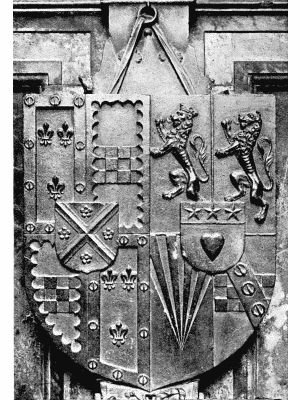
Fig. 194. Shield from the tomb of Margaret countess of Lennox (ob. 1578) in Westminster abbey church.
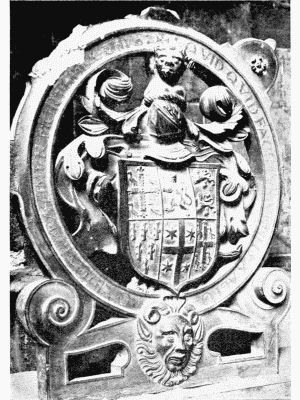
Fig. 195. Achievement of arms from the monument of Sir Richard Pecksall (ob. 1571) in Westminster abbey church.
The Lennox and Pecksall shields are likewise indicative of another characteristic change, the desire to illustrate ancient descent by the multiplication of quarterings. The disastrous consequences of this practice, even in the fourteenth and fifteenth centuries, have already been pointed out, but in the reign of Elizabeth it was carved to such an excess as to produce at times a mere patchwork of carved or painted quarters, in which the beauty of the heraldry was entirely lost. In the great hall of Fawsley House, Northants, there hangs a coloured achievement of the Knightley family containing actually 334 quarterings, which have been rightly described by Mr. J. A. Gotch as '330 too many for decorative effect.'
The heraldry of the seventeenth century is in general but a duller version of that of the later sixteenth century, with a tendency to become more commonplace as time goes on.
Under the Commonwealth every vestige of regality was ordered to be put down and done away; a very large number of representations of the royal arms were defaced and destroyed; and the leopards of England were for a time 'driven into the wilderness' along with the lion of Scotland. It was nevertheless thought desirable that the United Kingdom should still have arms, and on THE GREAT SEALE OF ENGLAND/ IN THE FIRST YEARE OF FREEDOM BY GOD'S BLESSING RESTORED, that is, 1648, the cross of St. George appears for England, and a harp for Ireland. The royal crown was at the same time superseded, on all maces and other symbols of kingly power, by another which curiously reproduces all its elements. It had a circlet inscribed THE FREEDOM OF ENGLAND BY GOD'S BLESSING RESTORED, with the date, and for the cresting of crosses and fleurs-de-lis there was substituted an intertwined cable enclosing small cartouches with the cross of St. George and the Irish harp. The new crown was also arched over, with four graceful incurved members like ostrich feathers, but wrought with oak leaves and acorns. These supported a pyramidal group of four handsome cartouches with the cross and harp surrounded by an acorn, instead of the orb and cross.[29] Perfect examples of this singular republican crown still surmount the two maces of the town of Weymouth.
On the obverse of the new great seal of the Commonwealth, designed and engraved by Simon and first used in 1655, the field is filled with an heraldic achievement of some interest (fig. 196). This includes a shield with the cross of St. George in the first and fourth quarters, St. Andrew's cross in the second quarter, and the Irish harp in the third quarter, with the lion of Cromwell on a scutcheon of pretence. This shield of the State's arms is supported by a lion with a royal crown on his head, and by a dragon, standing upon the edge of a ribbon with the motto PAX QVÆRITVR BELLO, and is surmounted by a front-faced helm with much flourished mantling, with a royal crown and the crowned leopard crest above, set athwart the helm.
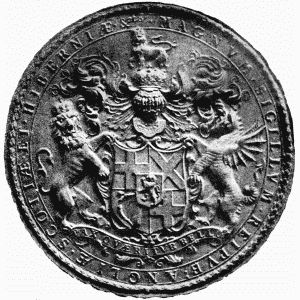
Fig. 196. Obverse of the Great Seal of the Republic of England, Scotland, and Ireland, 1655.
The seal furnishes an excellent illustration of the heraldic art of the period, but it is singular that under a Nonconformist domination the arms selected for England and Scotland should consist of the crosses of their patron saints. It is also interesting to note that the expunged arms of England and Scotland had evidently been regarded rightly as personal to the murdered King. A further curious point is the reappearance on the seal of the royal crown of England above the helm and on the leopard crest and the lion supporter.
On the reverse of the seal just noted the State's new arms are repeated on a cartouche behind the equestrian figure of the Protector.
Of the heraldry of the Restoration and later it is hardly necessary to make mention, so lifeless and dull is the generality of it. A good specimen c. 1670 with the arms of the Trinity House (fig. 197), and a later one (fig. 198) with the arms, etc. of the Trevor family, are to be seen in the Victoria and Albert Museum. Reference is due, too, to one other notable example. This is the beautiful panelled ceiling set up over the chapel (formerly the great hall) of Auckland castle, by doctor John Cosin bishop of Durham (fig. 199). It was in making from 1662 to 1664, by a local carpenter, and consists for the most part of a series of square panels containing alternately the cross and four lions that form the arms of the bishopric of Durham, and the fret forming the arms of Cosin. In the middle bay the bishop's arms are given in an oval, and flanked by similar ovals with the eagle of St. John in allusion to his name. No earlier wooden ceiling could be finer in conception, and the effect of the whole was originally enhanced by colour and gilding, but this was most unhappily removed by order of bishop Barrington (1791-1826).
With so notable a late survival of medieval tradition this book may fitly end.
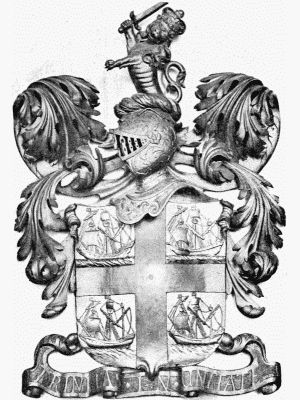
Fig. 197. Arms, etc. of the Trinity House, London. From a wood carving c. 1670 in the Victoria and Albert Museum.
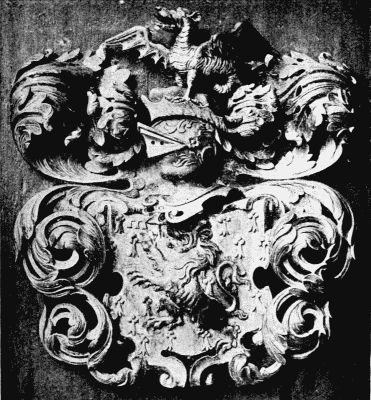
Fig. 198. Limewood carving with the arms and crest of the Trevor family, c. 1700, in the Victoria and Albert Museum.
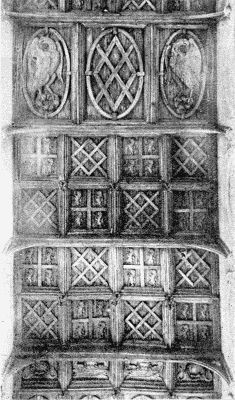
Fig. 199. Part of the carved oak ceiling of the chapel, formerly the hall, of Auckland castle, Durham, with the arms of bishop John Cosin, date 1662-4.