Front matter (continued 4)
Reading edition
"What condition?" asked Indiana, innocently.
"That I should not give in."
"Oh!" exclaimed Indiana, falling back on the sofa. If he brought up that justification, there was no longer any ground to argue upon.
"I have never in my life broken my word once given. This is our first difference. I must keep my promise to you. No matter how much I suffer, I will not give in." He tucked her in the rug again, extinguished the lamp, and left the room.
CHAPTER XVI.
An Escapade
Indiana, lying in the dark, tossed restlessly. Scattered scenes and personages of her old life and the new, floated through her mind, jumbled in a rare confusion. She counted and multiplied to induce sleep. Finally she thought of the formula children repeat when they play hide-and-seek—
"'Ena, mino, mina, mo,
Catch a nigger by the toe.
If he hollers let him go.
Ena, mino, mina, mo.
You're it—I'm out!'"
"Out of everything," she added, with a sob. "Oh, I can't sleep!" She tossed the pillows about desperately, feeling nervous and irritable, angry with herself, angry with Thurston and her family. The room was suddenly lit from the lamp on the centre-table. Indiana's dazzled eyes saw a tall figure standing before her. "Glen!"
Jennings retreated with a chuckle of delight. Indiana threw her arms about her old playmate's neck, and was on the point of kissing him, but drew suddenly back at the recollection that he had been her lover as well as her comrade.
"I'll bet you forgot, for the moment, you were married—now didn't you?"
Indiana nodded. Tears were not very far from her eyes. He pressed her hands, looking into her face. He felt both pain and joy—pain that she was another's, and joy at beholding her in the flesh once more, no matter under what circumstances.
"So you were the surprise," said Indiana, a little shyly. He looked so manly, so strikingly tall and handsome, as he stood there in his evening clothes. His dark eyes gazed at her in an unmistakably tender fashion. "Just as though I were not married at all," thought Indiana, with a sudden uprising of wifely virtue.
"I was the surprise," answered Glen, releasing her hands slowly.
"I was just trying to sleep, and, thinking of the old days when we played tag together and—"
"Yes," said Glen, eagerly.
"Oh, never mind," answered Indiana, brushing the tears from her eyes.
"The old days," repeated Glen, staring into the fire.
"They seem so far away, and it's only a few months, Glen. So much has happened—I suppose that's the reason."
He looked at her intently. There was a wistful expression in her eyes. She was paler and thinner, more thoughtful. He gathered his own conclusions from her appearance, aided by certain hints which the family had let fall. He knit his brows in a fierce scowl.
"What's the matter, Glen?"
"My old thoughts are working on me again—that's what it is—your mentioning the old days. They were the best after all, Indiana. Why, people are always raving over sunsets. You should have heard them on the steamer coming over. But once I saw a sunset far off in an orchard in Indiana—there's never been anything to compare with it since—there never will be—to the end of time."
"Sit down, Glen. Tell me all about yourself. You've changed so much for the better, I'm quite bewildered."
"It's worth crossing the ocean to hear that—from you," said Glen, with a superior air. "But I won't sit down here—the place chokes me. I've brought a hansom, and we'll jump in and take a spin about, till it's time to join the folks at dinner."
"I'm not going," said Indiana, without meeting his eyes. "My husband won't let me."
"Your husband won't let you? Poor child—so it's come to this!"
Indiana's pride rose in arms. "Don't waste any sympathy!" she exclaimed, her eyes flashing. "I'm perfectly happy, I assure you."
"Yes, you look it," said Glen, skeptically. "I understand it's a case of jealousy. He's trying to wean you from your own people. I suppose I won't be allowed to see anything of you either. I'm glad they let me in this time, to get one glimpse of you. Next time it will be 'Not at home' or 'Engaged.' I'm very sorry you couldn't come this one night. It'll spoil the evening for all of us, and I had so much to tell you. But I won't keep you. Good-bye."
"Glen!" cried Indiana, clenching her hands and stamping her foot. "How can you act like that? I'm no prisoner. I can go if I want to—but I don't want to."
"That makes it worse than ever," replied Glen, seriously. "We sympathize with you, in the other case, but now we must have the pride not to beg when you turn upon us. Good night!"
This was more than Indiana could bear. "Glen, I'll go!" she exclaimed, desperately.
He came back slowly into the room, his eyes shining with joy. "Will you, Indiana?"
"Just sit down and I'll slip into a dress. I shan't be long, Glen."
"Yes."
"We'll have a good time, altogether, this one night." Her resolve, once taken, she threw scruples to the wind. Glen, walking restlessly up and down the room after she had gone to dress, spied her photograph on a cabinet. First looking suspiciously around him, he took possession of it and kissed it passionately.
"Poor little thing," he murmured, gazing on the photograph, and seating himself in a comfortable position, his feet on the table. "Now the first blaze of glory is over, and you find—you're in for life—what are you going to do, little western bobolink, with your wings clipped, and your little eyes peering over the cruel ocean? Oh, you'll never complain—you're too proud." He let the photograph fall, and buried his face in his hands.
Indiana rang for her maid, and dressed in feverish haste. She wished to leave the house without coming in contact again with Thurston. Slipping quietly down the stairs, she saw a light in his den. The door was not quite closed, and she peeped through the crack. He was sitting at his table, reading, in a patient attitude, his head propped on his hand. She passed the door, then, moved by a sudden impulse, went back and looked at him again. There was something which appealed to her in the solitary figure sitting there, in a pose so passive as to almost suggest hopelessness. She noticed the touch of gray in his hair, under the lamplight—that, too, appealed to her. She felt vaguely that his was not the face of a happy man, and also, in a vague sense, her conscience reproached her for being responsible. She remembered they had always been together since their marriage. Neither had taken any pleasure apart. She would have liked to have kissed him good-night, and gone with his sanction—but, she told herself, that would be impossible to gain. With an involuntary sigh she sped down to the library. Glen was still sitting, his face buried in his hands. The photograph had fallen on the floor.
"Here I am, Glen," throwing her white wrap in his lap. "It's not necessary to ask you how I look. I've completely stunned you." He looked at her with worshipping eyes. She had donned an airy, diaphanous white gown, and her cheeks were glowing, her eyes sparkling with excitement. "You've been looking at my new photo. Do you like it?"
"Oh, so-so," he answered, indifferently.
"Now I'm going to leave a message for Thurston." She sat down to the table and drew some writing materials towards her. Then she gnawed the end of the pen in some perplexity, looking a little grave.
"You're afraid," said Glen. "You're sorry—you'd like to back out."
"Not at all," answered Indiana, drawing herself up indignantly. "I know just what my husband will do. He won't say a word to anyone—he'll jump in a cab and follow me."
"And then—a family row."
"Not at all. My husband is too high-bred for any public display of feeling. He'll look cold and proud, I'll quiver my eyelids—and—he'll kiss me—that's all." She smiled triumphantly as she scribbled a hasty note.
"I know," agreed Glen, with a sigh. "You could soften anything—even stone."
"Do you know that my husband is an H.F.R.G.S.?" sealing the note.
"Is he? You quite astonish me."
"Now, what is it? Of course you don't know. Honorary Fellow Royal Geographical Society. They want him to lead an expedition to the North Pole. If I had said 'no,' he would have gone. It was a toss-up."
"What a shame he didn't go," remarked Glen, shaking his head dolefully. "What a loss to science! Ha, ha, ha, ha, ha!" He laughed so heartily, Indiana felt obliged to join him. "How jolly I am!" he thought, bitterly.
"Oh, I'm so excited!" exclaimed Indiana. "I love uncertainty of any kind."
"Women are born gamblers," observed Glen, fastening her wrap under her chin. Jennings entered, in answer to the bell.
"Jennings," said Indiana, with an indifferent air, "there's—there's a note on the table for—your master."
"Yes, yer little leddyship."
"Er—I shall be—"
"I hear someone coming downstairs," whispered Glen. "Quick, or Bluebeard will cut off our heads!"
"I feel like a bad boy, playing truant," laughed Indiana. "Scoot!" They ran, giggling quietly, into the hall. Jennings, with a horror-stricken face, tottered to the window, pushed aside the curtains hastily, and pressed his face against the glass.
Lord Stafford, entering the library then, saw him in this position and heard the sound of wheels. "Who's driving off, Jennings?"
Jennings started. "Her—her—little leddyship."
Lord Stafford looked at him incredulously. He had just been talking with Thurston, and Indiana was not likely to go out without him. They always remained at home on Sunday nights. "Impossible!"
"Her little leddyship's gone out with a gentleman from America," said Jennings.
A light broke on Lord Stafford. "Oh, evidently young Masters," he thought. He sank into a chair by the fire, pulling his moustache contemplatively. "Thurston was apparently unaware of the fact—something's up."
Thurston came into the library a moment later. "I thought you were dining out to-night, Uncle Nelson." He rubbed his hands, holding them over the fire.
Lord Stafford lit a cigarette, trying to appear unconcerned. "I shall be off in a minute."
"I'm as hungry as a bear," said Thurston, cheerily. "I must go and find Indiana. I left her asleep here. She is usually dressed and down by this time."
"Er—Thurston," commenced Lord Stafford. But Thurston had left the room before he could speak. Jennings, still standing near the window, was a little, old figure turned into stone. "By George," muttered Lord Stafford. "A pretty mess, this."
"Indiana's not upstairs!" exclaimed Thurston, when he entered again. "She may be with my mother. I did not think of that."
"Her little leddyship's gone out, sir," said Jennings, shrinking into the shadow of the curtains.
"Impossible!" exclaimed Thurston, loudly. "I left her asleep here." Lord Stafford put his hand warningly on his shoulder.
"Her little leddyship left a note," continued Jennings, peering over the table.
Thurston instantly saw the little white note lying among the books. He seized and read it quickly. His first expression of incredulous surprise faded away. His face became impassive.
"Will I serve dinner at eight, sir?"
"Certainly," answered Thurston, calmly crushing the note in his hand.
Lord Stafford looked at him inquiringly, as Jennings left the room.
"She has gone with Glen Masters to dine with her people—at the Cecil—and asks me to fetch her," said Thurston, slowly.
"Then it's all right." Lord Stafford felt, in a measure, relieved.
"It's not all right, by any means, Uncle Nelson," answered Thurston, in the same repressed voice. "My wife has gone against my express wishes."
"Ah, by George! Too bad!" exclaimed Lord Stafford, sympathetically. "You'll go and fetch her, of course?" Thurston failed to answer. An ash dropped loudly on the hearth.
"No," said Thurston, finally.
"Shall I go and fetch her?"
"No." The frozen monosyllable dropped from his lips like an icicle.
"What are you going to do?"
"I—I am going to wait up for my wife—like a good, obedient husband," he said, bitterly, dropping into a chair.
CHAPTER XVII.
Late Visitors
The great bronze clock on the mantel struck eleven. Thurston paced the library restlessly. His mother had retired, as usual, a little after ten. He had thought it best to keep from her the fact of Indiana's escapade; excusing her absence from dinner on the score of a nervous headache, due to the surprise she had received that afternoon. He had impressed upon his mother the necessity of perfect rest and quiet, for that night, at least. Lady Canning had promised not to disturb her, confiding to Thurston that she had anticipated his wife would suffer bad effects from such a "cruel shock," as she expressed it. He wished to save Indiana from the blame his mother would be sure to attach to her, if she knew the truth. He could not brook the idea that his wife should fall one iota from her esteem. And he also wished his mother's belief in his happiness to remain undisturbed. She would have suffered intense anxiety, on his account, if she had suspected there was any flaw in his marital relations. He hoped that some blessed future period would see his union, with Indiana, established on the solid rock of mutual love. Until then his unhappiness was his own secret, one which he guarded jealously. The inference his household might take from Indiana's action, was a source of great mortification to him. He went to the window and looked out. The thought rankled in him that if she had felt the slightest respect or love, she could not have treated his wishes with such contempt. When he turned back into the room, Jennings was standing at the door, looking at him wistfully.
"Well, what is it?" he asked, in a quick, sharp tone.
"I'll keep up the fire, sir, it's a bit sharp out to-night," answered Jennings, apologetically. Thurston continued to pace the floor, while Jennings piled fresh logs on the fire, shaking his head and muttering, as he was sometimes in the habit of doing. Suddenly there was an imperative knock upon the front door. "Ah, here she is, now, sir!" exclaimed Jennings, struggling to his feet. "Here's her little leddyship." He hurried from the room, chuckling with delight. Thurston's eyes were illumined with a sudden flash of joy and he rushed to the door to meet his wife. But the movement was an involuntary one. On second thought he sat down to the table, took up a book and endeavored to appear disinterested. "Why," he thought, remembering anew the facts of her absence, "should he act as though she had done nothing wrong. That in itself would be a condonation of her offence." He turned his head slowly, as Jennings came back to the room, followed hurriedly by Stillwater, holding his overcoat and opera hat. Thurston rose, his expression of cold and assumed indifference changing to one of deep disappointment and anger.
"Where's my wife—where is she?" he demanded, with an uncontrollable burst of passion.
"She's all right, my boy, she's all right," answered Stillwater, in a conciliating tone, beneath which there was a trace of embarrassment. "She's at the hotel, with mother and Grandma Chazy. And I came to bring you back to finish up the evening with us."
"Thank you, very much," said Thurston, sinking into his chair.
"Now, you're mad. You won't be so foolish as to make a fuss about nothing." Thurston looked at him, in incomprehending surprise.
"Mr. Stillwater, do you know that my wife left the house against my express wish and command? Drove away from my door on Sunday evening with a gentleman not her husband."
"Yes, I know all about it, my boy," answered Stillwater. "But it was only Glen—just the same as her own brother."
"My household does not know that. The appearance of such a proceeding is not favorable."
"I know—but it's Indiana's way of doing things," said Stillwater, rather impatiently. "Just because you said she shouldn't, she would. Now, if you handled her a little better—you'll excuse me, but I've known her longer than you—"
"You may have known her longer, but I doubt if you understand her better. As to handling her, as you call it, I will never stoop to bribe or cajole her into doing her duty."
"That's all right," continued Stillwater. He was there on an errand of conciliation, and, though his son-in-law's argument seemed absurdly precise and conventional, and he assured himself that he did not approve of any such cut-and-dried policy, he was determined to carry out his intention. "I approve of the stand you are taking, but commence after we're gone. It seems rather mean to spoil mother's holiday, doesn't it? Now come along, and Indy will receive you with open arms. It'll be all right, I promise you."
Thurston felt irritated by his father-in-law's free-and-easy good nature, his light way of disposing of a matter which struck the core of all that was sacred to him.
"I am very sorry to mar your pleasure," he answered, firmly and coldly. "This is the first time my wife has openly defied my wishes. It must be the last. If I give in, it will be the beginning of endless repetitions. And I shall fall in line behind her, like a good American husband."
Stillwater took a slight exception to these last words, uttered in a bitterly sarcastic tone. "It's not such a terrible thing to be an American husband," he said, in an offended voice. "I'm one—I don't look very bad on it, do I?"
Thurston smiled. "My dear father-in-law, if I were an American, I would consider it the acme of bliss to be in the leading-strings of my pretty wife. But I'm an Englishman and—"
"You're not built that way," interrupted Stillwater, with an explosion of mirth. Thurston shrugged his shoulders and joined in the laugh. "Come along, Thurston," said Stillwater, feeling more at his ease. "Come along. She's only a mite. She's done wrong, she knows it, and she's mighty uncomfortable." Thurston's spirits rose at this. Then she was not utterly without heart or conscience, where he was concerned. Stillwater watched his face, keeping his hand on his shoulder. "Now come, and when you get her home, read her the riot act."
Thurston shook his head. "I'm very sorry."
Stillwater's expression became serious. He had at first intentionally made light of the matter. Now, as Thurston's resolution remained unshaken, things commenced to assume a graver aspect. "Now, look here, Thurston, we won't have her staying over night with us. The place for a young wife is under her husband's roof."
"Then use your authority to convince her of that fact."
"Do you think I haven't done so, already?" asked Stillwater, now intensely grave. "Do you think I came here alone to-night without doing all I could to get her to come with me? She never told us, until the evening was half over, that you forbade her to go—on account of Sunday, and your mother, an old-fashioned kind of a woman. Well, we wanted to clear her out then and there—we begged, and we prayed, and we bullied her, and she gave it back to us, as good as she got it." He laughed at the remembrance of the scene in their rooms at the hotel. Thurston listened in anxious suspense. "And Grandma Chazy became so mad she nearly slapped her. But do you think she'd budge? Not a foot."
Thurston went over and sat down on the lounge near the fire, his head on his hand, in a hopeless attitude. It was becoming worse and worse. She persisted in her defiance and contempt of him, showing it openly to her family. She had no compunction for what she had done—none. Before Stillwater's arrival, he had allowed himself to think of her coming to him, asking prettily for forgiveness, or even one look from her deep-blue eyes would have been enough. He would have taken her then, so gladly, so thankfully, to his heart. If he had reproached her, it would have been tenderly—the chiding which is in itself love. If she had made one step towards him, he would have met her with three. But she would give him no chance to show her how freely, how generously, he could forgive for the asking. It is easy for love to ask forgiveness of love. But when there is none—this secret wound pricked him sorely. His head sank lower on his hand.
"Come on, come on," said Stillwater, persuasively. "She don't mean anything. And I'll tell you something—she's afraid to come home. I know that little, uneasy laugh of hers—with her eyes full of tears. She's done wrong, she's sorry, and she wants you to come and make it up. Won't you come, Thurston—won't you?" He bent down, looking into the younger man's face. There was a pathetic appeal in his voice.
Thurston shook his head. "When I think of you three old people, helpless against that slip of a girl—it appalls me."
Stillwater took his hat and coat from the chair where he had laid them. "Then I'll tell you what it is—she won't come home until you do come after her. That's her ultimatum."
Thurston rose. "And this is mine," he answered, sternly. "My mother's house closes at twelve o'clock, and if she does not return at that time, the doors will be closed for the night."
"I'll tell her," said Stillwater, with an indescribable expression. "I warn you," pausing at the door, "you're making a very hard time for yourself. Good night."
Thurston stood motionless, thinking deeply, for some moments after Stillwater left the room. Then he rang for Jennings. The old man responded, with an anxious expression. "Jennings, Lady Canning may not return to-night," said Thurston, in a measured tone. "She will probably remain with her people. Naturally, she wants to see as much of them as possible."
"Yes, yer lordship."
"Lock up at the usual hour and go to bed. If she is not here by that time, she will not return."
"Yes, yer lordship." After he left the room, as he was crossing the hall, he heard a slow, familiar step, a soft rustle of silk, on the stairs. He looked up with a sudden throb of fear, and saw Lady Canning descending. He knew she thought his little mistress was ill in bed with a headache, and the contingency that she might come home at any moment appalled him. He hurried back to the library. "Milady, sir, milady!" he ejaculated. "She's coming down the stairs."
"Heavens," thought Thurston, "I thought she was safe for the night. Don't look so anxious, Jennings."
When Lady Canning entered, he greeted her with a bright smile, taking both her hands in his. Jennings pushed a chair up to the fire.
"Mother, this is unusual. What keeps you up at this hour?"
"I've had so much to think of, since this afternoon. I wasn't at all sleepy."
She looked at Thurston with wide-awake, luminous eyes, as he placed a footstool under her feet. "How is Indiana? Is she sleeping?"
"Yes," answered Thurston.
"I'm glad of that, poor little thing! Such a cruel surprise! The excitement was too much for her."
"Yes, the excitement," repeated Thurston, mechanically.
Jennings left the room, after he had brushed some imaginary ashes from the hearth and arranged the curtains. Thurston showed no sign of the strain under which he was suffering, as he talked gently with his mother. Once in a while his eyes sought the clock, and his ears, preternaturally sharpened by anxiety, heard an imaginary hansom, bearing Indiana homeward. Their conversation reverted to his wife's people.
"I don't object to the father and mother," said Lady Canning. "We have one great point of sympathy—our love for Indiana. But the grandmother—Thurston, is she quite well balanced?"
Thurston laughed. "She's a shining light, mother—a prominent member of women's clubs." Lady Canning shuddered. "A very shrewd, clever woman."
"It's wonderful how people differ in their conception of things," said Lady Canning, with a sigh. "If she were my mother, I should consider it necessary for her to have a personal attendant. What do you think she said to me? That 'I ought to make more out of myself,' and if I would come over to the hotel, she'd fix me up." Lady Canning looked at her son with a shocked expression. He laughed involuntarily, and she finally joined him, seeing the amusing side of Mrs. Bunker's remark. "Well, we'll get along with them, won't we?" continued Lady Canning, taking Thurston's hand affectionately in hers. "They have given us our Indiana. I'm going to make a great effort for her sake. I'm going to present her myself at the first drawing-room of the season."
"Mother!" exclaimed Thurston, in surprise.
"Yes, I'm coming out of my retirement, after twenty years, and we'll make a sensation, I promise you." She patted his hand, feeling that the grateful love in his eyes was ample reward for all this resolution had cost her. "She's brightened my life so much since she came. I'm beginning to take an interest in things, for the first time since I lost your dear father."
"I'm very glad of that, very glad, mother—and happy."
"Now, may I creep in and kiss her good-night, when I go upstairs?" asked Lady Canning, rising.
"I wouldn't, mother," answered Thurston, quietly.
"I won't wake her," assured Lady Canning.
"I think you had better not, mother," said Thurston, in the same quiet tone.
"Very well, just as you say. I can't blame you, even if you are over-anxious. Give her my love and a kiss." She paused at the door, looking thoughtfully in his face. "We must love her very much, Thurston. And if there are any faults, we must deal gently with them, because—she is very young, and from what I saw of her people, she could have had no bringing up whatever."
It seemed strange to hear his mother pleading for Indiana just at that moment. "Good-night, mother." She put her arms about his neck and kissed him. He threw himself in a chair, after she left the room, feeling deeply depressed. "If there are any faults, we must deal gently with them." His mother's words always carried their own weight. Her unconscious intercession had touched his heart. He was ready to do everything, to make every extenuation, but he felt a dull premonition that Indiana would ask for none. Neither would she care. This was the worst. His hidden wound throbbed painfully.
Jennings crept into the room. When he saw Thurston, sitting with his head bowed upon his hands, his face became an image of distress. He looked at the clock, then back again to the hopeless figure in the chair. Thurston raised his head suddenly. "What are you prowling about for, Jennings?"
"I—I just looked in to see after that danged fire," said Jennings, in confusion, tottering to the fire and poking the logs.
Thurston smiled. "There's no sign of it going out, Jennings. Find a more plausible excuse."
"Won't you have a cold bite, sir?" asked Jennings, piteously. "You never touched the dinner."
Thurston shook his head, opening a book.
"A glass of wine, sir?"
"Nothing, Jennings. Don't bother, there's a good fellow—and don't come crawling in and out continually. I can't read; it disturbs me."
"Very well, sir," in a heart-broken voice. He went to the door, then tottered back again. "Another log on, sir, if you're not going to bed? But perhaps you are going to bed?"
"No, I shall sit up and read." The page before him was a blur. It lacked but a few minutes of twelve. If she would only come, no matter how—whether stormy, sulking or weeping—if she would only come. Even at the very last moment, to show him that she had, at least, some compunction—that she realized, in even a slight measure, what was owing him!
After putting another log on the fire, Jennings opened the window and looked out. Then he closed it, with a sigh, and stood in the shadow of the draperies watching Thurston, with his heart in his eyes. The clock commenced to strike. Thurston, sitting with his head over his book, ceased to hope. Every silvery chime fell on his head with a dull weight of pain. What had she not left him to infer from the fact of her not coming? Contempt, indifference, even fear. At the last stroke of twelve he raised his head and looked over at Jennings. The old man was the image of misery. Answering the command in Thurston's eyes, he slowly took a bunch of keys from his pocket. "I'll only put up the chain, yer lordship, in case—" He looked imploringly at Thurston.
"Lock it fast," answered Thurston. "Take the key out as usual, and go at once to bed."
The old man made a silent motion of assent, and tottered to the door. Suddenly there was a loud knock.
"Ah, here she is at last!" cried Jennings. "Here's her little leddyship!"
Thurston sprang to his feet with an involuntary exclamation of joy. "My wife, my Indiana," he thought. "She has come at the very last moment—a sudden impulse to do right. Thank heaven!"
Jennings entered slowly, followed by Glen Masters.
CHAPTER XVIII.
Awakening.
"This is rather a late visit, Lord Canning," began Glen, in a slightly embarrassed manner. He also refrained from offering his hand. "But I—I left the folks about ten o'clock, and I—I've been driving about the city trying to collect my thoughts."
Thurston silently offered him a chair, suffering the reaction of his sudden access of joy.
"Indiana told me you generally sit up after she retires, so I waited late to find you alone and have it out with you."
Thurston met Glen's intense gaze with one of polite surprise. "Oh, indeed! I was not aware there was any subject to be thrashed out between you and me."
"Indiana's unhappy. I can't see it—it—it—breaks my heart."
"You are a very young man, sir," answered Thurston, coldly, "and closely connected with my wife and her family, otherwise I should consider this a piece of impertinence."
"I don't mean it in that way. I'm square and above board, and I hate anything clandestine. This is a case of a husband and wife, and another man who loves her. I'm the other man. Now kick me out."
"I should assuredly do so, if you were an Englishman. But in your case I will only beg you to explain your meaning—I am always willing to learn." He felt obliged to take Glen seriously, yet he was conscious of feeling amused, in spite of his suffering.
"Er—have a cigarette?" asked Glen, offering his case. Though he had been braced with confidence when he entered, he felt now very much embarrassed and at a disadvantage. "Indiana won't be likely to come in, will she? I hope she's safe in bed."
"No, it's not likely," answered Thurston, evasively, taking a cigarette, which he omitted to light.
"I want to keep her out of it, if I can," said Glen. He leaned back in his chair, smoking. "I'm not much of a talker, and this helps me." He puffed furiously. "But I'm a great thinker. I've lived alone a considerable part of my life, and my way of doing things may not be considered strictly constitutional. However, that don't say I'm wrong."
"Not at all," Thurston assured him.
"Do you believe that the pursuit of happiness is the highest aim of life?" asked Glen, in a very important manner.
"That depends whose happiness a man is pursuing. You are evidently after mine."
"Ha, ha! Very good. But I mean, is making others happy the highest aim?"
"Possibly. My highest aim at present is to see my wife perfectly happy."
"Ah, that's the point. And, as we both want the same thing, there will be no difficulty in joining forces and accomplishing it."
"I fail to see how you can help to those results," remarked Thurston, far from being infected with the same friendly spirit of co-operation.
"That's what I came to tell you," said Glen, boyishly. "I'm the only one who really understands Indiana. I know how to get at her true feelings better than all her folks put together." Thurston half smiled at this assertion, which frankly ignored him—the husband. Glen puffed his cigarette, thoughtfully, watching the rings of smoke, as they widened and disappeared. "I saw the end of it from the first," he continued, in a superior tone. "Like all young girls, Indy wanted something new. I'm not blaming her—but—she's not happy. She never can be happy, away from her own home and people."
"Are you here as my wife's ambassador?" asked Thurston, icily.
"Well, no, not exactly," responded Glen, uneasily. "But she didn't object, when I told her I was going to have it out with you."
"It will be interesting to know what your intentions are against me."
"I—I want to tell you the thing don't work—I don't see how you could expect it. I want, in a perfectly open and straightforward way, to discuss the means to the desired end—her happiness."
Thurston smiled wearily. "This would all be very farcical if there were not a very serious question for me at the root of it, and which my wife's conduct to-night has made me realize very keenly. I suppose she was discussing me, during your rather unconventional hansom-ride this evening?"
"Yes, she was—and—er—not favorably. Now, what do you propose to do?"
Thurston rose, answering, very sternly and coldly. "Prove to my own satisfaction if it is true, that my wife is not, and never can be, happy in her new home. I shall not ask her, because she does not know herself what is good for her. I am egotistical enough to think that I understand her better than her own family—and even better than you. And I am convinced that a few years away from her own country, and her own people, will convert the spoilt child into a splendid, self-controlled woman. If I am mistaken, I assure you, the way of retreat shall be made very easy for her."
"Er—how long will it take to discover all this—a lifetime?"
"About twelve hours."
Glen looked at him thoughtfully, feeling that, owing to his jealousy, he had always been unjustly prejudiced against Indiana's husband. There was a consciousness of right, a dignity in Thurston's bearing, which impressed him. And beneath the calm, cold manner in which he had spoken, Glen recognized an undercurrent of pain. It dawned on him, suddenly, that the other's composure was only repression, and the man was suffering. He also appreciated the unfailing courtesy with which he had been treated.
"Lord Canning," he said, rising, "I don't feel near as confident, as I did when I came in. I was sure my platform was a just and equitable one, but since I've been watching you and listening, I begin to feel a little ashamed of myself."
"No occasion for it, I'm sure," Thurston replied, kindly.
"You're a fine fellow, and if Indiana's not happy with you, it's not your fault. It's the fault of your nationality—that's the only weak point I see in you."
"An Englishman and his nationality cannot be so easily divorced as a husband and wife," said Thurston, significantly.
Glen held out his hand. "Lord Canning, although it's against my own interests, I—I wish you luck."
"Thank you, sir. One moment, please," touching the bell, "the house is already closed for the night." They waited silently until Jennings appeared.
"Show this gentleman out, Jennings. Then lock the door securely."
"Yes, yer lordship."
"Good night," said Glen. He stepped back to the fire, where Thurston was standing, adding, confidentially, "You won't see me again. I shall keep out of the way. I won't move a step in this matter until I am quite convinced the case is hopeless with you. Good night."
When he reached the street, he found the cabman asleep on the box. He touched him on the shoulder.
"Where to, sir?"
"Anywhere—only drive," slipping a sovereign in his hand. The cabman whipped up his horse furiously. He had been following similar instructions since ten o'clock. It was now past midnight, and the handsome young American still persisted in his strange whim. He refrained, however, from fatiguing his brain with futile questions, realizing the fallacy of such a proceeding, when a sovereign reposed securely in his pocket.
Glen leaned comfortably back, lighting a cigarette. His dead hopes had risen that day from their ashes, and, like beautiful, deceiving phantoms, had melted into air. His equilibrium, the fortitude it had cost him so much to gain, had been shaken to their foundations by the thought that his cherished dream might still materialize. He saw Thurston's white, suffering face as he calmly said he would make the way of retreat very easy for Indiana. Well, he was worthy of her love. That was, at least, one solace. And he would win it in time. It was his right. With a sigh for his transient vision of happiness, the beautiful Fata Morgana which had charmed his eyes for such a brief space, Glen gathered all his moral forces to banish Indiana from his mind. His manhood was firmly building itself on the foundation of these accumulated efforts.
Thurston, still sitting up in the library, vainly attempted to read. It seemed as though his life were falling about him in ruins. He was mortified, humiliated, and incensed at Indiana. If she had no love for him, she could, at least, have shown more respect for the sacred tie which bound them, and should have refrained from discussing their relations and publishing the fact of her unhappiness.
Jennings crept in. He gave a sly glance at Thurston, who, with his head bent over his book, appeared to be reading. Then he opened the window softly and looked out. Hearing nothing, he closed it, but still waited, listening, in the shadow of the curtains. He felt it incumbent on him to share his master's vigil. Although he would not presume to express an opinion to Thurston, he had a firm belief that his little mistress would come home that night. Jennings' head swayed, and he dozed, his head against the window. Thurston, sitting with his head in his hands, was only dimly alive to his surroundings, his consciousness dulled, not by drowsiness, but a species of stupor. A knock sounded, very low and timid—then again, louder, more decided. Thurston started. Jennings, awakened suddenly, rubbed his eyes, wondering if he had heard aright. The knock was repeated, doubly and imperatively. Jennings hurried to the door, but Thurston, with a quick stride, brought his hand heavily down on the old man's shoulder.
"It's her little leddyship, sir. It's her—"
The words died on his lips as he met his master's determined gaze.
"Draw those curtains," directed Thurston, in a low, set voice.
Jennings obeyed. There was another knock. Thurston extinguished the lights. "She's at the door!" cried Jennings, desperately. "I must let—I—"
"I have said my doors will not be opened to-night—and I mean to keep my word. If you make one move to undo what I have done, in spite of the affection I have for you, I shall dismiss you on the spot."
The old man's head sank on his breast. "That I should live to see this night," he sobbed. "I love her—little—leddyship—and she—out there!" He slowly took the keys from his pocket and laid them on the table.
Thurston listened intently. "She has gone back to the cab," he thought. "She is speaking to the cabby." He heard the door of the cab slammed and the sound of receding wheels. "She has returned to the hotel. A little longer, and I might have—" He put his hand to his head, which was burning. "Jennings, I'll try and get an hour's sleep."
"Shall I help you, sir?"
"No, thank you. I shall probably come down again." He mounted the stairs heavily to his room, and threw himself, dressed as he was, upon the lounge. It was only to live, again and again, through the scene which had been enacted below. He heard the knock—first faint, then louder, still louder. He saw Jennings break down, sobbing, then take the keys from his pocket and lay them on the table. He listened intently. He heard the door of the cab slam. He heard it drive away—over his heart. She had forced him to this. And he had kept his word to her. He had not given in. She would never know, never care to know, perhaps, what it had cost him. He tossed restlessly.
Jennings still waited below in the library. Thurston had said he would come down again. There was no light but the fire, near which the old man stood, a little, heart-broken figure. Suddenly the sound of low sobbing fell on his ears. He lifted his head quickly, listening like a watchdog. Then he went to the door and looked into the hall. Hearing nothing, he approached the fire again. The faint sobbing continued. Jennings shivered with a slight sensation of fear. The sound was uncanny in the dark room, at that hour. Again he listened, every nerve on the alert. "It's outside," he suddenly concluded. He went to the window, opened it and peered out. The night was not utterly black, but lit faintly by the rays of a watery moon. Jennings distinguished a white object below on the steps.
"Jennings!" called a familiar voice.
"God! Her little leddyship—on the steps—in the cold!"
"Is it you, Jennings?"
"Yes, yer little leddyship," he whispered down, his body half out the window. "I can't open the door, yer leddyship. Hush! don't call out—wait!" He tottered to the hall, in fear of Thurston, and listened. Hearing nothing, he tottered back, trembling with excitement. "Yer little leddyship, there's those little iron bars—can't you find them? Put your hand through the ivy underneath. Ah, that's it. Now, if you could climb up, you're such a light, little body—I'd swing you easy enough over the balcony. That's right. Be careful. Ah, my heart stopped beating. Now, hold on with one hand and put up the other as high as you can." He drew her up gradually; she jumped lightly over the balcony and into the room. The fire was burning brightly. She crouched before it, shivering, and warming her hands.
"Oh, I'm so cold!" she cried. "I'm chilled to the bone!"
"Hush," whispered Jennings, in mortal fear. "Speak lower, yer little leddyship, if you don't want to ruin me."
"What's the meaning of this?" exclaimed Indiana. "Where's my husband?"
"Asleep."
"Asleep! You heard me, why didn't you open the door?"
"The master took the key from me."
Indiana rose from the fire with a horror-stricken face. "He heard me, then—he knew I was there?"
"You won't tell him I helped you in, yer little leddyship?" asked Jennings, clasping and unclasping his hands, in a nervous, frightened fashion. "He said he'd dismiss me on the spot—and he always keeps his word."
"Yes, he keeps his word," repeated Indiana, in a dazed tone, leaning against the table. "I won't tell—and I'm in now, thanks to you. It's a terrible thing to be locked out on a cold night." She shivered, folding her arms across her bare neck and shoulders. She had left her wrap on the step, in order to be disencumbered as she climbed up to the window.
"Jennings," called Thurston's voice. "Are you in here? I thought I heard someone moving."
"Go," whispered Indiana. Jennings slipped quietly from the room.
Thurston, feeling his way to the table, pressed the electric button of the lamp, then started slightly at beholding Indiana.
She faced him with clenched hands, panting with rage and excitement. "You locked me out," she said, hysterically.
"And you came in by the window," answered Thurston, coldly and calmly, giving a comprehensive glance at the open window.
"You heard me knock, and you left me on the doorstep."
"You had due warning."
"Yes, you sent me a nice message with my father—to make me look ridiculous in the eyes of my own family. I waited purposely till after one o'clock to prove to them that I was no servant, compelled to come home at a stated hour, or have the door shut in my face." Her fingers tore nervously at her gloves. "You are my husband—not my jailer, I am your wife—not your prisoner, to be let out on parole. I give you full liberty of action—if you do not give me the same, I shall take it. How dare you leave your wife out on the doorstep, like an outcast?—how dare you?"
"I dare do whatever is for your good."
"My good!" she repeated, with a cold laugh. "I am a child, then, to be lectured into silence, to be terrorized into submission. Ah, you do not know me! I will not live with you—I will never forgive you—until you come on your knees to me—on your knees!"
"I have not asked forgiveness. It is for you to do that. My wife must not outrage my sense of dignity and propriety. You have hurt and wounded me beyond pardon. The sacredness of my home relations has been violated and coarsely discussed. I am ashamed to raise my head before my own servants. And to make it, at last, unbearable—your old sweetheart calls me to account for your unhappiness. It is too galling—too humiliating!"
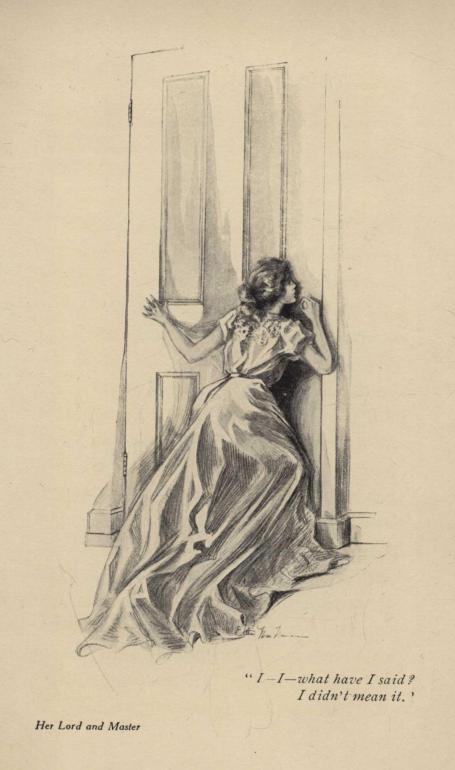
"I—I—what have I said? I didn't mean it."
"Ah," exclaimed Indiana, "Glen did come, then?"
"At your invitation," said Thurston, quickly.
"What of it? He would not have locked me out—insulted me. Oh, I'm sorry I ever married you!" Thurston gave a suppressed cry of pain. "I mean it. I have never known a harsh word in my life. You—to treat me like this! I won't stand it, I tell you!" Losing all control, she took up a paper-cutter and snapped it in pieces in her rage. "I hate you—standing there like ice! I hate—" Thurston looked down into her face with an expression of horror and rushed from the room, slamming the door. "I—I—what have I said? I didn't mean it, Thurston," murmured Indiana, with a sudden revulsion of feeling. She stretched out her hands piteously, helpless and groping, like a frightened child. "Thurston, I didn't mean it. There was a rush of red before my eyes—it blinded me." She sank on her knees with a feeling of terror at the remembrance. "Thurston, I'm afraid," she sobbed, shudderingly. "Don't leave me here with myself." She struggled to her feet, trembling from head to foot. "Thurston, I'm sorry—forgive me—I love you—I—" She fell blindly against the door, then sank to the ground, shaking with sobs.
When the storm passed, her exhaustion was so great she felt powerless to mount the stairs to her room, and lay there on the floor, beside the door, throughout the night. Though stiff with cold, her moral distress would scarcely permit her to notice this physical discomfort. She was clutched tightly in the grasp of a terrible dread. That this sudden tidal wave of love had rushed over her heart too late. And if this proved true, she felt she would no longer have the courage to live. The fact had so suddenly awakened in her consciousness, as a flower might spring at once into full and perfect bloom, that her husband's love alone gave life significance. She fell, at intervals, from pure exhaustion, into a short, troubled sleep, awakening always with a remembrance of Thurston's horrified face as he rushed from the room, closing the door, as though he would shut her forever out of his life. When daylight came, she rose with an effort and threw herself upon the lounge.
CHAPTER XIX.
"And as he Wove he heard Singing."
Jennings, entering the library at an early hour that morning, started when he saw his little mistress lying there, still in her gown of the night before, one arm hanging listlessly down, her face buried in the pillows. The light was still burning in the lamp on the table.
"Yer little leddyship," said Jennings, softly, bending over her. She stirred and raised her head.
"I wasn't asleep, Jennings," she answered, in a pathetic voice. She looked like a little, pale wraith, in her white, crushed, tulle gown, a fragment of a cloud blown by chance into the old, gloomy room.
"You left this on the doorstep, yer little leddyship." He held her long, white wrap over his arm.
"Did I? Oh, so I did!" She took it and wrapped it about her shoulders, shivering. "I've been here all night long, Jennings," piteously, "and I'm so cold!"
"Poor bairn!" exclaimed Jennings, indignantly. He hurried from the room, then returned in a moment, and busied himself making a fire, muttering to himself—"Poor bairn, it's a shame, a shame!" Indiana watched his operations with interest, as she crouched, shivering, on the lounge. "Now, yer little leddyship." He wheeled a large armchair before the fire, and she nestled into it, holding her hands to the flame.
"Pile on the logs, Jennings, pile on the logs. That's right—a big, big blaze. Oh, I shall never be warm again. Who's that?" starting up, as some one knocked at the door.
"No one will come in, yer little leddyship," said Jennings, soothingly. "I ordered some tea and toast for you."
"Tea and toast," repeated Indiana, blissfully. "Tea and toast."
Jennings took the tray and closed the door, then drew a small tea-table up to the fire. She watched him eagerly, as he poured out the tea.
"Oh, thank you, thank you, Jennings," she said, gratefully, taking the cup from his shaking hand. "Oh, that's good! I've never tasted such delicious tea. Is it a new kind?"
Jennings shook his head, handing her the toast. "Yer little leddyship must be very hungry."
"Jennings, I can trust you—I know you won't say anything."
"No, yer little leddyship."
"Did I do so very wrong, did I, that I should be treated like this?" She caught her breath with a sob, the tears rising to her eyes.
"It was cruel, cruel, yer little leddyship," answered Jennings, in a heart-broken voice. "There, there—have another cup of tea—that'll comfort yer."
"Do the servants all like me, Jennings?" asked Indiana, eating the sugar out of her tea, like a child.
"They'd go through fire and water for yer little leddyship, every mother's soul of them," answered Jennings, enthusiastically. "And my lady—she's taken on a new lease of life."
Indiana smiled brightly through her tears. "How long have you really been with the family, Jennings?"
"Sixty years, yer little leddyship," said Jennings, turning out the light and arranging the books on the table. "My father was gamekeeper for his lordship's grandfather, and when I was ten years old I was taken into the house."
"Sixty years," repeated Indiana, dipping her toast in the tea and eating it with relish. "And have you never thought of bettering yourself, Jennings?"
Jennings drew himself up proudly. "Impossible to do better. It's a great satisfaction to look back on my life, and feel I have always done my duty faithfully."
"I suppose it is a great pleasure to serve those whom we respect," said Indiana, looking at him with interest.
"It's more than pleasure, yer little leddyship. To serve the right master, it's pupil and teacher, friend and friend."
The handle of the door turned slowly. Indiana, who had been coiled up, like a kitten, in the big armchair, put down her feet, which had been tucked under her, and straightened herself stiffly. In her nervousness she almost dropped her cup, and she looked piteously at Jennings, as though for help. It could be no other than Thurston, as the servants would have knocked, and no one else rose so early.
She was right. When he entered and saw the picture by the fire—Indiana, sitting in her white wrap, with the tea-tray before her, and Jennings standing near—he paused for a moment. Jennings took the tray and left the room. Thurston felt neither curious nor interested to know why she had stayed there all night. He himself had not closed his eyes. He had summoned all his strength to make a certain resolution, one which he considered imperative, after his wife's passionate avowal of hate and regret. All else—things which at another time he would have accounted strange—seemed trivial and unimportant. He had relinquished all hope of winning his wife's love. He saw himself weaving the gray web of his life until the end. Indiana gave one swift glance at his face as he approached the fire, then quickly averted her eyes.
"I have weighed existing circumstances as fairly as possible, and have concluded that our case is hopeless," began Thurston, without preliminaries. Indiana, her hands tightly clasped, her eyes gazing straight before her, listened with strained attention. "I have tried to awaken you, gradually, to the personal responsibility of your new position. My confidence was strong in my own power to win a love that, to me, was worth waiting for—worth the winning." He covered his eyes with his hand, then went on, with an effort. "My courage has gone. The dread of a repetition of last night's frenzy—degrading to us both—between husband and wife—horrible!" His agitation would not permit him to continue. He turned from her and paced the room. Finally, he stopped and looked at her motionless figure. "Have you anything to say?"
Her lips trembled, she shook her head, trying to restrain an hysterical outburst of sobs. Then she rose to go to her room.
"One moment," said Thurston, sternly. "I do not wish your maid to see you like this. You must help yourself this morning, and—I shall breakfast with my mother. When you are quite composed and ready to receive her, she will come to you—as she thinks you retired early last night with a headache."
"Ah, she doesn't know!" exclaimed Indiana. "I'm glad of that—very glad."
"Your people were talking of going to Paris in a week or so—you will go with them—on a pleasure trip." Indiana, leaning against the table, lifted her eyes wonderingly to his. He met her gaze, proudly and relentlessly. "You will go with them to America—on a pleasure trip. I will break it to my mother, slowly—that you are not coming back."
A deathlike faintness passed over Indiana as she listened to his calm, passionless voice, pronouncing sentence upon her. She could not, at that moment, utter a word of pleading or remonstrance. He seemed like a rock of relentless justice, against which she might hurl herself, only to be dashed in pieces.
"You see, I have made it very easy for you to drop the shackles of the tyrant and regain your lost and coveted freedom," he added, bitterly. She grasped the edge of the table desperately with her small hands. "If you had only loved me," cried Thurston, despairingly, "it might have been different! But how could I expect it? You have never been taught to love—to sacrifice for love. Only to be loved—to demand sacrifices from others." Gathering all her strength, Indiana moved to the door. He held it open for her, and she passed him with averted eyes, looking dazed and hopeless. "Indiana!" he cried, involuntarily, as she disappeared down the long hall. By a great effort he prevented himself from rushing after her. Sinking down in a chair, he buried his face in his hands. He had spoken the final words between them—there was no retraction now. But so utterly had the serene and smiling little witch taken possession of his heart, he felt, that in exorcising her he was plucking it bodily from his breast. Only the necessity of appearing composed before his mother rescued him from succumbing utterly to his despair.
Indiana had not heard Thurston's smothered cry. She climbed the stairs laboriously, clinging to the banisters. There seemed to be iron weights hanging to her limbs. But this was the result of lying for so many hours on the hard floor, in the cold library. Consciousness, too, seemed fading away from her. She only wished to retain it until she reached her room; then, she felt, she would be quite satisfied to part with it forever. Thurston's last words echoed in her ears, "You have never been taught to love—to sacrifice for love—only to be loved—to demand sacrifices from others." That was what Jennings meant when he said that he looked back with satisfaction on his life, knowing he had served a loved master faithfully. Even Jennings realized the spirit of love, while—reaching her bed at last, she pushed back the covers and coiled herself in its soft depths. Thoughts floated mistily in her brain. "I have missed many things—to love, to serve, to sacrifice. Perhaps it was not all my fault—not all." She lapsed into unconsciousness, but it was the unconsciousness of which nature makes use to soothe exhausted and tired humanity—sleep.
At noon she awoke of her own accord, wonderfully refreshed morally and physically. Things assumed a new aspect. The very knowledge of her love gave her happiness. One supreme fact remained, in spite of all that had passed—she loved her husband, and he her. It was impossible, she argued, that her conduct of last night could have utterly killed a love as deep as she knew his to be. The only barrier between them was his wounded love and pride, one which she thought she could easily break with her two small hands.
Jennings knocked, and whispered that Mrs. Bunker and her father and mother were below. He had told them she was asleep. Did she wish to give any message?
"Don't say anything. I'll be down in a little while, Jennings." She dismissed him with a reassuring smile and a nod.
"Her little leddyship looked so smiling—maybe it's all come right again," thought Jennings, in delight, as he descended the stairs.
"So they're all there," mused Indiana. "I shall act as if nothing is the matter." She continued the process of dressing, without a maid. A cold bath brought the bloom back to her cheeks. Her eyes were very bright, yet tender. She donned an airy, rose-colored morning-gown, dotted here and there with black velvet bows. Standing at her dressing-table, putting another black velvet bow in the fluffy, yellow puffs of her hair, a sudden misgiving assailed her—that her power to win him back might not be as strong as she imagined. She shivered at the remembrance of his stern, implacable face, when he entered the library that morning. What if he would not retract his words, remaining strong in his determination that they should part? Her face looked piteously back at her from the glass. "Well, I, too, am strong—very strong," she thought, bravely. "I am his wife—and I love him." She bent forward and kissed her face in the mirror. "Good luck to us, Indiana," she said, with a laugh, followed by a rush of tears. "We'll fight for our happiness—won't we?"
The family were sitting below in the library with Thurston and Lord Stafford. No one, so far, had ventured a remark or asked a question relating to the night before.
Mrs. Bunker, finally, tired of discussing matters which did not interest her, and anxious to know something relating to the subject uppermost in all their minds, went to the window, pretending that she wished to see if her hansom was still waiting, well aware Lord Stafford would follow her.
"You look charming this morning, Mrs. Bunker," remarked Lord Stafford, gallantly joining her, as she expected, in the window embrasure.
"So Indiana is sleeping it off," observed Mrs. Bunker, confidentially.
"I am sure I don't know," answered Lord Stafford, twirling his moustache.
"You were with Thurston when we came?"
"Yes," said Lord Stafford, indifferently.
"Well, he told you?" queried Mrs. Bunker, in an exasperated tone.
"Thurston said nothing, and, of course, I couldn't ask."
"Well, you English are the closest-mouthed people. They've had a row. Haven't you any curiosity to know how it ended?"
"I'm burning to find out," answered Lord Stafford, calmly.
"There's nothing burning about you—except your cigar," said Mrs. Bunker, contemptuously, "and that's going out."
"So it is—thank you."
"Let me hold the match, your hand is trembling, mine is as firm as a rock."
"Ah, I'm getting on—but you have discovered the secret of eternal youth."
"We had a time getting her home," said Mrs. Bunker, in a low voice, ignoring this last remark. "Do you think her mother and father had any influence with her? Not a bit. Grandma Chazy did it. I sent the poor, deluded parents to bed, and I put on a wrapper and fussed about my room, while she sat by herself in the parlor, working herself up into a rage about her husband's tyranny, and rushing to the window, every time a cab passed, to see if he was coming. Well, I grew tired of this, so I went to bed. When she had worn herself out, she put her head into my room. 'Grandma Chazy, where shall I sleep?' 'On the sofa, dear. Throw your cloak over you. I've only a single bed, or I would offer you half.' She slammed the door, in a rage. About a half hour later, 'Grandma Chazy, I guess I'll go home.' 'Is that so, dear? Going—good night.' And I fell asleep, apparently."
"Mrs. Bunker," remarked Lord Stafford, "if I ever marry, it shan't be an American."
"Oh yes, you will, because you say you won't."
"Oh, then I shan't marry at all—that's the safest way."
"The most dangerous," assured Mrs. Bunker, mockingly. "A man is never safe from marriage until he is married."
"Ha, ha, ha! Very good. Mrs. Bunker, you are really the liveliest woman I have ever met."
"Well, I'm not going to waste my day here," said Mrs. Bunker, decidedly. "I want to see the shops and take Indiana along. Thurston," advancing into the room, "I'm dying to see Indiana."
Thurston looked at her gravely.
"My dear Mrs. Bunker, I have plans for the future, which it is best you should know before you see Indiana."
Mr. and Mrs. Stillwater looked anxious, but Mrs. Bunker took his words lightly.
"Don't make any plans, Thurston. And don't look so serious. You've made up your mind to something—I can see that—but she'll upset it all in a jiffy. You don't know Indiana."
"No," answered Thurston, without relaxing his gravity of expression, "and I never shall. Mr. Stillwater, your daughter is very anxious to go with you to Paris—and I have consented."
"Thurston, how good of you to let her!" cried Mrs. Stillwater, innocently. "It is the only thing to complete my happiness."
"I don't approve of it," said Mrs. Bunker.
"I am about making arrangements for a long trip—for scientific purposes," continued Thurston, in a slow, mechanical voice. "I will be away from England for some time, and I think it advisable your daughter should go home with you—until my mission is over."
Mr. Stillwater folded his arms, looking keenly into Thurston's eyes. "Well, of course, nothing would suit us better; but, my dear fellow—is it good for a young married couple to separate so soon?"
"No, it is not good."
"Then must you go?" asked Mr. Stillwater.
Thurston raised his eyes, meeting Stillwater's piercing glance, steadily. "I must go."
Mrs. Stillwater was so overcome with joy at the prospect of having Indiana at home once more, she failed to see anything strange in the arrangement. "Of course, we're sorry, Thurston, but if you're obliged to go away, it's quite natural you should want to leave Indiana with us."
"I, for one, don't like it," added Stillwater, decidedly.
"How long do you expect to be away?" inquired Mrs. Stillwater.
"For several months—perhaps forever." His voice broke. He turned from them all and leaned his forehead against the mantel, gazing with hopeless eyes into the fire. The others looked at one another in apprehensive silence.
"Good morning, everybody," said a gay, sweet voice. They all looked, in relieved surprise, at Indiana, smiling in answer to her greeting. Her cheeks were as rosy as her gown. Her eyes seemed to laugh with happiness. Thurston stared at her, aghast at this apparent heartlessness. "Her eyes have not looked so happy since I married her," he thought. "It's the prospect of freedom. My resolution was well taken—I'm glad, for her sake. What a charming little face—like a cherub. Ah, if she had only loved me!"
Indiana went to Lord Stafford, with outstretched hands. "Dear Uncle Gerald, you want to kiss me good-morning, don't you? Well, you shall." She put up her mouth to be kissed. Then she flitted airily to Mr. Stillwater, put her arms about his neck and nestled to his breast. "You dear old pop, I love you so!" She rubbed her face against his. "I was naughty last night, wasn't I? Don't tell anybody. You forgive me, don't you? There!" She kissed him a number of times, and then floated out of his arms, a rose-colored cloud, over to her mother. "You old goosie, you were afraid I wouldn't come home. Why didn't you take me by the shoulders and push me out? But you couldn't be harsh with your little Indy, your baby, your only one. I love you so!" Mrs. Stillwater pressed her joyfully to her breast, murmuring caressing words, and kissing her hair. Finally, releasing herself, Indiana looked at Mrs. Bunker, undecided how she should approach her. She had been severely scolded by that lady the night before.
Mrs. Bunker frowned at her, then smiled. "You little monkey," she said, then shook her finger warningly. Indiana answered by a good-natured grimace, then she went to Thurston.
"Good morning, Thurston," she said, after a swift glance, demurely offering her cheek. Thurston hesitated. "Ah, here's dear Lady Canning," continued Indiana, artfully, still standing in an expectant position. Thurston bent down quickly and touched his lips to her cheek.
"I have been so worried about this child," said Lady Canning, taking Indiana's outstretched hands, when she had greeted the others very graciously. "I wanted to see you last night, dear, but Thurston wouldn't let me. Are you sure you feel quite well again?" She seated herself, drawing Indiana to her side and looking anxiously in her face.
"Splendid," replied Indiana, sinking down on her knees and putting her arm about Lady Canning's waist. "It was a bad spell—while it lasted, but when it passes off I always feel better. I won't have another for a long time—I hope never." She peeped slyly under her eyelashes at Thurston. "A bad spell is good for something—it makes me realize how much everybody loves me, and how much I love everybody—and I do love you, dear Lady Canning."
"Darling!" murmured Lady Canning, quite overcome, pressing Indiana's head to her breast.
"There now, who can resist Indiana," said Mrs. Stillwater. "Darling, your husband says you are going to Paris with us."
"Am I?" asked Indiana, in a surprised voice. She turned to Lady Canning. "I want you to scold Thurston, dear. He's too good. He's given in, because they're dying for me to go to Paris with them. But I wouldn't think of such a thing. I wouldn't leave him—or you, dear Lady Canning."
"Oh, Indy!" exclaimed Mrs. Stillwater, in a hurt and jealous tone.
"Indiana," said Stillwater, watching her face, "Thurston says you can home with us, if you like, while he's on his trip."
"What trip?" asked Indiana, quickly.
"Is it possible you have not given up that idea, Thurston?" questioned Lady Canning, severely. She turned apologetically to Mrs. Stillwater. "He always had an insane desire to go to the North Pole, but I thought marriage had cured him of it. Indiana, put your foot down on that idea, once and for all."
"I put my foot down!" exclaimed Indiana. "Oh dear no—he's the master. But let us hope he will think better of it." She folded her hands severely, bearing with the highest degree of equanimity the astonished looks of her family.
Thurston, who at first could scarcely give credence to what he heard, concluded she was playing the hypocrite in order to win sympathy for herself, and at the same time divert it from him, putting him in the character of a heartless husband.
"That little monkey's playing for something," thought Mrs. Bunker, "and she'll win her game, as sure as I'm her grandmother. Well, Indiana, it's settled, then, that you're not going to Paris with us."
"Grandma Chazy, I'm a married woman," answered Indiana, with an offended air, "I can't be running about like a young girl." Lady Canning nodded approvingly.
"I must get out of this," exclaimed Mrs. Bunker, desperately. "I feel choked for air. We're going to do some shopping. Indiana, do you want to come?"
"Well, considering Indiana was so ill, I think it advisable for her to remain quietly at home to-day," said Lady Canning. "But I should be very pleased to have you all dine with us this evening."
Indiana heard Lady Canning with a sensation of relief. She was suffering a tension of suspense. And she felt that to go out with her family and keep up this semblance of light-heartedness would have been an unendurable strain.
"There, what did I tell you?" remarked Mrs. Bunker to Thurston, when they were on the point of leaving. "Where are your plans now?" He made no answer, standing, determined and pale, by the mantel, and following Indiana's every move as she flitted from one to the other, kissing them good-bye. "Good morning, Lady Canning," said Mrs. Bunker. "I wish I had your complexion. Yes, I do."
"Come early," pleaded Indiana, clinging to her mother, "and we'll have a good, long talk before dinner, my dearest mother—and—and—after to-day we'll spend all our time together."
"I think it's a shame you can't go with us. You're perfectly well?"
"No, Lady Canning's right—I have a headache. I was excited last night—at the hotel."
"Your color's so bright—perhaps you're feverish," observed Mrs. Stillwater, anxiously. "Indy, is it all right between you and Thurston?"
"Yes—mother—it's all right." Mrs. Stillwater looked at her with an anxious expression. But Indiana met her gaze hopefully. "Don't worry, mother," she said. "I love Thurston, and he loves me—so it's all right, isn't it?"
"Yes, my darling," sighed Mrs. Stillwater, greatly relieved.
"Even if—if things don't go as they should sometimes," said Indiana, wistfully, "they come right after a while—don't they—when people really love each other?"
"Nothing matters, so long as you love each other," Mrs. Stillwater assured her, with the wisdom of her long matrimonial experience.
Indiana watched them driving off, from the window—her mother and father in one hansom, Mrs. Bunker and Lord Stafford in another. The latter had manifested a desire to go shopping. He thought seriously of joining the party on their Parisian trip.
"Thurston," asked Lady Canning, in a very serious voice, "is there anything wrong between you and your wife?" Indiana, at the window, listened with every nerve.
"Nothing, mother," answered Thurston, purposely refraining from one glance at the little figure standing in the shadow of the curtains.
"Then what has driven you to this sudden resolve? How could you think of doing such a cruel thing?"
"I mean to do it, mother."
Lady Canning looked at her son with very displeased eyes. "Thurston, you are developing an exceedingly bad temper. You—you have never before acted in such an inconsistent, inconsiderate manner. And with such a sweet wife. You don't deserve her."
"Mother, don't scold him," said Indiana, pleadingly. Thurston cast on her an indescribable look.
Jennings appeared then, and announced that the carriage was waiting to take Lady Canning for her morning drive. She sat in displeased silence, until her maid brought her bonnet and cloak. Before she left the room, she turned severely to Thurston. "I do do not wish to see you again until you tell me you have abandoned this fool-hardy, heartless idea, for good and all." She took Indiana in her arms. "My darling, forgive him, for my sake."
"I will, dear Lady Canning," said Indiana, angelically. "I—it's very weak, I know, but I couldn't be angry with him—no matter what he did." Thurston stared at her, aghast at such hypocrisy. Indiana led Lady Canning out into the hall. "Don't worry," she whispered, as Jennings held the door open for her to pass to the carriage. "It will be all right, I'll manage him." When she returned to the library, Thurston was staring into the fire. She approached quietly, and he raised his eyes, to see her standing meekly before him, her hands clasped in a childish fashion.
"You have played your part well," he said, bitterly.
Indiana raised her eyes supplicatingly, then dropped them again. "I wasn't acting," she said, innocently.
"It's well that you can be so light-hearted, when I am suffering tortures," he continued, with an involuntary burst of grief and bitterness.
"No, no, I was acting—but I felt the part. I do love everybody, and I want to be good again and make up."
"Cease playing the spoilt child," said Thurston, wearily. "Last night's performance can never be repeated under my roof—never shall be. You can tell your own story. Paint me the brutal husband—the tyrant. I shall not contradict you. I am resolved upon one thing—to leave England." He stared hopelessly into the fire again, leaning his forehead on the mantel.
"I suppose it's no use—asking you—to—forgive me," she said, watching him sharply. He turned quickly, and she dropped her eyes. "If—if there won't be a repetition," she continued, her lips quivering like those of a child on the verge of tears.
"You cannot change your nature," he replied, coldly, not allowing himself to believe in the sincerity of this contrition.
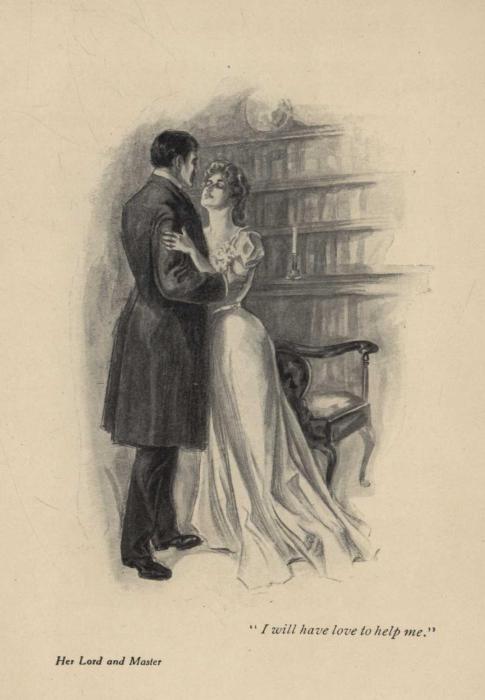
"I will have love to help me."
"No, and that's why you're very wrong in being so hard with me. I was good, wasn't I? For three months and then, when the folks rushed down on me, like a river breaking a dam, I broke out—that's all." She raised her arms, with a long, despairing sigh. "Thurston, if you will go away, may I stay with your mother?"
"Indiana, you don't know how I suffer—you cannot. As long as all the love is on my side, my wishes will be commands to you; my plans for your welfare and happiness—domination. There should be no such question between a man and wife who love each other. It could not have ended otherwise. A union without the sacred seal of love—is cursed." He went from her to the door, terribly agitated, wishing they could part finally, then and there, in order to spare himself the further torture of looking at Indiana with the thought that he had renounced her.
"Thurston, you'll shake hands with me—won't you?" she asked, imploringly, a look of terror dawning in her eyes. He extended his hand, with averted gaze. Indiana grasped it quickly, then held it for dear life. "You shall listen to me," she pleaded, in a voice vibrating with intense emotion, her breast heaving, her eyes dilating, until they looked almost black under the yellow hair. "I won't let you go until you've heard it. All my life I've queened it over people, delighting to feel my own power—to make the poor things who loved me bend to my will. Last night I saw the horror in your face when you turned from me—leaving me alone with my uncontrolled, undisciplined nature. Thurston, how could you expect me to be different? It wouldn't be natural if I were. I wanted to queen it over my husband—to be put up on a pedestal and worshipped. I thought it was enough if I let him love me—but I never knew it was better to love than to be loved, to serve than to be served." She looked into his face with piteous eyes, and said, in a low, frightened voice, "Thurston, take my two hands—hold them fast—while I step down from my throne—and then, when we stand together, side by side, I can whisper in your ear—I never could up there—that I love you."
"Indiana, for God's sake, don't play with me again!" he cried, passionately.
She drew his head down to her and kissed him. "Thurston, husband," she murmured, in a low, wondering voice, "I love you better than myself."
"Indiana!" He pressed her to his heart, with the feeling that they were on holy ground, even standing at the altar, and the sacred seal had just been set to their union.
Indiana raised her head, the tears trembling on her lashes. "I'll never break out again."
"Yes, you will, but next time I will have love to help me. Indiana, look at me—look at me. I cannot realize it—my wife loves me! Do you remember one day, in the Adirondacks, out on the lake, at that weird place called the Devil's Pulpit? I think—yes, it was the first day I spent with you—you wanted a story, and I gave you a part of my inmost life—do you remember?"
"Yes, I remember—how clearly I remember. The great, black rock hanging over us; the blue mountains in the distance; your voice, telling me of the weaver—"
"Indiana, his dream has come true—at last. 'And the web, transformed into a gleaming fabric of light, gladdened the soul of the weaver.'"
Indiana drew a little space away, quoting his own words, with uplifted hands, "'And as he wove he heard singing, a choir of beautiful, jubilant voices.'"
Thurston looked into her eyes, then held out his arms. "I hear them, Indiana!"
THE END.
* * * * * * * *
The Invaders
By JOHN LLOYD.
12mo; cloth; illustrated. $1.50.
The story is one of ranch life and of the troubles with the so-called cattle-thieves, which eventuated in one of the most dramatic incidents of the ever-dramatic West—the famous "Rustler War."
The cattlemen alleged that their fight was one against "Rustlers"; their opponents contended that they were but honest homesteaders, whose only crime was that of fencing in their possessions, thereby destroying the open range. Owen Wister's great story, "The Virginian," gives the cattlemen's side of the controversy; "The Invaders" is written from the opposing viewpoint.
Into this stirring history, the hero, John Thorpe, a tenderfoot, is precipitated, and it is his part in the struggle that furnishes the thread of the story. The love plot introduced early in the tale enlivens the story and sustains the reader's interest throughout.
* * * * *
Fanny Lambert
By HENRY DEVERE STACPOOLE.
Author of "The Crimson Azaleas," "The Blue Lagoon," etc., etc.
12mo; cloth. $1.50.
The two chief figures in this story are Fanny Lambert and her father, two entirely unconventional characters, delightfully simple and unworldly. The book is full of irresistably humorous touches, irresponsible fun being, in fact, its characteristic feature. The lesser figures, down to the merest thumbnail sketches, are all incisively drawn.
* * * * *
For Charles the Rover
By MAY WYNNE.
12mo, cloth $1.50
Author of "Henry of Navarre," etc., etc.
A rattling good story of love and intrigue in good old Ireland in the days and for the cause of Charles the Rover.
"Of all the days that's in the year
The tenth of June I love most dear,
When sweet white roses do appear
For sake of Charles the Rover.
"Our noble Ormond, he is drest,
A rose is glancing at his breast;
His famous hounds have doffed his crest,
White roses deck them over."
R. F. FENNO & CO., 18 East 17th St., N.Y.