Front matter (continued 2)
Reading edition
"There they go," said Indiana, waving her handkerchief. She then sat down on the dock, watching the boat grow smaller and smaller. The strains of the mandolin floated to them over the water.
"Indiana, you look as though you hadn't a friend left. If I thought as much of a person as that, I wouldn't let him out of my sight."
"Well, Grandma Chazy, Glen's my best friend."
"And look at your mother! She's actually crying."
"Well, I hated to see him going off like that—I—I'm so fond of him."
"Ma's a good soul," cried Indiana, jumping up and throwing herself into Mrs. Stillwater's arms. "Yes, she is."
"Well, I am not disputing that, Indiana."
"He was so set on going," said Mrs. Stillwater, holding Indiana to her. "I think it was because of those Englishmen. He don't like strangers."
"A pity about him," retorted Mrs. Bunker, sharply. "Does he want to monopolize Indiana altogether? He went because he might be of some use for once. He could have livened things up a little nights with his mandolin, but I wouldn't give him the satisfaction of saying so. Well, I'm just as well pleased. He might have been unmannerly or bearish."
"Not Glen!" said Indiana.
"Oh, Glen," repeated Mrs. Bunker, imitating her. Haller, who was washing out "The Indiana" and observing at the same time, gave vent to a long guffaw. Mrs. Bunker looked at him crossly. "I can't bear that Haller," she said, as they climbed up to the camp. "He's always making faces at me."
"When you think he's making faces, he's only smiling, I tell you," said Indiana. "He's a fine guide; what more do you want?"
"Wear your red dress to-night, Indiana," said Mrs. Bunker, ignoring this last remark.
"I think white is so much prettier for a young girl," suggested Mrs. Stillwater.
"Yes, that's the conventional thing," said Mrs. Bunker. "Well, let her look like a bread and butter miss—I have no objection."
"I don't want to look like a bread and butter miss," interrupted Indiana.
"Wear what your mother wishes, Indiana."
"Oh, I'm satisfied with anything," apologetically murmured Mrs. Stillwater. "Let the child please herself." She looked questioningly at her daughter. The latter, looking very self-important, declined to commit herself just then.
"Take your finger out of your mouth, Indiana," said Mrs. Bunker, sharply. "It's time you stopped that baby habit."
Indiana, whenever she was making a decision of any kind, still put her finger in her mouth as a help to thought.
Later, in her granddaughter's room, Mrs. Bunker said in the voice of an oracle. "Take my advice and wear your red silk, Indiana."
"He won't think it's loud?" asked Indiana.
"You're too much of a child to look loud in anything. But it will be so effective and a little audacious. That's what takes. He'll be sure to see you in that dress." And, as she went, she fired a last injunction, "wear your red silk; it'll hit him right in the eye."
CHAPTER VI.
Guests
Meanwhile the travellers were approaching their destination. They had compared the Hudson River with the Thames and the Rhine, and were now watching the forest tracts and the streams choked with logs awaiting the elements.
"Uncle Nelson," said Lord Canning, "this is the first time in my rememberance that I have visited people I did not know well, in a country I have never seen."
Lord Stafford glanced sleepily at his nephew from under his tweed travelling cap. They were in the smoking car. "There's a charm about everything fresh and new," he murmured. "That's what you're always saying, Thurston."
"There certainly is," said the other, eagerly. "I realize it in this fresh, young, healthy country. It has given me many new sensations. I felt quite old when I first came here—"
"Old!" repeated Lord Stafford. "You?"
"Just turned forty, my hair commencing to grey." Lord Canning laughed, and then sighed. "Yes," he continued, smoking thoughtfully, "there is nothing like fresh scenes. They give new food for the mind—another impetus to life—a man like myself needs such a stimulus—if I should continue to rust in England, I would shortly become—antiquated. Do you notice that the trees are for the most part conical in shape, Uncle Nelson?"
"You always were a restless character, Thurston."
"Nature designed me for an explorer."
"You'll never be satisfied until you undertake that expedition to the pole—"
"Never—unless—"
"Unless what?"
"A new interest should arise in my life—necessarily something very absorbing."
"I know of nothing, except—perhaps—a woman. And as for that, every mamma in England has despaired of you."
Lord Canning laughed heartily, and his uncle yawned and closed his eyes, considering he had satisfactorily disposed of the subject.
"We are strangers to our host," recommenced Lord Canning, after a short survey of the vanishing prospect. "The invitation was necessarily off-hand, but very hearty."
"They do everything in an off-hand way, over here," said Lord Stafford, "at least, so it seems to me."
"We have been travelling too much to judge very correctly of manners and customs," answered his nephew. "And have we met the entire family?"
"I believe so."
"Mrs. Bunker—"
"Mrs. Bunker!" exclaimed Lord Stafford, sitting up and rubbing his eyes. "Isn't she a lively woman?"
"Mr. and Mrs. Stillwater and daughter."
"The little girl," said Lord Stafford, sinking back on the cushions, "the little, blonde girl, who had plenty to say for herself."
"She did not really say so much," returned Lord Canning, taking out another cigar. "It was how she said it."
"Well, she conveyed the impression that she was not backward," remarked Lord Stafford.
"By the way, Uncle," the younger man lit his cigar, laughing amusedly. "Did I ever tell you of a peculiar dream I once had?"
"Dream?"
"About Miss Stillwater."
"Have you been dreaming about that little girl?"
"Didn't I tell you? I thought I had."
"Ha, ha, ha! You've been dreaming about little Miss Stillwater—that's rich."
"Well, wait until you hear it. Then you'll have good reason to laugh. It was quite too absurd."
"Well."
"The night before we started for the West—the night we met Mrs. Bunker at the Waldorf Hotel, in New York—"
"Mrs. Bunker—one never knows what that woman is going to say next—she is so—"
"She introduced us to the family, and Miss Stillwater and I had some conversation—not much, but quite enough, as you will see—about bears."
"Bears?"
"She had been used to shooting them, in the Rocky Mountains."
"The little girl—the blonde one?"
"The little blonde one," repeated Lord Canning, with a softer intonation. "Well, I dreamt I saw her riding on the back of a grizzly, over the highest peak of the Rocky Mountains. She was in full evening dress, and on seeing me, she hilariously waved a bunch of hyacinths—she carried those flowers the night I met her."
"Mrs. Bunker had carnations—I took one—ha, ha, ha!"
"I was on my knees examining strata. When I saw the lady riding towards me, I rose and bowed profoundly. But she returned my polite salute by throwing her bouquet directly in my face—I felt the blow, I smelt the hyacinths—then I awoke—before the lady apologized, allowing that she had that intention. It was all so absurd and incongruous, and yet so distinct. Miss Stillwater looked as natural as life, and sat the bear in such a graceful fashion—she might have been riding a finely bred horse in Hyde Park."
Lord Stafford, listening with closed eyes, made an articulate noise. Whether it was expressive of wonder, disbelief, or ridicule, it was difficult to say.
"But what I consider most remarkable, is that I saw the Rockies very much as I saw them in reality, later on. I explain this on the score of—suggestion. Miss Stillwater has spent some time in the Rockies. Naturally, our conversation recalled them to her mind, and she, of course, unconsciously suggested them to me. It was quite—psychic."
"Nightmare," murmured Lord Stafford, sleepily, "what did you eat for supper?"
"I don't know," said Lord Canning, disgustedly. "Don't attribute everything to what one eats."
"You will, when you're my age. Now it's 'suggestion', and 'quite psychic.' If that little, dainty, yellow-haired Miss Assurance had been an unattractive, elderly person, she wouldn't have suggested a pin's worth to you—beyond the fact that she was ugly. I must say, I never heard you go on like that before, Thurston."
"Go on like what?"
"Oh, about your dreams. Only old women tell their dreams. Ha, ha, ha!"
"You are quite mistaken, Uncle Nelson, dreams have been made the subject of scientific research."
"Oh, poppycock! You'll be telling fortunes in a tea cup next, ha, ha, ha!"
"I am glad you are amused, Uncle Nelson."
"I am—it's rich—ha, ha, ha, ha!—Ha, ha, ha, ha! Thurston, will you oblige me, and tell when there's anything to look at beside these interminable forests? I'm going to nap a little."
Lord Canning resumed his watch at the window. "Beautiful forests," he thought, "for the most part untouched and untrammelled. We seem to be plunging deeper and deeper into a virgin region. I feel strangely expectant, as though something were awaiting me there. Something that I have hitherto missed in my life—my sober, colorless life—awaiting me there. If I should tell Uncle Nelson this, he would ask me what I had eaten for lunch."
In a little while he became conscious that the train was slackening speed and felt the exhilaration, of most people, at the idea of being transported higher than the ordinary level.
"Uncle Nelson!"
"Yes."
"There is something else."
"What?"
"Clouds—ha, ha, ha, ha!"
Lord Stafford looked disgustedly out at the scurrying white masses.
"Do you want h'anything, your Lordship?"
"It's about time you showed up, Flash. Unstrap that plaid—it's beastly cold."
"It h'is, your Lordship—compared to the 'eat in New York," carefully tucking Lord Stafford into the plaid. Flash was a young fellow, of the ordinary English cockney type.
The train labored on painfully up into the heart of the mountains. Lord Stafford slept while his nephew smoked and mused, watching the clouds, barely perceptible now in the fading light.
They felt a jerk, the train stopped suddenly. Flash put his head in, "We're a h'our and a 'alf late, your Lordship. We won't h'arrive until h'eight o'clock."
"What an infernal nuisance."
"H'any h'orders, your Lordship?"
"Get out!"
When they finally arrived it was pitch black night, no moon nor stars. The rude little station was lit by torches flaming in the mist and wind. Beyond, impenetrable darkness. A storm was brewing over the mountains. Haller's face, as he greeted the travellers with one of his contortions, looked weird in the torchlight. They followed him out to the wagon, in which they sank with a sigh of relief. The trip, with the delay, had been tedious. Haller whipped the ponies up briskly. The wagon careered recklessly from side to side as they drove, and the wind drove the mist into their faces.
"I suppose you know your road, my good man?" said Lord Stafford.
"There's no risk of falling over a precipice or anything of that kind, is there? It's so confoundedly black."
Haller chuckled. "Them ponies know the're way—the've been bred up in these parts. I'd trust them sooner'n myself."
"Indeed!" said Lord Canning.
"Is this our destination?" asked Lord Stafford, as they stopped at the landing.
"Oh, we ain't no ways near thar yet," said Haller, with another chuckle. He raised a lantern and showed them "The Indiana" waiting at the dock, the lake lapping against her sides.
"Must we get in that?" said Stafford, peering out into the darkness of the lake.
"Waal, yes; if you want ter go to Camp Indiana. It's at the far end of the lake."
"Camp Indiana!" repeated Lord Canning to himself. "After her, of course. They have a curious faculty over here, of naming people after places and vice versa."
"What sort of a boat is this 'ere, my man?" asked Flash, after they were installed and on their way.
"Naptha launch."
"No danger of explosion?" he asked, cheerily.
"Waal, yer never can tell—yer never can tell."
Lord Canning laughed heartily. As they puffed along, the wind commenced to wail dismally, echoed by the mountains, until it seemed as though a pack of wild beasts were howling in the night. At intervals a camp fire enlivened the prospect, blazing cheerily down on the shore. The shadow-dance of the flames on the water, together with the outlines of human forms feeding the fire, produced a fantastic effect on the travellers. At Camp Indiana an enormous fire had been kindled to welcome the guests. The boat-house was lit up with different colored lanterns. Haller shouted as they passed in the dock, and was answered by William, who hurried down and assisted the disembarking. Haller, holding the lantern, lit them up to the camp. A flood of light streamed from the open door, in which Mrs. Bunker stood.
"Well, here you are at last—so glad to see you."
She shook hands with them vigorously.
"My man Flash," said Lord Stafford.
"Kitty, show Mr. Flash the gentlemen's rooms. What a nuisance the train was late. The world stops when one comes up here."
Mrs. Stillwater met them in the hall. "I'm so pleased you have come," she said in her soft gracious voice.
"Thank you, Mrs. Stillwater."
"How do you do, Lord Canning?" said Indiana with a hearty shake of the hand. "Too bad the train was late. It's what you must expect in these primitive parts."
Lord Canning looked about him, receiving the impression of warmth, light and luxury, but no sign of primitiveness. Coming out of the darkness and the wind, into the brilliant hall, he was a little dazzled, and for the moment was at a loss for something to say to Indiana. He stared at the brilliant little figure standing near the fire, the flames reflecting red lights from her dress on her laughing face and her yellow hair, with the Persian rug for a background. "An Arabian night's vision," he thought.
"It's a tedious trip," said Indiana. "You must be starved to death."
"I am so interested in my surroundings, that I can plead no sense of fatigue," answered Lord Canning.
"This is a jolly fire," said Lord Stafford. "It's like a glimpse of heaven here, after that awful black night."
Mrs. Bunker shortly led the way to the dining room, where a shaded red drop-light threw a rosy glow on the well-equipped table, upon which reposed a centrepiece of wild ferns. The easy, natural manner of the hostesses soon made their guests feel perfectly at home.
"Don't hesitate to smoke, gentlemen!" exclaimed Mrs. Bunker, after dinner. "This is Liberty Hall."
"We didn't expect this, Mrs. Bunker," said Lord Stafford, as they walked through the rooms, "when you invited us to 'rough it' with you in the woods."
"I assure you, Lord Stafford, that we consider this camping out," laughed Mrs. Bunker. "Now which chair are you going to take? This one is comfortable. Place it near the fire."
"Very artistic and most original," said Lord Canning, surveying his surroundings. "I have never seen anything like it."
There was a note of simplicity in all this luxury, even to the dress of the ladies, which struck him agreeably. Indiana sat in the midst of the group, talking and laughing unreservedly. Lord Canning, leaning back in a large armchair smoking his cigar, listened attentively, trying to find some clue to her character in the careless words. He finally realized this was foolish. She was evidently little more than a child, with no deep realization of life, as yet; a child with her own charm. There was no doubt of that. He gazed deeper and deeper into the fire.
"Lord Canning, you are so absorbed in the fire the rest of us might be jealous," said Indiana.
"There is no occasion for jealousy," he answered, looking directly at her. "But the fire is certainly fascinating—and productive of thought. I have a recollection of another, outside, which welcomed us very cheerfully, when we arrived. Is it still burning?"
"Oh yes," said Indiana, "our camp fire is still burning."
"I should like to see it, may I?"
"Certainly," said Indiana rising, "Lord Stafford, are you also curious?"
"Oh Miss Stillwater, I'm so comfortable, don't ask me to go out again! this is such a charming fire. Now Mrs. Bunker, let me poke it. This is the way we do it in England."
"Run along, Indiana," said Mrs. Bunker, sweetly.
Without, the night was still black, but the storm had not yet broken. The fire down on the shore lit up the lake and the boat-house. Haller and William were throwing on logs, and in the red glare Kitty could be seen standing, talking volubly to Flash, who listened with deferential interest.
"The boat-house looks very pretty in this light," said Lord Canning.
"There's such a cozy room in it with a fire," asserted Indiana. "We've had rare, old times there. We go down nights, and make things in chafing dishes."
"What a novel idea! And is there a fire burning there now?"
"Oh, yes! The guides keep the fires always going—when it's cold."
"I should like to see this cozy room, where you make things in chafing dishes. May I?"
"Certainly. Be careful, Lord Canning! It's pitch dark, and you don't know the way! There! I knew you'd stumble—you'd better take my hand."
"I—I really think I had better," said Lord Canning, helplessly.
CHAPTER VII.
The Weaver
The storm spent its full force in the night. The wind raged in the clearings and upon the lakes. But Camp Indiana, sheltered by the woods, heard nothing of the angry elements beyond the continuous sighing of the trees, which, when the wind was most fierce, grew into a painful sobbing whisper. The pines of the North Woods sing varied harmonies, always in a minor key; sometimes, it is a sacred anthem, sometimes a tragic prophecy, sometimes a death chant and sometimes a sad lullaby, such as a bereaved wife might croon to her child.
When the guests emerged upon the balcony in the morning the clouds still shrouded the mountains and the lake. There was nothing to be seen but a white mist.
"We are literally in the clouds," said Lord Canning pacing the balcony. "But what a soft rare air, and that strong odor of pine; it is most exhilarating." He drew a deep breath.
"What a magnificent tree," said Lord Stafford. "They've built it into the balcony. Look, Thurston! Isn't that a unique idea?" He bent over until his body was half in the tree. "By George, there's a chipmunk!"
"Balsam!" exclaimed Lord Canning, examining a branch. He ascended the steps looking up at the tree. "Magnificent! A natural ornament! What a novel thought to make it a part of the house. I am reminded of the roof-tree of olden times, Uncle Nelson."
"Quite so!" said Lord Stafford.
"Look!" continued his nephew. "The clouds are rising—slowly. There is the lake! How blue, and what beautiful slopes—how rich in foliage. Such a contrast in greens; the vivid emerald of the maple trees, with the dark shade of the hemlock and other pine varieties—there is no green like theirs—and that faint, very faint touch of red, here and there—a foretaste of Autumn. Look at those wild crags, with the trees rooted in their clefts! This is a panorama of clouds. How systematically they rise, one veil after the other. The mountains are just becoming perceptible—do you see their shadowy outline behind that last thin veil? It is rising—slowly—slowly. Little fragments of mist are floating everywhere. Upon my word, it is quite unreal—like a dream scene."
"Ha, ha, ha! I'd advise you not to broach the subject of dreams again."
"Charming! The dark, rich blue of those mountains, with the little mists curling upon them, here and there. That low cloud on the lake here, has remained stationary. Ah, now it is rising. Uncle Nelson, do you see anything?"
Lord Canning had suddenly discerned in the mist, the phantom outline of a female figure kneeling in a canoe.
"Yes, by George! Do you think it could be a peculiar form taken by the mist?"
"Either that—or—it might be the spirit of some unhappy Indian maiden, a heroine of one of the legends of this region. Ah, the sun is coming out—now we shall see her disappear!"
On the contrary, the sun striking through the mist revealed Indiana paddling a red canoe. Bareheaded, the sleeves of her red blouse rolled above the elbow, the sun caught her in a sudden flash of scarlet and gold, so that she seemed an apotheosis in the cloud, of Lord Canning's Indian maiden.
"It's Miss Stillwater!" cried his uncle. "Ha, ha, ha—you with your dreams and your Indian maidens."
Lord Canning rubbed his eyes, watching Indiana paddle toward the boathouse with swift, unerring strokes. "Let us go down and meet her!" he said.
"Good morning, gentlemen!" exclaimed Mrs. Bunker, joining them, as they descended. "How did you sleep last night?"
"Extremely well, thank you, my dear lady," answered Lord Stafford. "I cannot speak for my nephew, he is addicted to dreams. Ha, ha, ha. That sort of sleeper is always rather restless. Don't you think so, Mrs. Bunker?"
"This," said Lord Canning, indicating the prospect, "is very charming, quite unique in its way. I really cannot remember seeing anything like it."
Lord Stafford slipped. "Be careful, Lord Stafford. It's the pine needles. They fall year after year. You see how soft and yielding they make the ground. But it's slippery on an incline."
They reached the boat-house in time to see Indiana jump from her canoe.
"An extremely picturesque little craft," said Lord Canning, after they had exchanged the morning greetings.
"Birch bark," said Indiana. "There's another here."
"Ah, a white one. But this red canoe is very effective on the lake. We were quite startled, when you first appeared. Were we not, Uncle?"
"Ha, ha, ha, ha. My nephew thought you were the spirit of some Indian maiden, who had died a tragic death."
"You glided out of the mist in such a wraith-like fashion," said Lord Canning.
"There was an Indian maiden"—
"Oh, keep those ghost stories for the camp fire, Indiana! Before breakfast is no time for them."
"Don't forget, please, Miss Stillwater!" said Lord Canning. "Positively at the camp fire to-night."
"At the camp fire to-night," repeated Indiana, in a tragic voice.
"Oh, Indiana can tell you any number of legends about these parts. She picks them up from the guides," said Mrs. Bunker.
"I am always interested in the legends of a country. There is so much to be gleaned from them."
"Exactly, Lord Canning," said Mrs. Bunker. "That's what I think."
"I shall look forward to hearing them all, Miss Stillwater," said Lord Canning, "by the camp fire of course. Every night a story."
"Like Scheherezade in the Arabian Nights," said Indiana, "amusing the sultan to save her head."
"Ha, ha, ha, ha. Quite so, Miss Stillwater," laughed Lord Canning.
"But I don't think my stories would last a hundred and one nights, Lord Canning," replied Indiana, putting her hands behind her back, and meeting his persistent gaze mischievously.
"Too bad," he answered, contemplatively. "I should hate to cut off that head. Don't you know anything else appropriate for a camp fire, which might serve to amuse me, and prolong your life. Can you tell fortunes?"
"Oh, Indiana's great at that!" said Mrs. Bunker.
"Good—by cards or consulting the palm?"
"Both!" said Indiana promptly. "Learned it from the girls at school. I can also tell your fortune in a tea cup."
"Indeed, you must initiate me."
"Ha, ha, ha, ha—I prophesied you'd come to it—telling fortunes in a tea cup. That's rich. Mrs. Bunker, I'll explain to you—later!"
"What does he mean?" asked Indiana.
"I'll tell you by the camp fire, Miss Stillwater. Can you interpret dreams?"
Lord Stafford laughed with intense enjoyment.
"I have a dream book, I'll study it up."
"Well, in view of your many accomplishments, your head will be quite safe."
"How about yours?" she said, shyly, bending down to take her jacket from the canoe.
"Ha, ha, ha! Quite so, Miss Stillwater."
"I'm not sure about mine," he answered, smiling.
"And if you lose it?"
"The Sultan will meet his fate philosophically, repeating, 'Kismet, and Allah is wise, saith the Prophet.'"
"Breakfast is served," exclaimed Kitty, running breathlessly into the boat-house.
"You must be hungry," said Mrs. Bunker. "You were up so early. Indiana rises at an unearthly hour, here. She's on the lake at six, sometimes."
"Do not be surprised if you should see me also at that unearthly hour, Miss Stillwater. I, too, have a passion for early rising, in a place like this! There are some beautiful boats here!"
"Yes, this is a St. Lawrence. I always take ma out in that. She likes it, because it's steady. But it don't run like this one—this is my pet. A real Adirondack cedar wood."
"Indiana," read Lord Canning. "Everything here is named after you. You're the prevailing spirit of the place. Will you take me out on the lake after breakfast, and teach me how to manage an Adirondack boat?"
"This is a dangerous lake, Lord Canning," said Mrs. Bunker. "You wouldn't think so, to look at it now."
Lord Canning turned and glanced at the beautiful vista of the lake, sparkling, blue and serene, between the mountains.
"A squall can come up, any minute—a regular tornado—and blow you and your shell of a boat to Jericho."
"And what would you do, Miss Stillwater," asked Lord Canning, in visible alarm, "if you were out in your little canoe, and were caught in one of these sudden squalls?"
"Head for the shore. Besides, I'm a swimmer."
"Are you?" She looked very young to him, standing there in her little, short skirt and loose blouse, her hair blowing about in the breeze, which came freshly over the lake. Younger, even, than when he had first seen her.
"Now, Lord Stafford," said Mrs. Bunker, after breakfast. "You, my daughter, and myself, will take a trip in 'The Indiana.' The horses will be waiting at the landing, and after we have explored the lake, I think we'll have time for a short drive. Will that program suit you?"
"Ha, ha, ha! Everything that you arrange is bound to be delightful, Mrs. Bunker."
"We'll leave the young people to their own devices. Lord Canning is so bent on learning to row an Adirondack boat."
"Ha, ha, ha! Yes, Mrs. Bunker."
"It's a dangerous lake, Lord Stafford—I warned him."
"You did, Mrs. Bunker—your conscience can rest easily."
"I feel I'm taking an advantage, Miss Stillwater," said Lord Canning, lounging comfortably in the bow of Indiana's pet boat, "to sit here and let you do all the work. Let me take the oars. I have been watching you closely—I think you can trust me."
"Sit down!" commanded Indiana.
"Dear me, what have I done?"
"You can't change places in an Adirondack boat, in the middle of the lake. It would tip over, and we'd both flop in." She laughed merrily.
"Her laugh has the vital ring of youth," thought Lord Canning. "I might learn to laugh like that again, if she would teach me—"
"Glen and I have often tried it, just for devilment, but then Glen is more used to these boats than you, Lord Canning—"
"Glen!"
"Oh, I forgot. I think everyone knows Glen—everyone does in America, who happens to know us. He's one of the family."
"A relative?"
"No!"
"Not a relative, and one of the family," thought Lord Canning. "Young, old or middle aged?"
"Glen's only twenty-four and handsome as a picture."
"Only twenty-four, and handsome as a picture," thought Lord Canning.
"Wouldn't you like to smoke, Lord Canning?"
"There's something of the witch about you, Miss Stillwater. That's just what I'm longing to do. You are sure you don't mind?"
Indiana shook her head. Her cheeks were glowing, her eyes sparkling from the exercise.
"That's very good of you, Miss Stillwater." He lit his cigar leisurely, then leaned back with a long sigh of content. "You're a splendid oarswoman, Miss Stillwater; such long, graceful strokes. That splash of color here and there in the woods—it's most effective—especially, when it's reflected in the lake—like this branch—look—we are just nearing it—how gracefully it droops over the water. It's most delightful here—near the shore—let us linger a little while—do you mind? There's no occasion for this terrific speed, is there? That's better—now we are merely gliding. Lean back, Miss Stillwater! Won't you have this pillow? Are you quite comfortable? Are you sure you are quite comfortable? These Adirondack oars are very convenient—just let them swing—I see—and take them up when you are ready. A stroke or two, now and then, will be quite sufficient to send us along—not yet—don't disturb yourself. No, we will not run into anything—I'll see to that—you look very nice lying there. The water is like a perfect mirror here, under the trees—every leaf and twig is reflected—beautiful—so restful—I could drift like this—"
"I thought so," cried Indiana jumping up.
"Dear me, what is the matter?"
"We're caught in a tree!"
"Why so we are—be careful—that branch will strike your face—I think I can reach it—a most obstinate branch—it persists in bending your way. Well, I can't blame it—there—how ever did this occur?"
"Why—you insisted on my leaving everything to you—I yielded from pure amiability—but I foresaw what would happen, because you hadn't the slightest idea where you were drifting."
"But I know quite well, where I'm drifting—"
"Then how were we caught in this tree?"
"Ah, that's another story—"
"You were certainly not looking ahead."
"Then where was I looking? You ought to know."
"You were lying back with your hands clasped behind your head, saying, 'I could go on like this forever,' or something to that effect, and we went plump into the tree."
"Poor Miss Stillwater—I'm a great trial—you'll never take me out again, will you?"
"Well, I won't say that—"
"I'm so glad you didn't. I think it's rather a novel sensation to be caught in a tree."
"Everything is a sensation to you, Lord Canning."
"Ha, ha, ha, ha. When you are my age, Miss Stillwater, you will also appreciate a new sensation. May I ask the object of those violent efforts?"
"Lord Canning—do you realize you're on the tree as well as in it. There's an immense branch extending under the water, and with our combined weight we won't get off in a hurry."
"Where is the hurry—there are no trains to be caught, I believe."
"Yes, but I wanted to show you the lake this morning—that would be something. There is so much for you to do and see."
"Restless little American spirit," said Lord Canning. "Now if you will hand me that oar—although I appreciate your anxiety to show me everything without delay—I, with my slow English methods—prefer to take things by degrees—if you have no objection, Miss Stillwater; I am enjoying this immensely."
"Really," said Indiana doubtfully.
"I give you my word. Now let me have things my own way. There's no necessity to show me the whole lake at once. I would rather prolong the pleasure—"
"We're off!"
"Slowly, Miss Stillwater! we're drifting once more. Ah, look at this giant rock looming above us; how dark and grim—"
"That's called the 'Devil's Pulpit.' The water right here is five hundred feet deep."
"And a moment ago it was quite shallow. How black and impenetrable—'The Devil's Pulpit.' I think I can sniff an odor of sulphur. Five hundred feet deep. How quickly the shallows change to the depths—how quickly—don't hurry—what a gruesome spot. Just the place for a ghost story—that Indian maiden we were talking of this morning—will she do?"
"Well, there was a certain tribe—"
"Pardon me, Miss Stillwater. I forgot that story had already been reserved for the camp fire. Everything in its place."
"How systematic—"
"I don't believe in taking all the good things at once, like a greedy child—besides, poor Scheherezade's head is at stake! I would not deprive her of one night's respite—"
"Suppose you tell me a story, Lord Canning—one of your adventures. You have travelled so much, you must have had a very interesting life."
"Interesting in one way—barren in another. Don't lean over like that, please."
"Your uncle says you have a passion for exploring."
"Yes. I suppose it has never occurred to you, Miss Stillwater, that this passion for exploring, in a man of my settled years—Miss Stillwater, I beg of you to be careful, remember it is five hundred feet. This passion for exploring might exist only for want of another interest—a dear and sacred interest—most men of my age possess. Life has withheld from me, so far—it's most precious gift. I shall hold it the sweeter when bestowed. Do you find it interesting to peer into the depths, Miss Stillwater?"
"Very! They say—"
"Yes, what do they say?"
"That if you look into them long enough, here at the Devil's Pulpit, you are seized with an impulse to throw yourself in."
"Dear me; well, I have no fear for you at present. But I shall take care you do not come here unaccompanied. What you have told me, however, is a fact which has been often proved. Whether it is a rocky precipice, five hundred feet of water, or a human soul—the depths have a dangerous fascination. Are you afraid, Miss Stillwater? Don't you wish to leave this dangerous spot?"
"I want my story, first."
"You will persist in peering into the depths—beware of them!"
"I'm not afraid."
"No, I don't think you are."
"Well, the story."
"Ah, yes—the story—you're in the mood to listen?"
"Yes, yes. Is it to be one of your adventures?"
"Not exactly. I'm not in the mood to relate an adventure. That will keep for another time. This is a charmed spot, you see—as its name would denote—a spell has been laid on me, in the shadow of this rock, and I am obliged to speak the words that come into my head."
"Then I won't consider you responsible."
"No—not here." Lord Canning folded his arms and gazed down into the impenetrable depths. "There was once a weaver. He wove a dull, gray woof—always the same gray woof. Sometimes, he would look up at the rich blue of the morning sky, then go on weaving his gray web. Sometimes, he would glance at the sunset, and marvel at the gorgeous hues of the clouds—but there was never a gleam of color in the web, that he wove—it was always the same, dull gray. Sometimes, the laughing face of a child would peep into his—and he would gaze longingly back—yearning to snatch the blue of the eyes, the gold of the hair—for that colorless web which Fate had set him to weave. Once he dreamed that a sudden burst of sunlight streamed upon him, as he sat at his loom. He put up his hand and drew down the rays one after the other, weaving them into his work. And as he wove, he heard singing—a choir of beautiful, jubilant voices. The web, transformed into a gleaming fabric of light, gladdened the soul of the weaver. Then he awoke, and saw the dull, gray woof in the loom. He went on, patiently weaving the web which Fate had given him. But his soul cherishes the hope—that some day, perhaps, his dream will come true."
CHAPTER VIII.
The World's Rest
Indiana lay back with closed eyes. Lord Canning's deep, well-modulated voice, soothing her alert faculties into a dream of consciousness. He looked at her as he concluded. The innocence of her face, with its closed eyelids, appealed to him. She looked very childish, lying at the foot of the giant rock. Without any comment, she looked out on the lake. He lit a cigar and smoked it in silence. Both were thinking of the weaver.
"Did you feel that icy breath from the rock, Miss Stillwater?"
Indiana laughed. "We come for that on hot days, and lie in the shade and read. It's always cool here."
"Who is 'we'—may I ask?"
"Glen and I."
"Glen again," thought Lord Canning. "I have an absurd feeling against another having been here with her—another, who is only twenty-four and handsome as a picture—"
Indiana commenced to row.
"Going? Perhaps you are right—this is a dangerous spot."
"People are not so carried away with the Adirondacks at first," ventured Indiana. "But they grow on them after a while."
"Yes," said Lord Canning, studying her attentively. "I find a great many things grow on me in this part of the world. Why do you laugh, Miss Stillwater? Have I said anything amusing? I should like to learn how to laugh like that. Will you teach me?"
Indiana laughed again.
"May I have the first lesson now?"
"Oh, I can't give you any lessons—you must just listen, that's all."
"I see—just listen. It is shallow again—what a beautiful white, sandy bed—how restlessly the minnows dart—here and there—backwards and forwards. They symbolize the activity of your nation, Miss Stillwater. Oh, what a cunning little stair-case cut in the rock—it looks so inviting—I should like to get off and climb it, and sit up there in the trees—may I?"
"No," said Indiana, "there are so many other pretty places, I want to show you."
"But I have a fancy for this—obduracy itself. Well, will you promise to take me here again another day—do promise!"
"I promise," said Indiana.
The sun was long past its meridian, when they reached home. Mrs. Bunker, her daughter and Lord Stafford, were watching from the boat-house balcony. Lord Canning was rowing, without a coat, bareheaded. Indiana, comfortably ensconced in pillows opposite, was employed in spattering water over his face, regardless of his laughing remonstrances. Their voices—Indiana's high-pitched but sweet, mingled with Lord Canning's deep tones—were carried by the clear air over the water.
"Allow me to thank you for a delightful morning, Miss Stillwater," said Lord Canning, ceremoniously, as he helped her from the boat. He stood looking looking back on the lake.
"Are you coming, Lord Canning?" asked Indiana, her foot on the little rustic staircase leading from the dock up into the boat-house.
"One moment, if you please," said Lord Canning, still looking at the lake. "I want to fix firmly in my mind all the details of this delightful morning."
"How slow these Englishmen are," thought Indiana, "and yet—"
"You naughty child," said Mrs. Bunker, beaming on Indiana. "Do you know it's almost two o'clock! Lord Stafford is starving."
"And your mamma is 'worried to death about you,'" said Lord Stafford. "Ha, ha, ha, ha! How am I getting on, Mrs. Bunker?"
"Bravo, Lord Stafford, you are an apt pupil."
"Blame Lord Canning," said Indiana. "He does not like to hurry."
"No, indeed," added Lord Canning in an injured tone.
"He would insist on going in and out all the nooks along the shore."
"Yes, indeed," asserted Lord Canning.
"He persisted in exploring everything. He has such a thirst for information—"
"Naturally," interrupted Lord Canning.
"And of course, when he took the oars, I was powerless. I'm thankful we're home this early."
They all climbed slowly up to the camp.
"Won't you take my arm, Mrs. Stillwater? Your daughter has forbidden me to wear a hat, and has been throwing water on me in the sun, as she wishes me to acquire a certain reddish shade of tan, which prevails here, and which your two guides possess to an enviable degree. She was quite impervious to all my scolding."
"Oh, Indiana always has her own way, Lord Canning."
"Evidently. I was almost obliged to take the oars by force. She wished to row the entire morning, and I thought that was entirely too much."
"Indiana will never give in that she's tired. When she was a child she was the same. She'd play until she dropped asleep on the ground from sheer exhaustion."
"Indeed," said Lord Canning. "Then I was quite right. But we had a very exciting argument—it almost caused a quarrel—and I rather congratulated myself we were in such an isolated spot. I don't wish to convey that Miss Stillwater actually lost her temper—"
"Indiana," interrupted Mrs. Stillwater, reprovingly.
"What do you young folks propose to do this afternoon?" inquired Mrs. Bunker.
"Lord Canning is very anxious to see the Notch," said Indiana. "I thought I'd drive you all over there."
"Your daughter has been describing certain falls, Mrs. Stillwater, whose tremendous power have worn a gorge in the rock, and which supply water-power for this entire region. Most interesting—"
"Oh, a very picturesque spot." said Mrs. Bunker. "Lord Stafford, I'm sure you'll be charmed with it. We must start immediately after lunch—it's a long drive."
"And if Miss Stillwater is to drive, I'm afraid she will be taxing herself too much, after rowing the greater part of the morning."
"Oh, Indiana likes to be always on the go," said Mrs. Stillwater. "I'm afraid she'll wear herself out some day."
"Nonsense, Mary," exclaimed Mrs. Bunker, sharply, "she's as strong as a horse."
"Your granddaughter is athletic," said Lord Canning, "but of a very slender build. It is her nervous activity that keeps her up, rather than strength. On the whole, I prescribe rest this afternoon."
"Then, Indiana," said Mrs. Bunker mildly, "you could show Lord Canning that cunning little brook in the woods, back there—"
"I dearly love little brooks in the woods," said Lord Canning.
"Oh, I can show him that any time," said Indiana, "before breakfast."
"Shall we say to-morrow, before breakfast—can I depend on that?"
"Yes. And this afternoon we'll drive to the High Falls," replied Indiana.
They were still at the table when Haller presented himself. "Be yer goin' ter drive ter the Notch this afternoon? If ye be, it's nigh on ter three o'clock. Yer can't get back fore dark. William's waitin' at the landin'." Mrs. Bunker rose precipitately.
"Get ready, Indiana!"
"I insist on Miss Stillwater resting for ten minutes at least. Don't you agree with me, Mrs. Stillwater?"
"Yes, indeed, Lord Canning. But I can never force Indiana to lie down."
"Well, I will endeavor to see what I can do."
"You will be accomplishing wonders if you can persuade Indiana to do any thing against her will."
"Come, Miss Stillwater. There's a hammock out on the balcony—waiting for you."
"But I must get ready for the drive, Lord Canning."
"Now let me have my way, Miss Stillwater. Ten minutes, more or less, does not count. I don't approve of this rush after meals. This is a wonderful hammock—so comfortable—different from most hammocks. I tried it this morning—simply a piece of canvas stretched flat. I shall take it in my head to sleep out here one fine night. Are you comfortable? Now, Miss Stillwater, you have been very good to take this rest, and I am deeply indebted to you. I shall be still more so if you will try to forget the fact that you are going anywhere. Simply make your mind blank; now, don't raise your head and look at me like that. I mean it—make your mind a blank. Is it impossible for you to keep your eyes shut, Miss Stillwater? Not even for ten minutes—in truth, only eight now. I have a pocket Tennyson—I will read you a few extracts; I always carry some literature about me. In travelling among so many shifting scenes, a thought now and then from a great mind goes largely toward establishing one's equilibrium. By the way, I had this Tennyson with me this morning. I might have read to you on the lake. Still, we did not feel the want of it, did we? Time passed so quickly—almost too quickly. Dear me! 'In Memoriam' is my favorite poem—which is yours, Miss Stillwater?"
"Mine," said Indiana, dreamily. "Let me see—'Evangeline' is very beautiful."
"A charming pastoral—I suppose it would be the favorite poem of a young girl who knows nothing of life—"
Indiana sat up suddenly in the hammock.
"You make a great mistake, Lord Canning. I have travelled all over the United States. I have come in contact with the world. I have a very shrewd idea of life—"
"Lie down, Miss Stillwater, please. That was a very unhappy remark of mine. So you have a very shrewd idea of life. I'm obliged to take your word for it—but, pardon me, you look very young for a person who has such a profound knowledge of the world. Now, don't talk back at me—remember, you are resting. Please shut your eyes—shut them—it's only three minutes now. I forbid you to open them again. Returning to our original subject—'In Memoriam' embodies a philosophy which appeals to me. We must read it together. I suppose you have not given it especial study?"
"No."
"I think such a poem should be read with someone else. I am very familiar with it. I may be able to throw a light on passages that may appear obscure to you, and, perhaps, ultimately succeed in imbuing you with my own love for it. This—
'Oh, yet we trust that somehow good,
Will be the final goal of all—'"
"Indiana," called Mrs. Bunker.
She sprung from the hammock.
"Dear me! it isn't—yes, it is—eleven minutes and a half." "Provoking," thought Lord Canning, as Indiana disappeared. "I don't seem to have any time alone with her."
He very soon found himself in the little naptha launch, 'Indiana,' with the rest of the party.
"Isn't this jolly?" said Lord Stafford. "We seem to be always on the go, here."
"Indeed, I'm not going to let you stagnate," replied Mrs. Bunker. "There's a different place to see every day, and when you've seen everything the hunting will commence."
"We couldn't have a nicer day for a drive," remarked Mrs. Stillwater. "It has rained all night, and there won't be any dust."
"Oh, if a storm don't come up while we're out," said Mrs. Bunker. "You never can tell what's behind these mountains. They're always brewing something. Don't you ever let Indiana get you out in that sail-boat—while I think of it, Lord Canning."
"No, Mrs. Bunker, I will not let her get me out in that sail-boat. There, I put my foot down."
"Yes, you will," said Indiana, propping her chin on her hand, "won't you?"
Lord Canning smiled back into her eyes. "Well, perhaps," he said.
"There!" exclaimed Mrs. Bunker. "Indiana makes everyone do as she wishes."
"Have you your Tennyson here, Lord Canning? I should like to look through it."
He gave it to her, and then two heads were soon bent, in a discussion, over the book. Lord Canning started, when they reached their destination, and Haller gave a spring to the dock.
"Already," closing the book, "this has been most interesting, Miss Stillwater. You have a very clear and fresh conception. It's a great pleasure to read with you."
"Oh, Indiana has always distinguished herself in her studies," said Mrs. Stillwater.
"I can believe that," said Lord Canning.
As the ponies sped along with their swift, firm trot, Indiana explained to him the different points of interest in the country.
"Why, Indiana, you're taking the old road—that's the longest," as she made a sudden turn from the highway.
"And the prettiest, Grandma Chazy."
"Well, do as you like. We'll never get home."
"Thinking of home already, Mrs. Bunker. We're just started. This is awfully jolly."
"Well, we'll see how jolly you'll think it, Lord Stafford, when you're kept till nearly nine for your dinner."
"Dear me, is it so serious as that?"
"We follow this all the way," said Indiana, pointing to the narrow stream on whose banks they were driving.
"Charming to hear, that delightful gurgle. I am so fond of the sound of water!"
"A very narrow path," said Lord Stafford, peering over the banks. "One lurch to the right, and we're over."
"The banks are propped with logs," explained Mrs. Bunker. "That is done every spring. The force of the water in winter breaks them down. They're none too safe now, I believe. But Indiana would take this old road!"
"I am so glad you did," murmured Lord Canning. "The continuous perspective of this winding stream is charming."
As they drove on they were surprised now and then by little green islands, very small, sometimes merely clumps of trees.
"Mysterious little islands," said Lord Canning. "So lonely, set here and there in the stream, like little green shrines, for those who wish to pray."
"You have more imagination than many would credit you with, Lord Canning."
"I am not understood by many—I would not care to be—"
"Do be careful, Indiana," said Mrs. Stillwater, as they bounded over a frail bridge built on logs.
"Have no fear, Mrs. Stillwater. Your daughter is managing these ponies admirably—" he added to Indiana—"with those small hands. May I relieve you presently?"
"Thank you—I am not tired. I should fear to trust you. One must know the roads."
Gradually the low musical gurgle of the stream deepened into a more significant undertone. Indiana made a sudden cut to the left and turned out, after crossing a bridge, on another narrow road overlooking a deep ravine. From its depths they still heard the voice of the stream, growing into an angry murmur. After a while, on the right, rose a high, craggy mountain-wall, with sparse foliage growing in its crannies.
Lord Stafford peered down into the ravine. "What a wicked looking place. We're quite on the edge, Miss Stillwater. Our lives are in your hands—and that terrible mountain on the right."
"It shadows us like fate," said Lord Canning.
"There is a mysterious voice warning us from the ravine. Remember, that was once the low cooing murmur of a placid stream."
"There's a lesson in that," said Mrs. Bunker. "Never trust a woman with a soft cooing voice."
"Ha, ha, ha, ha! Quite so, Mrs. Bunker."
"What a sudden change," remarked Lord Canning, "from a fairy pastoral to this mysterious wilderness. Are these sudden changes common to the country?"
"Common to the country—and the women," replied Indiana, laughing.
"Quite so, Miss Stillwater," said Lord Stafford. "You know Pope's familiar couplet—
Women like variegated tulips show,
'Tis to their changes, half their charms they owe.'"
"Do you echo that sentiment, Lord Stafford," asked Mrs. Bunker, archly.
"Well, really, that's a difficult question, Mrs. Bunker. One is bored by monotony, of course—but sometimes these sudden changes can be deucedly unpleasant—ha, ha, ha, ha!"
"There is the river," explained Indiana, pointing to a black rushing current, murmuring angrily below them. They watched it for a mile, sometimes writhing slowly in its rocky bed, like a long black snake, while the angry murmur grew faint and then rose again as the water rushed on with renewed power, frothing madly over the holders and rocks which barred its progress. Suddenly before them rose the blue, distant peak of one of the giant mountains.
"You wish to climb all the mountains?" inquired Indiana. "This will be the first—it is the nearest. I have climbed it." Lord Canning surveyed it with interest.
"And will you climb it with me again?"
"I suppose so. I climb it every year. It's only four miles from our camp to the trail."
"Always driving with this blue peak before us," remarked Lord Canning, after a while, "reminds me of the high aims we set for ourselves, and which we never seem to reach—the ideal of the true artist which he despairs of ever attaining—but, still, his eyes fixed on that pale blue peak of perfection in the sky, he forgets the bitter materialisms of life."
Indiana bent down and gazed at the dark current.
"Do not look down, Miss Stillwater. That is the river of Biting Reality. Close your ears to its threatening murmur—gaze with me before us. I am under the delusion that I have discovered this region. Naturally, I wish to christen everything myself. I would make that distant peak—"
"It is called—"
"Now, Miss Stillwater, I do not wish to know—I will christen it—humor me—I am one of those harmlessly insane people with one delusion. I name that peak the Mount of Perfection. You said you would climb it with me. It is a very arduous ascent, and you are young and 'frail.'" He looked down into the laughing eyes. "But when two climb together the stronger helps the weaker. All I ask—"
"Yes," said Indiana.
"Is that once in awhile you will smile up at me—as we climb—in order that I shall know you are not tired."
"I will smile," said Indiana. "That is not much to ask—"
"Ah, but will you smile brightly, so that I may know you have not lost courage; will you smile trustfully, so that I may feel you have implicit faith in any way I choose to lead—will you? Ah, well, I won't say any more—"
"Listen," interrupted Indiana. Far away he heard a faint roar. "The Falls."
"I will christen them later. That distant sound is very fascinating. I really cannot say yet what it conveys to me. But these falls are the culmination of the river—they typify some crisis in life—some great emotion into which all others are submerged."
He leaned back, with folded arms, watching the dense woods which had replaced the craggy mountain-wall, and listening to the growing roar of the falls. The air here was laden with balsam. Sometimes an icy breath from the deep woods, into which no sun could penetrate, fanned their faces.
"I have not yet named the lake on which we spent this forenoon. I hereby christen it Lake Dangerous, as a warning to those who might be deceived by its apparent harmlessness. All ye unwary ones, take heed of sudden storms, deceiving shallows, unfathomable depths, and certain rocky places, where supernatural powers are at work to steal the precious secret of the soul!"
At this dramatic proclamation Indiana gave vent to a ringing peal of laughter.
"What's the joke, Indiana?" called Mrs. Bunker.
"Oh, Lord Canning is talking the greatest amount of nonsense."
"Your nephew isn't near as serious as when I met him at Cannes," observed Mrs. Bunker. "Indiana brightens everybody up."
"Quite so, Mrs. Bunker. Now hadn't you better use your arts to brighten me up?"
"What have I been doing all this time? Wasting my sweetness, I see."
"Ha, ha, ha, ha! yes, Mrs. Bunker. You had better commence all over again."
As they drove on the sound of the falls grew into a loud roar. Miniature rapids could be seen, now and then, as the river emptied itself into small rocky basins, then plunged onward. Finally, Indiana slackened pace at a rustic bridge, where they alighted. This bridge led by short flights of steps to other ascending bridges spanning the falls.
"I'll sit down by the water," said Mrs. Stillwater. "I don't like to cross the falls. They make me giddy."
They saw her comfortably installed on a large boulder beneath a tree, near a spot where the river wandered off in a placid mood. Then they climbed the frail stairs leading to the different bridges, pausing at each to gaze closer at the fierce rush of the waters.
"What a wild, dark glen!" exclaimed Lord Canning, looking about him, as they reached the last bridge. "Those majestic pines stand like sentinels watching the falls." He gazed down into the enormous gorge called The Notch, into which the falls dashed, with a deafening sound, sending up a blinding shower of spray. "How the water seethes and boils and bubbles! It is like a gigantic cauldron. Magnificent for witches! What poisons, what love-potions and charms they could brew down there! Just the place for a conjuration!"
"You'd say that if you saw the place by moonlight. It looks simply unearthly."
"I should love to see it by moonlight. May I?" He looked pleadingly at Indiana.
"Well," she said, meditatively.
"Certainly," interrupted Mrs. Bunker. "We'll have a moonlight picnic, just as soon as there is a moon. Probably my son will be here then."
"My handkerchief is quite wet," said Lord Stafford, wiping the spray from his face.
"Take mine," offered Mrs. Bunker, holding up a wet morsel.
"Oh, my dear lady, of what use would that be?"
"I love the spray," remarked Indiana, taking off her hat and leaning over.
"Indiana, stop that! Lord Canning, will you hold her?"
"Allow me," said Lord Canning, putting his arms about her and bending himself to gaze down into the falls.
Their tremendous rush and power awoke a responsive chord in his own breast. He was conscious that what had been first an impulse with him was rapidly becoming a force, as wildly impetuous in its way as that upon which he was gazing.
In one part of the glen some logs had been stacked under the trees. Lord Canning secured one. "I wish to test the force of the water," he said. It took all the strength he possessed to raise the log high in the air and fling it down into the falls. There, it was lifted and tossed by the eddying current, then whirled onward, out of sight, as though it had been a leaf. "Tremendous power! Miss Stillwater, you have gazed long enough into the witches' cauldron."
They ascended slowly, behind Mrs. Bunker and Lord Stafford.
"Let us rest a little while," said Lord Canning. "I should like to sit in this mysterious glen and listen to the falls as we hear them now—on the bridge they were too deafening."
They sat down beneath one of the immense pines, which looked down on the falls. Lord Canning closed his eyes and leaned back on the deep green moss. It was a spot where the sun seldom penetrated. "I christen these the Magic Falls," he said, after a few moments, in which Indiana idly plucked the moss. "Listening to them one loses all sense of past or future. Here, just before we reach the falls—but in view of them, within sound of them, before we are carried away by their impetuous rush, rendered dizzy and blinded by their thunder and spray—one can rest. This is one of life's lulls. We all deserve to rest one day in a spot like this, deeply shaded and carpeted with moss, within sound of the Magic Falls. Here the world stops, for once,—the world, with all its pros and cons, its clear and valuable logic, of which one grows very weary. The world itself must tire sometime of its plentiful stock of common sense. Then, I christen this The World's Rest."
CHAPTER IX.
In an Orchard of the Memory
When Lord Canning and Indiana finally rejoined the others, they were made the subject of much reproval and interrogation.
"Blame me, Mrs. Bunker!" said Lord Canning. "Dinner is a fact that I had forgotten."
"Apparently," answered Mrs. Bunker, who looked wonderfully well pleased considering her impatience.
"That is something new for you, Thurston. You always used to be quite punctilious in the matter of meals."
"Indeed, Uncle Nelson!"
"Lord Canning has lost his memory for the time being," explained Indiana. "He is just a trifle demented—by his own confession."
"Don't be alarmed, good people!" said Lord Canning, with a far-away look. "I belong to the harmless variety. Miss Stillwater, who is my keeper for the present, can testify to that."
"Oh yes, quite harmless! He has only one delusion. He believes that he has discovered the Adirondacks, and he christens everything that he sees, with a name of his own."
As they made their way to the wagon, Lord Canning read an indescribable expression on his uncle's face, which amused him greatly.
"Thurston never went on like this at the country houses we visited in England," reflected Lord Stafford, on the homeward drive. "It seems that people act differently abroad from their manner at home."
"Don't take the old road home, Indiana!" cried Mrs. Bunker as they started. "It's too long."
"The sun is sinking," observed Lord Canning, "but all we know of it here in the woods is this soft, golden haze. This is the most beautiful time to drive. The others may be hungry, but I think we have arranged it very well, to suit ourselves. How still the woods are at sundown! Look at their deep, rich green in the golden light! Do you hear that musical murmur? It's one of those tiny brooks—we have just passed it. You are to show me one to-morrow near the camp. What time before breakfast? Eight? Half-past seven? Say seven. Now do not be late."
As the light gradually faded, they felt a touch of frost in the air. Its exhilarating effect was heightened by the rapid speed the ponies had taken on the homeward road.
"Grandma Chazy wants me to take the new road back. It's a short-cut," whispered Indiana.
"I don't like short-cuts," murmured Lord Canning, crossly.
"Indiana, you're not—well, what do you think of that girl, Lord Stafford?" As Indiana took the forbidden road, both she and Lord Canning laughing with intense enjoyment. "Just like naughty children, aren't they, Lord Stafford?"
"Ha, ha, ha, ha! yes, Mrs. Bunker," laughed Lord Stafford, edified beyond description at hearing his serious nephew, with a scientific bent, classed in the category of naughty children.
"I hope cook won't mind," ventured Mrs. Stillwater, with a worried expression.
"Ten to one she will, Mary. But don't get worried over that yet. You can have an hour's peace of mind before she gives you notice."
"It's so hard to get another up here, or I wouldn't care," added Mrs. Stillwater, apologetically. "You see I should have to telegraph Mr. Stillwater—and he would have all the bother of getting us one, putting her on the train, you see—and then, Lord Stafford, she mightn't suit."
"Quite so, Mrs. Stillwater."
"Don't allow a small matter of cooks to annoy you, Mrs. Stillwater," said Lord Canning. "In case of emergency call on me. There are certain dishes which I pride myself upon. If cook has the bad taste to leave us, we will camp out in earnest."
"You're very good, Lord Canning," replied Mrs. Stillwater, laughing.
"Have you ever tried these special dishes, Lord Stafford?" inquired Mrs. Bunker.
"Ha, ha, ha, ha! no, Mrs. Bunker, My nephew is developing accomplishments which surprise me, to say the least, Mrs. Bunker."
"Isn't this fascinating! Look at the soft, dim perspective of the stream winding off there! The little islands, mysterious and fairy-like, in the deepening light! Those low clouds floating in the glassy surface—the picture fading imperceptibly, as we gaze! That gentle, continuous ripple with it all! There is no poetry to equal this. None which could convey such a sense of infinite peace and calm," enthused Lord Canning.
"I love this old road," said Indiana.
"I, too, love this old road," echoed Lord Canning, fervently.
When they finally emerged upon the open country there was still a dull, fiery streak in the western sky. In this fiery streak the evening star, rising slowly above the dark-blue outline of the mountains, glimmered faintly, a pearl in a ruby setting. As they drove on in the growing night, lights gleamed from scattered homesteads; the clear cold air blew keenly in their faces.
"I'm thinking longingly of that glorious fire in the hall," said Lord Stafford, rubbing his hands.
"There'll be a heavy frost to-night," remarked Indiana. "I can feel it. You'll see a great change in the foliage to-morrow."
"This is most exhilarating. I have been watching that long twilight in the west. How clear and bright it is there! This is a purely Northern sky," exclaimed Lord Canning.
A week later they received word from Mr. Stillwater that he was coming for the remainder of the season. Lord Stafford was present when the letter arrived, and notified his nephew in this wise.
"Pa's coming!" he exclaimed, bursting into Lord Canning's room.
"What!"
"Pa's coming!" he repeated, in a feminine falsetto.
"What do you mean, Uncle Nelson?" interrogated Lord Canning, in an irritated voice.
"I'm repeating Miss Stillwater's words, 'Pa's coming!'"
"Oh!" Lord Canning gazed out of his window at the lake, thinking. "So papa is coming. Well, all the better!"
"He arrives to-morrow, the fifteenth. They're arranging a deer-hunt for the day after. The guides are jubilant that the real business of the season is to commence. They've been idling so long. Haven't you opened your letters yet, Thurston?" noticing the pile of letters on the table.
"I have read my mother's—here it is. She is well, thank God!"
"And you're going off without opening the rest of your mail—part of it arrived two days ago. There might be something important."
"I have an appointment with Miss Stillwater. That is the most important thing at present."
"Why—what—where are you going?"
"Well, if you must know, Uncle Nelson, I am invited to help her catch pollywogs down here by the lake. She does not like to be kept waiting. I'm in a great hurry, Uncle Nelson. Ha, ha, ha, ha!" He rushed out of the room.
Lord Stafford sank into a chair, holding his sister's letter.
"Well, I don't know what to make of Thurston. It really looks as though that little thing has bewitched him—that little blonde thing—it's too absurd!—ha, ha, ha, ha, ha, ha, ha, ha, ha!—she's clever, though!—she runs the entire tribe of them—mother, father and grandmother. She can turn Thurston round her little finger—em—en! Perhaps I ought to devise some means of getting him away from here. I promised his mother to look after him. But then the hunting is just about to commence, and I've been looking forward to it—so long—besides, what would Mrs. Bunker say?"
Catching pollywogs was one of Indiana's favorite recreations. She kept them in bottles for the pleasure of seeing them turn into frogs.
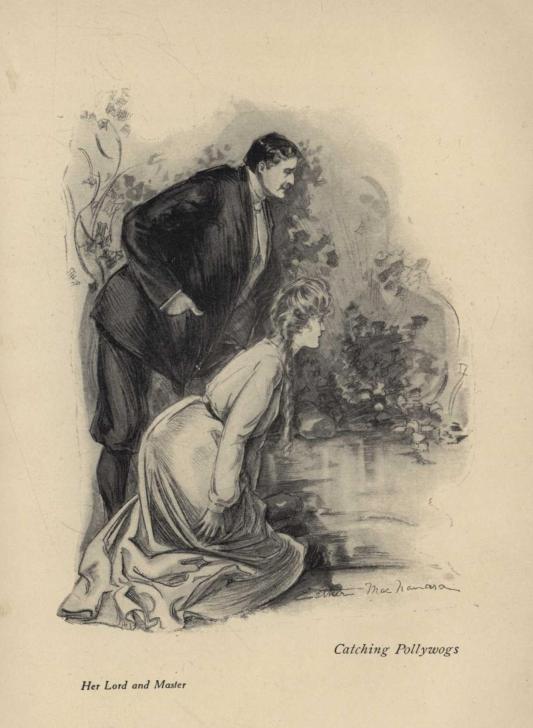
Catching Pollywogs
"Look at this little one! How beautifully green and speckled!" She held the little squirming, slippery thing fondly in her hand.
"I wish I were a pollywog!" said Lord Canning.
This remark, coming from such a source, appealed to Indiana's sense of humor. She laughed until the tears rose to her eyes, while Lord Canning surveyed her with a deeply injured expression.
"It's most unkind of you to ridicule my ambitions in this way, Miss Stillwater."
"And such lofty ambitions, too."
"They were—once, but they have gradually diminished, until now I am quite satisfied to be a pollywog—but that one in your hand, you understand."
Indiana put it into the bottle, then leaned back on the soft ground clasping her hands behind her head.
"Tired—so soon? But you weary of most things like this, I have perceived—a truly feminine trait." He lit a cigar.
It was one of those fair, bright autumn days, when one could imagine it was June instead of September, were it not for the glorious splashes of color that enlivened the lake.
"Do you notice," said Indiana, gazing upward through the pines, "how near the sky seems to us here?"
"Yes," said Lord Canning, "heaven seems very near to me here"—he bent down, looking into her eyes—"very near, and sometimes very far—"
The sound of a mandolin floated to them over the water.
"Glen!" cried Indiana, starting up. Lord Canning rose also, self-contained and somewhat pale. They watched the boat growing larger. Burt was rowing and Glen playing, "My Georgia Lady-love." Indiana stood up and waved her handkerchief.
"Why does he play that now?" she thought. "He played it that day in the orchard—when he told me—and I was sorry for him. It was such a beautiful day! He said there would never be another—maybe there won't.
"'Way down in dear old Georgia State,
We parted—but she said she would wait—'"
sang Indiana, to the familiar strains. "There were so many apple-blossoms, and they were falling—falling over my face, my neck, my hair. The sky was so blue when I looked up through the blossoms—a different blue from this—
'She slowly dropped her head,
And then she softly said:
'Mister Johnson, 'deed I loves you too.''
We cried and made ourselves miserable—I wanted to kiss and comfort him, I wanted to whisper what he wished to hear—but something held me back. I was sorry for myself as well as for him. I wanted to please everyone—his folks and mine—but I couldn't. I didn't know then—I was waiting for this. But I'm sorry for Glen—so sorry!" She saw the boat through a mist of tears and the mandolin sounded far, very far away, as though Glen were still playing it in the orchard of her memory, where the blossoms fell, in a last rosy glow of the sun.
Lord Canning watched her, jealous of the new expression on her face. He realized she was carried away by some recollection in which Glen held a part. "A boy-and-girl affair, probably," he thought. "There is always a boy-and-girl affair, but it seldom amounts to anything—very seldom."
Glen joyfully recognized Indiana waving from the shore. "Looks as though she'd been standing watching for me ever so long, but that's too much to expect." Burt rowed slowly in, while Glen waved his cap, gaily. Indiana ran down to the dock to meet him, slowly followed by Lord Canning.
"Well, Glen, here you are at last!"
"Glad to see me back, Indiana?" he asked, holding her hand, while Lord Canning stood discreetly in the background.
"Cause—Lord Canning, this is Glen Masters, my old friend and playmate—the Right Honourable Thurston Ralph Canning, Viscount. Right?"
"Perfectly."
"Glen's a character," continued Indiana, "he hates cities."
"I do, sir," said Glen, rather aggressively. "But I'm not out of the swim. I keep myself thoroughly posted upon politics and literature of the world."
"He fought in the Spanish-American war," said Indiana, putting her hand proudly on his shoulder.
"And when it was over," laughed Glen, "I came, like Cincinnatus, back to the plow. My father's been working a farm this spring for his health, and I've been helping him."
"Character, brain, muscle," observed Lord Canning. "That is the stuff which has made the American nation what it is to-day." He extended his hand to Glen, who grasped it without enthusiasm.
"Mail for me, Indiana?"
"Yes, it's all up in your room." He took his coat and several other things from the boat.
"Did you have a nice time?" asked Indiana.
"Oh, I'll tell you all about it later. We had a fine time, lots of sport. I must go and shake hands with the folks now, and read my mail. See you later, sir." He swung his coat over his shoulder and saluted them, military fashion.
"Will you take me for a walk, Miss Stillwater?"
Indiana looked hesitatingly up at the camp.
"Oh, perhaps you would prefer to stay and talk with your old playmate. Do as you feel inclined, Miss Stillwater." But he looked distinctively aggrieved.
"Oh, no," said Indiana, carelessly. "There is plenty of time for that. He will tell us his experiences around the fire to-night. Where would you like to go?"
"Oh, let us simply follow one of those little 'trails' through the woods—one of those charming little trails, which one loses, and finds again, like a broken thread of thought, in the forest. There is always the murmur of some distant stream, which one vaguely hopes to reach—and sometimes a glimpse of blue sky through the dark pines."
CHAPTER X.
The Might of the Falls
"She doesn't look a day over thirty! Remarkable!" said Lord Stafford.
"She grasps the ideas I present to her with astonishing quickness," answered his nephew, absently. "A very bright, eager mind. She has innate refinement and tact—for all her unconventional freedom of manner, which is only the outcome of her unconsciousness—and that is, after all, her particular charm, her unconsciousness. I catch a glimpse, now and then, of a certain wildness of spirit. I fear she would beat her wings against—certain fetters—unless—unless—well, it is most interesting to watch the phases of this young, tender nature—the product of a new civilization."
"Thurston, who in the world are you talking about?"
"Miss Stillwater, of course!"
"I thought so. You were talking about the young one and I was talking about the old one. It's very irritating—you've done that before."
"When did I do it before? And be kind enough to explain who you mean by 'the old one'?"
"Mrs. Bunker, of course."
"Oh, Mrs. Bunker!" repeated Lord Canning, with a sarcastic intonation. "I presume I have the same right to talk about Miss Stillwater as you have to talk—about Mrs. Bunker, Uncle Nelson!"
"No one's disputing your right, but you're continually talking about her!"
"I wasn't aware I monopolized the conversation to that degree."
"Well, you do. You're continually 'studying' her and relating the results of your observations. I should think you would know her by heart before you left her."
"Unfortunately, so far, I have not been allowed an opportunity for such extended knowledge. I'm rarely left alone with her long enough for a proper interchange of ideas. There are always so many plans and excursions on foot."
"By George, you're off with her all the time, somewhere!"
"Not for long," said Lord Canning, gloomily. "Before one is aware, it's lunch or dinner—meals are so interfering! What's that?" Lord Stafford peered out of the window. They were sitting in his room, which was flooded with moonlight.
"It's that Masters fellow. He's playing his mandolin on the lake. Fancy, at this hour!"
They smoked for awhile in silence, listening. It was long after twelve.
"We're going on a moonlight picnic to the Falls to-morrow night."
"Are we?"
"So Mrs. Bunker told me. We drove there our first day here—don't you remember?"
Lord Canning looked at his uncle in utter contempt.
"Do I remember? What a delightful day it was, that first day! And how many delightful days we have had since! Let me see. We have been here going on four weeks—is it possible?"
"That poor chap," with an inclination of his head toward the lake, "seems awfully cut up about Miss Stillwater!" Lord Stafford watched his nephew closely. "Why don't you retire and leave him the field? You may as well, you know, first as last."
"I have no intention of doing it—first or last!"
"The devil you haven't!"
"Uncle Nelson, I have made up my mind to marry Miss Stillwater!"
"Good God! Your mother!"
"My mother will be satisfied with whatever is to result in my happiness. This is the only thing in my life I have ever intensely desired."
"Think it over—well over. You may change your mind."
"I have thought it over. You remember when I climbed Mt. Marsy with Haller. The night we spent on the summit—I never closed my eyes. In the morning I watched the sun rise over the forests, mountains and lakes. Such a young, rejoicing world! And I stood above it all, sleepless, miserable, old! The questions I had asked all night seemed vain and trivial. I was simply answered. 'Be happy!' said the new-born world, bathed in dew and light."
"I promised your mother to look after you," insisted Lord Stafford, weakly.
His nephew put up his hand in laughing remonstrance, then grew instantly grave. "Do you remember that log I threw in the Notch? How it was tossed and whirled onward, like a leaf, by the might of the falls? I am as helpless in the force that has now taken possession of me. I have ceased to reason. I am going—wherever the falls will send me." He drank deeply from the glass which stood at his elbow, Lord Stafford regarding him helplessly. They talked into the small hours of the morning.
Late in the afternoon Stillwater sat in a sunny corner of the balcony, reading the Herald. One hand held a nut, which a chipmunk was speculatively watching in the shadow of the big balsam tree. Whenever he ventured near, a rustle of the paper sent him scampering back to the branches, It was the first week of October and they were having Indian summer. The evergreens on the borders of the lake were a sombre background to the gorgeous autumn color of the beech and maple trees. The mountains were covered with an Oriental carpet of blended browns, greens, and reds. Mrs. Bunker came out on the balcony, shading her eyes to look on the lake.
"No sign of them yet."
"How long are your English friends going to stay?"
Mrs. Bunker leaned carelessly against the rustic railing. "I'm sure I don't know. Lord Stafford is a devoted sportsman, and his nephew is accumulating information about the country. They're both taken with the place, and—the people in it," she smiled, in a self-conscious way at her son-in-law. He looked at her closely. She wore a tailor-made gown, showing the fine lines of her tall figure. A scarlet cape dropped carelessly off her shoulders. Masses of silvery hair, piled artistically on top of her head, presented a striking contrast to her dark, youthful eyes.
"Grandma Chazy! You don't think of marrying again?"
Mrs. Bunker laughed as though her sense of humor had been irresistably touched. "I can't help guying Lord Stafford. He looks at me with those owl eyes, and takes all my jokes for solemn earnest."
"You will flirt, Grandma."
"I will, while there's a breath left in my body—but I'm not the only marriageable candidate in the house."
"Now, keep your match-making hands off Indiana," he said, rising and throwing down the paper. "I won't have it. If she marries away from us, it will break her mother's heart. If I thought you had any such schemes in your head—"
"Wouldn't you like to see Indiana Lady Canning?" she asked sweetly.
"No!" exclaimed Stillwater decidedly. "My girl's a good, little Yankee and she shan't emigrate." He passed up and down the balcony, talking excitedly. "Yes, there's rich emigrants and poor emigrants—and it's leaving your country, bag and baggage. England's got the flower of our women already, and of course, now the men are following suit."
"You talk like a backwood's man," said Mrs. Bunker, contemptuously. "You've never been abroad."
"No. You can do the globe-trotting for the family. Is there anything better than this—in Europe?" He gave a comprehensive sweep of his head toward the lake and the woods. "Those Englishmen are wild over the place." Mrs. Bunker folded her arms patiently, while he continued his restless promenade. "Hit me between the eyes with the Jungfrau—what's the matter with the Rockies? All the snow I want—there. Where can you see another Niagara or a Yellowstone Park—or a stretch of balsam woods, like we have here in the Adirondacks—or a—"
"My dear Horatio," interrupted Mrs. Bunker, "your spread-eagleism is wasted on me. You can be sure of one thing—when Indiana marries, we won't be consulted. She'll please herself—"
Mr. Stillwater brought his hand down on the railing. "She can have anything the world affords—but I won't buy her a title!"
Mrs. Bunker swept inside, laughing good humoredly. Seating herself by the fire in the hall, she took up a square of chamois upon which she was embroidering the head of an Indian chief, in full war-paint.
"The others not back yet?" asked Glen, entering presently. "They're making a day of it." He placed the gun he carried in a corner of the hall and threw himself into a chair by the fire. "Those Englishmen are having the time of their lives. Lord Canning monopolizes Indiana, without considering whether it's agreeable to her—"
"She's not the kind to sacrifice herself, Glen," said Mrs. Bunker, smiling, and setting colored stones among the feathers on the forehead of the Indian chief.
Glen stared into the fire.
"I think they've been here quite long enough."
"You're jealous," said Mrs. Bunker, laughing.
He looked at her with kindled eyes. "I am," he answered. "I confess it—horribly jealous!"
Again Mrs. Bunker laughed.
"You don't take me seriously, Mrs. Bunker."
"That's the trouble. I'm trying to laugh you out of this thing for your own good." She laid down her work and looked at him sympathizingly.
"Yes, I know you mean all right by me," he said with a sigh which was almost a sob. "But you needn't try to laugh me out of it—you can't do that."
"My dear Glen, you're making it very hard for your yourself! Take my advice for once."
"You can't laugh me out of it," he repeated, burying his face in his hands.
"I'll talk to you just as if you were my own—I've often wished I had a son. I could have done so much for him—I could have made something of a son of mine. You are a young fellow, with every advantage that money can give—handsome, and healthy, and clever. The world's before you. Rise up and be a man! Crush this thing under your feet! Don't consider your life is over before it's begun—because you can't have the first thing you happened to wish for. Love isn't the only thing in life—especially for a man. Look at the sphere a man has for his activity! I sometimes feel like shaking some of you!"
"You don't understand—you don't know—what a hold it has taken of me!"
"Nonsense! Make an effort! It's in you. You're a soldier—there are other battles to be fought beside those on the battlefield."
"I know. And I'll fight—when I must. It hasn't come to that yet. I haven't given up hope. Don't talk to me as if I were a coward. I went off to Manila, and I loved her then. I didn't know when I wished her good-bye but that it might be the last time I should ever see her. But it wasn't so bad as this man walking in here, a perfect stranger, and trying to steal her under my very eyes—when I've known her all my life. And what does it all mean? Fine talk—a little extra polish!"
"Lord Canning's a very interesting man—a man who holds a high position in England. Indiana also has her future to make. You mustn't expect because you've played with her as a child—well, what is the use of talking sense to you!"
"You mean well by me, Mrs. Bunker, and I thank you for it—you may be even right in what you say. You've travelled a great deal and met hosts of people, and you're very experienced, but you don't understand. This has been growing in me before I knew—growing with my growth—and growing after I knew—it's tearing a flower from the roots!" He rose abruptly and leaned against the door.
"Come out," called Stillwater. "What are you sitting over the fire for? The sun feels fine to-day! This is great weather! I'm half sorry that I didn't join the rest and bring down a few birds. Here's a boat coming in now. Lord Stafford's man with Haller."
"I don't see anything of Indiana nowadays, since those Englishmen have been here."
Mr. Stillwater looked at him significantly. "Well, they'll be gone soon—then we'll have her all to ourselves again, my boy!"
"Mr. Stillwater, you—you don't think Indiana cares for that man, do you?"
"No!" replied Mr. Stillwater, scornfully.
"He's a man of position," said Glen, "and she's flattered—that's all."
"That's all," repeated Stillwater, putting his feet up on the rustic railing.
"And another thing," Glen lowered his voice, "I suppose Mrs. Bunker's been getting in some of her fine work."
Stillwater winked. "You can depend on that. Hi, Flash!" Flash ran up, the bottles in the lunch-basket he carried rattling loudly. He bowed obsequiously, out of breath, as he neared the camp. "What sport?"
"Magnificent, sir! Partridges as thick as rabbits! Their lordships and the young lady h'is a coming, sir."
"That'll do," as Flash stood bowing and scraping. "I can't stand the crawling ways of these English servants," remarked Stillwater.
"Neither can I," said Glen.
"Well, Mr. Flash, look where you're going!" exclaimed Kitty, as Flash ran precipitately against her.
"Miss Kitty!"—he bowed exaggeratedly—"ten thousand pardons!"
"Give an account of yourself! Where are the folks?"
"They're h'on the lake. We 'ad a fine day's sport! I've never seen 'is lordship in good temper for twelve consecutive hours before. And their h'appetites, bless 'em!"—Flash whirled the basket in the air—"the h'eatables 'ave vanished and they've drained the bottles!"
"That's good!" said Kitty, relieving him of the basket. Flash sank down on a rustic bench with a sigh of fatigue.
"So the lordships are enjoying themselves?" Kitty seated herself beside him and looked meditatively at her shoes. "A lucky day for them when they fell in with the Stillwaters! We are celebrated for being magnificent entertainers."
"Are you?" said Flash, with a stare that comprehended every detail of her trim personality. Kitty was a source of much entertainment to him, besides being an unending study and a continuous novelty. Kitty, conscious of the stare, rose with a toss of her chestnut head. "I'm going down to the lake to watch for the folks."
"Stay 'ere, Miss Kitty!" pleaded Flash. "Don't compel me to mount this 'ill again!"
"There's really no necessity that you should accompany me, Mr. Flash." She deposited the basket within, and strolled down through the trees. Flash surveyed her from where he was sitting. Her smooth, shining hair was mounted by a modish black bow. She wore a little dainty, ruffled apron.
"Very neat!" he murmured, then rose with an effort and caught up with her.
"It's a big thing, as you say in h'America, to be 'unting and 'unting for miles and miles, and still be 'unting on your own 'unting grounds."
"I should say so! Mr. Stillwater bought up all that land you're talking about, years ago. It's worth ten times more now than what he paid for it. It's for that model farm."
"H'if all you've been telling me h'is true, I'm glad. I'm an h'expert on farming. I 'ave never seen h'anything like you describe, h'even in Devonshire."
"The farm's only a fad of Mr. Stillwater's. You should see our home in Indiana!"
"I say, Kitty," he looked confidentially in her face, "'ow much is 'e estimated at? Say two 'undred thousand pounds?"
Kitty laughed contemptuously.
"Three? Five?"
"Mr. Flash, you're quite a nice young man, but you're very unexperienced. A man who knows how rich he is, is not a rich man in America. He's only well off. Mr. Stillwater has reached that stage where money is never even mentioned!"
"H'is it possible!" exclaimed Flash.
"I think I see the folks. So in future, Mr. Flash, when they say a man's rich in America you will understand he is not limited to figures."
William was rowing them all in. They were talking and laughing in the highest spirits. Mrs. Bunker came down through the trees in her scarlet cape, still holding her work.
"A most enjoyable day's sport, Mrs. Bunker," said Lord Stafford.
"You did bravely to-day, Miss Stillwater," praised Lord Canning.
"Not Still*water," said Indiana, in a drawling voice. "Still*water."
"I'm afraid I shall never conquer your proper names. As for your wonderful charms—"
"I'll give you a lesson," interrupted Indiana. "Suppose you saw a chubby little partridge over there in the scrub fern and wanted to bag him—what would you say?"
Lord Canning took his gun and levelled it in the direction indicated.
"I should say, I'm afraid the little fellow's out of gunshot, but I'll try."
"That's not American—to be afraid!"
"No, you'd guess."
"I—guess—when there's game to bring down! Never!" She seized her gun and levelled it at him. "I'd just bag him! Aren't you afraid?"
"No," looking at her meaningly, "ready and eager to be sacrificed!"
Indiana dropped her gun, laughing rather coquettishly.
"Good hunting, Indiana?" asked Mrs. Bunker.
"Good hunting, Grandma Chazy," answered Indiana, with a comprehensive look at Lord Stafford. "You see we know our Kipling, Lord Canning."
"I've ordered tea in the boat-house," said Mrs. Bunker.
"I'm glad you did. It would be a pity to leave the lake to-day."
Up in the cozy little room of the boat-house the logs were crackling. Gay sporting prints adorned the green walls.
"Will you have this chair, Miss Stillwater? Right this time? So glad! It was quite an effort, I assure you." He thought as he drew her chair near the fire—"Perhaps I shall not be obliged to make the effort long. What an endless source of pleasure it will be to call her—Indiana!"
"I suppose you're all dying for a cup of tea," said Mrs. Bunker, seating herself at the tea-table, while Lord Stafford sank into an arm-chair near the fire, warming his hands at the blaze.
"Where are the rest?" inquired Indiana.
"Your father and mother are having their tea together on the balcony. They're perfectly happy. I believe, Glen's there too."
"The devotion of your father and mother is very touching to me," remarked Lord Canning.
"They've always been like that—ever since I can remember," said Indiana.
"It's very beautiful to see, in these days of marital indifference and incompatibility."
"They'll be lovers to the end of the chapter," declared Mrs. Bunker. "And there's Lord Stafford enjoying his single blessedness. Think what you're missing!"
"Ha, ha, ha! Yes, Mrs. Bunker, but at present this delightful cup of tea is a great consolation."
"What have you found most interesting in the States, Lord Canning?" asked Mrs. Bunker.
"Well, I should say—" he hesitated, holding his cup and gazing contemplatively out at the lake.
"Don't be afraid to commit yourself," added Mrs. Bunker, quickly. "You English hate to make a positive assertion."
"Quite so, Mrs. Bunker," returned Lord Canning amusedly. "We think more slowly than you do—and you have asked me a very difficult question."
"I'll answer it for you," volunteered Indiana. "Your uncle has come to America to shoot things, and you for scientific purposes—ostensibly. But you spend night after night over your brandy and soda, discussing the American woman."
"Remarkable!" ejaculated Lord Stafford, adjusting his monocle and staring at Indiana.
"How did you find us out, Miss Stillwater?" Lord Canning laughed heartily.
Lord Stafford drew his chair closer to the tea-table.
"Are you not a very remarkable woman, Mrs. Bunker, even in this country of remarkable women?"
"You'll find women like me all over the States. You see we don't become old before our time—to make way for the girls. I had my daughter to rear, and I did it as well as I knew how. Then I superintended my granddaughter's training. Now she's a woman, I'm commencing all over again on my account." She laughed heartily at the serious countenance with which Lord Stafford heard her explanation.
"Remarkable, Lord Stafford, or bewildering—which?" She smiled archly into his face.
"Charming, this time, charming, I assure you!"
"The lake looks so blue and enticing from here! Shall we drink our second cup on the balcony, Miss Stillwater?"
Indiana assenting, Lord Canning brought her empty cup to Mrs. Bunker. "Make yourself comfortable in the hammock, Miss Stillwater. I will be out directly, with a fresh supply."
"Don't spill it, Lord Canning! Really your hand is very steady—a good sign! Another—with me, Lord Stafford?"
"I will take another with you, Mrs. Bunker."
He returned the cup and leaned comfortably back in his chair, enjoying the cosiness of his surroundings—the proximity of the fire, the blue lake shining in the distance, and the domestic picture afforded by Mrs. Bunker at the tea-table.
"How is it that a good catch like you has escaped the matrimonial anglers so long?" she asked confidentially, as she sipped her tea.
Lord Stafford stirred his cup in amused embarrassment, quite at a loss for an answer.
"Now, why don't you marry?" continued Mrs. Bunker.
"Er—er—I'm rather sensitive about being asked such personal questions," gasped Lord Stafford. "My own sister never asked me that!" He resumed a reminiscent expression. "She asked me if I should marry, but never why—never why!"
"You'll tell me, won't you?" urged Mrs. Bunker, sweetly.
"Oh, by George, I declare I've never even asked myself that question!"
"Well, I should be quick! Start an investigation committee and find out something about yourself. You don't know how long you are going to live."
"Mrs. Bunker, one never knows what you are going to say next."
"The lake has a ruby necklace," remarked Lord Canning, looking up from his note-book, in which he had been writing while Indiana rested in the hammock. The deep red coloring of the bank mirrored along the shore as far as one could see. "Ah, there is Mr. Masters going out in a canoe!" He watched Glen's well-knit figure as he paddled with swift, unerring strokes, clearing a perfectly straight line down the centre of the lake. "A very fine specimen of young manhood," he thought.
Later there was a tinge of rose on the mountains, gradually fading into purple. Glen remained on the lake watching the sunset. His solitary canoe rested in a spot commanding a view of White Face Mountain—that which Lord Canning had called the Mount of Perfection. Its giant shadow lay on the lake, with the purple glow on its towering peak. He was discouraged and depressed. The transient purple glow on the water reflected itself in his spirit for the moment. Then it faded, leaving the dark shadow of the mountain on the lake and a chill in the air. He paddled slowly homeward. He had isolated himself from the rest lately and spent his time restlessly roaming the woods with his gun, which lay for the most part neglected beside him, while he asked constantly of a blue patch in the pines why he should be robbed of his birthright of happiness. The pines, bending and sighing over him, whispered always the same consolation, as a sad nun, weeping with the stricken, will speak the lesson of submission she has learned, and, knowing nothing else, repeat it many times again.
CHAPTER XI.
A Moonlight Picnic.
They were all jubilant during dinner at the prospect of the moonlight picnic. When they emerged 'The Indiana' waited at the dock, illuminated with colored lanterns. The camp-fire burned brightly as usual. Haller sat on the steps with a lantern, ready to light them down to the lake.
"Just eight," said Stillwater, looking at his watch.
"No hurry," assured Mrs. Bunker. "This is to be an all-night affair."
Haller chuckled.
"Dissipation in the woods—fancy!" remarked Lord Stafford.
The electric lights on the balcony were arranged to give only a subdued glow. Glen played his mandolin softly while coffee was served, his eyes fixed on Lord Canning and Indiana, who were talking in a very gay, lively strain.
"The Pacific coast is a great hunting ground, Lord Stafford," began Stillwater. "I've heard stories about bands of elk that once roamed the San Joaquin Valley in California, living on plains same as the buffaloes—miles away from anything like cover."
"Remarkable!" said Lord Stafford, while Haller listened with open-mouthed surprise.
"You see there was no demand for them before the discovery of gold, but when the miners came they wanted meat. And then there were travelling bands of bloodthirsty explorers. They and the miners murdered everything in sight—the white man generally does. I was told that the great novelist Dumas landed there in 1849, and one of his first performances was to kill an elk in Sacramento Valley."
"Indeed, an interesting fact! These vast herds of elk retreated—where?"
"To the Great Red Woods."