Front matter (continued 5)
Reading edition
"I'll soon get my breath," she feebly said as she sipped her tea. "I do get out of puff so quick, still, since my lungs took so bad this fall."
"It was really too much of a trip for you to take, and all alone," said Margaret solicitously. "I was just this very day deciding that I would go out to see you some time this week, if I could manage it. It's very hard for me to get away or I should have been to see you before this."
"Well, my dear, what brang me in to-day was that I just had to see Danny and the girls on a little business, and so my neighbour fetched me in in his automobile. I couldn't spare the money to come by train. But," she said tremulously, "he made his automobile go so unmannerly fast, I didn't have no pleasure. He said he ain't commonly got the fashion of going so fast, but, you see, he raced another automobile. He took me along for kindness, but indeed I'm sorry to say I didn't enjoy myself."
"It was a strain on you, I can see," said Margaret sympathetically.
"But the tea's making me feel all right again," said Mrs. Leitzel reassuringly. "It's wonderful kind of you to give it to me; but I didn't want to make no bother. I seen Danny down at his office, and when he told me the girls wasn't home this after, I came up here on the chanct of seein' you alone, and them dear little twinses! Indeed I felt I got to see them two twin babies before I died a'ready. You see I knowed by your nice letters to me that you'd treat me kind, and indeed I had afraid to try to go back home alone on the train; I conceited that mebby you'd take me to the depot," she said with timid wistfulness, "and put me on the right train, and then I wouldn't have been so afraid. Danny thinks I went straight off home by myself. But indeed I didn't darst to."
"Of course I'll take care of you. But you must not think of leaving before to-morrow when you've had a chance to get thoroughly rested."
"Oh, but, my dear," said Mrs. Leitzel nervously, "Danny give me the money to pay my way back home and he thinks I went. And you see, it would put the girls out to have to make up the spare bed just for me."
"But who could be more important than you—you who took care of them all when they were children? Indeed I shan't let you go a step to-day."
"Did they tell you I took care of them, my dear?" asked Mrs. Leitzel, puzzled. "Because they never talked to me that way. And Danny tried to show me this after, when I put it to him that now I couldn't hold out no longer to support myself gardening on the old place—he said I hadn't no claim on him. I don't know," she added sadly, "what I'll do. I'm too old and feeble to work any more, my dear. God knows I would if I could. I'd work for all of them as well as for myself, the way I used to, if I had strength to. But I come in to-day to tell Danny that at last I'm done out. Yes, the doctor says I got tendencies and things and that I got to be awful careful."
"'Tendencies?'" asked Margaret.
"He says I got somepin stickin' in me."
"Something sticking in you! Do you mean that you swallowed a bone or something?"
"No, my dear, I didn't swallow nothin'. I got a tendency stickin' in me that might give pneumonia. So I come to ask Danny to-day if—if he couldn't mebby spare me something," she faltered, "to live on for the little time I got left, so that"—a childlike fear in her aged eyes—"I don't have to go to the poorhouse!"
"When you told Danny all this," asked Margaret, laying her hand on Mrs. Leitzel's, "he said you had no claim on him?"
The old woman's lips quivered and she pressed them together for an instant before she answered.
"He told me he'd talk it all over oncet with Hiram and the girls. But," she shook her head, "I'm afraid Hiram's less merciful than any of my children and he'll urge 'em to put me to such a home for paupers; and, oh, Margaret—dare I call you Margaret?"
"What else would you call your son's wife, dearie?"
"I have so glad Danny has such a sweet wife! I wouldn't of believed he'd marry a lady that would be so nice and common to me. It wonders me! I can't hardly believe it!"
"But you are good to me, making me that lovely quilt and the baby socks. I use the quilt all the time and one of the twins is wearing the socks now. How could even Hiram be hard to you?"
"But Hiram and the others is wery different to what you are." Mrs. Leitzel shook her head. "Danny says if he did pay me a little to live on, Hiram would have awful cross at him. You see, my dear, the reason I ain't got anything saved, as they think I had ought to have, is that I never could make enough off of the wegetables I raised in the backyard to keep myself and pay for all the repairs on the old place, for all I done a good bit; enough anyhow to keep the old place from fallin' in on me. I don't know how I'd of lived all these years if it hadn't of been for the kindness of my neighbours. And now Danny says if I can't keep myself at all no more——" Again she pressed her lips together for an instant. "He don't see nothing for it but that I go to a old woman's home. He calls it a old woman's home, but he means the poorhouse."
"Mother," said Margaret, clasping the hand she held, "I wish you would tell me the whole story of your life with Daniel and Hiram and 'the girls.' Begin, please, away back at 'Once upon a time.'"
Mrs. Leitzel smiled as she looked gently and gratefully upon Daniel's young wife who wasn't too proud to call her "Mother."
"Well, my dear, I married John Leitzel when Danny was only six months old, because them children needed a mother. John drank hard and it was too much for them young folks to earn the living and keep house and take care of a baby. I married John because I pitied 'em all and so's I could take hold and help. Jennie was fifteen, Sadie ten, and Hiram five, and then the baby, Danny. I sent the three older ones to school and I took in washings and kep' care of the baby and did the housekeeping and the sewing. I kep' Jennie in school till she could pass the County Superintendent's examination a'ready and get such a certificate you mind of, and get elected to teach the district school. And with all my hard work, I kep' her dressed as well as I otherwise could. For I was always handy with the needle and Jennie and Sadie was always so fond for the clo'es. Well, when at last Jennie come home with her certificate to teach, my but we was all proud! Indeed, I wasn't more proud when Hiram got his paper that he was now a real preacher—sich a seminary preacher, mind you!—though that was a long time afterward. Well, I thought it would go easier for me, mebby, when Jennie got her school. But you see, she had so ambitious to dress nice and do for Danny (he was such a smart little fellah) that I had still to take in washings and go out by the day to work. Hiram he worked the little farm we had and I helped him, too, in the busy seasons to save the cost of a hired man, for our place had such a heavy mortgage that the interest took near all we could scrape together. Yes, for nine years and a half we struggled along like that, and then at last John died. And mind you, the wery next month after he died, we all of a suddint found coal on our land! Yes, who'd ever of looked for such an unexpected ewent as that! Ain't?"
"To whom did the land belong?" asked Margaret.
"It had belonged to my husband's first wife, but she had willed it over to him before she died. So it was hisn."
"Oh, but, my dear, then you were entitled to one third of it, if you didn't sign away your rights."
"Indeed, no, I didn't sign nothing. Leave me tell you something, my dear: John on his deathbed he thanked me for all I done and his dying orders to me was, 'Don't you never leave Jennie and the rest get you to sign away your rights in the farm that you worked so hard to keep in the family. If it wasn't for you,' he said, 'we would of been sold out of here long ago, and the children all bound out and me in the poorhouse! And if I had the money for a lawyer, I'd sign the whole farm over to you before I die.' 'No, John,' I said, 'that wouldn't be right, neither, to give it to me over your children's heads.' 'Well, anyway,' he says, 'it's too late now, so you just pass me your solemn promise on my deathbed that you'll never leave 'em persuade you to sign nothing without you first leave one of your Mennonite brethren look it over and say you ain't signin' away your rights.' So I passed my promise and I've kep' it, though it has certainly went hard for me to keep it. Danny worried me often a'ready these thirty years back, to sign a paper, and it used to make him wonderful put out when I had to tell him, still, that I'd sign if he'd leave one of our Mennonite brethren read it first and say if I was breakin' my word to John or no. Danny always said he didn't want our affairs made so public and the Mennonite brother would have too much to say. So then I had to say I couldn't sign it; I couldn't break my word to John on his deathbed. Many's the time I was sorry I passed that promise to John—they all have so cross at me because I won't sign nothin'. You see, they always was generous to me, giving me the house and backyard to live in without rent. But to be sure I couldn't break my word to my dying man!"
Margaret saw that there had been no self-interest in her refusal to sign away her rights, but that the binding quality of a deathbed promise was to her a fetish, a superstition. And it was this, no doubt, that Catherine had meant in speaking of her "breast-plate of righteousness," her conscientious devotion to her solemn vow had shielded her from the snare of the fowler; from "the greed of the vulture," Catherine had said.
"And lately," Mrs. Leitzel continued her story, "Danny didn't bother me no more to sign nothing. But to-day," she concluded, suddenly looking very weak and helpless, as she leaned far back in her chair, "to-day he ast me again, and he said it couldn't make no matter to me now when I was so near my end, and if I'd sign a paper he'd not leave the others put me to the poorhouse. But I told him if I was so soon to come before my Maker, I darsent go with a broken promise on my soul. If only I hadn't never passed that promise, my dear! John meant it in kindness to me, but you see," she suddenly sobbed, "it's sendin' me to the poorhouse to end my days!"
"Oh, but my dear!" exclaimed Margaret, her face flushed with excitement, "why didn't you, from the very first, get your one third interest in those coal lands? You were and are entitled to it!"
"Well," said Mrs. Leitzel, "right in the beginning when they first found the coal, they got me to say I'd be satisfied to take the house and backyard for my share; not to keep, of course, but to live on for the rest of my life; and seeing the land had been their own mother's, that was a lot more'n I had the right to look for. To be sure," she gently explained, "you couldn't expect your step-children to care for you as your own flesh and blood might."
"You cared for them as though they were your own flesh and blood. Tell me, you did not sign an agreement, did you, to accept the house and backyard in lieu of your one third interest in the estate?"
"No, for that would of been breakin' the promise I passed to John. For you see, Danny never would leave one of the brethren look over the paper he wanted me to sign, and say whether I could do it without breakin' my word. So I never signed nothing."
"Then the only thing you need to establish your absolute right in one third of the income of the coal lands (now enjoyed by your step-children and excluding you) is the proof that the title to those lands was vested absolutely in your husband at the time of his death. If it wasn't, you have no case. If it was, you've plenty of money! You see, my brother-in-law is a lawyer and I've imbibed a little bit of legal knowledge. But I have an intimate friend, Miss Catherine Hamilton, who knows nearly as much law as Daniel does and I'll get her to look up the court-house records for your husband's title to that land, and then, my dear, if we find it—— Oh, my stars!"
"But, Margaret," the old woman protested fearfully, "you'll get 'em all down on you if you go and do somepin like that!"
"You see," Margaret gravely explained, "I am living on this money which belongs to you, and my children will be living on it, inheriting it. I couldn't bear that, of course."
"Do you mean," faltered Mrs. Leitzel, "you think they cheated me? There's others tried to hint that to me and I wouldn't never listen to it. Why, Hiram's a Christian minister and they're all church members and professin' Christians! They wouldn't steal, my dear—and from an old woman like me!"
"It's been done, however, by church members and professing Christians. We'll investigate it, my dear," Margaret firmly repeated.
"But I wouldn't want to be the cause of you and Danny's fallin' out, little girl! That I certainly wouldn't. And, dear me!—if you got Jennie down on you yet!"
"She couldn't be much more down on me than she is. And during all these years, you know, you've stood up to them for the sake of a sacred promise. I hope I haven't less courage."
"Don't you think Danny's too smart a lawyer, my dear, for you to get 'round him?" Mrs. Leitzel anxiously tried to avert the disaster which Margaret's suggestion surely presaged.
"My brother-in-law is a smart lawyer, too. I'll write to him this very night, put the case to him (omitting names) and ask his advice. Oh," she suddenly lowered her voice, "here come 'the girls.' Do not breathe a word of what I've said to you!"
"Oh, no, indeed I won't. I know how cross they'd have at me! My dear," she added, clinging to Margaret's hand, "stay by me, will you? Please! Jennie and Sadie won't like it so well that I come. I conceited I'd get away before they got back, and they're likely to scold me some, my dear, and——"
Margaret stooped over her impulsively and kissed her forehead. "Come out to the porch with me and see the babies." When a moment later Jennie and Sadie came into the room they saw, through the long French window opening on to the porch, their step-mother bending over the sleeping infants in the big double coach, and Margaret standing at her side, her arm about her waist.
XXIII
"Why!" exclaimed Jennie as she grudgingly shook hands with her step-mother when Margaret returned with her to the sitting-room. "You here! We saw Danny downtown just now and he said he gave you money to get home."
"Yes," added Sadie, also shaking hands reluctantly, "we didn't look to see you here. Anyhow Danny thought you went to the depot from his office."
"But," smiled Margaret, "she gave me the pleasant surprise of a call. I am so glad, because I wanted so much to know her, my husband's mother and the babies' grandmother! How pretty your flowers look, Sadie!" she added diplomatically and quite insincerely, for she groaned inwardly at the bunch of little artificial roses Sadie girlishly wore on the lapel of her coat.
"What is this to do?" Jennie suddenly demanded as her eyes fell upon the tea-table.
"We've been having tea and toast."
"Well!" breathed Sadie.
"Upon my word!" exclaimed Jennie. "You stopped Emmy in her Sa'urday's work to make tea and toast in the middle of the afternoon yet!"
"It took her just fifteen minutes."
"She ain't ever to be hindered in her Sa'urday's work! She has a cake to bake for Sunday then!"
"But you know," said Margaret patiently, "you stopped her on wash day to make tea for Mrs. Ocksreider."
"Well, but Mom ain't used to tea in the afternoon and Mrs. Ocksreider is. Anyhow, who's keeping house here, Margaret?"
"But surely I may have a cup of tea with your mother if I wish to, in this house!"
"But it up-mixes my accounts when you do somepin like this. Danny pays half of all the expenses here and Sadie and I pay half."
"Oh, I see," Margaret breathed rather than spoke. "But after all, Jennie, it's quite a simple matter—charge the tea, sugar, milk, bread, and butter to Daniel's side of your account and I'll take the responsibility of it."
Jennie turned abruptly to her step-mother. "It's getting late on you, Mom, to get out home. You don't want to get there after dark, with a half a mile to walk from the station yet. Before I take off my coat and hat, I better see you on the street car that'll take you to the depot for the five o'clock train."
"Yes, Jennie," the old woman submissively answered, "I was just a-goin' to start to go when you come."
She rose with an effort from the comfortable chair before the fire in which Margaret had again placed her. But Margaret at once pressed her back into her seat.
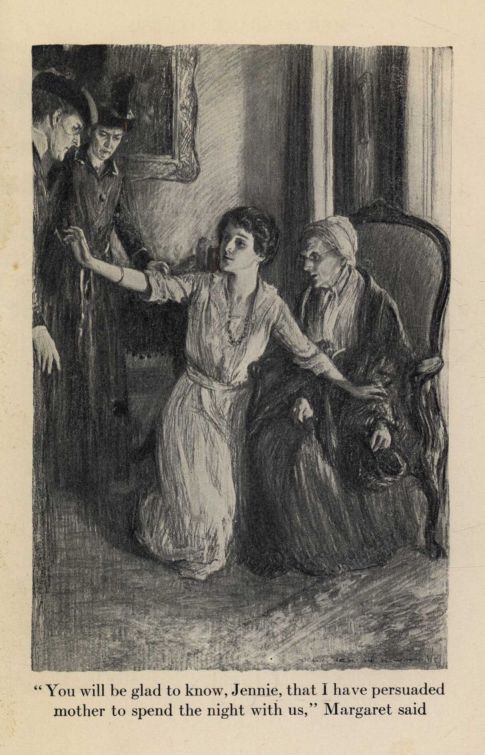
"You will be glad to know, Jennie, that I have persuaded mother to spend the night with us," she said, "as she is too tired from her journey to go back before to-morrow."
"You will be glad to know, Jennie, that I have persuaded mother to spend the night with us," Margaret said
"She never stops the night with us, Margaret," Jennie coldly returned. "Come on, Mom, I'll put you on the street car."
"But isn't it nice," cried Margaret, holding her arm around Mrs. Leitzel to keep Jennie off, "that I've succeeded in coaxing her to stay to-night? Such a pleasant surprise for Daniel when he comes home, to find you here, dear! What is home without a grandmother? Good discipline for Daniel, too, to have to give up this armchair for one evening! Even I have to get out of it when he wants it. But naturally he can't put his mother out of the only really comfortable chair in the house."
"But Danny paid for that chair," explained Sadie. "It would be funny—ain't?—if he couldn't sit in his own chair when he wants!"
"The spare-room bed ain't made up," Jennie frowned at Margaret. "And nobody has time to make it up at four o'clock on Saturday afternoon! Anyhow, strangers stopping over night is apt to give Sadie the headache. And Mom never wants to be away from her own bed. She won't can home herself in a strange bed, can you, Mom?"
But Margaret spoke before Mrs. Leitzel could reply. "I'll make up the guest bed. It won't take me ten minutes. Mother"—she patted Mrs. Leitzel's shoulder—"I'll be right downstairs again in ten minutes."
But Mrs. Leitzel clung to her hand. "Don't let me alone with—stay by me, Margaret——" she pitifully pleaded.
"You shall come upstairs with me, then, to my room," Margaret said, helping her, now, to rise to her feet.
"No, Margaret, Mom's to go back on the five o'clock train," affirmed Jennie peremptorily. "Our Danny give her the money to go back. It ain't for you to be using our clean linens to make up the spare bed. Come on, Mom."
Jennie laid an ungentle grasp upon her step-mother's arm, but Margaret, her face suddenly ablaze with indignation, confronted her.
"Jennie! This is my husband's home, and his feeble mother shall be his guest and mine until to-morrow morning."
"She ain't his mother, she ain't even a blood relation. And what right have you, I'd like to know, to meddle in our family affairs?" Jennie fiercely demanded. "It's just your contrariness that makes you want to do everything that you see will spite us; for what other reason would a person like you have for taking up with an uneducated old woman like Mom? You wouldn't look at a person like her if it was not to spite us!"
"What right have I? The right of the humane to protect the helpless from brutality, under any and all circumstances, without exception. She shall not leave this house to-day!"
"Now, Mom," Sadie turned on her step-mother, "you see what you make by coming here like this, without leaving us know! Ain't you worrying us enough all the time, without raising more trouble between us and Danny's wife yet?"
"Yes, yes, I'll go. Please, my dear"—she turned to Margaret,—"leave me go. I'd rather die on the way home than stay and make it unhappy for you, Margaret! Danny will take up for them, you know, so I can't stay and make trouble. Leave me go, my dear!"
"But if you don't make your mother welcome here," Margaret addressed both Jennie and Sadie, "I shall have to go with her. I can take her to Catherine Hamilton's for the night. Or," she added with sudden inspiration, "to Mrs. Ocksreider's, and ask her if she won't give her a bed until the morning. She shall not take that journey to-night!"
Jennie glared in baffled fury, while Sadie turned white with dismay.
"Danny won't leave you do such an outrageous thing!" the elder sister said hoarsely.
"Daniel can't stop me. Come, mother."
"You don't mean to say you'd do as mean a thing as that—take Mom to Mrs. Ocksreider's!"
"But I am so sure that Mrs. Ocksreider is the very person who would be very glad to receive her for the night."
"You up and tell me to my face you'd disgrace us like that!"
"But where would the disgrace come in?" asked Margaret innocently.
"Where would the disgrace come in?" repeated Jennie hotly. "Don't you see any disgrace in telling Mrs. Ocksreider that we won't leave our mother (even if she is our step-mother) sleep at our place over night?"
"Then you admit that you are acting disgracefully in turning her out?"
"You wait till Danny comes home and he'll show you if you can go against me like this in his house!" Jennie violently threatened, more furious than ever at being trapped by her own words. "Now you leave Mom be till I take her out to the car!"
"No, Jennie, if she goes I go with her—to our friend, Mrs. Ocksreider. Therefore, it behooves you——"
But it was just at this instant that the sitting-room door opened and Daniel walked into their midst.
"Margaret! I've got an automobile at the door. Get your hat——"
He stopped short in astonishment at sight of his step-mother, at Margaret's attitude of shielding her against the evidently furious antagonism of Jennie and the cold disapproval of Sadie.
"Well?" he demanded testily. "What's up? How did you get up here, mother?"
"Yes, how did she, when you gave her the money to go home yet?" scolded Sadie.
Margaret, leaving the statement of the situation to Jennie, remained silent.
"Who brought you up here?" Daniel inquired of the old woman.
"I come by myself, Danny. I wanted to see your wife and the twinses, and I conceited I'd be gone before the girls got home. But I'll go right aways now. I'm sorry I come. I didn't want to make no trouble—I——"
She made a movement from Margaret's side, but the latter clasped her firmly.
"Margaret," commanded Daniel, "let her go."
"I have invited her to spend the night here, Daniel. She is not able to go home to-night."
"I'll take care of that—this is not your affair. Let her alone! Take your hands off her!"
"Will you let her spend the night here?"
"I said I would take care of that. Take your hands off her."
Margaret obeyed.
"Now come here, mother."
Mrs. Leitzel walked feebly toward him, but Margaret walked beside her.
"Now, you see, Danny, how contrary she acts!" Jennie broke forth. "I wanted to take Mom out to the trolley car and Margaret would not leave her come along, when Mom said she wanted to come, too!"
"Well, I'm here now," returned Daniel grimly. "I'll take you to the station, mother," he pronounced conclusively, taking the old woman's arm.
"Daniel! Your mother can't go home alone this evening! It will be cruel of you to send her!"
Daniel, ignoring her, led his mother to the hall.
"I tell you I'm going to stop this cruelty!" cried Margaret, darting upstairs to get her wraps.
She was down again almost immediately, her coat over her arm, but when she reached the sidewalk the automobile containing her husband and his mother was beyond her reach.
"I may be able to get to the station before that five o'clock train!" she thought, starting almost on a run to go the length of the town to the depot, putting on her coat and gloves as she went. "I believe his mother will die on the way if she goes, and has to walk that half-mile alone in the dark, after being subjected to all this horrible scene! Oh, my God! What people they are!"
She realized, on her way, that her purse was empty, her monthly allowance having been spent, and that she had not even money for trolley car fares—a serious handicap in her efforts to help Mrs. Leitzel.
When, panting for breath, a sharp pain in her side, she reached the station, the train to Martz was just pulling out.
Daniel, smiling blandly, came toward her along the platform.
"God help me!" was the cry of her heart, "that I cannot even hate him—he is too utterly pitiable! If I could hate him, there might be some hope for us!"
"Want to take a little ride, my dear?" he inquired, waving his hand to the waiting automobile.
"Take me home," she returned weakly, feeling suddenly collapsed and helpless.
"You know," he said as he helped her into the car, "you ought not to excite yourself like this—it's bad for Daniel Junior's milk—about something, too, that is no concern of yours. And I want to warn you also," he added, lowering his voice so that the chauffeur might not hear him, as the car turned into the street, "that you've got to refrain from offending Jennie and Sadie so constantly. They have a lot of money to leave to our children. Keep on offending them as you are doing and they'll will all they have to Hiram's children!" said Daniel in a tone that expressed all the horror that such a possibility contained for him.
Margaret did not reply.
"You get me?" Daniel inquired.
"Considerations like that, Daniel, have never entered into my philosophy of life, thank God!"
"Margaret, you really must break yourself of this dreadful habit of swearing! It's so unladylike! And so unchristian!"
"Oh, my good Lord, Daniel! Don't dare to talk to me about anything's being 'unchristian,' when you have just done a cruel, cruel thing to your aged, helpless mother! I don't profess and loudly flaunt my 'Christian principles,' but I do believe in the Golden Rule. Evidently you don't. Don't speak to me!"
"Hoity-toity! Cut out these tantrums, Margaret; they're bad for the boy, you know."
"Why don't you tell the Y.W.C.A. about your smart 'deal' with your tenant, George Trout, and your treatment of your step-mother? Maybe they'd send you another congratulatory letter that you could have published in the Intelligencer."
"You heed my warning about offending Jennie and Sadie," was Daniel's reply.
"At the time of your father's death was the title of the farm at Martz vested absolutely in him?"
Margaret had the satisfaction of seeing Daniel start and turn red at her question, as he turned abruptly and looked at her.
"What makes you ask that?" he nervously demanded.
"Was it?" she repeated.
"Why do you wish to know?"
"It was," she affirmed.
"How do you know?" he sharply questioned.
"That same old Woman's Intuition."
"I insist on your answering me intelligibly! What do you know of business matters like that anyhow?"
"Not much, but a little."
"Understand, Margaret, once and for all, that my business affairs and that of my folks are no least concern of yours!"
"Yours are."
"They are not!"
"Oh, yes, they are, Daniel. You and I are life partners and I am the mother of your heirs. Therefore, I have everything to do with your business. Neither I nor my children shall live on stolen money."
"Stolen money! You talk to me of 'stolen money,' when I stand in this community as the one honest, upright, Christian lawyer! Gracious, Margaret, I certainly expected that after the children were born I'd have back again the sweet girl I married! I'm beginning to feel that I've been awfully taken in!"
Margaret leaned back in the automobile, closed her eyes, and did not answer. During the remainder of the ride the silence between them was unbroken.
XXIV
Immediately after dinner Margaret went to her room, got into a negligé, and sitting down to her writing-desk, began a letter to Walter.
She stated the case of the Leitzel coal lands under the guise of Western gold mines and asked her brother-in-law to give her all possible light on the legality of the case for the benefit of the "grandmother."
"If the laws governing such a case differ greatly in the different states," she wrote, "please give me all the general information on the subject that you can. This is a very important matter to me, Walter, though I can't tell you why; nor can I explain to you why I consult you rather than Daniel on a question of law. The fact is, I am preparing a little surprise for Daniel."
At this point in her letter she paused, resting her elbow on her desk and her head on her hand. "Walter will see right through my disguises and subterfuges," she reflected. "He will understand perfectly what the surprise is that I am preparing for Daniel. And in his reply he will undoubtedly tell me what the law of Pennsylvania is governing such a case as I've outlined. Well," she drearily sighed, "I can't help it if he does see through it, I can't be a party to defrauding that old woman, as I would be if I consented to live here on money that ought to be hers."
She took up her pen again and dipped it into her ink, but the bedroom door opened and Daniel entered.
She looked so pretty in the dainty pink negligé which she wore, and with her abundant dark hair hanging in two heavy braids down her back, that Daniel, despite the coldness which had prevailed at dinner, came to her side, put his bony arm about her shoulders and patted her bare arm.
"Writing to Walter, I see," he remarked; and quickly she covered her letter with a blotter.
"Yes," she answered.
"Glad you are. I've not yet got an answer out of him. Are you, my dear, repenting of your unwifely behaviour and writing to him what I want you to?"
"I'm doing what I consider my wifely duty, yes."
"Good! I knew I'd get my sweet girl back again! Let me see what you've written. All this!" he exclaimed, reaching across the desk to pick up her letter; but Margaret, looking at him in startled amazement, held him off.
"I haven't said you could read my letter, Daniel."
"Do you have secrets from me, Margaret?"
"Do you have any from me, Daniel?"
"That's neither here nor there. Come, let me see your letter, my dear!"
"I don't wish to. Why do you want to?"
"You are writing something to your brother-in-law you don't want me to know about?" he accused her, his narrow gaze piercing her.
Margaret quickly decided to resort to guile.
"Daniel," she smiled upon him, "I'm preparing a little surprise for you."
"A surprise?" he repeated suspiciously.
"Yes. Now, while I am finishing my letter, I want you to do something for me. Will you?"
"What?"
"Is there any way of finding out by telephone or telegraph," she asked, her eyes big and sad, her lips drooping, "whether your poor mother is by this time safe at home? I shan't sleep a wink to-night from worrying over that half-mile walk she had to take after dark!"
"She didn't have to take the half-mile walk. I arranged for that. I gave her a quarter to pay for a 'bus ride from the station to her house and I 'phoned to Abe Schwenck to meet her train with the 'bus. Could I have done more?"
"You really did all that?" she asked, her face lighting up with relief.
"I did all that. So you see I'm not 'cruel' and hard-hearted. I did all that for one who is no relation to me and has no claim on me."
"The claim of gratitude?" Margaret suggested; "or of mere humanity?"
"As for gratitude, haven't we repaid her for her ten years' service for us by our thirty years of taking care of her?"
"Taking care of her?"
"We've never charged her a cent of rent for the only home she has had for thirty years."
"Why wouldn't you let her stay here to-night?"
"Because we don't want to start that kind of thing, or she'd be here on our hands all the time. Once we take her in, we'll never be able to shake her off, and we don't want her."
"I see."
"Of course you see. Now give me a kiss, and promise me you will turn over a new leaf and not be so stubborn about the care of the babies and about Catherine Hamilton and about all the other little matters in which you tease me so that I've got indigestion!" he said fretfully.
"I act only as I must, Daniel," said Margaret sadly. "It gives me worse than indigestion!"
"Look at Hiram's Lizzie! She never antagonizes the girls the way you do!" he complained, genuine anxiety in his voice.
"She doesn't live with them."
"Well, but don't you see that's where we have the advantage over Hiram? They'll get more attached to our children because they'll see more of them. If you acted toward my sisters as you should, as your duty to me and to your children requires that you should, they might leave nearly all they have to our children, giving Hiram's children merely small bequests."
"If I should let them have their way with our babies, they certainly would leave all their money to Hiram's children, for there wouldn't be any babies in this house. They'd kill them off with slow torture."
"Hiram's children haven't died and Lizzie does with them as Jennie and Sadie have always advised her to do."
"Exceptions to every rule," Margaret briefly replied, perfectly willing to shield Lizzie.
"Well," said Daniel emphatically, "you keep up your present injudicious course, and the day will come when your children themselves will reproach you for having deprived them, by your sheer perversity, of what was justly their due."
"I hope to bring them up too well for that."
"And I hope to bring them up to have a little more judgment about money than you have, my dear! Well, I should say so! or they would be ill-prepared to take care of all they will inherit!"
"They will inherit a great deal, will they?" Margaret casually inquired.
"Enough to need some common sense in the management of it."
"Couldn't you spare a little from what they'll inherit to keep that dear old step-mother of yours for her remaining years?"
"Margaret!" said Daniel curtly, "I tell you again I want no interference from you in my family affairs!"
"Well, then, can you, or can you not, afford to give me more than ten dollars a month for pocket money? I find it embarrassing to be out of money so often as I am. It is my right to know what you can afford to let me have."
"If you would keep an account and submit it to me, I could judge better of the justice of your request for more. Ten dollars a month seems to me considerable money for a woman to spend on nothing, for you are not expected to buy your clothing and food with your allowance!"
Margaret, toying with her pen, her eyes downcast, did not answer.
"If I did increase your allowance, it would be just like you to pass it on to my step-mother! Positively, I believe that's what you do want to do with it!"
"You are giving me credit I don't deserve. I was asking for the money for myself. I am so often embarrassed for lack of money. I had to borrow a dollar from Catherine Hamilton yesterday to pay Mrs. Raub for washing my hair. Catherine said she'd collect it from you."
"Jennie and Sadie wash their own heads."
"My hair is so thick I can't dry it myself and, you know, it would be bad for the baby's food if I took cold."
"Adopt the rule which helped to make my success, Margaret: never let yourself get entirely out of money. And, my dear, if you'd do what I ask you to—give me power of attorney—you'd have a little income of your very own. Why, don't you feel under some obligation to do something for me, in return for all I do for you?"
"Have I done nothing for you? I have given you a son and a daughter. Can anything you ever have or ever will do for me cover that debt?"
"Well," Daniel smiled, patting her neck, "you did pretty well by me in that instance, I must admit; and I promise you this: when you can persuade Walter Eastman to do what's fair by you as to Berkeley Hill, I will increase your allowance."
Margaret lifted her eyes, grave and melancholy, to Daniel's face bent smilingly above her. "Catherine Hamilton mentioned yesterday, Daniel, when I was obliged to borrow a dollar from her, that she felt safe in lending it to me as you were a millionaire and your income was twenty times (or fifty, I forget her figures) more than you spent."
"She has no business discussing my finances!"
"She didn't discuss them. She quite casually dropped the remark (which I confess I found rather startling in view of some things) that you were a millionaire and could not begin to spend even a small part of your enormous income. Yet you let your old step-mother suffer and subject me to the embarrassment of borrowing money to pay a hairdresser!"
"It's your own bad management that obliges you to borrow at any time," Daniel coolly returned, not at all disturbed. "And your constant disregard of my wishes, my dear, would justify my cutting off your allowance altogether! But I don't do it, do I? As for Miss Hamilton, she's not the excellent clerk I took her for! She has no sort of business to discuss my income and my expenditures."
"I envy her!" Margaret suddenly cried out passionately. "She is at least independent, self-supporting, not a miserable parasite! I wish I were in her place, working honestly for wages that you would have to pay me, instead of being in the degrading position of having to ask you for money which you refuse me! I'd better have gone and worked in a factory than have done what I did!"
Her face fell on her arms and wild sobs shook her.
"Margaret!" Daniel cried in alarm and distress, his arm about her. "My dear! You'll injure yourself and Daniel Junior, if you do so! Stop going on so! Oh!" he exclaimed, "you've waked the babies with your noise!"
A little cry from the adjoining nursery brought Margaret to her feet. Daniel, infatuated quite humanly with his beautiful babies, followed her eagerly, as, forgetful instantly of her own troubles, she went to minister to her children.
XXV
In reply to her letter to her brother-in-law, Margaret received from him, a week later, a telegram that puzzled her greatly.
Charleston, S.C.
Important Berkeley estate business brings me to New Munich Thursday, February tenth.
WALTER.
She had ten days before his coming to anticipate with some uneasiness the shock he would certainly get in making the acquaintance of her husband's sisters and in seeing the kind of home she lived in.
"If only I could dispose of that navy blue owl on the sideboard!" she worried. "And of all that imitation onyx in the parlour! And the 'oil-paintings' in the sitting-room! As for Jennie and Sadie themselves—— Oh, what can Walter be coming here for? I don't suppose they've discovered coal on our estate. I hope not, such a dirty mess as it would make! More like our luck to discover we don't, after all, own the place."
But she found, when she announced her brother-in-law's prospective visit, that she herself had not yet got all the shocks and surprises the Leitzels were capable of affording her. Her Southern sentiment of hospitality received another unexpected blow in discovering that Jennie and Sadie quite seriously objected to entertaining her brother-in-law at their home.
"We ain't used to comp'ny stopping here," Jennie explained to her. "Danny's business acquaintances always go to the hotel. It wouldn't suit me just so well. We ain't so young as we used to be, and it would certainly be a worry to me to have company stopping here. You'd best not begin that kind of thing, Margaret. If your brother-in-law slep' and eat here, it would mebby give our Sadie the headache."
That New Munich hospitality, instead of being a condition of daily life as with Southerners, was so specialized an occasion as to cause the upsetting of a household and the expenditure of the nervous energy of a whole family, Margaret had come to recognize. People did not "keep open house"; they "entertained." But how was she to spring such a thing upon Walter, who knew no other standard of hospitality than that of the open Southern home? How explain to him upon his arrival that her home and her husband's was not open to him, and that he must stop at a hotel?
She had not at all solved the problem when in a wholly unlooked-for way it was solved for her. Confined to bed one day with a violent headache, and quite helpless to protect her babies from Jennie's hygienic theories, the twins were kept by their aunt in a hot, airtight room such as Jennie considered their proper environment, with the result that they cried all day; and the next day had heavy colds—their first disorder of any kind since their birth. But when Margaret, herself recovered, insisted upon taking them, suffering from influenza as they were, out into the chill air of a cold day in January, Jennie's thwarted will, thwarted affection, and wild anxiety for these babies of Danny's whom she loved almost fiercely, broke all bounds, and she gave Margaret her ultimatum.
"Or either you keep those children in the house till they're well already, or either I and Sadie leave this house where we have to look on at such croolities, and go to keep house by ourselves! Yes, this very day we go!"
Margaret paused in the strenuous work of getting little Daniel's arms into his coat sleeves, preparatory to his outing, and gazed up at Jennie with such a light of joyful hope in her eyes that Jennie, had she not been too blindly furious to see it, would certainly have withdrawn this proffered happiness from her now heartily detested sister-in-law.
"If Danny wasn't in Philadelphia to-day, I'd 'phone to his office and have him make you keep them in!" she raged frantically. "They'll get pneumonia, so they will!"
"Daniel couldn't make me, Jennie. I act under the doctor's orders. Daniel's a lawyer, not a physician. I'm taking the babies out to save them from having pneumonia."
"Daniel couldn't make you, couldn't he? Well, I can! Yes, and I mean what I say! You take these babies out on a day like this when they're sick, and I and Sadie move out this very day!" she harshly reiterated, under the delusion that Margaret would never put her to the test: for not only was Jennie incapable of realizing Margaret's utter indifference to the economic advantage of their joint housekeeping, but it also seemed to her wholly incredible that her sister-in-law could subject her devoted and indulgent husband to the suffering he would certainly undergo if deprived of his sisters' constant ministrations to his comforts.
"And when Danny comes home from Philadelphia to-night and finds us gone and our half of the furniture being moved out, what do you think he'll say to you for driving us out?"
Margaret, realizing that she must conceal the heaven opened up by this unexpected ultimatum, quickly cast down her eyes, that her tormentor might not see her quivering eagerness.
"I'll goad her to moving out!" she desperately resolved. "Oh! if only I can make it impossible for her to back down from her threat."
She suddenly raised her eyes again and laughed sarcastically. "Oh, you can't scare me with your threats! You'll not go!"
"You'll see whether we won't! You just dare to take those sick children outside this house, and you won't find I and Sadie here when you come home!"
"That won't worry me. You'll be back soon enough. Catch you leaving your brother's house! Oh, no, my dear, you don't fool me for one minute. Why, where on earth would you go?"
"Maybe you don't know," put in Sadie triumphantly, "that Jennie and me own the nice empty house at the corner that the tenants moved out of because we wouldn't repaper!"
"Yes," exclaimed Jennie, "we own it and it's empty; and it's all been cleaned only last week a'ready. So then you see if we couldn't move out of here perfectly convenient!"
Margaret's hopes rose higher, while at the same time she suffered fearful misgivings lest by any inadvertency on her part they be dashed.
"Ha!" she laughed derisively and most artificially. "You'd never move in there and lose the rent of that house! You can't fool me! I'm not scared. Come, baby dear, other little arm now!" she said, tugging at Daniel Junior's coat. "Fancy your moving out! Ha!"
Her utterly unnatural tone of taunting sarcasm ought not to have deceived even so slow a mind as Jennie Leitzel's, but the woman's rage dulled what penetration she ordinarily had and she was completely misled.
"I'm not trying to fool you!" she almost screamed. "I tell you that sure as you go out the door with those two twins, my brother, when he comes home this evening, will find us and our furniture gone, never to come back! I'll prove it to you, I'll prove it! And we'll take Emmy along, and there'll be no dinner for my poor brother when he comes home!"
"Oh, yes, there will," Margaret laughed quite sardonically. "There will be dinner and there will be two dear, devoted sisters. If you do take your departure, you'll be back soon enough!" Her unnatural tones kept it up, every phrase carefully calculated to force the consummation she so devoutly wished, though inwardly her very soul was sick at the part she played; for deep down in her heart there was an undercurrent of pity for these poor creatures so limited in their capacity for happiness and yet capable of fiercely loving the babies so dear to them all and the brother they had cherished from babyhood.
"You'll see, then, if we'll come back again!" Jennie hoarsely harked back at her. "Yes, you'll see! And you'll see what Danny'll——"
Margaret having tucked the babies warmly into their coach, laughed again devilishly as she wheeled them out to the porch.
"You'll be back! Bye-bye until I see you again!" And with a peal of mocking laughter, so cleverly melodramatic that she marvelled at her own hitherto unsuspected histrionic talent, she disappeared.
And so it transpired that the marriage of Daniel Leitzel afforded one more sensation to New Munich's not yet surfeited taste for gossip concerning their notable townsman; for when Daniel got home that evening at seven o'clock he found a dismantled and disordered house, no dinner, no cook, no sisters; only two sweetly sleeping babies in the nursery and a wife with a face uplifted with a new-born happiness and peace. So deep was the serenity that had settled upon her and upon the servantless, dismantled, and disordered household, that Daniel's rage and grief, his bitter reproaches, his lamentations over the extra expense his home would now be to him passed over her head as though it were nothing more than the somewhat irritating cackle of an old hen.
Daniel, after a call on his sisters at their new home down at the corner and a long and painful interview with them, in which they affirmed that unless he exercised his marital and scriptural authority to make Margaret apologize and promise that in the future she would treat them and their wishes with the consideration which was their due, they would not return to his house, though from this close proximity to him they could and would continue to see after his comforts—after this most unsatisfactory and upsetting conversation with his sisters, Daniel went to his bed very late that night, feeling, for the first time in his life, that he was abused of Fate; but Margaret lay awake long, revelling ecstatically in the realization that now at last she had a home of her very own; two lovely babies on whom she could expend the pent-up riches of her heart and in whom her own highest ideals might perhaps be wrought out; a friend who deeply shared her life and whom now she could freely bring into the sanctum of her own home. Oh, life was full and rich! She was young, she was strong, she was happy.
The husband asleep at her side was a negligible quantity in her estimate of her blessings; he was a responsibility she had incurred and to which she certainly meant to be faithful. It was not in his power to make her very unhappy.
But Margaret was, in fact, rejoicing a little too soon. Jennie and Sadie had gone out from her home, but they had not yet gone out of her life, as she was to realize later.
Daniel's anger was not modified when, next morning, he was obliged, for the first time in his life, to get up and attend to the furnace and the kitchen range. Margaret judiciously repressed her amusement at his plight.
"Oh, well, dear, you are not the only one. It's the first time in my life I ever had to get up and get breakfast," she offered what seemed to him most irrelevant consolation.
"Marriage," she reflected philosophically when, without kissing her good-bye, he left her to go to his office, "must be an adjusting of one's self to, and acceptance of, the inevitable, Daniel being the Inevitable!"
She decided, as she called up the Employment Office, that she needed three servants, but she did not have the temerity to engage more than one. For here was a point at which Daniel held the whip-hand: he could refuse to pay the wages of those he considered superfluous, and she had no money of her own.
"As Jennie and Sadie paid half of Emmy's wages," she reflected, "it will go hard with Daniel to have to pay the maid entirely himself. Anyway," she rejoiced, "I shan't now have to send Walter to a hotel."
XXVI
Margaret bent all her energies to readjusting the household—her household now—in preparation for Walter's visit, to which she could, under these changed conditions, look forward with eager pleasure. But here again she ran upon a snag.
"Every cloud has a silver lining," Daniel sentimentally remarked, preparatory to the discussion of the new furniture necessary to replace what his sisters had removed. "You can now have your own things sent up from the Berkeley Hill home. Half of all that old mahogany, silver, rugs, books, and pictures. I couldn't afford to buy such valuable furniture as you've got there. And solid silver, too."
"Strip Berkeley Hill, my sister's home! and bring those things into this house!" Margaret almost gasped. "But don't you see, Daniel, this isn't the sort of house for old colonial furniture? It would be incongruous. What this house needs is early Victorian."
"The freightage on your things won't come to nearly so much as new furniture would cost, even though we bought the grade of stuff the girls had here. And you can tell your sister Harriet that I'll pay for the crating and packing. It isn't right that I should, for they've had the use of your things all this time, but you can tell her I'm perfectly willing to do that. Or, never mind writing to her; we can arrange it with Walter when he comes."
So strong was Margaret's sentiment for Berkeley Hill that it would have hurt her as much to see its familiar furnishings in this alien setting in New Munich as it would have hurt Harriet to strip her home. She did not, however, pursue the discussion with Daniel. Walter would be privately informed as to her wishes in the matter; and the places left bare by Jennie's and Sadie's departure would remain bare until Daniel saw fit to buy furniture to fill them.
Meantime, she managed, though with difficulty, to prepare, with what furniture she had, a comfortable room for her brother-in-law.
"If Daniel were poor, I'd feel I ought to help him out, painful as it would be to me to see any part of Berkeley Hill installed here. But he doesn't need to be helped out. Far from it!"
Daniel assumed Walter's visit to mean that at last this slow-moving Southerner had got round to the point of noticing his insistent demands for a settlement of Margaret's share in Berkeley Hill. So he awaited his arrival with much complacency.
Walter Eastman reached New Munich at ten o'clock one Wednesday morning and Margaret met him at the station. By the time Daniel came home to luncheon at one o'clock the "important Berkeley Hill business" of which Walter had telegraphed was entirely concluded between him and Margaret, as were also a few other items of importance.
"For the present, Walter, I prefer not to tell Daniel about this news you have brought me," she suggested at the end of their interview, which, by the way, found her rather white and agitated.
"But of course you understand, my dear," returned Walter, "that you can't keep him in ignorance of it long?"
"Of course not. Just a few days. Perhaps not so long."
"Any special reason for deferring such a pleasant announcement?"
"I want to spring it on him as a palliative, a sort of compensation, for something else which won't prove so pleasant."
"Ah, by the way," said Walter with apparent irrelevancy, crossing his long legs as they sat together on a sofa of the now very bare sitting-room, "what was the meaning, Margaret, of all that bluff you put up on me about Western gold mines owned by a friend of yours who thought perhaps his step-mother had a legal claim, and so forth. Quite a case you made out!"
"It's a true case. I'm much interested in it. And Daniel's clerk happened to know that the land was vested in the step-mother's husband at the time of his death and that he died without a will. What I want you to tell me now is this: can any power on earth keep that widow from her one third interest in those coal—gold mines, if she claim her share?"
"No, if she has never signed away her rights."
"She hasn't done that."
"You say your husband's clerk was working on the case? Then it's the case of a client of his?"
"Yes, the case of a client of his."
"And a friend of yours, you said?"
"Yes. His clerk wasn't exactly working on it; she simply told me, when I asked her, that she knew the mining land to have been vested absolutely in the husband."
"And you wrote me that the step-mother has not had her share because she's too ignorant to claim it, and that she's in want. That right?"
"Yes."
"I should say, then, no mercy should be shown those who have defrauded her. They should be made to pay up, especially as it was this old woman's hard labour and self-sacrifice in the first place (so you wrote) that saved the home and land for the family."
"Tell me, Walter, dear, how shall the old woman set about getting her dues?"
"Simply hire a lawyer to bring suit."
"But her religion forbids her to go to law."
"Then you're stumped. Nothing to be done."
"But I've learned that sometimes the New Mennonites allow some one else to bring suit for them."
"Aha!" laughed Walter. "All right. Let her have her lawyer bring suit for her."
"Can he surely recover her share?"
"Surely, if all the facts you've given me are correct, her share can be reclaimed without a struggle."
"I'm certain that all the facts I've given you are correct."
"You seem to be certain of a good deal about these far-distant acquaintances of whom I never heard, Margaret."
Margaret cast down her eyes, her face flushing; but after an instant: "Thank you, Walter," she said. "I'm very much indebted to you. One more favour: kindly refrain from mentioning this case of the silver mines to Daniel."
"'Silver' mines?"
"Gold mines. Ah, here he comes now! And not a word, remember, of the news you've brought me!"
"All right, my dear."
"And as for the furnishings of Berkeley Hill; sit tight and don't argue. Daniel always comes round to my way in the end, but it takes a bit of time and diplomacy."
"Poor Daniel, he's like the rest of us, henpecked lot that we are!" Walter teased her. "He comes round to your way because he's got to; no escape! But if I know your Pennsylvania Dutch Daniel, Margaret, and his letters to me have been very self-revealing, he wishes sometimes that the good old wife-beating days were with us yet!"
"No, Daniel isn't like that; he isn't a bit brutal—at least in the sense of rough. He's very gentle, really."
Daniel, now knowing his brother-in-law to be an impecunious and, by Leitzel standards, rather an incapable, unimportant sort of a man, manifested in his curt greeting of him the small esteem he felt for him.
But he found, during his noon hour of respite, that his repeated efforts to talk business with this discounted individual were very skilfully parried.
"We have a pretty big bill, Eastman, against that South Carolina estate," he began over his soup. "A whole year's rent, you know, for Margaret's half of the house, land, and furniture. But Margaret is willing to waive that, in fact, quite willing, and I concur in her willingness. We shan't press that. We'll let that go, especially now that you've come to settle up. If you'd waited much longer, we might not have been so willing to waive the year's rent. Eh, Margaret?"
"Please, Daniel!" Margaret murmured, hot with shame as she saw Walter's crimson embarrassment and rising anger.
"Well, of course, I don't mean," said Daniel, who considered himself a remarkably tactful man, "that Margaret would have gone so far as to bring suit. Not against her own sister, certainly. Nor would I, either, sanction such an extreme measure. But right is right, you know, and law is law."
"I've got a case on my hands," retorted Walter, avoiding Margaret's eye, "of a widow who for over thirty years has received no rent for her third share of some mines—oh, silver mines."
"You ought to draw a big fee for a case like that!" exclaimed Daniel, his eyes gleaming. "A regular big haul; enough to set you up for life! Silver mines! Well, I should say!"
"I don't expect to get much out of it."
"You'll never get much out of anything," grumbled Daniel, "the way you do business!"
"Sometimes, however, business men are so extremely devoted to their own interests, to the exclusion of all human appeal and all natural ties, that their 'vaulting ambition o'erleaps itself.'"
"Ah, Shakespeare!" nodded Daniel. "Very aptly quoted. Yes, but the prudent, astute business man looks ahead and on all sides before he 'vaults.' I've never taken one hasty, ill-considered step in my life. And look at the result! I've a—a very comfortable living," he concluded, with a furtive glance at his wife.
"The modern rule for getting rich," Walter, having quite recovered his equanimity, casually remarked, "seems to be to skin other people."
"Ah, but you go about it too clumsily, my friend!" returned Daniel, grinning. "Don't try to skin people who have all the law and, I may say, all the brains on their side!"
Walter stared. "I try to skin people!"
"Well, it wouldn't be very civil of me, would it, when you are my guest at my own table, to accuse you of trying to skin my wife and me of her half of Berkeley Hill? I hope I am a man of too much tact to commit a breach of hospitality and etiquette like that! But this I will say——"
Margaret, however, seeing her husband to-day with Walter's eyes, was so swept with shame that she could not endure it. "Daniel!" she interposed, fearing that Walter, with Southern heat, would rise and slay her husband, "do let me enjoy Walter for one day without bothering about business, won't you? Wait until to-night to talk things out."
"As I'm obliged to get back to the office by two o'clock, I suppose I shall have to wait until this evening. But I've already waited over a year!" said Daniel, glancing at Walter to note the embarrassment he expected his brother-in-law to feel at this thrust.
But Walter was, by this time, beyond feeling anything but wonder and amusement at Leitzel's conversation, with, also, a sense of consternation at his fresh realization of poor Margaret's fate in being saddled to a "mate" like this, who, apparently, let her have none of the compensations which his huge wealth might have afforded her.
"But you know," he trivially replied to Daniel's thrust, "'all things come to him who waits.' You waited pretty long for a wife, didn't you, Mr. Leitzel, and now you've got one—very much so!—a hotheaded little Southerner, with ideals of chivalry and honour and honesty which I fear must make your hair stand up sometimes, you bloated capitalist! Yes, in these days, when a man marries, he finds himself very much married, eh, Leitzel?" he inquired with a lightness which Daniel thought extremely unbecoming under the circumstances.
"Well," he retorted irritably, "I'll admit that sometimes I do think I'm a little too much married!"
"I'm afraid we've lost the art of keeping them within their 'true sphere'; they've got rather beyond us in these days, haven't they?"
"They're not nearly so womanly as they used to be!" said Daniel sullenly.
"But what are we going to do about it, poor shrimps that we are? Suppose, for instance, that a man's wife has a quixotic idea of honour, eccentric scruples about using money she thinks was not come by in quite an ideal way, what's a corporation lawyer going to do about it, if she sets up her will, eh?"
"There are the quite easy divorce courts," said Daniel darkly.
"But there is also alimony."
"The marriage laws of our land," affirmed Daniel, "ought to be revised."
"They will be, as soon as women get the vote," said Walter. "And then——"
But Margaret, fearing the lengths to which her brother-in-law might go in this reckless mood, brought the talk abruptly to an end.
"It's a quarter to two, Daniel. You'll be late to your office. I'll have dessert brought in at once. And you know it always takes you fifteen minutes to say good-bye to the children. It feels so grand, Walter, to refer to 'the children!' In the plural! I can't yet believe or realize it! And as for Daniel—well, he's a Comic Supplement, you know, about those twins," she rattled on, keeping the talk, during the remainder of the luncheon, away from thin ice. So that at last, when Daniel rose to go away, the suspicion roused by his brother-in-law's remarks had been brushed aside and lost sight of; for the time being, at least.
XXVII
Daniel Leitzel's marriage had revealed to him a trait in himself of which he had never before been conscious, a trait which no circumstances of his life, hitherto, had roused into action; he discovered, through his love for Margaret, that he could be intensely jealous. Any least bit of her bestowed otherwhere than upon himself was sure to arouse in his heart this most painful emotion. He was jealous of her passion for books; of her friendship for Catherine Hamilton; of her devotion to the twins; and now, to-day, of her evidently chummy relation with her brother-in-law. It was, then, not only his eagerness to get down to real business with Walter Eastman that made him hurry through his office work and get home an hour earlier than usual, but it was also the uncomfortable jealousy he felt for Eastman, together with a return, during the afternoon, of the vague suspicion Eastman's rambling, enigmatical remarks at luncheon had roused in his mind, that goaded him.
The fact was that some things Walter had said, as they kept recurring to Daniel, were coming to have a sinister significance.
To his keen disappointment and chagrin, however, he found, when he got home, that neither his wife nor their guest was in the house.
Seeking out the very capable maid Margaret had succeeded in securing, he discovered her in a state of sulky indignation that would scarcely vouchsafe to him a civil or intelligible answer to his inquiries.
"Where is Mrs. Leitzel, Amanda?"
"I don't know where your wife's at. She went out with that fellah," the girl crossly replied.
"'Fellah?'" repeated Daniel, indignant in his turn at what, even in a New Munich servant, seemed very rude familiarity.
"The fellah you're eatin' and sleepin' here," elucidated Amanda.
"Did she take the twins with her?"
"No, sir, she did not; she left 'em in my charge!"
"Why, then, are you not with them?" Daniel asked in quick anxiety.
"I was with 'em till them two women come in here interferin'!"
"Two women? Ah, my sisters! Are they here? Where are they?"
"Out there on the porch wakin' up them two babies your wife left asleep, with me in charge of 'em! If them women hadn't of been two of them to one of me, they wouldn't of got the chanct to wake up them twinses, you bet you!"
Daniel banged the kitchen door spitefully and started for his sisters, his sore and lacerated soul crying out for the sympathy, the consolation their own aggrieved spirits would offer to his wrongs and worries at the hands of a wife who, owing him everything, seemed to find her chief occupation in irritating and thwarting him.
He found Jennie and Sadie bending solicitously over the twins, who, roused from their regular sleep, were wailing fretfully.
"Yes, Danny, no wonder your poor babies cry!" Jennie exclaimed as he appeared. "All alone out here in the cold, on a day like this yet! Yes, this is where we found 'em when we come in! This is where you can find 'em most any time!"
"We saw Margaret start out walking with a strange young man, Danny," Sadie explained, "and we come right over to see whatever had she done with these poor babies; and this is where we found them—alone out here in the cold."
"They wasn't alone, no such a thing!" Amanda shouted from the doorway whither she had followed Daniel. "I was right in here with my eye on 'em every minute, like Missus give me my orders before she went out a'ready! I'm a trustworthy person, I'd like you to know, if I am a poor workin' girl, and I ain't takin' no insults!"
"Nobody is blaming you," Daniel snapped back at her.
"Yes, they are, too! These here two women come in here and begun orderin' me round like as if they was hirin' me! I take my orders from one Missus, not from three!"
"We told her to bring the coach indoors and she flatly refused!" cried Jennie.
"My orders," said Amanda, folding her arms and standing at defiance, "was to leave 'em out. When Missus tells me to bring 'em in, I'll bring 'em in. Not till."
"Amanda," said Daniel impressively, "these ladies are my sisters and when they tell you to do a thing, you must do it."
"Do they hire me and pay me my wages?"
"I hire you and pay you your wages."
"Then have I got four bosses yet at this here place? Not if I know it!"
"Take this coach into the house!" ordered Daniel.
"When Missus tells me to. See?"
"Danny," Sadie offered a suggestion, "leave me take the babies over to our house while their mother is away. The idea of her going off like this and leaving these poor infant twins in the care of a hired girl that she ain't had but a week and don't know anything about! Don't it beat all!"
"I'd thank you not to pass no insinyations against my moral character!" Amanda retorted. "If them twinses own mother could trust 'em to me, I guess it's nobody else's business to come in here interferin'. I wasn't told, when I took this place, that I'd be up against a bunch like this, tryin' to order me round and passin' insults at me!"
"That will do, Amanda," said Daniel with dignity. "Go out to your kitchen."
Amanda flounced away, as Sadie wheeled the baby-coach down the paved garden path to the sidewalk, followed by anxious cautions from Jennie to "go slow" and not strain her back pushing that heavy coach.
"You poor Danny!" Jennie commiserated with him as they together entered the parlour. "The way Margaret uses you, it most makes me sick! Even her hired girl she teaches to disrespect you! Ain't?"
"My life with Margaret is not exactly a 'flowery bed of ease,'" Daniel ruefully admitted.
"If only you hadn't of been so hasty to get married already, Danny! You could of done so much better than what you did!"
"But with all Margaret's faults," Daniel retorted, his pride of possession pricked by the form of Jennie's criticism, "she's the most aristocratic lady I ever met."
"Oh, well, but I don't know about that either, Danny. It seems to me she has some wonderful common ways. I never told you how one day when our hired girl was crying with a headache, Margaret went and put her arm around her yet and called her 'my dear,' and made her lay down till she rubbed her head for her! I told her afterward, she could be good to Emmy without making herself that common with her."
"And what did she say?"
"Och, she just laughed. You know how easy she can laugh. At most anything she can fetch a silly laugh."
Jennie walked into the sitting-room as she talked, inspecting Margaret's makeshift arrangements to conceal the gapes caused by the removal of the furniture which was hers and Sadie's.
"I'm awful sorry, Danny, that you'll have the expense of new furniture, when if Margaret had treated us right, we never would have left you. And the very day you can make her pass her promise that she'll act right to us, we'll be right back."
"I'll never get her to," Daniel pouted. "She's too glad you're gone."
"'Glad!'" echoed Jennie, horrified at the idea that her act of vengeance in her sudden departure with her things an act so fearfully expensive and inconvenient to her and Sadie, should be affording joy to her enemy.
"She was working you all the time to get you to go. She's half crazy with delight at keeping house by herself. I certainly can't get her to promise anything that would bring you back."
"Oh!" Jennie gasped, her face almost gray from her deep sense of defeat. "But look how we took all the care of housekeeping off of her! And how it saved expense for us to live together and——"
"She never thinks of the expense of anything!"
"And to think," said Jennie, her voice choked, "she feels glad to put you to all that exter expense and she with not a dollar of her own! Och, Danny, I don't know how you take it so good-natured off of her! I can't bear to see you used so! And to think that you'll have to spend for furniture if she keeps on being too stubborn-headed to apologize to us!"
"Well, as to the furniture, Jennie, her brother-in-law is here, and I'm going to have him ship to us the furniture that belongs to Margaret from her old home. It's very handsome and expensive furniture. Much more expense than I could afford to buy. It's the handsomest furniture I ever saw."
"But I didn't know she had anything!" Jennie exclaimed in surprise.
"She has nothing but a half interest in a tumbledown old country place."
"And look at how lordly she wants to act to you, and to us yet, that have our own independent incomes!"
They had reached the dining-room in their inspection of the house, and Jennie noticed at once that the navy blue owl which for ten years had stood on the sideboard was not there.
"Oh!" she cried in a tragic voice, "is the owl broke?"
"No. Margaret won't have it on the sideboard."
"Won't have it on the sideboard! And haven't you something to say if that owl shall stand on the sideboard or no?"
"I told her you and Sadie wouldn't like it when you found she had taken it off."
"Danny!" Jennie said in a sepulchral tone, "mebby she's fooling you: mebby her dopplig (awkward) hired girl broke the owl, or either Margaret broke it herself, and is afraid to tell you. Do you think mebby?"
"No, it's up in the garret. She told Amanda to put it clear out of sight in the garret."
"Garret! The blue owl pitcher! But why don't she want it here?" Jennie demanded in mingled anger and wonder.
"Margaret don't like that owl, Jennie."
"To spite you does she say she don't like it and put it in the garret."
"I told her I would miss it. I'm so used to it."
"And don't she care if you want it on the sideboard setting, Danny?"
"She said she'd save up and buy me a cut-glass pitcher to take its place."
"Well, to think you haven't the dare to have your own owl on the sideboard setting when you want it, Danny! We'll see once if you can't!"
She suddenly strode to the door leading into the kitchen and pulled it open.
"Amanda, go up to the garret and fetch down the blue owl pitcher you took up there."
"When Missus sends me."
"Danny!" Jennie appealed to her brother, "do you hear the impudence she give me?"
"Amanda," Daniel commanded, stepping to the door, "go up to the garret and fetch down that blue glass pitcher as my sister tells you to do."
"Missus told me to pack it away in the garret and I done it. When she tells me to unpack it, I'll unpack it. Not till."
"Amanda," said Daniel, looking white and obstinate, "you'll go upstairs and bring down that owl, or you'll pack your things and leave this house."
"I'll leave this here house when Missus sends me! I like the place and I'm stayin' till I'm fired by her. Not till."
"If you're not out of here in half an hour"—Daniel took out his watch and glanced at it—"I'll send for the police and have you ejected."
Amanda glared for an instant. "Well, my goodness!" she exclaimed at length, "to think of my gettin' up against a common bunch like this here, when I thought (judgin' by Missus) that I was gettin' into a swell family, the kind I'm used to! All right! Suits me to go. I never worked anyhow at a house where they kep' only one maid. I'm used to livin' with aristocrats!" she flung her parting shaft as she cast off her white apron, stamped out of the kitchen and upstairs to her room.
"Now," Jennie triumphed as she and Daniel went back to the sitting-room, "when Margaret comes home, she'll find out how nice it is to have no hired girl and us not here to cook, and her with company to supper, and the babies over at our place where she—can't—come!" she said with a cold-blooded incisiveness. "Mebby, after all, Danny, she will wish she had us back here to keep care of things for her."
"I'd like to know," Daniel pouted, "why she stays out so long with Walter Eastman! I came home early on purpose to talk business with him. I have several things of importance to settle up with him. I want to get through with it and see him off, for I'm in a hurry to get Margaret's furniture here, and to see what can be done with her property down there. I'm sure I can make it worth something. I'll get Eastman's wife to give me a mortgage on it and then I'll——"
The banging of the front door checked him. "They are back at last," he said.
"No, it's that sassy hired girl going," said Jennie with satisfaction as she glanced from the window and saw the girl departing with a heavy suit-case.
"I guess," said Daniel, "I'll have to eat my supper over at your house, Jennie, if you'll invite me. It looks as if there wouldn't be any supper here. Or, if there is, it will be late. And you know how I like to have my meal on time."
"Of course you do. You come right along home with me, Danny, and get your nice, warm supper at the time you're used to it! Emmy's making waffles for supper this evening."
"I'll leave a note for Margaret," said Daniel, going to a desk in a corner of the room. "She might be frightened if she came in and found us all gone and no explanation."
"Leave her be frightened; she needs to worry about you, Danny!"
"Yes, but it would be bad for Daniel Junior's milk to have her get frightened."
Jennie turned away primly. The frankness of speech upon ordinarily unmentionable topics, which had seemed unavoidable since the advent of the twins, was a severe strain upon her virgin sense of propriety.
"Come on, Danny, it's five o'clock and we eat at half-past. I want for you to have your nice, hot waffles right off the stove."
As they left the house, Daniel saw, a few pavements off, Margaret and Walter coming leisurely toward home, Margaret talking with eager animation and Walter laughing in evidently keen enjoyment.
Daniel set his teeth as he whirled about and moved at his sister's side in the opposite direction.
"All right!" he determined resentfully, looking like an angry bantam, "I won't come home with the babies to-night until I'm good and ready."
XXVIII
When again, the next morning, Daniel was obliged to arise betimes and start up the fires, he felt a little regretfully that perhaps he had been a bit hasty in discharging the capable, if impertinent, Amanda.
"She was never impertinent to me," Margaret replied to his reason for sending away her excellent maid. "And of course she did perfectly right in refusing to take orders from Jennie that were directly contrary to mine."
"But from me?"
"But you say you told her she must obey your sisters even when that meant disobeying me. But there! I won't discuss it! Be sure, however, that I shall take steps to protect myself against an interference with my affairs that upsets my household. I shall instruct my next maid that when Jennie and Sadie appear, she's to stand by her job and 'phone for the police!"
After breakfast that morning Daniel decided that he would not depart for his office until he had "had it out" with his brother-in-law.
But Walter's ideas as to the obligations of hospitality differed rather widely from Daniel's. As a guest in Daniel's house, he could not transact the business he meant that day to put through. So he declined emphatically his host's invitation to come with him to the sitting-room to "talk business."
"At your office, Mr. Leitzel."
Daniel's insistence that it suited him better to have it over right here, "without any further procrastination," did not move Walter from his persistent refusal to discuss their affairs under this roof. He felt rather sure that in any business discussion he might have with Daniel Leitzel he would be tempted to use language which a gentleman cannot use to his host. After the interview, he intended to take his suit-case and go to the Cocalico Hotel.
Arrived at Leitzel's private office (Daniel feeling not at all amiable at being forced to this second futile postponement of the adjustment which surely Eastman must realize was inevitable) Walter stretched himself out lazily in a comfortable chair by the window, lit a cigar, and waited complacently for Daniel to open up fire.
So Daniel, feeling strong in the righteousness of his cause, outlined elaborately his plan to improve Berkeley Hill and rent it for the benefit of the joint owners; or, if Walter and Harriet preferred, he would take a mortgage against Harriet's half of the estate.
Walter heard him through without a word of comment.
"I wish," Daniel finally concluded, "to begin work on the place at once to make it marketable. Can you give me the names and addresses of any reliable contractors of Charleston?"
"Plenty of them."
"Good," said Daniel, taking from his pocket a notebook and pencil. "Well?"
"But it is quite useless for you to write to a contractor," said Walter, blowing a long line of smoke from his mouth: "first, because Mrs. Eastman would not consent to mortgage away her half of Berkeley Hill; secondly, neither Margaret nor my wife would consent to such alterations as you propose, which would indeed quite ruin the place; thirdly, Margaret wishes her sister to continue to live at Berkeley Hill."
The cool effrontery of this latter made Daniel stare.
"And you," he sharply demanded, "wouldn't you feel a little more comfortable if you paid rent for the house you live in?"
"But why," smiled Walter, "should my 'feeling' in the matter interest you?"
"Bluff and impudence won't carry you through when I'm on the job, Eastman! You'll have to come to terms or get into trouble. We'll seize your wife's half of the estate for back rent, and then you'll have nothing, whereas as I propose to work this thing——"
"Your methods of 'working' business deals, Leitzel, are perfectly familiar to me and I prefer to have nothing to do with them."
"You prefer to continue to live in Margaret's house without in any way compensating her? Well, I warn you, I don't intend to stand for it. Since you take the stand you do, I'll make you pay rent for the past year and a half!"
"Margaret didn't tell me she had given you power of attorney over her property. I happen to know that she and my wife have a perfectly good understanding as to Berkeley Hill. It isn't at all necessary for you and me to discuss it."
"Oh, yes, it is, unless you want me to——"
"There is a much more important matter," Walter interposed, "that we need to discuss."
Daniel's sharp little eyes bored into his like two gimlets. "Eh? What?"
"The case of your step-mother's right to one third of her husband's estate."
"What do you mean?"
"Your wife's conscience, which you will of course think quixotic, but which I, being of her own class and kind and country, quite understand, will not permit her to live on money gotten by the defrauding of a helpless and ignorant old woman; nor will she consent to her children's inheriting such dishonest money. I must tell you this morning, Mr. Leitzel, that you and your sisters and brother must at once restore to your step-mother what is her own, or I will bring suit for her."
Daniel, though looking white, nevertheless answered quite steadily: "My step-mother is a New Mennonite; they do not sue at the law."
"But get others to sue for them."
"Did Margaret send for you to come up North for this?" Daniel demanded, a steel coldness in his voice and look.
"She did not send for me at all. I came to see her on quite another matter—connected with the Berkeley Hill estate."
"Indeed? But she has given you these data which you are using as blackmail, has she, as to my father's widow, her religion, her rights, her wrongs, her ignorance, and so forth?"
"Margaret has not once mentioned to me your father's widow."
"Then what do you mean? How do you know Margaret objects to the source of my wealth? And what's your authority for all the rest of your bluff?"
"I know she objects to the source of your wealth because I know her, as you, Leitzel, could not know her if you lived with her through three lifetimes, since you are not, as I've already intimated, of her race or class or country. I learned all the facts—the facts, notice—as to the illegal withholding from your step-mother of her share of her husband's estate entirely through surmise."
"'Surmise?' You surmised them! How extraordinarily perspicuous! It's rather surprising so sharp a lawyer has not made more of a success of himself, eh?"
"Your idea of success and mine would differ as widely as does your understanding and mine of your wife. To get down to business, Mr. Leitzel, you must at once restore to your step-mother her share in her husband's estate, or we bring suit."
"'We?' Who?"
"I, for the old woman."
"And what," Daniel asked, his lips stiff, "do you think you are going to get out of this?"
"A reasonable fee."
"Margaret authorizes you to say all this to me?"
"She doesn't know I'm saying it. Has no least idea I meant to say it."
"Oh, so you are acting independently, as a counterstroke to save yourself from being forced to pay rent for the good home you and your family enjoy?".
"I am acting independently of Margaret anyway," returned Walter, quite unruffled.
"Margaret will forbid it!"
"If I were not taking up this case with you this morning, Leitzel, Margaret would herself, I am confident, put it into the hands of another lawyer, who might not be so interested as I am in keeping it out of the newspapers. Margaret would probably bungle the thing and get herself into a mess of trouble, so I've decided I'd better do it for her and do it with a minimum of fuss and worry for her."
"She has told you she was going to put it into a lawyer's hands?"
"She has told me nothing; at least she thinks she has told me nothing."
"What do you mean by that—that she thinks she has told you nothing?"
"I've said that I've surmised the facts I hold."
"Well, your 'surmises' are all wrong! Margaret would not set a lawyer to bringing suit against me! She's not quite a fool! She wouldn't deliberately disgrace the father of her children!"
"She would consider, rather, her children's shame in inheriting tainted money."
"I'll have her down here"—Daniel rose suddenly, though his knees shook under him—"and put it to her, and you'll see whether she is loyal to her husband or not!"
"Wait!" Walter checked him. "You will have her here of course if you like, but don't you think she's been subjected to about enough unpleasantness and nervous strain since yesterday afternoon? I can give you the answer she'd have for you: you will restore to your step-mother her third, or she will first institute a suit to make you do it and then (as so drastic a measure as that will make your living together rather unendurable) she will come home to Charleston with me."
"And the twins?"
"Would of course come with her."
"And you'd support them?" sneered Daniel.
"Margaret would be amply able to support them. She wanted to postpone telling you what it was that brought me North to see her just at this time, but I persuaded her this morning to let me tell you at once. It was this: a later will of her Uncle Osmond's has been found, in a volume of Kant's 'Critique,' giving Margaret an annual income of five thousand dollars. As the trustees of the estate had not yet begun the work of founding their free-thought college, the matter was easily adjusted. Uncle Osmond's change of heart, he states in a note, was brought about by a talk he had with Margaret one night in which he discussed his will with her and she pointed out to him that having given to him those years of her life in which a girl might prepare herself for a career, or at least for self-support, she would, if he left her dowerless, be stranded high and dry. So the old curmudgeon drew up a new will giving her a comfortable income, had it witnessed by two psychologists from two Western universities who called on him one day, stuck it into a damned old work on philosophy that no one would ever dream of looking into except by accident, and so two years and a half passed by before it was discovered."
Under the double shock of being threatened in one moment with a lawsuit that would rob him and his sisters and brother of a large part of their income from their coal lands, and in the next moment learning the joyful news that his wife was heiress to an annual income of five thousand dollars, Daniel felt weak, almost helpless.
He rallied after a few moments sufficiently to suggest feebly that he would compromise in the case of his step-mother: give her a comfortable income for the rest of her life.
"For you see," he reasoned, "after all, the land was my own mother's, and my step-mother has no moral right to it."
"No use for you and me to discuss the moral values of anything, Leitzel," said Walter; "our points of view, as I've said before, being too widely different. So we'll stick to the legal aspect, please."
"Well, then, look at the matter practically. My step-mother would have no use for the large income she would receive from one third of the estate. Her needs are too simple. It would simply be wasted."
"That's a question for her, not for her lawyer. The more she has, the better her sons and daughters will treat her, I guess, human nature being what it is!"
"What's more," argued Daniel, "she'd be under the necessity of making a will, and at her time of life and in her state of health, that would worry and tax her, and quite unnecessarily. I can settle a nice income upon her that will more than cover all her simple, modest needs."
"And hold it over her constantly that she is beholden to your generosity! Your tender consideration that she shall not be worried with the making of a will does credit to your heart! But you've let her be worried for the past decade with impending starvation or the poorhouse!"
"And you want to tell me," Daniel burst out, "that Margaret hasn't talked to you!"
"Of 'a friend' of hers 'out West.' Of course I saw right through that."
"So that," said Daniel bitterly, "was what that long letter was about that I saw her writing to you one night, when she threw dust in my eyes by saying she had 'a little surprise' for me up her sleeve!"
"Aha!" laughed Walter. "Margaret always was cute!"
"'Cute!' You call it 'cute,' to be underhanded with her own husband; to plot to rob her own children of a large part of their inheritance; to act in every possible way she can devise against my interests and those of my family! And don't you see," he tackled another line of argument, "that it will be extremely difficult to avert a public scandal if we actually make over to my step-mother all this money? Whereas a compromise——"
"The only rule I know for averting scandals," said Walter, "is to live honestly. Yes, it may cause comment, but not so much as a lawsuit would cause."
"You won't consider a compromise?"
"Not for an instant. Except this," Walter added, lifting his hand; "we will waive a claim for the accrued profits of past years."
There was a long silence between them, Daniel nervously tapping his foot on the fender before which he sat, and Walter lounging back in his chair, looking so lazy and indifferent, it was difficult for Daniel to believe that this man held in his hands the power to force a man like himself, rich, influential, secure, to give up a large part of his annual income.
Well, there seemed to be no use in prolonging the present interview; Daniel rose slowly to bring it to an end.