Front matter (continued 4)
Reading edition
"I'm of course entirely in sympathy with your idea, Catherine, but I hope your 'service' education includes home-making and motherhood. Leave us a few of the old-fashioned women, won't you?"
"My dear, don't worry about homes and husbands and babies. It is the futile fashionable woman, not the disciplined, thoughtful, college-bred woman, that refuses to have children. I've never known an earnest woman that didn't love children and yearn for motherhood. The trouble is, men are afraid of the earnest kind. They marry the frivolous, parasitical women, who live upon them like lotus flowers, sapping their vitality and giving nothing in return. Yet you'll find men opposing college education for women, not realizing that a woman who has stood the discipline of a college course has developed a force of character that does not shrink for a moment from the further discipline and burden of motherhood, but welcomes it as her privilege and blessing, while the so-called 'society woman' will none of it. You know," Catherine continued, "in the days when home-making was necessarily an absorbing occupation, it lent to women a dignity of character quite wanting in our present-day large class of feminine parasites, a class that has grown out of the new and easier domestic conditions and the too-great concentration of wealth in the hands of a few. That's the explanation of woman's latter-day restlessness; she's fighting against the deterioration which comes with idleness and too-easy conditions of life. She's fighting for her very life! That's what the 'feminist movement' means."
"And my part in your fine scheme?" asked Margaret, her face glowing with responsive enthusiasm.
"As a rich and influential woman, you will countenance and patronize my school; perhaps send me your daughters; be a stock-holder in it; you can even be fitting yourself, meantime, if you like, to be a teacher in it."
"But, Catherine—'rich and influential?' I? I am neither!"
Catherine looked at her curiously. "What do you call 'rich,' Margaret?"
"Oh, I don't know. I've never handled money in my life. I've always had everything I actually required right at my hand. I am afraid I am absurdly ignorant about money. I never had any of my own."
As Margaret spoke, she glanced up to meet in Catherine's eyes a puzzled, questioning expression which she failed to interpret.
"But surely you know that Mr. Leitzel is very rich?" said Catherine.
"It is such a relative term. My sister's family think themselves awfully poor, but they live more comfortably and spend money more freely than the Leitzels do. Of course I understand that you Northerners are all more frugal than Southerners are," she ended vaguely.
Catherine laughed oddly. "You are an innocent!"
"I'm beginning to realize that I am," nodded Margaret, feeling a something behind Catherine's tone and countenance that she did not quite get.
"I might have been reared in a convent for all I've seen of life, Catherine."
"Yet you've not lacked the essentials," returned Catherine with evident relief at turning the talk from the subject of money.
"The essentials to what?"
"To making you a truly fine and charming woman. You've lived in an environment of culture, of big ideas; and you've had no sordid money cares to embitter you or blunt the sensitive fineness of your spirit."
"But my life has lacked one great essential, Catherine—affection, love."
"Your uncle must have loved you, dear, he must have. For you are lovable, you know. Well, rather!"
"He loved me as his handmaid who kept him comfortable. If ever I tried to be affectionate with him, he would act like a hyena!"
"If he was human, he loved you!"
"He wasn't human, that was it. He had all run to intellect and hadn't a vulnerable spot left."
"Did you love him?"
"I wanted to, but he wouldn't have it. When he died, I did miss him keenly, he had grown to be a habit with me; a stimulant, too. No one could live with Uncle Osmond and not keep very much alive. So of course my life seemed suddenly very empty without him: he had been my chief care and thought for so many years. I suppose I shall never quite get over missing him. But I can't say I ever really grieved for him."
When about a half-hour later, at the end of an exhilarating and satisfying time together which put a new seal upon their friendship, the two young women parted to go to their homes, Catherine considered, as she walked slowly, to give herself time to think, how strange it was that she, as Mr. Daniel Leitzel's confidential secretary, knew so very much more about him and his affairs than did his own wife.
"She actually does not know that she has married a multi-millionaire. And I don't believe it would impress her greatly to discover that she had. She is unique! For a woman like Margaret to find herself tied up with those Leitzels, oh!" Catherine laughed to herself at what seemed to her the extreme absurdity of the combination. "But it is so tragic, too! Why on earth did she marry him if not for his money? Will she, I wonder, ever reach the point of telling me why she did? No," she shook her head conclusively, "not so long as she continues to live with him will any one ever hear one disloyal syllable from her, I'm sure. If she ever came to the point of rectifying by divorce the blunder she made in marrying him, for whatever mysterious reason, then perhaps she'll explain herself to me."
Catherine wondered how long it would take Margaret to find out that she was married to one of the richest men in the state.
"If I ever see her inconvenienced by lack of funds, I'll enlighten her with some facts and figures known only to her husband and myself," she resolved. "Even I don't know all he has, though I do know what the public doesn't dream of."
She was aware that her employer had, before ever trusting her with any knowledge of his financial affairs, tested and proved her to be a very safe repository of his secrets.
"But his wife, supposed to be one with himself and endowed with all his worldly goods, has a right to know the extent of them. If I don't supply her with any actual facts (which would, of course, roll from her like drops of mercury, leaving no least impression), I can, without treachery to Mr. Leitzel, give her to understand that her husband doesn't spend, in the course of a year, more than one thirtieth of the interest on his capital."
She doubted, however, whether even a succinct statement like that would make any difference to Margaret unless she became a mother; for Catherine believed she had succeeded, though with some difficulty, in impressing upon her friend her own theory that the divine right of motherhood ought to make a woman, by law, a full and equal partner in all her husband's "worldly goods."
"I certainly did have a time persuading her that my theory is of any importance in our modern social economy. Wait until the poor child learns to know the Pennsylvania Dutch idea of woman's economic position, and until she begins to get a little acquainted with the man she has married!"
She drew a long breath as she reached the front door of her "rented" home. "Well," she concluded, "my intimacy with my employer's wife promises some excitement!"
XVII
In spite of the forbearance which Margaret felt she had exercised in her desire to be scrupulously considerate of Daniel and his sisters in everything pertaining to the party, the night of this much-advertised "social event" found her in serious disfavour not only with her sisters-in-law, but with her husband himself; first, because of her persistence in ignoring their dictation as to the sort of gown she should wear; secondly, their discovery that she was taking daily walks with Miss Hamilton; for though Margaret would not stoop to any secrecy as to her relation with Daniel's secretary, yet she had not gone out of her way to publish it, and so the walks had been going on for some time before her three monitors learned of them; thirdly, the exception they had taken to her telling some callers, by whose patronage they felt honoured, that she could not afford a new set of furs! Mrs. Ocksreider had spoken admiringly of the furs she had seen Margaret wearing one day and had asked where she had bought them, and Margaret had replied that she had never bought any furs in her life; that she had always been too poor (Danny's wife admitting poverty!), and that these furs had been her grandmother's!—telling Mrs. Ocksreider, of all people, that she wore her grandmother's old clothes!
But Mrs. Ocksreider's reply had been puzzling to Jennie and Sadie:
"Oh, but my dear Mrs. Leitzel, to have had a grandmother who wore sable! It ought to admit you to the D.A.R's! No wonder you flaunt them and refuse to buy new ones!"
Then Margaret had further mortified them before this same formidable social leader of New Munich by refusing her invitation to join the Women's Auxiliary of the Episcopal Church, which, as Jennie and Sadie well knew, was made up of New Munich's "leading society ladies"; so what was their horror to hear Margaret reply, "It's very charitable of you to fancy that I'd be of the least use to you. But I've always hated Women's Auxiliaries!" And she said it with such a musical drawl that Mrs. Ocksreider, instead of showing how offended she must be, had laughed as though she found it funny. But the idea of saying you hated Women's Auxiliaries! It was next thing to saying that you hated the Bible! Never had Jennie and Sadie experienced such a painful half-hour as that of this call.
Fourthly, Daniel's sisters had at last discovered, through persistent prying, that his wife did not have an independent income; and Margaret, her wits sharpened by her new environment to recognize things at first unthinkable to her, saw that this discovery made Jennie and Sadie feel more free than ever to dictate to her and interfere with her liberty.
All these little episodes combining to bring upon her the displeasure of the household, the night of the party found her in a not very cheerful frame of mind, though the deep satisfaction that was hers in the great friendship that had come into her life, the most vital human relation that she had ever known, made it impossible for these smaller things to disturb her fundamentally, as otherwise they might have done.
There had been one event of that day that had somewhat brightened for her the gloom of the home atmosphere: a belated wedding-gift had come from Daniel's step-mother—a patchwork quilt—accompanied by a letter addressed to Daniel and his wife, written for the old woman by the district school teacher.
"'It's a very humble present I am sending you,'" Daniel had read the letter aloud at the breakfast table. "'But it's the work of my old hands, dear children, the last I'll ever do—and the love of my heart went into every stitch of it. I was so proud that you sent me such a notice of your wedding; to remember your old mother, Danny, when you were so happy yourself. I've been working on the quilt ever since I got the notice about the wedding already, and now I'd like so well to see your wife, Danny. I'll try, if I am strong enough, to take the train in, one of these days, and see you both. I'll come back the same day so as not to make any of you any extra work or trouble. I would like to see the lady you married, Danny, before I die, and give her an old woman's wishes for a happy, useful life with my good son that I am so proud of. I wish I could live long enough to see your first baby, Danny, but I guess it won't be many months any more before I must go to my long home.'"
"Yes, that's always the way she talks—she 'hasn't long to live' just to work on our feelings so as to make us give her more!" Jennie commented. "She has no need to come in here to see Margaret. She makes herself very bold to offer to. And she can't spare the car fare, little as what she has to go on. What's Margaret to her anyhow? And she's likely to be too feeble to get back if she comes in. Then we'd have her on our hands yet!"
But Margaret had spent an hour of the morning in writing to Mrs. Leitzel, acknowledging her gift, telling her how glad she would be to see one who had done so much for Daniel when he was a boy. For their step-mother's self-sacrificing devotion to them all in their childhood had been made known to Margaret through many an unwitting, significant remark dropped in her presence. She concluded her letter:
I am coming out to see you very soon, certainly some day next week. Daniel will bring me if he has time. If not, I'll go myself. Until then; with my heartfelt thanks for the work of your dear hands, which I shall use with pride and with grateful thoughts of you,
I am your affectionate daughter, MARGARET BERKELEY LEITZEL.
All that day, through the constant little rasping antagonisms which Margaret, despite her good intentions, seemed unable to avert in any intercourse between herself and the Leitzels, she felt that consolatory bit of kindness and good will which had come to her from the old woman in the country. And when she stood at night with her husband and his sisters to receive their guests (Sadie in pink satine) the friendly spirit of her aged mother-in-law was with her still in the background of her consciousness, softening the light of her eyes and making human the perfunctory smile of her lips as she repeated her conventional formula of greeting over and over; so that people marvelled at the apparent continued tranquillity of this incongruously assorted household.
When later in the evening Margaret was free to move about among her guests, Daniel's cold displeasure with her was greatly modified as he witnessed again to-night, as on many previous occasions, how attractive she undoubtedly was to the men of his world. His uncannily keen little eyes read in the faces of his male guests, as they approached and talked with Margaret, the covetousness they felt for this rare possession of his. No acquisition of all his acquisitive career had ever given him a more delectable joy than his realization of the worth, in other men's eyes, of his charming wife.
Had he overheard the view of her which was ventilated, though surreptitiously, by some of the guests over their supper, his satisfaction might have been somewhat modified.
"I think she's a scream!" declared Myrtle Deibert to the group at her table. "Did you hear what she said to me as we were leaving the Country Club dance last Wednesday evening, when I remarked to her, 'Your husband is so awfully in love with you, Mrs. Leitzel; just see how he is beaming on you from clear across the room!' 'Scowling at me, you mean,' she corrected me. 'Don't you hear our taxicab registering out there while I linger to talk to you?"
This anecdote was met with a shout of laughter, the point of which would certainly have remained obscure to Daniel Leitzel.
"Of course you all heard of her telling mother," said Miss Ocksreider, "that she hated Women's Auxiliaries? And that she wore her grandmother's old furs because she couldn't afford to buy new ones? Mother says"—she lowered her voice and the group at the table closed in a bit closer to catch her words—"that it was a perfect circus to see the consternation of Miss Jennie and Miss Sadie when she said she was poor. Isn't it queer how they are so proud of their money and yet so afraid to spend it?"
"Did you hear," inquired Mrs. Eshelman, "what Mrs. Leitzel said to me last Sunday after church when I told her I'd put a five-dollar gold piece on the collection plate in mistake for a nickel and I had half a mind to ask the usher to let me have it back. 'You might as well,' she said, 'for you know the Lord won't give you credit for more than five cents.'"
"She certainly does go to the ragged edge," Mr. Eshelman added his quota; "I asked her this evening whether she had been to hear the evangelist's address to Women Only, and she said no, what she wanted to hear was a talk to Men Only!"
"What do you think she said to me when I told her," said Mrs. Hostetter, "what a bad boy the son of the Presbyterian pastor is. 'This proverbial badness of minister's children,' she said, 'is often, I think, just the hypocrisy of the minister breaking out.' 'But all ministers are not hypocrites,' I said to her, shocked. 'Of course, unconsciously hypocrites,' she answered. 'They don't deceive any one else as they deceive themselves.' Isn't she queer?" added Mrs. Hostetter, genuinely puzzled.
"She's a peach!" declared Mr. Hostetter.
"Danny must think so," declared Mr. Eshelman, "to open up like this in her honour!" indicating the elaborate supper provided by the city caterer. "Terrapin, mind you, at Danny Leitzel's!"
"And the 'floral decorations!'" breathed Miss Deibert with an appreciative glance at the roses and palms that decorated the dining-room. "It doesn't seem possible, does it?"
"This party is costing Danny something!" grinned Hostetter.
"And to think," said Mrs. Hostetter, "that Dan Leitzel has married a penniless bride—as she certainly gives it out that she is! It doesn't seem possible."
"The power of one little woman!" said Mr. Hostetter pensively. "I tell you that girl's eyes, and her voice, and her figger, and her teeth and lips, would melt any man's heart, even one of flint like Dan Leitzel's!"
"That will do, Jacob!" stiffly admonished Mrs. Hostetter.
"Will you look at that blue glass owl on the sideboard," said Miss Ocksreider. "Wouldn't you think Mrs. Leitzel would have removed it before this party?"
"She wouldn't dare! Miss Jennie thinks it's choice!" responded Mrs. Eshelman. "She got it ten years ago at the ninety-nine-cent store for Danny's Christmas present, and she told me at the time that she knew it was an awful price to pay for a mere pitcher, but that they needed a handsome ornament for the top of their sideboard. No, indeed, Mrs. Leitzel wouldn't dare discard that old owl!"
"How she manages to steer her way peaceably among the three members of this household!" murmured Miss Deibert.
"She's a wonder!"
"And she certainly knows how to keep her opinions to herself," said Mrs. Hostetter. "No one gets a word out of her as to what she thinks of her in-laws!"
"Then she is a wonder!" volunteered Hostetter.
"Wouldn't I like to be her father confessor!" exclaimed Miss Deibert. "I don't know what I wouldn't give for an X-ray view of her mind!"
It was a curious fact that the only person present at the Leitzels' notable party who was quite unimpressed by the expensiveness of the affair was Margaret herself.
What did impress her, as she chatted with her guests and ate her supper, was the subtlety with which one can be penetrated by the spiritual atmosphere of a given group; she felt so acutely that of this gathering to-night as compared with the fine aroma of any social collection of her Southern environment, with its old inherited simplicity and culture. She had thought, in the first weeks of her New Munich life, that the difference must be only external, for she was not only democratically disposed by nature, but the rather socialistic theories with which her uncle had imbued her inclined her to a large view of any social discrepancies.
To-night, however, it was borne in upon her that she was an alien in this company; that she could more readily find a real point of contact and sympathy with the plainest sort of day-labouring people; with, for instance, the Leitzels' cook, who was at least genuine and not pretentious, than with these people who knew no ideals except those of material possession and whose purpose in life seemed to be, on the part of the women, to outshine their acquaintances and kill time; and on that of the men to make money enough to allow the women to pursue this useful and exalted career.
"People who are poor enough to be obliged to work," she spoke out her reflections to the lawyer, Henry Frantz, who happened to be sipping coffee with her, "have really purer and more wholesome views of life than—than we have" (she indicated, by a turn of her hand, the company at large). "I begin to understand, Mr. Frantz, why, in the history of nations, we see decay set in just as soon as a climax of prosperity has been reached. To survive the deadening influence of great wealth, well, it's only the fittest among nations and individuals who are strong enough to do it, isn't it?"
"But it is only where there is a leisure class that we find art and culture," suggested Mr. Frantz.
"The great minds and the great characters of the world, however, have never come from an environment of wealthy leisure. In our own country, has any one of our really great Presidents been educated in private schools? Nearly every citizen of eminent usefulness is a public school product."
"A notable exception—your husband," he replied.
"'Citizen of eminent usefulness,'" she musingly experimented with her phrase. "Would Mr. Leitzel come under that head?"
"He's a lawyer of state-wide, if not national, reputation, Mrs. Leitzel."
"I know. Are they an eminently useful class—corporation lawyers? I merely ask for information. My ignorance on most subjects is unfathomable."
"Well, we couldn't get along without them."
"Corporations couldn't. But aren't we beginning to think we could get along without corporations?"
"Boneheads may think so. It is civilization that has built up corporations, and every time a corporation is dissolved we take a backward step in civilization."
"If public utilities," said Margaret dogmatically, quoting her Uncle Osmond, "were conducted for the benefit not of corporations, but by the Government for the benefit of the whole people, we'd have a full treasury without taxing the people."
Mr. Frantz looked at her and broke into irrepressible laughter. "Excuse me, Mrs. Leitzel, but that anything looking so girlish and pretty, that anything even remotely associated with my good friend Danny Leitzel, should be giving out remarks like that—well, it's a little too much for me, you see! Did you and my friend Danny exchange views on social economics before you were married?"
"We didn't have time to exchange views on anything. We knew each other just six weeks before we were married."
"And have been getting acquainted since?"
"I'm inclined to think a six weeks' acquaintance just as good as a lifetime one for finding out what kind of a mate your lover is going to make."
"Exactly. No good at all, eh?"
"Not much," she smiled.
"I wonder," speculated Mr. Frantz, eying her curiously, "if there was ever a married pair whose ideal of each other grew higher after marriage. Think so?"
"Surely. Their lives being a daily unfolding of new beauties and excellences to each other."
"Oh, but I'm afraid you're a sentimentalist."
"Southerners generally are, but they're saved, you know, by their unfailing sense of humour," she responded, turning from him to give some attention to the man seated on the other side of her at the little supper table.
Mrs. Leitzel's adroitness in avoiding thin ice was the despair of the gossips of New Munich.
XVIII
Margaret's radiant happiness in the discovery she made on the very day after the party, that she was embarked on the wonderful passage to motherhood, fraught with its strangely mingled suffering and bliss, was somewhat tempered by the consciousness that the coming child would have to be a Leitzel; there was no escaping that catastrophe. She tried to persuade herself that the Leitzel characteristics, if properly educated, might not be so very lamentable; but her deep-down conviction that her child ran the risk of inheriting a small, mean soul gave her no little anxiety and self-reproach.
"My penalty for trying to compromise with life's austerities!" she grimly told herself with sad misgiving.
Her husband's joy and pride in the prospect of being a father consoled her somewhat, it was so human and normal of him; though even here the taint of greed entered in, he was so inordinately pleased that his money would not have to be left to Hiram's children.
Indeed, during the earlier weeks of her pregnancy, Margaret tried hard to keep her mind off the topics discussed in the bosom of the family, so fearful was she of the effect, upon her child, of her own recoil from the Leitzel view of life.
She found that they never would get done talking about the cost of that party; it was evidently going to occupy them for the rest of their mortal lives. The worst of it was they so insisted upon impressing it upon her.
"Hiram never spent that much for a party for his Lizzie, and she brought her husband thirty thousand dollars. It ain't many husbands that would so spend for a wife that—well, don't you think, too, Margaret, that Danny's awful generous considering?"
"Considering what, Jennie?"
"Ach, Margaret, don't be so dumb! Considering you ain't got anything."
"Oh, yes, I have something—youth and health and intelligence and good temper. I'm a prize. Daniel thinks so."
"But you see," interposed Sadie, "our Danny could have had any of our rich town girls here."
"And yet preferred me. His good taste. The only instance of it I've ever noticed."
She knew the puzzled despair of her husband's sisters over their inability to make her humbly grateful for that she, a penniless bride, had been "chosen" by their brother. But that she should fail to appreciate the expenditure for the party given in her honour was too much.
"Why, Danny's bills come to three hundred dollars yet!" Jennie told her with heat. "And Sadie ain't well yet from over-eating that rich supper we had that night off of the Philadelphia caterer!"
"Yes, I feel it yet," said Sadie plaintively. "Just to think, Margaret, that Danny spent three hundred dollars for the party for you!"
"Did he get off so easily as that? The flowers were so abundant and the supper so nice, I would have supposed they would have cost more than that, if I had thought about the cost."
"Well, why didn't you think about the cost, when it was all for you?"
"I didn't think about it, my dears, because the cost of things doesn't interest me; I have so many more interesting things to think about. This, for instance," she said, holding up the dainty baby dress on which she had been sewing as they all sat together in the sitting-room, awaiting Daniel's coming home to his noon dinner.
"But it's a wife's place to——"
Daniel's entrance cut short Jennie's admonitions. The dinner-table talk, however, scarcely relieved the tension on Margaret's nerves.
Daniel was always expansive as to his business "deals" when he felt complacent, and to-day his state of mind was one of unusual satisfaction, for just before dinner Margaret had displayed to him (surreptitiously, to spare the virgin squeamishness of Jennie and Sadie) the baby things upon which she had been working, and his delight in them was like unto that of a woman. He was therefore talkative and confidential over his roast beef.
"Well, Margaret, you can be proud of the way your husband upholds Christian principles in this community. I received in my morning's mail a letter from the Board of Managers of the Y.W.C.A. thanking me for the stand I took at the meeting yesterday afternoon of the stockholders of the Country Club on the question of Sunday sports. Some of the men want tennis and golf allowed on Sunday, but I stand for the sanctity of the Sabbath, and I wouldn't give in one inch. I'm the biggest stockholder of the club and they can't go against my vote in anything. I may say I rule the Country Club. One fellow, Abe Meyers, got up and declared he'd organize a new country club before he'd 'submit to the tyranny of one hidebound Pharisee!' What do you think of that?" chuckled Daniel. "'The tyranny of one hidebound Pharisee!' Sour grapes, of course. He hasn't the cash or the influence to organize another club. I told them that so long as I was a member of that club, the sanctity of the Sabbath should be preserved. Golf and tennis six days of the week, but on the Sabbath, no sports; and I said I knew I had behind me the support of our Christian community. You see, Margaret, if I withdrew, the club couldn't go on."
"That very fact," said Margaret, her voice rather weak, "ought, I should think, make you unwilling to impose your theories upon the other members. Noblesse oblige, you know."
But Daniel was incapable of seeing this point of view.
"The evening papers," he continued, his eyes gleaming with satisfaction, "will give a full account of the meeting yesterday and publish, also, the letter of thanks sent to me by the Y.W.C.A. I handed that letter to a reporter of the Intelligencer. You'll see it in to-night's paper, Margaret."
"Oh!" breathed Jennie and Sadie, awe and admiration in their tones, and worship in the glances sent across the table to Daniel. "Here, Emmy," Jennie ordered the maid, "don't you see Mr. Danny's milk glass is empty? Fill it up. Do you like these pickles, Danny? They're the first I opened yet."
"They're of just precisely the degree of sourness I like," Daniel nodded approvingly.
"Danny's so much for sour," Jennie informed Margaret. "Yes, you took notice already, I guess, how he eats sour all the time at his meals, even up to his pie. I have to put up a lot of pickles and Chili sauce and chow-chow for him. Ain't, Danny? And he says no one's sour tastes so good to him as what mine does. I don't know what he would do," she said in consternation, "if I was taken and he couldn't have his sour any more."
"There's Heinz's fifty-seven varieties," said Margaret.
"Heinz!" scoffed Jennie. "Our Danny eat that Heinz stuff, used as he is to good home-made sour! Well, Margaret, you don't mean to tell me you'd feed that to our Danny! I'd turn in my grave!"
"I'd 'feed him' Heinz's fifty-seven varieties and tell him I'd made them myself; a plan, you see, which would make Daniel happy while it saved my time and energies for something more useful than pickles."
"You'd deceive him?" exclaimed Sadie, scandalized. "Tell a lie to your own husband yet!"
"Is a lie ever justifiable?" asked Margaret ponderously. "History and psychology answer, Yes; to the insane, the nervously distorted, and to spoiled and pampered men creatures."
"Well, you'd have a hard time fooling our Danny! He ain't so easy fooled. A good thing he's got us to look after him if you wouldn't even put up sour for him!"
"Now I begin to see," said Margaret, "that the man, Heinz, creator of 'sour,' is a human benefactor and should have a noble monument erected to him by put-upon wives. I'll start the movement."
"A stroke of luck," Daniel here broke into the dispute, "came to me to-day. You remember, Margaret, the leather store on the corner of Third and Prince streets?"
"Yes."
"Danny owns near that whole block," Jennie quickly informed her, though Margaret's persistent indifference to such facts was a constant irritation to her and Sadie.
"I've been getting one hundred dollars a month rent for that store," Daniel stated, while his sisters listened breathlessly to such fascinating statistics. "Three months ago, George Trout, the renter, came to me and said he'd have to have more storeroom for his growing business and wanted me to extend the room back into the lot. He laid it off to me how I ought to do this for him because he had rented that room from me for the past fifteen years and had never been a day late with his rent, not even when I had suddenly and unexpectedly raised his rent two years ago from seventy-five to one hundred dollars a month; and he argued that he himself had paid for the repairs and the upkeep of his storeroom for the past eight years; that his successful leather shop had increased the value of my property; and that I certainly owed it to him to extend the floor space. Well, I simply told him that if the place was too small for him, he was perfectly welcome to move; that I certainly wouldn't incur the expense of enlarging the store when I could so easily rent it any time as it was. He argued and fussed 'round my office and said he'd been my faithful tenant for fifteen years and I had never done a thing for him and that I knew perfectly well he couldn't move his business, for there wasn't another vacant storeroom in the town in a location that wouldn't kill his business dead. Yes, I said I knew that all right. 'And,' said he, 'I absolutely require more floor space.' 'Yes, I know that, too,' I said, 'but it's no concern of mine; I have no stock in your business, Mr. Trout. I'm your landlord, and you know business is always strictly business with me. I can rent that storeroom the very hour you move out of it.' He tried to tell me again about his keeping up the repairs, but I cut that short and said he'd got my answer and now I was busy. Well, I certainly was amused to see how mad he looked as he flung himself out of my office. But," said Daniel, his eyes narrowing to the look of cunning from which Margaret was learning to wince as from a touch on a bared nerve, "the affair has turned out just as I foresaw it would! That's the secret of my success, Margaret, as Jennie and Sadie can tell you. I look at every proposition, no matter how small a one, to find in it the main chance—the chance for me. I saw there'd be only one thing for Trout to do: enlarge the store at his own expense. No more than right that he should. No least reason why I should do it."
"Of course not!" exclaimed Jennie and Sadie in one breath, while Margaret, looking rather wan, did not raise her eyes from her plate, for the self-complacency of her husband's countenance, as he told his yarn, was more than she could stand.
"So, last week," Daniel went on, "when the changes in the storeroom were completed, I went in and took a look around. Trout spent about eight hundred dollars on the job. Of course this enlargement increases the value of the property and demands higher rent. So, yesterday," Daniel smiled, "I notified him that his rent was raised twenty-five dollars a month. He came storming into my office and said the bills for the repairs should be sent to me. I pointed out to him that I couldn't be held legally responsible for them, as I had not had them made; and that he could take his choice: pay the increased rent or get out. Well, you see, there was nothing else for him to do but pay the higher rent. Anything else spelt ruin for him. He knew that as well as I did. He had to swallow the pill," grinned Daniel, "though it did go down hard! Yes, that's the way I turn things, even little things, right around to my profit, Margaret. Pretty cute, isn't it?"
"If I were Mr. Trout," Margaret returned, looking white, "I'd set fire to your damned store and burn it to the ground!"
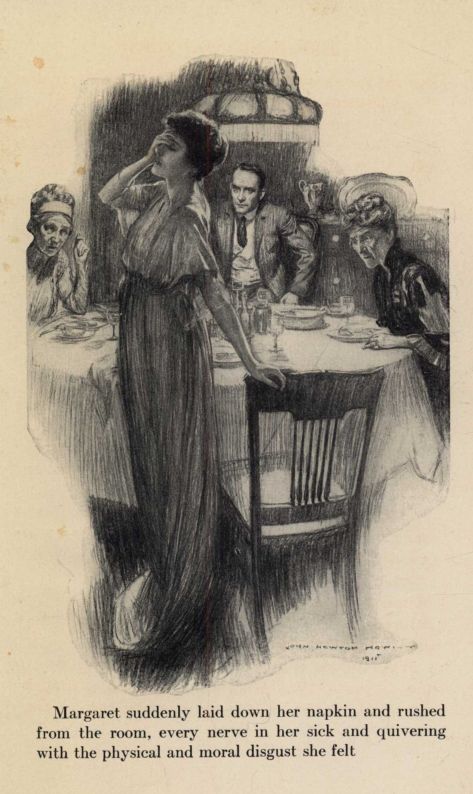
There was an instant's silent, awful consternation, when Margaret suddenly laid down her napkin and rushed from the room, every nerve in her sick and quivering with the physical and moral disgust she felt.
Margaret suddenly laid down her napkin and rushed from the room, every nerve in her sick and quivering with the physical and moral disgust she felt
When before returning to his office Daniel went to their bedroom, where Margaret, weak and despairing, lay prone upon the bed, he found the door locked against him.
"I insist upon coming in, Margaret!"
"Go away!" she faintly called.
"Open the door!" he commanded.
"I won't! I can't! I don't dare to! I'm dangerous! Go away from me!"
"Get up and open this door!"
"If I did, I'd—I'd scratch you! Keep away from me!"
Daniel telephoned for the doctor.
"My gracious!" exclaimed Jennie, as they all awaited the coming of the physician in the sitting-room, "Hiram's Lizzie never carried on like this when she was expecting!"
"No, she certainly didn't," echoed Sadie; "for all she might have had a little more right to; while Margaret, here, coming to Danny without nothing at all, up and sasses him like what she did at dinner yet! Don't it wonder you?"
Daniel, lounging in his own big chair before the fire, pouted like a thwarted, spoiled child.
"What got into her, anyhow, to act so hystericky all of a sudden?" Sadie speculated.
"Saying she'd set fire to Danny's store!" exclaimed Jennie indignantly. "And swearing yet! My gracious!"
"It certainly does, now, beat all!" said Sadie mournfully.
"I certainly didn't think she'd turn out like this!" scolded Jennie. "You hadn't ought to have picked out a wife, Danny, without me looking her over for you first."
"I can't do anything with her!" snapped Daniel spitefully. "Nothing I can say will make her stop running with Catherine Hamilton. She tells me to my face she won't give her up. And she won't, either!"
"Och, Danny, I wouldn't take it off of her!" said Jennie harshly.
"Well, what can a man do?" he fretfully demanded.
"Discharge Miss Hamilton."
"She's invaluable to me. She's in my confidence in a business way. I can't discharge her. It wouldn't matter to her anyway. Every lawyer in town that has any practice would like to employ her. What I'm afraid of is that she'll resign. Oh, if she were afraid of losing her job, then I could easily fix Margaret!"
"It looks, Danny, as if Margaret took up with your clerk just to spite and worry you; for what else would she run with her for?"
"Well, if you'd hear them talking together once!" Daniel sullenly responded.
"Well, if we did?" questioned Jennie curiously.
"You wouldn't understand a word they were saying!" snapped her brother.
"Do they talk so dumb?" asked Sadie wonderingly.
"They seem to think it means something—the stuff they get off to each other!"
"It certainly does spite me, Danny," said Jennie with sympathetic indignation, "to have your wife use you like this! And when I think how you could have married most anybody!"
"Here comes the doctor," announced Sadie. "Supposing she won't leave him in her room?"
"Och, but that would make talk!" exclaimed Jennie. "I'll go up and tell her she has to open!"
Margaret, meantime, her sudden gust of passion subsided, realized how foolishly she was acting.
"I can't say I didn't marry him with my eyes open," she prodded herself. "I have no right to scorn him and fly out at him. I see that well enough, alas! I owe him everything I can reasonably give him to make up for my lack of love."
Her sense of her obligation to Daniel did not, however, and never could, include the denial of such fundamental principles as her friendship with Catherine Hamilton, or her own personal freedom in so far as it did not clash with his just rights.
Margaret was not so stupid as to suppose for a moment that she could, by any utmost effort on her part, lead Daniel to see a case like that of George Trout's store rent as she saw it. That he could flaunt and boast of such "deals" proved him too hopelessly obsessed.
"If he were ashamed of it and tried to hide it, there might be some hope of redeeming him. As it is, I certainly shan't waste myself in any such futile endeavour. But if I outlive Daniel, I shall pay to George Trout or his heirs that eight hundred dollars on the very day that I get possession of my widow's third. Or, if I have a son, he shall discharge that debt!"
However, by the time Jennie knocked on her door demanding admission for the doctor, she was in a sufficiently chastened frame of mind to receive both him and her husband with all the outward semblance of a dutifully happy wife.
XIX
Accustomed as Margaret was to the Southern ideal of the chivalry due to a pregnant wife; reared in a state where a fundamental principle of marriage is that the husband's share in the burden and sacrifice of bringing a child into being shall consist in cherishing the mother of his child with reverence and tenderness, so that her difficult ordeal be made as bearable as unselfish love can make it, and that she be upheld throughout her trial by the man's strength and devotion; and that the husband who did not so regard his wife was a cur to be horsewhipped—Margaret had to learn, during her weary, waiting months, that this attitude of the Southern gentleman would have seemed to the average Pennsylvania German ridiculous sentimentality, his view being that woman was created, in the Providence of God, to be a breeder and that was all there was to it; that in merely fulfilling her natural function she was in no more need of sympathy or help or compassion than a cow in the same condition; that her inclination during pregnancy to tears, tantrums, fretfulness, indolence, a muddy complexion, a phlegmatic indifference to everything except the making of baby clothes, not even her husband getting, at this time, any consideration to speak of at her hands—these things were recognized by him as burdens to be borne either with stoicism, or, for the sake of the child, peremptorily prohibited.
So, it was a matter of wonder to Margaret, rather than of distress, that Daniel should be so extremely moderate in his expression of concern or sympathy for her condition. So used as he was to being taken care of by his sisters, it would have been a wholly unnatural attitude on his part, she saw, to be actively solicitous for a woman. He would have felt he lowered his dignity and made himself absurd if he had put himself out for her comfort in the many little ways he might have done and which she had at first looked to see him do.
But, as Daniel told her one day when she expressed some of the wonder she felt at his lack of chivalry toward her, he had never seen Hiram bother about Lizzie when she was in that condition, and it was after all only Nature.
"A baby's teething is only Nature, but we help and comfort it, don't we? I did expect you'd get a little bit excited over my health! It would all be so much easier to bear," she spoke rather to herself than to him, knowing his impenetrability, "if one were treated as a woman!"
"As a woman?" Daniel inquired, puzzled.
"Yes, instead of as a cow."
"A cow?"
"Treated as a Southerner treats a woman."
"Now I should think," was Daniel's complacent reply, "that when a husband acts toward his wife as I saw your brother-in-law act toward your sister, like a butler or a porter, she wouldn't respect him."
"The mediæval peasant idea that if her husband doesn't beat her, he doesn't love her," said Margaret.
But the dreariness of mind Daniel's attitude caused her she, with a sort of mediæval superstition, almost welcomed as being at least some expiation for the sin of her loveless marriage.
Margaret was disappointed to find, as the days passed over her head, that because of her inability to ride on the cars without great physical distress, she was obliged to postpone the promised visit to her mother-in-law; and at last, when her appearance made the little trip no longer possible, she wrote to Mrs. Leitzel and explained the reason for her not keeping her promise.
"But just as soon as your grandchild is able to travel," she concluded her letter, "I shall bring it (not knowing its gender) out to see you."
It seemed to Margaret that, unaggressive though she was, the weeks before her confinement were constantly marked by contentions, apparently inevitable, between her and Daniel about the many things of life which they viewed from diametrically opposed standpoints. Her monthly account of her expenditures with her ten dollars allowance was one of these points of difference. The first time Daniel asked her to produce the little account book he had given her she took it from her desk, scribbled a few words in it, and cheerfully handed it to him, and he read on one page, "Daniel gave me ten dollars," and on the opposite page, "All spent. Balances exactly."
Daniel looked up from the book inquiringly.
"That's as much of an account as you'll ever get from me, Daniel, as to what I did with ten dollars in a whole month! Did you actually suppose I'd give you the items, like a little school-girl?"
And no amount of persuasion, or of fretting and fuming on his part, could induce her to submit to him an itemized account of her allowance.
Her South Carolina property was another bone of contention.
"I can't get a word from that brother-in-law of yours in reply to my letter to him!" Daniel complained one September evening when they were alone in their bedroom just after supper, Margaret, in a pink silk negligé, lying on a couch at the foot of the bed and Daniel seated in an armchair beside her. "The slipshod business ways of those Southerners! What does the man mean?"
"He's such a procrastinator! I must admit Walter's rather lazy. Clever, though. He's considered a mighty intelligent lawyer."
"A clever lawyer has some sense of business, which he does not seem to have!"
"Don't you be so sure of that!"
"What do you mean?"
"Oh, nothing."
"Well, he does seem to have enough sense of business about him to defraud you out of what belongs to you!" snapped Daniel.
"Walter is an honourable gentleman," Margaret quietly affirmed, "with a sense of honour, Daniel, that to you would be as incomprehensible as a Sanscrit manuscript, or a page of Henry James."
"The quixotic 'sense of honour' of a South Carolinian!" scoffed Daniel. "Oh, I know all about that. Impracticable moonshine! Nothing in it, Margaret. Has no market value."
"No, thank God, it has no market value."
"You're a little simpleton, my dear, about 'values' of any kind, and I wish you wouldn't swear!"
"Can't one thank God except in church and at the vulgar hour of feeding?"
"Be reverent!" Daniel, looking shocked, reproved her. "And I don't see where his sense of honour comes in in his behaviour as to your property!"
"Don't bother about my property, Daniel," Margaret wearily advised. "It's not worth bothering about."
"It's all you have, though," Daniel ruefully retorted.
Margaret offered no reply to this.
"I want you to write to Walter, Margaret, and see whether you can get an answer out of him."
"What about?"
"What about? Haven't I just been telling you? You write and demand of him why I receive no answer from him to my repeated inquiries as to your property."
"But I have told you all there is to know about it, Daniel."
"Margaret," Daniel patiently answered, "I have already explained to you how I can make that estate yield you a handsome income."
"By depriving my sister of a home? No, thank you."
"Naturally your sister would also profit by what I would do for the estate."
"Profit at your expense? Not if you could help it, Daniel."
Daniel laughed appreciatively at this flattering tribute to his business acumen.
"I think I see, Daniel, how you would manage the 'deal.' You'd improve the estate, rent it at a high figure, and keep the rent (at least my share, if not my sister's) to pay you for what you had spent."
"Pretty good, my dear! You have some business cleverness yourself, I see, after all! Sufficient, at any rate, to recognize that you ought to be getting your share of your uncle's bequest. Just inform your brother-in-law, in your letter, that you are going to sign over to me the power of attorney to manage your affairs. That will bring him to time and fetch an answer!"
"But I'm not."
"Not what?"
"Not going to sign away any 'power' I may have. I didn't know I had any. It's a pleasant surprise. I shall certainly hold on to it. I need it, whatever it is."
"Without power of attorney to act for you, Margaret, I can't help you. You'll have to give it to me," said Daniel firmly. "I'll bring up a paper from the office on Monday and Jennie and Sadie will witness your signature. Can't you get up and write to Walter now? I'll dictate the letter."
"I wouldn't rise from this comfortable couch, Daniel, if the house were on fire."
"It's very bad, very bad indeed, I'm sure, for you to lie about so much."
"If you were carrying a weight of several tons, I guess you wouldn't be on your feet when you didn't have to."
"'Several tons?' That's a gross exaggeration, Margaret."
"I never was strong on figures or statistics," Margaret admitted.
"Won't you try to get up and write the letter? I very much wish you to," urged Daniel, still quite unable to credit the fact which in these days frequently confronted him, that any feminine member of his household could fail to jump at his least bidding.
"What do you want me to write?" Margaret parried.
"Great heavens!" Daniel cried, exasperated. "I've told you only about a dozen times!"
"A dozen? A gross exaggeration, I'm sure. And to call upon the heavens is irreverent. There, there, I won't tease you," she patted his hand; and he immediately clasped and held it, for he still adored her. "But as I've told you, Daniel, that I won't sign over to you the power of attorney, there's nothing to write to Walter about."
"Is this your idea of not 'teasing' me? I've said that without the power of attorney, I can't help you."
"I don't want that kind of help, my dear, thank you very much."
"Will you write the letter before I go to the office to-morrow morning?"
"Telling Walter I'm not signing over to you the power of attorney? Is that necessary?"
"Very well, Margaret." Daniel rose with dignity and turned away from her. "I'll dictate to my stenographer what I wish you to say to Walter and I'll bring the letter up from the office for your signature."
"Daniel!" Margaret suddenly exclaimed at mention of his stenographer.
He turned about and looked at her.
"Did you give Catherine the note I sent her this morning?"
"I certainly did not."
"Why not?"
"You ask me to play the messenger boy to my own clerk! I read your silly note, my dear, and burned it."
Margaret, sinking a bit lower among the cushions of the couch, did not trust herself to answer.
"Now, my dear," said Daniel, "since you can no longer go out, you can take advantage of the chance that fact gives you, to drop this unseemly intimacy, which no doubt by this time you find burdensome enough, especially as you have seen how exceedingly annoying it is to my sisters and to me. We are willing to overlook your having flouted our wishes if you'll now——"
"Has Miss Hamilton been to see me and been turned away?" demanded Margaret, who for the past two weeks had neither seen nor heard a word from her friend, her notes and telephone calls having both failed to bring any response. She had been deeply wounded and worried at Catherine's seeming unfaithfulness to her in her time of dire need; and she had suffered keenly from the deadly loneliness that had engulfed her; for she had, through almost daily association for many weeks, become so deeply bound to Catherine that she felt she could never again know happiness if she lost her. While she had indeed suspected that some treachery on the part of the Leitzels was keeping Catherine away, yet she did not understand how her friend could possibly have failed to receive at least some of the communications she had sent to her; letters which she would have supposed must bring Catherine to her side, if she had to storm the house to get there.
"Have your sisters sent my friend away when she came to see me and kept it from me that she was here?" Margaret repeated in a tone so quiet that Daniel never suspected the volcano it covered.
"She has been told by Jennie every time she called that you wished to be excused. This unseemly intimacy is to cease! You will have to understand, Margaret, that I am not a man to be trifled with by a mere woman—a mere girl, I might say!"
"Brave and manly of you, Daniel, certainly."
"If you don't watch out, you will be the cause of my losing the most valuable clerk in New Munich and one to whom I have confided important private business matters, for, if I must, I shall tell her straight that I object to her running after my wife!"
"Oh!"
"I have already hinted to her that you are at last coming to your senses and getting over your silly infatuation for her. I intimated to her that it was only your appreciation of her valuable services to me which had led you to be very nice and friendly to her."
"Do you suppose for an instant, Daniel, that she was idiot enough to believe that?"
"Why shouldn't she believe it?"
"Because she knows me—and she also knows you."
But though Margaret assured herself many times in the course of the wakeful, restless night which followed that Catherine would not believe Daniel's absurd story nor let the family attitude toward her come between them, she really suffered an agony of doubt and fear lest the friendship so precious to her should not be able to stand under the pressure brought to bear upon it.
"Surely Catherine will think I am asking too much of her, to expect her to stick to me through all this! But oh! I can't give her up, I can't! I will not let them separate us!"
The next morning, as soon as Daniel had left the house for his office, she hurried to the telephone and called up Miss Hamilton, knowing that her only chance of getting Catherine was when Daniel was not in his office. She actually trembled with apprehension for fear she should be told that Miss Hamilton had not yet reached the office. But to her joy it was Catherine's own voice that answered her.
"Oh, Catherine! It's Margaret! Catherine, listen! I've been wanting you so! I didn't know why you didn't come, and I only learned last night. Catherine, I'm coming right down to the office, now, in a taxicab, and I want you to come out with me for an hour, for I must see you to straighten things out. Tell the powers that be that you've a headache or small-pox symptoms or something and just come. Will you?"
"I will, dear. I'll leave a note on my desk and walk out now, and meet you at the door when you get here."
"I'll be as quick as I can."
She hung up the receiver. But just as she was going to lift it again, to call the taxicab office, her eyes fell upon Jennie and Sadie congregated a few feet away from her, Sadie staring at her in consternation and Jennie in wrath and indignation.
"Margaret!" Jennie suddenly came to her and forcibly pushed her from the telephone. "You ain't to call a taxicab, so you ain't, Margaret! Our Danny ain't to be spited so when I'm close by!"
"Very well," answered Margaret coolly, "I'll go next door and use Mrs. Kaufman's telephone."
"But," gasped Sadie, "that'll make talk yet!"
Margaret, not replying, started for the door.
"Margaret!" cried Jennie sharply, hurrying after her and catching her arm, "how that'll look yet—you going into the neighbours' to 'phone! You darsent go round to our neighbours' making talk!" she commanded. "I won't leave you do it.'"
"Then will you let me use the telephone here?"
"No, I won't, not for no such a purpose—to go down to see our Danny's clerk when he don't give you dare to. You're near worrying my poor brother to death with the way you act!"
"Please let go my arm, Jennie."
"You pass me your promise, then, that you'll behave yourself. You're all the time raising excitements in our peaceful home that gives Sadie the indigestion!"
Margaret wrenched herself free and went to the front door; but Jennie got there first, turned the key and removed it from the lock.
"I ain't leaving you disgrace us with our neighbours!" she indignantly affirmed.
Margaret, looking white but resolute, went to a side window, raised it, and called into the Kaufmans' dining-room where the family was then breakfasting, while Jennie and Sadie, foiled, but horrified and incredulous of her audacity, fell back.
"Will you please be so very kind, Mrs. Kaufman," Margaret called across the space between the two windows, when Mrs. Kaufman had raised hers, "as to 'phone for a taxicab for me at once. I have to hurry down to Mr. Leitzel's office. I shall be so much obliged, and I'm very sorry to trouble you at breakfast."
"We're just done, Mrs. Leitzel, and I'll be very glad to oblige you. Nothing wrong, I hope?"
"No, but I must get to the office as quickly as I can. Will you please tell them to hurry with the taxicab, Mrs. Kaufman?"
"Yes, of course I will—don't mention it! Your telephone out of order?"
"I can't use it," said Margaret, and with a nod and a smile, she closed the window.
She turned slowly and looked at her sisters-in-law. They, almost leaning upon each other for support, were regarding her as though she were a dangerous lunatic. Without a word, she went past them and upstairs to get her wraps. When she came down five minutes later the taxicab was at the door and Jennie was at the 'phone calling up Daniel's office.
Margaret found, however, that the front door was now unlocked. They evidently felt too uncertain of her to try her any further.
XX
Margaret wondered whether, if Jennie succeeded in warning Daniel of her coming, he would again contrive to prevent Catherine's seeing her.
"Wouldn't it make a good Movie! I might have it copyrighted!" she shrugged.
But she told the chauffeur to hurry, hoping that she might, even yet, get to the office before Daniel got there.
"If I don't, and if he tries to keep Catherine from coming down to me—well, if I didn't look such a sight, I would go right up into the office!"
When, however, the taxicab drew up before the building of which the second floor was occupied by Daniel's law offices, and she leaned for an instant out of the cab window, she saw her husband coming down the street. Jennie, then, had been too early for him. Margaret looked about hastily for Catherine, but she saw nothing of her. She shrank far back, then, in the cab to prevent Daniel's seeing her, for he was now close by.
She saw him hesitate at the door of the building and glance inquiringly at the cab; then, curiosity moving him, for Daniel had the petty curiosity of an unoccupied woman, he came over to the curb and looked into the window of the cab.
Margaret met his glance calmly. All she cared about was that he should not prevent her meeting Catherine.
"Why, Margaret! You out of doors! What for? You came for me? Is anything wrong?"
"I came out for some fresh air."
"But to come out on the street!" he protested, scandalized.
"I'm not exposed to view."
"But the chauffeur has seen you!" whispered Daniel, actually colouring with embarrassment.
"He doesn't mind it nearly as much as you do, Daniel. I think he'll recover; he looks robust."
"But what have you come down to my office for?"
As Margaret at this moment saw Catherine coming out of the building, she promptly answered, "To see Miss Hamilton and clear matters up with her. Here she is now."
Daniel turned about sharply, and Catherine, nodding a cheerful good-morning to him, stepped into the cab and bent over Margaret to kiss her.
"But, Miss Hamilton," cried Daniel as his clerk settled Herself comfortably beside his wife, "why are you not at your desk?"
"I left a note on your desk, Mr. Leitzel, asking you to excuse me for an hour. I shall be back before ten," she replied, drawing the cab door shut and speaking to him through the open window.
"To the park," Margaret ordered the chauffeur. "Good-bye, Daniel."
"Miss Hamilton," faltered Daniel, but before he could collect his wits to decide how he ought to meet so unprecedented a situation, the car started and whirled down the street.
Slowly and thoughtfully he turned into his office building. Never before in all his life had his will been so frustrated as by this young wife of his hearth and home upon whom he showered every comfort, every luxury and indulgence. That any one whom he supported should disobey, defy, and thwart him! It was beyond belief. How did she dare to do it?
"But what's a man to do with a wife who doesn't care for his displeasure any more than if he were an old cat!" he raged. "Oh, well," he tried to console himself, "it won't be long, now, until the baby comes, and then surely she'll be different. She'll have to be! I'll find some means of teaching her that my wishes can't be disregarded!"
Miss Hamilton's note which he found on his desk stated succinctly that she had an imperative engagement this morning which would make her an hour late.
Daniel, sinking limply into his desk-chair, crushed the note in his long, thin fingers and tossed it into his waste-basket, with the murderous wish that it was his clerk's head he was smashing.
"What will they be when they get the vote?" he groaned. "Women," he said spitefully but epigrammatically, "are the pest of men's lives!"
Margaret, meantime, without once directly referring to her husband and his sisters, had managed to convey to Catherine an explanation of the silence and desolation that had existed between them during the past two weeks; and she was now making a compact with her which she felt must insure them both against any future misunderstanding.
"Tell me first, Catherine, that our friendship means more to you than—than any petty considerations! Please, Catherine, tell me that it does! For I just must have you, you know! You are more to me than I can possibly be to you, for you have your mother, while I——"
She hesitated and Catherine said, "And you, Margaret, will soon have your child. Will that make you need me any less? I don't believe it will, dear. And my other dear ones can't in the least fill your place in my life. I can't give you up any more than you can spare me. Nothing," she said with decision, "shall separate us."
"Then," said Margaret, pressing Catherine's hand, "hereafter, when you come to see me, ring the bell four times by twos, and I, knowing about the hour to look for you, will be on hand to let you in myself."
"All right. I will."
"Catherine! You are large-minded!"
"My dear!" protested Catherine, "'large-minded' to be indifferent to the eccentricities of—well," she closed her lips on the rest of her sentence, "two illiterate, vulgar old women," was what she had nearly said; but she left it to Margaret's imagination to finish her remark.
"While you are ill in bed, I suppose I shan't be able to get near you," she ventured. "It will be dreadful if I have to wait nearly a month before I can see that baby! It's going to be awfully dear to me, Margaret! Next thing to having one of my own."
"I couldn't wait a whole month to show it to you. I'll ask the doctor to bring you to me."
"We'll manage somehow," affirmed Catherine.
Margaret, looking rather pale, did not answer, and Catherine suddenly put her arms about her and kissed her.
"You poor child!" she said tenderly.
"I'm not a good fighter," Margaret sadly shook her head. "And there are so many, many adjustments to be made, I——"
She stopped short and bit her lips to keep back the tears that sprang to her eyes.
"At least," said Catherine encouragingly, "you seem to be coming to your ordeal, dear, with plenty of courage; and that's the main thing just now."
"Oh, Catherine, I'm willing to go through a lot for the sake of holding a baby of my own to my heart!"
"Then you think, Margaret, that motherhood is going to be all that it's cracked up to be?"
"Under ideal conditions," said Margaret, "I can see nothing greater to be desired."
"But do the ideal conditions ever exist?"
"I suppose they seldom do."
"Sometimes I've had my doubts," said Catherine. "The male poets and painters exalt the beauty, the holiness of motherhood, and the women bear the burden and pain of it."
"But when women whose lives have had the largest horizon—women like Elizabeth Barrett Browning and Margaret Fuller—have declared that their motherhood was the crown and climax of all their experiences of life, I suppose the poets and painters are not very wrong about it, Catherine."
"I hope they are not, since all my instincts about it are entirely primitive and I feel that nothing in the world will compensate me if I've got to go through life childless."
"There would be one compensation," said Margaret earnestly.
"What?"
"Sometimes, since I've known I was going to have a child, the responsibility, the almost crushing responsibility, has seemed more than I could bear. That's what I meant when I spoke of ideal conditions."
Catherine held back her mental reply to this, which was, "Yes, we should be careful whom we marry, and why did you tie up with a little rat like Danny Leitzel?"
What she did say was: "You didn't feel this crushing sense of responsibility until after you found yourself pregnant?"
"No. Before that I thought only of my own happiness in having a baby to cherish. But, Catherine, when we look about us and see what life can do to us, I wonder how we ever dare, under any conditions, to bring a child into this awful world!"
"We can't question the foundations of the universe, however."
"No, but we can question modern civilization, which produces a huge population of criminals, lunatics, degenerates, and incapables."
"Think of pleasant things, my dear!"
"I try to. To tell you the truth, in spite of my heavy sense of responsibility, I can hardly wait, Catherine, until I have my baby! I want to show you the lovely little embroidered dress Harriet sent me. Will you come in to see it and me this afternoon after four o'clock?"
"Yes."
"I'll be on the watch."
"All right," Catherine nodded.
"The baby received another present, the other day, which touched me very much," added Margaret. "A cunning pair of socks from its grandmother which she knit herself."
"Its grandmother? But——"
"I mean Mr. Leitzel's step-mother."
"Oh!"
"Did you ever happen to see her, Catherine?"
"Once. She came to the office once to see Mr. Leitzel."
Catherine's tone of withdrawal, as though she feared to be questioned, piqued Margaret's interest.
"What was your impression of her?"
"Margaret, your husband's mother has an unforgettable face! There's a benediction in it, such sweetness, refinement, and simplicity shine in her countenance. When she had talked to me for a while, I felt as a good Catholic must who has been blessed by the Pope. Just the sort of person (with a heart too tender to hurt a fly) to be herself easily victimized by the human vultures that prey upon the too confiding."
"Has anybody victimized her?" Margaret casually inquired.
Catherine hesitated an instant before she answered: "Righteousness is sometimes a breastplate to protect the otherwise defenceless. It is that dear old woman's extraordinary conscientiousness that has saved her from being entirely devoured by the vultures, though she has certainly been gnawed at pretty hard. I can't explain to you, now, just what I mean. Some day, perhaps."
"Oh, do tell me, Catherine."
Again Catherine hesitated before she replied: "She made a certain promise to her husband on his deathbed which her conscience has never allowed her to break, though she has always believed that she was acting against her own interests in keeping it. But it's her loyalty to her promise that's been her breastplate; that has saved her from the vultures."
Margaret considered in silence this suggestive bit of information. It was rather more lucid to her than Catherine suspected. But she was impressed with the sudden realization she had of her friend's intimate knowledge of Daniel's affairs and it flashed upon her that perhaps his seemingly unreasonable objections to their intimacy might have quite another explanation than that he had given it.
In this, however, she was mistaken. Daniel entirely trusted the discretion of his clerk. Not so much because he believed her bound in honour to keep his secrets as because it was the part of a first-class clerk (which she was) to be discreetly silent as to her employer's business operations.
"And now, my dear," Catherine broke in on her thoughts, "since we've threshed things out and have made a compact that we will not again misunderstand each other, I think I'd better get back to my 'job.'"
Margaret gave the order to the chauffeur; and when a little while later, alone in the taxicab on her way home, she found her heart overflowing with a sense of the fulness, the richness of life, and considered how strenuously Daniel and his sisters tried to take from her the comfort, the happiness, of companionship with Catherine and how impossible it would be to make them see what that companionship meant to her, she felt greatly strengthened in her resolve to resist, steadily and persistently, their aggressions upon her personal liberty.
At her own door, as she opened her purse to pay for the cab, she found she had remaining of her monthly allowance only two dollars and the chauffeur's price was three dollars. She hesitated an instant, then telling the man to charge the cab to Mr. Leitzel, she got out hastily and went indoors.
"Rather hard on Daniel to make him pay the costs of my plots gotten up to circumvent his plots! He won't like it. Ah, I've a bright idea! I'll tell him to deduct the three dollars from my next 'allowance.' That will appease him."
But on second thoughts she realized that that same bright idea would surely occur to Daniel without any suggestion from her.
XXI
Margaret felt an impersonal curiosity as to what Daniel would say to her when he came home to his dinner at noon. Jennie and Sadie were also curious as to that. But Daniel himself was curious, too. How was a husband to meet such unnatural behaviour in a wife? Did other men's wives so disregard their husbands' wishes and commands? If women got much more independent it would break up the holy estate of matrimony altogether.
He finally decided, on his homeward walk, that about the only course open to him was to take refuge in a dignified silence, though now that Margaret's time was drawing near, he felt sufficiently apprehensive of the outcome to be very leniently inclined toward her. Funny how he cared for her when she treated him the way she did! He could not help it, somehow. She certainly had a way with her! Well, when she was over her trial and quite herself again, he'd have another try at bringing her to a proper sense of the confederation to which he was accustomed and which was his due.
He wondered uneasily what the people of the town thought of this incongruous intimacy between his clerk and his wife. It certainly passed his comprehension as much as it did that of his sisters that a girl as "high-toned" as Margaret was should insist upon being intimate with his stenographer. That Miss Hamilton was equally "high-toned," he was incapable of recognizing. Jennie had voiced his own sentiments when a few days before she had exclaimed, "When she could run with anybody, she goes and picks out an office clerk! It's nothing else, Danny, but that she's bound to act contrary, to show us she don't care if she didn't bring you a dollar to her name!"
However, a letter which he found on the hall table when he reached home diverted not only his own attention, but that of the whole household, from Margaret's case.
It was from the school teacher of Martz Township, who wrote in behalf of his step-mother; and after dinner, as the family sat together, as was their custom, in the sitting-room, for an hour before Daniel went again to his office—Jennie and Sadie fussing about him to make him comfortable, adjusting the window-blind, placing his chair, handing him the newspaper, retying his necktie, brushing his coat collar—Daniel presently opened and read the letter he had received.
Margaret listened to it and to the lengthy discussion which followed with an attention that was to bear early and abundant fruit.
"DEAR FRIEND:
"I am writing for Mrs. Leitzel, to leave you know she had it so bad in her lungs here the past couple weeks the neighbours thought it would give pneumonia, but she got better and now she's up again, but very weak, and I'm leaving you know that we think she ought not to live alone a half a mile away from her nearest neighbour, because if she got so sick that she couldn't help herself, she might die before her neighbours found it out yet that she needed help. And she's too feeble any more to make up her fires and fetch her water from the spring and chop her wood. The house not having any modern improvements, and so much out of repair, it makes it harder, too, for such an old woman. And she has hardly anything to live on. The neighbours say she had either ought to have some one with her, or you ought to take her to your home to live. If not, she'll have to go the poorhouse, and that of course you would not want, either.
"She is better now and says to tell you not to worry, but I warn you she may get down sick again any time, as old as what she is. And I think you have got good cause to worry, though I told her I'd tell you not to. If it hadn't been for the neighbours doing for her this last couple weeks, she'd have died.
"Yours truly, "MAYBELLE RAUCH.
"P.S. She says she sends her love to all and that you have got no need to worry."
But Daniel and his sisters did seem to think they had "need to worry" very much, at the startling revelations of this letter, not the revelations as to their step-mother's sufferings and needs, but as to the neighbourhood publicity given to their neglect of her.
"To think she'd go and have that busybody teacher and all her other neighbours in and complain to 'em all like this, so's they write to us yet and ask for help for her! Well, this beats all! She never went this far before!" scolded Jennie.
"Yes, I don't see why she couldn't leave us know herself if she's got any complaints, and not put it out to the whole township like this!" Sadie worried.
"It certainly will make talk out there!" Daniel frowned.
"Enough to get into the newspapers if she doesn't watch out!"
"But how," Margaret ventured a question, "could she let you know except in the way she's taking, since she can't write herself? And how could she help having the neighbours in if she was ill and helpless and alone?"
"She could anyhow have sent us a postal card to say she was sick and wanted one of us to come out," said Jennie.
"Would you have gone to her?"
"Of course one of us would have gone."
"Maybe she couldn't even write a postal card, or get out to mail it if she did write it, if she's so old and feeble, and was ill."
"If that was the case," said Daniel, "then to avoid a repetition of the occurrence, I don't see what else we are to do but put her into a home."
"You know how she's against that, Danny," said Jennie. "If you decide to do it, you'll have a time with her! And those neighbours all taking her part!"
"This impertinent teacher," said Daniel, tapping the letter he held, "has the face to reproach us, you notice, for not keeping the place in repair! It wasn't our business to keep it in repair when we never get any rent for it."
"Yes, it does seem as if Mom might have kept it in repair when she was getting it rent free," said Jennie. "I don't see why she has not been able to save something in all these years from what she's earnt from her vegetable garden."
"She certainly hasn't managed good," said Sadie.
"And to think of the cheek of those neighbours!" said Jennie wrathfully. "Saying we had ought to take her in here to live with us yet! As if she was our own flesh and blood!"
"What would Hiram say to something like this coming!" Sadie speculated; "when he thinks we did too much in not charging her rent."
"Well," Daniel suddenly announced with a magnanimous air that seemed to swell his chest, "I'll send her a check. I'll send her five dollars. Maybe I'll make it ten."
"Ten dollars yet, Danny!" said Sadie, regarding her brother with affectionate admiration.
"I'm not sure I'll send as much as ten. But anyhow five."
"She'll be sure to show the check around to prove to those neighbours how good you are to her."
"And there will be some among them," said Daniel indignantly, "that will be ready enough to call it stingy!"
"Oh, well, some folks would say it was stingy if you sent her twenty-five dollars yet!"
"If you and Sadie want to put a little to what I send," Daniel tentatively suggested, "we might make it ten or fifteen."
"Well," said Jennie reluctantly, "it ain't fair for you to pay all, either. What do you say, Sadie?"
"Well," Sadie hesitatingly agreed; "for all, I did want to get a new fancy for my white hat. How much will you give, Jennie?"
"Well, if you and I each give two-fifty to Danny's five or ten, that ought to stop her neighbours' talking out there."
"All right," Sadie pensively agreed.
"No use asking Hiram to contribute," Daniel growled, "when he thinks we ought to charge her rent for the place. He gets angry whenever he hears I gave her a little. I told him once, 'If I can better afford than you can to give her a little, and I don't ask you to help out, what are you kicking about?' 'It's the principle of it,' he said. 'If you give her money, it's admitting you owe it to her, or you wouldn't give it to her. Now I contend that we don't owe her anything.' 'Well, then,' I said, 'when I give her a little now and then, I'll put it down on my accounts under Christian Charities. Will that satisfy you?' But no, even that didn't satisfy him. He's all for putting her to a home. And it looks now as if that's what we'll have to do pretty soon," Daniel concluded, rising to go to his office.
Margaret looked on in silence as Jennie and Sadie each counted out carefully from their purses two dollars and a half and passed it over to their brother.
"I'll send a check, then, to mother for fifteen dollars," he said as he put the money into his own purse. "I'll make it fifteen," he nodded. "I'm willing to make it fifteen. That will certainly settle the gossips out there and keep her going for a while comfortably."
He came across the room to Margaret's chair by the window.
"Good-bye, my dear," he said, bending to kiss her; and it took all her self-control not to shrink in utter repugnance from his caress.
"Oh!" she inwardly moaned as she turned to gaze out of the window when he had gone, "what crime have I committed in marrying a man I——"
But even her innermost secret thought recoiled from the admission that she despised her husband, the father of her child.
She went upstairs to her room to spend the time, while she waited for the hour of Catherine's arrival, in putting some last touches to the baby outfit she had made and in writing a note to Daniel's step-mother expressing her sympathy with her recent illness and reiterating her promise to come to see her as soon as possible after her confinement.
"I'll mail it myself," she decided as she sealed and stamped her letter, "or give it to Catherine to mail."
At four o'clock, feeling a little nervous, but quite determined, she went downstairs to await the signal ring at the door. As it was ten days since Catherine had been to the house, Margaret hoped that Emmy, the maid, was off her guard, unless the episode of this morning had caused Jennie and Sadie to renew their watchfulness.
"It's so stupid of them, to say the least, to imagine I'd submit to such interference in my own personal affairs!" she reflected.
She knew their suspicions would be aroused if they found her in the parlour, for of late she spent most of her time in her own room. But she felt quite ready to deal with them as effectively as she had done that morning.
She had not been downstairs long when a ring at the door-bell brought her to her feet, only to sink down again trembling, for it was not the four by twos agreed upon between her and Catherine; and a moment later Mrs. Ocksreider was shown into the parlour. Jennie and Sadie came directly into the room to receive with much satisfaction this distinguished and now frequent visitor who, until Daniel's marriage, had confined her calls on them to once a year; and they looked surprised to see Margaret already there.
"Were you expecting Mrs. Congressman Ocksreider that you're down already?" Jennie suspiciously inquired, when the sisters had greeted Mrs. Ocksreider obsequiously.
"No, but I'm expecting Miss Hamilton," Margaret quietly announced. "I have an appointment with her at four-thirty. When she comes, I shall have to ask you all to excuse me."
Jennie and Sadie looked the consternation they felt at Margaret's audacity, not to say disrespect, in asking such a person as Mrs. Ocksreider to excuse her because of an appointment with that Hamilton girl!
"It's to be hoped," Jennie rapidly thought, "that Mrs. Ocksreider will think it's a business appointment she's got with our Danny's clerk," while Sadie ostentatiously consulted her new wrist-watch to see how soon they might expect the objectionable Miss Hamilton.
"You and your husband's stenographer seem to be great friends," said Mrs. Ocksreider with what seemed to Margaret a rather malicious enjoyment of her sisters-in-law's evident discomfiture.
"We are," said Margaret.
"I've always heard those Hamiltons very well spoken of, as very nice, worthy people," Mrs. Ocksreider said in a tone of kindly condescension. "Where do they live, Mrs. Leitzel?"
That Mrs. Ocksreider shouldn't even know where they lived, put them of course outside the pale. Jennie and Sadie suffered acutely at Margaret's reply.
"They live in a small rented house on Green Street," she said, and added: "One of the few really distinguished homes in our town."
"'Distinguished?'" repeated Mrs. Ocksreider, puzzled.
"I mean, rather, it is a home that has distinction, by reason of its inmates and its furnishings."
"Its furnishings?" questioned Mrs. Ocksreider, still puzzled.
"Its pictures and books and general good taste. One of the few households that have pictures and books."
"Oh, but we all have pictures and books, Mrs. Leitzel!"
"Real pictures, I mean, and real books, too."
"But I'm sure most families of our class have the classics in their homes," Mrs. Ocksreider protested.
"The classics' do help to furnish a room nicely, don't they?" Margaret granted. "But the Hamiltons have books which they read. French and German as well as English."
"Well, of course, a public school teacher's home would be likely to have all kinds of books," Mrs. Ocksreider conceded, "that society people wouldn't buy."
"Of course," Margaret agreed.
"But I don't see why that should make their little home on Green Street what you called it—'distinguished.'"
"But I said the furnishings and the inmates gave it distinction. You see, I know because I am very intimate with them."
"I have heard that you were. It is so nice for your husband's little stenographer that you should take her up like that. It's so unusual, too. She's very fortunate, I'm sure."
"It's rather she that has taken me up. I'm quite proud that she thinks me worth the time she gives me. You see she's more than Mr. Leitzel's stenographer: she's an able law clerk. Mr. Leitzel says she's indispensable to him."
"Then he and his sisters share your enthusiasm over the Hamiltons?" Mrs. Ocksreider inquired in a tone of polite skepticism.
"I am the only one of us all who is intimate with them," Margaret complacently stated.
"I didn't see them at your reception last fall, did I?"
"They didn't come," Margaret readily answered. "You know they don't go into society at all."
Jennie and Sadie felt cold as they heard these shameless admissions, their Danny's wife bragging of her intimacy with people whom she openly advertised as living in a rented house on a side street and as not going into society! Not to go into society was, in the Leitzels' eyes, to be so abjectly unimportant as to make you want to get off the earth. And Margaret flaunted it!
"Ain't she the contrary piece though!" Jennie inwardly raged.
"Ah!" Margaret almost jumped from her chair as the door-bell at this moment rang "four by twos."
"That's Miss Hamilton now," she announced, rising and walking as quickly as she could (which was not very quick) across the room. "Will you please excuse me, Mrs. Ocksreider? I am sorry, but it is an appointment——"
But as she reached the door which opened into the hall, she saw the front door closed abruptly by Emmy, the maid.
Instantly stepping back into the parlour, Margaret hurried to the window, rapped upon it, then raised it and leaned out to speak to Miss Hamilton on the pavement. "Emmy made a mistake; I am at home, Catherine. Come back, and I'll open the door."
She closed the window and again made her way heavily across the room, smiling in a friendly way upon Mrs. Ocksreider as she passed her. "A mistake of the maid's. I'm seeing so few people just now," she dropped an explanation on her way.
Mrs. Ocksreider's subsequent description of the scene, in which the Leitzel sisters' horror at Mrs. Leitzel's innocent candour about "those Hamiltons," and the young woman's clever outwitting of her two would-be "keepers," afforded most delectable entertainment to New Munich society for two months to come.
XXII
It was late in October that the twins were born, a boy and a girl, and Margaret did not rise from her bed for a month. It was six weeks before she got downstairs.
Long before the trained nurse left her, she realized what, before her confinement, she had dimly foreseen, the struggle to the death which she would certainly have with Jennie's strong prejudices in favour of old-fashioned country methods of taking care of a baby. It was only the doctor's powers of persuasion that induced the nurse, harassed beyond endurance by Jennie's interference with her methods, to remain with her patient until she was no longer needed.
"You poor thing, you certainly are up against it!" was her parting bit of sympathy to Margaret. "She'll kill off those precious twinlets for you, or she'll kill you. One of you has got to die! The woman's a holy terror, my dear! And the other one, that wears Mother Hubbards and Kate Greenaways and Peter Thompsons and Heaven knows what, she's nearly as bad as her sister about these babies. I don't know what you're going to do! You may be able to protect them when you're with them; but you've got to get out sometimes for an airing without dragging the baby-coach along, and those two"—indicating, with a twirl of her thumb, the twins' redoubtable aunts—"will certainly kill off your babies for you while you're out."
"If you're sure of that I'll never go out."
"And you can't look for your husband to help you any," continued the nurse. "Crazy as he is over the twinnies, he'll help the old ladies kill them off, because he thinks their ancient ideas are right. The old ladies, for that matter, are nearly as crazy over the babies as he is. You'd think nobody but Mr. Danny Leitzel had ever had twins before. I never saw such a looney lot of people. But it's their love for those children that's going to make them kill them, for it does beat all the way you can't knock a new idea into any of them."
In the very hour of the nurse's departure, Jennie, supported by Sadie as always, swooped down upon Margaret to insist, with the triple force of conviction, of tyranny, and of her love for Danny's precious babies, that they be brought up as she knew how babies should be, and not by the murderous modern methods of exposing them to the night air, of bathing them all over every day even in winter, of feeding them, even up to the age of one year, on nothing but milk, of taking them outdoors every day in winter as well as in summer.
"Many's the little green mound in the cemetery that hadn't ought to be there!" Sadie sentimentally warned Margaret. "So you let us teach you how to take care of Danny's babies!"
Well, the conflict or convictions between the mother, on the one side, and the aunts and the father on the other, was not settled in a day, nor yet in a week. It was, indeed, prolonged to the inevitable end. But while the strife and tumult of battle raged, the mother's will was carried out, at the cost to her of a nervous energy she was in no wise strong enough to expend.
The fact that the twins thrived wonderfully under Margaret's régime did not in the least modify the Leitzels' prejudice against it. Daniel could not help believing profoundly in the wisdom of his sisters, since they had made such a success of him. And never once in his life had he failed to "come out on top" when following their advice. He admired and respected them; and he felt as much affection for them as he was capable of feeling for any one. So that, with his loyalty to them challenged by that force which to most men is the strongest in life—the love of a woman—the atmosphere of his home was, just at present, rather uncomfortably surcharged.
But in spite of this and of his actual bewilderment at the continued obstinacy of a wife who, though tenderly beloved, indulged, and petted, dared to stand out against not only his sisters but against himself, Daniel was so radiantly proud and happy at finding himself the father of a son and daughter at one stroke that he discussed with every one he met the charms, the characteristics, the food, and the habits of his offspring; told his colleagues in business what food-formula agreed with his girl baby, who was being brought up on the bottle, the mother being able to nurse only one child and that one being, of course, by his wish, the boy; delivered to every one who would hear him his views on Modern Fallacies in the Care of Infants; and invited the opinions even of his employees as to suitable or desirable names for the daughter, the son being of course Daniel, Junior.
It was one mild day in January, when, after a siege of more than usually bitter opposition on Jennie's part to the twins being kept on the piazza all the morning, Margaret found herself, during the afternoon, in a blessed solitude in the family sitting-room, Jennie and Sadie having gone out calling. So tired and heartsick was she that she did not even feel any desire to call up Catherine and ask her to share her few hours of freedom from interference and fear of harm to her babies. The twins were again healthily sleeping on the porch outside the sitting-room and Margaret gave herself up to the sweet peace of this respite, reading, dreaming, resting, when presently the door-bell rang, and a moment later Emmy ushered into the sitting-room a feeble old woman dressed in the plain religious habit of the Mennonites.
Margaret instantly knew who the visitor was, and as she went to her, took her two hands in both her own, kissed her and looked down into the motherly old face with its expression of childlike innocence and sweetness, she was thankful that the rest of the family was not at home and that she could for a little while bask in the warmth of this kindly human countenance.
When she had made her visitor comfortable in Danny's big easy-chair before the fire and had had Emmy bring in some hot tea and toast, the old woman's beaming gratitude betrayed how unlooked-for were such attentions in this home of her step-children.