Book 1 — Chapter VII
Reading edition
Wherein, at the Request of Lady Katharine Clanranald, whom he loved, Sir Hugh Richmond takes up the Tale, relating what happened to him in the Tolbooth Prison
Lady Katharine Clanranald has asked me to make this personal contribution to her veracious narrative.
I shall not soon forget the mystification and surprise of worthy Master Dunner, counsellor-at-law. I could well understand his amazement. That the emissary of the King, presumably bearing the royal warrant for his patron's execution, should appear at his carefully selected hiding-place in the company of her ladyship was surely inexplicable.
His wonderment and admiration grew after we had entered the dining-room and were seated about the table partaking of the excellent repast his worthy factotum had provided when, with some promptings from me when she would fain have minimised her own heroic part, the adventures of Lady Katharine were related to him. His legal mind was quick to grasp the salient fact that the warrant had been destroyed and that no execution could take place, therefore, until it had been supplied by a new one. When this fact had been thoroughly apprehended to his satisfaction, he had time to give thought to other matters, and he proceeded to cross-question us both with a searching power by which he learned everything that had occurred.
"Why," he asked me, "did you determine upon this quixotic action which would result in such serious consequences to yourself, sir, were it disclosed to the King?"
"Master Dunner," said I meaningly, "if the good reason for my action be not apparent to you, then all I can say, sir, is that you are a very blind man."
At which her ladyship blushed divinely. She looked charming as a boy, so winning, indeed, that I could scarce imagine her fascination enhanced by any change of apparel whatsoever, and I should have kept her a boy forever were it not that I could not see how in that capacity I could change her name from Clanranald to Richmond, which I was firmly purposed to do at the first convenient opportunity, provided her consent could be obtained, and of that I was bold enough to feel hopeful.
"Sir Hugh," she said, almost in answer to my unspoken thought, "I have to thank you for kindness so great that I know not how I shall ever repay you."
"I have rendered you some slight service, madam, a tribute to your gallantry and devotion, as one soldier might to another, and there is no word of repayment ever to be mentioned betwixt us," I said. "But now it grows late. I am expected at the castle to-night, I infer from what Master Dunner hath said, and it will be necessary for me to take my departure without further delay."
I drew forth from my pocket, as I spoke, the wallet of which my lady had despoiled me and which she had returned to me, and, asking for pen and ink, I gave to Master Dunner such writings as, in his judgment and mine, would enable him to command the sum of seven thousand pounds, which, with what he had, would complete the sum of ten thousand with which to approach the King. Master Dunner was very careful to give me such security as he could, acting as the Earl's agent and jealous for his patron's honour, and promised speedy repayment of the loan. Lady Katharine made some demur, but between us we easily overruled her: I, because I was determined that my quixotic impulse should be carried out; and Master Dunner, because he would have taken anything from anybody to save his patron. The transaction was soon over, and I arose to take my departure.
"I have a word of advice to give," I remarked, ere I said good-bye. "Whatever you do, do quickly. It is quite late. I may have difficulty in getting access to the Lord Chief Justice or the military commandant. Possibly I shall not see them until the morning. No messenger, it is likely, will be despatched to the King until late to-morrow."
"I will ride to the King myself early in the morning," said Lady Katharine immediately. "You told me that he would be at Durham by the time I could get there."
"Ay," replied I, "but it will be a hard ride for a woman."
"I will go just as I am," returned her ladyship.
"Your wounded shoulder?"
"A night's rest will put that to rights."
"Have you none other who can go?"
"I have only two friends," returned her ladyship—and her appreciation really thrilled me—"Master Dunner"—she hesitated—"and yourself, Sir Hugh," she continued, extending her hand.
I do not know what made me do it. I had kissed it in the carriage like a courtier. Now I took her fine hand in my own and shook it well.
"As one soldier to another, lad," I said, clapping her lightly upon the shoulder for the third time. "'Fore God, I like you well, and, when the time comes, I should be glad to have you in my company," I said, with double meaning, "forever."
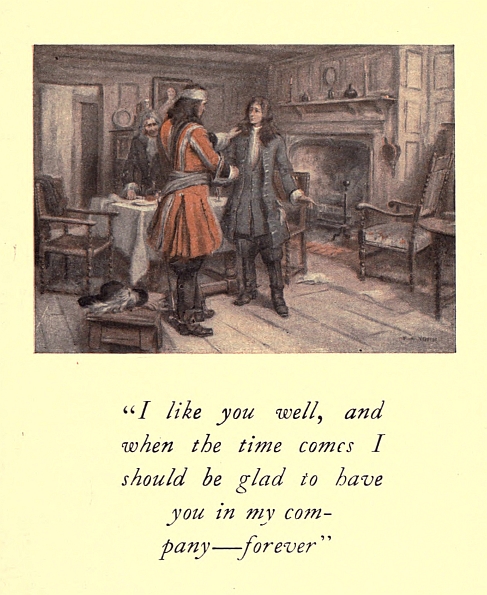
"I like you well, and when the time comes I should be glad to have you in my company—forever"
"Should I enlist as a soldier, Captain Richmond," returned my lady, saluting gallantly with her disengaged hand, "I should like no better fortune than to follow your flag."
I dared not trust myself to continue the conversation in this vein. There was no doubt about it, although I be writ down here as a fool, I was head over heels in love with this beautiful and daring woman. She had captured my heart as completely as she had captured my person back on the highroad. I was helpless before her. And only the fact that she was in some small measure in my debt prevented me from carrying her heart by escalade. I would have taken it by storm like a soldier had it not been that gratitude might have inclined a capitulation, which I would not accept unless it came from an interest and affection that equalled my own.
I answered her salute in kind, therefore, and, not trusting myself to say another word, turned on my heel and went out, accompanied by Master Dunner, who desired to walk a space with me and talk further about these various matters. He begged Lady Katharine to retire at once and get such rest as she could, if she persisted in her determination to ride south in the morning, and he promised to be with her betimes.
"Sir Hugh," he began, as we walked along the almost deserted street,—the house being in one of the meaner quarters of the city for safety,—"it is idle to attempt to disguise from me that you have placed yourself in a position of considerable danger."
"I did not choose," said I, "to dwell upon that in the presence of her ladyship, for obvious reasons."
"I understand," said the old lawyer gravely, and yet with a little twinkle in his eye. "Your interest in her ladyship can only arise from one cause."
"You are not so blind as I fancied, Master Dunner," I returned, smiling. "I confess to you, I have never met a woman of her spirit, her wit, her resource, and, if I may judge from what I see, of her beauty, of..."
"You may spare me the catalogue of her ladyship's attractions," said the old man drily, "not because I am not fain to hear you dilate upon them, but there are other matters more pressing which must be considered between us, and more interesting as well."
"There is nothing more interesting," said I—and if I had been a young cornet instead of a veteran captain of horse well on his way to majority, who indeed might have commanded a regiment had he chosen to give up his place in the King's bodyguard, I could not have been more reckless in my speech—"than discussing Lady Katharine, but what you say is true. I cannot and need not disguise from you that my position is somewhat perilous."
"Exactly," returned the lawyer. "You have been robbed of the King's warrant here in Scotland. The act is more than highway robbery; it is treason. The fact that the only warrant that is taken is Clanranald's points to some adherent of that house. It is possible there are those who will say that the resistance you offered was not so vigorous as you might have made, despite that bandage upon your forehead. You may have been observed. Indeed, I am sure you must have been, for you have admitted to me that you gave your full name and rank most imprudently at the city gate and at Musselburgh as well. Perhaps some one may have heard your conversation with Lady Katharine in the wood. In short, sir, I need not refrain from telling a soldier that you are in grave peril of being attainted for treason yourself as an accomplice—and, forgive me, that you certainly are—to a treasonable attack upon the King his privilege."
"Even so," I replied. "But I can honestly give my word that the warrant was taken from me by force, and back it with my oath were that necessary; that I did not surrender it willingly; that I did everything that I could to retain and defend it, and that it was not until I was senseless from a bullet wound that I lost it. I have not failed in my duty."
"Except," said Master Dunner, "you have not given up to justice the assailant whom you captured after the assault."
"Lady Katherine?" said I.
"Exactly," was the answer.
"Well, my only defence for that is Lady Katharine herself."
"And how far think you would that go in a court of justice?"
"Before a jury of soldiers, a long distance," I laughingly replied. "But, jesting aside, I realise all that you say, and, were any harm to come to the King from my action, I should feel differently, and I should have acted differently. Lady Katharine Clanranald made a brave play for a few days' delay, and all I have done is to assure her that she shall have the time for which she struggled. If the King persists in his determination that the Earl shall pay the extreme penalty, why, no great harm will have been done by the few days' respite which he will enjoy. And if, on the contrary, his daughter's enterprise meet with its proper reward, a great harm will have been avoided. Therefore, I justify myself for what I have done, and hold it not inconsistent with my honour as a man, my obligation as a subject, or with my duty as an officer."
The reasoning was specious, but, specious or not, it had to serve.
"I am glad to see you in so reasonable a frame of mind," continued the advocate. "We are now upon the High Street. If you will refresh yourself in the inn yonder, I will have your horse brought to you and you can then ride to the castle and report to the Governor and the Lord Chief Justice while I turn these bills of exchange into drafts upon London. It would not advantage your cause, should you fall into difficulties, if I should be seen in conversation with you. But should you need an advocate, I recommend to you Master William Abadie, a skilled and learned counsellor-at-law, and my very good friend, through whom my own poor talent will also be at your service freely."
"I thank you," said I, "and I will await my horse here."
We parted with mutual expressions of esteem, and, though I have little affection for lawyers, I own I never met one that I liked better than Master Dunner. If I got in trouble and Master Abadie proved as agreeable, I should be in fortune. I ventured to charge Master Dunner, ere he left me, with a message of reassurance to her ladyship, which he promised faithfully to deliver, and I engaged his good offices as well to represent my conduct to her in the proper light should occasion serve.
My horse was soon brought to me, and I made my way without difficulty to the gates of the castle, announced my name and rank, and demanded to see the commandant without delay. I was ushered into the presence of General Ramesay. He was seated at a table in his office, and by him in another chair was another man of imposing, if somewhat legal, aspect. General Ramesay received me with a certain abruptness, which was somewhat disconcerting. However, I was not called to be a censor to his manners, and, so long as he was decently civil to me, I had no reason to make any complaint.
I reported briefly that I had been stopped on the road from Cockenzie to Musselburgh that morning by a highwayman, with whom I had had an encounter; that, although I had wounded him in the shoulder, he had been fortunate enough in an exchange of shots to strike me in the head; that his bullet had laid me senseless in the road, whereupon he had taken my despatch-bag, broken it open, extracted therefrom the warrant for the execution of the Earl of Clanranald, and made off with it; that I had come to my senses, and, without a horse, had availed myself of such means as presented to reach Musselburgh, where I had bought the animal I had left outside, and I now delivered my other despatches and reported myself subject to his orders.
General Ramesay heard me without interruption. When I finished my brief recital, in which I told nothing that was not absolutely true, although I was very careful not to tell everything that happened, it was the man on the other side of the table who spoke. His accent was decidedly Scottish. His manner was harsh, imperious, and severe. I felt instinctively that trouble was to be looked for from him. He had some notes scribbled upon a sheet of paper before him, which he drew closer and examined carefully through a pair of great horn spectacles before he spoke.
"You lay last night at Cockenzie you said, Captain Richmond?"
I turned to General Ramesay.
"Sir," said I, "I am quite willing, in the exercise of my duty, to answer any question, to obey any order from you, my superior officer, but before I reply to this gentleman, will you kindly advise me as to..."
"This is Sir Alexander Forfair, Sir Hugh," said the General. "The Lord Chief Justice of Scotland. 'Tis he to whom the warrant was to have been delivered."
"I beg your pardon, your lordship," said I, bowing to the old man.
He wasted no time in ceremony.
"Your answer to my question, please."
Although I did not at all fancy his manner, and saw indication of trouble for me therein, I promptly replied in the affirmative with the best grace possible.
"You had as a companion at table a young"—he paused—"gentleman?"
"I had, sir."
"What was his name?"
"He told me that it was Carthew."
"Have you any reason for believing that that name was assumed for the occasion?"
I was silent.
The Lord Chief Justice was skilled in reading men, and he saw at once that he need press that question no further.
"He answers not, mark you, Ramesay," he said, turning to the General.
"Sir Hugh," said the old soldier, with whom I had some acquaintance, having served under him previously, "as a brother officer, and I may say as a friend, I advise you to be entirely frank with his lordship. You stand in a position of some peril."
"Pardon me, General Ramesay," interposed the other man. "We need not dwell upon that at present. Sir Hugh doubtless understands his position. He is experienced enough to know how grave it is and what the consequences of his refusal to answer would be."
I knew well how serious the position might be if these men knew all that I had done, but that they could know it was beyond belief. I determined, whatever might betide, not to betray Lady Katharine. I was in for it, I supposed, and I did not disguise to myself the gravity of the situation in which I had become involved.
"We know more," resumed Sir Alexander Forfair, "of your movements than you imagine, sir. We know that you and this young man were extremely friendly on last night; that you parted after an evening spent together on the most amicable terms; that the young man left before you did; that some sort of an encounter, as you allege, took place in the wood a few miles this side of Cockenzie. We know further that you and the young man rode together in Lord Leven's coach to Musselburgh; that you and he came a-horseback to Edinburgh, and that you are now here alone."
It was not difficult for me to see whence this information had come. My horse had gone back to the inn at Cockenzie. The landlord had sent a messenger immediately, who had observed the blood and evidence of struggle in the wood. He had galloped on to report the adventure to the authorities at Edinburgh. They had been looking for me. They had learned in some way of our ride to Musselburgh, probably from the coachman, who would be apt to talk about it, and our entrance through the city gates an hour since had been doubtless reported.
What a fool I had been! I had permitted myself to be robbed by a woman and had become so infatuated with her that the simplest precautions had escaped me. I stood absolutely convicted. There was no defence I could make; no explanation in the least degree plausible that I could urge. In one moment the peril of the situation burst upon me. Lady Katharine's act had undoubtedly been treason. I stood as an abettor and participant therein. My only salvation would be to tell the whole truth and throw myself upon the mercy of the Justice and the King. If I did that, I had no doubt that I might escape with no more severe punishment than a reprimand. But that was the one thing I could not do. I had put my head in a noose, or under the axe rather, having previously fettered myself, hand and foot. I was helpless. What I should have been glad to have done for love of her ladyship, I had now the added incentive to do for my honour's sake. No gentleman, under such circumstances, could have betrayed a woman.
"Now, sir," continued the Chief Justice, as these thoughts ran lightning-like through my head, "what have you done with the royal warrant for Clanranald's execution?"
"It was burned," I answered.
"Who burned it?"
"The highwayman."
"And you permitted it?"
"I had naught to do with it, lying senseless in the road."
"Do you deny that the young man with whom you supped at Cockenzie and with whom, doubtless, you arranged this pretty little play was the highwayman?"
"I deny nothing, sir, neither do I affirm anything, save that there was no arrangement between us; that I was assaulted upon the highway; that I made the best defence I could, and that I was wounded."
"Do you deny that you were thereafter this day in company with this young man?"
A thought came to me.
"I will take oath, sir; I will pledge my word as an officer and a gentleman that I was not in company with any young man during the whole day, save such chance companionship as was thrust upon me by the inn-keeper at Musselburgh, the men from whom I bought horses, and so on," I protested warmly.
General Ramesay of his kindness here did me a good turn.
"I have known Sir Hugh Richmond these many years, my lord," he said to the Chief Justice; "we have served together and I would stake my life upon his honour."
"I have heard the testimony of many men," said Sir Alexander. "I think I am as able to tell when a man is speaking the truth as any judge in all Scotland. I beg to assure you, General Ramesay, and you, Sir Hugh Richmond, that I not only believe but know that you are speaking truthfully, for the man who held you up on the highway, with whom you rode to Musselburgh, with whom you entered the city, was a woman. What is her name?"
If a bombshell had exploded at my feet, I could not have been more amazed.
"That," I said at last, with such firmness as I could muster, "I decline to state."
"Sir Hugh Richmond," continued the old man, pointing his finger at me, "I rather like your bearing and appearance. I have no doubt what you say is, in the main, true; that you were robbed on the highway by a woman."
He laughed grimly, and, while I was willing to be robbed by her ladyship, I could have killed him for the mocking sneer in his voice. It is one thing to be robbed by the woman you love; it is another thing to be twitted about it and have the world throw the fact in your face.
But I could do nothing. It was part of the price that I would have to pay for the winning of her ladyship, which had become the chief object of my life, from the moment I held her wounded and senseless in my arms by the brook-side in the wood.
"But, sir," continued the Chief Justice, "while I, for one, am rather glad that the warrant hath not reached my hand, for I understand that a petition for pardon, with a full statement of certain circumstances which render it reasonable, is to be presented to the King, yet all this has nothing to do with your conduct. You are constructively guilty of the gravest dereliction of duty and of high treason, and it becomes my duty, sir, to see that you are arrested and tried forthwith. The fact that you have done this halfway under compulsion, and halfway out of foolish regard for a petticoat, or that which should have worn one I would better say, may mitigate your offence in the eyes of frail mankind, but the law takes no cognisance of that. I think, however, that I may promise you clemency and my interest with His Majesty, which is not small, as well, if you will disclose to me the name of your accomplice, the woman in question."
"That, sir," said I, bowing to the old man, "is the one thing which as a gentleman, if not as a justice, you will perceive that I can by no means declare."
"As a gentleman, sir, I am not discussing this matter, but as a justice."
"Then, sir," said I, "we have no common ground on which to meet."
"You may pay," said Sir Alexander, smiling grimly at my repartee, "for your silence with your head."
"At least, sir," I answered, "'tis better to pay with my head than with my honour."
"There is not a woman in Edinburgh," said my lord reflectively, "or in Scotland, that I know of, who could do this thing, unless it were Clanranald's daughter."
I was a veteran; I am glad to say I did not change colour or manifest the slightest emotion, although this arrow drawn at a venture had hit the mark.
It was General Ramesay who interposed at this juncture to relieve what might otherwise have been an embarrassing pause.
"She hath been searched for throughout Scotland. She hath vanished completely since her father's apprehension, and it is believed she is now in England," he said.
Would God she were, thought I.
"Well," said Sir Alexander, "whoever it was, she must be found. 'Tis not safe that such a woman should be at large."
He rose to his feet as he spoke and bowed grimly but not ungracefully toward me. Indeed I rather liked this stern old Justiciary.
"Sir Hugh Richmond," he said, "speaking as a man, and not as a justice, I will admit that there is some reason for admiration and protection and alliance with a woman of that stamp, if her person accord with her courage."
"Sir," said I, bowing in my turn, "her spirit is above all praise, and her wit and her beauty are beyond even her enterprise."
"I take it," continued Sir Alexander, "that if you escape the block, Sir Hugh, you will be a lucky man in more ways than one."
"Even should I not escape, sir," said I, "I shall count myself fortunate in what I have been able to do."
"As a man," continued Sir Alexander, stepping closer to me, "I offer you my hand."
I shook it heartily as he continued, turning to withdraw:
"And as a justice, if I have to sentence you, it will be with a very grave regret. General Ramesay, with this information laid before you, attested by the landlord of the inn, the physician at Musselburgh, the soldiers on watch at the gate, Lord Leven's coachman,—you see we have agents everywhere and spies as well in these troublous times, Sir Hugh,—you will, of course, put this gentleman under immediate arrest, and keep him in close confinement, pending the formal presentation of the charges, the trial, and the King's pleasure."
After having thus boldly laid his cards upon the table and revealed the course by which our movements had been traced, and how he got knowledge that my companion was a woman, the Lord Chief Justice bowed to us both and left the apartment. General Ramesay summoned his guard, demanded my sword, placed me in ward for the night, allowing me to use one of the rooms of the castle upon my parole. At my urgent request, he forthwith sent a messenger for Master Abadie, urging him to come to me without delay. I was then left to my own reflections.
Well, I had done that which had brought my fortunes to a pretty pass, but, when I thought of Lady Katharine, I could not bring myself to regret it as I should. I had somehow a confident hope that Fortune, which had thus favoured me in permitting me to make her acquaintance, would be of service to her and see me through this coil of difficulty.
My head ached furiously, as it had off and on, from the wound, but I welcomed every pang with pleasure, for was I not suffering for her, and did I not know by intuition that she would be acutely conscious of every pang that I felt? Indeed, I think I was inclined to luxuriate a little in my martyrdom, and, although I was not base enough to declare the situation to Lady Katharine, yet I knew that she would hear of it sooner or later, e'en though I used every precaution to keep it from her.
Indeed, I realised that I must get word to her in some way of the fact that her venture was known; that my companion was discovered to be a woman, and that, if she wanted to get out of Edinburgh, she must do it that very night. Well it was for me that Master Dunner had given me the name of Master Abadie. It was through him that I must communicate with Lady Katharine at once.