Book 1 — Chapter IV
Reading edition
Wherein I played the Highwayman and what befell me on the Road
I retired to my chamber in a great state of perturbation. I had made the captain's acquaintance; I had some idea of his temperament and quality; I had gained, to a certain degree his confidence and won, in some measure, his regard, it appeared. There was no doubt about his liking for me. Yet I was no nearer the accomplishment of my purpose than before, and the sight of the captain had not reassured me as to its entire practicability. He could jest and discourse idly with me, and play and eat and drink like any other man and soldier, but I instinctively realised that in an emergency it would be a bold, a ready, and a resourceful person who could get the better of such as he.
In the parlour of the inn he was one man; on the road to-morrow he would be another. I could match him at repartee easily enough, but when it came to a quick eye, a steady hand, a daring heart, I would be sadly lacking. There was no comparison between us on the score of efficiency. In so much as I fancied that I surpassed other women in physical ability, so I was sure that in the same degree he surpassed other men. Only the desperation lent to me by my father's grave peril would tend to equalise conditions between us.
I said that he liked me. I liked him. He differed from the gentlemen with whom I had been acquainted. He was more a man of the world than any. His coolness, his personal distinction, even his age, attracted me. I wished that he had been on my side. I could have trusted him with the wild undertaking I was now endeavouring to bring about, and I could have rested quite confident that he would succeed in it.
Yes, marvellous as it may seem, I could have viewed his claiming the inevitable reward with a certain degree of equanimity, if equanimity be the word to describe a wildly fluttering, beating heart such as my own. He inspired my confidence and something more.
My mind swiftly reverted to his ideal woman. I was not vain and foolish, I trust, and yet was I not tall and fair? Was there not sunshine, or had there not been sunshine in my long locks before I cut them off? Were my eyes not the blue of which he spoke? Was not my figure plump? I examined what was visible of it with another burning blush, wondering if he had marked it. Could I not ride and hold a sword and fire a weapon without shutting my eyes? Did I not have learning enough to match me with this...
Pshaw, the man was nothing, could be nothing, to me except my enemy. And all such speculations were indeed idle. If I had time and could appear before him in my proper person, I might win his devotion did I desire it, I made no doubt.
But I had no time. I had to get from him to-morrow, in some way, by some means, the fatal warrant. How? His chamber was across the hall from mine. Could I effect entrance therein in the middle of the night, and, unobserved, steal the despatch-case in which, doubtless, he would carry it? It might be done, but suppose he awoke and seized me there and found me a woman?
I shivered at the thought. What would he think of me in such a case? On the other hand, what did I care what he thought of me so long as I got the warrant?
But if I were caught, would I not have to pay the price, lose all, and get nothing? It could not be.
Was there any way in which I could win it from him by finesse? None. By cajolery? Men do not cajole men. And if I said, or he discovered, that I was a woman, I would be helpless.
There was but one way: I should have to take it from him by force. I, a woman, to all intents a slender stripling, would have to overmaster this veteran soldier! Well, I swore that I would do it. I would stop him in the highway, be the risk what it might.
A long time I made plans, only to dismiss one after another until, at last, I hit upon something that seemed to give at least faint promise of success. I would stake all upon that. I could do nothing else.
Slipping off my boots and coat and loosening my clothes slightly, I threw myself down upon the bed, having left directions that I should be called by four of the clock, and fell into a troubled sleep, full of anxious dreams born of my strange plight.
I was up betimes, hastily dressed myself, and descended to the taproom. It was still dark. I knew that Sir Hugh would not be called until daybreak, that he would order breakfast ere he started, and that I should have probably an hour for my purposes. Bidding the sleepy maid to get me some kind of a meal, I went out to the stables to look to my horse.
There were only two strange horses in the stalls, mine and this soldier's. Our saddles hung side by side on pegs. Awakening the ill-tempered hostler, I despatched him to the taproom to bring my saddle-bags and to draw a bucket of water for my horse. The instant he left the stable, I ran to Sir Hugh's saddle and drew the pistols from the holsters. They were a pair of heavy, serviceable, soldier-like weapons. I had a fit of trembling at the idea that they might be pointed at me.
To unscrew the ramrods and draw the charges was the work of a few moments. I was in a desperate hurry and, fortunately, got the pistols, still primed, back in the holsters before the stable-boy came in. I tossed him a crown to relieve his spleen, and bade him get my horse ready quietly and bring him to the door of the inn within ten minutes.
Then I went back, hastily partook of such breakfast as was set before me and paid my reckoning to the landlord, who had by this time come sleepily down the stairs. I left a message for Sir Hugh Richmond that, being nervous and having passed a sleepless night, I had risen early, breakfasted and had ridden on ahead, and would progress slowly that he might overtake me on the road at his convenience. Then I clambered to the saddle and rode away in a rare state of perturbation indeed.
Coming to Cockenzie the day before, I had marked a place where the road bent sharply away from the shore, on account of the broken nature of the cliffs, and plunged for the space of a mile through a stretch of woodland. Such a place, if fortune gave me the least favour, would be most advantageous for my purposes. There I had determined to play the part of highwayman.
When I reached the spot, I drew away from the road beneath the trees and made a careful survey of the situation. I found that I could sit my horse under the shelter of the trees, myself unseen, although with a clear glimpse of the open road leading to the forest, and could easily burst out upon a traveller coming around the bend without giving him the least previous warning.
It was still early in the morning—in fact, it was not yet full dawn—when I reached this point, some miles from the inn, and I hoped that no other traveller on the road would inconveniently appear to balk me in my desire. Fortunately no one was abroad then. The place and road were lonely and deserted.
I had plenty of time to make all my preparations. I carefully examined my pistols and saw that my sword was ready at hand. If Sir Hugh had examined his own weapons critically and had recharged them, if I did not kill him first I should probably be shot dead.
The alternatives before me were simple, I reflected with a faint heart. Before an hour, I should possibly be murdered or be a murderess myself. I liked neither the one possibility nor the other. If Sir Hugh had not recharged his pistols, it was likely that I could get his despatch-bag, but probably only after I had shot him, for I realised that a man such as he would never give up a charge upon a mere demand or threat such as I had at first hoped might suffice.
Well, I knew all this before. There was no use repining at it now. I played for a great stake—my father's life. That stood higher with me than the life of any other man or woman, including my own. I would carry out the enterprise with determination to the end as I had planned, whatever the consequences to myself. But I would that the necessity had never been laid upon me, a helpless maiden.
It is simple enough and easy enough to say all this, but it was by no means easy or pleasant to think on at the time, and I own that no hour I ever spent dragged as that one. Indeed, if the undertaking had been put off another hour, I believe I could scarce have mustered courage enough to carry the affair through even for my dear Lord's life.
It seemed such a pity that no other way presented itself. Certainly, I did not want to shoot this unsuspecting officer. I had almost rather he shot me. Instantly my imagination ran away with me, and I pictured him lying lifeless and bloody at my feet, or myself in like case. And in these speculations I own I quite lost sight of the heads-man's axe and the block awaiting my father in Edinburgh with only me to stay them.
I was becoming quite unmanned when I caught the sound of a horse's footfalls on the road. I rose to my feet from the grassy bank where I had been resting, ran back under the trees, mounted my own horse, rode to the bend of the road, and stationed myself out of sight behind a thick growth of underbrush. I peered cautiously down the road before I took this position and discovered that the oncoming horseman was the red-coated Sir Hugh.
The sun had just risen, and the open road was full of light, although the place where I stood was still in quite deep shadow. My nervousness, I am thankful to say, largely left me in the moment of emergency, and I observed with satisfaction that the hand which held the pistol resting lightly across the pommel of the saddle was quite steady.
Sir Hugh was pushing his horse at a smart pace. Fortunately for me, however, he reined in just as he approached the wood and scanned it curiously, like the careful soldier that he was. There was nothing suspicious, however, and he rode on rather carelessly. As he came around the bend, I was instantly disclosed. I endeavoured to sit and to look as negligently as was possible. I don't think anything in my appearance awakened his suspicion, for he checked his horse, and turned slowly toward me with an air in which were mingled surprise and satisfaction.
"Good-morrow, Master Carthew!" he cried, with a wave of his hand and quite buoyantly. "I thought I had lost you. What strange freak made you get up and ride ahead?"
The moment had arrived. It was now or never. If I waited, I could not do it. He looked so handsome in the full light. He bore himself so bravely and seemed so glad to chance upon me again. Quick as a flash, I lifted my right arm and pointed the pistol fair at his heart, although I prayed that I might not have to press the trigger.
"Stop where you are!" I cried peremptorily. "If you move a hand, I'll put a bullet through your heart, sir."
I never saw such blank astonishment in any human face. At other times I might have laughed at it.
"Why, good God!" he exclaimed when he could master his amazement a little.
"Silence!" I cried. And my voice, I am sorry to say, lost the deep pitch to which I had striven to subdue it and rang highly feminine. "I mean what I say," I continued. "If you do not obey my commands, I shall be under the painful necessity of killing you."
Instinctively confronted by such a weapon,—and my hand, I thrilled to see, did not even yet tremble, though my heart beat so it was like to choke me,—he had remained absolutely motionless.
"Is this a jest, young sir?" he at last inquired, frowning.
"No jest as you will see, but I have no time for talk. I want..."
"Your hundred guineas, I suppose," he sneered. "Why, I offered you them last night. You could have taken them like a gentleman instead of filching them like a thief."
"I want no guineas!" I protested.
But he was too quick for me. With a movement of lightning-like rapidity, the which I had not imagined him or any man capable of, he bent forward, whipped a pistol out of his holster, pointed it at me, and pulled the trigger. For one brief second my eyes did close. There was a flash in the pan—thank God, nothing more. I had not, in spite of my fright, lowered my weapon.
"Curses on the pistol!" he cried.
I laughed.
"If you do not instantly drop it in the road, I will pull the trigger."
I think he realised now that I was in earnest, for he unclosed his fingers and the pistol fell to the ground.
"Now," said I, "you need not look at the other weapon, for I myself drew the charges this morning."
I was sure of my man now and I could afford to temporise.
"You can examine it yourself," I continued confidently, "to make sure that further resistance on your part is futile. Only I warn you that, if you turn it never so little toward me, I will let you have this pistol, and I assure you it is thoroughly charged."
With this permission he at once drew the other pistol from the holster, examined it, and, by command, dropped it in the road beside its useless fellow.
"You have me at a disadvantage, Master Carthew. I am soldier enough to know when I am beaten. What do you wish of me?" he asked me quietly enough; too quietly, had I but known it.
"Your despatches," I said.
"My despatches?"
"You can understand the English language," I continued, "even when spoken by a Scot. Hand them over, or I swear to you..."
"This is foolish preparation for a commission in the King's service, boy."
"I desire no service with that false King," I answered recklessly.
"Are you for Monmouth, then?"
"I am."
"Why, Lord love ye, boy, the Duke hath been executed long since on Tower Hill, and..."
"I'm for myself, then!" I cried. "We waste words. Your despatches!"
"I have liked you," said the man gently, looking at me quite pleasantly, with a little smile upon his lips. "There is the making in you of a rare soldier, for all your slender, almost feminine appearance."
At that my pistol did waver for a second,—it was terribly heavy, I found, extended out before me,—but only for a second.
"Be advised. This is high treason. You will die for it surely."
"On my own head be the consequences. I appreciate the kindness of your warning. Once and for all, will you give over the packet."
"Needs must with such a persuader," he said, smiling.
He reached his left hand into his breast pocket and drew forth a heavy leather wallet. He extended his hand toward me. I was new at the business; I should have had him drop it in the road and ride on, but such was my eagerness for it that I spoke to my horse and advanced a pace to meet him.
I nearly had cause to rue forever that miscalculation, for while still extending the packet with one hand, with the other he reached down with astonishing quickness, drew my other pistol from the holster, and pulled the trigger. Our horses were both in motion at the time. My only salvation was to fire upon him, and, even as the weapon which he had seized spoke, so did mine. I felt a sharp, agonising pain in my left shoulder. I knew that I had been hit; how seriously I could not tell, nor could I give much thought to my condition, for my interest was in him.
Fortune had favoured me, for as I stared, my left arm dangling, Sir Hugh threw up his hands, his face went white; I could see a red smudge on his forehead. He reeled in his saddle, fell back, slipped sideways, and slid down to the road. Both horses were in a great state of excitement. Sir Hugh's foot was still in the stirrup. I had managed to control mine by a word; his own horse started off. Sir Hugh would have been dragged and battered to pieces in a few bounds. I barred the way and, with my right hand, I caught his horse's bridle and brought the well-trained animal instantly to a stop. I found that, although my coat-sleeve was stained with blood, I could still move my arm, which rather convinced me that my wound was a flesh wound of the shoulder and nor serious.
Therefore I dismounted, stepped over to Sir Hugh, disengaged his foot from the stirrup, and tore the packet from his hand. His forehead and the side of his face were covered with blood. He was still breathing. Recklessly, I tore off a ruffle from my sleeve and strove to stanch the blood. I expected to see a round hole in the skull. There was nothing there, however, but a deep gash that extended sideways along the temple. I was not skilled in gunshot wounds, but I realised instantly that he was not mortally hurt, and I was never more fervently thankful in all my life than for that.
As soon as I saw what had happened, I took my lace and linen tie and rapidly bandaged the soldier's head. Then, as I knew I must get away for my life, I mounted my horse again, and, having first taken the precaution to detach from its straps a little despatch-bag that hung from the pommel of the saddle, I turned his horse's head back toward the inn and gave it a hearty stroke or two with my hand to set it galloping away. Thereupon, with a final and reluctant glance at the poor prostrate soldier, I put spurs to my own horse and galloped madly down the road, feverishly anxious to get away.
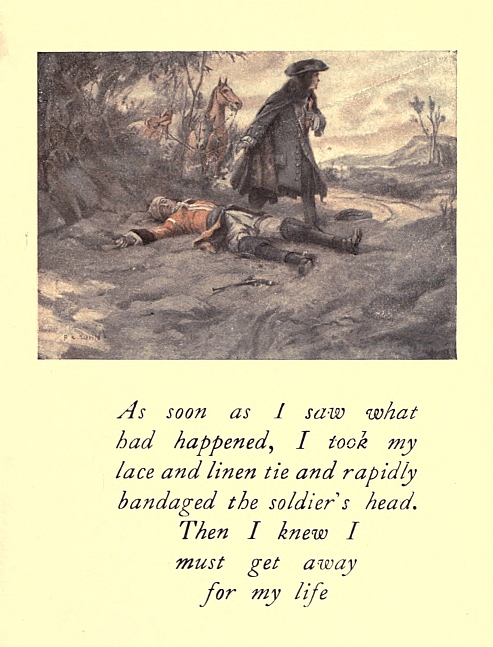
As soon as I saw what had happened, I took my lace and linen tie and rapidly bandaged the soldier's head. Then I knew I must get away for my life
When I had got out of sight of any possible observation from Sir Hugh, even if he had recovered sufficiently to observe me, I turned my horse into the wood by the side of a little brook that crossed the road. I urged him through the trees until he was completely out of sight of any passerby. Then I swung myself from the saddle, tore open the package that Sir Hugh had handed me, hastily glanced over the papers, and discovered that the precious warrant was not among them!
Sick at heart, I hammered at the lock of the despatch-bag, which I thanked God I had had the wit to bring with me, until I got it open. It contained various official documents, and among them was one I recognised, to my great relief and happiness. Ruthlessly, I broke the royal seal. The name of my father swam before my eyes. It was the warrant for his execution.
With hands that trembled now as they had not trembled before during the adventure, I dragged from my pocket the flint and steel. Heaping together some leaves, touchwood, and dried brush, I soon kindled a blaze. I held the warrant therein with my hand and watched it burn. The wax melted at last and left a red spot in the middle of the ashes. I had succeeded, and by my own wit and address. My father's life was saved.
I had kept myself up till then by sheer strength of will. The wound in my shoulder had bled unheeded. I was greatly weakened. A sudden reaction came. I felt frightfully faint and ill.
I rose to my feet and managed in some way to divest myself of my coat and waistcoat, fumbling with my one hand amid the unfamiliar buttons. Then I tore open the breast of my shirt, dragged it off my shoulder, and discovered a long, jagged wound across the top. The sight of the red blood upon my white flesh made me nervous and sick.
I fell to my knees and started to crawl toward the brook. I did not know whether I should reach it or not. The world was growing darker and blacker about me every minute. I set my teeth together and crawled mechanically on. I had almost arrived at the brink when a voice I knew broke upon my ear, recalling me at once to full consciousness.
"Well, Master Carthew,"—the words came to me as if from a great distance,—"I have you now."
I looked up. There stood Sir Hugh, hatless, his head still bound, his cheek still bloody. He had a drawn sword in his hand. Amazing as it may seem, I was almost glad to see him: I felt so sick, and weak, and helpless. Yet I did not give up. With a flash of my old spirit, I strove desperately to rise to my feet. I got as far as my knees and, forgetful of my naked shoulder, I stared up at him boldly.
"Too late," I said.
"Good God!" I heard him exclaim. "'Tis a woman."
And then I knew nothing more.