Front matter (continued 3)
Reading edition
For the last few years his feet had followed his errant will, now here, now there. He was impervious to hardship while he could wander as he wished, indifferent to good clothes when the price was eight hours a day spent in a stuffy office, bent, round-shouldered, hump-backed, over a column of figures. Beneath good clothes or shabby, there was nothing but a human body, all more or less alike. So the Watermelon had gone his careless, contented way, now resting here, now working there, unworried by rent days falling due, by collars fraying around the edges, coats getting shabby and shiny at the seams, and then Billy came along, Billy, young, sweet, conventional, an honored member of convention's band, walking around and around the same well-beaten path, in the same small inclosure. If he had elected to be one of the throng, he would never have met her. Struggling along at ten per, he would have been so far down the line, plodding painfully on, that Billy would never have seen him.
But now he was out and a fence unscalable was between them. If he climbed the fence again, it would do no good. No vagabond can ever fall in line and keep step, and there is not room enough in the inclosure for the man who has dared to climb the fence and drop down the other side.
Bartlett, like Billy, wondered if he were growing simple-minded. A desire to confide in Henrietta, to tell her what he was up to, had come upon him and seemed too strong to be resisted. Last night, up the quiet country road, alone with Henrietta, he had been forced to suppress the desire sternly, and now in the garish light of day it was still upon him. He took a seat beside her on the stone wall where she tried to be comfortable as she fished olives from a nearly empty bottle, the remains of last night's supper.
"I wonder," said he, hovering on the edge of his foolish desire, "if any one can become a man with nothing to regret."
"Certainly not," said Henrietta. "There would always be the years."
"I mean something that he had done himself," explained Bartlett soberly, a sandwich in one hand, a buttered roll in the other.
"Don't tell me your troubles," said Henrietta, thinking miserably of the years it would soon be so hard to deny. "I have enough of my own. Confession may be good for the soul, but it's the death-blow to your reputation."
"Father used to say that if there were public confession instead of private in the Catholic church, there would be no Catholics," said the Watermelon, helping Billy to the last of the sardines.
"Let's have a public confession," cried the artless Billy. "Everybody tell the worst thing that they ever did in their lives."
The Watermelon laughed and leaned toward her, a moth flirting with the candle flame. "Oh, kid; I'll bet the worst you ever did was to swipe the jam-pot when ma wasn't looking."
"No," said Billy, "I did an awful thing once."
"Let's hear it."
Billy took the olive bottle from Henrietta, speared an olive and passed the bottle on before she spoke. "Will you confess, if I do?" she asked, pausing with the olive half way to her mouth.
"Sure," said the Watermelon. "I robbed an apple orchard once."
"You're fooling," accused Billy. "I'm not. I'm really serious."
"So am I," vowed the Watermelon.
"Billy," said Henrietta, "spare us. I am too young to listen to a tale of depravity."
But the lure of the confessional held Billy and she passed Henrietta's remark without notice. She turned to the Watermelon. "If I tell you the worst thing I ever did, will you tell me the worst you ever did?"
"I haven't done the worst yet," explained the Watermelon.
The general having nearly wrecked the cars and seen the damage repaired by Alphonse, hurried to the four sitting on the stone wall.
"Come on," said he. "It is time we were going. We have no blue book, you know."
"I shouldn't wonder," said Henrietta, "if there were not a rare chance for some one to confess a heinous crime."
She looked at Bartlett as he held out his hand to help her down and her eyes laughed deep into his.
"In self-defense—" he pleaded in a whisper.
It was very early. The freshness of night still clung to fields and wood. The air was full of the clamor of birds and from the valley below came the stentorian crow of a rooster. Little wisps of white clouds drifted by in the deep blue of the sky and a breeze played gently with the girls' long auto veils.
So in the freshness of the early morning they dipped down the hill into the valley, passed farm-houses and corn lands. They stopped about nine at a farm-house and partook of a breakfast of coffee, bacon and eggs. Alphonse filled the cars at a village store and they went on. The glory of the day, the close proximity of Henrietta, who sat beside him, dainty, merry, feminine, the success so far of his plan, which in his saner moments he still cherished, raised Bartlett's spirits higher and higher and they went faster and faster. They swept over the boundary line into Maine with a rush, taking the hills at high speed and skimming into the valleys, now entering a stretch of cool dark wood, now tearing into the sunshine again, past corn-fields, hay-fields, and rocky pastures. Cows whisked their tails at the cars' approach and dashed awkwardly away from the fence rails. Chickens squawked and tore madly to safety with flapping wings. Farmhouses appeared and disappeared in a cloud of dust. Lakes were seen one moment and gone the next. They swept around a bend in the road and into a man trap, a pile of wood across the road and three farmers waiting grimly with loaded guns.
The Watermelon in the tonneau of the general's car, with Billy, straightened up with a sickening fear of being arrested in her presence. The fun and excitement of the adventure had disappeared. In their stead stalked the grim reality of the fear of exposure, of the surprise, scorn, perhaps anger, maybe pity, he would see in Billy's eyes. When they parted and the Bartletts returned to the city, they would learn how they had been deceived, and Billy would be angry, scornful and a bit amused, for Billy enjoyed a joke even against herself and her ideas of humor were young and of the same style, more or less, as those of the Watermelon. But if he could he would drop out of her sight, first, the good-natured, successful young financier, not slink away, the shiftless, beaten tramp.
The general for a moment considered it merely another means taken by the conspiracy to rob him of his car and contemplated stern defiance of the law's command to stop.
"It's not highway robbery, Charlie," laughed Bartlett. "We've been going a bit fast and have to pay up, that's all."
Haled before the justice of the peace in the village store, Bartlett paid his fine with casual indifference, the general with the haughty disapproval of a judge presiding at the bar of justice, while Henrietta, with gentle condescension, bought some highly-scented soap, "to help them out," she explained, meaning the owners of the store, and the Watermelon, to all outward appearances, frankly bored by the proceedings, presented Billy with a choice assortment of gaily tinted, dusty candy.
They put up for the night at a small town in Maine. It consisted of four or five scattered houses, a school, a store, and a barrel factory. They found rooms in one of the houses and after supper, Henrietta, Bartlett and the general sat on the stoop, while the men smoked and the stars came out one by one, the frogs croaked dismally and the whippoorwills called and called.
The Watermelon asked Billy to take a walk with him and she consented. She must never know, thought the Watermelon, with boyish self-loathing, that he had dared to insult her by thinking of love, but it would not hurt any one but himself to walk with her. There was only a day or two more at the most before they parted, she to go to Newport and Bar Harbor, and he to drift out on the tide again, one with James and Mike.
They walked up the road in the soft beauty of the summer night. Billy was tired and thoughtful, her girlish eyes catching a far off vision of womanhood and what it meant. Unconsciously to both, a man's soul had spoken and her woman's soul had stirred in answer, stirred, but would it fully waken?
The Watermelon rolled a cigarette and puffed moodily, too busy himself with thoughts to talk, and the Watermelon did not like to think. He was not used to it.
"Darn it," he mused, "what did the Lord give us bodies for to want and want and then add minds to think?"
They came to a New England graveyard, perched on a rise of ground, where the road cut through a hill, a lonely, neglected place, overgrown with weeds and tall rank grasses, the gravestones flat or falling. Hardly aware of what they did, they turned in and picked their way among the sunken graves.
"God's acre," whispered Billy softly, for youth loves sadness, at certain times.
The Watermelon tossed away his cigarette and took off his hat. Somewhere, over there among the Green Mountains, in just such another place, his tired little mother slept. Was her grave sunken, he wondered, her tombstone flat or falling limply sidewise?
The moon was sinking slowly in the west, a silver crescent just above the dark outlines of the woods. The sky was bright with stars, like the kindled hopes of those who have gone. A wind stole softly by, rustling the tall grasses and swaying the tree tops. But there among the graves, it was very dark and still.
Billy sat down on the bank by the driveway, and the Watermelon sat beside her, not too near. There was at least a foot between them.
"We are all alone," said the Watermelon, thinking aloud half of his thoughts. "All alone, but for the dead."
Alone, and the seven seas could not have parted them farther.
"And God," added Billy piously.
"If there is one," admitted the Watermelon.
Billy looked at him quickly, earnestly. "Oh, Jerry, of course there is a God. Don't you know it?"
"No," said the Watermelon. "When a person is happy, they know there is a God; when they are wretched, they say, every one does, 'There is no God.' If there is one, why doesn't He let the miserable wretch realize it instinctively as well as the happy person?"
Billy had never suffered, had never felt the foundations of her world falling around her in ruins, had never cried aloud in anguish, "How long, oh Lord, how long?" She answered from her inexperience, from the faith that had never been tested, "Of course there is a God. Every one knows it, every one prays. Why, if your father was a minister, I should think you would know that there is a God."
"That's the trouble. He was a minister and he lost faith, and when he who should have known, wondered if there was a God, we kids knew there wasn't. I suppose it's the same if a boy finds that his mother has lost her virtue. He thinks there is none."
Billy placed her hand on the bank between them and leaned toward him on her straightened arm. "Poor old Jerry! But if your mother still believed?"
"A mother always believes in God and her worthless sons. It's a part of being a mother, I suppose."
CHAPTER XVI
A THIEF IN THE NIGHT
Billy laughed a low, throaty gurgle, and laid her hand an instant on his sleeve. "Don't you see, she believed in God and she believed in you. You didn't go back on her. Would God?"
The Watermelon did not answer. He was busy with a scene of the long ago. He and the youngest Miss Martin had been engaged in a set-to which hardly savored of brotherly love, and parental authority had separated them and passed judgment.
"Sister should not have struck you," the mother said as she stood him grimly in the corner. "But, Jeroboam, you should not have deceived sister. If you men would only keep faith with your women, this world would be too good to leave, even for Heaven," she had added with her usual tired sigh.
How had he kept faith with Billy? The question stared him in the face and he felt like the child again, standing in the corner, unable to answer. For the sake of an amusing week of her society, he had practically betrayed her father, had branded himself a thief by keeping the clothes, the watch, the money, which he had taken wrongly, for a few hours' fun, but which he had intended to return. In the love he felt for the girl, his long-stifled conscience slowly stirred again.
Billy was talking, crooning her comfort with the maternity latent in all women for the men they love. "Don't you see, Jerry, there is a God? Think of what you did for your mother, think of how proud she was of you when you did so well. By sheer grit you have made yourself what you are. You are tired and blue to-night, poor old boy."
The Watermelon was not listening. He took a roll of bills from his pocket and counted them. Billy watched him in perplexity. Was he worrying over money, she wondered. One hundred and seventy-four dollars left. He had not had an opportunity to spend more of that roll of bills which he had betrayed a woman and lowered his manhood to steal. He crushed the bills back into his pocket and rose.
"We had better go back," said he shortly. "It's late."
They found Henrietta and Bartlett on the front porch, talking in low voices, oblivious to all else. The general had long since sought the doubtful comfort of the country bed for city boarders.
Billy held out her hand to the Watermelon, a little ceremony she had heretofore neglected, wishing in her tender little heart that she understood his strange mood better and could comfort him.
"Good night," said she gently.
"Good night," said the Watermelon.
Henrietta rose. "I didn't know it was so late. Wait, Billy, I am coming with you. Good night, all."
Bartlett followed the girls, but at the door he stopped and glanced back at the Watermelon, standing on the grass by the steps.
"Better come to bed," said he.
The Watermelon nodded abstractedly and Bartlett went in, leaving him out there alone.
Without thinking of Billy other than as a pretty girl with whom to flirt, moved by the mischief of the moment, he had placed her father financially at the mercy of his enemy. And now to right the wrong to Billy, the only thing he could do would be to tell them who he was, a tramp, masquerading with decent people in his stolen finery. Petty thieving, the sharp tricks of the road, had passed quickly from his conscience, but this was different. A woman had been thrown into the bargain, the woman he loved, and Henrietta and the general trusted him. Bartlett deserved all he got, and Batchelor he dismissed with the comforting conviction that he was doing him a good turn. But Billy, Henrietta and the general! A wry smile twisted the Watermelon's mouth as he thought of the horror on the general's face when he learned that he had spent the week in the company of a nameless hobo. For a while he contemplated hurling away the watch along with the rest of the "hardware" and stealing away in the dark, hitting the trail again and catching up with Mike and James on their annual pilgrimage north. He drew the bills from his pocket and thought of all Bartlett would lose if he crept away without explaining, and Bartlett was Billy's father.
He heard a step on the porch and turned to see Billy hesitating in the doorway. "Jerry," she whispered softly and glanced behind her as though fearful of seeing her father or Henrietta peering at her over the banisters.
He went toward her, the bills still in his hand. "Billy," said he, thrusting the money into his pocket, "what are you doing at this time of night?" And he looked down at her tenderly in the dark where the hall lamp could not reveal his face.
Billy hesitated. She had seen the bills again and knew that he was worried. To worry over money matters was an unknown experience to Billy. She felt a delicacy in mentioning her errand.
"I—I—I came to see if the moon had set," she faltered.
"It's set," said the Watermelon.
"Well," said Billy, "then I will go back."
"Good night," said the Watermelon.
"Good night," said Billy, and lingered.
Then she laid her hand on his arm and spoke in a rush. "Oh, Jerry, please don't worry. If you want any money, father has heaps. You can have all you want."
The Watermelon drew a bit nearer. "Billy, Billy," said he softly.
"I think it must be terrible to worry about money," Billy hurried on. "It's not worth it."
"I'm not worrying about money, kid," said the Watermelon with a laugh. "I have a bunch. What made you think I was?"
"Twice to-night you've counted your money."
"Esau's bowl of pottage," sneered the Watermelon, turning unconsciously to the old familiarity with the Bible. "Say, Billy, if he found he didn't like his pottage, could he give it back and get his birthright again?"
Billy blushed. She was not sure who Esau was. In a dim way she remembered the name and vaguely associated it with the Bible. "Couldn't he have gotten something else?" she asked judiciously.
"No," said the Watermelon. "He had nothing more to sell."
"What did he sell?"
"His birthright—for a mess of pottage."
"Why'd he do that?"
"He was stony broke, he wanted something to eat, see, and he sold his all for a mess of pottage. Now, if he found he didn't like his pottage, could he have given it back and gotten his birthright again?"
"Yes, indeed," chirped Billy. "I don't see why not. But why didn't he get something better than a mess of pottage?"
"Don't ask me, kid. But, I guess you're right. No one can keep your birthright unless you're willing they should."
"I usually know more about the Bible," stammered Billy, fearful of the impression her ignorance must have made. "I know about Moses and Ruth."
The Watermelon nodded. "You see, I was raised on the Bible," he said kindly.
"Yes," agreed Billy, "and I was raised on Mellen's food."
A step was heard on the floor above and she started hastily. "I guess I had better be going," she whispered. "Good night, Jerry."
"Good night, Billy."
She slipped away and the Watermelon was again alone.
"She's right. If you don't like your pottage, you can get your birthright back. I can leave a note," he thought and laughed bitterly. "Haven't a thing, name, clothes, honor. Sneak away like a whipped cur. Gosh, I'll be hanged if I can't do something respectable. I will tell them in the morning and they can do and say what they please. If you've sold your birthright to the Old Man, you have to go after it in person to get it back. Why the deuce did I fall in love with Billy? I had fun in the beginning—but now!"
When the Watermelon awoke next morning he lay for a time, stretching and yawning in the comfortable bed and the pea-green silk pajamas he had found in the suit-case in Batchelor's car. He glanced at the general slumbering beside him, his mouth open and his round fat face as pink as the pink cotton pajamas he wore.
"Here's me in silk and him in cotton," thought the Watermelon. "He couldn't tell a lie to save his soul, and I— Stick to your pink cotton, general," he whispered and slipped quietly out of bed. He crossed the room to the bureau where he had left the watch the night before to see the time. The watch was not there and he turned to look in his trousers pockets, thinking he might have left it in them. But his pockets were empty, save for a few old keys, his knife and "the makings." Money, watch, cigarette case, all were gone. He turned to the bureau. Cuff links and stick pin were also gone. Gingerly he felt in the general's pockets. They, too, were empty. He stood a moment in the middle of the room in his pea-green silk pajamas and gently stroked his back hair, then he chuckled softly and glanced at the bed.
The general was awake, looking at him with half-shut, sleepy eyes.
"Robbed, General," said the Watermelon.
"Robbed?" repeated the general, sitting up.
"Everything gone," said the Watermelon, "or I'll eat my hat."
The general rose and they made a systematic search through empty pockets and rifled bureau.
Bartlett came in gloomily. Without a cent among them they could not continue the trip. They would have to make for the nearest telegraph station and wire for help, and Batchelor, his whereabouts known to his brokers, would probably receive an urgent call to return at once.
"Robbed?" asked the general.
"They left me my name," said Bartlett grimly. "Who steals your purse steals trash, I suppose. We have that comfort."
"Not my purse," said the Watermelon. "Mine had money in it."
"My watch," said the general, "was a family heirloom. My great grandfather carried it."
"I wonder if the girls lost anything," said Bartlett.
"We will have to go to the nearest telegraph station and telegraph for money," declared the general.
"I suppose so," growled Bartlett, and trailed from the room to finish dressing.
They found the girls in the dining-room, unaware of what had befallen them. They had slept late and the clock on the mantel registered half-past nine as the three men filed into the room. The general was calm, pompous, austere, but Henrietta had not lived with him for five and thirty years without having acquired the ability to read his every mood.
"Father," she asked, "what's the matter? Have your sins found you out?"
The general waited for the slatternly maid-servant to give them their breakfast and leave the room before he spoke.
"We have been robbed," he said calmly, casually, as one would mention the weather. His tones implied that he was perfectly willing to listen to reason, but that he knew who the thief was and anything stated to the contrary was not reason.
"I spend my whole life, father," said Henrietta, "finding the articles you have been robbed of. Your system is all right. You have a place for everything, but you never remember the place."
The Watermelon pulled out the linings of his empty pockets and held out his wrists that they might see the cuffs tied together by a bit of string.
Henrietta and Billy stared.
"I have never had a thief in my room," cried Billy. "I would like to see how it feels."
"I'm not robbed," said Henrietta, making a hurried examination of the small-sized trunk she carried as a hand-bag.
"It's the stable-boy," said the general. "I noticed him carefully last night. He would not look any one in the face."
"He goes home every night," objected Henrietta. "Mrs. Parker told me so."
"That's no reason he couldn't come back," said the general.
"No," said Henrietta. "But because a boy won't look at you is no reason to say that he is a thief."
"He does look at you, anyway," said Billy innocently. "He looked at me."
"It was clever in him to take our checkbooks," said Bartlett.
"He will forge our names," declared the general. "I made a check out to pay for the board here, signed it, too, I remember, and then I found some cash and thought I would use that and went to bed and forgot to destroy the check. I know it was the stable-boy for my room has a balcony in front, over the porch, and last night it was so warm I left the door open."
"Maybe it was," agreed Henrietta. "I hate to suspect him, though."
CHAPTER XVII
ALPHONSE RIDES AWAY
"The stable-boy would have access to the back of the house, too," said the general, who felt that if he had not become a general and had escaped being a master mechanic, he would have been a famous detective.
"Yes," agreed the Watermelon. "But I don't think it is the boy. I was out until after eleven, and just before I came in I saw him drive up with the girl. They had been out to some dance and he left her and drove on."
The girl appeared in the doorway wiping a plate, slip-shod and awkward. Henrietta blushed, the general was painfully confused and the other three turned their attention hastily to their food.
"Want anything?" asked the girl.
"No, thank you," replied Henrietta gently, feeling that in judging the stable-boy she had somehow injured the girl.
The girl lingered a moment, glanced significantly at the clock, and went out.
"Who could it be?" asked Billy, pleasantly excited.
"Why, this is terrible," said Henrietta. "If the boy didn't do it, there is no one else who could have, but the family."
"It looks that way," admitted the Watermelon.
"What shall we do?" gasped Billy. "What shall we pay them with?"
The slatternly girl again appeared in the doorway much to the general's nervousness.
"Want anything?" she asked, and glanced again at the clock.
"No," said Henrietta. "No, thank you."
"I will speak to Parker," declared the general as the girl left.
"I wish you didn't have to," sighed Henrietta. "It's horrid to lose your money, but it must be so much worse to need money so that you would steal it."
"But that's the test of honesty," declared the general. "To need money and not steal."
"I know," admitted Henrietta, pushing aside her coffee cup. "I do admire strong people who can resist, but I'm so much sorrier for the weak who can't. It's pitiful, that's what it is."
"Yes," cried Billy, as usual carried away by her feelings. "Let's not say a thing."
The door opened for the third time, but instead of the ineffective maid-servant, the farmer's wife, fat, red-cheeked, good-natured, entered.
She approached the table and smiled jovially from one to the other.
"I hope you liked everything," she said with a gentle hint in her tones that they had lingered around the breakfast table long enough. "Have you had plenty, General? Can't I get you some more coffee, Miss Crossman?"
"No, thank you," said the general, confused and unhappy.
Mrs. Parker smiled still. "I am glad you liked everything. Your man should be back soon. He hasn't had any breakfast yet."
"Where'd he go?" asked the general, feeling that that was safe enough ground.
"My husband thinks that he went out in one of the automobiles very early, for he found one of them gone."
"Did your husband see him go?" asked Bartlett.
"Oh, no, but he thinks he must have gone because there is only one automobile—"
"Oh, yes," said Henrietta, and stared at the others, fearful of reading her own crushing suspicion in their eyes.
Alphonse, the quiet, blasé, peerless Alphonse? Could it be he? That Alphonse had gone for an early morning spin lured by the dew on the clover fields, by the sweet chorus of awakening birds, borne by the unsuppressible desire to see the shy, sweet advent of a new day creeping up the flushed and rosy sky, was wholly out of the question. Alphonse's soul, in the early morning hours, was filled only with the beauty and glory of bed. The general had always been forced to arouse his serving-man and the process had often been painful, calling for sternness and suppressed wrath on the general's part. Alphonse a thief was more believable than Alphonse getting out of bed uncalled.
Billy was the first to speak.
"The car," she whispered.
"Oh, yes," said the landlady hastily, not quite sure what had happened or was to happen by the expression on the faces before her. "Oh, yes," reassuringly, "he took the car. My husband wasn't up when he went—"
The general rose, his face red with anger. "If he has taken my car," he thundered, "I shall have him prosecuted whether Henrietta likes it or not."
"It's an outrage," sympathized Bartlett. "We can telegraph the police."
"Oh," moaned Henrietta, "I did love that car."
The landlady sought to reassure them in a calm, placid manner that savored of a big, gentle-eyed cow. "Why, he has only gone for a ride. He went—"
The general paused in the doorway. "He went last night, madam," said he coldly, and slightly dramatically, for the general never believed in spoiling a good story by a mild delivery. "And he took not only the car, but all our money."
Led by the general and followed by the landlady, they made for the barn. There, in the middle of the floor where last night two cars had stood side by side, a red and a blue, was now only one, a big, blue Packard. A few hens stepped daintily here and there, around and under it, while the cat cleaned her paws contentedly from her seat on the running-board.
The general stopped in the doorway and stared. His car? And such a wave of thanksgiving rushed over him that it was not his car that was missing that he felt he owed Alphonse a debt of gratitude and forgave him immediately.
"My car," said he, and chuckled with relief.
"Where's mine?" demanded Bartlett, growing red and angry.
"Where's Alphonse?" suggested the Watermelon significantly.
Henrietta laughed with positive gratitude to her erstwhile serving-man. "Why," she cried, "he left us ours."
"Alphonse was very fond of me," said the general with some little pride, as he patted his car tenderly.
"Yes," agreed Bartlett, "I can see that. He demonstrated it fully. I am glad he didn't love you or he might have killed Billy and me."
The landlord, followed by the slatternly maid-servant and the shifty-eyed stable-boy, trailed into the barn.
"Man gone off with your car?" asked the landlord. "I locked up last night about twelve. He must have left before then."
"The general's man did," said Bartlett, who felt that the general was in some way to blame.
"He has taken all our money," added Henrietta.
"A thief, eh?" said the landlord.
"Can't we follow the car by the tracks?" asked Henrietta. She went to the door and peered eagerly at the many wheel tracks in the dust of the drive.
The general waved the suggestion scornfully aside. "You can't tell whether the tracks are coming or going," said he.
"All detectives do," said Billy, following Henrietta to the door.
"I'm sorry," whispered the Watermelon in Billy's ear.
Billy laughed. "We have more cars at home," said she. "It doesn't bother me at all. That's the trouble of being rich, you can't be robbed and feel badly about it."
"Batchelor, you say that you were up until after eleven," said the general, feeling that the occasion called for intelligence. "Did you see Alphonse go out?"
"No," said the Watermelon.
"The landlord says, however, that he must have gone before twelve," went on the general. "Then don't you see how Alphonse could not have stolen the money? Those thefts were not committed until after twelve."
"I don't see how you work that out," said Henrietta, puzzling over it with knit brows.
"Don't you see, Henrietta, that if Alphonse stole our money after twelve, he could not have gone out in the car before eleven, so if he went out in the car before twelve, he did not steal the money. He either stole the money or the car."
"Maybe he didn't take the money," said Henrietta, feeling vaguely and disappointedly that she was not a person with detective-like instincts.
"You see," said the general, "if Alphonse took the car, he did not take the money; if he took the money, he did not take the car."
"He certainly did take the money," snapped the farmer.
"And my car," added Bartlett angrily.
"He could not have taken both," declared the general.
"You were robbed last night, weren't you?" demanded the farmer. "Well, then?"
"And my car is gone, isn't it?" demanded Bartlett.
"Yes, yes," acknowledged the general, feeling that every word he said only made the other two angrier, but still clinging to his deductions as to his life's principles. "Yes, of course; but Alphonse could not have done both. He went off with the car before eleven, so he could not have robbed us after twelve—"
"Sir," interrupted the farmer with a quiet dignity that was impressive, "do you accuse any of us of stealing?"
"No, no," protested the general, now hopelessly rattled. "But if Alphonse stole the money—"
"Alphonse swiped both," said the Watermelon, and that settled it as far as the general was concerned, for the general had boundless faith in the young man's deductive abilities. "I went in about eleven. He took the car out, ran it down the road a bit and then came back and sneaked our things."
"Certainly," said Bartlett, who could not help feeling irritated with the general for the fault of his man.
Billy laughed. "All this bother about nothing," said she. "Dad, what's one car, more or less?"
"A car is a car, Billy," said Bartlett coldly, refusing to be comforted for the ruin of his plan to keep Batchelor away from the city over Saturday.
"Yes," agreed Henrietta sympathetically, "any one hates to lose a car."
"But when you have seven," objected Billy.
"We haven't got them here, have we?" asked Bartlett.
"No, but we have one, and that's enough for five," declared Billy, finding the usual difficulty in persuading people to count their blessings. "We didn't need two, anyway."
"Yes, we did," said the Watermelon, thinking of the tonneau with only Billy and him, the general in front completely absorbed with the car.
"Why?" asked Billy.
"Why," stammered the Watermelon, who no longer cared to flirt with Billy and who had spoken without thinking, "why, so the general and your father could each run a car," he explained weakly.
"Oh, yes," chirped Billy. "What will they do now?"
The Watermelon turned and glanced out of the wide doors, down the tree-shaded road, and thought pityingly of the unfortunate Alphonse, gone off at the wrong time, with the whole country-side on the watch for a lone youth in a big red touring car. That the car was of a different make from the one they were hunting for would not impress the sheriffs so forcibly as the fact that the youth also carried a time-piece as big as a clock, along with a cigarette case, cuff links and stick pin, all marked plainly and beyond question, with the damning initials, W.H.B.
The Watermelon laughed softly, and glancing at Billy, laughed again. With Bartlett going directly back to the city, he would not have to confess to make things right. He could leave them at the telegraph office and drift away on some pretext or another, leaving Billy gaily, head up, as became a successful financier, not slink away like a whipped dog, with only the scorn and loathing in her eyes to remember, to obliterate all the other memories of that one nearly perfect week.
CHAPTER XVIII
OH, FOR A HORSE
The farmer forgave the general with lofty dignity and turned to Bartlett with suggestions and offers of help. There was a telephone in the village store. They could telephone Boston or Portland, or they could telephone Harrison and Harrison could telegraph the larger cities. With the police notified promptly, Alphonse would not be able to get far.
Bartlett meditatively chewed a straw and pondered the suggestion, leaning against the nearest stall and frowning thoughtfully at the general's car, while the others stood around him in a semicircle.
They were ten miles from the nearest railroad, and the train service, when they did strike a road, was decidedly poor in that out-of-the-way locality. Still, by good luck, quick work and prompt connections, Batchelor would be able to reach Boston late that afternoon or evening and New York before ten A.M., Saturday morning, and at ten A.M. Saturday the last fight was to be fought, the last stand made. Without their brilliant young leader, the opponents to the cotton ring would be outnumbered and outclassed, hopelessly beaten. Bartlett's fighting blood was up at the thought. Was he to have his week spoiled by the worthless Alphonse's deviltry? Batchelor should not run the slightest chance of reaching Boston that day, if he could help it. Henrietta had a little money in her bag that would tide them over. Better avoid anything to do with telegraph and telephones as long as possible. They could make an attempt to reach Harrison and get lost. But getting lost wasn't as easy as it appeared, when the general was along, thoroughly determined not to get lost. Bartlett's thoughts were broken in on by the Watermelon in a way that caused him quick alarm. The young man had at last awakened to the gravity of the situation, as Bartlett had been expecting him to do ever since the trip began.
"We had better telephone," said the Watermelon, "as Parker says. We can telephone for money and have it sent to Harrison, and we can ride to Harrison and probably get there the same time as the money does and get the train for Boston. It's time we were back in New York, anyway."
The trip was ended and the sooner he left Billy the better. He could give them the slip at Harrison and once more hit the road.
"Telephoning from here won't help matters at all," objected Bartlett, fighting for that opportunity to get lost again, just for one more day—twelve hours would be enough. "We can drive to Harrison and telegraph from there. It is only a ten-mile drive. We can make it in fifteen minutes."
"No joy-riding," warned Henrietta, "when we haven't any money to pay the fines. I don't want to do my time in the workhouse."
"We will do it in twenty minutes, then," laughed Bartlett, who saw another way to create a delay that might be used with advantage. The Parkers scorned to accept the few dollars Henrietta still had in the dark recesses of her bag.
"You can send it to us," said they, and the farmer added, heaping coals of fire on the general's unfortunate head, "We trust you perfectly."
The Watermelon looked sharply at Bartlett and wondered if he were up to any tricks. The Watermelon had only ten more miles of Billy and he didn't want to shorten the precious time by a confession if there were no need for one.
"Let's hurry," said he. There was no need of prolonging the misery in the thought of the parting.
"Worrying over his affairs," thought Bartlett. "He has come to at last."
The general insisted upon driving, and as it was his car, Bartlett perforce had to be content. He protested, however, that he knew the road thoroughly, and could direct the general with no instructions at all from the farmer, waving them all good-naturedly aside.
They were all quiet as they started down the road. Henrietta was depressed thinking about Alphonse. She had always stood in awe of his superlative virtues, and the fact that he lacked several was a bit of a shock. The general also was grieved. He had trusted Alphonse and Alphonse had failed him. Billy was silent, for she wanted to think, and all her thoughts were of the youth beside her, tall, slim, good-looking, with his merry eyes and devil-may-care indifference.
They could all go to New York together, she planned, and later, when her father and herself went to their summer place on the coast of Maine, they would get him to visit them there in their own home. And in the winter—and Billy's thoughts lost themselves in the hazy rosy glow of the future, with its possibilities and pleasures.
It was after three. The day was intensely warm, even in the shady wooded road on which they found themselves. They had been running through the woods for nearly an hour, and apparently had not reached the end of it. The last abandoned farm-house, gray, weather-beaten, forlorn, had long ago been passed. The birds chattered shrilly in the leafy profusion overhead; somewhere out of sight in the underbrush a brook gurgled refreshingly over its stony bed, and once, far away and very faintly, they heard the wild loon's dismal cry.
The general stopped the car and turned sidewise to face those on the back seat. "We are lost," said he. "Look at the odometer. We have come twenty miles since we left Stoneham and we are no nearer Harrison than when we started."
"Lost again," wailed Henrietta. "How very stupid we are!"
"It's my fault," admitted Bartlett truthfully, but with contrition. "I said to take this turn back there near that barrel factory."
"We can go back," suggested Billy.
"Parker told me last night," said the general gloomily, "that there was no settlement north of here for forty miles. We have probably come north."
"If we have come twenty miles, we can go twenty more without dying," said Bartlett.
"I don't know," laughed Henrietta. "I am famished now."
"So am I," wailed Billy. "Henrietta, haven't we a thing to eat?"
"Not a thing," said Henrietta.
"Hit her up," cried Bartlett jovially. "We will break some more speed laws, by George. I want something to eat."
"We have heard nothing from father," teased Henrietta, her laughing eyes on the Watermelon's face, full of tender amusement. He was so young and looked so serious and almost unhappy that she was unhappy herself.
The Watermelon was unhappy. By this time they should have been in Harrison, with the parting over, and he wanted it over. The thought that they would probably be together a day longer did not please him. The sooner he took to the road again and became a bum and a hobo, the better. Billy did not care for him. He was the only one who would suffer, and every moment he was with her only made the suffering worse. He turned to Henrietta with relief from the thoughts that were insistently bothering him and would not let him alone.
"Father was never in a motor-car," said he. "He used to say that his funeral would be just another irony of fate. The only chance he had to ride, he wouldn't be able to appreciate it."
"I know that it is terrible to be poor," said Henrietta, "but I think people ought to enjoy other things than just those that money can give."
"What things?"
"Why, the woods and fields, a beautiful day—"
"Rent day, probably, and no rent money. Father used to say when you're poor, every day is rent day."
"We're nearing the end of the woods," cried Bartlett. "And I think I see a house."
And then the car stopped.
"Gid ap," chirped Bartlett.
Henrietta leaned forward. The general was hastily trying all the brakes, slipping one lever then the other, fussing here and fussing there, and Henrietta knew the symptoms of approaching trouble.
"Father, is there anything the matter?"
"Oh, no," pleaded Billy. "Not here?"
The Watermelon leaned forward and opened the door. "Every one get out," he ordered. "We can walk to the house. We mustn't monkey with the car unless we want a pile of junk on our hands."
He stepped out and turned to help the girls.
"Not at all," declared the general. "I know all about a car. I can fix it directly." He alighted and started to raise the bonnet. The Watermelon intervened.
"Look in the gasolene tank first," he begged.
The general was already deep in the mechanism, oblivious to all else. "It's the carburetor—"
"Carburetor nothing," pleaded the Watermelon. "It's the gasolene."
"Yes," agreed Henrietta indiscreetly, "maybe it is."
"That won't help us any," snapped the general angrily. "Where can we get more? Much better to have something else wrong—"
"Not for the car," said the Watermelon. "None of us would be able to fix it."
"My dear sir," said the general warmly, "I have owned this car for a year—"
"I know," murmured the Watermelon. "I think it marvelous."
"I am perfectly capable—"
"Will you bet with me," interrupted the Watermelon, "that it's the gasolene? Alphonse may have filled the other car at the expense of this one."
It was the gasolene, or rather the lack of gasolene, that had stopped the car.
"That's where a horse beats a car," lamented Henrietta. "You don't have to keep bothering with their works."
She sat down on the car step and clasped her hands in her lap. "We could spend the night here, but in the morning we wouldn't be any nearer gasolene than we are now."
"I'm not fretting about gasolene," said Bartlett. "I want something to eat. Let's all go to that house—"
"We can't leave the car," objected the general.
"No one could go off with the car," argued Henrietta.
"And we can get them to send a horse," added Bartlett. "I am starving."
"I feel like the car," said Billy. "I have no gasolene."
"I can not leave the car," reiterated the general, and Henrietta realized that that settled it as far as the general was concerned, and that it would take her greatest tact to unsettle it.
"I will go and get a farmer and a horse," said the Watermelon, unexpectedly siding with the general. "We would have to be here anyway, to see that they towed it in right."
"A horse would do," said Billy gravely. "We don't need the farmer."
"I have hopes of Billy sometimes," said Bartlett, regarding his daughter quizzically. "I sometimes even think that she may grasp the difference between sunshine and rain and realize it's best to keep out of the latter."
Billy looked hurt. "Father doesn't like me any more," said she, adding shrewdly, "He thinks I'm getting rather too old for him, anyway."
Bartlett blushed, Henrietta laughed and the general roared.
"You grown-up daughters are so hard to explain," said he. "Not once do you offer to be a sister to us."
"I wouldn't be a sister to father for anything," protested Billy. "He must be fifty, at least."
Bartlett flushed angrily. He dared not glance at Henrietta. "I am forty-five," said he coldly, which was at least two years and a half as near the truth as Billy's rash statement.
"Yes," sneered Billy. "And I'm only eighteen."
Henrietta changed the subject. When one is eighteen one can announce the fact loudly and cheerfully. When one is thirty-five, one prefers to talk of other things.
"Why not all go for the horse? The car will be all right, father; and I am so hungry," she added pathetically.
CHAPTER XIX
A BROKER PRINCE
"I am going," said Billy with determination.
"We can't leave the general alone," objected Bartlett.
"I don't see how I would be able to help the general any," returned Billy in injured accents.
"I thought you could push him in the car," explained Bartlett with gentle sarcasm.
"You all wait here," said the Watermelon. "I will go and get you something to eat and see about having the car towed, also about rooms for the night."
"Why not all go?" pleaded Henrietta. "Why wait here starving—"
"I can go faster alone," answered the Watermelon.
"Certainly, certainly," seconded the general. "We would have to help you girls over every wooden fence and under every barb wire one we came to. You would probably even then get stuck on one or under the other."
"I never get stuck on anything," contradicted Billy perversely.
Henrietta laughed. "Billy, cheer up. The worst is yet to come."
"That house may be empty," said the Watermelon. "Then we would be all over there and have to come back."
"We've been in empty houses before," said Henrietta crossly.
"But what good would that do, to be over there without food?" asked the Watermelon.
"What good to be here without gasolene?" retorted Henrietta.
"I can not leave the car," reiterated the general.
"Father," exclaimed the exasperated Henrietta, "some night I will find that you have taken the car to bed with you."
"Suppose we leave the car here—" began the general argumentatively.
"We can't," sighed Henrietta. "Such a supposition would be impossible with you the owner of the car."
The Watermelon laughed. "Aw, cut out the conversation," said he. "I will be right back."
"So will I," said Billy.
Now the Watermelon objected. He did not feel equal to a tête-à-tête with the adorable Billy, adorable still, though a bit cross.
"Cut out the conversation," mimicked Billy, and scrambled with more speed than grace under the broken bars of the worm-eaten fence.
The Watermelon leaped the fence after her. Henrietta slipped under the fence after the Watermelon. Bartlett hesitated one moment, glanced guiltily at the deserted general and then followed Henrietta.
Billy and the Watermelon were young and light of foot and soon outdistanced the stout Bartlett, who did his gallant best to keep up with the nimble Henrietta, but found that the years of good living told against him.
Henrietta waited politely for him at the stone wall which Billy had just scaled and the Watermelon jumped.
"What are we hurrying for?" asked Bartlett, removing his hat to wipe his heated brow.
"I am sure I don't know," laughed Henrietta. "Monkey see, monkey do, I suppose. That is why there is such a thing as style. No one thinks."
"If we waited here," suggested Bartlett, "our dinner would come to us."
"As the office to the man," agreed Henrietta.
"Precisely."
Henrietta sat down on the wall and Bartlett leaned beside her, gazing over the field to the distant woods. He felt thoroughly comfortable and contented. No matter what happened now, Batchelor could not reach the city by Saturday. The cotton ring was saved.
The scene before them was a typical Maine landscape, rugged, hilly, beautiful, with the long shadows of approaching evening creeping across the fields. From where they rested, the farm seen from the road was hidden from sight. The whole place seemed desolate, primeval, with a beauty and a charm that were all its own.
Henrietta drew a quick sigh of pleasure and fell silent, with dreaming eyes wandering into the mysterious shades of the distant woodland, her hunger for the time forgotten. The place, the time of day, just at eventide, suggested romance, the one man and the one woman, and the world not lost, but just attained. She wished she was Billy, young and foolish and pretty, and that Bartlett was the Watermelon, long-limbed, broad-shouldered, with the glory of youth that sees only glory down the pathway of the future.
Bartlett broke in upon her reveries. "See that hill?" and he waved toward the slope ahead of them.
Henrietta nodded, still wrapped in her dream. "The hill of life," said she, "with glory at its top."
"A railroad," said Bartlett, prosaically matter-of-fact, "a railroad has been cut through the hill. See, there go the children, suddenly out of sight."
Henrietta came back to earth. "How do you know? Maybe there is just a steep incline the other side and that is why they disappeared so quickly."
"No, there is a cut up there. Don't you notice how abrupt it looks, and there are no trees or bushes. They haven't had time to grow since the cut was made. And those big lumps, see, covered with grass, they are the earth thrown up out of the cut. It's the Grand Trunk. It runs through Maine, you know, into New Hampshire."
Henrietta nodded and frowned. "There is no more romance," and she threw out her hands with a graceful gesture of hopeless disappointment. "It went when the first steam-engine came."
Bartlett looked at her, amused, with a man's tolerance. "What do you want romance for? A railroad pays better."
"Pays, pays, pays," cried Henrietta. "I want something that doesn't pay—that isn't associated with returns. You men have nothing but a bank-book for a heart. It's so lovely here, so quiet. Don't you feel it? With the shadows creeping across the pasture? I was young and beautiful—"
"And a princess."
"No, a goose maid. My hair was brown and thick and hung over each shoulder in two long braids. I was bare-headed, with sleeves rolled to the elbows of my shapely arms—"
"You would have got malaria," said Bartlett. "It's very damp here. I think there must be a pond over there in the woods. You can hear the frogs."
"Oh, yes," agreed Henrietta. "I would have had malaria and rheumatism, but I wouldn't have cared, then—for you see, I had come after the geese, and down here in the tiny glen, with the hush of evening over all, I had met him—"
"Who? Me?"
"My lover," said Henrietta.
"Me," said Bartlett softly, and to Henrietta's surprise he laid his hand gently on hers.
Henrietta blushed and looked away. Her lover, this stout, grim, hard-eyed man of business? She raised her hands to her cheeks and her heart fluttered so she could hardly breathe, while before her startled gaze swam the vision the years had been unconsciously forming. Had romance come to her thus late, in this guise? Was a middle-aged member of the New York Stock Exchange her prince?
"Henrietta," he asked gently, leaning toward her, "shall I finish the story?"
"Why no," said Henrietta, "there was no finish. It had just begun."
"Just begun," whispered Bartlett, and took her suddenly into his arms.
"Oh, please," begged Henrietta, feeling that modesty called for some remonstrance.
"Please," he taunted. "When you were the goose girl and I was the prince, you didn't say please."
Henrietta laughed. "And neither did the prince," she dared him.
"No decent lover would," said Bartlett, bending and kissing her full on her whimsical mouth.
After some little time they saw the others reappear over the top of the hill. Henrietta had returned to her seat on the fence and Bartlett was beside her, his arm around her waist, her head on his shoulder with a simplicity truly bucolic. So might the Parkers' shifty-eyed stable-boy be wooing the slatternly maid-servant in some secluded place behind the barn.
Henrietta straightened quickly and blushing crimson after the manner of the maid-servant, raised her hands to her hair so that one side of her coiffure might not appear unnecessarily flattened before the sharp eyes of the youthful Billy.
"Aren't we silly?" said she, glancing at Bartlett with the same expression with which the maid-servant would have glanced at the stable-boy.
"Why silly?" demanded Bartlett. "We love each other, don't we? Why shouldn't I put my arm around you?"
"Oh," said Henrietta, "you should, but—er—er we seem so old for such things."
"Old?" Bartlett laughed. "Love is the oldest thing in the world."
"I know," agreed Henrietta, "but not before people."
"Why not before people? People have become too artificial. They must not love, nor hate, nor have any feelings, apparently, before people. Feelings are interesting and we ought to show them more."
Henrietta laughed. "Oh, you are silly, silly, silly. I never knew a New York broker could be so silly, so mushy."
"There's not a man living whom the right woman can't make mushy. Women never realize how silly men are at bottom, my own. They are frightened by our exteriors, by the ingrain fear of the chattel for her master, born in women since Eve handed the larger share of the apple to Adam."
"I always thought that I would be dignified and sweet—"
"You are, my love."
"No, I am as silly as you. I put my head on your shoulder just as these girls do whom you see in Central Park on Sunday afternoons. I never thought that I would be like that."
"You have never loved before—"
"Indeed, I have. I have loved nearly every one I have ever met. Most all girls do."
"That isn't love. Merely an increased vibration of the muscles of the heart. Love—ah, Henrietta, do I have to tell you what love is?"
"No," whispered Henrietta. "It's just giving."
She paused, gazing before her into the deepening shadows of the evening with misty eyes, for the first time realizing the completeness of life.
She nodded after a moment toward the approaching Billy and the Watermelon. "What's the matter with the children? They look so serious, and yet they must have something to eat, for they are carrying bundles."
"Probably couldn't arrange for a tow for Charlie's car and see where we sit up with it all night and hold its head."
CHAPTER XX
THE SEVEN O'CLOCK EXPRESS
As Bartlett said, the hill was cut through by a railroad. The deep gully brought Billy and the Watermelon to a halt when they had outstripped Bartlett and Henrietta, leaving them behind at the foot of the hill. The sides of the gully were overgrown with grass and tangled briers, but a narrow foot-path led down to the tracks and up the incline on the other side. The Watermelon helped Billy down one side and dragged her up the other.
"I would hate to be a tramp," panted Billy as she reached the other side and paused a moment for breath. "I would get so cross if I were hungry and knew I couldn't get anything to eat for a long time."
The Watermelon flushed hotly, but she was not looking, and when he spoke he spoke carelessly enough. "You would get used to it," said he. "You can get used to anything. Father used to say that the idea of hell for all eternity was an absurdity—you were sure to get used to it and then it wouldn't count any more as a punishment."
"I suppose that's so," agreed Billy. "But how do you know? You weren't ever a tramp, were you, Jerry?"
"A tramp, kid, is the only man in America to-day, besides the millionaire, who is his own master. Do you know that?"
"I would kind of hate that sort of master," said Billy.
"A tramp never has to worry about rent—"
"I know, but I should think the house might be worth the worry."
The Watermelon changed the subject.
A grim, elderly woman, thin and work-worn before her time, listened to their troubles in the faded, weather-gray farm-house. Her man, she explained, was out in the fields with the horses, but when he returned, she would send him around and he would tow the car in for them. She never took boarders. The house was a sight, but if they didn't mind, she did not and they could have two rooms. She wrapped some bread, fruit and cookies up for them in newspapers, and they started back to wait with the others by the machine until the farmer came.
The still hush of evening was over everything, creeping with the lengthening shadows across the pasture. A flock of turkeys was making noisy preparations for bed in some trees near by. The frogs had begun to croak and once in a while a whippoorwill called from the woods. In an adjoining hay-field, hurrying to get in the last load before dark, the Watermelon saw the farmer. A pair of sorry looking nags drooped drearily, attached to the cart with its high, shaky load of new-mown hay.
"I'm going to speak to him myself," said the Watermelon, stopping. "It will save time. You wait here. I won't be long."
"Give me the food," said Billy. "I will take it to the others. Poor things, they must be starving."
"I won't be long," objected the Watermelon. "You can't carry it alone."
"Indeed, I can," protested Billy.
The Watermelon laughed down at her. "You couldn't get up the other side of the crossing," he teased.
"A girl," said Billy sagely, "is a lot more capable when she is alone than when she is with a man."
She took the ungainly bundle and he watched her hurry away across the fields, slim and graceful, dainty and sweet, while he was—a tramp! His eyes darkened with pain and he threw one hand out after the small figure in a gesture that was full of mingled longing and hopelessness.
"Billy, Billy," he whispered, then turned from the thoughts which were coming thick and fast and started toward the distant field and the farmer.
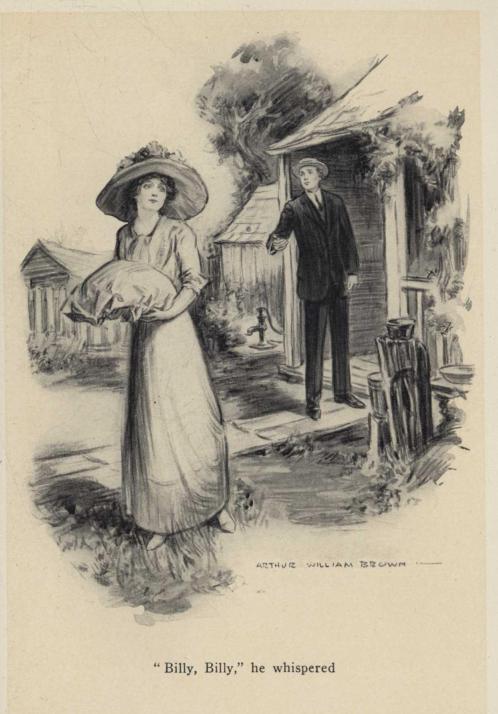
"Billy, Billy," he whispered
The farmer listened with blunt stupidity, hot and tired and cross. Yes, he would come for the car as soon as he could, but the hay had to be got in first. It was late now. That train whistle you could hear was the seven o'clock express. His horses were tired, too, but, of course, if he were paid, why that made a difference. He would be around as soon as he could get his load in. It was the last load, anyway.
The Watermelon turned and far in the distance, echoing and reëchoing through the hills, he heard again the scream of the approaching train.
"Billy win be across the tracks by this time," he thought. "I will have to wait for it to pass. Glad it ain't a freight."
He hurried moodily through the field. His position had become intolerable and yet he could find no chance to get away without revealing his identity, and to do that now would do no good. They could not reach the railroad any sooner than they were trying to. He longed for the morrow that would end it all and yet dreaded the barrenness of the future without Billy.
As he approached the cut, he saw the smoke of the train rising above the bushes, an express, tearing its way through the evening calm like some terrible passion searing the soul. The Watermelon stepped to the edge of the cut and glanced carelessly downward.
There was Billy on the track, struggling to free herself from the rail which held one small foot. Around the bend came the huge engine with its headlight already lit for the wild night run.
The next two minutes were ever after a blank to the Watermelon. He was in the cut, beside the white-faced, struggling girl almost simultaneously with seeing her. As he shot down the bank, he felt for and drew his knife. The engineer had seen them and the engine screamed a warning, while the emergency brakes shrieked as they slipped, grinding on the rails. On his knees, with one slash, the Watermelon cut the lacings which, becoming knotted, had held her prisoner, then with one and the same move, he had regained his feet and forced her flat against the bank, as the train whirled by in a cloud of dust and cinders, brakes grinding, wheels slipping, whistle screaming, a white-faced engineer leaning horrified from the cab window.
Trembling violently, Billy clung sobbing to the Watermelon, her face hidden in his breast. The Watermelon crushed her to him as if he would never let her go, his arms tightening with the agony of remembrance. He was trembling as much as she from the horror of that terrible moment. His head rested on her hair and he talked, poured out his love in a rush of misery and thankfulness. Words tumbled over themselves and were repeated again and again, in phrases hot from his lips came all his pent-up longing for the girl.
"Sweetheart, sweetheart," he whispered with white lips as Billy still sobbed. "Darling, hush. Dear heart, my love, my Billy."
After a time her sobs stopped and she raised her face. The Watermelon bent his head and they kissed frankly with the simplicity of perfect understanding, perfect love. For a moment they clung together, still, then Billy was the first to rally.
"We've got to go," said she, her hands raised to her tumbled hair as she tried her best to laugh.
The Watermelon caught her hands and forced them down, drinking her in with hungry eyes. Then he bent his head and buried his face for a moment in the backs of her small hands, while something like a sob shook his shoulders.
"Jerry," whispered the girl, a woman now, tender, compassionate, gracious.
The Watermelon dropped her hands and turned abruptly. "I'm a damn fool," he muttered and picked up the bundle, still beside the track.
"Why did you come?" she asked, all solicitude for him. "You might have been killed."
The Watermelon did not answer. He stalked across the track to the other foot-path and Billy perforce had to follow.
Henrietta and Bartlett had not even heard the wild scream of the engine as it shrieked past, and when the Watermelon and Billy joined them, were too preoccupied to notice anything for long in any one else. All four returned to the general, quiet and apparently depressed. The general was depressed himself. He did not see how it would be possible to get gasolene in that neighborhood, and without gasolene they might as well be without a car.
Billy divided the bread and fruit, and without a word, they sat side by side and partook of their humble repast, the two girls, the general, the tramp and the financier. The color returned to Billy's face and in her eyes was a great and shining light every time she looked at the Watermelon, where he sat on the step of the car, bread in one hand, an apple in the other, a part of the paper spread on his knees to serve for napkin.
But he would not look at her. His face was still white and he read the paper before him that he might not think. Billy knew of his love and loved in return, white, pure, decent Billy, and he a filthy piece of flotsam washed for the moment from the slime of the gutter. Slowly, precisely, he reread the article he had just read without having comprehended a word of it.
The parting that evening was slightly prolonged, much to the general's annoyance. He was tired and wanted to go to bed, and why the others should prefer to linger on the small stoop which served for porch, he could not understand, and what he could not understand always vexed him. Bartlett wanted to take a stroll before turning in, and when the general kindly offered to accompany him, he decided suddenly and rudely, the general thought, that he didn't care to go. Henrietta wanted to sit on the stoop apparently all night. Billy wanted to walk, too. Walking, the general decided, ran in the Bartlett family, but instead of taking a stroll with her father, she hung around the stoop with Henrietta; while the Watermelon did not know what he wanted to do as far as the general could make out. He was quiet, strangely uncommunicative, seemed to be thinking deeply on some important subject. Worried over the past week, thought the general. Irritated and tired, the general could not bother with such nonsense and tramped off to bed.
The Watermelon felt that he could not say good night alone with Billy. He had read the desire in her eyes for a bit of a walk with him and to escape the temptation, he wished them all good night and followed the general up to bed.
All the strength of the man cried constantly for the girl, for her sweetness, her charm, her grace. But he loved with the love that is love, that will give all and ask nothing, a love that is rare and fine and that comes to king and peasant alike, and to no one twice, to some not at all. His week was up. He would slip away that night when they were all asleep. Billy would forget him and he would be better with his old cronies, fat blear-eyed Mike and James of the bon-ton.
Long he lay on his narrow cot and stared at the gray square of the window, while the gentleman he was born fought gallantly with the tramp he had become.
CHAPTER XXI
RICH AND POOR ALIKE
He lay staring at the window while Bartlett's and the general's snores rose and fell, mingling in a steadily growing crescendo of sound. As he stared, he noticed suddenly a faint glow in the east. It was too early for daybreak and the glow was of a different color, brighter, more orange in tint. He watched it a while without comprehending, waiting until it was time for him to steal away from Billy, back to the road again. And as he watched, he was brought to quick consciousness of what it was by a tiny crimson flame which appeared for an instant and was gone.
The Watermelon leaped to the window. The barn, which, fortunately, was unlike Maine barns, stood some little way from the house instead of being attached to it. With a mighty burst of flames the roof caught from the sides, which had been slowly smoldering. Every moment the flames mounted higher and higher, fanned by a bit of a wind that had arisen when the sun went down. The place was filled with the summer hay, and even as the Watermelon took in the scene, he knew that there was no hope to do more than to save the live stock, if they could do that.
Turning he aroused the general and Bartlett.
"Get up," he whispered, not to disturb the girls, "the barn's on fire."
Bartlett was up and half in his clothes before the general had opened his eyes. The Watermelon had already slipped quietly from the room.
"Fire," cried the general hoarsely, at last awake. He stood a moment in the window, brightly lighted now from the dancing flames in the summer darkness. Then he swore.
"My car!"
"Quick." snapped Bartlett. "The gasolene—"
"There was no gasolene," said the general sadly, as one would talk about a loved and dying friend. He turned mournfully from the window.
The fire had gained too much headway to leave the slightest possibility of saving the barn. The farmer, with the help of the Watermelon, Bartlett and the general, had barely time to lead out the horses and turn the cows into a temporary shelter. When that was done there was nothing more that could be done but to watch the walls crumble and the roof fall in a shower of sparks and a roar of flames, leaping and dancing in a mad riot of destruction. All night the fire burned and all night the four men and the three women turned their efforts to protect the house.
The general, by right and instinct, took command. He formed a bucket brigade, stationing the Watermelon on the roof, at one end of the line, and the girls and the farmer's wife at the well to fill the buckets at the other end of the line. They worked hard and quietly, as people work when face to face with the grim forces of nature. Under the general's able management the few sparks which did threaten were quickly extinguished and save for a slight scorching here and there the house was safe. In the excitement no one but the general thought of the general's car.
The cold, gray streaks of dawn found them worn out, excited and hungry. Unable to console the farmer and his wife, the five drew in a semicircle around the smoldering heap which had been the barn, and forlornly watched the last tiny flames licking around the twisted, blackened ruin that had once been a motor-car.
"Gone," said the general sadly.
And Billy sniffed.
"Better Alphonse had taken it," lamented Henrietta.
"What shall we do now?" asked Bartlett. It was Saturday and Batchelor would not be able to reach New York now no matter what happened. He had won, the ring was safe, but he turned sadly to the general, and laid his hand kindly on his old friend's shoulder. "Hard luck, man," said he. "Hard luck."
"We will have to go home," said Henrietta dully.
"We have no money," replied the general quietly, unmoved by his penniless condition, thinking only of the motor-car that was no more.
"I have a little," said Henrietta. "About six dollars."
"We owe at least all of that here for supper and rooms," said Bartlett.
Henrietta glanced from one to the other, then laughed, a gay little bubble of mirth. They had no money, but what did that matter? What did anything matter when one loved and is loved? She felt guilty because she was not sorrier over the loss of the car, and she patted the general lovingly on the shoulder.
"Cheer up, daddy, we haven't a cent, none of us," she crooned.
"We can telegraph," suggested Billy.
"From where?" asked Bartlett shortly.
"Why, we can drive somewhere where we can," returned Billy desperately, under her father's calm scrutiny of amusement.
"Drive what?" asked Bartlett.
"A horse," said Henrietta mildly.
"What horse?" questioned Bartlett. "There are two. The farmer wants them both to help clear up and to go to a neighbor's for assistance. What shall we drive?"
"Shank's mare," said Henrietta. "At the nearest farm, we can get a team and drive to some town where we can telegraph."
Bartlett and Billy agreed. The general said nothing. There was nothing to say. The dream of his heart, the occupation of his days, was gone. What was there to say?
The Watermelon also was silent. He felt that he could not leave them, now that they were again in trouble. When they reached the town and had telegraphed, he would go—back to the road. He was chewing a straw, hands in his pockets, gazing with the others in dull apathy at the remains of the car, and he raised his head instinctively to read the sky for approaching storms. There would be a moon that night and a good breeze, which would make walking easy.
"Hungry?" asked Billy gaily, smiling at him, her eyes asking what the matter was. Had she done anything to offend him since the evening before when they had climbed the railroad cut together?
"I'm always hungry, Billy," said he and joined the general on the way to the house.
Billy stood a moment, hurt and flushed, then she followed the others in to breakfast.
The farmer's wife had made some hot coffee, strong and black, and fried some bacon, and with thick slices of bread and butter, they all ate ravenously at the bare deal table in the kitchen, with no pretense whatever of tablecloth or napkins. The Watermelon and the farmer's wife stood alone in the kitchen after the others had left and he looked down kindly at her with the camaraderie felt only by one unfortunate in trouble for another in a like place.
"It's damn hard on you," he said.
"And on him," said the woman. "All the hay was just in."
"Lay not up for yourselves treasures—" murmured the Watermelon laconically, instinctively turning to the Bible on every occasion. "Pity you aren't a man. Then you could chuck the whole show and hit the road with me. I'm stony broke, too."
He patted her shoulder gently and tears leaped into the woman's tired eyes. She cried a bit and he soothed her softly as one would soothe a tired child.
"Those others," said she, wiping her eyes on her coarse apron, "they are kind, but they don't understand."
"They mean well," said the Watermelon, "but you have to go through the mill yourself, to do well. I know what poverty means. Its ways ain't ways of pleasantness by a dog-gone sight."
"Beggars all, beggars all," cried Henrietta, as they started up the road, in the dewy freshness of early morning.
It was still early and quite cool, with the breeze of the night following them, laden with the depressing odor of charred timbers and burning leather. The road wound around a hill, sloping now and again into the valley and rising again to the heights. The view swept fields and hills and woods, all of the deep green of mid-June, and over all bent the blue sky of a summer day.
The air was like ozone. It was a physical joy simply to walk, to breathe the odor of fields and woods and open places and to let one's eyes dwell on the beauty and the glory of the land.
"I am glad it pleases you, Henrietta," said the general tartly.
Henrietta sobered. "Father, I feel as badly as you do about the car. But I can't go into mourning for it."
"You needed another one anyway," consoled Billy, with the kindly reassurance and hopeless misunderstanding of the rich. "The last model is out now, you know."
"Billy," said Henrietta, "do you think we can buy a car every time the humor moves us? You don't understand."
"I know," said Billy humbly, crushed under repeated rebuffs from every one. "I am a perfect fool, Henrietta, but I can't help it."
If the general could have forgotten the car for a while, he would have been agreeably pleased and flattered by the Watermelon's sudden apparent infatuation for him. The young man insisted on walking with him, suiting his long, lazy strides to the general's best endeavors. Bartlett, Henrietta and Billy swung along briskly ahead. Henrietta was touched. The boy was trying to show his sympathy, she thought, and liked him more than ever.
It was nearly noon when they came in sight of their destination, a gaunt gray farm-house, perched on the top of the gentle slope overlooking the valley and the winding river to the woods on the hills beyond. They came to the bars of a cow pasture and a narrow cow path leading across the field to the house, a shorter way than by the road.
Henrietta and Billy, seeing no cows in sight, allowed the Watermelon to let down the bars and to pass through. Billy waited inside the fence, standing by the path, among the sweet fern, until all had entered and all but the Watermelon had started up the path for the house.
Quietly she watched the Watermelon as he slowly and reluctantly replaced the bars.
"Jerry," said she, when he had at last finished, "what's the matter?" She had stepped into the path in front of him and he had to stop and face her.
He flushed hotly and would not look at her. "There is nothing the matter," said he. "Why? What makes you think so?"
She drew herself up with pretty dignity. "You need not have told me what you did yesterday in the railroad cut, if it were not so," said she, quite simply.
CHAPTER XXII
THE TRUTH AT LAST
"Billy," began the Watermelon, turning aside with darkening eyes, his flushed face growing slowly white as he realized that the reckoning had come. Billy must know all now, know who her companion of the past week was, know the status of the man who had told her he loved her. Then he turned to her again with all his mad, wild, foolish, hopeless longing in his eyes and voice and held out his arms.
"Oh, kid, I love you," he whispered, as she went to him, frankly and happily. "I love you so I can't marry you."
"It's old-fashioned to love your wife, I know," chirruped Billy, "but let's be old-fashioned."
"It isn't that, Billy," said the Watermelon slowly. He held her a moment, looking down into her eyes as she looked up at him, her hands on his shoulders, her head back.
"What is it?" she asked, frankly puzzled, but refusing to be dismayed. "You can't afford a wife, you who made three—four—millions this year?"
"Yes," said the Watermelon, grim and quiet, "that's it." He let her go and thrust his hands into his pockets. "I haven't a cent, haven't ever had one. I'm not Batchelor with a few millions. I'm a tramp without a cent, stony broke. That suit-case," kicking Batchelor's suit-case which he had carried with him, "is another's and I'm going to chuck it to-night."
Billy stared, mouth slightly parted, her brows drawn together in wonder, unbelieving. "Not Batchelor?" she stammered. "William Hargrave Batchelor?"
"I am Jeroboam Martin of Nowhere and Everywhere," said the Watermelon bitterly. "That Sunday I met you, I found Batchelor in bathing down in the woods. I swiped his clothes, Billy, for the dinner I could get at the hotel. Then I saw you. I wanted the week with you and I just went on being Batchelor. See?"
"How?" asked Billy through white lips, staring at him from where she stood in the middle of the tiny cow lane, winding away up the hill among the sweet fern and the bracken.
The Watermelon raised his hand to his head and gently brushed his back hair with futile embarrassment. "Why, you know that guy we heard coughing in the bushes? Well, he put me wise to the fact that your father—er—that your father and Batchelor were enemies on the Street and I thought—maybe—er—if—why, your father asked me to go with you on the trip, you know, and I thought—er—that if Batchelor was in the city alone and your father thought he was with him—why, Batchelor could beat him on the Street and not mind the loss of the few things I had to take—er—see, I deceived the gang of you for a week's fun. See what a cheap guy I am, Billy? A bad egg."
"Yes," said Billy. "Father asked you to go. Why did he do that?"
The Watermelon flushed. "Why—er—"
"Father knew you were an enemy. He told me that you, Batchelor, I mean, had made him lose a lot of money last week and would probably make him lose more next week. Maybe father thought as you did, that if you were out of the city—" she knitted her brows and gazed off across the valley. "Father telegraphed just before we went to that place behind the bam, right after dinner. I know, for I saw him go to the office. Why don't you tell me the truth, Jerry?"
"God, Billy, ain't I giving you the straight goods?"
"Not about father," replied Bartlett's daughter gravely.
"Why—er—he may have telegraphed—"
"Certainly, he did," said Billy. "This whole trip was father's idea." She brushed the subject aside as one to be returned to later. "Tell me, Jerry, isn't your father a minister?"
"Yes, that's straight. He was poor, darned poor. We were all poor. He used to say that a man with more children than brains had no place in the ministry."
"I should think that possibly your father had brains," suggested Billy.
"Yes," admitted the Watermelon. "But they didn't keep pace with the children."
"What happened to you all? Why—er—why couldn't you have worked at something?"
She was gazing at him bewildered, trying to get a grasp on the new state of affairs.
"Aw, we went from bad to worse," muttered the Watermelon sullenly. "Father left the ministry. He used to say that you could appreciate the glory of the Almighty much better in a dollar bill than in the Bible."
"Maybe he had—er—no leanings toward the ministry," murmured Billy, endeavoring to express as politely as possible her growing conviction that the Reverend Mr. Martin was not a godly man.
"Maybe not," agreed the Watermelon. "But when a man's down, every one's down on him. Nothing father did went right. Ma died and the home broke up—I don't know what's become of all the others—working, I suppose, day after day, like slaves in a galley, you know. I tried it, and every night I drank to drown the damnable monotony and stupidity of it all. So, you see what I am, a bum—a tramp."
"And yourself, my love, my Jerry."
Billy held out her hands and he caught them and held them tightly in both his own for a moment, then dropping them, turned away with half a sob.
"Don't, Billy. Don't make it so hard for me, dear. We can't marry. I'm filth and you're sweetness and purity."
"But other men have married. You aren't the only one who isn't clean."
"I know, but I love you. See? When you love a person, you don't make them suffer for it. You can't understand, Billy, for you have never known life. You don't begin to know what it means. I will probably marry a girl from the streets, or one with no brains and no soul. But, you see, I love you."
Billy's eyes blazed. "You will never marry any one else with me alive," said she.
"How could I marry you, dear? I have nothing—absolutely nothing. We couldn't have a home anywhere."
"We can make a home," pleaded Billy. She leaned toward him and laid her hand on his arm, smiling into his moody face with all the charm, the daring, the tenderness of a woman who loves and is fighting for her happiness with every weapon at her command.
"You can't make a home with nothing to make it on," said the Watermelon.
"Ah, but we have something to make it on," cried Billy. "We have you and me."
"But no money."
"Why, Jerry, I have money; hundreds, thousands, dear."
But the Watermelon shook his head. "Money wouldn't be any good when I'm rotten," said he.
"Dear," crooned Billy, and kissed him on the chin, for she could reach no higher.
"Billy," he groaned.
"Tell me you love me, Jerry."
"Tell you I love you? Ah, sweetheart."
"Tell it to me, Jerry."
"Billy, I love you so, that if there is a God, I will thank Him all my life for this week and the thought of you."
"You may not," said Billy, "when we have been married a year."
"We can't marry, dear. Don't you understand? I am a tramp."
"And so am I."
"Your father will kick me out when he knows—"
"It's none of my father's business," said Billy with a saucy tilt of her small chin. "He's marrying whom he pleases and I shall do the same."
"Wait until I speak to him—"
"No," said Billy promptly. "I will speak, Jerry. Promise me that you won't say a thing until we get to the town where we can telegraph. Oh, Jerry, my love, promise me."
"I promise, Billy, kid."
"Promise you won't say a thing until I speak."
"I won't say a thing until I can't help it, but what good will that do?"
"Let's be happy while we can," returned Billy, with a pretty evasion. "We have one more day."
"Oh, Billy," whispered the Watermelon.
Billy turned and led the way up the path to the house while the Watermelon picked up the two suit-cases and followed her.
At the house they found the general with his usual inability to conceal a thing, explaining that they had no money, but wished to have a two-seated team and a driver to take them to the nearest town.
The farmer did not hail the proposition with unalloyed joy. He looked thoughtfully from one to the other while Bartlett explained earnestly who he was, who the general was, who they all were, in a vain attempt to undo the general's commendable, if mistaken, frankness. Upon promising to let the driver keep his watch as a guaranty of good faith, to be returned when the money they were to telegraph for arrived, Bartlett persuaded the man to give in and go to the barn for the horses.
Billy drew her father aside, while the general, Henrietta and the Watermelon retired discreetly to the well for a drink.
"Father," said Billy, coming directly to the point and evading it with a skill that befitted her father's daughter. "Jerry wants to marry me. Oh, father, I love him so. I love him as much as you do Henrietta."
Bartlett flushed and dismissed Henrietta from the conversation. "My dear Billy, you have only known him a week."
"I know, father," agreed Billy, "but a week is long enough to fall in love in. Truly, it is, father. And we both care so much, so very much."
Bartlett was secretly elated at the idea. He and Batchelor, with their differences reconciled, fighting together, instead of each other, would become rulers of the Street, could attain to any height. Batchelor was young, clever, lovable. There seemed nothing to object to. But he felt that he should. Conventionality, Henrietta, Mrs. Grundy, one or all would clearly see that there was something wrong, would counsel delay, waiting. He had never given a daughter away in marriage and was not sure what to do. He hemmed and hawed and wished that he could consult Henrietta.
"We don't want the others to know," went on Billy guilefully. "Wait until we get to the town before you say anything, won't you, father?"
"But, Billy, a week."
"Now, father," advised Billy, "just forget it. And I will forget about you and Henrietta."
"About me and Henrietta?" snapped Bartlett.
"Yes," said Billy, "and last night on the porch when you thought we had all gone in."
"That will do, Billy. We did nothing at all but say good night. I have no objection to Batchelor as a son-in-law from what I know of him; but only a week—"
"It was only an hour," said Billy. "I loved him that very first day. And please, father, you won't say anything, will you, even to him, about it? Just be nice to him, you know. And then I won't say anything."
"Certainly I won't say a thing if you don't want me to, Billy—but there is nothing whatever that you could say."
"No," said Billy, "only what I heard."
The carriage drove up at that moment, which was well.
CHAPTER XXIII
BACK TO THE ROAD
Bartlett took the telegram the clerk handed him in an elation it was hard to conceal from Batchelor, who leaned against the counter of the store and telegraph office combined, and watched him moodily.
"Realizes that it was a piece of foolishness, his taking that trip," thought Bartlett with the sympathy of the victor for the beaten. "Has probably forgotten Billy for the time. Poor Billy!"
He tore open the telegram quickly and read it eagerly and then slowly and still again more slowly, while his florid face grew first red and then white.
"Come back, for God's sake. B. here all the time. Where have you been?" signed by his broker's name.
After the third reading, Bartlett raised his eyes and glanced dully at the Watermelon, leaning against the counter, among the gay rolls of calico and boxes of rubber overshoes and stockings, watching him with thoughtful wary eyes, and Bartlett wondered if he were going mad.
It was late in the afternoon. The general and the girls, having telegraphed for money, had gone to the hotel to wait for the answers, while Bartlett and the Watermelon had remained in the store, Bartlett eager to receive the answer to the joyful congratulations he had sent his broker on the success of his plan, and the Watermelon because he scorned to run away like a whipped cur, preferring Bartlett to know who he was.
"To ask me for Billy," Bartlett had at first decided, but changed his mind as the youth's gloom became apparently impenetrable.
Bartlett's jaw was set squarely, sternly, his eyes gleamed angrily and a small pulse beat in his cheek. He handed the Watermelon the telegram and watched him as he read it.
"Who are you?" he demanded hoarsely, when the Watermelon had finished reading the message and returned it.
"Jeroboam Martin," said the Watermelon slowly, a grim amusement in his half-shut eyes.
"Jero—what?"
"Jeroboam Martin."
"But Batchelor," stammered Bartlett, confused. The power of suggestion had been so strong that, though he occasionally thought the youth a bit eccentric for a stock-broker, it had never entered his head to question his identity.
"Batchelor is in New York," returned the Watermelon. "I just telegraphed him, C.O.D., where he could find his blooming car. Don't suppose the police had sense enough to look for it at the hotel."
"A low dirty trick," sputtered Bartlett.
The Watermelon agreed. "Typical of the Street," he sneered. "Yah, it fairly reeks with the filth of money, your plan and mine."
"My plan?" Bartlett flushed and looked away. "Stung," said he humbly, and crumpled the telegram in his hand as he gazed moodily through the open door to the village street, impotent to refute the words of the Watermelon.
The Watermelon nodded without any undue elation, in fact, not thinking at all about Bartlett, he was too entirely absorbed in his own troubles.
"I suppose you are his partner—friend?" questioned Bartlett, after a moment's painful readjusting of ideas.
"No, I am a stranger. We met by chance, as you might say. I am a tramp."
"A tramp!" Bartlett's business chagrin vanished before the rush of his paternal alarm and surprise. "But, by heavens, man, I told Billy she could marry you."
The horror in his tones angered the Watermelon. The hot blood leaped into his face and his hands clenched.
"Well, why not?" he demanded. "I am a man if I am a tramp."
"Bah," sneered Bartlett. "A man? A cow, rather, an animal too lazy to work. I suppose you stole your clothes."
Both talked in low voices that the clerk, who only restrained himself from approaching by the exertion of tremendous will power, might not hear them. The Watermelon's face was very white, and he spoke slowly, carefully, as he retold the episode of the swimming-hole and the stolen car, still leaning against the varied assortment of dress goods. "I borrowed these clothes," he concluded, "to keep you away from New York for a week. That object may not sound original to you, and it wasn't. You were the one who suggested it to me through the telegraph clerk last Sunday."
"That boy would take candy from the baby," swore Bartlett gently.
"You were stung, that's all. I love Billy and she loves me. I hate work, but for Billy I will work and am going to work. I love her."
"Does she know you are a tramp?"
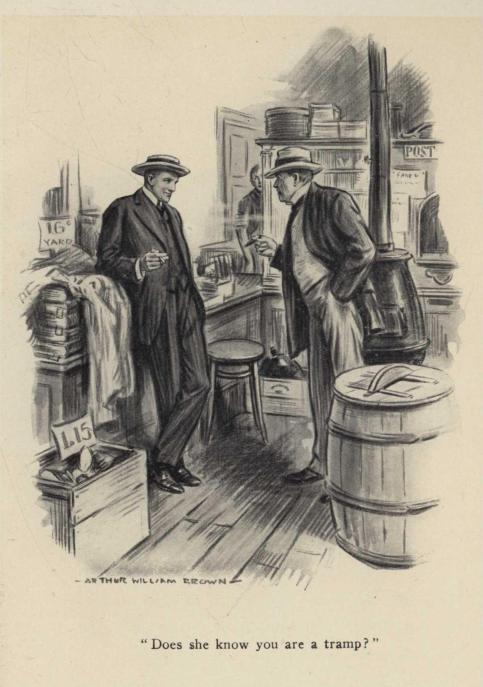
"Does she know you are a tramp?"
"Yes."
"You haven't a cent, I suppose."
"No, but I can earn some."
"How?"
"Working."
"At what?"
"Something."
"What?"
"Anything. Damn it, I ain't incapable of anything but sleep!"
"I've lost thousands through that dirty trick of yours—"
"Yours. You originated it, you know."
Bartlett leaned against the counter beside the Watermelon and glared at the floor. Neither thought to leave the store, and even forgot the clerk, who gazed at them dubiously from a discreet distance and wondered how many more telegrams they wanted.