Front matter (continued 2)
Reading edition
The Watermelon slowly unwound another bill and nodded. "I know, but I'm sorry for him. A few hours won't make much difference. He hasn't the slightest idea who swiped his clothes. He'll think some tramp did and that the feller is getting out of the country by cross-cuts and as fast as he can. Don't you see? No one will look for me with the general and Bartlett. I'm going to have a week of fun—"
"Maybe," said James gloomily. "Hardly, if you give that bloke his clothes before you need to."
The Watermelon waved the statement aside. "We are going to leave about five," said he. "They are waiting for me, now. It will take you a bit of a walk to find the place. I put the clothes in an empty log near a pile of rocks at the foot of three tall pines, standing together about ten yards from the lake. You can't help but find it. Give him the clothes and this check-book and fountain pen. I can't use them and you two won't get gay with them 'cause Mike's a coward, and James has too much sense."
"You're a damn fool," said James shortly.
"He's all right," argued Mike, meaning the man in the forest shades. "What can hurt him?"
"I know, but he's mighty uncomfortable. Can't sit down, maybe, and there may be flies and mosquitoes—"
"Naw," protested Mike. "He's just comfortable. If it was the style, I would like to have gone naked to-day."
"He'll have the police after youse," warned James, "as soon as he can reach the village."
"Sure he will. Gratitude is a flower," said Mike grandiloquently, "that I have never picked."
"And never will," added James with grim pessimism.
"That's all right," returned the Watermelon. "I ain't gathering any flowers this trip. Here's a ten-spot for each of you, and mind you do what I say."
"For you," said Mike, "I'd give me heart's blood."
"Where do we find this pond?" asked James.
"Come with me and I'll take you to the road that leads by it. You give me time to get to the hotel, though, before you give him his clothes."
"Trust me," said Mike, lovingly concealing the greenback in the dark dirty recesses of his rags.
They parted in the road where the Watermelon had come upon the big red touring car. Mike and James watched him until he disappeared over the top of the hill, then climbed the wall and made their way through the woods to the little mountain lake.
"We won't get the clothes," said James, "until we have had a talk with the guy and tried to get him into a reasonable frame of mind. It's just likely that he may be somewhat put out."
There was no one in sight as they made their way cautiously to the edge of the lake. The trees grew nearly down to the narrow, pebbly beach and were reflected in the quiet depths of the water. The little brook, tumbling over its miniature waterfall, with a ripple and splash, was the only sound that broke the all-pervading silence. Nothing stirred in the underbrush, neither man nor beast, and James and Mike were about to slip away as quietly as they came when a stick snapped behind them sharply and Mike wheeled.
A man was peering at them eagerly over the tops of a few bushes. His face was white and his teeth chattering. His arms, dimly discerned through the branches, were wrapped around his shivering form with fervor and he was standing gingerly on first one foot and then the other.
"Hello," said Mike facetiously. "Going in?" and he nodded casually backward to the lake.
"Been in," chattered the miserable wretch, trying to control his teeth so that he could say more.
"Oughtn't to stay in too long," advised James solicitously. "Your lips look blue."
"Bad for the heart," said Mike.
"We ain't ladies," added James with delicacy. "You might come out from them bushes."
"Some—some one stole my—my—my clothes," stammered the young man, stepping carefully forth. "Been here—here since this—this morning." He looked sharply at the shabby pair before him, with quick distrust in his bloodshot eyes and added coldly, "Some—some tramp."
"Did you see him?" asked James.
"No—no—no. But who else could have stolen them?"
"I," said Mike, drawing himself up to his five feet five and throwing back his pudgy shoulders, "I am a tramp. I trust, sir, you meant no insult to me profession?"
The stranger waved the question aside. "Get me some clothes and I'll give you some money."
"What money?" asked James.
"I will send you some. I am rich. My car is in the road. Maybe you saw it. I was coming through the woods to the hotel to get a tow up, for I was out of gasolene, when I saw the lake. It was early and I thought I would take a swim. Maybe you saw my car by the side of the road?"
"I didn't see no car," said Mike.
"Did you come by the road?"
"Yes, a narrow wood road."
"Yes, yes; that's where I left it. The damned thief has probably gone off with my car, too."
"Then he couldn't be a tramp," said James judiciously. "Tramps don't know nothing about motor-cars."
"Maybe he took it up to the hotel," said Mike, cheerfully helpful.
The stranger shook his head. "No, he wouldn't do that. He would get out of the country as fast as he could."
"If there wasn't no gasolene," suggested James tentatively.
"He could easily get some from the hotel. It was early when he stole my clothes." And James realized with relief that the youth before him was, in his own eyes, always right, and advice wholly superfluous.
"I saw a big red car," said Mike, "down the road a bit, over the other side of the village, going south. But maybe your car wasn't red."
"Yes, yes, it was," cried the stranger. "What was the make? Could you tell?"
"A Thomas car—"
"Ah, my car. Get me something to put on and I'll make it worth your while. I'm William Hargrave Batchelor. Maybe you have read about me in yesterday's papers?" And the poor, shivering, naked wretch drew himself up proudly and smiled with much complacency.
"I," said Mike, tapping himself on his breast, "am George V., of England."
"No, no," protested the stranger. "I'm not fooling. Get me, some clothes and come with me to the nearest telegraph office and I'll show you."
"How much," asked Mike, "will you give me?"
"Us," corrected James.
"How much do you want?"
"How much will you give?"
"Ten dollars."
"For a suit of clothes?" Mike's fat red face depicted his horror.
"Twenty," cried the stranger.
"Apiece?" asked James.
"Apiece," declared the unhappy youth.
"Apiece, James," said Mike, turning inquiringly to his companion.
"Make it thirty," said James, "and we may be able to help you."
"All right, thirty apiece. Get me the clothes."
"You might write us each a check," suggested James, and drew forth the pen and check-book.
"For innocence," groaned Mike, "commend me to me loving comrade, James."
The stranger's eyes glittered as he recognized his book and pen. He glanced from one ragged specimen before him to the other, from James' crafty face to Mike's sly visage, but he said nothing, merely took the pen and book.
"Your names?" he asked, opening the book and resting it against a tree for support.
"Better put 'to bearer,'" said James. "Simplicity is always the best."
The stranger wrote the checks, signed them and turned to the two watching him. "Bring me the suit," he said quietly, "and these are yours."
Mike shuffled off into the trees and James and the stranger waited in silence for his return. He came back presently and threw the suit at the stranger's feet.
"You'll notice," said he, "that this nobby spring suit in our latest style is cheap at the price. Fancy, a thing like that for only sixty dollars!"
"I see," said the stranger.
"Payable in advance," said James.
The stranger handed them each a check and thoughtfully drew on the shabby clothes of the Watermelon. It had not been long since he had worn rags of a necessity, and he hitched them up with the skill bred of familiarity. He thrust the pen and book into a pocket he had first made sure was holeless. Then he turned to the two and his eyes gleamed.
"How much for the car?" he asked.
Mike raised his hands to Heaven. "The car? James, does he think we stole his car?"
"A stock-broker," said James, "would suspect his own mother."
"If you want youse car," said Mike, "go to the hotel."
"Bah," snapped the stranger. "Do you think I was weaned yesterday? Be quick and tell me your price."
"I have no price," said Mike proudly, not sure where the car was.
They started through the woods to the village, the stranger leading and Mike and James following. At the edge of the village, they paused instinctively and without a word.
"Tell me where the car is and who your accomplice is," said the stranger in the short sharp tones of one born to command, "and you two can go free. If you don't tell, I'll do my best to have you arrested and sent up for grand larceny. Understand?"
"Oh, yes," said Mike, "I understand. When I was young I learned English, foolishly, as I haven't used it since."
"We don't know where your damn car is," declared James. "And we didn't steal your blooming outfit. What do you take us for, anyway?"
"Very well, then," snapped the stranger. "I see that you won't tell. Remember, I gave you your chance."
He turned and hurried down the village street. The two watched him as he stopped a pedestrian and apparently asked to be directed to the justice of the peace, then they slipped away in the woods and quietly, simultaneously, turned north, falling into a gentle lope that took them far with the minimum of effort.
"I hope the kid ain't pinched," said James, after a while.
Mike sighed and shook his head. "Grand larceny," he murmured. "That's gratitude for you."
CHAPTER IX
ON THE ROAD
The general never went anywhere without a well-stocked library, guide-books, instruction books, maps. All were consulted long and often, and with a childlike faith that Henrietta's sarcasm and the sign-posts had not been able to shake.
If the guide-book read, "White rock on left," the general stopped the car if the rock were not immediately seen where it should be according to the book and refused to go farther until it had been discovered. If the rock could not be located, the general ran back a little way or ahead a little way and if the white rock still refused to be seen on the left, the general did not see what right any one had to remove valuable landmarks. Henrietta's tentative endeavor to point out the possibility that the book was mistaken, doubtless unintentionally, but still mistaken, was simply waved aside as one more indication of woman's inferiority to man. If the book said that there was a hill at such and such a place and there was in fact no hill there, the book was still correct. There was something the matter with the landscape.
Bartlett knew of this unfortunate tendency of the general's and resolved to get rid of those books and maps and papers. With every mile indicated and nicely tabulated, every turn and landmark mentioned, it would be almost impossible to get off the beaten route, and they must avoid telegraph stations and post-offices as much as possible. The success of the scheme lay in keeping Batchelor away from all touch and communication with the city. They must, if possible, get lost, and with the multitudinous books and maps they would not be able to. Therefore, they must get rid of the books and maps.
When they had separated to prepare for the trip, Bartlett returned hastily to the garage. No one was in sight except a strange chauffeur lounging in the doorway. Bartlett collected all the literature from the general's car and hastened back to the hotel. Surreptitiously, he entered an empty room near the one assigned to him and when he emerged again, his arms were burdenless and he was smiling gently.
They waited for the Watermelon on the porch, intending to have an early supper and start while it was still light. Bartlett greeted the returning youth with relief and lead the way to the dining-room. He mentioned a small village some thirty miles to the north, where they could find accommodations for the night in an old farm-house.
"Friends of mine," said he. "I go there every fall."
The general rose to get his blue book. "We will look it up," said he.
Bartlett stopped him. The town was not in the book. He knew, for he had tried to find it.
"The maps will do," said the general, who liked to locate every town visually on the maps or in the books before he undertook to motor there.
Desperate, Bartlett declared that it was not on the maps. But the general would not be daunted. They could put it on the maps themselves if they knew in which county it was, near what post-office—
"We don't want to locate it," said Bartlett, growing stern and cross of a necessity.
They found the cars waiting at the steps and a small crowd to see them off and wile away the time before supper.
Bartlett said, as he knew the way, he would lead. "We need only two cars. Mr. Batchelor's car can be left until we return."
"Three cars might come in handy," protested the general, who objected to every suggestion not his own, on principle.
"Why?" asked Bartlett coldly.
"Mr. Batchelor might become offended at us and want to ride by himself," suggested Henrietta, laughing.
"Yes," agreed Billy, who, though young and charming, was sometimes lacking in that reserve that should have stamped her father's daughter. "He and dad are fighting each other now on 'Change."
Henrietta flushed, the Watermelon laughed and the general looked pained at the thought of any possible lack of congeniality.
"My dear Billy," said Bartlett, "the third auto would be extremely handy for you and your tongue, at least."
Billy glanced miserably from one to the other. "Why, Daddy, you told me, yesterday—"
"I have told you many things," said Bartlett, "both yesterday and the day before."
He took the general by the arm and gently but firmly thrust him into his car, getting in himself and taking the wheel. The young folk could ride in the tonneau and Alphonse follow in the general's car with the luggage.
The cars started down the hill in the first sweet flush of evening. Birds were going to bed with noisy upbraidings. A few cows at the pasture bars watched them pass with great, stupid, placid eyes, jaws going slowly, rhythmically, as they waited for the milking time. Now they flashed from the shadows of the woods to the open country, pastures and rolling grain fields on each hand. Now they plunged among the trees again with the drowsy twitter of birds and the clear babbling of a brook somewhere off among the ferns and brambles.
The Watermelon leaned back in the deep soft cushions of the big car and smiled a smile of calm and peace and comfort. The car ran smoothly, noiselessly, little breezes laden with the sweetness of the approaching night wandered by, on each side of him was a pretty girl. Tramping idealized! It was living idealized. And that morning, hungry, shabby, unshaved, he had been content to lie in the sweet lush grasses of a chance meadow, under a butternut tree, with the convivial James and the corpulent Mike! He crossed one well-pressed, silken leg over the other and saw by the wayside, lounging in the shadows, waiting for the car to pass, the two, James and Mike—Mike, fat, red-faced, dirty, his frowsy hat pulled aslant over his small, bleary eyes, shoulders humped from long habit in cold weather, toes coming out of his boot ends; James, clean shaven, but otherwise no better dressed, no cleaner, both chewing tobacco with the thoughtful rumination of the cows watching over the pasture bars at the end of the wooded lane.
Over the trees, the sun was dropping from sight. Clearly and sweetly on the quiet air of the eventide, the church bells began to toll from the village below them in the valley.
Billy nudged the Watermelon to call his attention to the two weary figures by the wayside.
"Poor fellows," said Henrietta softly, lest they hear her.
The Watermelon glanced at them in lofty disgust and catching James' eye, his own flickered the fraction of an inch and he raised his hands languidly to adjust the brown silk tie at his throat. When they had passed, he turned and waved a graceful farewell. He explained to Billy as they swept on into the deepening dusk.
"You might as well encourage the poor fellows. They probably want to ride as well as I." And Henrietta fancied that possibly his father had looked thus on a Sunday, in the pulpit of a country church.
"Yes," agreed Billy. "They may be perfectly dandy fellows."
"Assuredly," laughed Henrietta. "The stout one fairly radiated truth and nobility, a manly, upright youth."
"I don't care," declared Billy warmly. "You can't always tell from appearances. You ought to know that, Henrietta. Clothes don't make the man."
"Nor his manners," laughingly retorted Henrietta.
"Sure," said the Watermelon. "Father used to say that manners didn't count any more than the good apples on the top of the box to hide the rotten ones beneath."
"I think your father was a cynic," said Henrietta sharply, into whose ears Billy had been recounting the sayings of the absent divine.
"Yes," admitted the Watermelon, "he was."
"Cynicism is a sign of failure," quoted Henrietta. "Surely your father wasn't a cynic."
"Yes, he was," declared the Watermelon, "and you didn't make that up yourself. You heard some failure say it. Father used to say, and he's right, that if a man reached forty without becoming a cynic, he was a fool and might better never have reached forty. A success can be a cynic, for cynicism is simply a pretty good idea of the meanness of human nature and no unfounded expectation of anything especially decent coming from it, isn't that so? Father used to say that love was divine, hate devilish and meanness just cussed human nature, and a mixture of the three in more or less degree made man."
"Your father was a philosopher," laughed Henrietta. "I would like to have met him."
"I thought the papers said—" began Billy, in her slow, anxious way to get things right.
"Yes, they did," interrupted the Watermelon, "and they were right."
It was quite dark now. Bartlett stopped a moment while Alphonse lit the lamps, and then they went on and on, faster and faster, into the summer night. Once in a while they passed a lighted farm-house and a dog rushed out and barked at them. Twice they whirled through small villages and the villagers, going home from church, paused to watch them pass and be swallowed up in the dark ahead. The air was full of fireflies. A whippoorwill called plaintively from the bushes, and low in the west were flashes of heat lightning, with now and then an ominous rumble of distant thunder. Silence had settled on all, even Billy mused in her corner, half asleep.
The general had been worried for some time. They were apparently getting nowhere. He felt that he should have consulted the blue book. He was about to suggest that they stop and get the book from the rear car, when Bartlett waved toward the dark bulk of a house looming out of the night, some little way ahead.
"That's the place," said he. "We can spend the night there and get one of the best chicken breakfasts I ever ate."
The general looked at the place and rallied his sinking spirits. It appeared dark and he should say it was deserted, but Bartlett doubtless knew what he was talking about. The people probably lived in the kitchen. He was hungry and tired and the thought of hot sausages, bread and jam and milk and then a soft cool bed was nearly as good as the reality. He turned gaily to the quiet three in the tonneau.
"Wake up and hear the birds sing."
Bartlett glanced back and laughed. "Asleep, eh? We're there," he added, turning the car neatly into the open driveway. "Guess you won't refuse a good supper very strenuously."
The drive was rough and they rolled slowly tip to a great dark house, standing on a slight rise of ground, a typical New England farmhouse, square and gaunt and unadorned, with a small front stoop and a long side porch. From the trees behind the house, came the dismal cry of a hoot owl, as the cars came to a rest, and an answering cry from the grove across the road.
"Ghosts," whispered the general.
"Oh, hush," pleaded Billy. "There is no need of fooling with things like that."
"This house ain't lived in," said the Watermelon, as he slipped from the car to straighten his cramped legs.
"Folks gone to bed," explained Bartlett cheerfully, since he was not the one who had gone to bed. "We will just have to rout them out."
He shut off the power and alighted from the car, pulling off his gloves. Alphonse came up in the other car and peered out at the dark, quiet, lonely house and shook his head with forebodings.
"There isn't any one here," insisted the Watermelon, "asleep or awake."
The general climbed out. "If we had consulted the book—"
"My dear sir," interrupted Bartlett, a bit irritated, "the book could not possibly have told us that the family had moved since last fall when I spent two weeks here, hunting."
"Certainly not," laughed Henrietta, who spent a good part of her life steering with infinite care and constantly growing skill between the Scylla of her father's wrath and the Charybdis of the hurt feelings of those whom the general had offended. "This is simply one of the unforeseen misfortunes of the road."
"Besides," said Bartlett, "we don't know that the Higginses have gone!"
"Don't you see that there aren't any signs of life?" demanded the Watermelon. He had lived by his wits so long that he noticed instinctively the little things which mean so much and are generally overlooked. "If there was any one here some window would be open on a night like this, wouldn't it?"
CHAPTER X
THE DESERTED HOUSE
"Wonderful, wonderful!" murmured Henrietta in the tones of the famous Watson.
Bartlett looked at the house and nodded gloomily. "I guess you are right. Funny they should have left without writing me about it. I have known them for years."
"I will get the blue book," said the general, with the calm satisfaction of one who at last comes into his own. "We can return to the nearest village—"
"What do we want a blue book to do that for?" sneered Bartlett. "I should think two motor-cars could do it, provided we followed the road."
"Hold on a shake," said the Watermelon. "I will get in a window and open the door."
"We had better not," objected Henrietta, "Wouldn't that be house-breaking?"
The general agreed. "Certainly. It is warm and we can spend the night outside quite comfortably if you do not want to return to the village."
Billy shuddered and glanced appealingly at the Watermelon. A deserted house was bad enough, but outside where the owls called dismally from the woods and where bats flitted by in the dark held possibilities infinitely worse.
"I have known these people longer than I have Billy," said Bartlett. "I used to come here when I was a kid. It will be all right to break in. They are like my own folks."
The Watermelon immediately jumped to the porch, disdaining the few steps, and disappeared behind the vines which covered one end and concealed the window.
Bartlett turned reassuringly to the general. "It will be all right, Charlie. Don't worry about it. Why, I've always called Mrs. Higgins, Aunt Sally."
Visions of hot sausages, bread and milk die hard when one is hungry and the general snorted. "That's all right. I am hungry enough to break into the Bank of England if it resulted in something to eat, but what can we find in an empty house?"
"Ghosts," said Henrietta.
Billy pinched her. "If you think there are ghosts in there, Henrietta, I simply won't go in."
"Certainly there are ghosts," said Henrietta. "There always are in empty houses. Where else do you find them?"
"We will return to the village," declared the general, "and get something to eat. I will get the book—"
"An empty house is better than the countryside," said Bartlett. "And we have plenty to eat in that basket Henrietta put up."
"If there is something to eat—" wavered the general.
A light gleamed a moment through the crack of the door and then the door opened and the Watermelon grinned at them in the light of a small smoky lamp he held.
"Where did you get the lamp?" asked the general as the Watermelon led the way in.
"Found it," said the Watermelon. "The place is furnished. The family is probably only away for a visit." He set the lamp on the table and from long habit wiped his dusty hand on his trouser leg. "I fell over everything in the room before I got next to the fact."
He glanced about with some pride and the others stood in a semicircle and stared around. The room was a typical country kitchen, a huge stove side by side with a large chintz-covered rocking-chair. A dresser for the crockery and a haircloth lounge took up one side. There was a center-table with a red checked cloth, a few chairs and a sewing-machine near the window. On the walls were a number of cheap prints and several huge advertising calendars With gay pictures of young women in large hats and low-cut dresses.
Bartlett glanced around and at every unfamiliar object his heart sank lower and lower and his first sickening suspicion became a painful fact. He had never been in that room before. The Higginses had never lived there. Everything was strange, the furniture, the rugs, the very shape of the room. Where were they? Whose house had they unceremoniously broken into? A clammy chill crept down Bartlett's back and his florid face grew still redder.
None of the others was noticing him. The general was prowling around to see that the enemy could not come upon them unawares. The Watermelon had lifted the basket on to the table and the girls were preparing gaily to set forth the repast, all three rummaging in closets and drawers for plates and knives and forks.
The general returned to the table. "All serene along the Potomac," said he, thrusting his hands into his pockets and peering into the basket with renewed hope. Henrietta smiled gaily. She had pushed aside her auto veil, her cheeks were flushed with the joy of the adventure and her eyes bright.
"Father," said she, "in all our lives, we have never had an adventure before, because you persist in using those blue books."
The general laughed and helped himself to a sandwich.
Billy opened the dresser and peered gingerly in, her small nose wrinkled for any unforeseen emergency. She had taken off her hat, and her soft yellow hair, bound back by a black velvet snood, escaped around her temples in tiny waves. Her eyes, thought the Watermelon, were brighter than the lamp upon the table and her laughing, kissable mouth redder than the crimson lips of the fair creatures in the gay calendars on the wall. Her hand upon the latch of the door was so near his own, that he was tempted to put his on it, but instead slipped his into his pocket with a delicacy he did not recognize in himself. She was a girl, young and sweet and attractive, and because she was attractive, she had been flung into the maw of the Street, a victim of the age's insane desire for money and more money. Each dainty curl, each flash and disappearance of her single dimple had been reckoned as so much in dollars and cents. So the Watermelon put his hand in his pocket and only watched her with poorly veiled admiration.
"Do you know what I am looking for?" she asked, glancing at him, her eyes full of mischief.
"For the family silver," said the Watermelon. "We might as well take some souvenir of our visit."
"I don't believe the family silver is silver," said she. "I am trying to find a bucket which you can take to the well and fill for tea. It will give you an appetite."
"We will let Alphonse go for the water," said the Watermelon, turning over the articles on the dusty, crowded shelves. "The general sees to the cars. We will give Alphonse a chance to earn his pay."
"You should do something to earn yours," said she.
"What is mine?" he asked, trying to see into her eyes.
"We must find that bucket," said she, gazing innocently upward at the higher shelves. "I love to muss around among other people's things. They are so much more interesting than your own. I wonder why."
"We can't be amused with ourselves and our things," said the Watermelon. "We are too important. Father used to say nothing else was really important but ourselves and what affected us."
Henrietta, fussing with the alcohol lamp at the table, laughed. "Why didn't your father write a book," she asked, "a philosophy? It would have been a deal more interesting than James or Spencer or Decant."
"He used to say that a man who knew life never wrote about it. It would be too painful. It wouldn't sell."
There was a heavy step on the porch and Bartlett turned quickly with sickening fear. It was Alphonse come from putting the cars away in the shed beside the barn. Bartlett wiped his brow and swallowed heavily. This was terrible, this being in another man's house unlawfully. The utterly hopeless inability to explain satisfactorily took all one's nerves away. He glanced at the other four, merrily unconscious of his ghastly discovery, their thoughts filled only with the desire to eat.
"Billy," said he sharply, "what are you doing in that closet? Come away at once."
"I was only trying to find a bucket," stammered Billy.
"Those things don't belong to you. You have no right there." And Bartlett sternly and promptly shut the door.
Billy drew back hurt. "I don't see why it is so wrong to break into a man's pantry," said she, "after you have broken into his house. Besides, Daddy, you have known these people all your life."
"That's the trouble," said Bartlett desperately, with a rush, "I don't know these people. I have never been here before." He glared defiantly at the general, daring him to suggest the blue book.
For a moment no one spoke. Alphonse at the door, hat in hand, the general by the table, another prematurely acquired sandwich in his hand half way to his mouth, Henrietta, busy with the flame of the tiny alcohol lamp, Billy before him, the Watermelon on the edge of the dresser where he had seated himself, all stared in dull surprise. The Watermelon broke the silence.
"Better to break into another man's house than have him break into yours," said he. He glanced at Bartlett with just the flicker of amusement in his mild gray eyes, thinking that Bartlett had got lost already, deliberately, with the intention of spending the greater part of the following day finding themselves, and so successfully passing one day of the seven. Bartlett glanced at the young man and flushed. It seemed to him for one fleeting moment that the youth with the sleepy eyes knew a bit more than Bartlett cared to have him know, cared to have any one know, that he even seemed to suspect him of having got lost on purpose. Then the sleepy eyes turned again to Billy and the older man told himself that he was mistaken. He was growing nervous and reading his own intentions in every one's eyes. He strove to regain the mastery of his nerves by airy indifference.
"A slight mistake," said he.
"Ah, yes," said Henrietta, "as when you go off with another man's umbrella."
She turned down the flame, which threatened a conflagration, and put the cap on, extinguishing the lamp. One did not take tea in another's house when one had entered by mistake and through the window. One merely got out again, quietly and with no unavoidable delay.
The general, with rare nerve, took a bite from the sandwich and laid it on the table. He drew his handkerchief and wiped his hands. "I will get the blue book," he began busily, his mouth still rather full.
"We don't need the blue book to tell us to get out," said Henrietta, a bit tartly. She looked at the dainty pile of sandwiches, the cold chicken, cakes and olives on the table with the wooden plates and gay paper napkins she had arranged for the coming feast and hesitated. She wished some one was courageous enough to suggest that they eat before they leave.
"Certainly not," said the general. "But if we had consulted them before we left—"
"Sort of in the fashion of an oracle," sneered Henrietta as she began slowly to gather up the napkins and the wooden plates.
"Tell me," said Bartlett calmly, impersonally, not as one desiring an argument, but simply as a humble seeker after knowledge, with no prior views on the subject, "tell me, can you never make a mistake if you have a blue book?"
"No," said Henrietta, "never. With the blue book one could go directly to Heaven. It would be impossible not to."
Billy laughed.
"Billy would laugh at her funeral," said Bartlett coldly.
"We haven't anything to cry about," said the Watermelon, frankly unconcerned. "It's for the man who owns the house to do the crying."
"How did we get here?" demanded the general, as Alphonse went to get the blue book, for the general could no longer be gainsaid in his desire for his book. "Is this where the Higgins' home should be?"
"Why, no, father," said Henrietta, "or it would be here."
"I meant, Henrietta, did we come the right way? If we took every turn and have come far enough and not too far, this should be the Higgins' house."
"It should be," admitted Bartlett. "But it isn't."
Through the open door came the many noises of the summer night, the incessant hum of insects, the plaintive cry of the whippoorwill, the strident chorus of the frogs in the pond back of the bam. A moth, fluttering around the dingy lamp, fell on the table with scorched wings and Billy tenderly pushed it on a plate and carried it to the door.
"Why not eat here?" suggested the Watermelon, unimpressed by the aspect of the affair as it struck the others. "We can hunt for the Higginses afterward. They ought to be around somewhere unless we're helplessly lost."
Henrietta smiled and took out the napkins she had laid back in the basket. "It won't take us long," she agreed. "We don't need to have any tea."
"No," protested Bartlett, glancing at the door and listening for the crunch of wheels on the gravel without, "no, we must leave at once. We aren't lost. The Higginses' is probably the next house."
"Suppose it isn't," said Billy.
"Just so," said the general. "We will return to the village and put up at the hotel. It isn't late."
"It's half-past eleven," said Henrietta, glancing at her watch.
Alphonse returned, blasé, indifferent. "There are no books," said he, devoid of all interest in the affair.
"No books?" cried the general. "Alphonse, what has become of them? Did you take them out of the car before we left?"
"No," said Alphonse, and violent, positive protestations could not have been more convincing.
"But where are they? I left them in the car."
"They probably fell out, father," said Henrietta.
"They have never fallen out before," snorted the general, with base suspicions against Henrietta.
"We can get another to-morrow," said Henrietta. "We will simply return to the hotel in the village for the night." And once more she replaced the napkins in the basket.
"Yes," agreed Bartlett. "There is a good hotel near the railroad tracks."
"Where are the railroad tracks?" asked the general, who had lost all faith in Bartlett's knowledge of the country. "We passed no railroad tracks."
"Just before you come to the village," retorted Bartlett, irritated as a badgered animal. "You have to cross them as you come up the main street."
"We crossed none," said the general, with the indifference of one who realizes that there is no more to hope for. The boat is sinking, let it sink. The last cent gone and the landlord coming for two months' rent. Let him come.
"No," said Billy gently, "we didn't, father."
"Why, we did, we must have," protested Bartlett. "I always come here on the railroad train. They have to flag it, but it stops. Why, I know there are tracks there."
The general did not attempt to argue. "We are lost," said he, and one knew that the unfortunate event was entirely due to the scorn of others for the blue book.
"No," said Henrietta kindly, "there were no tracks. I remember saying to Billy I was glad there was one town not spoiled by the garish contamination of the world. Didn't I, Billy?"
"Yes, she did," admitted Billy, looking pityingly at her father.
"If we didn't pass through Wayne, we are lost and the Higgins' home is probably miles from here and there is no use looking for it," said Bartlett, and smiled—grimly, the general thought; happily, the Watermelon thought. It would be rare luck to be lost thus early.
They were all gathered around the table, except the Watermelon and Alphonse. Alphonse still stood by the door, hat in hand. He was merely a paid hireling. His master's affairs were none of his. The Watermelon still sat on the dresser and swung his feet. The predicament was only one of the many he was more or less always involved in and not worth thinking about. Batchelor and the police did not worry him that night. It was too early.
"Why not eat something before we go?" he said. "We have been here about an hour now, and another hour won't make our crime any the worse."
"Yes," agreed Henrietta promptly, surprised at her own depravity. "Let's," and again she took out the plates and napkins.
"Suppose they come back," softly whispered Billy.
Instinctively they all glanced at the door, and Henrietta paused with her hands on the edge of the basket.
The Watermelon laughed. "You ain't worrying because you broke into another's house," said he. "What's fretting you is that you may be found out."
"It's awful," acknowledged Billy. "I feel funny in my stomach and have creeps up my back."
"So have I," said Henrietta, and nodded grimly.
"Do what you please," said Bartlett. "But don't get caught."
"They won't come," said the Watermelon. "They have been gone for quite a time and aren't coming back."
"Ah, my dear Holmes," said Henrietta, "explain your deductions."
"They've been gone long because there is so much dust on everything and the house smells so close. They won't be back to-night because none of the neighbors have been in to leave anything for them to eat and there aren't any chickens in the chicken-house. Alphonse would have stirred 'em up if they had been there."
"Suppose some one passes and sees the light," suggested the general, tempted to the breaking point by the dainty supper so near at hand and the thought of the terrible apology of a meal they would get at the dilapidated hotel they had passed in the village. And above all things, the general loved his meals.
"We are at the back of the house and it is almost twelve. Every one is in bed and those who aren't are drunk and wouldn't be believed anyway."
"It's five miles to the village," added Bartlett with no apparent relevance.
"Aw, be game," encouraged the Watermelon. "Be sports."
"Just being hungry is enough for me," declared Henrietta, taking the last of the edibles from the basket.
CHAPTER XI
A NIGHT'S LODGING
The general hesitated. It was not lawful, not right. They had broken into another man's house and should leave at once. But all his life he had lived by rules and regulations, followed life's blue book as persistently and as well as he did the auto blue book. Now he was lost, the blue book was gone and there was an indefinable pleasure in letting go the rules and regulations that had governed him so long. In the warm June night, with the youthful, foolish Billy, and the irresponsible Watermelon, the general's latent criminal tendency came uppermost, that tendency in all of us once in a while to do wrong for the sake of the adventure in it, for the excitement and fascination, rather than for any material gain. In the experience of being in another man's house unknown and uninvited by the owner, of listening for the rattle of a wagon turning in at the gate, for the crunch of a foot on the gravel without, there was an exhilaration he had not known for years. He felt that a bold lawlessness which he had never had and had always felt rather proudly was only kept under by the veneer of civilization, was rising in him and that he was growing young again. He had always believed that if the occasion arose, he could out-Raffle Raffles.
"It will not do any harm," he thought with the remains of his old conscience. "We will go directly after supper."
It was a jovial meal. The conversation waxed merrier and merrier. The general grew younger with every mouthful and Bartlett more and more genial. He forgot that he was kidnapping a famous young financier, and told all his most enjoyable stories with the skill of many repetitions. When they had finished, no one for a while made any motion to clear up the table preparatory to leaving. Billy, with her chin on her hand, thoughtfully gathered up the crumbs still on her plate and transferred them to her mouth. Henrietta leaned back in her chair, her hands clasped behind her head, gazing dreamily at the flickering lamp. Bartlett and the general smoked in contented silence and the Watermelon rolled a cigarette with his long, thin fingers, his old clay pipe discarded with his rags. Alphonse was already asleep. A snore from his corner drew their attention.
The Watermelon licked his cigarette paper and glanced at Billy. "He's got his nerve," said he, putting the cigarette in his mouth and reaching for a match.
"I don't think that any of us have been lacking in nerve to-night," said the general, with no little pride.
"You're dead game sports," admitted the Watermelon. "Let's stay all night."
"It's morning already," said Henrietta. "We have stayed all night."
"Let's sleep here," said the Watermelon. "We can leave early."
"Er—er—are there any beds?" asked the general.
"Father, father," cried Henrietta, "you are backsliding."
The general protested, immensely flattered.
"Father used to say if you didn't backslide once in a while, goodness wouldn't be goodness but a habit," said the Watermelon.
The general always looked back on that night and the week that followed with wonder, thankfulness and pride. When the Watermelon, waiting for no further consent, picked up the lamp and started to investigate the bedrooms, the general was the first to follow him.
They found two bedrooms on the ground floor, and though the beds only had mattresses and pillows on them, even the Watermelon did not suggest a search for sheets and pillow-cases. The girls took one room, the men the other. Alphonse was aroused enough to be dragged to the haircloth sofa in the kitchen, from which he kept falling during the course of the night with dull thuds that woke no one but himself.
The Watermelon was having the time of his young life. Abstract problems of right and wrong did not trouble him. He took each event as it came and never fretted about it when it was over or worried about the next to come. Last night in the open with the fat Mike and the languid James, all dirty, all tired, all tramps, he had slept as peacefully and had fallen asleep as quickly, as he did that night in a comfortable bed with an austere member of the New York Stock Exchange as bedfellow and a retired general of the United States army on the couch at the foot. The whole adventure was diverting, amusing, nothing more. He took each day as it came and let the morrow take care of itself. Batchelor would probably try to make trouble, but if Bartlett were as successful as he hoped to be, and kept on getting lost, there was little danger from that source. Bartlett, desiring secrecy as much as the Watermelon, had effectually silenced the enterprising reporter at the hotel.
It was early when Bartlett awoke. The birds were singing riotously in the vines over the porch and the sun streamed through the cracks in the shabby window shade. He yawned and stretched, glancing with amusement at the general, still raising melodious sounds of slumber from the couch at the foot of the bed. Then suddenly he became aware that the place at his side was empty, that the Watermelon was gone. He crawled stealthily out of bed and dressed, filled with misgivings.
Batchelor had consented so readily the day before to come with them that now, when he had had time to think it over, he might have regretted his decision and be already on the way to the railroad, somewhere. His had been the master mind to conceive the check and ruination of the cotton scheme, and surely he would see the folly in what he had done the day before, when lured on by the pretty, bewitching Billy. He would realize now in the clear light of day that he must return to the city or get word to his brokers somehow. He might even then be in a telegraph office, sending a despatch of far-reaching importance.
Bartlett dressed with feverish haste and hurried out to the side porch. The Watermelon was there, sitting in the sun, his feet hanging over the edge of the porch, talking carelessly with the immobile Alphonse. Both were smoking and both had apparently been up for some time. Had Batchelor been to the village and telegraphed already? He would have had time to go and return if he had used one of the cars.
The Watermelon looked up. "Hello," said he.
"Hello," said Bartlett. "Been up long?"
"Not so long," said the Watermelon.
"Are the cars all right?" asked Bartlett.
"I haven't been to see," returned the Watermelon, rolling another cigarette.
Bartlett drew a sigh of relief and started after Alphonse for the shed beside the barn.
The Watermelon had not had time to walk to the village and back, besides telegraphing. Bartlett paused and glanced over his shoulder.
"Aren't you coming?"
"No," said the Watermelon. "I ain't bugs about the gasolene buggies."
Bartlett walked on, shrewdly guessing that the languid youth was waiting for Billy. Her charms, it seemed, had not grown any less effective. He decided that he would not try to get in touch with his broker. He could trust him to take care of the city end of the business if Batchelor were to be eliminated until the following Sunday. Batchelor was an ordinary youth and if Billy's charms were not enough to hold him, finding himself an equal and on friendly footing with people in what his policeman father and washerwoman mother reverently called "society," would probably turn his otherwise level head completely. Bartlett admitted to himself, as he gazed abstractedly at the shining cars, that the young man had not appeared visibly impressed either by himself or the general. But Batchelor was clever and would hide his elation.
The Watermelon's slow drawl at last aroused him.
"Cut it," said the Watermelon. "The cops are coming."
One of New York's leading citizens, bank president and corporation director, felt a slow, cold, clammy chill creeping up his spinal column. His first instinctive desire, like that of the small boy caught robbing an apple orchard, was to hide. Last night was one of those unfortunate occurrences it were best to pass over in silence. He turned and glanced at the house. The place looked deserted in the morning sunshine. The blinds were drawn, the doors shut. The general and the girls apparently still slept, and no country variety of New York's "finest" with warrant and shotgun could be seen approaching. Alphonse looked up from the car and gazed a moment at the house with the scornful indifference for the law and its minions of the confirmed joy-rider.
"I do not see any one," said Bartlett with calm dignity.
"They are creeping up on us," said the Watermelon cheerfully. "Trust the rube to do the thing up in style. Three men came along. They stopped down by the gate and talked, pointing up here, then one ran on to the village to get help, I suppose, and the other two are waiting down there."
"I will go and explain that it was a mistake," said Bartlett.
"Now, don't do that," adjured the Watermelon. It was just possible that the police had already picked up his trail and he preferred the chance of escaping in a car to stealing away by himself, through the woods, a tramp again, leaving behind him Billy and a week of fun. "Alphonse can bring up the cars and we can slip away before the reinforcements come. See?"
"I will explain that it was a mistake—"
"Mistakes," said the Watermelon coldly, "aren't on the cards in school and the law. Come up to the house and see the others first, anyway."
"One can afford mistakes as well as any other luxury," said Bartlett. "Money is all the fellows want."
"Let's talk it over first with the others, anyway," urged the Watermelon, feeling that it might be that money was not all they wanted.
They found the general and the girls in the kitchen putting it in order.
"Certainly," said the general with the calmness of one immune from the law. "We will explain."
"What?" asked Henrietta, as she drew shut the basket lid and slipped in the catch.
"Father used to say that if what you've done makes a fight, explanations will only make another," said the Watermelon. While he had the time he realized that he should slip away, but there was a chance that the police, finding their youthful quarry in the society of a general and a reputable and wealthy citizen of New York, could be impressed with the belief that they had made a mistake, and the Watermelon was always ready to take chances. Still, there was no need of running needless risk, and if he could persuade them all to escape with him in the cars, he would do it.
Henrietta nodded. Billy was for an instant flight. "We might as well," she explained lucidly, eying her father questioningly.
"Not at all," said Bartlett. "Money is all they want."
"An explanation," said the general, "will be sufficient. We do not want any tampering with the law." He picked up his hat and started for the door as he would sally forth and demand the surrender of a beaten foe.
"But, father," Henrietta's clear voice made him pause, "what can we explain?" She pushed back her auto veil and gazed from one to the other in gentle deprecation. "How we got in? But they wouldn't want us to explain that. You see, they can surmise that."
The general came back to the table. A little firmness, tempered with a lucid explanation in words of one syllable had always been his method in dealing with the weaker sex. "My dear Henrietta, we can explain why we are here."
"Why are we?" asked Henrietta meekly.
"Why are we?" demanded the general. "Because we took it for the house of a very old and dear friend."
"But as soon as we entered, father, we knew our mistake."
"Henrietta," said the general, "I can not argue with you."
"No, father," agreed Henrietta. "But when we found out our mistake, why didn't we leave?"
"I can not argue with you, Henrietta," repeated the general.
"Money," said Bartlett, "is all they want. They always fine all motorists for breaking speed laws. It becomes a sort of habit with them."
"This ain't breaking the speed laws," warned the Watermelon. "This is house-breaking."
"Sir," demanded the general, "do you accuse me, me, of house-breaking?"
"The whole damn family," said the Watermelon bruskly. He wanted to slip away quietly, whether the men at the gate were waiting for him alone or for all of them, having a tramp's dislike for anything that smacked of a possibility of falling into the hands of the law. "This is some different from speed-breaking," he added gloomily.
"This is preposterous!" cried the general. "That I, I, should be arrested! Why, I refuse to be. No one has a right to arrest me."
"If you break into another person's house, father—" began Henrietta.
"But, Henrietta, I am not a house-breaker. I deny the charge."
"We all are," said Henrietta. "That is all I can see to it."
"Money—" began Bartlett again, the refrain of his life. He felt he could not be arrested and haled before a magistrate, even such an humble one as a country justice of the peace. His whole scheme would be ruined. Batchelor would probably want to return to the city as soon as he could bail himself out, and not care to have anything more to do with motor trips run on similar lines.
"No," snapped the general, "we will have no graft."
"Graft," sputtered Bartlett. "Who suggested graft? A wise manipulation of the financial end of a difficulty will more often save you than not. There is no graft in paying for a night's lodging."
"Under the present circumstances, paying for a night's lodging is graft," declared the general.
"It's graft, then, or prison," snapped Bartlett.
"Prison," said the general heroically.
"Prison is foolish," said Billy, "when one has a motor-car and can get away."
"Besides," said Bartlett, "graft is not dishonest for the man who gives the bribe."
"It ain't," agreed the Watermelon, "if the man has money enough to give publicly to some college or institution."
Henrietta drew on her gloves. "I think you are all cynics," said she. "Graft is dishonest."
"Why?" asked Bartlett, turning to her. "Why, Henrietta?"
"Because," said Henrietta firmly.
"The only dishonor is playing on another man's weakness, using that for your own ends. If I know a man has a price, am I dishonest to take advantage of the knowledge? No, certainly not. The dishonor is in him who has a price, whose dirty little soul cares so much for money that he lets his manhood go at so much in dollars and cents, like merchandise."
"Ah," cried Henrietta with quick sympathy for the tempted. "Poverty is so terrible and money such a temptation. It doesn't seem to be fighting fair to take advantage of it."
"Father used to say that it would take the constitution of an ostrich, the empty head of a fool and the nerves of a prize-fighter to stand poverty," said the Watermelon, thinking of those days when there were eight children and no money.
"I think," said Billy, as one propounding a wholly original suggestion, "that we should go at once."
"If we have done wrong," said the general, "we should suffer for it. We should not attempt to evade the consequences of our acts."
There was a heavy step on the porch without. The general turned pale, Bartlett reached for his pocket-book and Billy leaned weakly against the knobby end of the haircloth sofa. Only Henrietta and the Watermelon were quite calm, the latter with the calmness of desperation, the former, of despair.
CHAPTER XII
THE KEY TO THE SITUATION
The Watermelon accepted the inexorable with the tramp's sang-froid; Henrietta with a sweet dignity, though slightly flushed. The door had been shut before the conference began and the person on the porch had not come in sight of the windows. With a slow wink at Henrietta, the Watermelon strode to the door. Instinctively the general started to lay his hand on the young man's arm as he passed, to detain him a moment, but instead picked up his hat from the table and hoped that no one had seen that involuntary little gesture. The Watermelon threw open the door with a bit of a flourish and Alphonse, stolid, unsmiling, entered.
There was an involuntary sigh of relief from all, even the general.
"Well," asked the Watermelon, "what are the sleuths doing?"
"Where are the cars, Alphonse?" asked the general sternly, in the reaction of the suspense of the moment before.
"I left them at the back door," answered Alphonse, as one who understood perfectly the whole aspect of the case and realized that sometimes a quiet exit is more to be desired than great acclaim. "I thought you would not want them seen from the front."
"I have no objection to my car being seen by everybody," returned the general with a wave of his hand, which appeared to include the universe.
The back door was locked and the key gone, and the Watermelon had hurried to the door into the sheds and was struggling with the rusty lock. "This is the way," said he, "through the woodshed. That door's locked and there ain't a key; family probably left that way. I noticed the woodshed route this morning."
"We can shut this door on the side porch and lock it just as we found it," said Henrietta.
She shut the door and Alphonse as quietly turned the key. She lowered the window the Watermelon had opened and, finding that he had broken the lock in doing it, she slipped a dollar from her purse and left it on the ledge. It seemed to Henrietta to leave more, to pay for their night's lodging, would simply be adding insult to injury. One can not take unpardonable liberties with another's possessions and then pay for it in the gold of the land.
"Come," said she.
The Watermelon had already opened the door and was working on the lock of the one in the woodshed. Henrietta paused in the house door, the basket on her arm, and glanced back at the others. "Come on," said she.
"I will explain," began the general, with a firmness that was fast weakening.
"Father," said Henrietta, "you can not explain. Graft is dishonest. The only thing we can do is to run."
Billy grabbed up her gloves and obeyed with alacrity. Bartlett and the general followed in dignified majesty. Alphonse came last and shut each door as they passed through. With no undue haste, and yet with no loitering to admire a perfect summer morning, they climbed into the cars; Alphonse alone in the general's, the other five in Bartlett's, with Bartlett at the wheel.
"Shall we rush them?" suggested the Watermelon with happy anticipation.
Alphonse, like the voice of reason, calm, unemotional, blasé, spoke: "There is a cow lane back of the barn. It is wide enough for the cars. It leads into the road farther on. I left the bars down."
"You're a man, Alphonse," said the Watermelon.
They glided without further comment through the barnyard into the rocky, tree-shaded cow lane. The general glanced behind. No one was in sight. The lane was narrow and rough, last spring's mud having hardened into humps and ridges from the passing of many feet. The cars ran slowly of a necessity, and while the engines throbbed, the noise was not loud, and the slight hill on which the house stood deadened the sound and concealed the cars from any one in front.
Henrietta leaned toward the Watermelon, who sat on the small seat just in front of her and just behind the general. "On such an occasion as this," she asked, "what did 'father' used to say?"
"Nothing," said the Watermelon. "There were two times when he never said anything, one was when he was asleep and the other was when he was escaping from the police."
"Oh," cried Billy, "he was a minister, why should he have had to escape from the police?"
"He left the ministry," explained the Watermelon.
"What did he say when he left it?" teased Henrietta.
"Good-by," said the Watermelon.
Then the cars turned into the road and two men stepped from the bushes on either side. They were tall, raw-boned country men, in flapping straw hats and blue jeans. Each carried a shotgun in the crook of his arm with a tender pleasure in the feel of it, each chewed a big piece of tobacco and each was apparently more than enjoying the situation. The Watermelon, leaning forward, with wary eyes, was pleased to see a look of surprise flit across their square-jawed, sun-tanned faces as they saw the second car slowly following the first, and four men instead of one, as the telegram had said "one man in a big red touring car," the make and engine number given.
For a moment the general could think of nothing to say. If he had been permitted to sally forth from the front door, he could have explained clearly, emphatically, with all his old-time belief that being himself no one could possibly doubt him or his good intentions. But now, caught thus, acknowledging his guilt by his surreptitious leave-taking, he did not know what to say, where to begin. Bartlett reached for his pocket-book.
"What's the make of your car?" demanded the taller of the two of Bartlett, laying his hand on the fender.
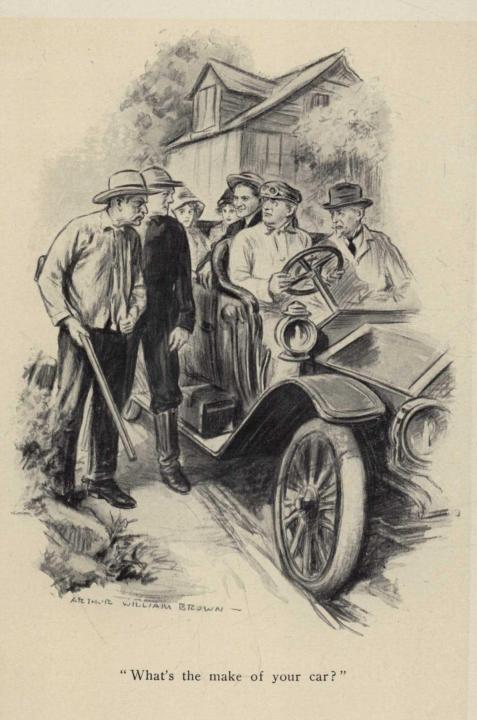
"What's the make of your car?"
Surprised, Bartlett told, thankful that he had not been asked for his name.
"Engine number?" demanded the man.
Bartlett gave it.
"License number?"
"Great Scott!" snapped Bartlett. "What do you want next? My age? My number is on the back of my car. I have so many cars I have forgotten it. Go and look, or ask my man. Alphonse, what's the number on the back?"
"97411," droned Alphonse coldly.
"Be both these cars yours?" asked the man, puzzled and a bit disappointed.
"That car," said the general pompously, "is mine. Allow me." He drew his card-case from his pocket, and to the tall man's consternation and Bartlett's horror, presented him with his card. The two withdrew and consulted a moment. Clearly the family party before them was not the young man wanted in Wilton for stealing a motor-car and a suit of clothes, but for all that, what were they doing in an empty house?
"We can arrest 'em and get a fine anyway," said the taller of the two, and the other agreed.
The Watermelon leaned forward with languid interest, his hat on the back of his head. "How d'ye do?" he drawled. "What are you doing with the popguns?"
"Hunting," grinned the spokesman pleasantly.
"Any luck?" asked the Watermelon.
"Bet cher life!" said the man. "Got what we were after."
"Bear?" asked the Watermelon innocently.
"Autos," said the man.
"Sir," began the general. He felt a pressure on his shoulder so firm, that, irritated, he turned to remonstrate with Henrietta. One could not explain the situation with any degree of pride in the first place, still less so, if some one behind were apparently endeavoring to suppress one.
The Watermelon frowned. "We weren't breaking any speed limit, unless the snail is the standard you regulate your speed laws by." The men no longer believed that they had caught the thief, but if they insisted on taking the party before a magistrate, each would have to give his name. With the general present, fictitious names would only be so much waste of breath, and the Watermelon had no desire to give his assumed name to any one in the employ of the law.
"Naw," sneered the man, spitting with gusto. "There're other things to break besides speed laws."
"Yes," agreed the Watermelon, "your empty head."
"Now, don't get sassy," warned the man, growing angry. "I'm an officer of the law and I'm not going to take any of your sass."
"An officer of the law can't arrest a law-abiding citizen," snapped the Watermelon with righteous indignation.
"Law-abiding?" jeered the man.
"What have we done?"
"Try to guess," suggested the man pleasantly and the other laughed.
"I can't guess," said the Watermelon. "Is it for riding through the cow lane? We didn't hurt the lane any. I rode through this same lane last summer and the Browns didn't kick up any row over it. In fact, they were with me, that is, Dick and Lizzie were."
The man stared and the Watermelon frowned coldly.
"Do you know the Browns?" demanded the fellow.
"Not very well," admitted the Watermelon. "I was through here last summer and stopped over night at their place. They were fine people, all right. They told me if I ever came this way again to drop in and I said I would. It was a sort of joke. They gave me a latch-key." He drew a key from his pocket and held it out as proof of his integrity.
"Huh," said the man dully, gazing from the key to the Watermelon.
The second man took it. "Which door does it fit?" he asked.
"The front door," said the Watermelon promptly. "Go try it if you want proof."
"Not so fast," said the second man, who had taken the affair into his own hands. "If you know the Browns, tell me something about them? No, you chuffer feller, hold on, back there. Don't try to slip by, for you can't. You automobilists think that the Lord created Heaven and earth for your benefit and then rested on the seventh day and has been resting ever since. That's better. Now, then—" turning again to the Watermelon—"how many in the family?"
"How many?" queried the Watermelon. "I don't know. I only saw Ma and Pa and the three kids, Dick and Lizzie and Sarah. Sarah was a young lady about twenty, if I remember rightly; Lizzie was eight and Dick was a bit older, ten or twelve—twelve, I think he said. I remember his birthday came in January, anyway."
"Well, goldarn it," laughed the first man, thoroughly convinced. "Well, say, ain't we the easy marks?"
"Don't blame yourselves," said the Watermelon gently. "Father used to say that anything colossal, even stupidity, was worthy of admiration."
"What did Dick look like?" demanded the second man, loath to give up.
The Watermelon straightened up. "See here, my man," said he sternly, "we are in a hurry. You have detained us long enough. I have told you as much as I am going to about the Browns. It's a year ago this summer that I was there and I haven't been dwelling on their beautiful countenances in rapt and joyful contemplation ever since. I have seen a few people during the interval. Dick was fairly good looking, but Lizzie was the cutest. I took them through the cow lane to show them how they could go for the cows in a motor-car, farming up-to-date, see. Now move aside and let us pass, please."
"No, you don't," returned the man sharply. "Let that chuffer feller in the back car come up to the house with me while I try this key. Tom, you keep the others here, till I come back."
The Watermelon leaned back wearily indifferent and drew out his cigarette papers. Alphonse climbed obediently from the car, with his usual imperturbability. Calmly and willingly he scaled the stone wall and set off across the field with his captor. Tom thoughtfully examined his gun, one eye on the motor-cars.
The general's desire to explain was superseded by a still greater desire to get away. The grim faces of the two men impressed him with the gravity of the event. If they were to escape, now was the time, when the forces of the enemy were divided, but there was his car.
He could not leave that behind and the man in the road was a fairly good reason for him to remain where he was and make no attempt to reach it. Batchelor had put up a clever bluff, but it had been called, and they had to sit there until the return of the other man, when they would be exposed, for of course the key wouldn't fit. That second man was a stubborn brute. The Lord had made mules. He didn't intend men to be.
The general turned irritably and glanced at the Watermelon, lolling gracefully in his seat and humming a ridiculous little song between airy puffs of his cigarette.
Henrietta repressed a wild wish to scream aloud. Never, never again would she go into another man's house unless expressly asked to do so by the owner. She glanced behind, up the hill, toward the house. Alphonse and his captor had just come into sight again and were returning through the field. Henrietta breathed heavily. This was awful. When the two reached the stone wall, she hoped she would faint. She knew she wouldn't, she never fainted. She turned around that she might not see them. Nothing could be done, apparently, but simply wait for the hand of the law to fall upon them. The Watermelon had made a good guess as to the children, it seemed; why hadn't he been content to let it go at that? Why had he hauled out that useless key? She had ceased to feel, to think. She looked at Billy. Billy was frozen dumb. This was the end. Bartlett glanced at the man in the road and tried to figure his price.
The Watermelon turned carelessly and spoke to Henrietta. "That was a pretty bird up there. Did you see it?"
"Yes," said Henrietta automatically, though she had seen no bird. She heard the two men now right behind the car and she sank back limply. All was over.
"Well?" queried the Watermelon.
"By gum," admitted the man with the key. "It fits."
CHAPTER XIII
ONLY TO BE LOST
Bartlett grinned and removed his hat to wipe his brow. The general strove not to show a guilty surprise, Billy giggled and Henrietta began to live again.
The Watermelon held out his hand. "My key, please. Kindly remove that piece of artillery from the road and we will go on."
The man, covered with perspiration and embarrassment, handed back the key. "When the Browns come back, shall we tell them you called?"
"Certainly," said the general pompously, and in the exuberance of the reaction, he drew a half dollar from his pocket and handed it to the fellow. "Kindly give that to Dick," said he with the benevolence of a grandfather.
Billy waved to the crestfallen two and Henrietta gave them a gracious, forgiving bow.
"Never again," said she, "shall I do wrong. The possibilities of discovery are too nerve-racking."
"Father used to say—" began the Watermelon.
"I'll bet your mother didn't talk much," laughed Bartlett.
But the general had passed through an unhappy half hour and had no heart for jesting.
"If you knew the Browns, Mr. Batchelor," said he, "it was your duty to have told us so."
"Yes," said Henrietta. "I have aged ten years, and at my time of life that is tragedy."
"And why," asked Billy, "if you had the key, didn't we go in by the front door last night?"
The Watermelon stared from one accusing face to the other in frank surprise. Even Mike with his fat wits would have grasped the situation. "I didn't know them," he protested. "When I can go in by a door, I don't choose the window."
"But the key," objected Billy.
"Dick and Lizzie," added Henrietta.
"Their very ages," climaxed the general.
"It was only a bluff," said the Watermelon wearily. "I remembered their names and ages from books I had seen around the room last night and on the dresser, sort of birthday presents and things, you know. I never saw one of them."
The general roared and loved the boy. Henrietta leaned forward and patted him on the shoulder. "Wonderful, wonderful Holmes!" said she.
"Did you take the key on purpose?" asked Billy, all athrill with admiration.
The Watermelon flushed. He had taken the key if by any chance he should ever be in that neighborhood again, and the family away, he could spend the night in a comfortable bed instead of under a hayrick. Besides keys always came in handy. He didn't look at Billy. Like a sudden flash of lightning on a dark night, he had seen the difference between them, between what he had become and what he had been. But it came and was gone and the old careless indifference rushed back. He laughed and changed his seat to the one between the two girls.
"When I locked the front door, I slipped the key out without thinking, I suppose," said he. "Besides, keys are handy. When you are stony broke, you can rattle them and make the other fellow think maybe they're the mon."
"Now for breakfast," cried the general gaily, never long forgetful of his meals.
"Tell me," begged Henrietta, "what would father say?"
"Grace," said the Watermelon.
The general, as he informed Henrietta at the first roadhouse they came to and at which they stopped for breakfast, was full of the old Nick. He felt that there might be no limit to his daring, he might go as far as to rob an apple orchard and make no attempt to repay the owner, that was, if the apples were ripe. Henrietta's own spirits were rising. One never realized what liberty was until one threw aside conventionality—not honor, but conventionality, the silly, foolish laws of senseless ages. Billy as usual laughed at every remark, while the general, the tramp and the financier grew fairly brilliant beneath the spur of two pretty women's laughing eyes.
The Watermelon, in his silk socks, his soft panama and fine linen, was too much in the habit of taking fate as he found it, without wonder or protest, to marvel now at his change of fortune or to be disturbed or embarrassed at the unexpected society in which he found himself. Between him and Bartlett was only the difference of a few millions, both lived by their wits, and if one preferred to walk while the other rode, it was merely a matter of choice—no sign of inferiority between man and man.
They stopped that evening at a small town in the north of Vermont, as far from a railway and telegraph office as Bartlett could bring them. He had watched Batchelor carefully for signs of restlessness, but the young man appeared entirely absorbed in the present, with no thought for anything but the moment and Billy and Henrietta.
After supper, they loitered a while on the porch. The night was dark and warm. Across the road and over the fields, the frogs in a distant pond were croaking, and the air was thick with fireflies.
"Isn't it dark and still," said Billy, her hands thrust into the pockets of her linen coat, her feet slightly parted, as a boy would stand, her small head thrown back.
The Watermelon watched her covertly from the cigarette he was rolling, the clear oval of her dainty profile, her slender throat and well-shaped head with its coronet of braids.
"Dark as misery," said Henrietta dreamily.
"In the day, one sees a world," quoted Bartlett, standing beside her where she leaned, a slender figure, against the post of the porch. "In the night one sees a universe," and he waved his lighted cigar vaguely toward the myriads of stars above them.
"What good does that do," asked the Watermelon, "seeing a universe? It's miles away and can't help you any."
"Ah, but it's beautiful," cried Henrietta, who had never had much experience with misery. "It teaches one to look up, the night-time does."
The Watermelon lighted his cigarette in the cup of his hands and tossed his match away. "If you are trying to walk in the dark," he objected, "trying to get out of your troubles, say, and not standing still in the same old place, you can't look up."
"You have no beauty in your soul," declared Henrietta. "I think the idea is beautiful, seeing a universe."
"When you are down and out, you don't take any pleasure in looking at a universe," said the Watermelon. "A dollar, or even a quarter, will look a darned sight more beautiful."
"I wouldn't like to be poor," said Billy. "It must be so terrible to have no motor-car, for one thing."
"It is," agreed the Watermelon, who would have agreed to anything Billy said. "It's simply awful."
"What did you mind most," asked Billy, "when you were a newsboy?"
"Let's go look at the universe," suggested the Watermelon hastily. "We can see it much better down the road a bit."
Billy consented, and they strolled away in the dark. The general, who thought he was talking politics, was laying down the law to the hotel clerk, and Henrietta and Bartlett were left alone. They lingered a moment on the porch and then quietly disappeared up the road in the opposite direction from that taken by Billy and the Watermelon.
Bartlett's desire was to reach Maine as soon as possible and get lost over Saturday, but to avoid every city and larger town on the way and to hurry by the smaller places where there might be telegraph or telephone connections.
"Out of touch of the world for a week," he was fond of repeating, "no letters, no papers, no worries and no nerves."
And his desire was the Watermelon's. The more they avoided towns, the better the youth liked it. Telegraph and telephone stations were zealously shunned. He would have liked to have seen a paper, so as to judge what the police thought in the case of the theft of the wealthy young stock-broker's car, provided Batchelor had allowed the thing to become public, which he very much doubted, from the little he knew of the man's character. It was hardly an episode one would care to see in print if one was dignified and self-made. And the Watermelon chuckled.
It took them longer than Bartlett hoped, sticking to narrow, unused country roads, and the next night found them still in Vermont. They spent the night at the village boarding-house, and once again Billy and the Watermelon went down the road a bit to look at the universe, and Henrietta and Bartlett went up the road.
The following day, to Bartlett's satisfaction, they got lost. It was late in the afternoon when they stopped at Milford, a small town in New Hampshire, and made inquiries about the next town. Was it far and would the accommodations be good? It wasn't far, the farmer whom they questioned, assured them, only five miles. He directed them how to go and they thanked him and pushed on.
They went on and on and nightfall found them in a lonely bit of wooded road apparently miles from any town or habitation. Bartlett was pleased. They were lost, and by great good luck they might remain lost for a considerable length of time. The general, too, was delighted. They would make a night of it. It was what he had long wanted to do and now they would have to. The lunch basket had been filled earlier in the day at a country store, so there would be enough to eat. The seats of the autos were soft and one could sleep in the cars or on the ground, as one preferred. It was warm and the rugs and shawls would be covering enough.
They ran the cars out of the road to a convenient clearing. Henrietta got out the basket, shawls were spread on the ground in the light of the two cars and they prepared to make the best of things.
"This is like old times," declared the general genially; "a night on the march, far out on the prairies, not a thing in sight, not a sound but a coyote yelping or the cry of a wolf."
"And Indians," said Henrietta, "hiding back of the nearest hillock, creeping up on you unawares."
Billy glanced behind her at the woods and wished they had chosen a more open place to dine.
"Yes," agreed the general cheerfully, "or down in some southern swamp, with the Johnny Rebs stealing through the bushes."
"Oh, please," begged Billy. "What's the use of telling about things creeping up on you?"
And she glanced again at the bit of wood she could see in the light of the lamps. Far in the west the moon was sinking and here and there a star twinkled between the rolling clouds. A thunder-head was now and then revealed distinctly by flashes of distant lightning, and thunder rumbled ominously in the sultry night. A whippoorwill called steadily and once a bat on graceful wing flew by in the eery light.
The general laughed. "That was living in those days, Billy," he said. "A man was a man and not an office automaton, a dimes saving bank."
CHAPTER XIV
BILLY, BILLY EVERYWHERE
Bartlett nodded. He had been watching Henrietta through half-lazy, half-closed lids, leaning against a fallen log. Somehow out there in the coolness and sweetness of the summer night, in the open country, with only the drumming of the insects and the shrill clamor of frogs to break the silence, nothing seemed to matter, to be worth struggling for. He felt that he hardly cared what was happening in his absence, back there in the hot, crowded, dirty city. A few more millions added to the useless many he already owned, what did it matter? What amount could buy the night, the peace and sweetness and content? He glanced at the Watermelon and felt no triumph in the thought that this was Wednesday and so far not a paper had been received, not a letter sent to spoil his plans. He wondered lazily that he had gone to the bother of planning the small, petty intrigue of the small, petty city, like dogs snarling over a worm-eaten bone. How trivial it all was!
"You're right, General," said he, watching the play of Henrietta's thin white hands in the lamp light, as she and Billy arranged the evening meal. "A man's not a man in the city—nothing but a dirty, money-grubbing proposition. Dollars and cents, dollars and cents, the only reason of his being."
"I know," agreed Henrietta, nodding. "I sometimes wonder why it was so arranged—the world, you know. Why couldn't love, courage, honor have been made the medium of exchange, the most vital necessity of life? Every one has to have money, so every one has to struggle for it. Why couldn't things have been started differently?"
"Potatoes, two kisses a peck," suggested the Watermelon.
"Three," said Bartlett, "if the purchaser is young and pretty. A smile would be enough, if she were old and wrinkled and unwed."
"A motor-car would probably necessitate a wedding," said the general.
"No, no, no," protested Henrietta. "How silly! You don't understand me at all."
"I would hate to be a clerk at a bargain sale," said the Watermelon, pilfering a cracker from the box Billy held.
"Yes," agreed Bartlett, "think of the microbes—"
"Microbes?" asked Billy who had not been following the conversation. "Where?"
"In kisses, Billy," said the general. "I should think you would have found it out by this time. Everybody you kiss—"
"I never kiss anybody," protested Billy, blushing delightfully.
"Father used to say—" began the Watermelon.
"Look here," interrupted Bartlett, "that father of yours was a minister, you say. I vow he could know nothing about this subject."
"He married more people than you have," said the Watermelon.
"Yes," said Henrietta kindly, "he must have known all about it. Do tell us what he said."
"He used to say that kissing was just the reverse of poker—"
"Poker," cried Bartlett. "No wonder your father left the ministry."
"It says in the papers that your father was a policeman," declared the general.
"A policeman of souls," said Henrietta softly.
The general waved the sentiment aside as immaterial. "How could he have been a policeman and a minister?"
"I can't say," answered the Watermelon, and turned to help Billy with a sardine can as the best way out of a tight place.
"How is kissing the reverse of poker?" asked Henrietta, always amused by the Reverend Mr. Batchelor's remarks.
"A pair would beat a royal flush," replied the Watermelon.
"Surely," persisted the general, "if your father were a minister—"
The Watermelon looked up from the key of the tin he was laboriously turning and glanced gently at the general, his woman's eyes amused and pitying, the expression they always wore for the general.
"Why, you see that is just what I always fancied. He used to preach and have a church—but if the papers say he was a cop, he probably was."
"It's a wise child that knows his own father," said Henrietta. "Come to supper everybody."
Bartlett spread the filmy paper napkin on his knees and taking the plate Henrietta handed him, balanced it on his lap with great nicety. He was so sure that the Watermelon was William Hargrave Batchelor that it never occurred to him to doubt it. There were the cards, the monogram on the automobile and the general to vouch for it. The papers were a bit wrong.
Supper over, the general conceived the sudden inspiration of tinkering a while with the cars. Alphonse stood by to assist and the others wandered off down the road before turning in for the night.
Billy and the Watermelon soon drifted away by themselves up a tiny cow lane, fragrant with sweetbrier. They wandered up it side by side, like two children, neither saying a thing, content to be together. At the end of the lane, they leaned for a while on the pasture bars. The sultriness of the earlier part of the evening had passed. The thunder was less ominous and only sheet lightning, low on the horizon, was visible. A breeze, cool and sweet, whispered by. The fireflies danced in gay little flashes of light among the shadows.
The two stood side by side, their elbows on the top rail, their hands before them. They said nothing. There was nothing to say, just the night and they two, alone, among the sweetbriers and the fireflies.
Now and then Billy sighed, unconsciously and happily. A great silence had enwrapped Billy for the last two days, a silence in which she was content to dream and in which words seemed superfluous and uncalled for. She wondered that Henrietta could talk so much. What was there to say? Billy had never been in love. She wondered vaguely if the enfolding content, the longing for solitude and her own thoughts were forerunners of approaching death. The good die young, and Billy felt that she was content to go, to drift away into the eternal peace of the after life. She was not of an analytical disposition and she only knew that she was happy, causelessly happy, and did not ask the reason. The Watermelon stood so closely beside her that once when he turned she could smell the tobacco on his breath. She wanted to rub her head on his shoulder like a kitten, and wondered if she were growing weak-minded.
Without warning the bushes at her side parted and a cow with great gentle eyes peered out at them, so near that Billy could feel the breath, warm and sweet, upon her cheek. With a little cry, she shrank close to the Watermelon.
He felt her slender body, soft and yielding, nestling against him, smelt the fragrance of her curly hair, and suddenly a great tide of longing, of passion, of desire welled up in him and choked him. He wanted to crush her to him, to cover eyes and hair with kisses, to hold her so tightly that she would cry for release. All the ungoverned feelings of the past few years surged over him and threatened to carry both for ever out of sight of land and decency. But, blindly, not knowing what he did, he turned from her and picked up a stick to hurl at the cow. She had turned to him in her fear, and with the honor of his clerical father, he controlled himself.
Billy laughed and straightened up, as the cow, grieved and surprised, backed off in the dark. "I'm not afraid of cows, Willie," said she. "Don't you know it? She just came so suddenly I was startled."
"Yes," agreed the Watermelon dully. "So was I. Why did you call me Willie?"
"Short for William, and William is your name, goose. Don't you remember your own name?" crooned Billy, leaning toward him in the dark.
"Yes, surely," said the Watermelon. "But I hate my name. Call me Jerry. That's what the boys call me."
He did not add that his name was Jeroboam Martin. He being the seventh young Martin to arrive, his distracted parents had turned to the Bible for help in names as well as in the more vital necessities.
"Jerry?" laughed Billy questioningly.
"Yes," said Jeroboam gravely, and added abruptly, "Let's go back."
They turned and retraced their steps, Billy all athrill with she knew not what, singing a foolish little song beneath her breath, the Watermelon staring angrily before him, denying hotly to himself what would not be denied, that he loved Billy. He loved her, not as he had loved other women, not as a careless, lazy tramp, taking what offered, good, bad or worse, with airy indifference, but as the son of his poor virtuous, mother and of his gentle, reverend father would love and cherish the one woman.
But who was he to love like that? The past few years had branded him as a thing apart from Billy. He tried to think it out, but the blood pounded in his temples and he could not think, could only know that he loved her more than he did himself, with a love stronger than the mad passion and longing for her that throbbed in his pulses like leaping fire. The knowledge had come so suddenly, he was so unprepared, that he could not reason it out, could only know that Billy must never dream of such a thing. A companion of Mike and James, who was he to talk of love to Billy? God!
His head moved restlessly as though in pain and his hands, unconsciously jingling the keys in his trousers pockets, clenched tightly. Billy swayed against him in the dark and straightened up with a laugh and a smothered yawn.
"Oh, law," said she, "I'm tired."
"So am I," said the Watermelon moodily. "Tired of living."
"Do you know," said Billy, "I was just thinking that death might not be so awful, just to close your eyes and drift out into space, on and on and on."
"It would be a darned sight better than living," answered the Watermelon. "Hell would be preferable. I beg your pardon."
"Aren't you well?" asked Billy anxiously. "As for me, I never really want to die unless I am feeling perfectly well."
Henrietta and Bartlett strolled up as they approached the cars, where they found the general pacing up and down the road, filled with righteous indignation and anger.
It seemed Alphonse had long ago taken his rug and pillow and retired to the edge of the woods and slumber. Left alone the general had lighted a cigar and was walking slowly back and forth in front of the cars, waiting for the others to return, when a buggy, with two men in it, passed, the horse shying a bit and the general offering his assistance and advice. To his surprise they had not gone by more than three yards, when they stopped, tied the horse and came back on foot.
"First," said the general, as the four gathered around him in the light of the car lamps, "first I thought they were hold-up men. The lamps on my car had gone out and they did not see it, thought that there was only one car, so there would not be many to defend it; besides, I was the only one they had seen, and doubtless they surmised I was alone and they could have held me up easily."
"Father," cried Henrietta, "what did you do?"
"Before I could do anything they asked me the make of my car. I told them. They said it didn't look like a Packard, and I saw that they were looking at Will's car and hadn't seen mine, back near the wall and with the lights out. I pointed to it and said that was my car. They seemed surprised to see two cars. I told them my name, gave them my card, and told them I was motoring to Maine with a party of friends and asked them what they were going to do about it."
"What did they say?" asked Bartlett, while the Watermelon slowly rolled a cigarette.
"Oh, they apologized," admitted the general. "But what I want to know, and what I don't like at all, is why every one is so curious to know the make of my car, the engine number and the license number. What business is it of theirs?"
The two girls slept in one car, Bartlett and the general in the other. The Watermelon lay on the grass on Billy's side of the car and sought to reason the thing out, to plan what to do. Alone in the dark, he did not sleep, but stared before him, ears attuned to the many sounds of the summer night.
In every whir of insects' wings, in every whispering breeze that passed, he heard Billy's soft sweet voice. He stared up at the stars and likened them to Billy's eyes, twinkling points of light as far above him as Billy was, for Billy was Billy, and he was a tramp, a hobo—a Weary Willie.
CHAPTER XV
LOVE IN IDLENESS
One not born a vagabond in heart can never understand a vagabond's love for the open places, for absolute freedom, to go where he wants, see what he wants, work when he wants. To a vagabond an office is intolerable, the accumulation of dollars, grinding another man to gain a petty advance for oneself, utterly uninspiring, conventionality, the ceaseless humdrum round of existence as a clerk at ten per, revolting. Following step by step in the well-worn, beaten path, where no man dares step aside lest he be jeered at, where none dares fall, lest he be pushed from the road and another take his place, where all think alike, look alike, act alike, spending one's days in an office, bent over a littered, dusty, shabby desk, one's nights at some cheap play-house, seeking to find an outlet for the battered nerves, for the ceaseless strain of the day by stupefying the senses with some garish parody of life, is not living to a vagabond. He is willing to work if the work is a part of himself, a development of that clamorous ego that must find peace in the open, in the physical side of existence. If he is born rich, he will become a traveler, a mountain climber, an aviator; if poor, a tramp, and the Watermelon was born poor.