Chapter XIV · (continued 2)
Reading edition
Mrs. Mountfort also appeared in Portugal Street before the two companies united at Drury Lane in 1682. She was the best of male coxcombs, stage coquettes, and country dowdies, a vivacious mimic, and of the most versatile humour. Cibber sketches her admirably as Melantha in “Marriage à la Mode:”—“She is a fluttering, finished impertinent, with a whole artillery of airs, eyes, and motions. When the gallant recommended by her father brings his letter of introduction, down goes her dainty diving body to the ground, as if she were sinking under the conscious load of her own attractions; then she launches into a flood of fine language and compliment, still playing her chest forward in fifty falls, and rising like a swan upon waving water; and to complete her impertinence, she is so rapidly fond of her own wit that she will not give her lover leave to praise it;[754] and at last she swims from him with a promise to return in a twinkling.”
The virtuous, good, and discreet Mrs. Bracegirdle was another favourite in Portugal Street. For her Congreve, who affected to be her lover, wrote his Araminta and Cynthia, his Angelica, his Almeria, and his Millamant in “The way of the world.” All the town was in love with her youth, cheerful gaiety, musical voice, the happy graces of her manner, her dark eyes, brown hair, and expressive, rosy-brown face. Her Statira justified Nat Lee’s frantic Alexander for all his rant; and “when she acted Millamant, all the faults, follies, and affectation of that agreeable tyrant were venially melted down into so many charms and attractions of a conscious beauty.” Mrs. Bracegirdle was on the stage from 1680 to 1707. She lived long enough to warn Cibber against envy of Garrick, and died in 1748.
Three of Congreve’s plays, “Love for Love,” “The Mourning Bride,” and “The Way of the World,” came out in Portugal Street. Steele, in the Tatler, No. 1, mentions “Love for Love” as being acted for Betterton’s benefit—Mrs. Barry, Mrs. Bracegirdle, and Doggett taking parts. He describes the stage as covered with gentlemen and ladies, “so that when the curtain was drawn it discovered even there a very splendid audience.” “In Dryden’s time,” says Steele, “You used to see songs, epigrams, and satires in the hands of every person you met [at the theatre]; now you have only a pack of cards, and instead of the cavils about the turn of the expression, the elegance of style and the like, the learned now dispute only about the truth of the game.”
Poor Mountfort, the most handsome, graceful, and ardent of stage lovers, the most admirable of courtly fops, and the best dancer and singer of the day, strutted his little hour in Portugal Street till run through the body by Lord Mohun’s infamous boon companion. His career extended from 1682 to 1695. He was only thirty-three when he died.
The last proprietor of the theatre was Rich, an actor who, failing in tragedy, turned harlequin and manager, and became celebrated for producing spectacles, ballets, and pantomimes. Under the name of Lun he revelled as harlequin, and was admirable in a scene where he was hatched from an egg.
Pope, always sore about theatrical matters, describes this manager’s pompousness in the Dunciad (book iii.):—
“At ease ’Midst storm of paper fierce hail of pease, And proud his mistress’ order to perform, Rides in the whirlwind and directs the storm.”
Rich’s great success was the production of Gay’s Beggars’ Opera in 1727-8. This piece brought £2000 to the author, and for a time drove the Italian Opera into the shade. It ran sixty-three nights the first season, and then spread to all the great towns in Great Britain. Ladies carried about the favourite songs engraved on their fan-mounts, and they were also printed on fire-screens and other furniture. Miss Lavinia Fenton, who acted Polly, became the idol of the town; engravings of her were sold by thousands: her life was written, and collections were made of her jests.[755] Eventually she married the Duke of Bolton. Sir Robert Walpole laughed at the satire against himself, and “Gay grew rich, and Rich gay,” as the popular epigram went. Hogarth drew the chief scene with Walker as Macheath, and Spiller as Mat o’ the Mint. Swift was vexed to find his Gulliver for the time forgotten.
The custom of allowing young men of fashion to have chairs upon the stage was an intolerable nuisance to the actors before Garrick. In 1721 it led to a desperate riot at the Lincoln’s Inn Fields Theatre. Half-a-dozen beaux, headed by a tipsy earl, were gathered round the wings, when the earl reeled across the stage where Macbeth and his lady were then acting, to speak to a boon companion at the opposite side. Rich the manager, vexed at the interruption, forbade the earl the house, upon which the earl struck Rich and Rich the earl. Half-a-dozen swords at once sprang out and decreed that Rich must die; but Quin and his brother actors rushed to the rescue with bare blades, charged the coxcombs, and drove them through the stage-door into the kennel. The beaux returning to the front, rushed into the boxes, broke the sconces, slashed the hangings, and threatened to burn the house; upon which doughty Quin and a party of constables and watchmen flung themselves on the rioters and haled them to prison. The actors, intimidated, refused to re-open the house till the king granted them a guard of soldiers, a custom that has not long been discontinued. It was not till 1780 that the habit of admitting the vulgar, noisy, and turbulent footmen gratis was abandoned.[756]
Macklin, afterwards the inimitable Shylock and Sir Pertinax, played small parts at Lincoln’s Inn Fields Theatre till 1731, when a short speech as Brazencourt, in Fielding’s “Coffee-house Politicians,” betrayed the true actor. He lived till over a hundred, so long that he did not leave Covent Garden till after Braham’s appearance, and Braham many of our elder readers have seen.[757]
Macklin, an Irishman, and in early life a Dragoon officer, was irritable, restless, and pugnacious; he obtained his first triumph at Drury Lane, as Shylock in 1741. In stern malignity, no one has surpassed Macklin. His acting was hard, but manly and weighty, though his features were rather rigid. He naturally condemned Garrick’s action and gesture as superabundant. His Sir Pertinax was excellent in its sly and deadly suppleness. He was also admirable in Lovegold, Scrub, Peachem, Polonius, and many Irish characters.
Quin was at Portugal Street as early as 1718-19. There he first “delighted the town by his chivalry as Hotspur, his bluntness as Clytus, his fieriness as Bajazet, his grandeur as Macbeth, his calm dignity as Brutus, his unctuousness as Falstaff, his duplicity as Maskwell, and his coarse drollery as Sir John Brute.”[758] It was just before this, that locked in a room and compelled to fight, he had killed Bowen, who was jealous of his acting as Bajazet. When Rich refused to give Quin more than £300 a year, he joined the Drury Lane company, where he instantly got £500 per annum.
When Rich grew wealthy enough to hire a new theatre in Covent Garden, he left Portugal Street. Almost the last play acted there was “The Anatomist,” by Ravenscroft, a second-rate author of Dryden’s time.
The mob attributed the flight of Rich from the old theatre to the appearance of a devil during the performance of the pantomime of “Harlequin and Dr. Faustus,” a play in which demons abound. The supernumerary spirit ascending by the roof instead of leaving by the door with his paid companions, was believed to have so frightened manager Rich that, taking the warning against theatrical profanity to heart, he never had the courage to open the theatre again.[759] The legend is curious, as it proves that even in 1732 the old Puritan horror of theatricals had not quite died out, and that at that period the poorer part of the audience was still ignorant enough to attribute mechanical tricks to supernatural interference.
Garrick, in one of his prologues, speaks of Rich, under the name of Lun—
“When Lun appeared with matchless art and whim, He gave the power of speech to every limb; Though masked and mute, convey’d his quick intent, And told in frolic gestures all he meant; But now the motley coat and sword of wood Require a tongue to make them understood.”
Every motion of Rich meant something. His “statue scene” and “catching the butterfly” were moving pictures. His “harlequin hatched from an egg by sun-heat” is highly spoken of; Jackson calls it “a masterpiece of dumb show.” From the first chipping of the egg, his receiving of motion, his feeling the ground, his standing upright, to his quick harlequin trip round the broken egg, every limb had its tongue. Walpole says, “His pantomimes were full of wit, and coherent, and carried on a story.” Yet Rich was so ignorant that he called a ‘turban’ a ‘turbot,’ and an ‘adjective’ an ‘adjutant.’
Spiller, who died of apoplexy in Portugal Street, in 1729-30 as he was playing in the “Rape of Proserpine,” was inimitable in old men. This was the year that Quin played Macheath for his benefit, and Fielding brought out his inimitable “Tom Thumb” at the Haymarket, to ridicule the bombast of Thomson and Young.
King’s College Hospital, which occupies a large portion of the southern side of Carey Street, is connected with the medical school of King’s College, and is supported by voluntary contributions. For each guinea a year a subscriber may recommend one in and two out patients. Contributors acquire the same right for every donation of ten guineas. Annual subscribers of three guineas, or donors of thirty guineas, are governors of the hospital. The house is surrounded by a population of nearly 400,000 persons, of whom about 20,000 annually receive relief. In one year 363 poor married women have been attended in confinements at their own houses.
The last memorial of a gay generation, passed like last year’s swallows, was a headstone that used to stand in the burial-ground belonging to St. Clement’s, now the site of King’s College Hospital. The slab rose from rank green grass that was sprinkled with dead cats, worn-out shoes, and fragments of tramps’ bonnets; in summer it was half hid by a clump of sunflowers.[760] It kept dimly alive the memory of Joe Miller, a taciturn actor, in whose mouth Mottley, the poet put his volume of jokes that had been raked from every corner of the town. Mottley was a place-seeker and a writer of stilted tragedies and a bad comedy, for whose benefit night Queen Caroline, wife of George II., condescended to sell tickets at her own drawing-room.[761] Miller appears to have been an honest, and stupid fellow, but some good sayings are embalmed in the rather coarse book which bears his name. His portrait represents Joe as a broad-nosed man with large saucer eyes, a big absurd mouth, and a look of comic stolid surprise. He died in 1738, and the Jest Book was published the year after, price one shilling.
Joe Miller made his first appearance on the stage in 1715, at Drury Lane, in Farquhar’s comedy of “A trip to the Jubilee.” He also played Clodpole in Betterton’s “Amorous Widow,” Sir H. Gubbin in Steele’s “Tender Husband,” La Foole in Ben Jonson’s “Epicene,” and above all Sir Joseph Whittol in Congreve’s “Old Bachelor.” Hogarth designed a benefit ticket for this play. As Ben in “Love for Love,” Cibber cut out Joe Miller. In 1721 Joe opened a booth at Bartholomew Fair with Pinkethman. His last great success was as the Miller in Dodsley’s farce of “The King and the Miller of Mansfield.” Stephen Duck, the Wiltshire thresher, afterwards a popular preacher, wrote his epitaph. Joe Miller’s monument is still carefully preserved in one of the rooms in King’s College Hospital. John Mottley, his editor, was the son of a Colonel Mottley, a Jacobite who followed James into France. His son was placed in the Excise Office, and grew up a place-hunter. He wrote a bad tragedy called “The Imperial Captives,” and was promised a commissionership of wine licenses by Lord Halifax, and a place in the Exchequer by Sir Robert Walpole, but received nothing from either. He compiled the Jest-Book, it is said partly from the recollection of the comedian’s conversations,[762] but it is doubtful if this is true. The compilation (once so useful to diners-out) went through three editions in 1739, and at about the thirteenth edition was reprinted, after thirty years, by Barker, of Russell Street, Covent Garden.[763]
The Grange public-house close by, with its picturesque old courtyard, is mentioned by Davenant, in his “Playhouse to Let,” as an inn patronised by poets and actors.
The Black Jack public-house in Portsmouth Street was Joe Miller’s favourite haunt. Some paintings on its walls still testify to the occasional presence of artists of the last century. This inn used to be called “The Jump,” from that adroit young scoundrel Jack Sheppard having once jumped from one of its first-floor windows to escape the armed emissaries of that still greater thief, the thief-taker, Mr. Jonathan Wild.
When paviours dig deep under the Strand they find the fossil remains of antediluvian monsters. A church in the street bears a name that carries us back to the times of the Saxons and the Danes. In one lane there is a Roman bath, in another there are the nodding gable-ends of houses at which Beaumont and Fletcher may have looked, and which Shakspere and Ben Jonson must have visited. So the Present is built out of the Past. The Strand teems with associations of every period of history. The story of St. Giles’s parish alone should embrace the whole records of London vagrancy. The chronicle of Lincoln’s Inn Fields embraces reminiscences of half our great lawyers. In the chapter on St. Martin’s Lane I have been glad to note down some interesting incidents in the careers of many of our greatest painters. Long Acre leads us to Dryden, Cromwell, Wilson, and Stothard. At Charing Cross we have stopped to see how brave men can die for a good cause.
A thorough history of our great city, considered in every aspect, would almost be a condensed history of the world. I offer these pages to my readers only as a humble contribution to the history of London.
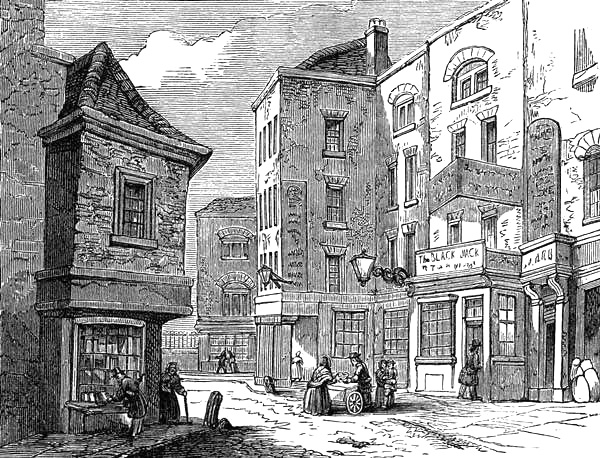
THE BLACK JACK, PORTSMOUTH STREET, LINCOLN’S INN FIELDS.
Our commercial wealth and the vastness of our maritime enterprise is shown in nothing more than by the distance from which we fetch our commonest articles of consumption—tea from China, sugar from the West Indies, coffee from Ceylon, oil from the farthest nooks of Italy, chocolate from Mexico. An Englishman need not be very rich in order to consume samples of all these productions of different hemispheres at a single meal.
In the same manner many books of far-divided ages have gone to form the patchwork of the present volume; I am like the merchant who sends his ships to collect in different harbours, and across wide and adverse seas, the materials that he needs. In this busy and overworked age there are many persons who have no time themselves to make such voyages, no patience to traverse such seas, even if they possessed the charts: it is for them I have written, and it is from them I hope for some kind approval.