Chapter XII · (continued 2)
Reading edition
In May 1836 Madame Malibran (de Beriot) appeared at Drury Lane as Isolina in Balfe’s “Maid of Artois,” which was a great success. At the close of the season she went abroad. Returned in September, she sang at the Manchester Festival, and after a duet with Madame Caradori Allen, was taken ill, and died a few days after. This gifted woman, the daughter of a Spanish Jew (an opera-singer), was born in 1808.
To return to our last batch of actors. James Wallack, born in 1792, began to be known about 1816, and in 1820 was principal tragedian at Drury Lane. His Hamlet, Rolla, and Romeo were very manly and bearable. He afterwards became stage-manager at Drury Lane, and was praised for his light comedy.
Charles Young, who played with Kean at Drury Lane, was a dignified but rather cold actor. Booth appeared also with Kean in 1817, and again in 1820 with Wallack and Cooper.
Mrs. Mardyn (the supposed mistress of Lord Byron) appeared on the Drury Lane stage in 1815. She was boisterous, but so full of girlish gaiety and reckless wildness that she became for a short time the favourite of the town. She failed, however, when she reappeared in 1833 in a tragic part.
Charming Mrs. Nisbett, “that peach of a woman,” as Douglas Jerrold used to call her, died in 1858, aged forty-five. The daughter of a drunken Irish officer who took to the stage, she married an officer in the Life Guards in 1831; but on the death of her husband by an accident, she returned to her first love in 1832, and reappeared at Drury Lane. Her great triumph was “The Love Chase,” which was produced at the Haymarket in 1837, and ran for nearly one hundred nights. It was worth going a hundred miles to hear Mrs. Nisbett’s merry, ringing, silvery laugh.
Irish Johnstone, who died in 1828, is described by Hazlitt as acting at Drury Lane, “with his supple knees, his hat twisted round in his hand, his good-humoured laugh, his arched eyebrows, his insinuating leer, and his lubricated brogue curling round the ear like a well-oiled moustachio.”[601]
Oxberry quitted Drury Lane with Elliston in 1820. In 1821 he took the Craven’s Head Chop-house in Drury Lane, where he used to say to his guests, “We vocalise on a Friday, conversationalise on a Sunday, and chopise every day.” His best characters were Leo Luminati, Slender, and Abel Day. Emery surpassed him in Tyke, Little Knight, and Robin Roughhead.
Farren, who was born about 1787, made his début at Covent Garden in 1818. He was for some time at Drury Lane, and latterly manager of the Olympic. In old men he took the place of Dowton. His finest performance was Lord Ogleby, but in his prime he excelled also in Sir Peter Teazle, Sir Anthony Absolute, Sir Fretful Plagiary, and the Bailie Nicol Jarvie.
John Pritt Harley was the son of a silk-mercer, and originally a clerk in Chancery Lane. He was born in 1786 or 1790. He made his début at the Lyceum in 1815, in “The Devil’s Bridge.” His first appearance at Drury Lane was in 1815, as Lissardo in “The Wonder.” In farce he was good-humoured, bustling, and droll; and he excelled in Caleb Quotem, Peter Fidget, Bottom, and many Shaksperean characters. He died only a year or two ago, repeating, it is said, this line of one of his old parts: “I have an exposition of sleep come upon me.”
Miss Kelly, born in 1790, was at the Lyceum in 1808, and went from thence to Drury Lane. She sang in operas, and was admirable in genteel comedy and domestic tragedy. Her romps were scarcely inferior to Mrs. Jordan’s; her waiting-maids were equal to Mrs. Orger’s. Charles Lamb, writing in 1818, says of her—
“Your tears have passion in them, and a grace, A genuine freshness which our hearts avow; Your smiles are winds whose ways we cannot trace, That vanish and return we know not how.”
Miss Kelly was twice shot at while acting. In both cases the cruel assailants were rejected admirers.
In 1850 Mrs. Glover took her farewell benefit at Drury Lane; Farren and Madame Vestris taking parts in the performance—Mrs. Glover playing Mrs. Malaprop. She was born in 1779, and had made her first appearance as Elvina in good Hannah More’s dull tragedy, at Covent Garden, in 1797. Beautiful in youth, Mrs. Glover had gracefully passed from sighing Juliets and maundering Elvinas into Mrs. Heidelbergs, Mrs. Candours, and the Nurse in “Romeo and Juliet.”
Robert Keeley, who was brought up a compositor, was born in Grange Court, Carey Street, in 1794. He acted at Drury Lane as early as 1819, and at the Adelphi as early as 1826 as Jemmy Green in “Tom and Jerry.” In 1834 we find the critics ranking him below Liston and Reeve, but he was very popular in his representations of cowardly fear and stupid chuckling astonishment. He left the stage for several years before his death. Miss Helen Faucit, born in 1816, was the original heroine of Sir Bulwer Lytton’s and Mr. Browning’s plays. Her Beatrice, Imogen, and Rosalind were admirable, and her Antigone was a great success. She retired from the stage in 1851, when she married Mr. Theodore Martin, the accomplished translator of Horace and Catullus, and the joint author with Professor Aytoun of those admirable burlesque ballads of “Bon Gaultier.”
William Charles Macready, the son of a Dublin upholsterer, appeared in London first in 1816. Kean approved his Orestes, and he soon advanced to Rob Roy, Virginius, and Coriolanus. He then removed to Drury Lane, and distinguished himself as Caius Gracchus and William Tell, in two of Mr. Sheridan Knowles’s plays. He reappeared at Drury Lane in 1826. The critics said that he failed in Rolla and Hamlet, but excelled in Rob Roy, Coriolanus, and Richard. He himself preferred his own Hamlet. They complained that he had a burr in his enunciation, and a catching of the breath—that he was too fond of declamation and violent transitions; others thought him too heavy and colloquial. In 1826 he went to America, where the fatal riot of Forrest’s partisans occurred, and twenty-two men were killed. His season closed at Drury Lane in 1843. His benefit took place in 1851, and he then retired from the stage to live the life of a quiet, useful country gentleman in the west of England. He died in 1873, and lies buried at Kensal Green.
Mr. Charles Kean, struggling with a bad voice and a mean figure, had a hard fight for success, and won it only by the most dauntless perseverance. Born in 1811, he appeared for the first time upon the boards as Norval, in 1827. After repeated failures in London and much success in the provinces and America, Mr. Kean accepted an engagement at Drury Lane in 1838—Mr. Bunn offering him £50 a night. He succeeded in Hamlet, and was presented with a silver vase of the value of £200. In Richard and Sir Giles Overreach he also triumphed. In 1843 Mr. Kean renewed his engagement with Mr. Bunn. Before retiring from the stage and starting for Australia, Mr. and Mrs. Kean performed for many nights at Drury Lane. Charles Kean died in 1868.
Miss Ellen Tree first performed at Drury Lane as Violante in “The Wonder.” She married Mr. C. Kean in 1842, and aided him in those antiquarianly-correct spectacles that for a time rendered a scholarly, careful, but scarcely first-rate actor popular in the metropolis.
We have room in this brief and imperfect résumé of theatrical history for only two pictures of Drury Lane. One is in 1800, when George III. was fired at by Hatfield as he entered the house to witness Cribber’s comedy of “She Would and She Would Not.” When the Marquis of Salisbury would have drawn him away, the brave, obstinate king said—“Sir, you discompose me as well as yourself: I shall not stir one step.” The queen and princesses were in tears all the evening, but George III. sat calm and collected, staring through his single-barrel opera-glass. In 1783 the king, queen, and Prince of Wales went to Drury Lane to see Mrs. Siddons play Isabella. They sat under a dome of crimson velvet and gold. The king wore a Quaker-coloured dress with gold buttons, while the handsome scapegrace prince was adorned in blue Genoa velvet.
Mr. Planché, the accomplished writer of extravaganzas and the Somerset Herald, brought out his burlesque of “Amoroso, King of Little Britain,” at Drury Lane in 1818. He afterwards wrote the libretto of “Maid Marian” for Mr. Bishop, and that of “Oberon” for Weber. In 1828 his “Charles XII.” was produced at Drury Lane.
On Mr. Falconer’s clever imitative experiments we have no room to dilate. The “Peep o’ Day,” a piece which reproduced all the “Colleen Bawn” effects, was the best.
And now leaving the theatres for meaner places, we pass on to the district of the butchers. Clare Market stands on a spot formerly called Clement’s Inn Fields, and was built by the Earl of Clare, who lived close by, in 1657. The family names, Denzil, Holles, etc., are retained in the neighbouring streets.
This market became notorious in Pope’s time for the buffoonery, noisy impudence, and extravagances of Orator Henley, a sort of ecclesiastical outlaw of a not very religious age, who tried to make his impudence and conceit pass for genius. This street-orator, the son of a Leicestershire vicar, was born in 1692. After going to St. John’s College, Cambridge, he returned home, kept a school, wrote a poem called “Esther,” and began a Universal Grammar in ten languages. Heated by an itch for reforming, and tired of the country, or driven away, as some say, by a scandalous embarrassment, he hurried to London, and for a short time did duty at a chapel in Bedford Row. During this time, under the Earl of Macclesfield’s patronage, he translated Pliny’s epistles, Vertot’s works, and Montfaucon’s Italian travels. He then competed for a lecturership in Bloomsbury, but failed, the parishioners not disliking his language or his doctrine, but complaining that he threw himself about too much in the pulpit.
Now, “regular action” was one of Henley’s peculiar prides. The rejection hurt his vanity and nearly drove him crazy. Losing his temper, he rushed into the vestry-room. “Blockheads!” he roared, “are you qualified to judge of the degree of action necessary for a preacher of God’s Word? Were you able to read, or had got sufficient sense, you sorry knaves, to understand the renowned orator of antiquity, he would tell you almost the only requisite of a public speaker was ACTION, ACTION, ACTION. But I despise and defy you: provoco ad populum; the public shall decide between us.” He then hurried from the room, soon afterwards published his probationary discourse, and taking a room in Newport Market, started as quack divine and public lecturer.
But he first consulted the eccentric and heretical Whiston, whom Swift bantered so ruthlessly—Whiston being, like Henley, a Leicestershire man—as to whether he should incur any legal penalties by officiating as a separatist from the Church of England. Whiston, himself an expelled professor, tried to dissuade the Orator from his wild project. Disagreement and abuse followed, and the correspondence ended with the following final bomb-shell from the violent demagogue:—
“To Mr. William Whiston,
“Take notice that I give you warning not to enter my room in Newport Market, at your peril.
“John Henley.”[602]
The Orator patronised divinity on Sundays, and secular subjects on Wednesdays and Fridays. The admittance was one shilling. He also published outrageous pamphlets and a weekly farrago called The Hyp-Doctor, intended to antidote The Craftsman, and for which pompous nonsense Sir Robert Walpole is said to have given him £100 a year. He also attacked eminent persons, even Pope, from his pulpit. Every Saturday an advertisement of the subject of his next week’s oration appeared in the Daily Advertiser, preceded by a sarcastic or libellous motto, and sometimes an offer that if any one at home or abroad could be found to surpass him, he would surrender his Oratory at once to his conqueror.
In 1729 Henley, growing perhaps more popular, removed to Clare Market, where the butchers became his warm partisans and served as his body-guard. The following are two of his shameless advertisements:—
“At the Oratory in Newport Market, to-morrow, at half an hour after ten, the sermon will be on the Witch of Endor. At half an hour after five, the theological lecture will be on the conversion and original of the Scottish nation and of the Picts and Caledonians, St. Andrew’s relics and panegyric, and the character and mission of the Apostles.
“On Wednesday, at six or near the matter, take your chance, will be a medley oration on the history, merits, and praise of confusion and of confounders, in the road and out of the way.
“On Friday will be that on Dr. Faustus and Fortunatus and conjuration. After each the Chimes of the Times, Nos. 23 and 24.”
Very shortly afterwards he advertised from Clare Market:—
1. “The postil will be on the turning of Lot’s wife into a pillar of salt. 2. The sermon will be on the necessary power and attractive force which religion gives the spirit of a man with God and good spirits.
2. “At five—1. The postil will be on this point:—In what language our Saviour will speak the last sentence to mankind.
3. “The lecture will be on Jesus Christ’s sitting at the right hand of God; where that is; the honours and lustre of his inauguration; the learning, criticism, and piety of that glorious article.
“The Monday’s orations will shortly be resumed. On Wednesday the oration will be on the skits of the fashions, or a live gallery of family pictures in all ages; ruffs, muffs, puffs manifold; shoes, wedding-shoes, two-shoes, slip-shoes, heels, clocks, pantofles, buskins, pantaloons, garters, shoulder-knots, periwigs, head-dresses, modesties, tuckers, farthingales, corkins, minnikins, slammakins, ruffles, round-robins, fans, patches; dame, forsooth, madam, my lady, the wit and beauty of my granmum; Winnifred, Joan, Bridget, compared with our Winny, Jenny, and Biddy: fine ladies and pretty gentlewomen; being a general view of the beau monde from before Noah’s flood to the year ’29. On Friday will be something better than last Tuesday. After each a bob at the times.”
This very year, 1729, the Dunciad was published, and in it this Rabelais of the pulpit had, of course, his niche. Pope had been accused of taking the bread out of people’s mouths. He denies this, and asks if “Colley (Cibber) has not still his lord, and Henley his butchers;” and ends with these lines, which, however, had no effect, for Henley went on ranting for eighteen years longer—
“But where each science lifts its modern type, History her pot, Divinity his pipe; While proud Philosophy repines to show, Dishonest sight! his breeches rent below,— Imbrown’d with native bronze, lo! Henley stands, Tuning his voice and balancing his hands. How fluent nonsense trickles from his tongue! How sweet the periods, neither said nor sung! Still break the benches, Henley, with thy strain, While Sherlock, Hare, and Gibson preach in vain. O great restorer of the good old stage, Preacher at once and zany of the age! O worthy thou of Egypt’s wise abodes! A decent priest when monkeys were the gods. But Fate with butchers placed thy priestly stall, Meek modern faith to murder, hack, and maul, And bade thee live to crown Britannia’s praise In Toland’s, Tindal’s, and in Woolston’s days.”[603]
In another place he says—
“Henley lay inspired beside a sink, And to mere mortals seemed a priest in drink.”
Pope often attacked Henley in the Grub Street Journal, and the Orator retaliated. A year or two after the Essay on Man was published, Henley (Dec. 1737) announced a lecture, “Whether Mr. Pope be a man of sense, in one argument—‘Whatever is is right.’” If whatever is is right, Henley thought that nothing could be wrong; ergo, he himself was not a proper object of satire.
Henley’s pulpit was covered with velvet and gold lace, and over his altar was written, “The PRIMITIVE Eucharist.” A contemporary journalist describes him entering his pulpit suddenly, like a harlequin, through a sort of trap-door at the back, and “at one large leap jumping into it and falling to work,” beating his notions into the butcher-audience simultaneously with his hands, arms, legs, and head.
In one of his arrogant puffs, he boasts that he has singly executed what “would sprain a dozen of modern doctors of the tribe of Issachar;” that no one dares to answer his challenges; that he can write, read, and study twelve hours a day and not feel the yoke; and write three dissertations a week without help, and put the Church in danger. He struck medals for his tickets, with a star rising to the meridian upon them, and the vain superscription “Ad summa” (“To the heights”), and below, “Inveniam viam aut faciam” (“I will find a way or make one”).
When the Orator’s funds grew low, his audacity and impudence rose to their climax. He once filled his chapel with shoemakers, whom he had attracted by advertising that he could teach a method of making shoes with wonderful celerity. His secret consisted in cutting the tops off old boots. His motto to this advertisement was “Omne majus continet in se minus” (“The greater includes the less”).
In 1745 Henley was cited before the Privy Council for having used seditious expressions in one of his lectures. Herring, then Archbishop of York, had been arming his clergy, and urging every one to volunteer against the Pretender. The Earl of Chesterfield, then Secretary of State, urged on Henley the impropriety of ridiculing such honest exertions at a time when rebellion actually raged in the very heart of the kingdom. “I thought, my lord,” said Henley, “that there was no harm in cracking a joke on a red herring.”
During his examination, the restorer of ancient eloquence requested permission to sit, on account of a rheumatism that was generally supposed to be imaginary. The earl tried to turn the outlaw divine into ridicule; but Henley’s eccentric answers, odd gestures, hearty laughs, strong voice, magisterial air, and self-possessed face were a match for his somewhat heartless lordship.
Being cautioned about his disrespectful remarks on certain ministers, Henley answered gravely, “My lords, I must live.” Lord Chesterfield replied, “I don’t see the necessity,” and the council laughed. Upon this Henley, remembering that the joke was Voltaire’s, was somewhat irritated. “That is a good thing, my lord,” he exclaimed, “but it has been said before.” A few days after the Orator, being reprimanded and cautioned, was dismissed as an impudent but entertaining fellow.[604]
Dr. Herring whom the rogue ridiculed was a worthy man, who in 1747, on the death of Potter, became Archbishop of Canterbury, and died in 1757. Swift hated Herring for condemning the “Beggars’ Opera” in a sermon at Lincoln’s Inn, and wrote accordingly: “The ‘Beggars’ Opera’ will probably do more good than a thousand sermons of so stupid, so injudicious, and so prostitute a divine.”[605]
In 1748 Dr. Cobden, the Court chaplain, an odd but worthy man, incurred the resentment of King George II. by preaching before him a sermon entitled “A Persuasive to Chastity”—a virtue not popular then at St. James’s. He resigned his post in 1752. The text of this obnoxious sermon was, “Take away the wicked from before the king.” Henley’s next Saturday’s motto was—
“Away with the wicked before the king, Away with the wicked behind him; His throne it will bless With righteousness, And we shall know where to find him.”
If any of the Orator’s old Bloomsbury friends ever caught his eye among the audience, he would gratify his vanity and rankling resentment by a pause. He would then say, “You see, sir, all mankind are not exactly of your opinion; there are, you perceive, a few sensible persons in the world who consider me as not totally unqualified for the office I have undertaken.” His abashed adversaries, hot and confused, and with all eyes turned on them, would retreat precipitately, and sometimes were pushed out of the room by Henley’s violent butchers.
The Orator figures in two caricatures, attributed, as Mr. Steevens thinks, wrongly to Hogarth. In one he is christening a child; in another he is on a scaffold with a monkey by his side. A parson takes the money at the door, while a butcher is porter. Modesty is in a cloud, Folly in a coach, and there is a gibbet prepared for poor Merit.
Henley, who latterly grew coarse, brutal, and drunken, died October 14, 1756. The Gentleman’s Magazine merely announces his death thus:—“Rev. Orator Henley, aged 64.” “Nollekens” Smith says that he died mad.
It is somewhat uncertain where his Oratory stood: some say in Duke Street; others, in the market. It was probably in Davenant’s old theatre, at the Tennis Court in Vere Street.[606]
The beginning of one of this buffoon’s ribald sermons has been preserved, and is worth quoting to prove the miserable claptrap with which he amused his rude audience. The text is taken from Jeremiah xvi. 16, “I will send for many fishers, saith the Lord, and they shall fish them; and after that I will send many hunters, and they shall hunt.”
“The former part of the text seems, as Scripture is written for our admonition, on whom the ends of the world are come (an end of all we have in the world), to relate to the Dutch, who are to be fished by us according to Act of Parliament; for the word ‘herrings’ in the Act has a figurative as well as a literal sense, and by a metaphor means Dutchmen, who are the greatest stealers of herrings in the world; so that the drift of the statute is, that we are to fish for Dutchmen, and catch them, either by nets or fishing-rods in return for their repeated catching of Englishmen, then transport them in some of Jonathan Forward’s close lighters and sell them in the West Indies, to repair the loss which our South Sea Company endure by the Spaniards denying them the assiento, or sale of negroes.”[607]
Among other wild sermons of Henley, we find discourses on “The Tears of Magdalen,” “St. Paul’s Cloak,” and “The Last Wills of the Patriarchs.” He left behind him 600 MSS., which he valued at one guinea a-piece, and 150 volumes of commonplaces and other scholarly memoranda. They were sold for less than £100. They had been written with great care. When Henley was once accused that he did all for lucre, he retorted “that some do nothing for it.” He once filled his room by advertising an oration on marriage. When he got into his pulpit he shook his head at the ladies, and said “he was afraid they oftener came to church to get husbands than to hear the preacher.” On one occasion two Oxonians whom he challenged came followed by such a strong party that the butchers were overawed, and Henley silently slunk away by a door behind the rostrum.[608]
There are still popular preachers in London as greedy of praise and as basely eager for applause as Orator Henley. Equally great buffoons, and men equally low in moral tone, still fill some pulpits, and point the way to a path they may never themselves take. To such unhappy self-deceivers we can advise no better cure than a moonlight walk in Clare Market in search of the ghost of Orator Henley.
There was in Hogarth’s time an artists’ club at the Bull’s Head, Clare Market. Boitard etched some of the characters. Hogarth, Jack Laguerre, Colley Cibber, Denis the critic (?), Boitard, Spiller the comedian, and George Lambert, were members. Laguerre gave Spiller’s portrait to the landlord, and drew a caricature procession of his “chums.” The inn was afterwards called the “Spiller’s Head.” One of the wags of the club wrote an epitaph on Spiller, beginning—
“The butchers’ wives fall in hysteric fits, For sure as they’re alive, poor Spiller’s dead; But, thanks to Jack Laguerre, we’ve got his head. ****** He was an inoffensive, merry fellow, When sober hipped, blithe as a bird when mellow.”[609]
The Bull’s Head Tavern in Clare Market, the same place in which Hogarth’s club was held, had previously been the favourite resort of that illustrious Jacobite, Dr. Radcliffe, who is said to have killed two queens. Swift did not like this overbearing, ignorant, and surly humorist, who, however, rejoiced in doing good, and left a vast sum of money to the University of Oxford. When Bathurst, the head of Trinity College, asked Radcliffe where his library was, he pointed to a few vials, a skeleton, and a herbal, and replied, “There is Radcliffe’s library.”[610]
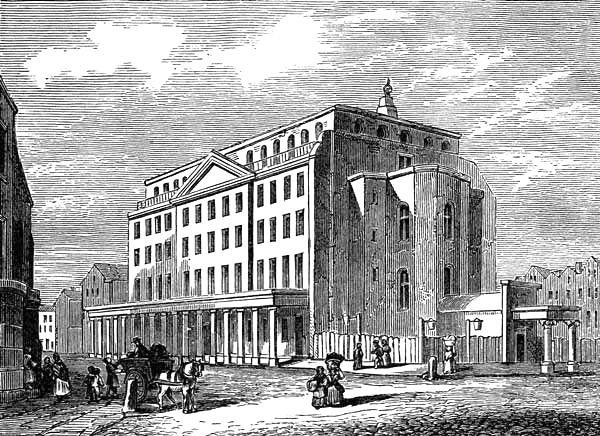
DRURY LANE THEATRE, 1806.
Mrs. Bracegirdle, that excellent and virtuous actress, used to be in the habit (says Tony Ashton) of frequently going into Clare market and giving money to the poor unemployed basketwomen, insomuch that she could not pass that neighbourhood without thankful acclamations from people of all degrees.
In 1846 there were in and about Clare Market, about 26 butchers who slaughtered from 350 to 400 sheep weekly in the stalls and cellars. The number killed was from 50 to 60 weekly—but in winter sometimes as many as 200. But the butchers’ market has now become almost a thing of the past.
Joe Miller formerly lay buried in a graveyard on the south side of Portugal Street, but the graveyard is now turned to other purposes. At the corner of Portugal Street and Lincoln’s Inn Fields is the “Black Jack” Inn, a hostelry whose name is connected with some of Jack Sheppard’s feats.
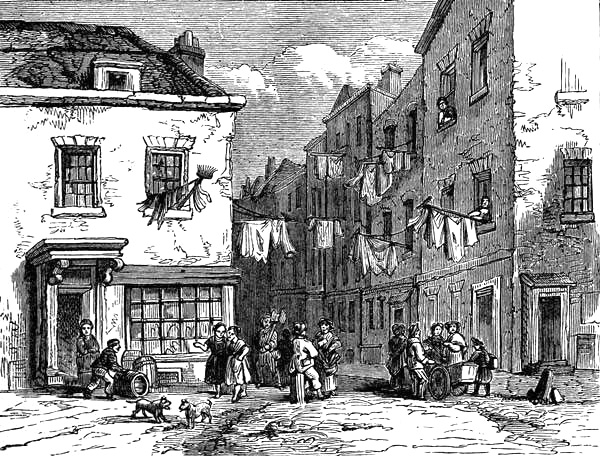
OLD ST. GILES’S—CHURCH LANE AND DYOT STREET, 1869.