EL BUCLE DE ESMERALDA Y ORO.
Reading edition
BY ARTHUR LINDSLEY.
Did you ever see a humming-bird? If you live in the country, or if you have been in the country during summer, very probably you may have done so, though in our Eastern and Middle States, and, in fact, in any part of the Atlantic States, they are not very abundant. Only one species, the ruby-throat, will you find east of the Mississippi, except that the Mango humming-bird comes over from Cuba into Florida, and then follows a little way further up the coast. But if you have ever seen one, you are not likely to forget it. There is no family of birds which attracts more attention, or which deserves more. Their size and their movements make them really objects of wonder. They are the smallest of all flying things, except insects, and in truth some of them are decidedly smaller than many of the large insects. And then, too, they come and go so like magic as always to astonish those who are not accustomed to watching them.
You see one hovering over a flower, but you can not tell how he hovers, for he moves his wings so rapidly that you can not see them; there he hangs in the air, making all the time a low hum, from which he takes his name, and which is caused by the flapping of his wings. You are looking at him, and all at once he is not there; but you probably did not see him go, for he shot away so quickly that you failed to detect it, and perhaps in another second there he is again, hanging in the same place, over the same flower. That is what a humming-bird does, and it is not strange that they are counted so wonderful, especially when you add to it all the fact that their colors are almost always very brilliant. Even our own little ruby-throat, which comes so far to the north, flashes like a fiery coal when he brings his red throat to glance in the sunlight.
HUMMING-BIRDS AND NEST.
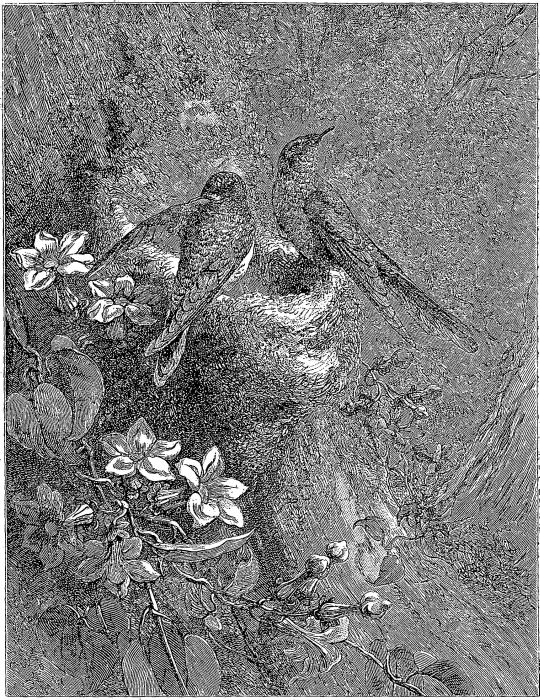
I have said that humming-birds in general are marked with brilliant colors. This is strictly true; but among them all there is scarcely one more gorgeously elegant than the one whose picture you see here, and whose Spanish name I have placed at the head of this account. Perhaps you can not read it in Spanish, but you can in English; it means the gold and emerald tuft or curl; and when I tell you more about him, you will understand the reason for such a name. I do not think the name is a common one; perhaps it is called so only by the people who told it to me; but it struck me as being so beautiful, and fitting the bird so nicely, that I have always loved to remember it. In works on natural history it is called Rhamphomicron microrhynchum. What do you think of that? What a horrid long name to give to such a lovely little fellow! It is as long as the bird himself. I doubt if you can pronounce it. El Bucle (boo'-klay) de Esmeralda y Oro sounds to me like music in comparison with it. Shall I tell you where I first saw him?
It was in a place almost as remarkable as the bird himself. The species is found only on the west coast of South America, and even there you do not see it until you reach the high valleys of the Andes.
I had landed about two weeks before at Truxillo, which is a port in Peru a little more than three hundred miles north of Lima. Look on your map, and find it. You will see that it is about eight degrees south of the equator. The name is Spanish, and you must pronounce it Trooheel'-yo. Does that sound strange to you? It should not; you ought to be taught to pronounce it that way in school. The Spanish x sounds like our letter h. Truxillo was founded by Pizarro nearly three hundred and fifty years ago, in 1535. But we must not stop here; we are looking for El Bucle.
It was the third day after my leaving Truxillo, when I found myself in a deep valley filled with flowers, and over the first flowering bush a humming-bird was hovering. I saw at once not only that he was very beautiful, but that he was different from any one that I had seen. It was my custom there to keep one barrel of my gun prepared especially for humming-birds, that is, loaded with what is called dust-shot, thus enabling me to kill them without tearing their skins, as large shot would do. It was but a minute, and I had my new bird in my hand. The right-hand figure of the two in this plate represents him as I saw him then, excepting that here the colors are not given, but I will describe them to you.
The top of his head and his back—his cap and mantle, so to speak—were of the most exquisite deep dark violet; his throat looked like polished gold, its long scaly feathers appearing to be gilded plates; while his sides and breast shone like emeralds, so bright was their green color. You see that his under surface was thus all emerald and gold—esmeralda y oro—only that his delicate little feet, almost too small to be seen, were so white as to fairly sparkle. At the same time his wings and tail were of a rich purplish-black. Can you imagine anything more elegant? I sat down to admire him, turning him over and over in my hand, and while I was thus engaged I heard a step, and looking up, I saw that one of the native girls from a house just below was coming toward me. I spoke to her, and after the usual salutation I asked her, "Señorita, como se llama este pajarito hermoso?"—"What do you call this beautiful little bird?"—and then she told me its name, just as I have told it to you. She also told me that the skins were sometimes set to wear as a brooch or buckle, and I did not wonder at it, so very beautiful were the colors.
These figures are of the natural size, and you can judge for yourself how small he is. Even with such a long tail as he has, his entire length is only three and a half inches, thus making him decidedly smaller than our ruby-throated humming-bird. As I went on down the valley I found them in abundance, and I found also that in that valley scarcely any other species was to be seen.
I was constantly watching for their nests, and before very long I saw one, and you have it represented here, with the two birds sitting on its edge. It was a very difficult matter to distinguish the nest, either that one or the others which I afterward saw, for they looked almost precisely like little knots on the bark. I found the first from seeing the bird sitting on it, and having learned how they look, I was able to find others. I climbed up to examine a number of them, and they were really very charmingly built. They were made of fine twigs and mosses, the inside being lined with the soft down from plants, while the outside was covered over with lichens, evidently with the intention of hiding the nest by causing it to look only like a knot or lump on the bark, and it was so neatly done as to require close search before the nest could be found.
You have seen from what I have said, even if you have not noticed it yourself, that humming-birds come about flowers of various kinds constantly, and evidently do it for some object. Perhaps you have been told that they get their food from the flowers. Do you know of what that food consists? It was formerly always said that they sucked the honey from the flowers, and that the honey constituted their food, and I have read many accounts in which the attempt was made to show how nicely their bills were fitted to draw up the honey from the bottom of the flower. We know now that this is not so. The humming-bird has nothing to do with the sweet fluid in the flowers, which by-the-way is not honey, though it is often called so; he cares nothing for it. Then why does he come to the flowers, you may ask, if he is not getting something from them. He is getting something; he is getting his food; but that food is insects, and nothing but insects. The sweet fluid of the flowers attracts great numbers of small flies of various sorts; you can scarcely look into any sort of flower without finding more or less of them, and sometimes the flower will be almost black with them. This the humming-bird knows, and he thrusts in his bill, and throwing out his slender sticky tongue, he picks up the flies one by one and swallows them, and that is the way he takes his meals; but the honey is nothing to him. The next time you see a humming-bird, watch him carefully, and remember what it is he is gathering.