"BARTLETT & ARNOLD."
Reading edition
BY A. C. H. STODDARD.
I'm Bartlett myself—R. F., and my partner's name is Guy. Anyhow, he was my partner once, but he isn't now, because we've gone out of business. We've been acquainted ever since we were real little, and always good friends, except once in a while we have a tiff or something.
Last summer there was going to be a big celebration at New Holland. It's called New Holland because our State sent over for lots of Holland people to come and settle, and we'd give 'em land. So they came, and we gave 'em farms, and their town is called New Holland, and it's twelve miles away from Deerville. Deerville is our town.
Well, the Governor was coming, and more'n a dozen brass bands, and militionary companies, and folks from all over everywhere. And they were going to make speeches and sing and eat dinner. And I and Guy we were talking about it under a plum-tree in the garden.
"Cal Pressy says his father's going to have a shanty and sell things out there—gingerbread, and pies, and pea-nuts, and such. And lemonade."
'Twas before this that I and Guy we wanted a good lot of money for something very particular. I don't mind telling you about it now, for 'tain't likely we'll ever get it, and I'd as lieves some other boy'd have the chance as not.
'Twas to buy a pony we wanted it, like those the circus had. The circus men told us that they bought their ponies of a man named David Solomon, who lived in a county that sounded like "Jumpup," down to Texas. And he had one more pony to sell for ten dollars, which was cheap, but we'd have to pay for him to ride on the cars.
The circus man winked a good deal and laughed when we thanked him, and said 'twasn't any trouble at all, and he hoped we'd get the pony.
So that's what we wanted the lot of money for. And as soon as Guy said that about Cal Pressy's father, an idea popped into my head, and I popped it out of my mouth:
"Let's we have a shanty too."
Guy stopped to think a minute.
"Well, say we do," said he, when the minute was up; "if the folks'll let us, which maybe they won't."
But I said they would; for I knew my father always likes to have me do business on my own hook, because he says it learns a chap to think for himself; and mother's bound to say "yes" if father does; and Mrs. Arnold always says, "Do as Mrs. Bartlett tells you"; and of course Mr. Arnold wouldn't fly in the faces and eyes of all three of 'em, and he's a little man anyway.
So it turned out just the way I said this time, though they chaffed us some, and father and Mr. Arnold made a good deal of talk about the new firm. But I and Guy we didn't care.
We counted up our bank money, and I had five dollars and four cents and Guy had three dollars and seventy-nine cents. But his father lent him one and a quarter to make him even partner, and Guy gave his note.
So that made ten, and ten dollars'll buy quite a lot of things. And the women-folks they said they'd make the pies and gingerbread and cake for nothing, but we must buy the flour, and so forth. So we did. The and-so-forth cost a good deal more'n the flour.
So we had six left—six dollars—and we bought candy with it, and nuts, and twelve lemons, and some sugar. And we divided up so's if it came to eating we wouldn't get more'n belonged to us. And we painted a sign with black paint:
"BARTLETT & ARNOLD."
It looked real nice. And Captain Tilley said he'd lend us his camping-out tent if we'd be careful of it, and we said we would.
So that's all until we came to go. We went the night before with the express wagon and Duke, because our old Duke he's pretty slow, and we wanted to be there before the procession did in the morning.
Well, we got to New Holland, and we were going to set up our tent 'long-side of the Capitol—that's their meeting-house and school-house and town-house all in a bunch. And I and Guy we were going to set up and get ready to sell things, when along comes a man, and says he, big as life,
"Got a license?"
"No, sir," said we.
"Then you can't sell here," said he.
"Why not?" said I.
"My father's name is Mr. Arnold," said Guy, redding up, "and he keeps a store."
"I don't care ef he keeps a dozen stores," said the man.
Come to find out, that man had bought the right, if that's what you call it, of a mile square, with the Capitol in the middle, and folks had to give him money or they couldn't sell there.
"How much is a license?" said I.
"Five dollars," said he.
"Will you trust us?" said Guy, bold as brass.
"No," said the man, "I won't."
Well, sir, we didn't know what to do, and all that gingerbread and pies and things just waiting to spoil. And we stood and thought.
"Let's we go half a mile back on the Deerville road," said Guy, in a minute, throwing up his hat, with a hooray, "and then the procession'll go by us, and maybe the folks'll buy something."
"Good!" said I.
So we found out how far half a mile was, and we went a little more, so's to pitch right on the top of a long hill. And we hitched old Duke out to grass. And after a while we laid down in the tent, and said 'twas fun. But I thought, for my part, I'd rather be to home.
In the night I dreamed I was in swimming, and the water was awful cold. And pretty soon I woke up, and there I was two inches deep in water, and 'twas raining like sixty. So I woke up Guy, and we felt round and found that the things to sell weren't getting wet; and then we sat down on a board, and the next thing I remember of 'twas morning, and the sun was shining, and I and Guy we laid there in the tent wet as water.
So we got up and combed each other's hair with our fingers, and then we ate a pie between us, and then we put out our sign. It was streaked some because it got rained on, but you could read it close to. Then we spread our pies an' things out on a board, and began to roll our lemons the way I'd seen mother do to make the juice come out easy. We rolled 'em slow, and before they were all done, after a long while, we heard music, away off and faint, but coming nearer every minute, the big drums and little drums and bugles and horns all pounding and tooting away at "The Star-spangled Banner."
Oh, it was grand! I and Guy we ran out to the road. We couldn't see the procession so far away, because everything was so misty after the rain; but we could hear it coming nearer and nearer, and we wondered if our folks would come first, or last, or where. It did seem as if we hadn't seen our mothers for a month of Sundays.
So we stood and cracked our feet together once in a while and waited. And all of a sudden we heard a thundering racket a good deal nearer than the procession—a dreadful rattling and humping and thumping, and somebody away behind singing out "Whoa!"
"It's Mr. Pressy's old roan!" yelled Guy, all on fire in a minute. "He's running away with the gingerbread 'n' stuff, I do believe."
Then we heard a screech—a regular ear-splitter. And a girl ran out of a little Hollander house across the road and down a ways. And she put her hands over her eyes, and tumbled right on her knees, and screeched and screeched. And it all happened in a heap, though you have to tell it one to time; so about as soon as we saw Mr. Pressy's old roan and the woman we saw two little Hollander babies, with their yellow hair braided in wispy pigtails, and white dresses on, playing right square in the middle of the road.
"IT WAS ALL IN A MINUTE."
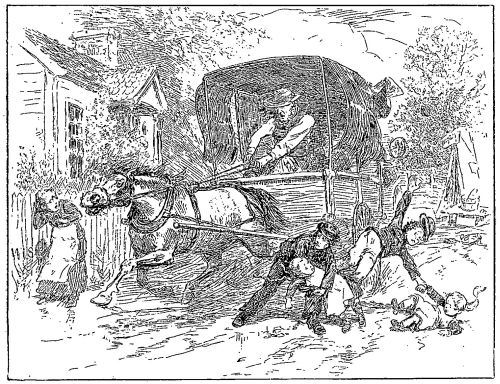
It seems to me as if I looked at Guy a long, long time, and Guy looked at me. And I thought about my mother, and my dog Ponto, and that we hadn't rolled all of the lemons; and then I felt as if something gave me a push. And it was all in a minute, and I and Guy we ran. And Guy was a little first, and he grabbed the nearest one, and I grabbed the other, and felt the horse right over me. And I jumped sideways, and threw the little Hollander, and something hit me.
So that's all I knew till I heard a roar in my ears that grew louder and louder, and pretty soon I knew 'twas folks talking, and I opened my eyes, and there I was in a little low room, with two funny brass candlesticks on the mantel-shelf; and my mother was there, and Guy, and Mrs. Arnold, and father, and Mr. Arnold, and Dr. Henry. They looked funny to me, and there was a queer smell in the room, and my head was tied up with a wet rag; the wet was what smelled so funny.
"Hullo!" said I, first thing.
"Oh, my boy!" said my mother, and then she began to cry like a good one.
"Pulse is pretty well," said the doctor, feeling of my wrist.
Then I looked at Guy, and Guy looked at me, and we both began to laugh.
"All right," said Dr. Henry, rubbing his glasses up; "he's all right, Mrs. Bartlett."
And so I was, only dizzy a little, and headachy where the hub of one of Mr. Pressy's wagon wheels had hit me.
Well, when we went out of the little Hollander house, there was the Governor's carriage stopped right in front, only I and Guy we didn't know 'twas the Governor's then. And the whole procession had stopped; and when we went out, you never heard such a cheer as the folks gave, just as if we'd done something big. They swung their hats—and the Governor did too—and hurrahed like all possessed for "Bartlett & Arnold." Because, you see, that Hollander woman she told the Commissioner what the fuss was all about, and he got up on a wagon and told it in English to the crowd, and the ones that could hear told the ones that couldn't, and my mother said when it came to her she thought she must faint. But she didn't; she wouldn't be so foolish.
So the folks cheered, and laughed a little, when they looked at our sign. And something swelled up big and hard in my throat, till I almost cried; but not because I was sorry. Guy almost did too. And my mother kept tight hold of my hand, and choked, and said:
"Now you'll come with me, Roy; I can't leave you here again."
Mrs. Arnold said so too. But I and Guy we said we'd got to sell our things, because we couldn't afford to lose ten dollars, could we? And there was the pony, too.
So we went over to the tent, and our mothers with us. And it seems as if everybody understood, for they came in and bought things until we had more than fifteen dollars, and not a gingerbread or anything left.
So then we said we'd go. And I suppose you won't believe that the Governor sung out "let the little young gentlemen ride with me, if you please, madam."
So we did; we rode with the Governor. And he talked to us, and looked just the same as other folks, only not so handsome as some. We sat side of him at dinner, too, because he said for us to; and after dinner some of the folks put us in their speeches. And I hope we didn't feel too stuck up about it, though my father he said 'twas enough to turn any boy's head.
So we made something out of it after all; and Guy said, what a good thing it was we didn't have a license, and had to go back just to where the babies would be in the road, or else they'd have been run over. And most all of Mr. Pressy's gingerbread and things bounced out along the way, so he didn't have much to sell; but he whipped the horse to pay for it. And that man that wouldn't let us have any license stood around all day and looked as if he thought somebody ought to give him a dollar. And we is satisfied, I and Guy are, because we made quite a lot besides what we ate, and the babies didn't get run over to boot. But don't you believe that the Hollander woman shook the two poor little chaps up like a breeze because they got their frocks muddy. That's what the folks said, anyhow, and it's just like what some women would do, I think.
'Tisn't likely we'll ever get the pony the way I said at first, because the circus man didn't tell us the town where Mr. David Solomon lives, and we don't know. And I don't know as I ought to tell this story, because it's about myself so much; but maybe you needn't print my name to it, and then folks won't know it's me.
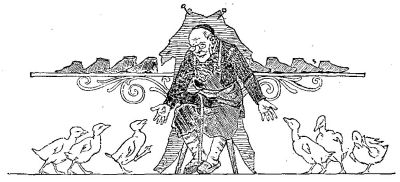
Six little goslings without any shoes, But to make them the shoemaker has to refuse; For he has no last that will fit their queer feet, And in great disappointment they'll have to retreat.
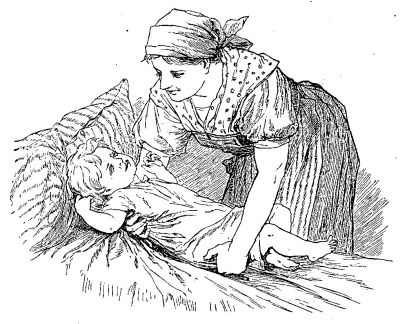
And now, Baby Curlyhead, what shall we do With six little goslings without any shoe? We take their soft down to make Baby a bed On which he can pillow his soft little head.
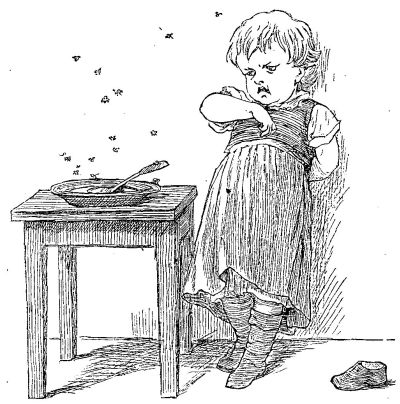
It's very naughty of the bees My little boy to scare and tease, And eat his bread and honey up; They can breakfast out of a buttercup.
See the jolly, jolly baker, He who makes the cakes so nice; How he kneads them, kneads them, kneads them, Out of sugar, flour, and spice. To the oven then he takes them, In the great hot oven bakes them, Thinking all the time, it may be, Of my cunning little baby, Who will eat the sugar-cakes That the jolly baker makes.
Awake, awake, my baby, The morning sun is up And waiting for my baby To find a buttercup. Buttercups and daisies Are growing all around, And here are baby's little shoes To caper o'er the ground. Soon he'll bring me pretty flowers Gathered in the morning hours.