THE 'LONGSHORE YACHT CLUB.
Reading edition
BY WILLIAM O. STODDARD.
"Yes, boys, de tide's a-comin' in now. Dat yot ob mine'll float afore long."
"General," said Bob Fogg, "may we have your skiff for our yacht club a little while to-day?"
"No, sah," replied George Washington, positively, with a wide grin on his wrinkled, old, very black face. "De club can't hab no skiff ob mine. Ef dey wants to borry my yot, dey can, dough."
"Bob," said Tommy Conners, "don't you know a sailin' vessel from a skiff?"
"Look at the mast," said Gus Martin.
"And the sail," said Stuyvesant Rankin, with some dignity.
"Now, Sty," said General George Washington, as he limped a few feet further from the spot where his rugged-looking old boat lay stuck in the mud, "wot do you know 'bout sails? Youah mudder nebber went to sea. She's a dressmaker."
"We can have the yacht, then, General, mast and sail and all?"
The little old black man evidently liked the members of that club, but he shook his grizzled head doubtfully. "You mought tip ober, and git yerselves drownded."
"No, we won't," exclaimed Put Varick; "every one of us can swim across the Harlem and back again."
"'Cept wen de tide's runnin' too strong. Well, it's wuff w'ile dat you kin swim. I 'mos' upsot her myself dis berry mornin' comin' home. Wouldn't I lost a heap ob crabs! More'n a bushel. Real blue-leg channel crabs, bestest kind."
There was more to be said, but the yacht club carried the day, and the General limped off, turning now and then to chuckle, as he saw his young friends crowding into the wonderful craft on the mud.
"Ef dey hasn't h'isted de sail! Yah! yah! Gwine to sail dat yot ob mine right across de sand-bank!"
There was hardly wind enough for that; but it would be some time before the tide would rise high enough to float the boat, and the club were not in a state of mind to wait.
"Tell you what, boys, we'll have a cruise," said Bob Fogg. "She's a beauty. Let's have a 'lection of officers before we start."
They were all agreed on that, but Joe McGinnis insisted that the grown-up yacht clubs never had any elections.
"They just draw cuts, boys, and they give the longest straw to the man that owns the club, to begin with."
"That's the best way," said Tommy Conners; "but the General's gone home."
"I'll take his cut for him," shouted Bob Fogg. "I'll choose to be Bo's'n, 'cause I know how to steer."
Nobody objected, although every member of the club said he knew how to steer, and Sty Rankin had a lot of straws ready in half a minute.
Tommy Conners drew the longest straw, and said he would be Captain; but when Gus Martin came next, and decided to be a Commodore, Tommy muttered, ruefully, "I'd forgot about that."
Stuyvesant Rankin's memory was still better, for he had hardly compared his straw with the others before he shouted, "I'll be Admiral of this club."
Put Varick was so stunned by that that he only said, "I'm Cook; there won't be any work for me this trip."
"What am I, then?" asked Joe McGinnis, with the shortest straw in his hand.
"You?" said Bob Fogg; "why, you're the Crew. Take hold of that larboard oar, and pull it out of the mud. There's those three landlubbers up on the bank. They'd pelt us if they dared."
The three landlubbers were there, and they were making loud remarks about the club, but the yacht was almost ready to float now, and no attention could be paid to them.
Just beyond the little creek where General George Washington kept his boat spread the busy waters of the Harlem River, with the great city of New York on both sides, but not very close to the edge of it. It was a very busy sheet of water indeed. There were small steamboats carrying passengers here and there; little tug-boats tugged and puffed and coughed at the sides of big schooners loaded with lumber from Maine; long race-boats, with gayly dressed oarsmen, darted swiftly over the water, like great wooden pickerel, they were so long and sharp and narrow. There were fishing-boats, pleasure-boats, steam-launches, even canoes that were driven by one man and a paddle. But among them all there was no other craft like General George Washington's "yot."
"Boys," exclaimed Captain Conners, "we've forgotten."
"What?" said Admiral Rankin.
"To name the boat."
"Oh, that's all right!" said Commodore Martin. "The General named her himself. She's the Hail Columbia."
"Admiral," shouted Boatswain Bob Fogg, "she's beginning to float. You get away forward there, beyond the mast. Captain, you and the Commodore get in the middle. Now, Cook, you and the Crew pull hard a minute, and we'll be out of the mud."
The Admiral obeyed, although there was hardly room to squeeze into, and the mast crowded his back a little. The Cook and the Crew also obeyed, and the Hail Columbia suddenly shot away from the bank, and around the head of the rotten old wooden pier.
"If there ain't those three landlubbers," exclaimed Boatswain Fogg, "out on the pier head. And they've got a lot of half-bricks to spatter us with."
THE YACHT CLUB STARTS ON ITS ANNUAL CRUISE.
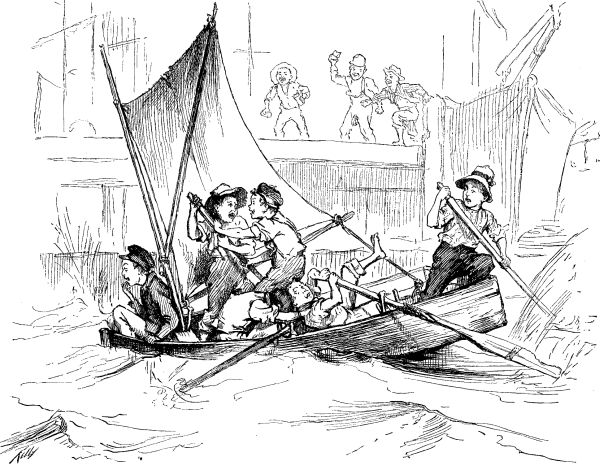
There they were; but at that moment the wind came up with a sudden puff, and filled the sail which the genius of the General had added to the motive power of that "yot." It was just at the wrong moment, for Captain Tommy Conners and Commodore Gus Martin were having an argument over an extra oar they had found in the bottom of the boat, and they were rocking it badly. The Cook was rowing his best, but the tip of the boat sent his oar deep under water, and the Crew suddenly found his oar lifted out into the air.
"Joe McGinnis, you've caught a crab," exclaimed Boatswain Fogg. But before he could say anything to the Captain and the Commodore, the three landlubbers were at work.
Splash, splash, splatter! how those bricks and sticks did fall around the Hail Columbia!
"Oh dear!" said Admiral Stuyvesant Rankin to himself, in the bows. "If the yacht upsets, I'm the only member of the club that's got a new coat on."
The breeze came fresher and fresher, and in a minute more the Hail Columbia was out of reach of the "battery" on the pier head. Her sable owner, however, was watching her from the door of his cabin with genuine pride.
"Don't she go! Don't she jest slip fru de watah! She does moah sailin' to de squar' foot dan any odder yot on de ribber."
So she did, if he meant that it took her longer to travel that foot, or any other.
It was no joke to be "Bo's'n" of the Hail Columbia, as Bob Fogg soon found out.
"Tell you what, boys," he said, "it's 'cause she hasn't any keel on her. I have to keep steering all the while. There's no saying where she won't go to."
"Keep along shore," shouted the Admiral from the bows. "You're heading out into the river."
"Now, Sty, if you think you can steer this yacht better than I can, just you come aft and try."
"Hey, there, you young pirates! Where are you heading for?"
It was the shout of a big-armed young fellow in a shell race-boat, who found himself suddenly compelled to pull to the right desperately to avoid being run down by the Hail Columbia.
"Lookout! Oh—"
Thump. "I declare!"
The first exclamation was from the tall, slim gentleman in the "out-riggered" wherry, who had been racing with the big-armed young man, and had not been looking out well enough.
He tried to turn to the left, but it was very late to try, and the suddenness of it helped him "catch a crab" with his starboard oar. When he said "Oh," he was just going over into the water.
The "thump" and the other exclamation did no harm to the Hail Columbia, but the fat old gentleman in the tub of a pleasure-boat that had bumped against the yacht remarked:
"The river swarms with boys to-day. I'm not sorry that other one got a ducking. I've had to get out of his way twice."
The officers and crew of the Hail Columbia were inclined to keep a little quiet, all but their brave Boatswain.
"Don't you know how to steer, you fellows? Don't you know that sailing vessels have the right of way? You ought to have blown your whistle sooner."
"I declare!" again exclaimed the old gentleman. "The child is perfectly right."
"Bo's'n," asked the Commodore, "can't we tack and keep along shore again?"
"We can't tack with the sail up—not in this yacht; but we can let it down and turn her round with the oars." They did that very thing, and in five minutes more the Hail Columbia was pointing her Admiral toward the north shore of the Harlem again.
The slim man managed to get back into his "shell," but he had lost his race with the big-armed man.
"Bo's'n," remarked the Commodore, as they sailed along, "you needn't run us into the mud."
"I guess not," said Bob Fogg; "but if I can steer her close enough to land, I'm going up as far as the bridge."
It was a grand cruise, and it lasted a long time; but when the Hail Columbia once more ran into the little cove, there was General George Washington ready to say,
"Look a-heah, boys, I didn't say you mought cross de 'Lantic Ocean. I wants dat yot to go for some bass."