THE ASHES THAT MADE THE TREES BLOOM.
Reading edition
A Japanese Fairy Tale.
BY WILLIAM ELLIOT GRIFFIS.
In the good old days of the Daimios there lived an old couple whose only pet was a little dog. Having no children, they loved it as though it were the tiny top-knot of a baby. The old dame made him a cushion of blue crape, and at meal-times Inuko—for that was his name—would sit on it as demure as any cat. The kind people would feed him with tidbits of fish from their own chopsticks, and he was allowed to have all the boiled rice he wanted. Whenever the old woman took him out with her on holidays she put a bright red silk crape ribbon around his neck.
Now the old man, being a rice-farmer, went daily with hoe or spade into the fields, working hard from the first croak of the raven until O Tento Sama (as the sun is called) had gone down behind the hills. Every day the dog followed him to work, and kept near by, never once harming the white heron that walked in the footsteps of the old man to pick up worms.
One day doggy came running to him, putting his paws against his straw leggings, and motioning with his head to some spot behind. The old man at first thought his pet was only playing, and did not mind him. But he kept on whining and running to and fro for some minutes. Then the old man followed the dog a few yards, to a place where the animal began a lively scratching. Thinking it only a buried bone or bit of fish, but wishing to humor his pet, the old man struck his iron-shod hoe in the earth, when lo! a pile of gold gleamed before him. He rubbed his old eyes, stooped down, and there was at least a half-peck of kobans (oval gold coins). He gathered them up and hied home at once.
Thus in an hour the old couple were made rich. The good souls bought a piece of land, made a feast to their friends, and gave plentifully to their poor neighbors. As for Inuko, they petted him till they nearly smothered him with kindness.
Now in the same village there lived a wicked old man and his wife, who had always kicked and scolded all dogs whenever any passed their house. Hearing of their neighbors' good luck, they coaxed the dog into their garden, and set before him bits of fish and other dainties, hoping he would find treasure for them. But the dog, being afraid of the cruel pair, would neither eat nor move. Then they dragged him out-of-doors, taking a spade and hoe with them. No sooner had Inuko got near a pine-tree in the garden than he began to paw and scratch the ground as though a mighty treasure lay beneath.
"Quick, wife, hand me the spade and hoe!" cried the greedy old fool, as he danced for joy.
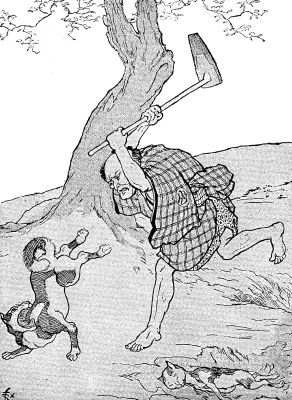
Then the covetous old fellow with a spade, and the old crone with a hoe, began to dig; but there was nothing but a dead kitten, the smell of which made them drop their tools and shut their noses. Furious at the dog, the old man kicked and beat him to death, and the old woman finished the work by nearly chopping off his head with the sharp hoe.
That night the spirit of the dog appeared to his former master in a dream and said, "Cut down the pine-tree which is over my grave, and make from it a mill to grind bean sauce in."
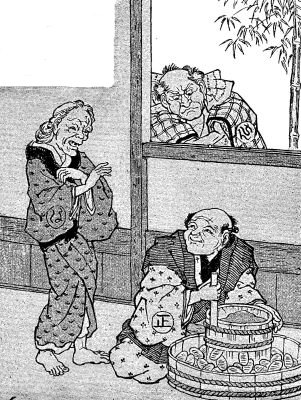
So the old man made the little mill, and filling it with bean sauce, began to grind, while the envious neighbor peeped in at the window. "Goody me!" cried the old woman, as each dripping of sauce turned into yellow gold, until in a few minutes the tub under the mill was full of a shining mass of kobans.
So the old couple were rich again.
The next day the stingy and wicked neighbors, after boiling a mess of beans, came and borrowed the magic mill. They filled it with the boiled beans, and the old man began to grind.
But, at the first turn, the sauce turned into a foul heap of dirt. Angry at this, they chopped the mill in pieces to use as fire-wood.
Not long after that the old man dreamed again, and the spirit of the dog spoke to him, telling him how the wicked people had burned the mill made from the pine-tree.
"Take the ashes of the mill, sprinkle them on withered trees, and they will bloom again," said the dog-spirit.
The old man awoke and went at once to his wicked neighbors' house, where he humbly begged the ashes, and though the covetous couple turned up their noses at him and scolded him as if he were a thief, they let him fill his basket with the ashes.
On coming home the old man took his wife into the garden. It being winter, their favorite cherry-tree was bare. He sprinkled a pinch of ashes on it, and lo! it sprouted blossoms until it became a cloud of pink blooms, which filled the air with perfume.
The kind old man, hearing that his lord the Daimio was to pass along the high-road near the village, set out to see him, taking his basket of ashes. As the train approached he climbed up into an old withered cherry-tree that stood by the way-side.
Now in the days of the Daimios it was the custom, when their lord passed by, for all the loyal people to shut up their second-story windows, even pasting them shut with slips of paper, so as not to commit the impoliteness of looking down on his lordship. All the people along the road would fall down on their hands and knees until the procession passed by. Hence it seemed very impolite for the old man to climb the tree, and be higher than his master's head.
The train drew near, and the air was full of gay banners, covered spears, state umbrellas, and princes' crests. One tall man marched ahead, crying out to the people by the way, "Get down on your knees! get down on your knees!" And every one knelt down while the procession was passing. Suddenly the leader of the van caught sight of the old man up in the tree. He was about to call out to him in an angry tone, but seeing he was such an old fellow he pretended not to notice him, and passed him by.
So when the prince's palanquin drew near, the old man, taking a pinch of ashes from his basket, scattered it over the tree. In a moment it burst into blossom. The delighted Daimio ordered the train to be stopped, and got out to see the wonder. Calling the old man to him, he thanked him, and ordered presents of silk robes, sponge-cake, fans, a netsuké (ivory carving), and other rewards to be given him. He even invited him to pay a visit to his castle. So the old daddy went gleefully home to share his joy with his dear wife.
But when the greedy neighbor heard of it he took some of the magic ashes, and went out on the highway. There he waited till a Daimio's train came along, and instead of kneeling down like the crowd, he climbed a withered cherry-tree.
When the Daimio himself was almost directly under him, he threw a handful of ashes over the tree, which did not change a particle. The wind blew the fine dust in the noses and eyes of the Daimio and his nobles.
Such a sneezing and choking!
It spoiled all the pomp and dignity of the procession. The man who cried, "Get down on your knees," seized the old fool by the top-knot, dragged him from the tree, and tumbled him and his ash-basket into the ditch by the road. Then beating him soundly, he left him dead.
Thus the wicked old man died in the mud, but the kind friend of the dog dwelt in peace and plenty, and both he and his wife lived to a green old age.
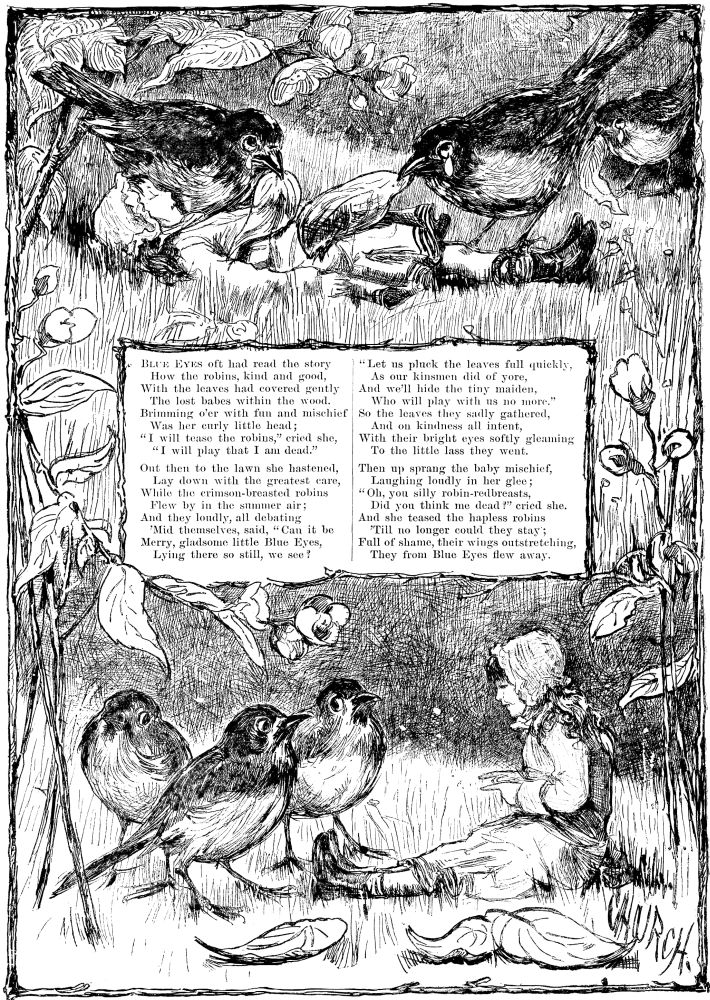
A BABE IN THE WOOD.—Drawn by F. S. Church.

Wakefield, Massachusetts.
An article in your paper of April 27, 1880, entitled "A Cheap Canoe," has given a decided stimulus to the boys of this town in the matter of canoe building. There are now six on our lake, built almost entirely by the boys who own them, on the model there given.
I send you a short article from our local paper, written by my son, a lad of fifteen, giving his experience on his first canoe trip down Ipswich River. He proposes a much longer one next summer vacation.
Many thanks are due to you for giving the boys something useful to do, which teaches them how to do their own work.
S. W. A.
St. Johns, Michigan.
Undertaking myself the education of my young son, I am deeply indebted to you for much useful information. I find Young People a multum in parvo, serving as an entertaining reader, besides giving manly hints in all branches of knowledge—geography, natural history, science, drawing, and music. Even the puzzles draw out the youthful mind, which learns from them unconsciously the analysis and definition of words. It is like the medicine which "children cry for."
Especially let me thank you for your historical sketches, and also for the healthy moral tone pervading every part of the paper, teaching the children to be gentle and kind, as well as manly and brave.
For myself, I am only less interested than the little ones for whose especial benefit it is intended. As a "little mother," my sympathies are all with your success.
E. S. C.
Frankfort-on-the-Main, Germany.
Perhaps you would like to hear from one of your little American friends over the sea.
We live in Frankfort-on-the-Main. It is a beautiful city, full of public monuments and handsome buildings.
Last month when I was in Freiburg, in Baden, I had the pleasure of seeing the Grand Duke and Duchess of Baden. They were spending a few days in Freiburg to visit their son, the Heir Prince, who lives there. During their stay the feast of Frohnleichnamstag, or Corpus Christi Day, took place, and a large procession was to pass through the streets and before their palace. The Grand Duchess came to an open window, and was joined by her daughter, the Princess Victoria, who is eighteen. Then the Grand Duke soon came and stood behind them, and when the Heir Prince peeped over his father's shoulder, the picture of the ducal family was complete.
The Grand Duchess also visited our school in Freiburg, and asked me several questions. She is very beautiful. She is about forty years old, but her skin is as fine and smooth as wax. She looks to be as good as she is beautiful. The Grand Duke is not less handsome.
I and my sisters and brother all enjoy Young People so much, and welcome it every week.
We have lived in Paris several years, and I have often seen going through the streets the bath-tubs and boilers full of hot and cold water that Paul S. speaks of in the Post-office Box of Young People No. 39.
I will write another time about the curious houses in old Frankfort.
Ethel D. W.
Philadelphia, Pennsylvania.
We have not been so fortunate with our pets as other young people. We had three rabbits and two guinea-pigs. The other morning, when we went to feed them, the top of the hutch was broken, and nothing was to be seen of the animals. We are pretty sure some dogs got them in the night, from the way things looked. We are very sorry to lose our pets.
Isabel and Helen C.
Passaic, New Jersey.
I am ten years old, and I have one little brother. Papa is a doctor, and Johnnie and I take long rides with him, and drive for him. We have two horses, named Roxy and Bill. We have gold-fish and turtles and frogs in the fountain in front of our door.
We like Young People very much, and jump for joy when it comes.
A. W. and J. R.
Alexandria, Virginia.
I have been taking Young People for eight weeks, and find it very interesting.
I have a little dog so small that mother can almost hold him in the palm of her hand. I call him Dash. Whenever I go out in the yard he runs after me, and tries to bite me. I have a little brother who is always begging for peaches.
Willie H. F. B.
Hamilton, Ontario.
A few weeks ago, as I was passing a bookstore, I saw Harper's Young People, and I went in and bought a copy. I am going to get all the back numbers. I think "The Moral Pirates" was a splendid story.
My brother has a row-boat, and I often go fishing and rowing in Burlington Bay. One day papa and I went fishing, and we caught four fish. Mamma laughed ever so much when we brought them home.
Anderson Gibson S.
West Hoboken, New Jersey.
I am very glad that I have commenced to take Young People, and sorry I did not begin sooner. All my friends take it, and like it very much, as it is both amusing and interesting. "Across the Ocean" and "The Moral Pirates" were splendid stories. I wait impatiently for Tuesday to come, so that I can read the stories and the Post-office Box, which I like very much.
Louis H.
New York City.
Here is a recipe for ink powder for the chemists' club: Four ounces of powdered galls; one ounce of sulphate of iron; one ounce of powdered gum-arabic; half an ounce of powdered white sugar. This, mixed with water, will make a quart of ink. A few powdered cloves stirred in will keep the ink from moulding.
Maud C.
Pontiac, Illinois.
I am twelve years old. I like Young People very much. My mamma has three mocking-birds she raised herself. She feeds them on cooked egg and bread, cooked potato and raw egg mixed, fruit of all kinds, and Hungarian seed. She gives them a feast of spiders occasionally, and always keeps plenty of clean sand in the cage.
I have two playful pet kittens, named Milly and Lillie, and a little dog named Dickie. He will shake hands with me, and when I make up a face at him he will frown terribly.
Nettie D.
Fairview, Long Island.
I am eleven years old, and I live in the country. I have a nice little pony, which I ride almost every day for two or three miles. I enjoy it very much.
We have a little bantam rooster that takes care of six little chickens which their mother deserted; and I have three dogs, five cats, and a bicycle.
Willie O.
East Warsaw, Indiana.
I have a little bantam hen that mothers twenty little chickens, although she only hatched four of them herself. I call her Minnie.
I have no sister, and only one brother. He is seven years old. He has a pet 'coon. I caught a little bird to-day in the meadow where my papa was working. This is a very pretty place. We live near the new cemetery.
Maggie D. M. B.
Bear Valley, Minnesota.
We live in the country. The farmers around here are harvesting their grain now. We have some very warm days. We like "The Moral Pirates" the best of all the stories, and "Across the Ocean" the next best. The little picture called "I's Learning to Swim, Mamma," is just as cunning as it can be.
Our little brother Artie says, every time it is mail-day, "Mamma, does Harper's Young People come to-day?" We like the Post-office Box best of all.
Nettie and Mary McK.
Seguin, Texas.
I am twelve years old. I have a pet shepherd dog and a little white calf. Papa takes Young People for me and my sisters, and we like the stories very much, especially "Across the Ocean," and "The Moral Pirates." This is a beautiful, healthy State to live in.
Willie H. J.
I have some old and foreign postage stamps that I would like to exchange for some pretty sea-shells and a few specimens of sea-weed. I also have two Japanese newspapers, a Japanese bill, and writing paper that I would like to exchange for some relic.
John Brooke, Greencastle, Putnam County, Indiana.
I would like to exchange birds' eggs with the correspondents of Young People. I give a list of birds found in the Canadian woods: Baltimore oriole, barn swallow, wild canary, sand-martin, cherry-bird, ground-bird, ring-dove, shore-lark, red-headed woodpecker, orchard oriole, brown canary, dipper, phœbe, kingbird, guinea-fowl, and sparrows.
C. H. Gurnett, Ingersoll, Ontario, Canada.
I have some morning-glories growing near a wild cucumber vine, and the leaf is just like the cucumber leaf. I am waiting to see what the flower will be like. I hope it will blossom before frost comes.
I have a good many French postage stamps which I would like to exchange for others.
Hattie R., Bismarck, Dakota Territory.
This address does not appear sufficient to render an exchange successful.
I would like to exchange birds' eggs with any correspondents of Young People. I give the names of some of the birds found here: linnet, tree blackbird, red-winged blackbird, thrush, ash-throated fly-catcher, California canary, ground-sparrow, chipping sparrow, yellow-hammer, California quail, meadow-lark, common swallow, bank swallow, martin, yellow Summer-bird, night-bird, golden-crested wren.
S. C. De Lamater, Santa Cruz, California.
My father takes Young People for my brother and sister and myself. We think there could not be a more interesting paper published. "The Moral Pirates" is about the best story I ever read. I wonder if it is true?
I am having a great deal of fun this vacation. I read two hours every day. I am now reading the Life of Benjamin Franklin. I enjoy it very much.
I am making a collection of stones, and will exchange stones from the shore of Lake Erie for specimens from other places of note.
Wilbur T. Mills, Cleveland, Ohio.
As Cleveland is a very large city, we doubt if this address is sufficient, and we will gladly print a fuller one if our young correspondent will send it.
I would like to exchange seeds of the sensitive plant for seeds or roots of rare plants growing in the far West or in the most eastern States.
Fred H. Lowe, Salem, Dent County, Missouri.
I am a constant reader of your splendid paper. I enjoy "The Moral Pirates" very much.
I brought two mud-turtles from the country this summer. One is so tame it will eat from my hand. I feed them on worms, meat, and flies.
I have a small collection of postmarks, and I should like to exchange with any boy reader of Young People in the West.
A. J. Dohrman, 557 Henry Street, Brooklyn, New York.
I wish the correspondent who sent me a piece of colored marble from Tennessee would kindly write again, as I can not make out the name.
I shall be glad to exchange shells or minerals with any readers of Young People.
Laura Bingham, Lansing, Michigan.
I have a collection of birds' eggs, and a collection of stuffed birds which I stuffed myself.
I would like to exchange eggs with any readers of Young People.
Harry B. Greene, 8 Myrtle Street, Boston, Massachusetts.
I am collecting postmarks and stamps, and I shall have enough before long to exchange with the readers of Young People. I would like to exchange a French stamp for a Danish one now.
Joseph Combs, Care of W. S. Combs, Freehold, New Jersey.
I would like to exchange postage stamps with any correspondent of Young People. I am nine years old.
Anna Stuart, Rye, Westchester County, New York.
I am making a collection of postmarks, and would like to exchange.
I have an aquarium with gold-fish, minnows, tadpoles, eels, frogs, and turtles, and would like to know how to feed them.
John Fisher, 3 Potts Street, Philadelphia, Pennsylvania.
Very full directions for the feeding of these creatures have been given in different numbers of Young People.
I should like to exchange foreign postage stamps with any boy.
Benjamin H. Whittaker, 120½ Eleventh Street, Brooklyn, New York.
I am collecting postage stamps, and would be glad to exchange with any of the readers of Young People. I have also some postmarks.
Thomas Hogan, P. O. Box 243, Boston, Massachusetts.
I and my cousin George are collecting stamps. We have a lot of War Department stamps which we would like to exchange in sets, or singly, for those of any other department. We have one, two, three, six, twelve, and fifteen cent stamps.
William Winslow, 74 De Soto Street, St. Paul, Minnesota.
I am beginning a collection of shells, minerals, birds' eggs and nests, and I would like to exchange with any correspondent of Young People. As I have just begun to collect, I have not very many things yet.
Marigo S. Gunari, Care of P. Gunari, New Rochelle, New York.
I would like to exchange Indian arrow-heads, and specimens of lead and spar, for shells, ocean curiosities, and pressed flowers.
Emma Lee, Elizabethtown, Hardin County, Illinois.
Earnest Reader.—The small round holes in the clam shells are probably the work of the oyster drill, a tiny sea creature which does much mischief to all kinds of shell-fish.
Alfred B. C.—Directions for making a paper balloon were given in Our Post-office Box No. 43.
B. H. W.—The numbers of Young People you require will be forwarded to you, postage paid, by the publishers, on the receipt of one dollar and eight cents.
Ford M. G.—The genuine Bologna sausage is manufactured in the city of Bologna, in Northern Italy. Many imitations of the imported article are sold in the United States under the same name.
Daisy Violet.—The first volume of Harper's Young People will close with No. 52, which will be published on October 26, 1880.
Maud C.—There is no better way to preserve autumn leaves than to press them between the leaves of a book, or sheets of paper, and varnish them when they are thoroughly dry. In the Post-office Box of Young People No. 38 there is a letter describing a neat and simple method of varnishing leaves.
PUZZLES FROM YOUNG CONTRIBUTORS.
No. 1.
LATIN WORD SQUARE.
First, negative individuality. Second, the imperfect form of a verb. Third, the ablative form of a noun signifying a portion of the body. Fourth, a bird.
Eddie.
No. 2.
ENIGMA.
My first is in yacht, but not in ship. My second is in beat, but not in whip. My third is in bun, but not in bread. My fourth is in needle, but not in thread. My fifth is in ink, but not in pen. My sixth is in boys, but not in men. My seventh is in table, but not in bench. My eighth is in chisel, but not in wrench. If ever my whole you chance to meet, You would better make a speedy retreat. James.
No. 3.
DIAMONDS.
1. In Labrador. Something all girls should learn to do. To revolt. A textile fabric. In Labrador.
2. In Palermo. Novel. A hard substance. A passage. In Palermo.
Susie.
No. 4.
DOUBLE ACROSTIC.
A gentle animal. One of the United States. A Scottish lake. A mark made by a blow. A Norman name. A recluse. Answer—A city in Europe and a city in the United States.
Mildred.
[The following puzzle is for the benefit of our young readers who are studying French.]
No. 5.
FRENCH NUMERICAL CHARADE.
I am a French proverb composed of 28 letters. My 18, 5, 27, 15, 10, 3, 24, 13 signifies endurance. My 12, 25, 23 is a ruler. My 21, 7, 19, 17, 27 is a measure. My 14, 28, 9, 16, 8 is a fight. My 11, 26, 1, 27, 20 is a pit. My 6, 22, 13, 2 is an adjective. My 9, 4, 24, 8, 16 is an educational institution. Uncle Tom.
ANSWERS TO PUZZLES IN NO. 43.
No. 1.
Cleopatra's Needle.
No. 2.
Josephus.
No. 3.
BOMB
OLIO
MIEN
BOND
No. 4.
SnoW
TerroR
OlivE
RepubliC
MonK
ShipS
Storms, Wrecks.
No. 5.
Chaucer.
Favors are acknowledged from Ethel Frost, S. T. H., Grace A. C., Mary L. Jones, C. T. Hamilton, Burton Wilson, Elvira Holder, St. Clair Thornton, Lynn D., E. L. D., Elmer Wheeler, Daniel D. L., Stella M. B., May, Hattie M., George Berkstresser, Etta D.
Correct answers to puzzles are received from Ada B. Vouté, Nellie Binney and Harry Phillips, Annie D. Jones, Fannie E. Cruger, E. Eden, K. T. W., Gracie Kelley, G. Volckhausen, Frank T. Merry, Eddie A. Leet.
The following poetic answer to "A Riddle in Rhyme" in Young People No. 39, page 568, has been received from a correspondent in Auburn, New York:
From Anno Domini—for short a.d.— Begins the count of the Christian year. That Adam was fatherless all agree; That he was a father is very clear. That a dam is a mother who'll dispute? Or that a son's his father's fruit? And puzzle over it, little or much, A dam gave Holland to the Dutch.
THE MUSICAL ANECDOTE.
The Musical Anecdote given in Young People No. 44 can be translated by substituting for the musical signs the following words in the order given:
Staff. Quick, staccato. Turn. Sharp. Run. Scale. Bar. Flat. Chord. Dashed. Rest. Time. Quarter. Sixteenth. Full stop. Very loud. Bind. Measures. Quaver. Brace. Slur. Natural. Rest. Signature.