"THEIR GIRL."
Reading edition
A STORY IN THREE CHAPTERS.
BY JAMES OTIS,
Author of "Toby Tyler," "Tim and Tip," "Mr. Stubbs's Brother," etc.
I.
"She had on a dress that was silk all over it, an' it was almost as much as you could do to see her hands for the lace an' fringe an' ribbons. She was a good deal handsomer than them wax images in Smith & Jones's store, an' when she bought a paper of pins of me she give five cents, without waitin' for the change."
"Wot's five cents when jest as likely as not she had as much as five dollars in her pocket?" said Johnny Davis, the newsboy, who was sometimes spoken of, and to, by his proper name, but more often as "Water-melon Davis," because of his enormous appetite for the watery fruit.
Johnny spoke almost contemptuously of that which Katy Morrison, the "black-pin girl," considered a piece of good fortune, and if he did not actually turn his nose up in disdain, it was because nature had already so elevated that rather prominent feature of his face that it was impossible for him to get it any higher.
"Well"—and Jimmy Green, Johnny's partner in business, as well as particular friend of Katy's, spoke very slowly, as was customary with him—"five cents ain't to be sneezed at when a feller's only expectin' to get one, an' if Katy could get enough of 'em she'd make three, four dollars a day."
"How I wish I could!" said Katy, enviously, as with her stock of pins in her lap she sat on the door-step of an unoccupied store, her chin resting on one hand as she rattled the pennies in her pocket with the other. "If I could make that much, I'd buy me a whole dress, an' real shoes without any holes in 'em, an'—an'—an' I'd buy a pair of bracelets, that's what I'd do."
"Bracelets!" sneered Johnny, as he folded the paper that was undoubtedly fated to remain on his hands as stale goods from his morning's stock. "It makes me feel almost like gettin' mad, Katy, to hear you talk about buyin' bracelets, when you can get a pair of boxin'-gloves down to Levy's for as much as you'd pay for bracelets."
"Well, I don't know 'bout that," said Jimmy, as he rubbed his chin reflectively. "P'r'aps they'd do her more good than the gloves would, 'cause, you see, Katy don't know nothin' 'bout boxin'."
"Then she oughter learn," was the very decided response from Master Davis. "Girls could box as well as fellers if they'd get somebody to show 'em how."
"But I don't want to learn, an' I do want the bracelets," said Katy, thinking that possibly she had the right to say how this prospective money of hers should be spent. "That's all you boys think about, how you can hurt each other, an' you don't care what you wear nor how you look. I'd like to wear dresses that wasn't all torn, an' I'd like to look the way girls do what have mothers, an' don't have to live in such a old house as we do, an' pay 'most all our money for what Mother Brown calls board an' lodgin'. Then when I want bracelets, you tell me to get boxin'-gloves."
"Well, if you don't want 'em, don't get 'em," said Johnny, philosophically, and looking much as if he fully understood how difficult it is to persuade girls as to just what they really need. "Buy the bracelets, an' then you'll look fine, won't you? sellin' pins fur a cent a paper with a big pair of gold bracelets slippin' down over yer hands every time you try to shy a stick at a dog."
"I never throwed a stick at a dog in my life," said Katy, indignantly; and then she added, quickly, "'cept once, when Dutch Pete cheated me outer two herrin's, an' I hit his dog to get even with him."
"I tell you what it is, fellers," said Jimmy, who had been making mental calculations based upon this argument he had unwittingly started, until he believed he understood it better than either of his companions did: "neither one of you hain't got the money to buy either the bracelets or the gloves, so wot's the use of makin' a fuss over it? When I get a paper stand of my own, I'm goin' to buy Katy everything she wants, an' I ain't goin' to let her sell pins, neither."
"Ain't you kinder tired talkin' 'bout that stand, Jimmy? We've heard 'bout it ever since you an' I was pardners, an' you hain't got no nearer to it now than to owe Mother Brown five cents on last week's board."
Johnny said this in a reproving tone, but it is very probable that he did it more to hide his confusion, caused by his partner's first remark, than for any other purpose, for he was usually careful not to hurt Jimmy's feelings.
"I'll have it jest the same," was the calm reply, and then Jimmy relapsed into another fit of chin rubbing, from which he did not arouse himself until one of his friends in the same line of business rushed up with the startling intelligence that there had been "a big accident on the railroad, an' papers are jest goin' to fly to-night."
It was not until quite a late hour in the afternoon that the three friends, who boarded in the same house, met again after their interview was broken in upon by the news of a probable activity in the newspaper business, and when they did meet both the boys were in the highest possible state of excitement.
The prediction that papers would "fly" had been verified, and more than one of Mother Brown's boarders had been made happy. Particularly was this happiness apparent in Jimmy's case. Even while the rush of trade was at its height he had been thinking of what Katy had said about wearing a dress that was not torn, and as his profits accumulated he conceived a plan so brilliant that he could hardly wait to meet Katy before he explained it.
The stores had been closed, and Katy, finding no customers for her pins, was walking slowly toward the not very cheerful place where Mrs. Brown kept a boarding-house for those children of the streets who have no idea of what home is, save as they see it from the outside, peering curiously in at those more fortunate ones who have a father, mother, home, and everything which goes to make up happiness and content.
She had walked nearly down town—for, as may be imagined, Mrs. Brown's house was not in the most pleasant portion of New York—and she was just beginning to wonder where her friends were, when she saw them coming toward her, looking quite as important and a great deal more satisfied than the most prosperous merchant on the street.
"Say, Katy," shouted Jimmy, while he was yet some distance away, his secret having grown so overpowering in the last few moments that he could hardly keep it until he saw the girl, "I've made a dollar 'n' forty-one cents, an' what d'yer s'pose I'm goin' to do with it?"
"Goin' to start your stand?" and Katy seemed quite as much pleased by the good fortune as Jimmy was.
"NO, SIR; I'M GOIN' TO BUY YOU A NEW DRESS."
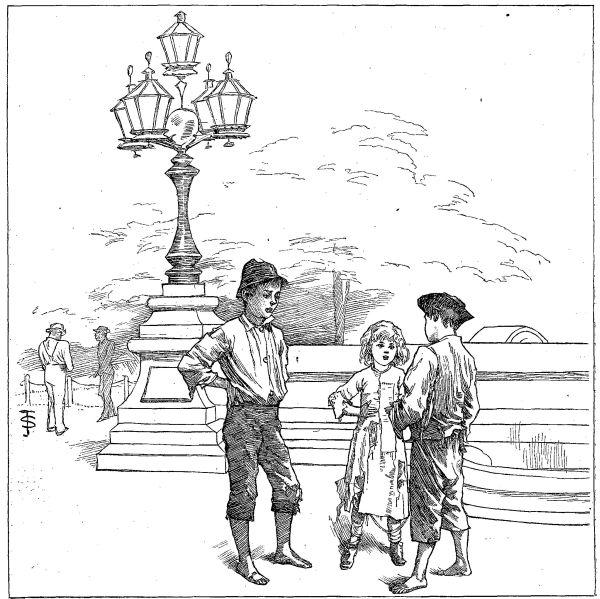
"No, sir! I'm goin' to buy you a new dress, after I pay Mother Brown, an' give Tom Brady the cent I owe him. That'll leave me a dollar 'n' thirty-five cents, an' you shall have the best one we can find in the city. I shouldn't wonder if we'd have money enough to get the bracelets too," he added, in the tone of one who is certain, but prefers to let the matter remain in pleasing doubt for a time.
"Oh, Jimmy," cried Katy, in delight, for the thoughts of what she might have if she only had the money had made her very nearly unhappy during the remainder of that afternoon, when trade had been dull, "are you goin' to spend that money for me?"
"Every cent," was the decided reply, as the money was rattled to give greater emphasis to the words.
"But you mustn't, Jimmy," said Katy, as she began to understand that her friend needed it quite as much as she did. "You can get your stand with that, an' I can wear this dress as well as not."
"But I'm goin' to buy the dress, an' the bracelets, an' a lot of things," was the reply, in a tone that admitted of no argument.
"An' ef he hain't got enough, I can put out the balance," said Johnny, speaking thus tardily because there had been a great struggle in his mind as to whether or no he would not be doing Katy a greater favor by buying the boxing-gloves for her.
Never since Katy Morrison could remember had she worn a dress that was made of new material. Even before her mother had died, leaving her to the anything but tender care of Mrs. Brown, her dresses had been made of old ones, and now the mere idea of having one without a hole in it seemed almost too good to be true.
She did make another protest against her friends spending their money for her, though she admitted that if the pin market remained in its present overstocked condition she could never hope to buy one from her earnings; but Jimmy had made up his mind, after much rubbing of his chin, and nothing she could have said would have caused him to change it. He and Johnny discussed the question of what color the dress should be—that it was to be of silk was understood, and Katy hardly knew how to contain her joy, so impossible had such a thing seemed a few hours before.
While they were talking they had passed through City Hall Park, and as they started to cross the street they were still eagerly discussing the question of color, Johnny being decidedly in favor of red, while Jimmy believed a bright green would be more suitable. Katy was just behind them, taking no part in the conversation, because one color would please her as well as another; the "whole" dress, whatever its shade, was sufficient for her.
So heated had the argument become that neither of the boys noticed, amid the general bustle of the square, the clatter and rush of a horse attached to a light express wagon, nor did they hear the warning cries of the driver until it was close upon them.
Then they had only time to escape being knocked down by the horse. As they jumped suddenly they heard a cry from Katy, another from those on the sidewalk, and they turned just in time to see the poor girl, whose thoughts of a new dress had rendered her careless to everything around her, lying on the pavement, with a great crimson stain, that grew larger and larger, upon her hair.
Before they could reach her a policeman had carried her to the sidewalk, and they were obliged to stand on the outside of a large crowd of curious ones, who always gather at anything unusual as if by magic, while the only being in the world who loved them and whom they loved, was perhaps dying, perhaps dead.
Clutching each other's hands tightly, while the great tears of a sorrow that had almost stupefied them rolled down their cheeks, the two stood there, near the curb-stone, not knowing what to do or say. They did not even know how long they remained there; but when the ambulance came, and they saw the still, lifeless form of "their girl," as they called her, lifted into the black, ominous-looking wagon, there was such a lump in the throat of each that it seemed as if he could not breathe.
The ambulance started off at full speed, its bell clanging the warning to drivers of other vehicles to clear the way, and without knowing where it was going, or anything save the fact that "their girl" was in it, the two boys ran after it regardless of fatigue or danger.
On and on the precious load was carried, until finally, when it seemed to Jimmy a physical impossibility that he could run any further, the ambulance was stopped before a huge building, which both the boys knew was the hospital.
One more glimpse they had of Katy as she was carried through the gate, and then they waited in painful suspense, as if they expected some word would be sent to them.
It was late in the evening when one of the attendants came out of the building, and found the boys crouching close by the gate. Before he had time to ask them what they were doing there, they overwhelmed him with questions as to the fate of Katy, and when he finally understood who they were inquiring about, he told them that it was impossible to say whether she could recover or not, as her injuries were believed to be very severe.
For several moments the boys stood looking at each other in mute fear, after the man had passed on, and then Johnny said, solemnly,
"Jimmy, did you ever pray the same as the rich folks do?"
"No."
"Let's do it now, an' p'r'aps Katy'll get well."
"Well, let's," replied Jimmy, earnestly, and there, upon the dusty street, two boys whose ragged coats covered true, kindly hearts, prayed, after their fashion, to the God of whom they had but seldom heard, for the life of "their girl."
[to be continued.]
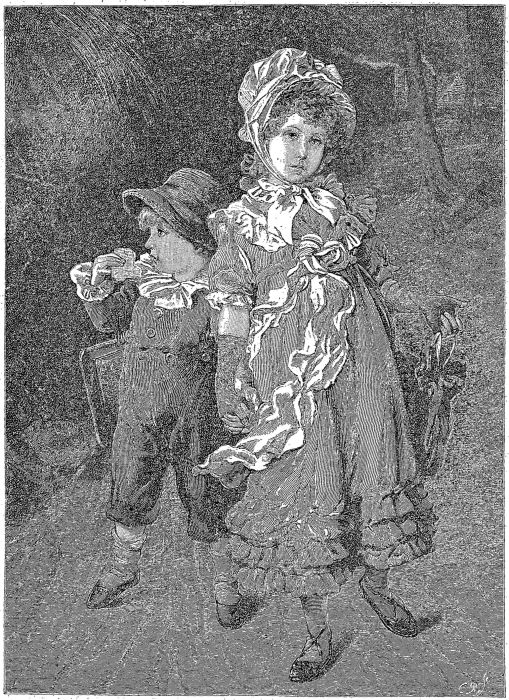
"BREAD-AND-BUTTER DAYS."—From a Painting by Weedon Grossmith.