THE BUILDING OF ST. MARY'S OF THE PEOPLE.
Reading edition
A LEGEND OF CHRISTIAN ROME.
BY E. M. TRAQUAIR.
Entering Rome by what was anciently called the Flaminian Gate, but is now the Porta del Popolo, or People's Gate, the stranger finds himself in a large, beautiful open place called the People's Square. It lies at the foot of the Pincian Hill, called by the ancient Romans, in the language of the time, the Hill of Gardens. If it deserved this name in those days, it does not deserve it less now. The most beautiful gardens in Rome, laid out with lovely flower beds, commodious carriage drives, and shady walks, are on its summit. A military band plays there in the afternoons, and it is the favorite resort of the rank and fashion of modern Rome, from the King downward.
Like much else in Rome, the history of the Pincian Gardens is sad and terrible. The great Mistress of the World, if she was at times rich in virtues, was just as often famed for terrible crimes. These gardens belonged at one time to the famous epicure Lucullus. This man, possessor of enormous wealth, loved good dinners much, but hated the trouble of ordering them as heartily as many a fine lady of the present day. To save himself this trouble, then, he had a number of dining-halls in his house, each arranged in a different manner. His steward was so well trained that he knew to a nicety, on receiving the order as to which hall the supper was to be served in, how it was to be arranged, and what degree of splendor it was to be of. The banquets of Lucullus became proverbial for luxury. It is even told of him that being very fond of a certain sort of eel he had a pond made for them in this garden. Their favorite food being human flesh, the legend tells us that he occasionally ordered a slave to be thrown in to them, to help to make them fat and savory for his table.
After the death of Lucullus, these gardens passed into the hands of a certain patrician named Valerius Asiaticus. This was during the reign of the Emperor Claudius. The Emperor's wicked wife Messalina coveted them for herself, so she got up a false accusation against poor Asiaticus, who seems, on the whole, to have been a very worthy man. But his innocence did not save him. He was condemned to death, and his property given to Messalina. The wretched woman's triumph did not last long, however. Claudius was told of her wicked life, and she was killed by his command on the very place she had obtained for herself by such a horrid crime. Word was brought to the Emperor while he was sitting at table that his wicked wife was dead. He made no reply, and went on quietly eating his supper. They were a queer people, those old heathen Romans.
To return to the People's Square. In the centre is a tall obelisk brought from the Temple of the Sun in Egypt during the reign of Augustus. It was thousands of years old, perhaps, before Rome was built. A beautiful fourfold fountain at its base spouts clear sparkling water from the mouths of four antique lions of basalt. It is the most picturesque square in Rome.
At the left-hand side of the Porta del Popolo, as you enter, stands the ancient Church of St. Mary's of the People, concerning the building of which the following story is told:
When the bloody and cruel Emperor Nero, who had wantonly killed so many people during his short reign, was killed in his turn, he was so execrated by the people that none could be found to give him burial. Then his nurse Eclaga, who still went on loving him, as some gentle souls will do, in spite of his dreadful crimes, buried him, with the help of two other women, compassionate like herself, in a tomb at the foot of the Hill of Gardens. On this tomb, for many years, a wreath of fresh flowers was found every morning, no one knowing who had placed it there. So they watched one night, and just before break of day discovered this poor faithful old woman bringing this loving offering to the memory of him whom she remembered only as the innocent babe she had nursed in her arms.
As time went on, these offerings ceased. Eclaga was dead and gone, and with her had passed away every loving remembrance of the wretched man who was buried at the foot of the Pincian Hill. Horror and loathing were the only sentiments his memory inspired. By-and-by nothing marked the spot where his body lay but a gigantic walnut-tree which had grown out of his grave. It was so large that it overshadowed all the place and covered it with gloom.
This gloom was still further increased by an innumerable quantity of large crows that had taken up their abode in this tree. They darkened the air all around by their flight. The people inhabiting the neighborhood had no rest by night or by day by reason of their hideous, unearthly croaking. Every means tried to drive them away proved vain. They kept their abode on the tree above Nero's tomb, and defied all earthly power to assail them.
Then a great fear fell on all the people, for they thought that it was not with natural crows they had to do, but with demons who were keeping watch over the grave of the wicked Emperor. Then, as there was no help in man, they prayed to God.
Now Paschal the First, who was Bishop of Rome at that time, and a good and holy man, had a strange dream one night. In this dream it was revealed to him that no earthly power could drive away the demon crows, which, if not exorcised, would soon overpower the whole of Rome. The only way to do this effectually was to go forth at early morning, at the head of all his clergy, singing psalms and hymns and praying fervently. Then they were to cut down the tree, and take it out by the roots to the very last fibre of it, and build a church on the spot where it had stood.
Full of joy at this revelation, Paschal summoned his clergy, and told them of his dream. Then he went, as he had been directed, at their head in procession through the city, singing psalms and hymns. Arrived at the spot, they knelt down and prayed fervently. Then they commenced to hew down the tree, the supposed demons all the while uttering wild and unearthly croakings. After the tree was cut down, and every root of it taken up, the crows flew away with a terrible noise.
A beautiful church was then built on the spot; and as the funds for its erection were entirely collected and given by the common people, it received the name of St. Mary's of the People. There are some beautiful marbles in it, and many fine old paintings, some of them by the most famous of the old masters.
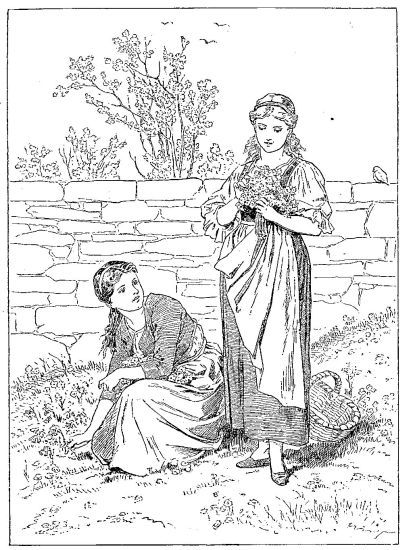
Oh, such a bunch of posies! We found them on our way, And gathered them for Robin, Who lies abed all day. "You'll soon be well, dear laddie," The posies sweet will say.
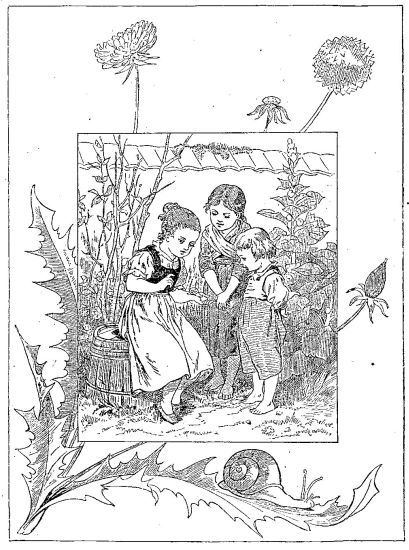
Oh dear, but he's queer, this wonderful snail, O'er the whole wide world he may travel and sail; But where'er he may go on the longest track, He carries his house on his funny back. What wonder, then, that he likes to roam, When the comical fellow is always at home.
Wilt thou listen, Jesus dear, To the prayer that I would say; Thou didst promise Thou wouldst hear When the little children pray. I would like, dear Lord, to be Patient, gentle, good, and mild, Ever growing more like Thee, And as Thou wert when a child.