THE CITY OF THE CALIPHS.
Reading edition
BY LIEUTENANT E. W. STURDY, U.S.N.
It was impossible for our friend Master Tom Fairweather not to indulge in a chuckle when he opened his eyes upon the harbor of Bagdad the morning after his arrival at that ancient city.
The passengers of the Blosse Lynch were being carried ashore by the basketful in the kufas which swarmed about the steamer, and which, made of wicker-work, and round in shape, reminded our young friend of peach and strawberry baskets.
It was not long, however, before Mr. Jollytarre and himself were likewise progressing shoreward, whereupon the humor of the situation considerably diminished. It is never as funny to do a thing ourselves as to see other people do it.
Immediately on landing Mr. Jollytarre was presented with a note by an important personage, who in a fez cap stood by while the Lieutenant read the missive. Having done so, he said, "Tom, you are in luck. One of the most influential merchants of Bagdad has invited us to lunch with him at twelve to-day. We shall have lots of time before then to walk through the bazars, and get, in fact, a general idea of the city. After lunch we can do more sight-seeing. Would you like to go?"
"I suppose there are no ladies," demurred Tom, doubtfully.
"I am afraid not," and the Lieutenant shook his head sadly.
"Then I'd like to go," agreed Tom, cheering up.
The Lieutenant smiled at him. "You will hold different views one of these days. But let me see; here, I'll write a line on my card;" and pulling out his card-case he wrote with a flourish,
"Accept with pleasure.
"Jack Jollytarre."
Then they started for the bazars, which they found to be long and broad, and moderately full of pretty things. The streets were cleaner than in most Eastern towns. The houses bore a family resemblance to each other—a square court-yard in the centre, around the four sides of which the rooms were built, sometimes to the height of three stories, and some of them being quite open to the sun and air of the court-yard, there being, as a rule, no windows on the dark narrow streets. The roofs are generally flat, and the people sleep on them during the hot summer. In fact, while the great heat lasts, the citizens of Bagdad spend the day in the serdaubs, or as we would call them, cellars.
Tom and Mr. Jollytarre in their walk stood gazing into one of these cellars through one of their grated windows.
"'Serdaub,'" read the Lieutenant from his guide-book, which he always carried like a devoted traveller, "'means cold water.' The Bagdadese call their cellars by this name because they keep cold water stored there. In short, these cellars might be called during the hot months the watering-places of Bagdad, when it is too intolerably hot to remain above-ground. But the nights almost always cool off, and then the frequenters of these summer resorts go up to spend their evenings on the roof by way of variety. This I should consider a change decidedly for the better, as venomous reptiles abound in the serdaubs, which do not make very pleasant companions. Besides which, the air is damp and the ventilation bad."
As they walked on, Tom said: "The air above-ground is good enough, though, isn't it?"
"Oh yes, delightful; no better air or climate in the East. The wind is always blowing over the city fresh from the surrounding desert. For six or eight months the climate is as pleasant as in any place on earth. In midwinter it is cold enough to form ice. The spring and autumn are particularly delightful. But the summer sets in early. In May, for instance, there are such swarms of insects as to render life almost insupportable. We are here, however, in the very nick of time—April."
"Such lots of flowers!" commented Tom. "I know what those little yellow flowers are in that garden—crocuses; and those are violets just like ours at home; and did you ever smell anything so sweet as those orange blossoms? That's something I never saw in our garden."
Here Tom and Jollytarre stood stock-still like two girls to stare in at the flowers in the Bagdad gardens, and up at the birds, and turtle-doves, and ring-doves on the mosques and minarets around them.
"There's a fine view from the top of that minaret," said Mr. Jollytarre, pointing to a very tall one in the middle of the city. "Shall we climb it?"
Of course Tom said yes, and off they started.
"The view is really very fine," exclaimed the Lieutenant, on their way up, "of the city, the gardens, the river, the plain of Mesopotamia, and the Persian hills; and the minaret itself is worth a visit on its own account, having been standing since the year 1235, more than six hundred years. It is, moreover, not only the oldest but the highest of any minaret in Bagdad. It is lucky for us that although unbelievers are not allowed entrance to Turkish minarets in general, this one being partly in ruins, and being besides unattached to any mosque, is therefore open to us dogs of Gentiles."
The entrance was high up, as in most minarets. A ladder was placed against the wall, and our friends climbed up and scrambled into the doorway over their heads.
From the top of the minaret Bagdad looked like a level plain made of the flat roofs of the houses, honey-combed by narrow ditches—the ditches, of course, being actually the streets.
Out of this plain of flat roofs rose mountain heights and peaks of mosques and minarets, which glittered in the sun with their gaudy covering of tiles, generally either blue or green.
THE BRIDGE OF BOATS.
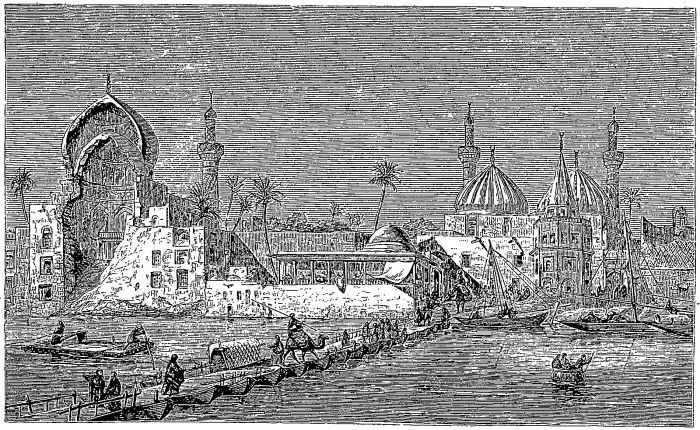
From their lofty position our travellers made out the fact that the town was divided into two parts, one on the eastern and one on the western bank of the Tigris. A certain freshness and beauty was given to the river by the mulberry and date-palm trees growing in the court-yards of many of the houses. The eastern and western portions of Bagdad were connected by a pretty bridge of boats. Up and down the course of the river groves and gardens follow the flow of its waters northward and southward. But away from it to the east and west trees disappear and deserts stretch out into trackless wastes.
Eastward of Bagdad are the old walls, now for the most part dismantled. Long ago the bricks of which this wall was built were given to the soldiers of the Caliph's army to eke out their pay, but the soldiers of to-day are more fairly treated.
Tom made a visit to the citadel and barracks, which were in exceptionally good order. The soldiers appeared very young-looking, but steady and enduring. They wore a blue Zouave uniform.
Their lunch hour approaching, after leaving the barracks Tom and Mr. Jollytarre now turned their steps in the direction of the house of their host.
They found this house built around a court-yard, as you have been told is generally the case in Bagdad. In this particular court, however, they found a number of hawks, which their owner kept for sport. They are used to hunt down gazelles and antelopes, which they either kill outright, or else keep at bay until the hounds come up and put an end to them. The general effect of the house was European. The walls, to be sure, were plainly whitewashed, but other details were handsome and artistic. For instance, the ceilings were handsomely decorated, and the floors were carpeted. One large room was furnished as a billiard-room. In others were handsome mirrors. The lunch table was laid in accordance with our notions or prejudices; that is, with a cloth, knives, forks, and plates. But there all sense of familiarity ceased. The fare was thoroughly Oriental. First of all a sheep, roasted whole and elaborately stuffed, was brought in on a tray and carried around to every one at table. Next came a roast turkey, served in the same way. Then a goose, then a gazelle, and then dishes and dishes of unknown names and composition. Such was the menu. Besides all of which, the table was laden with countless dishes of fruit and sweetmeats.
Tom, of course, being only a small boy, was admitted on sufferance, and sat perfectly still, and did not once contribute a word to the conversation. But he looked and listened all the harder, and I do not believe he missed a single point in the entertainment. Still, he was not particularly amused, and was certainly greatly relieved when the feast was over, and Mr. Jollytarre and himself were once more in the streets of Bagdad.
"They have the plague here frequently," said the Lieutenant, as they strolled along, an Arab whom they had picked up for a guide at their heels, "and the mortality is fearful. Once the authorities decided to try the plan of shutting up every one in any house where the plague broke out. But this plan was bitterly opposed, as it meant certain death to all in the house. The Jewish rabbis proposed another plan. They persuaded their people to emigrate to the desert, and live there until the plague was stayed, or at least until they had themselves got rid of it, having left it behind in the filth and foul air of the city. Some Christians and Mussulmans followed their example. There is one curious fact about the plague: hardly a person has ever been attacked who slept on a bedstead, even when persons sleeping on the floor in the same room have caught the disease and died."
"I suppose it is a summer disease," said Tom.
"No; on the contrary, it disappears with the fierce heats of summer, only to perhaps re-appear in the fall."
"I should hate to live in a place where there was danger of such a vile disease breaking out. But look at the troops of children—just out of school, I suppose. Do you know whether schools are found here?"
"Excellent, I am told. The gentleman with whom we lunched just now told me that these Bagdad children are taught to be good linguists, for one thing. They learn to speak Arabic, Syriac, and Turkish, as well as French and English, with fluency, in a Jewish school which was started not long ago. When this school was first opened the Turkish parents would not send their children. Now, however, they see the advantage, and the attendance is very good, especially among the boys."
"They look very knowing in their little fez caps," said Tom. "But how they stare! And did you ever see such black eyes? Are there no Turkish schools?"
"Yes, one or two, and pretty good ones, besides a few others not so good."
As they stood near the wharves, watching the shipment of grain, Tom remarked that he supposed a great deal of the grain went out of the country.
"Yes," said Mr. Jollytarre. "Bagdad ships immense quantities—last year as much as 50,000 tons. Every now and then there is a grain riot here, when the people take it into their heads there will be a failure of the next harvest. They insist that the government shall put a stop to the exportation of the grain. Sometimes these demands are yielded to, when there is any prospect of a famine. The government does not give in often, to be sure, but the thing has been done."
"Hello!" said Tom; "here's the Blosse Lynch."
"Yes, and it is time we were on board, for we've done a good day's work, haven't we?"
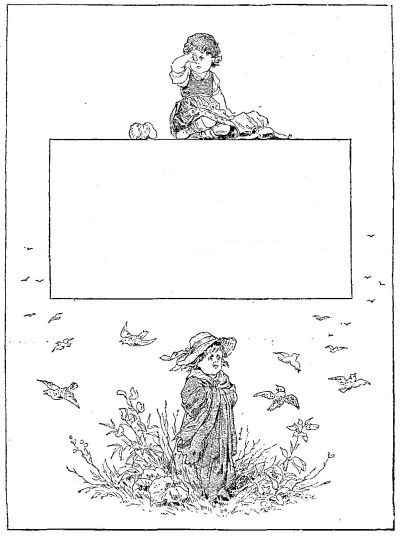
The naughty little girl that cries, And rubs her fingers in her eyes, And pouts and frets all day, A ragged hat and gown must wear, And in the garden stand, to scare The thievish birds away.
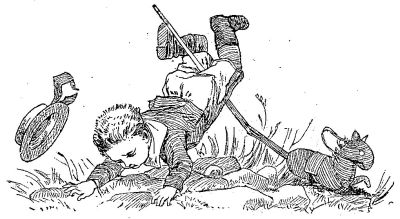
Have a jolly gallop
Over sticks and stones;
Do not get a tumble,
Or you'll break your bones.
That was a bouncer—
Very much too high—
But my little horseman
Is too brave to cry.
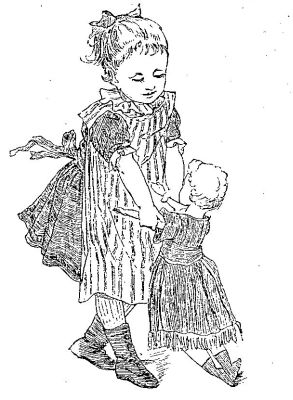
Trippitty trip, trippitty trip,
Round and round we merrily skip;
Hippitty hop, hippitty hop,
Oh, 'tis such fun we never can stop!
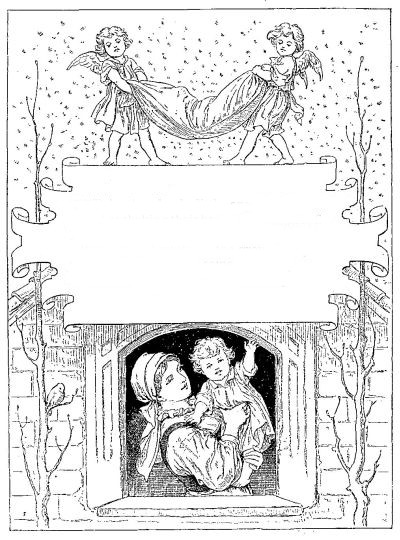
Up in the clouds little angel hands Are shaking their beds so the feathers fly. They flutter down through the frosty air, Till soft and white on the ground they lie. Oh, fair little angels, come and keep A watch while the baby lies asleep!
LITTLE GOSSIPS.