PIANO-PLAYING IN THE TIME OF MOZART AND BEETHOVEN.
Reading edition
BY MRS. JOHN LILLIE.
I hope that some of my readers will remember the history of the piano-forte in a former number of Young People. Since then we have looked somewhat into the lives of great composers. Now let us see to what degree piano-forte playing had progressed when Mozart died, in 1792, and when the great master Ludwig von Beethoven was a young man just entering on his career of work.
To begin with, let us look at the pianos of that day. Although the harpsichord had been greatly improved upon, the keys and strings yet needed something to aid elasticity of touch. In Bach's day it had been the custom to strike the key, drawing the fingers inward slightly, and a suppleness of wrist, which masters think so much of at present, was not considered valuable. But with Haydn and Mozart came a need of something finer in the piano-forte itself, and musicians felt strongly the necessity of an improvement in the instrument whereby they could make more gradual effects. Many efforts to alter the strings and hammers for this purpose proved unsuccessful, but at last the main difficulties were overcome, and before Beethoven's death, in 1827, pianos of various degrees of excellence were in use, with all the desired improvements. To this more than to anything else we owe the improvement in piano-forte playing.
LUDWIG VON BEETHOVEN.
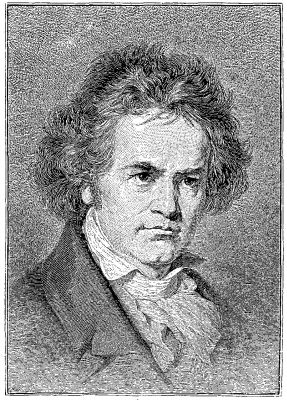
At concerts during this period the piano was largely used, and also in private houses; but lessons from the best masters were rare, and, unless the pupil designed to pursue a musical career, few except the leading people of society studied piano-forte music. In general, the interest in it was not great. Poor Beethoven used often to writhe under what he considered personal slights. A story is told of his once being at the house of Prince —— with Ries, the famous musician. They were invited to play together, and while in the midst of their performance a young nobleman at the lower end of the salon talked quite loudly with his companion. Beethoven glared at him once or twice in vain, and finally lifting Ries's hands from the piano, he called out, "Stop! I will not play for such dogs!" and away he went in spite of every attempt to an apology.
Such interruptions to music in a drawing-room occur often enough now, but in the beginning of this century, as I said, piano-forte performances were confined to a much smaller number, and naturally appreciation was not general. On the other hand, if a child showed any ability, it was kept very closely to study. Mozart had pupils who thought nothing of five hours' practice a day, and Beethoven, when a boy, was kept to the piano for hours by means of a good beating every time he left it.
The misery of a musical career at that time was certainly lack of general understanding of the art. Musicians had to procure for themselves noble patrons—rich ladies or gentlemen who would help them on in their divine art, patronize their concerts, get pensions for them, or in some cases offer them homes where they might work unmolested by debt and other domestic trouble. In this way Beethoven lived a great part of the time at the house of Princess Lichnowsky in Vienna. Mozart was also indebted to some friends for hospitality and influence, and indeed where the public were so often unappreciative, private patronage had to be sought for, in order that the world might have many of the noble harmonies we possess to-day.
In those days the famous composers or musicians were the only teachers, so that any young student who cared for his work had admirable opportunity to improve. Mozart gave lessons of great length, and seems to have enjoyed them heartily. Haydn had many pupils, one of whom was Beethoven, and we read that he paid Haydn eighteen cents a lesson!
During that period which includes the last years of Mozart's life and the first of Beethoven's, between 1780 and 1792, the way was being laid for Beethoven's grandest work, and yet we can hardly call it a transition state; that is to say, a period of time when any art is undergoing a change which shall effect its whole purpose. But with Beethoven came the perfection of the Sonata and the Symphony, and all performers, whether in public or private, who attempted his works, were compelled to understand technique and the use of their fingers on the keyboard, so that we may say, justly enough, that with Beethoven we seem almost to begin a new era in piano-forte music.
I have told you the step upward old Bach made; then Haydn went still further, preparing the way for Beethoven's perfect work. Mozart's brilliancy and delicacy both as a performer and a composer helped the movement on in every way, and during the first quarter of this century a number of men came into fame as masters in execution and composition as well. Indeed, with the beginning of this century piano-playing had reached a period of excellence which allowed a master to indulge all his feelings and ideas in composing for this instrument.
In 1787, Beethoven, then a lad of about seventeen, visited Mozart in Vienna. It was about the time that Don Giovanni was being produced, and Mozart's mind was full of its importance, so that the visit seemed of much less consequence to him than to Beethoven. The latter seated himself at the piano, Mozart standing by waiting good-humoredly for one of the usual performances of "prodigies" whose parents destine them for the public. But the lad played so brilliantly that Mozart could not but believe that he was executing a well-prepared piece. Beethoven felt this, and eagerly begged Mozart to give him a theme and let him vary upon it.
To this Mozart consented, and presently the room seemed to vibrate with the rush of harmony beneath Beethoven's touch. Mozart listened in silent admiration, and going softly upon tiptoe into the next room, said to some friends assembled there:
"Pay attention to him. He will make a noise in the world some day or other"[1]—a prophecy soon fulfilled.
Beethoven's touch was strong and masterly, but rather heavy, and as his deafness increased, his performances on the piano were almost painful to listen to. His left hand often remained unconsciously on the wrong chord. Mozart never lost the brilliancy of his playing. Haydn, it is said, made the piano "sing," but to the musicians who followed Beethoven we owe the perfection of piano-forte playing and instruction. Moscheles, Mendelssohn, Chopin, and others realized the highest art in execution. Not very long ago a lady was recounting to me scenes in which, according to her description, Mendelssohn and Moscheles performed actual marvels at the piano, the delicacy and lightness of both their styles reminding her "of a forest full of delicious birds."
In the period of which I speak now—that is, the beginning of this century—you will remember how little public appreciation of art existed, and how hard the greatest men toiled for all they obtained. But love of art is powerful. It will carry any one of you over the roughest places, and in looking at your well-arranged exercises, try to remember those patient, eager students of eighty years ago, to whom every bit of help came so slowly that we of to-day ought to think our pathway cleared of every thorn.