THE ANGEL IN THE LILLY FAMILY.
Reading edition
BY SHERWOOD BONNER.
There was something rather queer about the Lilly family. In the first place there were so many of them—fourteen precious children. This alone is queer, when it is the fashion of the day to have small families, and "well-springs of pleasure" are as scarce as diamonds in any properly regulated household. But Mrs. Lilly's heart was made on the omnibus plan; and there was no miserable little "Complet" ever scrawled over its door.
Then it was queer how they avoided nicknames in the Lilly family. Each child was called by its full name, which sometimes happened to be a pretty long one.
It was through a sad accident that one of the Lilly children turned into a regular little angel.
The day after Christmas Mrs. Lilly's aunt—grandaunt of the children—carelessly allowed poor Katharine Kirk Lilly to fall on a marble floor. A serious injury to her spine was the result.
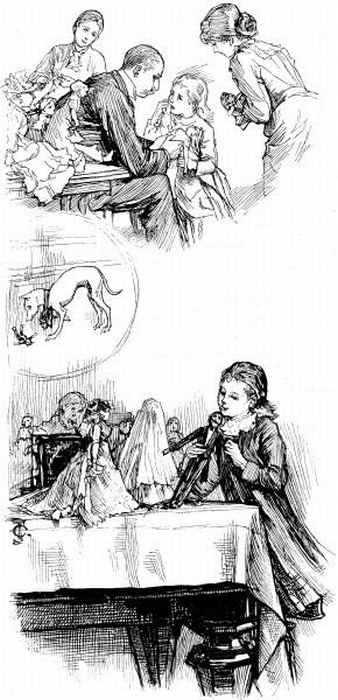
Dear! dear! how Mrs. Lilly screamed! She threw herself on the bed, and poured forth tears enough to put out a Christmas bonfire. She was not soothed until the doctor came, and after a careful examination—which the sufferer bore without a word or moan—pronounced that poor Katharine Kirk would live. But, alas! he added that she must always be an invalid. And smiling with the patient sweetness that distinguished her, the dear child sank back on the pillows from which she was never to lift her golden head. All the rest of the Lilly children stood round, showing by a sort of paralyzed expression on their faces how deeply they were moved; but none of them cried.
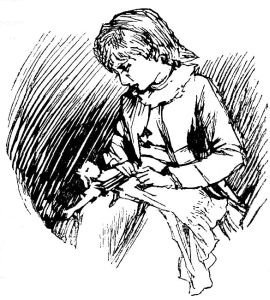
"Perhaps, dears," said the poor little mother, sobbing, "this affliction will be blessed to you."
"It will," cried the penitent great-aunt, clasping Mrs. Lilly in her arms; "it will teach them lessons of patience, of self-denial, of love, that will be as good as—"
"As the Prince's pricking-conscience ring in the family," suggested Mrs. Lilly's mother, who had a way of turning things into fun, and never gave way to her feelings.
It was surprising what a change from that time dated in the Lilly family. They had been like other children, a little faulty, perhaps, rather apt to stand on their rights—a fierce footing—but merely to look at the darling invalid, her shining hair outspread, her blue eyes ever bright, was to receive a lesson in sweetness and good temper.
Take the case of Phillips Arthur Cliff Lilly. This young gentleman was the youngest of the family, and his mother's favorite. Why, no one knew, except that he was so ugly. He had so many scars on his face, from falls and fights, that somehow he produced the impression of a target. His hair stood out like a halo of straw, and one defiant wisp reared itself above his forehead with the grace of a cat's whisker. Mrs. Lilly could never sleep until he was safe in her arms, and his life knew no cross until after the accident to Katharine Kirk, who became, in her turn, the pivot round which the family revolved. Horrible to relate, his mother one evening, in her hurry to get back to the invalid, forgot her youngest, and left him in the Common. There he lay all night, like a tramp, with the stars twinkling at him, and stray dogs sniffing as they passed him by. Yet when he was found he did not utter one word. He opened his blue eyes as he was picked up, and only gave a single plaintive cry as he was pressed to his frantic mother's bosom.
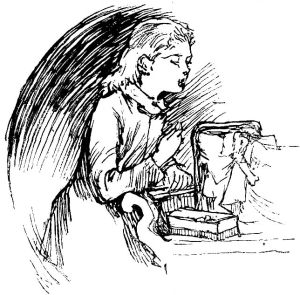
Then there was Myra Miles. She was one of the young ladies of the family, and, as might be forgiven in a beauty, a trifle vain. She was to receive calls on New-Year's Day, and had expected to come out in a fine new dress. Pink tarlatan it was to be, trimmed in the French taste with blue, with a train to thrill you to your finger-tips, which seemed to bear the same relation to Myra Miles as the rest of a snake does to its head. Mrs. Lilly's mamma was making it; but her time was suddenly demanded to do something for the invalid, and the dress was thrown aside. The consequence was that poor Myra Miles appeared in the gorgeous pink dress with a black lace scarf instead of the waist. Still, not one word of complaint did she utter, although her sisters Dorothy Dimple and Martha Bonn—the favorites of Mrs. Lilly's aunt—appeared in exquisite raiment of green and blue. There was something very beautiful about her resignation.
When the lovely Susan Mears Lilly was married, Katharine Kirk was taken in her pretty bed to view the ceremony, and was quite a feature of the occasion. Indeed, she did not begin to look so weak and ill as the bridegroom, who, poor youth, was so tottering that Mrs. Lilly's aunt cruelly suggested that his back should be propped with a hair-pin. You may imagine how the girls laughed at this, especially Teresa Fehmer Lilly, a wicked little bridemaid in red satin.
And such attentions as the sufferer had from friends of the Lilly family! The beautiful belle Miss Lilian Love spent many hours over a dainty quilt of silk and lace to adorn the sick-bed. A glorious poet sent in a box of agreeable medicine, with a note running like this:
"My dear Mrs. Lilly,—I send you a little book for your sick child, and some medicine for her poor broken back. The peculiarity of this medicine is that in order to produce any good effect it must be taken by the nurse. This is rather hard upon the nurse; but if she is a good nurse she will not mind it much."
Jane Jumper was the nurse really; but while the medicine lasted Mrs. Lilly herself took entire charge, and administered the sweet doses to herself, without one word from Katharine Kirk.
It may have occurred by this time to some shrewd little reader that under no circumstance was any member of this household apt to give utterance to silver speech. Shall I confess? Or, my dear children, have you guessed that Katharine Kirk and all the cherished fourteen belonged to the beloved, the beautiful, the dumb, family of—Dolls?

Viareggio, Italy.
I am nearly six years old. I would like to have a tea party on my birthday. After my birthday has come I will write again, and tell you all about it.
In Rome I have a big play horse and two kitties. My little cat is gray and white, and is called Bimbo. He walks on his toes, and makes a long face. Papa's cat's name is Cavaliere. He is a big Maltese cat.
In Rome we have a nice house and a nice garden, and in the garden there is a straw hut.
We are finishing the summer at Viareggio, and we have nice sea-baths.
Imogen R.
Smith's Hill, Feather River, California.
I enjoy the letters in Young People, especially those that tell of birds and flowers I have not seen. There are mocking-birds here in summer, and a beautiful bird called goldfinch. There are also robins, bluebirds, and many varieties of sparrows. The bluebirds and robins stay here all winter. It is too bad to take eggs from the birds to give away in exchange. The pitcher-plant grows in a valley not far from here.
My sister Bell went to Lassens Peak last week. It is 10,600 feet high. There is no snow on the mountain now except a small patch on top. Hundreds of small butterflies were flitting about on the mountain-side and alighting on the rocks. As there is no vegetation, except a few hardy plants scattered among the ledges, I wonder what they find to live on. A lake which could be seen from the top of the peak had the appearance of being frozen. In the valley below there are hot boiling springs.
Lou R. K.
Yes, it is too bad to take so many birds' eggs. But if our correspondents are careful to take only one or two from each nest, and to always leave more than half, as we have already begged them to do, the mother-bird will not suffer. If we could believe for a moment that our little friends would be so cruel as to disturb the brooding mother, and rob her nest of all its eggs, we would never publish another letter requesting an exchange of these pretty natural curiosities. The nesting season is now over in all the Northern States, but when it returns, we trust the young egg collectors will never allow their eagerness to secure the coveted treasure to overcome their sense of honor and their kindness of heart.
Charleston, South Carolina.
I am ten years old. I take Harper's Young People, and I like it very much. I am always glad when Wednesday comes, for that is the day I get it. I think it is a very nice paper for boys and girls. I have a pet dog whose name is Lion.
Samuel P.
Belleville, Texas.
I am ten years old. I have no pets except a Maltese cat and a dog. I was very much interested in the dog and cat of Madelaine, the little French girl. I like "The Moral Pirates" and "Who was Paul Grayson?" best of all the stories. My father gave me a piano for my birthday present; and when I was seven years old he gave me a pony, and I named him Button. I dearly love to gallop over the hills.
I went to New Hampshire in 1875 to see my grandfather, and we visited the White Mountains.
I think Young People is the nicest paper I ever saw, and I intend to take it until I grow up.
Josie C.
New York City.
B. I., of Radnor, Ohio, asks how to feather arrows. Choose goose or turkey feathers of a suitable size. Cut them carefully from the quill; put on hot glue, and fasten them to the sides of the arrow, about an inch from the notch, at equal distances apart. There should always be three feathers.
A. H.
It is a good plan to fasten the feathers to the arrow with pins until the glue is perfectly dry, when they can be carefully removed.
San Francisco, California.
I have a pet now, a lovely little dog, with long curly hair and large bright eyes. He is snowy white all over, and his name is Mischief. I am going to have his picture taken some time. He looks just like a bundle of cotton, with three black spots shining through. Those are his eyes and nose.
The tree represented in the illustration of the beetles in Young People No. 38 is just like the California buckeye-tree. The blossoms are exactly the same.
I am very much interested in the directions for making salt and fresh water aquariums. When I was in Monterey I might have collected lots of sea-anemones, snails, and pink and white star-fish, but I did not think of it. One of the gentlemen at the hotel went fishing with a net, and caught a little baby cuttle-fish, or devil-fish, as it is commonly called. It had seven or eight long legs, all lined with little suckers, like buttons. It was a dreadful ugly-looking thing. It must have been very young, for it was only ten or eleven inches long. The gentleman was going to keep it for a curiosity, and until he could get something better he put it in a pan of salt-water; but he forgot to cover the pan, and in the night the fish crawled out on to the floor, and died.
I have exchanged Farallon Island eggs and leaves and specimens of trees with a good many children since my letter was printed.
Is there any difference between postage stamps and postmarks? I don't believe I know what postmarks are.
Ida Belle Diserens.
A postmark is the stamp put on the outside of a letter at the office where it is posted. It certainly is not of much value in itself, but if a collection is neatly pasted in a book, States and countries being arranged together, counties being written under towns in the United States, and a note made of any manufactories or natural productions for which the town is celebrated, such a collection may become an interesting gazetteer, and valuable as a book of reference.
Hoboken, New Jersey.
On September 27 I found a blossom on the peach-tree in our back yard. I picked it, and have pressed it to send to you. I think it is very odd to have peach blossoms in September, and I would like to know if any girl or boy has ever seen them blooming in that month in this climate.
I think the story "Who was Paul Grayson?" is splendid.
Reba H.
South Eliot, Maine.
I bought three silk-worms' cocoons at the Educational Department of the Permanent Exhibition at Philadelphia. In about a week's time the cocoons broke, and the moths came out and began to lay their eggs on a sheet of brown paper which I laid them on. They have laid about all their eggs now, and there are a great many.
Chester B. F.
Howard, Texas.
I am seven years old. Mother teaches me at home. I am studying spelling, geography, arithmetic, and the Third Reader.
I love so much when Wednesday morning comes, for then I get my Young People, and I read until I have finished it.
I received a beautiful pressed bouquet, from Mary Lowry. It was real nice, and I am going to send her some seeds very soon.
I have three dolls, one wax and two china ones. Every day, when I am through with my lessons, my sister Myrtle and I have nice times playing with them.
Mabel P.
West Chester, Pennsylvania.
I live on a farm about one mile from town.
We had a ring-dove given to us, and we bought a mate for it, and now we have four more. One is just hatched. Last summer, a year ago, we had a present of a pair of guinea-pigs, and we have raised six others. One of the little ones is pure white, except its head, which is black. It looks as if it had a mask on. My brother, who is ten years old, has a pigeon-house and about thirty pigeons. And he has six rabbits, which are all the time burrowing out of the pen, and a young shepherd dog. We have black and brown bantams, and two little red calves we call Spot and Lina, because one has a red spot on its back, and the other a white line.
Last spring I planted one small ear of pop-corn, and now I have gathered nearly eighty ears from it. I also planted ground-nuts.
My brother, my sister, and I have each a pair of stilts, and we have lots of fun inventing new ways to walk on them.
Bessie R. H.
I would like to exchange postage stamps of France and Germany with any readers of Harper's Young People. Correspondents will please put "Viâ England" on the envelope, as letters thus addressed are more likely to come safely.
B. D. Woodward, 49 im Trutz, Frankfort-on-the-Main, Germany.
I would like to exchange postmarks for foreign postage stamps, or for other postmarks, with any boy in the South or West.
William F. Penney, 559 Henry Street, Brooklyn, New York.
I have a collection of postage and revenue stamps, and would like to exchange with readers of Young People.
W. H. Eastman, Emporia, Kansas.
My mamma takes Young People for my sister Laura and me. We read all the stories, and are never tired of it.
We have a pair of pet pigeons named Polly and Dolly. When we first got them we had to put the food in their mouths, but now they can eat alone. When we come they hunt in our hands for something to eat.
I am a little Iowa girl, but my father came to live in Old Virginia almost five years ago. We live near Greenway Court, the old home of Lord Fairfax, and where General Washington surveyed the land when he was a very young man.
I am thirteen years old. I have a cabinet and a museum, and am collecting postmarks and stamps, which I would like to exchange with any correspondent.
May Bell Miller, Care of Joseph A. Miller, Nineveh, Warren County, Virginia.
I am having a splendid time in Mamaroneck. I have a lot of chickens, and it is very funny to see the young roosters fight. I shall leave the country soon, and I would like to say to those wishing to exchange stamps with me that after October 25 my address will be
Pierre Jay, 291 Madison Avenue, New York City.
I am making a collection of postmarks, and would like to exchange with any correspondents of Young People.
C. H. McBride, Rexford Flats, Saratoga County, New York.
I am making a collection of birds' eggs, and would like to exchange with any readers of Young People.
Joseph Skirm, Santa Cruz, Santa Cruz County, California.
I am very much interested in the letters in Young People. I would like to exchange birds' eggs with any of the readers.
H. Gray, Albion, Orleans County, New York.
My younger sister takes Young People, and I like it as well as she does. I have no pets, but I have a flower garden and a good many house plants. I would like to exchange flower seeds with any correspondent of Young People. I have sweet-pea, cypress, rose-moss, dew-plant, and other seeds.
Mollie C. Michener, Kokomo, Howard County, Indiana.
I have read Young People ever since it started, and like it very much. I like "The Moral Pirates" and Jimmy Brown's stories about Mr. Martin the best.
I have a Chilian, a Greek, and a Portuguese coin which I would like to exchange with any reader who is collecting foreign coin. I have a collection of almost two hundred.
John Pyne, Wiscasset, Maine.
I thought you would like a letter from this town, where a great battle was fought.
I spend many happy hours with the dear Young People. I love, most of all, the little letters, as it seems like talking to little people.
I am sick in bed, and have been for almost ten weeks. If my cough would get better, then I would get strong again. I am nine years old. I can read and write, and play little tunes on the piano. I fear the other little girls will get ahead of me now.
I wish "Wee Tot," or any of the little readers, would send me some ocean curiosities or quartz crystals for pressed leaves and ferns gathered on Round Top. My pet canary died last week.
Nerva Wible, Care of J. Ed. Wible, Gettysburg, Pennsylvania.
I have a nice collection of curiosities, and would like to exchange with any correspondent for sea-shells or other curiosities. I have iron ore, soft gypsum crystals, stalactites, stalagmites, pretty pebbles, different kinds of limestone, pressed ferns, and other things. In sending specimens, correspondents will please mark each plainly with the name and the locality where it was found.
A few days ago I got my hand mashed in a cider mill, and can not use it now. My brother is writing this letter for me.
Harry R. Bartlett, Greensburg, Green County, Kentucky.
I would like to exchange curiosities and stuffed birds with any correspondent of Young People.
C. H. Mathias, Ingersoll, Ontario, Canada.
I have taken every number of Young People since it was published, and I think it is just splendid.
I am gathering specimens and curiosities, and would be glad to exchange with any one.
Charlie Leadbetter, 174 Plum Street, Cincinnati, Ohio.
I have a printing-press and a small breech-loading shot-gun that father made for me. I had a cat named Bill, but he is dead. He would jump over my arms, and stand up on his hind-feet and kiss me, and sit up in the corner.
I like the story of "The Moral Pirates" best of all. I and some other boys are planning to go off on a cruise next summer.
I have a lot of foreign stamps which I would like to exchange for Indian arrow-heads or Indian relics. I am eleven years old.
Bertie Harrison, Berlin Heights, Erie County, Ohio.
I am just beginning a collection of curiosities, and would like to exchange with some of the correspondents.
I have one brother. We live near a pond. Our pet kitten is very fond of fish; and I go out in a row-boat and catch minnows for it. I tie mussels on a string, and the minnows bite the bait and hold fast. I caught two large minnows with a string alone.
Jessie A. Brown, South Norwalk, Connecticut.
I should like to exchange birds' eggs with any correspondent of Young People. I have eggs of the following birds: hedge, song, house, and chipping sparrow, bluebird, swallow, brown and red thrush, peewit, woodpecker, meadow-lark, cat-bird, pigeon, turtle-dove, ring-dove, and cardinal-grosbeak.
R. D. Britton, Wyoming, Ohio.
I would like to exchange postage stamps, minerals, shells, and Indian arrow-heads for stamps, pressed sea-weeds, or birds' eggs. The shells are labelled with their scientific names.
E. G. W., P. O. Box 487, Binghamton, New York.
We would request all correspondents not to send us long lists of stamps, eggs, and other things, as they occupy too much space in the Post-office Department. It is much better for them to prepare their lists neatly, and have them ready to send to those who write to them for exchange, after their request has been published in Young People.
We are compelled to condense the requests for exchange from the following correspondents:
Postage stamps and birds' eggs for postage stamps.
William S. Aldrich, Freeport, Cumberland County, Maine.
Postage stamps, postmarks, and Indian relics for postage stamps.
A. S. Barrett, Fort Wayne, Allen County, Indiana.
Postage, Treasury, and revenue stamps for others.
Handy Daniel, Fredonia, Chautauqua County, New York.
Postage stamps and postmarks for postage stamps.
John A. Wolff, 92 Second Street, Albany, New York.
Foreign and United States postage stamps for others.
W. C. V. Chadwick, 44 St. George Street, Toronto, Canada.
Mabel.—The recipes you wish are in Young People Nos. 24 and 28.—A good method for varnishing leaves is described by Edith L. in Post-office Box No. 38.
W. De Veau.—The different species of the order Chelonia, to which turtles and tortoises belong, are distinguished mainly by the limbs. The common fresh-water turtles have distinct toes, which are webbed and provided with long nails. They are easy and powerful swimmers, but are very helpless on land. They feed upon all kinds of aquatic worms and insects. The tortoises, or land turtles, have short clubbed feet adapted for travelling on the ground, and stout, short claws. They feed upon roots, vegetables, fruit, and small bugs and flies. Their upper shell is more rounded than that of the water turtle. They are capable of swimming, but seldom enter the water.
W. S. B.—Alaric the Goth was proclaimed King of the Visigoths about a.d. 400. He was a bold and artful warrior, and under his leadership the Goths ravaged Greece, and entered Athens. He afterward determined to invade Italy, and after numerous repulses and misfortunes his armies succeeded in entering Rome in 410, eleven hundred and sixty-three years after the foundation of the city, which for six hundred years previous to the Gothic conquest had remained unviolated by the presence of any foreign enemy. Alaric, who had already embraced Christianity, showed much moderation in his treatment of the vanquished city, and after a short occupation he retired his troops, and proceeded to ravage Southern Italy. He was about to invade Sicily, and form an expedition to Africa, when his death, after a short illness, put an end to his conquests. His army, anxious to conceal his death, and even his burial-place, from the enemy, employed a band of captives to divert the course of the Busento, a small river which washes the walls of Cozenza, an ancient fortified town, and secretly at night a grave was dug in the river-bed, and the body of the dead chieftain was buried. The waters of the Busento were then turned back, and underneath the peaceful river the grave of the warlike Goth was securely concealed. His death occurred in 410, only a few months after his triumphal entry into Rome.
Gertrude C.—Your letter is very gratifying, and we are sorry we can not accede to your request, but the article in question would occupy too large a space in Young People.
Favors are acknowledged from Hamilton W., Willie C. Bartlett, Isabelle Van Brunt, M. L. Hannam, Macy Walcutt, C. F. Moses.
Correct answers to puzzles are received from Ida Belle Diserens, A. H. Ellard, Mary R. De La Mater, Harvey B. Ridgway, Miss N. J. Tiddy, Nella Coover, N. Bumpus, Clarence J. Washington, W. S. Ferguson, May Wells, H. A. Bent.
PUZZLES FROM YOUNG CONTRIBUTORS.
No. 1.
ACROSTIC.
Place the names of five trees in such order that their initials read downward spell the name of another tree.
Bolus.
No. 2.
UNITED DIAMONDS.
1. In Nebraska. An insect. A fluid. At a distance. In Nevada.
2. In Idaho. A graceful animal. An animal often trained for a special purpose. The limit. In Colorado. Centrals of diamonds read across spell the name of a savage beast.
Owlet.
No. 3.
WORD SQUARES.
1. First, a character in mythology. Second, ascended. Third, a body of land. Fourth, a prophet.
S. F. W.
2. First, lineage. Second, sour. Third, to quote. Fourth, a garden.
Katie.
No. 4.
ENIGMA.
My first is in lily, but not in white. My second in sleep, but not in night. My third is in man, but not in beast. My fourth is in sorrow, but not in feast. My fifth is in no, but not in yes. My whole is a fruit which you must guess. Mattie.
No. 5.
HOUR-GLASS PUZZLE.
An associate. A ravine. A reward. In Lexington. Devoured. One of a certain sect of philosophers. A boy's name. Centrals read downward spell the name of a celebrated battle.
Zelotes.
ANSWERS TO PUZZLES IN NO. 48.
No. 1.
PISAYACHT
ISARABHOR
SACOCHASE
ARONHOSTS
TRESS
No. 2.
NS
DISWHO
NIGHT-SHADE
SHEODD
TE
No. 3.
Cornwallis, Washington.
No. 4.
1. Ava, Orfah, Jiddah, Riad, Pekin, Surat, Omsk. 2. Exeter, Alabama, Paraná, Caracas, Panama.
WIGGLES.
For the benefit of those who have not read the original article on "Wiggles," we would say that the Wiggle is a line that may be turned into a picture by having other lines added to it. For example, take the new Wiggle, No. 15, given in this Number. Trace it carefully, so as to preserve the exact outlines, and then see what you can make of it. Add to it as much as you please, but do not change the original line. Send answers as promptly as possible.