OLD TIMES IN THE COLONIES.
Reading edition
BY CHARLES CARLETON COFFIN.
No. VIII.
THE BATTLE OF THE RANGERS.
When war broke out between France and England in 1755, the French and Indians came down from Canada and attacked the settlers of New England and New York, as they had done in previous wars, burning their dwellings, killing men and women, or carrying them to Canada as prisoners.
The French had a fort at Crown Point, on Lake Champlain, and another at Ticonderoga; while the English had Fort William Henry, at the southern end of Lake George, and Fort Edward, on the Hudson.
The English officers who had been sent over by the King to command the "Provincials," as the people of England called all who lived in America, thought that soldiers must march in the wilderness with just as much precision as along a hard beaten road, that they must move in platoons and columns, keeping step to the drum-beat. The French officers, on the other hand, adopted the plan of the Indians, marching in single file, each man carrying his provisions. They made quick movements, falling suddenly upon a settlement, with their Indian allies, making all the havoc possible, and before the settlers could gather to resist them, would be far on their way to Crown Point or Canada.
Robert Rogers, of New Hampshire, who was fighting the French, prevailed upon Lord Loudon, the English commander-in-chief, to allow him to form a battalion of troops, who should have the privilege of scouting the woods around Lake George and Lake Champlain, to discover the movements of the French and Indians, to fall upon them just as they were stealing upon the English, strike a blow, and be gone before the French would know what had happened. He would play their own game upon them.
Lord Loudon having given his consent, Major Rogers went to New Hampshire and enlisted his men. They were all young, strong, athletic. They had tramped over the hills and mountains of that province, hunting bears, and had set their traps along the streams for beavers. They could pick their way through the forest on a cloudy day when there was no sun to guide them, and could tell in the darkest and cloudiest night which way was north by feeling the bark on the trees—for the bark is always more mossy on the northern than on the side exposed to the sun.
It was to be a service of hardship and privation. They would have to make long marches; to sleep on the ground; to endure great fatigue; brave the cold of winter, wrapping themselves in their blankets at night, and lying down with the snow for their bed.
Although the hardships would be so great, Robert Rogers had no difficulty in obtaining all the men he wanted. The settlers had suffered so much from the enemy that they were eager to take their revenge. There was a fascination in the service. How stirring the thought of stealing through the woods, making roundabout marches, shooting a deer or bear, eating the nice steaks, lying down to sleep beneath the trees; up again in the morning, coming upon the French and Indians unawares, pouring in a volley, killing the savages or taking them prisoners, and returning in triumph!
Major Rogers chose as lieutenant the man who had knocked the Indians about, right and left, when called upon to run the gauntlet—John Stark, who could follow a trail as well as any Indian, who was always cool and collected, and as brave as a lion. The men were called Rangers. They wore green frocks, and besides their rifles each man had a long knife which he could use in a close fight. They wore boots and leather leggings, and each man carried his rations—bread and cold corned beef—in a bag.
The ice on Lake George was thick and strong in March, 1757, when the Rangers, seventy-four in number, with iron spurs on their feet, several days' rations in their bags, their blankets rolled upon their shoulders, marching in single file, with trailed arms, Major Rogers at the head, and John Stark in the rear, started from Fort William Henry.
They made their way over the gleaming ice for two days, but on the third day they left the lake, put on their snow-shoes, entered the woods, marched past Ticonderoga, and came out upon the western shore of Lake Champlain, discovered a party of French, with horses and sleds, on their way from Ticonderoga to Crown Point. Stark, with a part of the Rangers, made a dash and captured seven prisoners. He did not see another party of French around a point of land in season to capture them. They escaped to Ticonderoga, and gave the alarm.
Major Rogers knew that a large party of French and Indians would be sent out from Ticonderoga to intercept him, and at once started to return.
It was a rainy day. The snow was damp and heavy. "We will go to our last night's camp, and dry our guns," said Major Rogers.
They reached the camping-place, where the fires were still burning, dried their guns, put in new priming, and started once more, Rogers in front, Stark bringing up the rear.
It was two o'clock in the afternoon. Rogers descended a hill, crossed a brook, and was picking his way up another hill, when he found himself face to face with more than two hundred French and Indians, the nearest not twenty feet distant.
A volley. Lieutenant Kennedy and John Gardiner fall dead; a bullet glances from Rogers's skull, for a moment taking away his senses; the blood flows down his face, blinding him. Several other Rangers are wounded.
"Form here."
Lieutenant Stark issues the order, and the Rangers under his command take position on a little hill. The Rangers down in the valley fire a volley at the French, holding their ground till all the wounded can make their way back to Stark's position.
Rogers wipes the blood from his face, and issues his orders.
"You are to command the centre," he says to Stark.
He sends Sergeants Walker and Phillips with eight men to the rear, to give notice of any attempt of the enemy to crawl round and attack from that direction.
"Don't throw away your ammunition; keep cool; don't expose yourselves," are the orders, and each Ranger takes position behind a tree. They know that the enemy outnumber them three to one, that they have had the advantage of the first fire; but each Ranger prepares to fight to the bitter end.
Round through the woods steal a part of the French and Indians, making a wide circuit. Major Rogers reasoned correctly, and he posted the two sergeants in the right place. The eight Rangers pick off the French one by one, giving them such a warm reception that instead of rushing on, they remain at a distance.
The other French, with a horde of Indians howling the war-whoop, begin the attack in front, the Indians springing from tree to tree, getting nearer and nearer. But the Rangers are on the watch, and many of the savages leap into the air and fall dead, or crawl away, leaving bloody trails upon the snow.
"If you will surrender, we will give you good quarter," shouts the French commander.
Major Rogers was faint from the loss of blood, and at the moment was faint-hearted. He feared that the Rangers would all be picked off before the fight would cease. It would be three hours to sunset. Could they hold out till then? He had no thought of surrendering, but would it not be best to retreat?
John Stark's blood is up.
"Retreat! No; that will be certain destruction. We can beat them here. I'll shoot the first man that attempts to retreat."
It was bold language for him to use to his commander, but he knew that Rogers had been stunned by the bullet that had glanced from his skull, and was not quite himself.
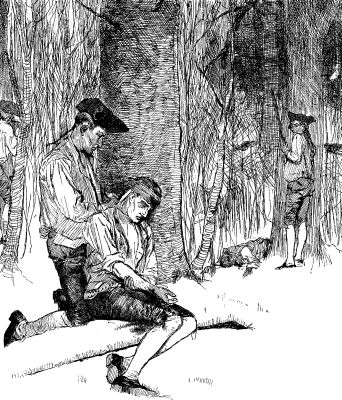
CUTTING OFF A QUEUE TO BIND A WOUND.
The fight goes on, the Rangers taking sure aim, the French firing more wildly, but still one by one the Rangers drop. Captain Spikeman and Mr. Baker are killed. A bullet strikes the lock of Stark's gun, and renders it useless. He sees a Frenchman fall at the instant, springs forward, seizes his gun, returns to his tree, and renews the fight.
A bullet tears through Rogers's wrist, and the blood spurts out in a stream. It must be stopped, or he will bleed to death. Rogers wears his back hair braided in a queue.
"Take your knife and cut off my queue," he says to one of the Rangers, who whips out his hunting-knife, cuts off the queue, and Rogers sticks it into the wound to stop the flowing of the blood.
All through the dreary afternoon the fight goes on. The snow is crimsoned with blood. The killed and mortally wounded lie where they fall. For the Rangers there is no escape; they must conquer or die.
The shades of night steal on; the fire of the French and Indians has been growing less; the war-whoop dies away; the last gun is fired. The enemy, picking up their wounded, retire to Ticonderoga, leaving the Rangers victors. What a dear-bought victory!—one-half of them killed or wounded. Of the enemy one hundred and sixteen have fallen!
The Rangers were only four miles from Ticonderoga, and might expect to be attacked again in the morning. They were forty miles from Fort William Henry. They were weary and worn, but they must move on. They made litters for the wounded, and started, marching all night, but making only a few miles.
The snow had ceased, the air was chill. They must have help. John Stark, leaving them, started for Fort William Henry, reaching it at sunset. Soldiers with horses and sleds started at once, and John Stark with them, stopping not a moment to rest his weary limbs. At sunrise he was back to the Rangers with the re-enforcements and supplies. The French had not followed them, and they made their way safely back to Fort William Henry, having fought one of the most obstinate, unequal, yet victorious battles recorded in history.