"THEIR GIRL."
Reading edition
A STORY IN THREE CHAPTERS.
BY JAMES OTIS,
Author of "Toby Tyler," "Tim and Tip," "Mr. Stubbs's Brother," etc.
II.
Business, so far as Johnny and Jimmy were concerned, was almost entirely neglected for two weeks after Katy was carried to the hospital. If they sold any papers, it was only sufficient to pay Mother Brown for their board, and nearly all their time was spent in remaining where they could look at the gloomy walls of the building in which Katy yet remained.
Some of their friends in the newspaper business had attempted to make sport of them for spending so much of their time simply looking at the walls of a hospital; but the light in Johnny's eyes had warned them to stop, and Jimmy had said, quietly, "We stay round here 'cause it would make Katy feel good if she knew it."
Fully repaid for the long hours of watching by the knowledge that their being there would please their friend if she could know it, the two remained day after day, and far into each night, until the time came when they were actually startled by the news that in another week, if nothing happened to her, Katy would leave the hospital.
This good news came to them so suddenly that they were almost as stupefied as they had been when the accident happened; but when they did fully realize all the happiness contained in that announcement, they gave vent to their joy in such extravagant antics that the old porter, who chanced to see them, declared it to be his solemn belief that they were "a couple of ijuts."
"Now what'll we do to show Katy how glad we are?" asked Johnny, when, breathless from the severe exercise, they seated themselves on the curb-stone to talk the matter over. "We've got to do somethin', you know, an' what shall it be?"
Jimmy rubbed his chin vigorously, as if to call forth his most brilliant ideas, and after an unusually long pause, replied, "I'll tell you jest what we'll do: we'll scurry 'round an' get money enough to buy her one of the stunnin'est dresses we can find, an' we'll carry it up to her the day before she comes out."
It certainly seemed as if that idea was an inspiration, and Johnny was so anxious to carry it into execution that he urged his friend along, on the way down town to purchase a stock of papers, at the most furious rate of speed.
They were not just certain how much money would be required to carry out their plan, but when they had gotten together a fund of two dollars and sixty cents, they were certain they could purchase almost any dress that was displayed in the shop windows, and have enough left not only to buy bracelets, but anything else in the jewelry line that they might chance to fancy.
THE BOYS TRYING TO SELECT A DRESS FOR KATY.
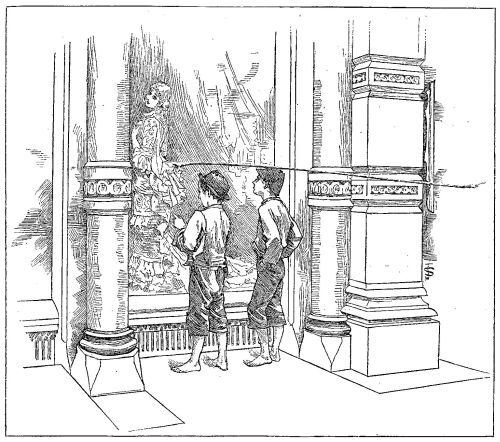
During one entire forenoon they went from one to another of the largest stores in the city, peering in at the windows at the ready-made dresses displayed, and not quite able to make up their minds which to choose. The greater number of the garments appeared to be too large, while none of them were quite bright enough in colors to suit them exactly.
"I'll tell you what it is," said Jimmy, after he had rubbed his chin harder than usual in front of a delicate party dress of pink and white silk with an enormous train, and had decided that it was not brilliant enough in color to please them, "we'd better go to Bob Spratt's mother, an' get her to come out with us to buy it. She'd know best what Katy'd like."
"I'm afraid that's what we'll have to do," said Johnny, with a sigh, fully convinced of the hopelessness of their succeeding unaided in their task. "I don't see how folks get along that have to buy more'n one dress a year; it must take 'em 'bout all their time pickin' 'em out."
"I s'pose they get kinder used to it, an' know jest what they want," said Jimmy, with an air of wisdom; and then, with just a shade of envy toward those particularly fortunate people who know exactly what to purchase, the newspaper merchant walked resolutely away from the party-dress which he was convinced was not beautiful enough for Katy to wear while selling pins on the street.
Mrs. Spratt was found, according to her way of expressing it, at her old established place of business, on the corner of Vesey Street, where she drove a flourishing trade in jackknives, candy, and other such necessary articles.
Never before had either of them doubted Mrs. Spratt's wisdom and superior judgment; but when she boldly declared that a silk dress could not be purchased for two dollars and sixty cents, they began to have suspicions that she was not the wise woman they had always believed her to be. Those suspicions became a certainty when she added that even if they could afford to buy such dresses as they had seen, they would not be suitable for Katy to wear while plying her trade on the street.
It was not until after they had withdrawn to a convenient distance, and there discussed the question of Mrs. Spratt's mental condition for fully ten minutes, that they finally decided to ask her just what she thought would be suitable for a dress for Katy, and within their means.
Even if Mrs. Spratt was not altogether right in her mind, and even if she did have ridiculous ideas regarding color, she spoke just as if she believed what she said when she told the boys that they could buy some pretty, plain material, sufficient for a dress for Katy, for about a dollar and a quarter, while with another dollar they could hire Mrs. Isaacs to make it for them in the latest style.
Several more strictly private consultations between the partners were necessary before they could make up their minds to trust to Mrs. Spratt's taste and honesty in buying the dress, and then they placed the entire matter in her hands, she generously offering to purchase the goods that very afternoon, providing they would care for her stand while she was away.
The boys had plenty of time in which to discuss the matter in all its bearings while Mrs. Spratt was attending to the important business. It was with deep sorrow that they admitted to each other that if the dress was to cost two dollars and a quarter, it would be almost impossible for them to buy any very large bracelets with the remaining thirty-five cents.
It was a disappointment that caused Jimmy to rub his chin until it was very red; but he bore up under the sorrow like a philosopher, his active mind presenting another plan that seemed quite as brilliant as the first.
"Johnny!" he cried, as he started up suddenly, at great danger of overturning Mrs. Spratt's rather frail "old established place of business."
"Wot?" asked Master Davis, moodily, for the impossibility of buying the bracelets weighed heavily on his mind.
"Why can't we earn a little more money, an' the day Katy comes out of the hospital, take her somewheres for a good time, jest like reg'lar folks do?"
"Cricky!" exclaimed Johnny; and by that expressive word Jimmy knew that he was impressed with the idea.
"I know a feller what carries 'round nuts an' candy on one of the Coney Island boats, an' jest as likely as not he could fix it for us so we could go down for half price. How Katy's eyes would stick out when she got down there! Why, she'd jest roll over in the sand, she'd be so tickled."
"Then good-by dress," said Johnny, feeling actually relieved that he had been able to find some fault with Jimmy's plan, for he was almost jealous of his partner's active brain.
"Well, of course I don't mean that she would really roll over if she had the dress on," said Jimmy, quickly, conscious that he had colored his picture a trifle too high, "but I mean she'd feel good enough to do it."
"When could we find that feller on the steamboat?" asked Johnny, anxious to settle all the details of this very brilliant scheme at once.
"I guess we'd see him if we went down on the pier an' waited till his boat come in."
"Then we'll go jest as soon as Mrs. Spratt comes back."
Johnny was not hindered very long by the absence of the owner of the stand, for in a few moments afterward she returned, flushed and heated by her unusual exertion, but wearing a triumphant look.
"I bought it," she said, as she tried unsuccessfully to fan herself with one of her largest combs, "an' I thought I'd save time by carryin' it right over to Mrs. Isaacs. But I brought a piece to show you what it is like," she added, quickly, as she saw a look of disappointment come over the boys' faces.
The goods was not exactly what they would have chosen, for it seemed much too sober in color, and not "shiny enough," as Jimmy said; but it was a soft, rather thin piece of blue material, which would make a very becoming dress for "their girl."
"I got it for twelve cents a yard," said Mrs. Spratt, in a tone of triumph, "an' I made the man throw in as much as ten inches extra, which will give her a good dress pattern. Then I bought the buttons an' the trimmings for twenty cents more, an' Mrs. Isaacs will find the thread, an' make it for a dollar. It'll be as handsome a dress as you could get anywhere for two dollars an' forty cents, an' a good deal better than Katy ever had before."
Mrs. Isaacs had promised to have the garment ready the day before Katy was to come from the hospital, and this most important business having been attended to, the boys started out in search of their friend the employé on the Coney Island boat.
The steamer which Ikey Moses graced with his presence and particularly valuable services was not at the pier when the boys arrived there; but what did two or three hours of waiting amount to when such an end was to be gained? Absolutely nothing, so they thought, as they loitered around the dock until, two hours later, the steamer arrived.
Ikey was on board, and in particularly good humor, having made twenty cents extra that day on a private speculation in sassafras bark. And being intrusted with his friends' secret, after he had solemnly crossed his throat never to divulge it, he made of the question of getting tickets at half price a very simple matter. In fact, he was quite certain he could get tickets for nothing, and he promised to use all his great influence in their behalf, providing they would pay him ten cents in case he was successful.
As may be imagined, the boys readily agreed to do this, and Johnny even generously promised that in case Ikey succeeded, they would give him all their custom on the passage. This latter consideration was not a weighty one with Master Moses, for, since his employer was the only one who had eatables to sell on the boat, and since he was the only clerk, the boys would be obliged to deal with him or go hungry.
All the details having thus been arranged, it only remained for the boys to work industriously to procure the necessary funds.
Business was not remarkably good during the four days that intervened before Katy's time in the hospital had expired; but they made enough to pay Mother Brown for their board, and then have a cash capital of one dollar on hand.
Ikey had succeeded in getting for them free passes, and they had paid him the amount agreed upon. The dress had been finished, and on the evening before Katy was to leave the hospital they carried it up to be sent in to her, in order, as Jimmy said, "that they might jest knock her eye out before she was stunned by the idea of the excursion."
"Tell her Jim an' John sent it in to her," said the latter, as he handed the bundle to the porter, "an' that we want her to be all ready when we come up here for her at nine o'clock to-morrow mornin'."
"That'll fix her," said Jimmy, triumphantly, as they left the hospital; and during the remainder of that evening they enjoyed in anticipation the royal time they were to have next day when they took "their girl" on her first excursion.
[to be continued.]
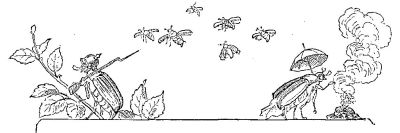
With gun upon his shoulder, Sir Beetle hunting goes,
There is nothing in the larder, for a dreadful wind arose;
It blew their cottage over, and the rain began to beat,
They couldn't find their overshoes, or anything to eat.
But Mrs. Beetle's thankful that after such a storm
She has still a silk umbrella, and a fire to keep her warm.
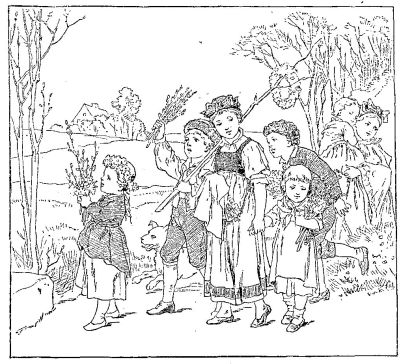
Back from the forest we're bringing our sheaves—
Armfuls of posies and bright Autumn leaves;
Happy are we, though the chill wind may blow,
The herald of Winter in garments of snow.
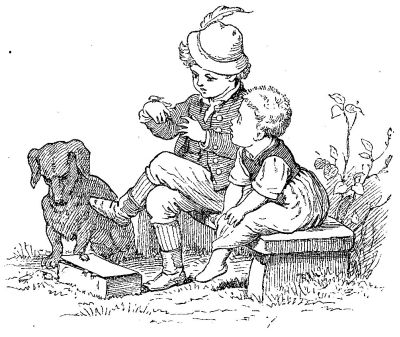
Oh, what a host of playmates has little Johnny Grey!
He says that Puss and Rover know everything we say;
And that the birds and squirrels always understand;
So he's talking to the beetle that is crawling on his hand.
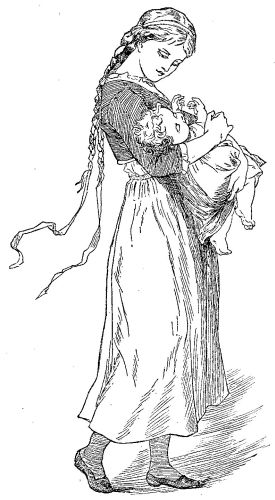
Mamma must work the long, long day,
While I have lessons to learn and say;
But Baby Blue Eyes, so bright and gay,
Has nothing to do but laugh and play,
Till the Sand Man works his wonderful charms,
When he goes to sleep in somebody's arms.
Many of you will be very glad to hear again from Mrs. Richardson, whose work among the poor people at Lincolnton has interested you very much. For the information of new subscribers we will state that this lady has, for several years, been trying to make the lives of the colored people around her brighter and happier.
She began by teaching the children of Uncle Pete, her faithful friend and servant, and once her slave. At present she is giving religious and other instruction to a great many children and young people, and through her self-denying efforts a little chapel has been built, where they worship on Sundays.
The little readers of Young People have assisted Mrs. Richardson by sending books, toys, and cast-off clothing to her for the use of her protégées:
Woodside (near Lincolnton), North Carolina.
My dear young Friends,—I have not written to you very often lately. The Post-office Box is always so full of interesting letters that I felt that it would be an imposition in me to take up space in it very often. Then, too, there has been nothing very interesting to tell you. The chapel is up (not yet finished, but covered), the floor laid, windows in (they look so pretty!), and the pews made; we can use it, though the door and a good deal of work is yet to be done. The chapel stands in a grove of pines and weeping-oaks. The branches of these oaks droop almost to the ground, and are very graceful and pretty, besides making delightful horses for the children to ride. You all, I guess, know just how far to creep up the limb, and then spring to make it go, and ride delightfully among the branches.
I know you will be glad to know that the school has gone on regularly and well since it first began. The scholars have all improved very much; those who were learning their letters last summer are now using Second Readers. A great number of them are reading in the Testament—very poor reading in many cases, spelling many words, but still we find, with the explanations we give them as we go on, that going through the Gospels they understand a great deal of it. We feel that it must do them good. When they came they did not know anything of prayer; only three knew "Now I lay me." Now they all know that and the Lord's Prayer, almost all the Creed, and the Ten Commandments.
Did I write you—no, I know I have not, for it was only a few weeks ago—that some kind, very kind, persons sent me an organ? I wish they could know and see the pleasure it gives us all. The scholars seem so delighted to sing that last Sunday we let them try chanting a psalm we had been reading, and they learned it very quickly. Then we tried the Creed and the Lord's Prayer to a tune in the choral service; that they did beautifully, all of them, even the tiny children, and all of them (over sixty) singing as with one voice, they naturally made a swell on the Amen that was truly beautiful. They were so happy singing these things over and over with the hymns they know, saying always, "Please, ma'am, one time more!" "Abide with me" they sing very well. "Jerusalem the Golden" is a great favorite too. When we thought we must stop, they begged so just to sing everything over once more that we did it, and found when we came home that we had been three hours at Sunday-school and singing. Two boys, or men, carry the little organ up there, and back again when we are done. We hope to have the door and lock this week.
I would like very much to have a few primers, and also some readers and copy-books and pencils; there are many of them so anxious to learn to write. A few slates were sent—most of them broken a good deal in coming—but their copies and writing get rubbed out, so they do not get on very well with them.
Oh, I do so wish you could be here and see how happy they are in Sunday-school, and in the singing after! My husband says they won't be any happier in paradise than they were last Sunday afternoon. Their black faces were filled with ecstasy, and we were almost as happy, seeing them so delighted. There are three children to be baptized next Sunday, when we will have service and a sermon after Sunday-school.
I find they are counting the weeks already to Christmas. There are some little ones and babies the mothers have to bring, so we shall have to give them something. Presents for seventy! We will do all we can, but can not make a tree for so many unless we have help. Remember, in sending, that things you would not care for will delight them. Clothes you would think worn out will please them, and make them warm and comfortable; ribbons, etc., too much soiled for you to use will please them as well as new; shawls, no matter if old and faded, anything warm, will be of great service; quilt patches, needles, and thread—in fact, anything and everything will be of use in making a tree for them. They all are very, very fond of candy.
One lady will give me some paper to help make cornucopias; that is all the help I know of yet for Christmas. Christmas is yet a long time off to you young people, but when one grows older the weeks just fly away, and Christmas always comes before we get ready for it. We are going to begin the 1st of November practicing the carols for Christmas, and hope they will all have as happy a day as they did last year.
With a heart full of love to you all for the help you have so kindly given me before, and hoping, as the years roll on, I may see some of your dear faces, I am, now and always, gratefully and truly your friend,
Mrs. Richardson.
What does the brook say, flashing its feet Under the lilies' blue brimming bowls, Brightening the shades with its tender song, Cheering all drooping and sorrowful souls? It says not, "Be merry," but deep in the wood Rings back, "Little maiden, be good, be good." What does the wind say, pushing slow sails Over the great troubled path of the sea; Whirling the mill on the breezy height, Shaking the fruit from the orchard tree? It breathes not "Be happy," but sings loud and long, "O bright little maiden, be strong, be strong." What says the river, gliding along To its home on far-off Ocean's breast; Fretted by rushes, hindered by bars, Ever weary, but singing of rest? It says not, "Be bright," but in whisperings grave, "Dear little maiden, be patient, be brave." What do the stars say, keeping their watch Over the slumbers the long lone night, Never closing their bonnie bright eyes, Though great storms blind them, and tempests fright? They say not, "Be splendid," but write on the blue, In clear silver letters, "Maiden, be true."
What a rainy time we have had, to be sure, children! I thought about my little correspondents as the floods fell day after day, and I wondered how those who have long, long walks to school contrived to get there when the bridges were down, and the great trees were torn up by the roots, and the paths, usually dry, were all covered with water.
Some years ago a friend of mine, waking up one morning, was saluted by her cook with the news that the kitchen floor was so wet that she could not prepare the breakfast. The water came over the poor woman's rubber shoes. My friend thought she could manage to boil a cup of coffee and make toast by the fire in the parlor; but later in the day Joe and Frank, her sons, found it great fun to march about the wet kitchen on stilts. They made the fire in the range, and, under Mary's directions, produced omelet, broiled steak, and other things, so that the family did not starve during the rainy day.
If any of you have met with adventures during the freshet, I shall expect to hear all about them.
Lincoln, Nebraska.
School begins next week, and I would like to tell you about my first vacation. In June I went to Indiana to visit my cousins. When I came home I crossed the Mississippi and Missouri rivers for the fourteenth time. In two weeks papa and mamma and I started for Denver. We left Lincoln at noon, and the next morning I saw the mountains for the first time. How strange to see snow in July! We spent a few days in Denver, and then such a wild ride as we had through the mountains to Georgetown, where I can't tell you half of the fun I had. I fed the fish, and had a lovely row on Green Lake. I went one-third of a mile into the Colorado Mine in a little car, then down a shaft 250 feet, in a bucket with a miner, to see the men at work; but I did not buy a mine like the other little "tenderfoot" I read about in Harper's. But it was the most fun to ride on a burro. There were ten children and seven burros, and we had a fine ride on the mountain, and then had our pictures taken. The cutest picture was a burro with four children on his back.
We went to Central over a queer railroad that runs almost up to the town at the foot of the mountain, then makes a loop and runs back a mile on the side of the mountain over the tops of the houses, then turns again and runs into the town—oh, ever so high up! And we went to the Bobtail Mine, and into the mill where they crush the ore and wash the gold out of it. It was very interesting. I had a nice play with a little new friend, Ethel S., whose papa owns lots of mines.
And now I must tell you about our going up Pike's Peak. We left Manitou at seven in the morning on horses, and such a wild, beautiful ride I never had before. We had to go on a narrow path just wide enough for a horse to go, very carefully winding around the mountain-side, and we could hardly ever see to the top, and not to the bottom, it was so far down. The bright little creek that came splashing down through the rocks made the sweetest music that mamma ever heard. The flowers, too, were very bright. When we were near the top, papa let me pass him, and I was the first to get there. Then we had coffee made from the snow-bank near the house. But the going down! So tired we were, we were fit to fall.
And now I am too tired to tell you about the Garden of the Gods, the Cave of the Winds, and the Denver Exposition. I am eight years old.
Joy W.
P. S.—It is twelve miles to the top of Pike's Peak.
I really felt, little Joy, as I read your letter, that some time or other I too must climb those great mountains, and venture into those mines, and maybe even ride on a burro, as, you did. But very likely the burro would not care about carrying even a lady like me, unless, perhaps, I could find the little fellow that had four on his back at once. And what would become of the Post-office Box while I was climbing the steep mountains? For the present I suppose I must be content to view the snow-clad peaks through your bright eyes. Thanks, dear child, for the lovely pressed flowers so prettily arranged.
HOW KID GLOVES ARE MADE.
"Oh, mamma, see how it is raining!" said little Lottie; "and it looks so dark, too, all around, that I fear it will keep on all the afternoon."
"And then we can't go for the new kid gloves you promised us," chimed in Helen. "Won't that be too bad?"
And the two little sisters—Helen, eleven years of age, and Lottie, nine—were quite disposed to pout and feel very ill-humored at the prospect of a rainy Saturday afternoon, and the consequent postponement of their anticipated walk for the purpose of purchasing two pairs of new kid gloves.
Mamma smiled at them. "Now, little folks, although you take so much pleasure in having and wearing kid gloves, I am sure you do not often think how many nice and careful operations these gloves have to go through, and how many hands are employed in their manufacture, before they can be put in the stores for sale. If you will sit down contentedly by me, with your cork-work or knitting, I will tell you, while I sew, much that is interesting about kid gloves, so that we can make this disappointment of a rainy afternoon as instructive and profitable as possible.
"Well, to begin, then, the materials used in making a kid glove are either the skins of kids from six weeks to three months old, or the skins of the little lambs of about the same age; but those of the kid make the finest glove, while for a cheaper and of course poorer article the skins of sheep even quite full grown are used. The first thing to be done with the skins freshly stripped from the animal is called 'towing'—to get the hair or wool off; the best and easiest way is to put the skins in a mixture of lime-water, very strong, where they must remain for some time, after which they are taken out and placed in running water, to remove all the lime, and then with a blunt kind of scraper the hair is carefully removed. This last process has to be repeated two or three times, until every hair, and every particle of flesh which may stick to the fleshy side of the skin, is removed. Then the skins are placed in a mixture (or the 'pudding,' as it is sometimes called) of yolks of fresh eggs, well beaten, with fine white flour, alum, salt, and carefully filtered water, and are left in this compound for some weeks, or about thirty or forty days, until they absorb or take up as much of this mixture as they can contain. When the skins are taken from this bath they are white and very elastic and soft, and are now ready for the dyer.
"The dyeing of kid gloves requires very skillful workers, and a very fine eye for the making of all the different and varied shades of color. The coloring matter is put on each and every skin separately with a brush, each needing from one to four applications of the dye, according to the shade desired. But the light or so-called evening gloves do not need quite so much care, as frequently two hundred or more skins can be put into the vat of dye, which will soak through every particle of the skin. Then they are well dried in a large room or space, where the heat must be at least 180 degrees of our ordinary thermometer.
"And now the cutter begins his task of cutting the skins into square pieces of a certain size, which must be done very carefully, as all gloves have to be cut with the grain of the skin, to run from the head downward, and a great deal of the skin would, of course, be wasted if any but very skillful hands were employed. One fine skin will generally cut about three or four gloves, according to the size required, and often large sheep-skins turn out nine or ten gloves, but of a much poorer quality. After the squares are cut they are put up in packages of from six to twelve pairs of gloves, and by the use of a sharp punch and a very heavy press are cut out in all the different-shaped pieces required for the entire glove, usually from about twenty to twenty-three pieces. Then comes the sewing, which for all the best gloves is done entirely by hand, and requires the best of needlewomen, as over six thousand stitches are needed to sew a pair of ordinary-sized ladies' gloves.
"Within a short time a machine has been put in use for sewing gloves, but even with this, which can only be used satisfactorily on low-grade gloves, not over a dozen pairs can be sewed in a day. Then putting on the buttons or hooks, dressing, and packing or assorting in numbers, colors, and sizes, passes the gloves through many more hands, until at last, after careful inspection of a skilled foreman, they are placed on sale, and forwarded to their many destinations."
"Thank you, dear mamma, thank you," cried both the children in a breath. "But where does all this take place?"
"Principally," answered mamma, "in France, Germany, and Italy, although some nice but heavy gloves come also from England; and here in our own country we are now beginning to manufacture some gloves which compare quite well with the imported, and as we in America generally succeed in all our undertakings, I think we shall soon be able to make first-class kid gloves."
M. E. M.
The two following letters are from a little sister and brother, Americans, who are studying music and French in beautiful Paris:
Paris, France.
We are always so glad to get Harper's Young People. Papa sends it to my largest brother. I have a little brother with long curls. Sometimes he is taken for a girl, but he don't mind it. We have a picture of Mozart with long curls. We have five canaries. We had more, but sent three to papa, and we all sent a kiss by them to papa. They were so tame they would eat sugar out of my mouth. I have a big dollie; I call her Daisy; she is very lovely, and can put her arm around my neck. We go to school here in Paris, and like it very much, but not so much as I liked my school in Germany. I wore the blue ribbon for six months last session in school for getting the highest mark in music. We have vacation now. My large brother got a prize in drawing. He liked the piece in Harper's Young People about Michael Angelo. We go out in the country with him sometimes when he goes to paint, and we play while he is sketching. We went to St. Cloud a few days ago, and had a nice time. We go to Park Monceaux nearly every day with the girl and play, but it is not so nice as in the country. I like to read the letters written by the little girls that live in the country. I can not write a very good English letter, but I hope you will print it. I can write French, and some German. I am coming back to America next year, and will be glad to go to school again, but I suppose I will have to study very hard. My cousin Blanche went home to America last month in the big steamer Servia.
Annie L. D.
Paris, France.
I send you a little Wiggle picture. I like the story of "Mr. Stubbs's Brother" very much. My little mother bird died after she had laid a little nest full of eggs three times, but only six of the little birdies lived. We buried our little birdie in Park Monceaux. I think she died because she was sorry we sent her three little birdies to papa. When my school closed I got a prize in arithmetic and conduct; it was a nice story-book. My sister read it to me. She can read French better than I, but I understand all the little story. I have a little violin, but I can't play much yet. I am tired now, as I have written a letter to my big brother to-day.
Robbie Lee D.
Buffalo, New York.
I am a little boy four years old. My name is Clifford, but when any one calls me, they say Chippy. I have two brothers and a sister Bessie. We have a mamma kitty that is ours, and she has a family of six kittycats. She takes five of them away every evening, and leaves one there. We don't know where she goes to, but she comes back to get ready to go again. She pays no attention to the one she leaves. We are all good little boys, I and my brothers; never play in the dirt to get ourselves dirty, and yet we are never clean. We try awfully hard. Do you know why? We play circus in the barn. There are no horses there. We jump over the barrels and in the barrels, pull on a long rope, and do lots of tricks. Our grandma made us a clown's suit. She took white cloth, and cut out big flowers and animals out of some more cloth, then took some flour and water and pasted and sewed them all on the white cloth. It covers us over; and we have a big cap just like it. We have a circus, when the people will come; the people are Clinton and Emma and Winnie. My mamma sent me to Sunday-school to-day, but I did not get my Golden Text. All the other children said theirs, but I know a nice one that my auntie sent me in a little letter, "Little children, love one another." I like to say that every time; then I don't have to learn another. Please hurry up and put this into a little paper, so I can see how it looks. My mamma is writing this for me; but I can write, but nobody can read it, so I guess you couldn't, for I make little lines all over, and then put little round marks all over. I knew you wanted to hear from me, because I wanted to write to you; and mamma reads the little letters to me out of your nice paper every Sunday afternoon.
Chippy H.
I know another little man about your age whose name is Clifford, and what do you think they call him? Tupper. He gave himself this name when he was learning to talk. Chippy is a very pretty pet name for a boy. I would like to go to your circus, but, dear, if I were your Sunday-school teacher, I think I would coax such a big and clever boy as you to learn the Golden Text every week. Don't you think you can do so if you try?
A dear child who lives in Titusville, Pennsylvania, incloses a verse which she made up herself about her dog Bruno. Here it is:
One Sunday morn the sky was blue,
August the first, in Eighty-two,
A little dog, both round and fat,
Was brought to us, small as a rat.
Old mother Gyp, so proud and wise,
Smiled upon it with loving eyes.
The dog is mine; I named it Bruno;
But mother said to name it Uno.
I said, "Oh no," and got my ball.
The dog is mine; and that is all.
Minnie J. B.
Here is another bit of rhyme from a little girl whose home is in Berryville, but who forgot to tell her State. Her verse is so droll that we will excuse her for that, however:
Johnny Gray went astray;
It was on a summer's day;
He went so far, he met a car.
And in it was his own papa.
Papa jumped out, and John did pout,
Because he wished to go for trout.
This is the end, you may depend,
Of Johnny Gray, who went astray
Upon a lovely summer's day.
Lizzie S. S.
Westport, California.
I have not written in a long time, because I wrote you two letters once before, and did not see either of them in the Post-office Box, and I thought I would wait a good while, and then perhaps you would have room for me. I like all the little letters so much! Especially I like to hear of all the pets each one has. It seems that I have had bad luck with all my pets. I had a pretty pony (her name was Daisy), and papa had me a nice saddle made to order in San Francisco, and I was very fond of horseback riding; but one night my dear Daisy was taken out of the field and stolen, and I never expect to see her more. The next pet I had was a pretty canary-bird, a present from my brother, with a new cage. I named him Dicky. One morning I was cleaning the cage, and he flew away just as I was putting the top on it. Oh, how badly I felt! But one of my school-mates caught me a wild bird, and I had it in the cage for some time; but it did not sing, and so I let it go.
I have no playmates near me, and I am often very lonesome. How I should enjoy playing with the dear little girls who write to you! I have one brother older than I am; he is away at school. It is called the Boys' Home School, in San Mateo, twenty miles from San Francisco. My brother is twelve years of age, and reads in the Fifth Reader. I am nine, and read in the Fourth Reader. I am piecing up a bed quilt for my bed, and hope to finish it before I am ten years old, which will be in January. The name of it is Lincoln's Platform.
Etta M.
South Haven, Michigan.
I wrote a letter to Young People some time ago, and it wasn't printed, so I thought I would try again. I go to school now, and study reading, writing, grammar, arithmetic, geography, and spelling! I picked raspberries for papa this summer for two cents a quart, and blackberries for one and a half cents a quart, and got two dollars and ninety-two cents for all. We live on the bank of Lake Michigan. My two cousins from Iowa are here now; they are the only cousins I have. We have had a nice time. We make houses on the beach in the sand, and go in bathing. We had four cats, and yesterday morning we found one of them dead. My sister felt very badly about it; she cried like everything. We think the kitten had fits. I like the story of the "Cruise of the Canoe Club."
Myrta R.
You were a very industrious girl to earn so much money. It was a great pity about the poor kitty. You see that Etta M., like yourself, has written before, and has had to wait a good while before finding her niche in the Post-office Box.
No little letter-writer must feel discouraged at delay in the publication of a letter. Even if we can not print a letter, we are glad to read it, and many loving thoughts are sent away to dear boys and girls whose words are read only by the Post-mistress.
Morristown, New Jersey.
I have taken your nice paper since the first number, and have never written to you yet. I rode on the locomotive of an express train for the first time the other day. It was splendid, but I got shaken up a good deal. I sat three seats ahead of President Garfield in church at Long Branch the Sunday before he was shot. He looked like such a good man it was a shame he was shot. There is an old house here which General Washington had as his head-quarters during the winter of 1780-81. I have been through it a great many times, and my father (who is a clergyman) showed me the room which an old lady parishioner of his, who has been dead over twenty years, had when General Washington was occupying the house. She was his housekeeper, and papa was told about his life here. I would like to have known her; would not you? I am afraid my letter is too long.
Alexander R.
I have been in Washington's Head-quarters at Morristown, and felt, when there, how much we owe as a nation to that great and good man, "first in war, first in peace, and first in the hearts of his countrymen."
PUZZLES FROM YOUNG CONTRIBUTORS.
No. 1.
THREE DIAMONDS—(To Count No Account).
1.—1. A consonant. 2. A large cask. 3. Purport. 4. An insane person. 5. Celebrated. 6. Freed. 7. A letter.
Eureka.
2.—1. A letter. 2. Pulp. 3. Furnished with panes. 4. A porter. 5. Small. 6. A point. 7. A letter.
Junebug.
3.—1. A letter. 2. To bite. 3. One of the African race. 4. Penurious. 5. To chatter. 6. Mineral in the crude state. 7. A letter.
Junebug.
No. 2.
THREE EASY WORD SQUARES (To Christine and Gretchen).
1.—1. More than one. 2. Married. 3. A poem.
2.—1. Not old. 2. A sheep. 3. A protuberance.
3.—1. A covering. 2. Fear. 3. A number.
Walter P. K.
No. 3.
NUMERICAL ENIGMA.
I am composed of 8 letters.
My 3, 4, 5, is a creature without a friend.
My 5, 2, 7 is a favorite game with boys and girls.
My 3, 8, 7, 1 is made into paper.
My 7, 6, 2, 5 knows how to climb.
My whole is a famous watering-place.
Charles De G.
ANSWERS TO PUZZLES IN No. 151.
No. 1.
Sphynx.
No. 2.
P
PA
PAN
PANT
No. 3.
Edisto. Gila. Neuse. Yazoo. Rhone. Don. Racket. Po. Orange. Duna. Lena. Obi. Mobile. Amos. Dwina. Loire. Thames. Pitchora. Tiber. Indus. Madeira. Pearl. Ural. Nile. Flint. Elbe. Intysh.
No. 4.
Hot, rope, lot, pot, port, hope, trip, leper, hop. Heliotrope.
Answer to Bishop of Oxford's Puzzle—1. Eyelids. 2. Knee-caps. 3. Drums (of the ears). 4. Feet. 5. Nails. 6. Soles (of the feet). 7. Mussels (muscles). 8. Palms. 9. Tulips (two lips). 10. Ears (of corn). 11. Calves. 12. Hairs (hares). 13. Hart (heart). 14. Lashes. 15. Arms. 16. Vanes (veins). 17. In(n)step. 18. Ayes and Noes (eyes and nose). 19. Two pupils and ten dons. 20. Chest. 21. Temples. 22. Gum. 23. Iris (the rainbow). 24. Crown. 25. Palette (palate). 26. Scull (skull). 27. Bridge. 28. Shoulder-blades. 29. Teeth (of a saw). 30. Elbows. 31. Locks.
The answer to the Great Peach Puzzle on page 752 of No. 151 is as follows: The morning rate was 7 peaches for 1 cent; the afternoon, 3 cents for 1 peach: each boy received 10 cents. Jack sold 7 peaches for 1 cent and 3 peaches at 3 cents each—10 cents; Tom sold 28 peaches at 7 for 1 cent and 2 peaches at 3 cents each—10 cents; Ned sold 49 peaches at 7 for 1 cent and 1 peach at 3 cents—10 cents.
Correct answers to puzzles have been received from Walter P. Knight, Harry Johnston, Effie May, Edith Ames, John Jackson, Elsie Hopgood, Charles Mark Ellis, "Junebug," Jessie P. and Mamie Hull, M. W. A., Hammond Tubman, Tiny Rhodes, Bertie Walters, Susan Chase, William Van Duser, Oliver Thompson, Benny Close, Frederick Lansing, Andrew Ward, "Fuss and Feathers," Alice Fleming, Amy Leslie, "Fanchon," "Little Buttercup," "Eureka," Flo Hanington, May Hanington, Grace P. Ford, Robin Dyke, A. L. Taylor, and Alonzo L. Gibbs.
[For Exchanges, see 2d and 3d pages of cover.]
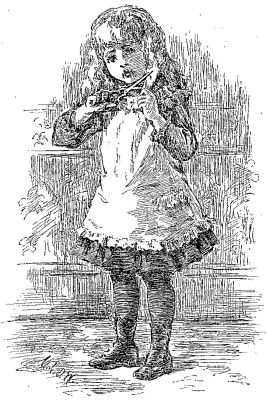
"I WONDER IF THE BLOOD WILL RUN?"
THE GAME OF HISTORIC CHARACTERS.
BY C. W. FISHER.
The game known by the above title is somewhat uncommon, and has afforded so much enjoyment to children of an older growth that it can not fail to entertain our young friends.
It is a round-table game, and may be played by any number of persons. A watch, slate, and pencil are all the materials required.
One of the players, who is called the leader, selects the name of some historical personage, and writes upon the slate several of the letters forming it, in the order in which they occur.
The slate is then passed to the next player, who is allowed two minutes to form some idea of the name chosen, and to write a single letter either before or after those already upon the slate. If the letter so added be the right one, the leader announces it correct, and the slate is passed to No. 3. If, on the contrary, it is wrong, he calls it a miss, passing the slate, as before, to the following player, but at the same time placing to No. 2's credit, or rather discredit, in his score, a mark to indicate the failure.
No. 3, who has had the advantage of studying the word during No. 2's allotted time, now takes his turn, scoring or missing, as the case may be; and so on around the table, only the misses being marked.
The leader is of course the judge of the correctness of the additions, and must act as time-keeper and scorer as well. Capitals are never used, and the period with which the word ends is regarded as a letter, with the difference, however, that all subsequent additions must be prefixed.
Suppose, for example, that the leader, having in his mind Sir Walter Raleigh, writes upon his slate the letters eig. No. 2, at the end of his time, finds no clew to the word, takes a miss, and No. 3 tries his hand. A happy thought strikes him: he adds an l, which is pronounced correct; and No. 4 finds himself confronted with leig, and with a thought perhaps of Lord Burleigh, boldly prefixes an r. His brilliancy is rewarded with a demerit mark, and so the game goes on, until, when the letters have grown to aleigh, the period is added, and almost any one can easily guess the rest. The game is won by the player who at the end of the sitting has the cleanest score. When one word has been discovered, the second player becomes the leader, and after him the others in turn.
No letters should be added at random even should they prove correct, and any player having reason to suspect that this has been done may demand the word of the person preceding him. If the latter can give any historic name in which the letters occur as then written upon the slate, even if it is not the leader's word, the person so calling is counted a miss, and the player giving the name chooses anew. If, on the other hand, he fail to do so, the miss is scored against his account, and the game proceeds as before.
As it frequently happens that the same series of letters is to be found in several or many words, one is very apt to get off the track, and the results are confusing and amusing. The want of capitals also makes even a completed word look so strange that all of a party have been confounded by it until the leader, in his turn, added the lacking period, and the disgust of his companions may be easily imagined. The game may be pleasantly varied by using noted names in poetry or fiction, authors, and the like, but it is well to confine it, during one sitting at least, to a particular class.
All disputes—and there will be many—as to whether a name can properly be called historical or not, and similar questions, must be decided by a majority of the players.
The game gives excellent opportunity for the exercise of observation and quickness, and leads to discussions and researches which prove as instructive as they are entertaining.
GREEDY JERRY.
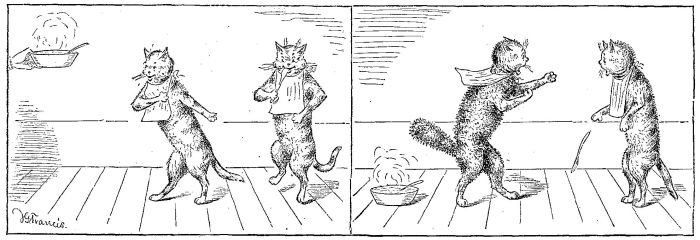
"Chowder? Why, bless your kindly heart, there's nothing so delicious; 'Twould keep the very wildest cat from being cross or vicious. Of all things you could offer us at morning, noon, or night, ma'am, There isn't any other dish would give us such delight, ma'am." Thus to his mistress Tom did speak, then raised his sweet voice louder: "Jerry, you most ungrateful cat, come thank the dame for chowder." But greedy Jerry, full of glee, would never mind his brother; He sucked his spoon, and danced about on one foot and the other; He grinned and gasped and giggled out, and couldn't wait a minute, He wanted so to seize the dish, and get at what was in it; Which made his brother rage and rave, while, better bred and prouder, He bowed and scraped, and blandly smiled, and thanked the dame for chowder. Alas for evil-doers all, on two feet or on four feet, Or even if, like centipedes, they've twice as many more feet! No sooner were they left alone than, without judge or jury, Tom flew at greedy Jerry's throat, and beat him like a fury. Then, while the blows and caterwauls came ringing loud and louder, Oh, didn't greedy Jerry wish he'd thanked the dame for chowder! M. E. B.