CLIMBING PLANTS.
Reading edition
BY MRS. S. B. HERRICK.
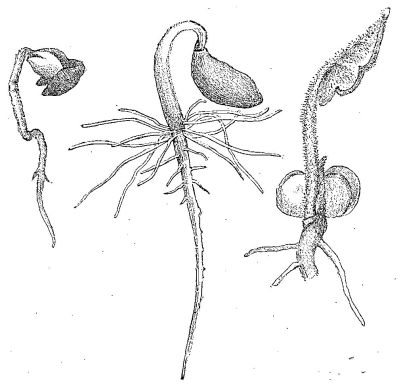
Fig. 1.—The Bean. First Leaves in different Stages.
Have you never wondered, when you looked at a tangle of grape-vine or morning-glory stems, how they came to twist themselves together so? Perhaps you had some sort of a notion that they got tangled up as a bunch of silk or a skein of worsted lying loose might do. Examine any vine which you can find growing near you, and see how different the tangle is from a snarl of thread, there is a regular twist, the branches coiling in the same direction. In some plants the turn is from right to left, in others from left to right.
There must, of course, be some reason for this, and we can best find it out by taking a young plant, a seedling, and watching what it does from the start.
It would be very natural to think that plants moved only as stones do, because something pulled or pushed them; but this would not be a true conclusion. Every plant that we know much about is firmly fastened by its root in the ground; the movements of its leaves and flowers seem only caused by the blowing of the wind or the beating of the rain. But though plants are anchored fast to the earth, they are all the while moving as they grow.
Fig. 2.—Movement of Root of Black Bean. A, Position at nine o'clock. B, Position half an hour later.
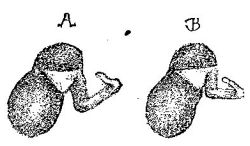
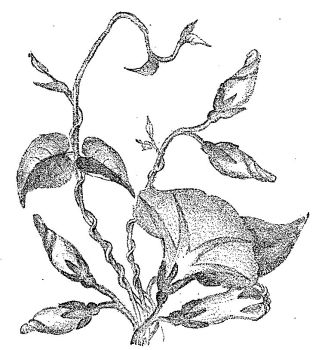
Take some seed—beans will do—and after soaking them, plant them in the ground about two inches deep. In a week or ten days you will see the earth cracked all about. This is not because the growing plant acts like a wedge and splits the earth open, but because in growing the first little leaves move round and round, boring their way out of the ground very much as a corkscrew works its way into a cork. The first leaves of most plants—a bean, for instance—do not come straight up out of the seed; but when the seed coat bursts from the swelling of the inner part a little arch projects, which raises itself up. This arch is the stem, and after a while the leaves are pulled out of the sheath, and the arch widens out, and finally straightens up. You have often seen a man who had a heavy weight to lift bow himself over and receive the weight, and then lift it by straightening himself, as the stem does to lift the leaves (Fig. 1, first leaves). The root burrows into the earth in very much the same way as the stem revolves, by going around and around as it grows (Fig. 2). Take a morning-glory vine, and let it lie without any wire or trellis to catch hold of. After a while you will find the stems and tendrils coiled round each other in a tight twist (Fig. 3); you could not begin to twist them so tightly yourself without breaking the stem.
Fig. 3.—Morning-Glories.
The tips of all growing plants, like the first leaves that pierce the ground, move around; they are forever weaving their magic circles in the air; they take many hours sometimes to make a single turn, but they are as regular as the hands of a clock, and never forget and go backward. I have been watching some wistaria branches lately, and have been very much interested to see the new shoots, as they grew rapidly in the soft warm air, taking a slow turn around the wire placed to support them very much as you might wrap your arm about a swing rope to take a better hold. If there is a post or a wire near, you do not have to give your vines the twist they need to climb; they do their own twisting as they grow, and always in this quiet, deliberate way.
Fig. 4.—Virginia Creeper.
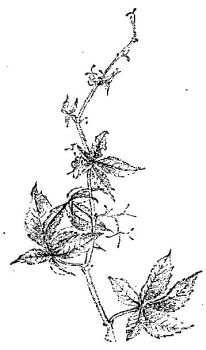
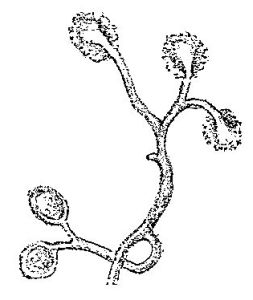
You have no doubt noticed that a Virginia creeper does not need a wire to climb by; it grows beautifully up any wall which has little unevennesses. Now look, if you can get hold of a new shoot, what the creeper has to help it along. It sends out tendrils that branch into many ends, and each one of these ends swells and becomes a sort of sticky pad, which glues itself to the wall (Fig. 4). These little pads, when they find no wall to fasten themselves upon, remain small, and finally wither away. Those on the vine in Fig. 4, which was trailing from a vine, are so, some small and some quite gone; but look at the pads in Fig. 5, which were detached from a painted board, and see how they look through the microscope. Very much like a boy's India rubber sucker, are not they? Some of these have the paint from the board still sticking fast on them. Others are all sparkling with the dried mucilage, which makes them look as if they had been sprinkled with sugar.
These little many-armed suckers give the plant a firm hold, while its head waves around until it touches some surface again, and again the pads lay hold for another upward stretch.
Fig. 5.—Pads through the Microscope.
There must be some curious arrangement by which plants, that can not feel and will as animals do, can move. They have no brains to think with, no nerves to feel with; it is strange to believe that they really do move with a reason. Mr. Darwin has examined the subject so closely that he has taken nearly six hundred good-sized pages to tell all he has found out about it. His ways of finding out are many. One method is this: he takes a small stiff bristle and glues it on the growing part of a shoot. By watching this shoot and comparing it with other shoots which had no bristle attached, he could not detect any difference in the movements. Above the little branch with the bristle attached he placed a piece of glass that had been smoked, so that the bristle, as it moved with the movement of the tip, would travel over the glass. He did not need to stand by and watch the branch; he could go away and attend to anything he chose, and when he came back there on the glass was a history of the travels the shoot had made, written by itself. He managed to hang up a sprouting bean or pea so that the root recorded its own movements in the same way. There were other ways which he used, all of them being ingenious, and requiring the greatest attention to get a correct map of their movements. He found that every plant in growing moved around as well as upward, but that some moved far more than others; the ones that grew tall and slender and needed support would send out shoots that swayed round in bigger and bigger circles until they could reach something to sustain themselves by, or else they would fall in helpless heaps on the ground.
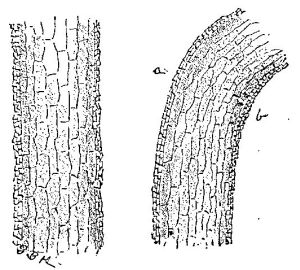
Fig. 6.—Diagram of Straight and Curved Stems. a, Stretched cells; b, crowded cells.
Mr. Darwin was not a man to be satisfied with finding that a thing is so. He never rested until he found just how it came about. I do not mean to say that he was the only man who studied these things, for there were many others who did; but he wrote about what he had studied in such a clear and simple and interesting way that anybody could understand him, and so people who don't pretend to be very wise in such matters read Mr. Darwin's account and nobody's else, and are apt to forget, though he is always careful to mention their names and what they have done, that any one else deserves any of the credit.
By closely studying the little cells of which the leaf or stem is made up, he found that when, for any reason, a plant needed to turn in a certain direction, the water in the stem rushed from the inner to the outer part of the curve, making the cells on the inner side of the stem a little smaller and those on the outer a little larger than usual. After a while the stretching of the outer cells makes them grow and stay larger (see in the figure how it must be, Fig. 6), and so the curve remains. You can not straighten a stem curved in this way without breaking it.
Every movement of stems and leaves comes from the movement of the water that fills their cells. But besides the water, there is something else just as important, and that is the sun. The water is only a servant, which obeys the light as its master. Many flowers turn their bright faces always to the light. They follow the sun as he moves through the heavens all the day long from his rising to his setting. This comes from the effect the sun has on the water in the stem, and not because the flower is beginning to "take notice," as the baby's bright eyes do of a lamp when it is moved about a room, though it does remind one of it.
The movement of climbing plants is only one of many curious movements that are made by stems and roots and leaves and flowers, though the cause is the same in all cases.