MRS. NOVEMBER'S DINNER PARTY.
Reading edition
BY AGNES CARR.
The widow November was very busy indeed this year. What with elections and harvest-homes, her hands were full to overflowing; for she takes great interest in politics, besides being a social body, without whom no apple bee or corn-husking is complete.
Still, worn out as she was, when her thirty sons and daughters clustered round, and begged that they might have their usual family dinner on Thanksgiving-day, she could not find it in her hospitable heart to refuse, and immediately invitations were sent to her eleven brothers and sisters, old Father Time and Mother Year, to come with all their families and celebrate the great American holiday.
Then what a busy time ensued! What a slaughter of unhappy barn-yard families—turkeys, ducks, and chickens! What a chopping of apples and boiling of doughnuts! what a picking of raisins and rolling of pie-crust! until every nook and corner of the immense store-room was stocked with "savory mince and toothsome pumpkin pies," while so great was the confusion that even the stolid red-hued servant, Indian Summer, lost his head, and smoked so continually he always appeared surrounded by a blue mist, as he piled logs upon the great bonfires in the yard, until they lighted up the whole country for miles around.
But at length all was ready; the happy day had come, and all the little Novembers, in their best "bib and tucker," were seated in a row, awaiting the arrival of their uncles, aunts, and cousins, while their mother, in russet-brown silk, trimmed with misty lace, looked them over, straightening Guy Fawkes's collar, tying Thanksgiving's neck ribbon, and settling a dispute between two little presidential candidates as to which should sit at the head of the table.
Soon a merry clashing of bells, blowing of horns, and mingling of voices were heard outside, sleighs and carriages dashed up to the door, and in came, "just in season," Grandpa Time, with Grandma Year leaning on his arm, followed by all their children and grandchildren, and were warmly welcomed by the hostess and her family.
"Oh, how glad I am we could all come to-day!" said Mr. January, in his crisp, clear tones, throwing off his great fur coat, and rushing to the blazing fire. "There is nothing like the happy returns of these days."
"Nothing, indeed," simpered Mrs. February, the poetess. "If I had had time I should have composed some verses for the occasion; but my son Valentine has brought a sugar heart, with a sweet sentiment on it, to his cousin Thanksgiving. I, too, have taken the liberty of bringing a sort of adopted child of mine, young Leap Year, who makes us a visit every four years."
"He is very welcome, I am sure," said Mrs. November, patting Leap Year kindly on the head. "And, Sister March, how have you been since we last met?"
"Oh! we have had the North, South, East, and West Winds all at our house, and they have kept things breezy, I assure you. But I really feared we should not get here to-day; for when we came to dress I found nearly everything we had was lent; so that must account for our shabby appearance."
MRS. NOVEMBER'S GUESTS.
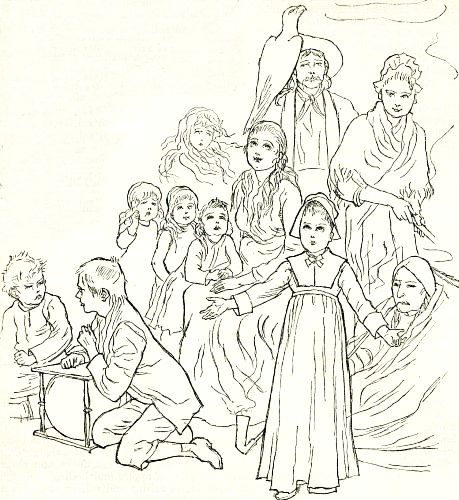
"He! he! he!" tittered little April Fool. "What a sell!" And he shook until the bells on his cap rang; at which his father ceased for a moment showering kisses on his nieces and nephews, and boxed his ears for his rudeness.
"Oh, Aunt May! do tell us a story," clamored the younger children, and dragging her into a corner, she was soon deep in such a moving tale that they were all melted to tears, especially the little Aprils, who cry very easily.
Meanwhile, Mrs. June, assisted by her youngest daughter, a "sweet girl graduate," just from school, was engaged in decking the apartment with roses and lilies and other fragrant flowers that she had brought from her extensive gardens and conservatories, until the room was a perfect bower of sweetness and beauty; while Mr. July draped the walls with flags and banners, lighted the candles, and showed off the tricks of his pet eagle, Yankee Doodle, to the great delight of the little ones.
Madam August, who suffers a great deal with the heat, found a seat on a comfortable sofa, as far from the fire as possible, and waved a huge feather fan back and forth, while her thirty-one boys and girls, led by the two oldest, Holiday and Vacation, ran riot through the long rooms, picking at their aunt June's flowers, and playing all sorts of pranks, regardless of tumbled hair and torn clothes, while they shouted, "Hurrah for fun!" and behaved like a pack of wild colts let loose in a green pasture, until their uncle September called them, together with his own children, into the library, and persuaded them to read some of the books with which the shelves were filled, or play quietly with the game of Authors and the Dissected Maps.
"For," said Mr. September to Mrs. October, "I think Sister August lets her children romp too much. I always like improving games for mine, although I have great trouble to make Equinox toe the line as he should."
"That is because you are a school-master," laughed Mrs. October, shaking her head, adorned with a wreath of gayly tinted leaves; "but where is my baby?"
At that moment a cry was heard without, and Indian Summer came running in to say that little All Hallows had fallen into a tub of water while trying to catch an apple that was floating on top, and Mrs. October, rushing off to the kitchen, returned with her youngest in a very wet and dripping condition, and screaming at the top of his lusty little lungs, and could only be consoled by a handful of chestnuts, which his nurse, Miss Frost, cracked open for him.
The little Novembers meanwhile were having a charming time with their favorite cousins, the Decembers, who were always so gay and jolly, and had such a delightful papa. He came with his pockets stuffed full of toys and sugar-plums, which he drew out from time to time, and gave to his best-loved child, Merry Christmas, to distribute amongst the children, who gathered eagerly around their little cousin, saying,
"Christmas comes but once a year, But when she comes she brings good cheer."
At which Merry laughed gayly, and tossed her golden curls, in which were twined sprays of holly and clusters of brilliant scarlet berries.
At last the great folding-doors were thrown open. Indian Summer announced that dinner was served, and a long procession of old and young being quickly formed, led by Mrs. November and her daughter Thanksgiving, whose birthday it was, they filed into the spacious dining-room, where stood the long table, groaning beneath its weight of good things, while four servants ran continually in and out, bringing more substantials and delicacies to grace the board and please the appetite. Winter staggered beneath great trenchers of meat and poultry, pies and puddings; Spring brought the earliest and freshest vegetables; Summer, the richest creams and ices; while Autumn served the guests with fruit, and poured the sparkling wine.
AT THE DINNER TABLE.
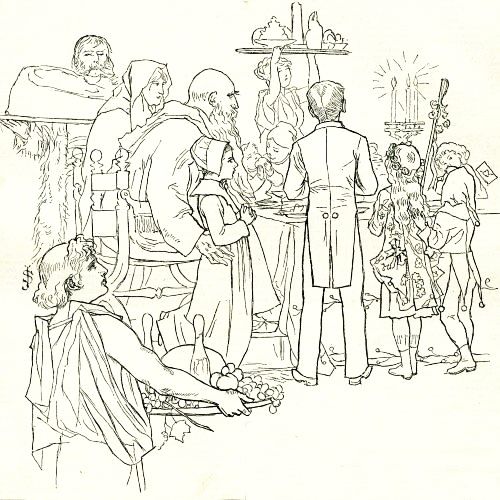
All were gay and jolly, and many a joke was cracked as the contents of each plate and dish melted away like snow before the sun; and the great fires roared in the wide chimneys as though singing a glad Thanksgiving song.
New Year drank everybody's health, and wished them "many happy returns of the day," while Twelfth Night ate so much cake he made himself quite ill, and had to be put to bed.
Valentine sent mottoes to all the little girls, and praised their bright eyes and glossy curls. "For," said his mother, "he is a sad flatterer, and not nearly so truthful, I am sorry to say, as his brother George Washington, who never told a lie."
At which Grandfather Time gave George a quarter, and said he should always remember what a good boy he was.
After dinner the fun increased, all trying to do something for the general amusement. Mrs. March persuaded her son St. Patrick to dance an Irish jig, which he did to the tune of the "Wearing of the Green," which his brothers Windy and Gusty blew and whistled on their fingers.
Easter sang a beautiful song, the little Mays "tripped the light fantastic toe" in a pretty fancy dance, while the Junes sat by so smiling and sweet it was a pleasure to look at them.
Independence, the fourth child of Mr. July, who is a bold little fellow, and a fine speaker, gave them an oration he had learned at school; and the Augusts suggested games of tag and blindman's-buff, which they all enjoyed heartily.
Mr. September tried to read an instructive story aloud, but was interrupted by Equinox, April Fool, and little All Hallows, who pinned streamers to his coat tails, covered him with flour, and would not let him get through a line; at which Mrs. October hugged her tricksy baby, and laughed until she cried, and Mr. September retired in disgust.
"That is almost too bad," said Mrs. November, as she shook the popper vigorously in which the corn was popping and snapping merrily; "but, Thanksgiving, you must not forget to thank your cousins for all they have done to honor your birthday."
At which the demure little maiden went round to each one, and returned her thanks in such a charming way it was quite captivating.
Grandmother Year at last began to nod over her tea-cup in the chimney-corner.
"It is growing late," said Grandpa Time.
"But we must have a Virginia Reel before we go," said Mr. December.
"Oh yes, yes!" cried all the children.
Merry Christmas played a lively air on the piano, and old and young took their positions on the polished floor, with grandpa and grandma at the head.
Midsummer danced with Happy New Year, June's Commencement with August's Holiday, Leap Year with May Day, and all "went merry as a marriage bell."
The fun was at its height, when suddenly the clock in the corner struck twelve. Grandma Year motioned all to stop; and Grandfather Time, bowing his head, said, softly, "Hark! my children, Thanksgiving-day is ended."
Round Lake, Haliburton.
My sister and brother wrote a letter to Young People, and I want to write one too. I am ten years old, and my sister Nettie is seven. She can read better than I can, but I write the best.
This is a very wild country, and very cold. We have nearly a foot of snow here, although it is only the 20th of October. We hear the wolves howl, and we get lots of deer. My brother has quite a number of horns, which are very pretty to hang on the wall.
We are sixteen miles from the Post-office, and we get our papers only every two or three weeks. We like Young People very much. Mamma makes out all the puzzles and enigmas, and we love to read the stories. We are very grateful to the kind gentleman in New York who sends it to my sister. He comes here every fall with some other gentlemen to hunt, and that is the only time in the whole year when we see many people. We have no little girls to play with, for our nearest neighbor, who lives six miles away, is an old man seventy years old, who lives all alone. Twelve miles away there is one more family, but we have to cross three lakes to get there. They have two little girls. They had three, but the oldest one went out in a boat about three weeks ago, and was drowned. We were very sorry to hear of it.
I have a loon's egg, and I can get a gull's eggs, and if Harry F. Haines, who asked for those eggs, will send me a doll in return, I will send him the eggs, together with some pretty moss which grows on the rocks in Muskoka, near where we live.
Agnes R. Lockman, Dorset P. O., Muskoka District, Ontario, Canada.
Webster, Massachusetts.
I have two little sisters. The youngest is not named yet. I go to school, and am in the Second Reader. I know the table, two and three, and up to twelve. I enjoy reading Young People. Please excuse this letter, because it is the first time I ever did try to write with a pen and ink.
Mabel.
Pueblo, Colorado.
We had a parrot, and I could take him and hug him, and touch his black tongue, and do anything I wanted to him. He knew when it was time for our meals, and would eat with us at the table. He was very fond of butter. He would walk all around the fence, and would go to the kitchen door to get in if the sitting-room door was shut. When Polly Parrot was walking along the floor, pussy would run after him, and pat his tail, which made Polly angry.
Eleanor McG.
Warsaw, Indiana.
My brother has taken Young People ever since it started, and now we could hardly do without it. I like "Who was Paul Grayson?" best of all the stories.
We have a juvenile band here, and we can play some very fine music. We have a drum-major and all, and when we parade we look something like the picture "Sons of the Brave." The band consists of fourteen boys, all about the same size and age.
Logan H. W.
Portsmouth, Virginia.
I am seven years old. I have a very pretty rooster. I wish some little girl would name him for me.
I think the story about Coachy was very pretty. My sister Allie has a hen like Coachy.
Johnny B.
Prince Edward Island.
I am a little boy not quite nine years old. I take Young People, and like it a great deal better than any paper I have ever seen. I have a pair of pigeons, which are very tame. I expect soon to get a guinea-pig from Charlottetown. I get my paper from Halifax.
F. R. S.
New York City.
I am six and a half years old. I live in Cranberry, New Jersey, but I am on a visit to my papa now. He has sent me Young People ever since it was published. I have wanted to write to the Post-office Box for a long time, and I have at last coaxed papa to do so for me, as I can not write very well yet, although I am fast learning.
I have two dogs at home, one black and tan named Gyp, which papa says is older than I am, and a hound named Juno. I also have a cat named Pinkie, who does not love my dogs as well as I do Young People. I save all my papers to send to a hospital, where they will amuse some poor sick boy or girl.
"Pickie" Van H.
Beaufort, South Carolina.
I read in the Post-office Box a request from Roscoe E. E. for information about the cotton plant.
I live five miles from Beaufort. Cotton is planted here every year. If they are in good soil the plants are usually four or five feet high. Marsh grass, which grows between the salt creeks, is sometimes used as a fertilizer for "Sea Island" cotton, which is the only kind raised here. This fertilizer makes it grow broad and tall. My father had some cotton once that was from six to eight feet high, and the branches bore from twelve to sixteen pods. It grew on what we call salt ground.
Cotton is planted in March and April. It begins to blossom about the 1st of June. The flowers are pale yellow when they first open, but become reddish after the first day. The picking of cotton is begun in August, and is continued until the first frost, which comes about the middle of November.
A. L. H.
Washington, D. C.
I have been taking Young People since it was first published. The first thing I do on Tuesday morning when I get out of bed is to look for the letter-carrier, who brings my paper. Then mamma reads it to me until school-time. And at night when I go to bed she reads me to sleep with it. I like the stories very much, but the one I like best is "The Moral Pirates." My papa and mamma like the paper very much too, and often at night they try to work out the puzzles. Sometimes they find them out, and sometimes they don't. I can not read or write yet, but I hope I shall take Young People until I am old enough to read it myself.
H. E. W.
San Francisco, California.
I wish Jimmy Brown would have a story in every number of Young People. Mamma reads to us about that queer Mr. Martin, and laughs till the tears roll down her cheeks. If the Post-office Box knows Jimmy, I would like to tell him that I am very sorry for him.
Arthur W.
The following verses are from a young correspondent:
MY FIRST BIRTHDAY PARTY.
I've grown to be a great, great girl, I'm eight years old to-day. Ted says I'm only a baby, And have too much to say. Brother Ted don't know everything, If he is twelve years old; He thinks he's nearly a man now, 'Cause his watch is real gold. I'm going to have a party, We'll have ice-cream and cake; There is no end to the nice things My dear mamma did bake. Then we shall have nice music, Uncle John is going to play; He sent me a wreath of flowers, Just like the Queen of May. And we shall play all kind of games, And maybe I'll catch some beaux, For sister Kate always says that When to parties she goes. There goes the bell, some one has come; No—a large box for me; Why, it's just the sweetest wax doll That ever I did see. J. V.
New York City.
If Georgie G. S., of Dubuque, Iowa, will put a handful of clean white pebbles and five or six clean sea-shells in her globe, the gold-fish are more likely to keep healthy. The water should be changed every day.
Vanderbilt O.
Champion, New York.
I like Young People very much, especially the stories of "The Moral Pirates," and "Who was Paul Grayson?" I have no pets except a little dog I call Watch. We have had a snow-storm here (October 24). I am thirteen years old.
Warren B.
I am eleven years old, and I have fourteen dolls. I have a little kitten for a pet. I call it Bob Short because it is a rabbit kitten, and hasn't any tail.
My cousin sent Young People to my brother Warren and myself as a present for two years, and we think she is very kind.
Eva E. B.
Platte City, Missouri.
I wish to notify my little friends that I can not send them any more samples of crochet trimming. I have no time now to make it, as I am going to school and taking music lessons. I have received a great many requests, and I can not possibly get time to crochet enough to answer them all.
Gracie Meads.
I like Young People very much. I think it is a very useful paper. I live on Big Sandy Creek near the railroad, six miles from any neighbor. There are antelopes, buffaloes, wolves, wild-cats, rabbits, owls, and eagles here. There are also some splendid specimens. I have some bullion out of a mine at Leadville, also some petrified wood, topaz, moss-agate, and other things. I sent "Wee Tot" some specimens of wild flowers and grasses, and if she will send me some ocean curiosities I will be much pleased, and will send her some of my specimens. I will also exchange some of them with any little girl or boy for ocean curiosities.
Clara F. R. Swift, Aroya Station, Colorado, K. P. R. R.
I can never thank my grandfather too much for subscribing for this delightful little paper for me.
Here is a recipe for keeping barberries and mountain ash for Christmas decorations. Fill a large jar with a strong solution of salt and water—cooking salt is best. Put the berries in the brine, and cork it. It need not be air-tight.
I have three hundred and sixty-four postage stamps, and have exchanged successfully with many of the boys and a few of the girls. I have now some white moss which came from Muskosh Mills, a little village on an island in the Muskoka River, which I would gladly exchange for curiosities from the ocean or the far South.
W. C. V. Chadwick, 44 St. George Street, Toronto, Canada.
The correspondents you inquire about have probably sent you sufficient address, and you would better try the experiment of answering them. If they do not receive the letters, it will not be from any fault of yours.
I would like to exchange foreign and United States postage stamps and postmarks with any of the readers of Young People.
Alfred C. P. Opdyke, Hotel Bristol, Corner Forty-second Street and Fifth Avenue, New York City.
I would like to exchange minerals for stamps, postmarks, seeds, shells, stones, or any other thing worth putting in a museum. I wish to get a collection of flints from every State and from Canada, and I will send a stone from Virginia in exchange. I will also exchange postmarks for others. I have some from England, Canada, and nearly every State.
H. H. Tucker, Box 75, Richmond, Virginia.
I have a small collection of stamps, and would like to exchange. I will also exchange a stone from Pennsylvania or from Caen, France, for others from different States.
Alfred W. Stockett, P. O. Box 119, Mauch Chunk, Pennsylvania.
I am collecting curiosities, and would be happy to exchange with any correspondent. I have about one hundred and fifty varieties of birds' eggs. I would be glad to supply any one with a list of the eggs of Canada.
J. F. Wells, Ingersoll, Ontario, Canada.
I would like to exchange postmarks, minerals, fossils, birds' eggs, or coins with any of the readers of Young People for minerals, fossils, coins, birds' eggs, or shells. I very much desire to obtain specimens from foreign countries.
Frank H. Lattin, Gaines, Orleans County, New York.
I have a large number of stamps and rare postmarks, and would like very much to exchange with readers of this paper.
A. W. Morse, Cheltenham Academy, P. O. Shoemakertown, Pennsylvania.
I want to tell you about my collection. It consists of an Indian mortar, an Indian axe and hatchet, a large number of arrow-heads, a nail from "Old Fort Massac," a French bullet weighing an ounce, and a piece of a French sword. I have also a fine collection of minerals, and I would like to exchange some specimens of purple spar for copper ore, crystallized quartz, or shells.
Willie B. Morris, Elizabethtown, Hardin County, Illinois.
I would like to exchange postage stamps for birds' eggs. Correspondents will please state the kind of eggs they have to exchange, and the varieties of stamps they wish in return. I have over one thousand stamps in my collection.
Frank Madison, 206 Stockton Street, San Francisco, California.
We are making a collection of postmarks and stamps, wood, minerals, pressed leaves and ferns, and the soil of different States and countries, and will exchange any of these things with other boys or girls. We will also exchange flower seeds or slips for ocean curiosities or Indian relics.
Mary, Lewis, Minnie, Care of E. M. Frazier, Lock Box No. 12, Caldwell, Noble County, Ohio.
I will be very glad to exchange foreign postage stamps with any readers of Young People. Correspondents will please send a list of their stamps for exchange.
O. L. Welch, 40 Bank Street, New York City.
I live on the San Jacinto River. My papa has a plantation on the Trinity. He has a plum orchard, and we go up there and eat plums. Mamma is going up there to preserve some. I am collecting snail shells. I have about four hundred.
I would like to exchange birds' eggs or postage stamps with any little boy or girl. I am nine years old.
Pearl A. Hare, Lynchburg, Harris County, Texas.
I have stamps from Venezuela and Curaçao I wish to exchange for others.
Charles De Sola, care of B. De Sola, 23 William Street, New York City.
I will exchange twenty-five kinds of postmarks from Georgia for twenty-five kinds from any other State. I will also exchange foreign stamps for their equivalent value in birds' eggs, shells, minerals, curiosities of all kinds, or for other stamps.
Louis J. Brumly, P. O. Box 126, Athens, Georgia.
I will exchange postmarks and French stamps for any American and European stamps except English and Canadian. To any one who will send me ten stamps, all different, I will send by return mail twenty postmarks.
Willie Gurnett, Ingersoll, Ontario, Canada.
I live near Niagara Falls. I have a white pony. She is very gentle, and can do a great many tricks. She will lie down and let me get on her back.
I take Young People, and like it so much I can hardly wait from one week till the next for it. I would like to exchange specimens of rock from Niagara Falls for shells or sea-weed. I would also like to exchange coins. I am eleven years of age.
Harry Symmes, The Grove, Drummondville, Near Niagara Falls, Canada.
E. McGarrah.—It is said that Robert Burns, when a youth of nineteen, became acquainted with Douglas Grahame, an honest farmer who lived at Shanter, and who afterward figured as Tam o' Shanter in the wonderful poem of that name. A merry story told of Grahame by his friends served as the material which Burns long afterward turned to such good account. The original story was as follows: Grahame had a friend named John Davidson, the Souter Johnnie of the poem, with whom he often made merry when in town on market-day, frequently lingering so late at night as to cause severe displeasure to the good dame waiting at home. It happened once, when returning later than usual, on a very dark, stormy night, Grahame had the misfortune to lose his "bonnet," or cap, in which was all the money he had made that day at the market. Fearing the scolding which he knew awaited him, he took advantage of his wife's superstition and credulity, and invented a terrible story of a band of witches which had appeared to him at Alloway Kirk, and from which he had barely escaped with his life. The dame was satisfied with his explanation, and gave thanks for the miraculous preservation of her husband. Honest Douglas Grahame, however, quietly returned by daylight to Carrick Hill, where he was fortunate enough to find his "bonnet" and money safe in the bushes near the Bridge of Doon. Grahame and Davidson, the originals of Tam o' Shanter and Souter Johnnie, are buried in the church-yard at Kirkoswald.
Mansfield.—In earliest times skins, cattle, corn, and other articles were used as money. According to Homer, certain numbers of oxen were paid for the armor of warriors; and even our modern word pecuniary, the etymology of which is traced directly to the Latin word pecus; signifying cattle, is a convincing proof that those beasts were used as money by the ancient Romans.
Precious metals were also given and taken in payment at a very early age. Abraham is represented in Genesis as coming up out of Egypt "very rich in cattle, in silver, and in gold," and payments made in so many pieces or shekels of silver are frequently mentioned in the Old Testament. It is supposed that at this period the precious metal was in the form of lumps of different weights, but bore no stamp. Wrought jewels are also mentioned as serving for money.
The first coined money is supposed to have been used by the Lydians about 700 or 800 b.c. Greek coins appeared at a little later period, the earliest being those of Ægina. The first coins were very rough in appearance, a rude device being stamped from a die on a lump of metal of a certain weight by a blow of a hammer. The early Lydian coins bore a lion's head, and the Æginetan a tortoise on the obverse, the other side being marked only by an indentation caused by the blow.
The oldest extant Jewish coins, specimens of which may be seen in the British Museum, are the shekel and half-shekel of Simon Maccabæus, "the priest and prince of the Jews," to whom Antiochus VII., the son of Demetrius I., granted the right of coining money about 139 b.c. The silver shekel and half-shekel had for their devices on one side the almond rod with buds (Numbers, xvii. 8, 10), with the legend, "Jerusalem the Holy"; and on the other the pot of manna (Exodus, xvi. 33), and the legend, "Shekel of Israel," or "Half-Shekel." This early coinage never bore a head, as that would have violated the law forbidding idolatry. The value of the Maccabæus silver shekel may be estimated at 2s. 6d. sterling, or 60 cents.
Lyman C.—You can buy the cover for Young People of Harper & Brothers for thirty-five cents, or forty-eight cents if sent by mail, but they can not bind your copies for you.
Newman G.—In Young People No. 36, in the story entitled "The Mohawk Bowmen," you will find directions for making bows and arrows, and in the Post-office Box of No. 51 the process of feathering arrows is described. In the Post-office Box of No. 19 are instructions for making a kite.
PUZZLES FROM YOUNG CONTRIBUTORS.
No. 1.
BOTANICAL CONUNDRUMS.
1.Plant a youthful Virginian before it can walk, and what comes up?
2.Plant a piece of bunting, and what comes up?
3.Plant a wise man, and what comes up?
4.Plant a large, inclosed basin, and what comes up?
5.Plant a ruminant's lips, and what comes up?
6.Plant an egg, and what comes up?
7.Plant a color, and what comes up?
8.Plant a sea-shore, and what comes up?
9.Plant yourself, and what comes up?
10.Plant a muff, and what comes up?
A. and T. J.
No. 2.
WORD SQUARE.
First, a dead body. Second, a bay-window. Third, stiff. Fourth, a net. Fifth, a shrub.
Bolus.
No. 3.
ENIGMA.
My first is in corn, not in grain.
My second in hail, not in rain.
My third is in lamp, not in light.
My fourth in darkness, not in night.
My fifth is in well, not in sick.
My sixth is in cane, not in stick.
My seventh in maple, not in pine.
My eighth is in back, not in spine.
My ninth is in green, not in red.
My tenth is in needle, not in thread.
My eleventh in archer, not in bow.
My whole was an emperor long ago.
May E. T.
ANSWERS TO PUZZLES IN NO. 53.
No. 1.
SM
ATEDIM
STORMINER
ERRIMEW
MISER
YAMENOW
MANOROBIN
MOBWIT
RN
No. 2.
Marseille.
No. 3.
1. Winnipiseogee. 2. Niagara Falls.