HOW JELLY-FISH LIVE AND MOVE.
Reading edition
BY SARAH COOPER.
When jelly-fish are seen lying in shapeless masses upon the beach, where they have been washed by the tide, their appearance is not attractive. If, however, we can watch them from the side of a boat, or from a long pier, as they dart through the water with their tentacles trailing after them, we shall soon learn to admire their graceful movements and their elegant colors. There is something very interesting too in these little inhabitants of the great deep. They are such soft and helpless little things, and yet they live and have their own good times if only the boisterous waves do not catch them and fling them too harshly against the rough shore.
Fig. 1.—Section of Jelly-Fish showing Tubes and Mouth.
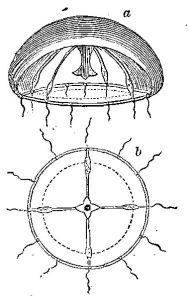
Jelly-fish consist of a single bell-shaped mass of jelly, from the inner surface of which hangs the body of the animal, with the mouth in the centre. The mouth opens directly into the stomach, from which several hollow tubes (usually four) extend to a circular tube around the edge of the bell. In the jelly-fish, Fig. 1, a, the side next to us has been removed that we may see the tubes and the mouth hanging in the centre; b shows us the same viewed from below.
The eggs of jelly-fish are formed in large quantities in the tubes leading from the centre. In Fig. 1 you will see the enlarged cavities containing eggs. At certain seasons of the year great clusters of bright-colored eggs may be seen through the transparent flesh. A few jelly-fish are thought to produce young ones resembling themselves, without passing through the strange forms we noticed in studying hydroids.
Hydroids, about which I told you in Young People March 14, No. 124, you will remember, are abundant in all oceans. So are jelly-fish, and they are often found floating in large companies. Jelly-fish are propelled by alternately taking in and throwing out water under the bell. This gives them a jerking movement, which looks as if it were caused by breathing. They come to the surface chiefly when the water is quiet, and, as they like the warm sun, you will not see many of them at an early hour in the day. They are easily alarmed. If they meet with an obstacle in their course, or if they are touched by an enemy, the bell contracts, the tentacles are instantly drawn up, and the creature sinks in the water.
Upon the outer edge of the bell there are bright-colored specks and solid spots, which are thought to be the beginnings of eyes and ears. Although they never grow to be perfect eyes and ears in the jelly-fish, they promise that Nature has in store for her children the precious gifts of sight and hearing. Such imperfect organs are called by the wise men rudimentary organs. This is the lowest animal in which anything corresponding to our nerves is found.
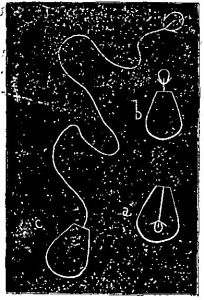
Fig. 2.—Lasso Cells from a Fresh-water Hydroid (Magnified).
Delicate fringes and tentacles hang from the lower edge of the bell, adding greatly to its beauty. The tentacles are often many feet long, yet the animal has the power of drawing them up so that they are not visible. This curious power of contracting and expanding the tentacles belongs to many humble sea creatures, and you will be greatly interested in watching their movements. Sometimes, while we are still wondering at their disappearance, they lengthen again as if by magic.
The tentacles of jelly-fish are covered with a great many lasso cells. These lasso cells are too small to be seen without a microscope; still, they are powerful weapons in their way, and are quite sufficient to enable the jelly-fish to catch its food. Many of you know how the skillful hunter uses a lasso for catching wild cattle. The jelly-fish uses its lasso in quite a different manner, but it may be equally unfailing.
When examined, each lasso cell, or little sac, is found to contain a long slender thread, coiled within it, somewhat like a lasso, and floating in a fluid. The cell is filled so full of the fluid that it bursts with the slightest touch, and as the fluid squirts out, it carries with it the slender lasso armed with sharp stings. In this way lassoes are darted out to capture many little crabs or fish that brush too near in passing.
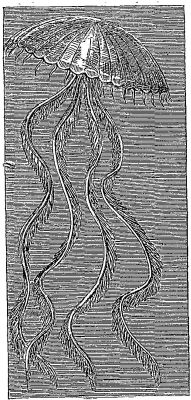
Fig. 3.—Jelly-Fish, showing Tentacles.
The sting of the lasso seems to paralyze the unfortunate creatures, and they make no effort to escape as the tentacles coil round them and carry them to the mouth of the greedy jelly-fish. In Fig. 2 you will see a group of lasso cells highly magnified. The cell at a has not yet burst, and through its thin walls we see the barbed dart at the end of the lasso. At b the lasso has been thrown out only a short distance, while at c the long slender lasso still carries the dart at the end, and the curious little bladder is much larger than it was inside the cell. The lasso cells of this specimen are exceedingly delicate and simple, but in some animals the lasso may be seen coiled within the cell; and when thrust out it bristles with sharp stings. Is it not a dainty weapon to be used in the continual warfare carried on by these innocent-looking creatures? Small as the lasso cells are, they serve to protect the soft-bodied animals from their numerous enemies.
Jelly-fish would hot hesitate in the least to use these tiny weapons upon us if we should touch their soft, pretty tentacles with too much familiarity. The irritation produced in the flesh by the numerous sharp points on the lassoes is similar to the stinging of nettles. For this reason jelly-fish are often called sea-nettles. The correct name, however, which you will find in scientific books, is "Medusæ."
Jelly-fish vary greatly in size. Some are mere dots, so extremely small that we should not notice them in the water, while one species is said to be seven feet in diameter, with tentacles measuring fifty feet (Fig. 3). The parent of this huge jelly-fish was a hydroid only half an inch high. Its children will be the same. What do you think its grandchildren will be?
Fig. 4.—Mushrooms of the Sea.
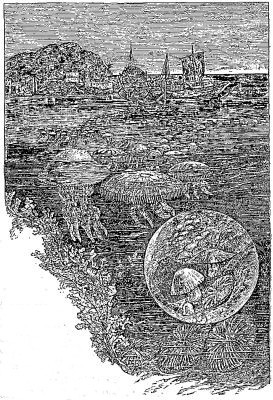
The size of jelly-fish is greatly enlarged by the water they absorb; indeed, the substance of which they are composed consists largely of water. A specimen weighing several pounds when alive will shrink away to almost nothing if exposed to the sun and the wind. As the body contains no bones or other solid matter, it all perishes together, and no trace is left of its former beautiful shape. You will see that jelly-fish are in no way like real fish. One writer found them so much like a familiar vegetable that he called them "Mushrooms of the Sea."
It would be impossible to describe to you the varied colors of jelly-fish, as they include almost every hue, the beautiful tints being probably due to their transparency. Some are purely white and as clear as glass, while all shades are to be found, from pale blue and pink, to bright red and yellow. Those found in tropical seas are of a deeper color than ours.
In striking contrast with these brilliant jelly-fish is one species which is so delicate and transparent that as it floats upon the water we can scarcely see the substance of which it is composed. The only parts that strike the eye are the circular tube around the edge and the four radiating tubes with their large clusters of eggs. The tubes look as if they were held together by some slight web. The movements of this jelly-fish are languid, and it sometimes remains perfectly quiet in the bright sunshine for hours, not even moving its tentacles.
Fig. 5.—Fixed Jelly-Fish.

You have probably noticed a great difference in the movements of people. So with jelly-fish: some are much more active and energetic than others. While some kinds appear to delight in darting through the water, until one might suppose from their frisky motions that they are having a great deal of fun and frolic, others prefer to make no exertion, and to drift idly with the waves. There have even been found "fixed jelly-fish" (Fig. 5)—those so fond of a settled resting-place that they have put out suckers by which they attach themselves permanently to some rock or stone.
Although jelly-fish are so brilliant in the daytime, they have a different beauty at night, when they throw out a golden light slightly tinged with green, resembling the light of a glow-worm. Vast numbers of small animals in the sea have this power of throwing out light from their bodies. The light is called phosphorescence. As it may be seen at anytime of the year illuminating air oceans, it is an unfailing source of delight to voyagers. It is most conspicuous on a dark night, when the water is agitated by the motion of a boat, or by the breaking-waves, because the disturbance of the water excites the little animals.
A pail of sea-water carried into a dark room often affords a good opportunity for studying this interesting phenomenon. Although we may not have detected the presence of any animals before, as soon as the water is stirred or jostled we will see the beautiful sparkles of light. The phosphorescence of some animals is of a bluish tint; in others it is red, like flame.
A person will rarely tire of watching a boat as its prow turns up a furrow of liquid fire, and each dip of the oar sends a miniature flash of lightning through the otherwise dark water. It fills us with wonder to think of the countless millions of little creatures required to produce these marvellous effects all over the ocean, and wherever the restless waves break in lines of light, either upon tropical shores or ice-bound rocks.
Crabbe, the English poet, has given us the description of a phosphorescent sea:
"And now your view upon the ocean turn, And there the splendor of the waves discern; Cast but a stone, or strike them with an oar, And you shall flames within the deep explore; Or scoop the stream phosphoric as you stand, And the cold flumes shall flash along your hand; When, lost in wonder, you shall walk and gaze On weeds that sparkle, and on waves that blaze."