FALSE COLORS.
Reading edition
BY MRS. JOHN LILLIE.
"It's to be what I call fun."
This from Mattie Blake, the eldest of the party, sitting on the bed, and dangling her feet idly.
"Rather risky," said little Joan in her shy voice.
"Risky! how absurd!" Bella Jones exclaimed. And finally I broke in with:
"What will Philip Sydney think of us?"
Mattie, with the superiority of her years, looked very scornfully upon my small figure.
"Philip Sydney will be there, himself, and you may be sure he will be delighted. Now come, Cecilia, don't make any new objections. Remember you promised me last night;" and Mattie's black eyes flashed angrily.
We all remained silent for two or three moments, while the dusk of the spring afternoon gathered in the room. It was a big bare-looking room, with our four beds and four dressing-tables and four chairs, but to my mind the scene of much that was fascinating in our school life at Hillbrow, for there Mattie Blake entertained us on every occasion with thrilling experiences, in which she was usually the successful and admired heroine. Nothing could have been more monotonous than our daily school life, and these hours and Mattie's recitals were looked forward to with romantic interest.
Looking back, I remember Mattie as a tall, thin, black-eyed girl of about fourteen, with saucy, independent ways, and a touch of what I now know was a vulgar love of show about her. In her dress, her profuse jewelry, her crimped hair, and her voice and laugh, she was not really the fine young person we girls thought her. From her own accounts, she led the most bewitching life at home. Her father was a rich railroad man—a widower, who left Mattie to her own devices; and when she descended one winter's morning into our midst she seemed to bring splendor and riches and excitement with her.
How she had happened to select me as a desirable acquaintance I can not say, but the fact was soon known to the school. Mattie's favor was bestowed upon my insignificant self, and I was delighted to be her humble servitor. My own little past seemed very tame in comparison with Mattie's: she had "fun" of the most daring, brilliant kind whenever she was at home; I had led a thoroughly childish life, yet there had been much pleasure in it too; but who could compare it with Mattie's?
My father was a country clergyman, and on my mother's death, dear, dear Aunt Anna had come to live with us, and to make our home very sweet and happy. But for Mattie's influence not a shadow would have fallen on my enjoyment of home pleasures and home duties; but during this one season she had sowed seeds of discontent. Already I was beginning to dread a return to Bridgeley, even though I knew the pleasures that were waiting for me: the rides on my pony, with Philip and Laura Sydney, the Squire's son and daughter; the long days out fishing and sailing; the picnics and the girls' sewing circle; the evenings at home, with papa to read aloud to us; and the quiet sunny Sunday mornings, when I liked to stand beside Miss Sydney at the organ, and hear my voice mingling with the rest in sweet, simple songs of praise to God.
No, Mattie Blake had cast her spell: I wanted to go home with her to North Erie to see "Bob" and "Jim," of whom she talked so much and so foolishly; to ride out to the "Lake"; to dance at the "Bell House," and to stay up until daybreak whenever I chose. And what would papa and Aunt Anna and Philip and Laura think of my latest ambition—the scheme which had brought us together on this afternoon, a thrilled little circle about Mattie, who had been the originator of it?
It was as follows:
The boys—or should I say "young gentlemen"?—of Barnabas Academy, some six miles distant, had sent us invitations to their "Prize Day": invitations promptly declined by our principal, Miss Harding; for although the day was to be a holiday with us, Miss Harding did not approve of its being spent in the Academy among a party of boys unknown to our friends, and who were always trying to make us break some of our rules. Two or three girls were going with their parents, but our party in "No. 6" had no such opportunity. Vainly had Mattie rebelled. Miss Harding was firm. Then there had entered into the girl's wild head a plan, which she unfolded to us with all her usual eloquence and dramatic energy. We were to get off early in the day on some pretext, and, once out of sight, make our own way to the Academy. Then, as we were invited guests, no one would be the wiser, and as our school was to break up the next day, the chances were that no one would ever betray us to Miss Harding.
"By the time we are back next fall," said Mattie, "it will all be forgotten; and I'll tell you what, girls, Bob and Jim will give us a splendid time. Just you leave it to me."
We trembled, half with fear, half with admiration of Mattie's daring. What were we three mites against her? And then to see the Bob and Jim of her fascinating romances! Bob was described as "perfectly elegant," and Jim was always depicted as "simply superb—one of the most splendid fellows you ever saw." While we talked it over for the last time, I happened to see my own figure and little brown face in the glass, while near it was reflected Mattie's fine brown silk gown, her frizzles and bracelets and rings.
"But, Mattie," I said, suddenly, "how can I go? I've nothing to wear."
"Humph! Let me think," she said, slowly, and added, with her usual impressive air, "Just wait until to-night."
When that decisive period came, it appeared that Mattie had decided to lend me one of her own costumes. It was a last year's white muslin, trimmed with Valenciennes lace, and so much finer than anything I had ever owned that I was completely carried away by the prospect of wearing it. It is true that for a few minutes my sense of refinement was disturbed. In our simple home we would never have dreamed of borrowing any finery.
"Oh, Mattie!" I said, timidly, "I never wore any one else's things. What would papa say?"
Mattie laughed shrilly. "Don't be a goose!" she exclaimed. "Think of my wondering what my father would say to anything I did!"
And so the matter was settled, and by the time I had tried on the muslin dress and a Roman sash, and tied some of Mattie's beads around my neck, I felt no misgivings, and went to bed in high spirits.
And so the 18th of June dawned, and found Mattie waking me up to see what a fine day it was.
"Bella and Joan have backed out," she said, disdainfully. "But I've made them promise not to tell of us. Now, Cecy, you leave the getting away to me. When eleven o'clock strikes, you leave the school-room, slip up here and dress, and put your duster over your dress, while I'm with Miss Harding. Then just march down coolly to the front hall, and you'll see."
"I SEE MYSELF HURRYING INTO MATTIE'S DRESS."
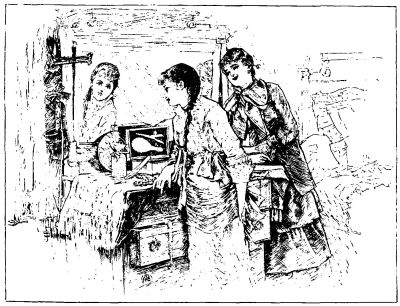
How perfectly I can recall that morning! I see myself now hurrying into Mattie's dress, tying on the sash and beads, and then slipping guiltily down to the front hall, which was quite deserted, and where I stood for a moment trembling, yet excited and happy. And then Mattie appeared from a side door, caught my hand, and putting her finger on her lips, hurried me out, down the garden, and into the road.
Just below the school garden we came upon a rockaway, in which a young girl, very like Mattie in general style, and a tall boy of sixteen were seated.
"Hello!" the boy called out, and Mattie, looking very delighted, said:
"Here's Cecilia Martin, I told you I'd bring. This is Mr. Bob Rivers, Cecilia, and Miss Rivers."
Then this was Bob! I looked, trying to admire; but Bob was not like Philip Sydney in any way. He was stout and red-faced, and decorated like a young man of fashion; and Kate Rivers was a pert miss of fourteen, quite unlike my dear Laura.
These two, it appeared, had arranged with Mattie, and we were to drive with them to the Academy.
After all it seemed like "fun." Anyway, it was one of Mattie's dazzling experiences; so we got in, I feeling quite finely, and prepared to enter into the spirit of everything. Bob drove, and we girls sat inside.