THE WEASEL.
Reading edition
The weasel is one of the prettiest and most graceful little creatures that can be imagined. It lives in all cool countries, and makes its home in hollow trees, in stone heaps, or in any convenient hole where it can find shelter. It is no larger than a good-sized rat, but has longer legs. It has a long, lithe, slender body, long neck, and dainty little head, with small round ears and bright eyes. It is covered with smooth, sleek hair, of a brown color on its back, and white below. It has long whiskers on its nose, and a very short tail. Its weapons are its strong claws and sharp teeth, which it knows how to use so well that many larger animals live in constant terror of this bold and wicked little marauder. The weasel itself has very few enemies. Even the powerful birds of prey, which are ever on the alert for rabbits and other small game, rarely swoop down on the weasel, for although they can easily carry it away in their strong talons, it often proves very troublesome booty. A hunter once noticed a large hawk, high in the air, which was flapping its wings violently, and apparently in great trouble. Suddenly it darted, and fell to the earth almost at the hunter's feet, where it lay gasping and dying, while a tiny weasel sprang from the heap of feathers, and scampered away to hide itself in the stone wall near by. On examining the bird, the hunter found that its throat was torn to pieces by the weasel's sharp teeth. The little creature, although unable to escape from the powerful grip of the hawk, had twisted itself until it could reach its enemy's throat, when it easily inflicted a deadly wound.
THE WEASEL AND HIS VICTIM.
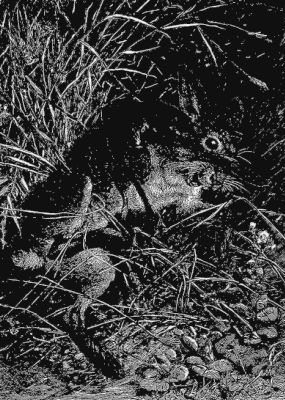
The defenseless hares and rabbits are bitterly persecuted by the weasel, which springs upon them, and with wonderful instinct knows exactly where to fasten its sharp teeth. The unfortunate hare may scamper away as fast as it can, but its enemy clings to its neck, and the poor little animal must soon fall, faint and dying, from loss of blood. The tragedy pictured in our engraving is acted over and over again by these two pretty inhabitants of woodland thickets, and the rabbit is always forced to yield to its little enemy.
Rats and mice, squirrels, moles, frogs, and birds of all kinds are hunted by the weasel, and it may often be seen twisting itself in and out of stone heaps or walls in the vicinity of barn-yards, where it watches for chickens, doves, and other domestic fowls.
If taken very young, weasels may be tamed, and a whole army of cats will not free a house so quickly of rats and mice as will one little weasel. Pussy must sit patiently by the rat's hole and wait until the mischievous beast ventures forth; but where a rat can go, the weasel can follow. Weasels and ferrets are often kept on board of ships, and are petted by the sailors, for a ship with a weasel as passenger is always free from rats.
There are many pretty stories told of tame weasels, and of the affection they manifest toward those who care for them. A lady who received a present of a very small and very young weasel fed it with milk, which it drank from her hand. The little creature became so attached to its mistress that whenever she called it, it would instantly appear from whatever corner in which it was curled up, and would climb all over her like a squirrel. It never bit her, and would play with her cat and dog, often riding round on their backs; but it never injured them. Its curiosity afforded its mistress much amusement. If she opened a box or trunk, Master Weasel would raise himself on his hind-legs and make every effort to peep inside.
This little creature is much hunted by man, and large numbers are caught in traps, it being a general impression that they do more harm than good; but although a weasel may now and then carry off a chicken from the farm-yard, it does much good by freeing barns and corn fields of mice and other small destructive animals.