Chapter IV
Reading edition
"How do all the boats that go through the inlet manage, I wonder?" asked Tom. "They can't all get as wet as we did, and we saw that the boat that went through just ahead of us didn't take in any water."
"That was just her luck," Charley answered. "We followed right after her, and happened to catch it pretty heavy."
"But I don't believe it's always so rough at the inlet. If it is, nine boats out of ten would get full of water."
"I'll tell you how they manage it," exclaimed Charley. "They wait till the tide is just right, and that's what we ought to have done. Don't you see there is a swell coming in from the ocean, and it meets the tide going, out? Now if the tide was coming in, or if it was slack water, the inlet would be smooth enough. Boys, I made a mistake in starting before the tide changed, and, come to think of it, I've been awfully stupid about this whole business. If we had waited two or three hours, we could have gone through the inlet without the least trouble; that is, if the wind hadn't changed."
"It's going to change before long," remarked Harry. "The breeze is dying away now, and in a little while we'll have a dead calm."
They were now entering the narrow channel leading to Hempstead Bay. A few years ago a heavy winter storm threw up a low island of sand just outside of the beach at Far Rockaway. The channel between this island and the beach communicated with Hempstead Bay, and although the island injured the business of the bathing-house proprietors, it saved the Hempstead fishermen the risk of passing out to sea through the regular inlets.
As the wind died out it grew uncomfortably hot; and as the Ghost had passed beyond the houses at Far Rockaway, the boys took in sail, anchored, and had a splendid bath. After the bath they were, of course, ravenously hungry, and so proceeded to get dinner. By this time the breeze had completely vanished, and the Ghost was lying motionless on the glassy waters. Suddenly the low growling of thunder was heard. The clouds had come up from the west without attracting the notice of the boys, and they now saw that a thunder-shower would soon reach them.
"We're going to get wet again," said Joe, gloomily. "I think I'll quit wearing clothes altogether, so that I can manage to have something dry to put on."
"What's the use of getting wet?" said Harry. "We can rig up our canvas cabin, and we won't get a drop of rain on us."
"If we're going to do that, we must be quick about it, for it's going to rain in a very few minutes," said Charley. "I guess it's the best thing we can do, though this isn't the best anchorage in the world. Come, Joe, you and I will roll up the sails, while the other fellows rig up the canvas. We've got to make things pretty snug, for it may blow hard."
The sails were quickly furled, and Tom and Harry had the canvas cabin ready just as the first drops of rain began to fall. The boys crept under the canvas, congratulating themselves that they had a secure shelter, and that they had noticed the approach of the shower in time to prepare for it.
The wind blew very hard, and the Ghost began to pitch uneasily.
"It's a good job we've got such a lot of cable," said Charley. "When I saw that the Ghost had fifty feet of inch rope coiled up on her deck, I couldn't help laughing, and wondering if Harry expected to anchor in fifty feet of water; but, after all, a long cable is a handy thing to have, and we needn't have the least fear that we shall drag our anchor or part our cable."
"This canvas cabin works splendidly," remarked Harry. "Tom, you deserve all our thanks for inventing it. Why, it's fairly dry on the inside." So saying, Harry put the palm of his hand against the canvas over his head, and rubbed it to see if it was wet.
"Now you've done it," cried Tom. "Don't you know how a tent will leak if you touch it when it is wet? You'll have a stream of water running in here presently."
Tom was right. In a few minutes the water began to drip steadily on the unfortunate Harry, who was forced to sit with a tin pail in his lap to catch the stream that he had introduced into the cabin.
The rain was now pouring down in a perfect cataract, and the gusts of wind were trying their best to tear the canvas away. Tom felt a strong desire to look out and see how things were getting on. Accordingly, without saying anything to anybody, he quietly unfastened the opening in the after-end of the cabin, and put his head out into the rain. No sooner did the wind find an entrance into the cabin through the opening Tom had made than the canvas gave a tremendous flap, which broke the cords that held it in place; and had not Harry caught hold of it, and dragged it inside the cockpit; it would have been overboard in a second.
"Well, I never in all my life!" began the astonished Tom.
"I told you we were going to get wet," said Joe. "We always do. We got wet about three times every day in the Whitewing."
"There's nothing to be done but to sit here till the shower's over," said Charley. "It can't last very long, and it won't do us any harm. You're sure the covers of those cushions are water-proof, Harry?"
"Oh, they're all right. They'll be dry enough if we just rub them off with a towel."
"It's all my fault," said Tom; "but who would ever have thought that the whole concern would blow away that way?"
"Never mind, Tom," said Charley. "It will teach us to use stronger cords to lash the canvas down with next time. There! the sun's coming out again, and the rain is about over. Let's try and get the inside of the boat dry, and the canvas rigged up again, before dark."
The cabin was a little damp, it must be confessed, but the beds and blankets were dry. This time the canvas was lashed down so stoutly that it would have stood a gale of wind, and under it the crew of the Ghost slept without hearing the singing of a single mosquito, and without suffering any unpleasant effects from the dampness.
THE MAN IN THE ROW-BOAT.
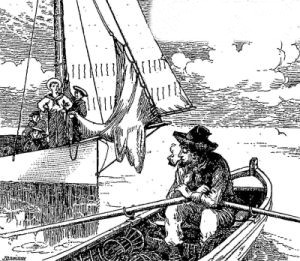
The boys had finished their breakfast the next morning, and were preparing to resume their voyage, when they were hailed by a man in a row-boat.
"Where be you from?" asked the new-comer.
"From New York," replied Charley. "Whereabouts is the best channel in Hempstead Bay? Do we want to keep near the beach, or near the other shore?"
"Where be you going?"
"To Amityville or thereabouts. Will we have any trouble in finding the way there?"
"Who be you, anyway?"
"Oh, never mind him," said Harry, in a low tone. "He'll ask questions all day, and never answer any."
But the man was not quite so exasperating as Harry imagined. After looking at the Ghost with some admiration, and expressing the opinion that she was "a tidy boat," he condescended to answer Charley's questions about the channel.
"Channel? Why, bless you, you can't find the channel to save your life. It jest winds in among the islands, and runs every which way. You've got to be brung up on this bay before you can ever learn the channel."
"But we can find it if we keep searching for it, can't we?" inquired Charley.
"You'll be growed up before you do," answered the man. "You can try it, I s'pose, if you want to. You must keep a-gradooally working up to the nor'ard, and if one of you gets up the mast and watches the color of the water, mebbe you can find the way. Say, where was you last night—aboard this consarn?"
"We've been here ever since that thunder-shower came up."
"You hain't seen nothing of no suspicious-looking fellows in a row-boat, have ye?"
The boys told him that they had seen nobody since they had cast anchor.
"Well," resumed the man, "you keep a smart look-out. There's been half a dozen sail-boats stole out of this bay in the last two weeks by some fellows that sneak 'round in a row-boat at night. Why, they stole a colored man's boat last week while he was asleep in her. Chucked him right overboard, they did. Those fellows is regular pirates, and if they catch you lying at anchor in some out-of-the-way place, you'll have trouble with 'em."
The man's caution did not alarm the boys, but they thanked him, and said they would remember his advice. "We'll set an anchor watch at night," said Charley. "It's what we ought to do, anyway. This anchoring the boat, and then going to sleep and letting her look out for herself, is too much like the way Frenchmen manage ships. We might have been run down by some big fishing-boat last night, for we didn't hang out our lantern, and we were all sound asleep."
The wind was fair, and the crew of the Ghost, thinking that the man had greatly exaggerated the difficulty of finding the channel, were not disturbed when they presently found themselves in what looked like a narrow creek winding through a low marshy meadow. Charley climbed up the mast hoops, and saw that the Ghost had entered an archipelago. In every direction, as far as he could see, the low meadow was divided into hundreds of little islands, separated by narrow creeks varying in width from a few feet to a dozen rods. He made up his mind that it was going to be a difficult task to find a channel deep enough for the Ghost, for he could see that the water had the appearance of being very shallow in nearly all the creeks. He had just decided on the course that it would be best to steer for the next ten minutes, when the Ghost ran on a mud-bank, and came to a stop.
It was some time before she could be pushed off again, so deep and sticky was the mud; and when at last she was once more on her course, Charley took the helm, and sent Joe aloft to look for the channel. Joe had no sooner climbed the mast hoops than the Ghost was aground again, and another half-hour had to be spent in getting her afloat. The whole morning was passed in this unsatisfactory way, and the boat was at least half the time stuck in the mud. At noon the crew let her remain aground while they had lunch, and rested for an hour. Then they resumed the tiresome business of running aground and getting afloat again, and when the end of the afternoon approached, they anchored in a little cove where the water happened to be deep enough to float the boat, and acknowledged to one another that the inquisitive old man was right, and that they would probably have to spend a long time in working their way out from among the islands.
"I don't believe what the old man said about pirates," said Harry, as they were rigging the canvas cabin, and preparing for the night; "but I did see what you may think was a suspicious-looking boat when I was up aloft this afternoon."
"Let's hear about it," said Charley.
"It was a row-boat tied up to the shore in a little bit of a creek about half a mile from here, and there were three men lying asleep in her. Now what were they doing that for, I'd like to know?"
"I don't see what could induce anybody to row into such a place as this, and then go to sleep. If they had been fishing, now, I could understand it," said Charley. "What sort of looking men were they?"
"I could only see the face of one of them. He woke up, and lifted up his head to look at me, and he didn't look a bit like a fisherman. He seemed to me just like one of those fellows that you see in New York—a regular 'rough,' you know."
"You're sure he saw our boat?" asked Charley.
"Sure as sure can be," replied Harry. "And he watched it very sharp, too."
"Boys," asked Charley, "has anybody got a pistol? I know there isn't any gun aboard."
"We didn't bring pistols, for Uncle John wouldn't consent to it," answered Harry; "and he said we wouldn't need a gun. I've got a lot of powder for the cannon, but it wouldn't be much good against the pirates that the old man told us of."
"We have got a cannon, haven't we!" said Charley, thoughtfully. "I'd forgotten that. Let me have a look at it."
He examined the cannon closely, and carefully dried the bore with the help of his handkerchief and a small stick. Then he came back to the cockpit and asked, "Does anybody happen to have anything that will do for shot?"
"I've got about a handful of marbles," said Joe. "I forgot to leave them behind."
"They're just the thing," said Charley. "Give 'em to me, will you, and let me have a lot of that thick brown paper that was wrapped round the stove, provided there is any of it left."
Charley wrapped the marbles in three or four thicknesses of paper, and then loaded the cannon, ramming the package of marbles close up against the powder. Then he laid a piece of cloth over the cannon to protect it from the dew, and put the powder-flask in his pocket. "Now if anybody attacks us," he exclaimed, "we can give him a dose of canister-shot."
"You'll have to ask him to be kind enough to come right up in front of the cannon," remarked Joe, "for you can't aim it at anybody while it's lashed fast."
"That's so," said Charley. "I am smart not to think of cutting the lashing." So saying, he cut the cannon loose, so that he could turn it in any direction. "Now, boys, turn in, and I'll keep a look-out till ten o'clock, for I'm not a bit sleepy. I don't believe anybody will trouble us, but at any rate we'll take care not to be surprised."
The boys felt so safe, in spite of what the old man had said, that they were soon peacefully sleeping, with the exception of Charley, who was sitting very wide awake, with his back against the mast. It was not yet ten o'clock when Tom was awakened by feeling a hand laid on his forehead. "Hush!" whispered Charley. "I can hear a row-boat coming toward us. Wake up Harry and Joe, and come on deck; but don't make any noise. I've unshipped the tiller, and you can use it for a club."