"POPSEY."
Reading edition
BY MATTHEW WHITE, JUN.
This was the name Walter Radlow's father had requested should be given the gray donkey which he presented to his son on the latter's thirteenth birthday.
"You see, I was at my wits' end what to buy," he afterward explained; "for a dozen birthdays, to say nothing of as many Christmases, had about exhausted my genius for discovering something new, and I was beginning to think I'd have to start all over again with a rattle, when the idea of a donkey and cart popped into my head."
So Popsey was the donkey, and the donkey was Walter's, and—such a donkey! Not one of your meek, spiritless animals, "warranted gentle with ladies and children," that you must beat to make go, and simply cease beating to stop.
Ah, no; Popsey, though not wild or vicious, was full of life, which was just what Walter delighted in; and as Mrs. Radlow had satisfied herself that the beast was really too small to do any serious damage, she ceased to worry about his "playfulness."
But it was not long before Popsey became so attached to his young master that it was thought perfectly safe to allow two-year-old Amy the privilege of a ride now and then, from which she returned in a very mixed state of mind as to whether she wanted to tell papa about Popsey, or Popsey about papa.
One Saturday, about three months after Popsey's advent, Walter's cousins came over from Wallingville to make him a visit. They were the children of Mr. Radlow's only brother, and Helen was fourteen, May twelve, and Jack ten.
They arrived about nine in the morning, to find Walter just recovering from an attack of rheumatism, and suffering from such a raging toothache that he could scarcely bear to speak.
"But don't mind me," he said, as they all gathered about him to condole and bemoan. "When you come from town to the country for the first time in years, and for such a short stay, too, you mustn't stick in the house just because a chap can't go round with you to— Oh!" and poor Walter suddenly dashed his head down against the hop pillow on the lounge, while the girls sympathetically exclaimed, "Too bad!" and Jack looked as if he was afraid it might be "catching."
But in a moment or two Walter bobbed up again to say, "There's the croquet set and archery, tennis and—Popsey."
"Oh yes; that's the donkey, you know," eagerly interrupted Jack. "And, oh, Walter, did you say we might drive him?"
"Of course. I guess Helen can manage the fellow. And, by-the-way, you might take the cart and drive over to the Hillwins'. Fred's got a prime book about middies I've wanted to read ever since Christmas, and if you'll borrow it for me, I think it'll make me forget this—" And the boy expressively ended his sentence by another plunge into the depths of his hop pillow.
When the plan was first mentioned to her, Mrs. Radlow was inclined to doubt Helen's ability to deal with Popsey's peculiarities. Though docile enough with Walter, he might prove troublesome to a stranger.
"But, Aunt Jennie, don't you remember how I drove when we were all up in the mountains one summer? And, besides, you know you wrote to mamma that Popsey was so small that you never worried about the children being out with him."
As this last argument of Helen's could not very well be answered, the coachman was ordered to harness up.
When the cart was brought to the door, and the three visitors prepared to crowd themselves into it, a great outcry was made by Amy, who shouted, "Me too! me too!" so often and so shrilly that, for the sake of securing quiet in the house for Walter, Mrs. Radlow at last consented to let her go.
"I'll hold her on my lap just as tight," pleaded May, "and Jack can stand up behind."
And so it was arranged, and Amy's face, which had been all drawn down for a good cry, wrinkled up into a laugh instead.
Then Popsey was petted and patted, endearingly addressed as "Good donkey," and called upon times innumerable to "whoa" when he had not thought of stirring, after which preliminaries the girls got in, Amy was handed over to them, and Jack climbed up behind.
"Drive around to the front lawn, so Walter can see you," said Mrs. Radlow, when all was ready for a start, whereupon Helen chirped to her steed, and guided him over the grass opposite the second-story window, at which appeared a black head and white pillow, one of which was nodded gayly, and the other waved on high, the two to be suddenly clapped together again in a fashion, that caused Helen to give Popsey a touch of the whip, and speed off after the "prime book about middies."
"'ISN'T HE JUST TOO CUNNING!'"
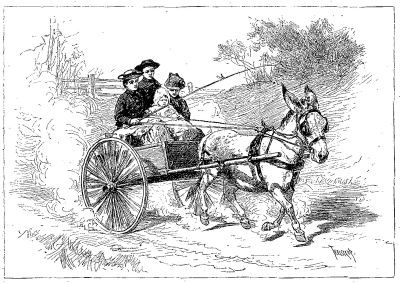
"Oh, isn't he just too cunning!" exclaimed May, as the little donkey trotted along, with his big load, as steadily as a family horse.
Amy crowed with delight; Helen made a great show of flourishing her whip (taking good care, however, to keep it out of range of Popsey's long ears), while Jack pranced about behind in genuine boyish joy. The road was easy enough to follow, and inside of three-quarters of an hour Helen drew up before the Hillwins' gate. Their house was the only one within sight, and just beyond it two or three roads crossed one another in quite a confusing manner.
"It's lucky we haven't any further to go, Helen," remarked May, as she noted the latter fact, "for we'd surely become mixed, and— But I declare, if Amy isn't fast asleep in my arms! Poor dear, the ride's been too long for her, I guess. You go in, Helen, and I'll sit perfectly still so as not to wake her. Don't be long, though."
Jack was already out and standing at Popsey's head, but no sooner had her elder sister vanished from sight under the long grape arbor that led to the house, than May suddenly discovered that she was terribly thirsty.
"Oh, Jack," she cried, "I must go in and get a drink; but I don't want to wake baby, and make her cross, perhaps; so I'll just put her down here in the bottom of the cart on the seat cushion. I'll be back in a minute or two; but mind, keep a tight hold on the donkey, and if Amy wakes up, talk to her till I come."
Jack answered "All right," May jumped down to hurry off after Helen, and then there was no sound to break the country stillness but the autumn wind, as it whirled the dead leaves to the ground, and the rumble of a train as it rushed along the track down by the river.
As it happened, Fred Hillwin was not at home, or he most certainly would have come out to inspect Popsey and keep Jack company. As for Fanny, she was so overjoyed at the unexpected call from her old school friends, that for about five minutes she could do nothing but give expression to her delight. Then the book Walter wanted had to be hunted up, all of which together consumed a good deal of time, the delay seeming especially prolonged to Jack, who soon grew tired of gazing at the top of baby's cap between Popsey's ears, and longed for some more exciting occupation. The donkey stood as if glued to the spot, and Amy slept on as peacefully as if in her little crib at home.
Suddenly the noon-day quiet was broken in upon by the blast of a horn, accompanied by the quick trot of horses' feet.
"A circus, perhaps!" exclaimed Jack; but, alas! whatever it was, nothing could be seen from where he stood, for the sound came from the turnpike just beyond the cross-roads before mentioned.
"Oh, how I would like to see what it is!" sighed the boy. Then he quickly measured with his eye the distance he would have to run, saw that Popsey seemed perfectly stationary, and with a sudden impulse dashed off to the corner, arriving just in time to behold a four-in-hand coach rush by like the wind.
It had scarcely passed him, however, when it stopped with an abruptness that threatened to pitch the passengers on ahead of it.
"What can be the matter?" thought Jack, and with all a boy's curiosity he ran on down the road to find out.
It seemed that one of the "leaders" had stumbled and fallen, and consequently been stepped on by the "wheelers," which resulted in such an entanglement of horses and harness as Jack had never seen before.
With wide-open eyes he looked on at the efforts of the gentlemen to straighten things out, and was about to ask if he could help them, when suddenly, with a cry of "Oh, Popsey—and the baby!" he tore back to the Hillwins' gate, and found the donkey-cart—gone.
With a terrible fear in his heart, the thoughtless boy gave one despairing look around him, and then started off on a run, in the direction in which Popsey had been headed, after a black speck just visible in the distance.
Two minutes later Helen and May came hurrying down the long walk through the garden, provoked with themselves at having staid so long.
"I do hope Amy hasn't waked up," said May; "but I told Jack in case she should— Why, where are they?"
"Perhaps Jack's driven down the road a little," suggested Helen.
But a hurried glance in both directions soon convinced the girls that the donkey-cart was nowhere near, and they were both beginning to feel a dread of they knew not what, when all at once May exclaimed, "Oh, Helen, look! here comes Jack now, and without Popsey!"
In great excitement the sisters ran to meet him, and imagine their horror when, with a voice all broken with sobs, he cried: "Oh! oh! it was only a—a peddler's wagon, and I ran nearly a mile to catch it, and—and now I don't know where to look, because Popsey's run off with the baby!"
Terrified beyond description at the thought of the danger that threatened their aunt's pet, who had been so reluctantly committed to their charge, the girls commanded Jack to tell them instantly just how it had all happened, which he did with teeth-chattering from fright, and repeated assertions that he had believed Popsey was asleep.
"But didn't I tell you not to stir?—and oh, Helen, it's partly my fault too, for if I hadn't been so foolish as to leave Amy, she—" Here May broke down completely, and leaving her and Jack in tears together, Helen flew back to the house, and soon returned with Mrs. Hillwin, Fanny, the maid, and the cook. Then she pointed out the three roads it was possible the donkey had taken, and burst out crying herself.
"An' shure, miss, don't give way so," said the cook, cheeringly, "but jist take yer stand at the cross-roads beyant, an' ask ivery person that comes along—an' precious few do it be in this wild region, bad luck to it!—ef they're afther seein' a donkey runnin' off wid a baby."
This sensible suggestion was at once acted upon, and while the rest all hurried off in the direction of a turnip-field, which the maid declared Popsey must have sniffed, Helen stood at the junction of the three roads until a pleasant-faced old gentleman in a buggy approached her.
"Oh, sir," she cried, rushing up dangerously close to the wheels, "did you meet a runaway donkey-cart?"
"No, not I," was the answer; and the gentleman repressed a smile, but suddenly grew quite grave as he drew rein and asked if the donkey's name was Popsey.
"Oh, yes, yes," exclaimed Helen. "And have you seen him?"
"No, but I am going to see his owner now, and if you will get in, I will take you along with me. I am the family doctor, and am quite well acquainted with Popsey."
Hardly knowing what she did, but feeling that any sort of motion or action was better than waiting in suspense, Helen accepted the invitation, and began at once to pour forth her tale of grief to the kindly old physician, upon hearing which he whipped up his horse, saying that he was sure no harm had come to Amy.
Then Helen suddenly recollected how she had deserted her post, and was filled with a foreboding lest some one should pass the cross-roads who might know something about the donkey-cart, and there would be no one there to question him.
"Here comes Mr. Radlow's coachman now," exclaimed the doctor, when they had nearly reached their destination, "and driving at a furious rate. I warrant it's turned out just as I expected;" and with the words he signaled to the man to stop.
"Yes, yes, exactly as I imagined," said the physician, when the coachman had hurriedly and excitedly explained that Popsey had come trotting back to the stable with the lines about his heels, and baby Amy crowing joyously in the bottom of the cart, and that in consequence Mrs. Radlow was in a great state of fright concerning the fate of the cousins.
"Well, I'll soon relieve her fears on that score; and do you, Dennis, drive on toward the cross-roads with your carriage as fast as ever you can, and bring the other two children back."
As for Helen, she had not yet recovered from her joyful surprise.
"To think," she exclaimed, "that that donkey should have turned deliberately around and walked off home, nearly four miles, without upsetting anything, while we were looking for him in every other direction! There certainly never was such a dear little animal. But that doesn't excuse Jack's thoughtlessness, and I'm going to give Aunt Jennie leave to punish him very severely."
However, when the case was laid before the doctor, he declared that as the fault lay really with so many persons, and that as the three cousins had suffered sufficiently already from anxiety and suspense, the blame should be changed to praise, and that given to Popsey, who had displayed a disposition to execute the errand upon which he had been sent as speedily as possible.
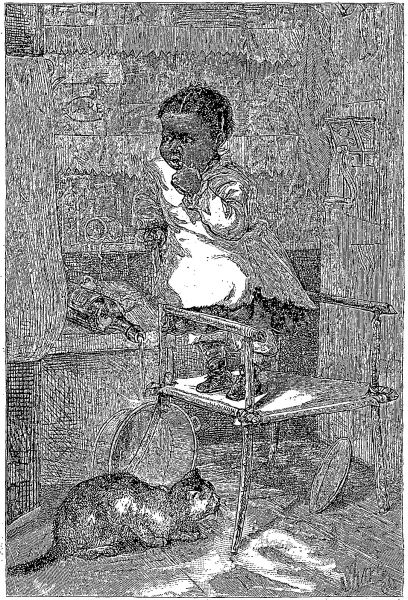
WHAT HAPPENED WHEN DINAH WENT OUT AND LEFT TOPSY ALL ALONE.
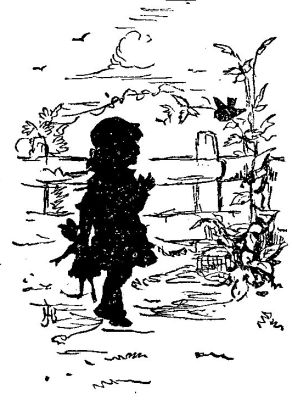
Good-morning, little bird; I wish you'd sing for me; You look as if 'twere fun to live Out-doors so wild and free. I've brought Matilda Jane Because she needs the air; She is a very pretty child, With lovely curling hair. How many little birds Are flying round to-day! Now surely you will stay with me When I've come here to play? Oh, you have children three, And they, perhaps, have stirred; Well, if they need you, hurry home. Good-morning, little bird.