HANDEL AND "THE MESSIAH."
Reading edition
BY MRS. JOHN LILLIE.
On February 23, 1685, there was born in Halle, Saxony, to an honest surgeon named Handel, a son, whom he christened George Frederick, and who was destined half a century later to become the first musician in the world.
Little Handel's father abhorred music. As soon as the boy began to show an aptitude for it, his father took him away from school, for fear that some one would teach him his notes. Whether among teachers or scholars I don't know, but the boy found a friend who contrived to procure for him a little dumb spinet, and this he secreted in an attic, and learned not only his notes from it, but how to use his fingers in practicing. Still his father opposed him, and but for a certain visit he paid, his genius might have been long hidden in the dull house at Halle.
The elder Handel was invited to visit his son who was in the service of the great Duke of Saxe-Weissenfels, and young George, knowing music was to be heard, if not easily learned, in that place, determined to go too. So he ran after his father's carriage so far that the parent's stern heart relented, and he was taken in.
GEORGE FREDERICK HANDEL.
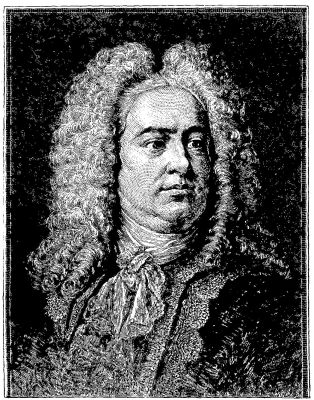
In the old castle at Weissenfels he quickly found out which of the inmates were musical, and soon made friends with them. One day, after the chapel service, he jumped on to the organ stool, and played in such an astonishing manner that the Duke, who was still lingering in the chapel, sent up to inquire who was playing. The boy and his indignant father were summoned: but the Duke's evident delight in the child's music softened old Handel's heart. He gave his consent to his son's musical education, and almost from that moment George Frederick Handel became known as a musician.
I can not tell you anything more of his childhood or youth but that he studied very hard, and that, like every true genius, he was humble while he was learning. We must skip over many years to the time when he went to England; for there he produced his greatest works, and to this day the English reverence him as their own.
George I., King of England, you know, had been Elector of Hanover, and so he as well as his successor felt a strong interest in Handel. The latter went to England in 1710, and there he found that much attention was paid to Italian music. Operas were very fashionable. They were quite a novelty then. Fine ladies and gentlemen filled the opera-house. They crowded the greenrooms behind the scenes, and chatted and talked at the "wings," as if they were in a drawing-room. Fashion governed nearly everything, and so Handel, realizing this, set to work upon an opera. He wrote Rinaldo in fourteen days, and it was produced at Drury Lane with a splendor that created great excitement throughout London. We never hear Rinaldo now, but its airs are beautiful, and one of these, "Lascia ch'io Pianga," lingers in the heart of every one who hears it.
Well, Handel began to teach the Prince of Wales's daughters, to write a great deal of music, and to be very much the fashion, and very famous. So he roused the jealousy of petty people, and, strange as it may seem, opinions differed to such an extent, and such a fuss was made, that society was divided into two factions. One party favored a distinguished musician named Buononcini, and the other Handel. The war raged, and during it a wit and poet named John Byrom wrote the following verse, which has since been famous:
"Some say, as compared to Buononcini, That Mynheer Handel's but a ninny; Others aver that he to Handel Is scarcely fit to hold a candle. Strange all this difference should be 'Twixt tweedledum and tweedledee."
Handel's genius, however, was not to be suppressed by any such foolish contentions. He worked on as usual, and in 1749 produced the work with which his name is most associated, the oratorio of The Messiah.
I do not think you can go into any part of England without finding people who love The Messiah. It used to seem to me it was the one work every one knew about. And it is well worthy of such general knowledge. In it are airs that must move every Christian heart. It seems to teach so many things—reverence, love, hope, and a glimpse of a heaven that has in it God's many mansions. When I hear it sung it always seems to me that the voices are those of the angels who sang on Bethlehem's plains, "Glory to God in the highest, and on earth peace, good-will toward men."
I want to tell you something about oratorios in general; that is, how they originated, and what they are as musical works. Oratorios, strictly speaking, are dramatic and musical compositions where the parts are sung without scenery or special costume, and they are on sacred subjects.
Dramatic representations of sacred stories are as old as Christianity. In the Middle Ages they were very common. At times of public rejoicing they were given, or during any special season, like Advent or Lent, and so far were they recognized as part of public life that the government or special societies paid their expenses.
These old performances were very roughly put on the stage, but gradually from them grew an idea of a distinctly musical and dramatic sacred work. In Germany, "Passion Music" was written. In Italy, it had long been thought of and given; finally, the oratorio as we have it now was developed by various great composers.
Let us consider the oratorio for a moment as represented by Handel's Messiah. The most famous part perhaps is the "Hallelujah Chorus." Hear this sung by thousands: do you not thrill with joy and praise? As the music swells on, with its bursts of melodious exultation, we feel ourselves lifted away from everything common and base. Then take the sweeter and softer airs: "Behold the Lamb of God," "With His stripes we are healed," and then the great chorus, "For unto us a Child is born," with the rush and sweep of the "Wonderful." Where do we seem to be? With the shepherds watching on that star-lit plain; with Mary at the cradle of her Divine Child; with the Wise Men offering up their gifts of frankincense and myrrh in that illumined stable. The light of God's glory dazzles us as we listen, and we can only echo in our humble hearts, with our heads bowed, that repeated joyous "Wonderful!"
Now do you not think a musician who could make any Christian heart full of such reverence and love ought always to be honored? I like to think of Handel revered as he is now. His life was not happy in many ways. Many things troubled him. He used to sit hours playing on his organ, and I have no doubt trying to reconcile himself to the blindness which fast came upon him. He had many friends, but no family ties of his own. He wrote on unceasingly, and some other time I may tell you more of his work. Just now I have had space only to speak of his greatest oratorio.
It was on April 6 that The Messiah was given at Covent Garden, and Handel attended the performance. He came home to his house in Brook Street very weary, and there, eight days later, he died, April 14, 1759. His grave is in Westminster Abbey.