TOM'S CARNIVAL.
Reading edition
BY F. D. MILLET.
'Twas a great pity that Tom couldn't keep a diary, for his life was full of lights and shadows. He was by nature much of a Bohemian, equally at home in the hovel and in the palace, but far preferring the free life of a vagabond to the formal existence in high society. Tom was a shaggy black terrier, and the way I made his acquaintance was by pulling him out of the dirty canal in front of my house in Venice one chill morning in autumn. He was as draggled and wretched a dog as ever was seen. He was in good flesh, but smeared with mud, and quite worn out by a long swim and his struggles to scramble upon the riva, or landing-place. I gave him a place near the fire on the stone platform in the kitchen, and he curled up and steamed and slept until he was dry and rested. He showed from the first great fondness for me, as the one who had saved his life, and for three or four days was modest, respectful, and obedient. Later, he developed habits of willfulness and disobedience. So, you see, he wasn't altogether a model dog; if he had been, perhaps his history wouldn't have been half so interesting.
Our house was the last house on the broad canal San Marco, and its position near the public garden—the only green spot of any size in Venice—made it a pleasant home for animals as well as men. Tom had for companions a little white Spitz poodle, Jerry; a black and white long-haired terrier, whom we called Harry; and Dick, the cat, who lived on terms of unhappy intimacy with the three dogs, and alternately romped and fought with them. Whenever we went away in the gondola we always took the happy family along, and as such a menagerie is uncommon, even in Venice, our boat made a great sensation wherever we went. This public exhibition soon told on the manners of our pets, and they got into bad ways of posing and showing off whenever they were looked at. Perhaps that is why we used to think them uncommonly sagacious animals.
It was two or three months after Tom's rescue that I found out his history. One of the maids of honor from the king's palace saw him in our gondola, and claimed him. She had given him to her gondolier to be cared for during the cold weather somewhere on the main-land, but he had played the part of the cruel uncle in the story of the babes in the wood, and had thrown the dog into the water, intending to drown him, and still to draw his pay for his keeping. Tom recognized his mistress at sight, and seemed to say, "I know you, but times are different now." She, finding him more fond of us than of her, gave him to us, on the condition that we should bring him to the palace once in a while to visit her. What a dog of Tom's nature must have suffered in the quiet, gloomy old palace I will not try to tell, and will only venture to write down a single chapter of his life with us.
TOM.
It was the morning of the second day of carnival before we made any preparations for joining in the sport. As Tom's costume was the only one in our party decidedly original and unconventional, I will describe that alone. We kept, in the attic of the house, a number of the pigeons for which Venice is famous—in fact, a part of the great flock which assembles daily in the Piazza San Marco to receive food from the city officials lodged at night in our dove-cote. We selected a pair of fine white ones, killed them, plucked all the large feathers, and dipped the quill end of each one in a little dish of melted sealing-wax. In a few moments we had quite a large pile of them. We seized upon Tom, who was watching the operation in anticipation of a generous meal off the bones, heated each little wax tip of the feathers in a candle-flame, and stuck it to his shaggy coat, beginning at his head, until he was like a feathered porcupine. On his long ears were rows of broad feathers which bristled defiantly whenever he raised the angles. Around his neck was a ruff of tail feathers, and his whole body was tagged with them so thickly as to nearly hide his black hair. His tail when straight looked like the feather ornament that an Indian chief wears down his back, and when it was tightly curled over his back was like a corkscrew of feathers. His face and lower part of his legs were the only portions that we left undressed. He seemed twice his natural size when his costume was completed, and certainly acted as if he fully felt his apparent greatness. Before he was dressed he looked at our gaudy costumes with surprise, not unmixed with fear, but when he was feathered out he became one of us at once. He capered about, barked loudly, looked impatiently out of the window, and the moment the door was open, he scrambled into the gondola.
TOM ATTRACTS ATTENTION ON THE GRAND CANAL.
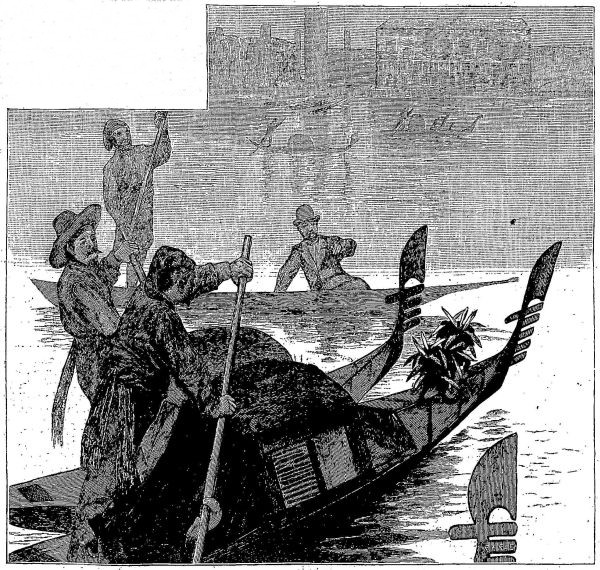
When we left the riva, Tom climbed upon the prow, and balancing himself on the highest part, excitedly sniffed the air. As our house was somewhat off the populous canals, we did not meet any boat until nearly half way to the Piazza San Marco, the central square of the town. Then we began to overtake gondolas of all sizes hurrying toward the piazza, crowded with jolly maskers. At the sight of Tom everybody shouted with delight, "Un' can' che fa carnevale!" (a masquerading dog), and in less time than it takes to tell it our own gondola, with Tom fairly dancing with excitement at the prow, was the centre of a shouting multitude. Oars were splashing, maskers shrieking and clapping their hands, and gondoliers straining every muscle to bring their overladen boats alongside. Rarely was any old carnival hero landed with greater enthusiasm than was Tom in his grotesque costume, and it is worthy of note that he jumped ashore without his usual involuntary bath. On the riva he lifted his small paws very high as the crowd of maskers made room for him, and he pranced away, leading the party to the palace.
In the apartment of his former mistress Tom made a great success, and posed triumphantly on a sofa until we led him away to visit other friends. Everywhere he was the hero of the day, and companies of maskers, fairly intoxicated with mirth, followed his footsteps from one side of the city to the other, only too glad to find something to laugh at. Tom's pride kept him up for hours, and he never lost his presence of mind for a moment. A more thoroughly wearied and self-satisfied dog was never seen than he was when he tumbled into his corner that evening.
I wish I could record new triumphs of this canine king of carnival, but fidelity to fact compels me to tell how disobedience was the cause of his fall. The kitchen fire was simply an open fire of wood, like a camp fire, built on a raised stone platform about as high as a table, and a yard and a half square. We often left dishes standing on this platform, and it was strictly forbidden any one of the animals to get up there on the pain of immediate and severe punishment. When I came into the kitchen the morning after Tom's triumph in carnival, his glory was indeed departed: All the feathers on one side were burned and shrivelled up; those around his shoulders were torn off, and his tail ornaments alone remained uninjured. A hollow in the ashes very near the fire showed where the little wretch had passed the night. I confess I hadn't the heart to inflict my usual whipping, although he had broken a salad bowl and a decanter. But I determined to give him the penalty for a crime of the second degree, and with as much firmness as I could muster made him follow me into the attic, where I intended to confine him for an hour or two in a closet—a punishment he dreaded almost as much as a whipping. The attic was a dark one, so I took a candle, and at the top of the stairs set it down at a safe distance from a cotton curtain which covered a row of garments hung upon pegs. While I was going across the attic to open the closet door, the interior was suddenly illuminated by a brilliant flame. Turning around, I saw the whole curtain in a light blaze. To tear it down and trample out the fire was the work of an instant, and the smoking plume on the end of Tom's tail showed the cause of the fire. He had swung his plume into the candle, and then under the curtain, while he stood there sadly wagging his tail. Of course I could not punish him after this ridiculous accident, and I gathered the singed animal in my arms, carried him down into the kitchen again, and shut him up there with his three companions, while we went away to enjoy the close of the carnival sports.
It was almost dinner-time when we returned with two friends to dine. As I opened the door Tom sprang upon me, overjoyed to see me. I noticed at once a suspicious odor of fish about his whiskers, and saw that he was puffed out like a toy balloon. In the kitchen the mystery was soon solved. Giovanni, the gondolier, who, after the Venetian custom, filled the post of cook, carriage-horse, and man-of-all-work, had learned to make some American dishes, and, to surprise our friends, had made a number of fish-balls for one of the courses at dinner, and had placed them on a high shelf over the sink. Now Tom had persuaded the cat to climb up and throw down the fish-balls, which were neatly arranged on the heavy chopping board. Cats are very fond of fish, and I dare say it did not take much eloquence on Tom's part to induce Dick to perform this feat. And all I found of the fish-balls was a few that were flattened on the stone floor under the board. Tom, Dick, Jerry, and Harry had all gorged themselves, and were in a stupid state in consequence. There was nothing to do but to put them out on the loggia in front of the house, and there on the cold stone platform they shivered and whined and scratched the door all through dinner.
If there was any one rule in the house more for the good of the pets than any other it was that the dogs should not run away. In Venice there is a large tax on dogs, and they must wear both collars and muzzles. Neither of our dogs would endure a muzzle for a moment, and so we were in constant fear of their falling into the hands of the public dog-catcher, the coppa cani. Wherever this man goes, the report of his movements precedes him, and dogs unlicensed and unmuzzled are hurried into safety until he is gone. We, of course, feared his approach as much as any one else, and the absence of any one of the dogs caused great anxiety in the house.
On the afternoon in question, after a leisurely dinner, we went out on the loggia to see the pets. Tom was not among them. He had climbed over the parapet, and made his escape through the ship-yard next door. This last trick quite exhausted my patience, and I had a heavy rod in pickle for him. Darkness came on, but the truant did not appear, and we were all afraid that the coppa cani had found him. At last, about eight o'clock, I took a turn on the loggia to whistle once more for the runaway, and I heard a most piteous moan that seemed to come out from under the house. We all went out and searched, and finally found that the sounds of distress came from a small sewer that emptied into the canal directly under the corner of the house. I jumped into the water, which was only waist-deep, waded round, and rescued Tom from where he was clinging to the brick-work of the sewer mouth. He had tried to return through the ship-yard, but had found the gate shut, then, knowing that if he barked at our door he would get a whipping for running away, he planned to jump from the riva of the street to our loggia, and to trust to a skillfully assumed look of innocence to deceive me and save his skin. The distance to jump was fully four feet, and he fell into the water, as he deserved. What was left of his carnival costume when I rescued him would not have feathered an arrow.
And what became of Tom? Why, of course the coppa cani got him at last. All his actions pointed to his probable fate. When I left Venice I placed him in charge of Giovanni, who was very fond of him. But the life of a gondolier at a ferry was wanting in just those luxuries which made Tom's life with us attractive and agreeable. His vagabond habits grew very fast on him, and Giovanni found it impossible to keep him in the gondola. At last one bright day in summer he was flung into the dark cabin of the dog-catcher's dirty boat, and no more was seen of him.
Tom had his vices, but they were very human ones; I have told few or none of his virtues, but they were remarkable.