HOW TO SAIL A SMALL BOAT.
Reading edition
BY LIEUTENANT WORTH G. ROSS.
CAT-BOAT.
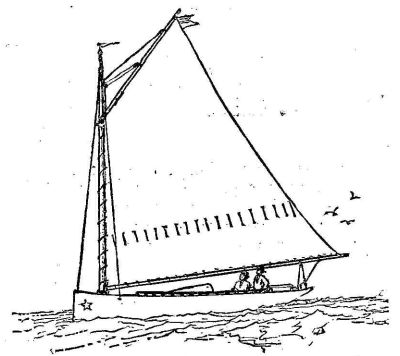
Boat-sailing is attended with far less hazard than is at first generally supposed. When proper care is taken, this refreshing sport affords more real enjoyment than almost any other amusement. It imparts strength, vigor, and health, and is in every respect a prudent exercise. And when we consider how little study and practice it takes to attain the necessary skill to handle a boat with safety, we wonder that there are not more sailing-masters among the young people.
There are two classes of small boats, depending upon their respective rigs, in most common use in harbors, rivers, and lakes—cat-boats and sloops; the former carrying but one sail, secured to a mast placed forward in the "eyes" of the boat, while the latter has a jib in addition to the mainsail. These types are shown in the cuts, but often other sails are used, particularly in racing, and when a good deal of speed is desired. We will deal with the simplest forms, and shall describe the sloop rig—one used quite as often as any other—bearing in mind that the principles of true seamanship apply equally to all boats. The first step is to acquaint one's self with the spars, sails, rigging, and a few terms. By reference to the diagram we find represented—
m m, the mainmast, which is encircled by a number of hoops, to which the mainsail (A) is secured. These hoops enable you to freely hoist the sail.
b b, the bowsprit, which supports the mainmast by means of the jibstay (s s), which leads to the mainmast head, and on which the jib (B) is hoisted.
o o, the boom, which extends the foot of the mainsail.
g g, the gaff, which extends the head of the mainsail.
y, the bobstay, an extension of the jibstay, and the chief support of the spars.
r r, the shrouds, which help to sustain the mast.
SLOOP.
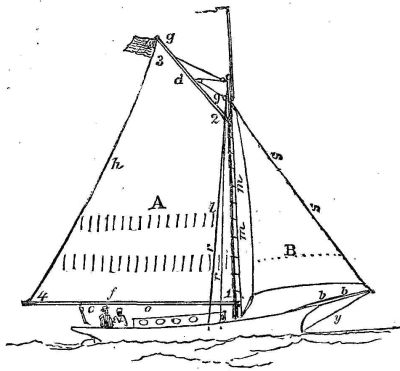
Now each part of a sail has a name, as follows: the luff (l) is that part which extends along the mast; the after-leach (h) is that part which is stretched between the gaff and boom; the head (d) is that part fastened to the gaff, and the foot (f) is the part secured to the boom. The four corners are, in general, called clews, and are divided into tack (1), nock (2), peak (3), and clew (4). The jib has a luff or hoist, head, foot, and leach, but only three clews.
The reef-points extend across the sails, and are pieces of small rope sewed into the canvas for the purpose of "shortening" the sail, when lowered, by passing and tying the ends under the boom or along the foot.
The mainsail is set by throat and peak halyards, which reeve through small blocks on the gaff, down along the mast to the deck. They are usually separate, but on small boats are combined in one rope for the sake of convenience.
The jib is hoisted by jib-halyards, which reeve along the jibstay, through a block at the mast-head, and down on deck.
The main-sheet is a long rope fastened to the boom, double or single, according to the size of the boat, and is used to trim the sail. This is the rope which requires most attention, and is the key to boat-sailing. The jib-sheets are ropes fastened to the clews of the jib, led "aft" on both sides, and are used to trim down the sail with the wind.
A boat is said to be on the starboard or port tack according as the right or left side is presented to the wind. The weather side is the one toward which the wind is blowing; lee is the opposite of weather.
Close-hauled, or full-and-by, means that a boat is sailing as near the "eye" of the wind as possible, and the angle formed is about five points, or 56° 15'.
Before the wind is when the sails receive the direct force of the wind from "astern."
Going free is when the wind is between the two points just named.
To belay means to make fast, as to belay a rope.
Helm applies to the rudder and tiller. She carries a weather helm when her head keeps jumping up into the wind (luffing), and shakes the sails, and a lee helm when she is inclined to go off, or away from the wind. If not evenly balanced, the boat with a weather helm is preferable. The build and ballast, together with the amount of sail forward or aft, regulate the disposition of the boat. Thus the pressure on too much after-canvas gives her a tendency to luff, while a similar fault with the head-sail would make her go off, which is a very bad habit indeed, and should always be remedied if possible.
Now supposing that we have our boat well ballasted, properly rigged, fitted, and trimmed, we will proceed to give some of the main features of boat-sailing.
The care of the main-sheet is one of the most important facts to bear in mind, for upon the correct management of this rope depends the speed of the boat, and in a great measure her safety. In squally weather it should never be belayed, but only a turn taken around the cleat to ease the strain from the hand, being ready to cast off in case of an emergency. No good boat will capsize unless the sails are confined by the sheets. The position of the boom trims the mainsail, and this is done by the action of the main-sheet, the boom being regulated in accordance with the direction of the wind, and the condition of the sea. When close-hauled, it should be at a sufficient angle with the keel to insure the boat moving ahead through the water. When running free, the boom is swung out to a greater degree over the side, and in going before the wind, or scudding, it is more nearly at a right angle with the mast.
Tacking is the process of working a vessel to windward, or against the wind. When you are ready, put the helm down (that is, if on the port tack, the end of the tiller goes to starboard, turning the rudder to port, and the boat obeys by coming up into the wind); this is done at the command, "Ready about!" As she begins to feel this touch, the order is given, "Hard a-lee!" at which words the jib-sheets are tended, and as the boat starts into the wind, the announcement "Let go the jib-sheets!" is a signal to your assistant to let the jib fly. When the craft goes past the direction of the wind, "Trim down your head-sheets!" and soon after, "Let draw!" If the boat is sluggish in coming round, the manœuvre can be helped by pushing the boom over to windward.
A very delicate evolution, and one which should only be resorted to in light summer winds, is jibing. It consists in letting the boat go off slowly from the wind, and while so doing hauling the boom amidships until the wind, blowing from directly aft, takes the mainsail on the other tack. In performing this the main-sheet must have plenty of play, as the boom often whips round with considerable force.
Reefing consists in shortening the sails, and should be attended to at once on the indications of heavy weather. To reef a jib, let the boat come to the wind, and lower the sail so that you can pass and tie the reef-points beneath it. Make the outer clew or tack fast, and shift the sheets. To reduce the mainsail, lower it a little below the boom (after bringing to the wind), stretch the foot down by means of the reef-pennant on the after-leach, and make fast; secure the tack, and then pass the points, tying with a square knot. In shaking out a reef, unknot the points first, then cast off the tack, and lastly the reef-pennant.
Furling sails is the operation of taking them entirely in, and is done by stowing them snugly along the booms with lashings of rope, called gaskets.
In a small sail-boat, when a thunder-shower is coming up, it is always safer to go quickly to a harbor, and there bring her into the wind, and as soon as she loses headway, let go the anchor, and pay out considerable cable before checking her.
When a sudden squall strikes you, there are two methods to pursue—to luff, or to slack off the main-sheet so that the sail will "spill." An experienced boatman usually does the former, but a modification of both systems will be found advisable. The safest position in an open boat in thick weather is for all, except the skipper, to sit in the bottom as near amidships as possible. This prevents the boat from careening, by bringing the weight in the centre.
In conclusion, I would say that if one has his wits about him, manages the main-sheet properly, reefs before the storm, and attends to the rudder, so as to maintain steerage-way, there is no pastime more harmless, fascinating, and agreeable than boat-sailing.
"SPRING."—From a Painting by W. Bouguereau.