MOUNTAIN-PEAKS.
Reading edition
AMONG THE ALPS.
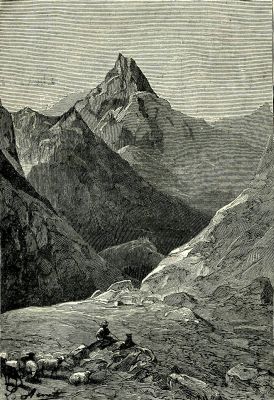
When the world was comparatively young, and people were contented with legends and myths concerning the wonders of creation, just as children like fairy stories, it was the common belief that mountains were the work of gods and genii, who hurled them down from heaven, and allowed them to fall by chance, or else raised them as mighty pillars destined to bear the vaults of the skies. The Titans, who were not gods, threw down all the mountains of Thessaly in order to use them again for building up the ramparts round Olympus. Another story is that a giantess of the North had filled her apron with little hills, and dropped them at certain distances that she might recognize her way. And still another, from the other end of the earth, is that Vishnu, one day, seeing a young girl asleep beneath the sun's too ardent rays, took up a mountain, and held it poised upon his finger-tips to shelter the beautiful sleeper. This, the legend tells us, was the origin of sun-shades. Nor was it even always necessary for gods and giants to lift up the mountains in order to remove them; the latter obeyed a mere sign. Stones hastened to listen to the strains of Orpheus's lyre; mountains stood erect to hear Apollo. It was thus that Helicon, the home of the Muses, took its birth.
Strange as are these stories, they are no more wonderful than the actual fact that, under the direction of the Creator, the two great giants Fire and Water have been and still are at work constructing mountains, slowly, it is true, and not by any sudden upheaval, as the lovers of the marvellous would have it to be, but none the less surely.
While wandering over the surface of the globe, and carefully observing its natural phenomena, we see that mountains are the slow growth of ages. When an insular or continental mass some hundreds or thousands of yards high receives rain in abundance, its slopes gradually become indented with ravines, dales, valleys; the uniform surface of the plateau is cut into peaks, ridges, pyramids; scooped out into amphitheatres, basins, precipices; systems of mountains appear by degrees wherever the level ground has rolled down to any enormous extent. In addition to these external causes which change plateaus into mountains, slow transformations in the interior of the earth are also being accomplished, bringing about vast excavations. Those hard-working men who, hammer in hand, go about for many years among the mountains in order to study their form and structure, observe in the lower beds of marine formation, which constitute the non-crystalline portion of the mountains, gigantic rents or fissures extending thousands of yards in length. Masses millions of yards thick have been completely raised up again by these shocks, or turned as completely upside down, so that what was formerly the surface has now become the bottom. And in this way have been revealed the crystalline rocks. Plication, or folding, is also an important feature in the history of the earth. By this process, subjected to slow pressure, the rock, the clay, the layers of sandstone, the veins of metal, have all been folded up like a piece of cloth, and the folds thus formed become mountains and valleys.
One of the most interesting features in the study of mountains is the discovery of fossils, by which the naturalist accurately determines the age of rocks. Millions of these remains of animal and vegetable life have been preserved. Of course the tissues of flesh and drops of blood or sap are gone, but in their stead are particles of stone which have kept the form, and sometimes even the color, of the creature destroyed. Within the thickness of these stones are shells of mollusks, disks, spheres, spines, cylinders in astounding numbers; we see the skeletons of fish with their fins and scales, the wing-sheaths of insects, and even foot-prints; upon the hard rock, too, which was formerly the shifting sand of the beach, we find the impression of drops of rain, and the intersecting ripple marks traced by wavelets on the shore. These fossils, which lived millions of years ago in the mud of oceanic abysses, are now met at every mountain height. They are to be seen on most of the Pyrenees, they constitute whole Alps, they are recognized upon the Caucasus and Cordilleras.
The wealth contained in mountains in the shape of silver and gold ore and precious stones has ever been, like the magic thread of the labyrinth, leading miners and geologists into the depths of their caverns. Formerly it was supposed to be an easy matter to reach these riches. All that a man needed was what is called "luck" and the favor of the gods. Boldly seizing some opportunity, such as the rolling away of a stone from a crevice, he had but to mutter some magic words, creep into a dark passage, and find himself beneath a vaulted roof of crystals and diamonds; he needed but to stoop and gather the rubies beneath his feet. Not by chance and magic do the miners of our day reach the rich veins of minerals. Study and hard work are behind all the engineering skill which penetrates our mountains.
When the summer is here, and you go forth with merry hearts and stout staves to climb some "Saddleback" or "Mount Tom," just stop and think of all the wonderful things which happen to make a mountain; and as you glance up its wooded sides, and see the clouds resting upon its summit, or behold the purple hues of evening gathering about its majestic form, remember "the hand that made it is Divine."