IN, OUT OF THE STORM.
Reading edition
It is high time that the poor little lamb was taken in, out of the storm, is it not, my young readers? The artist says that when he made the sketch from which this picture was drawn, the season was late in March, and the weather for a few days had been so warm that the children in the farm-house where he was staying thought old Winter had surely gone. He was still there, however, and to prove his presence he sent one of his very worst storms of snow and sleet, that lasted all day, and made people think that the almanacs were wrong, and that the month must be January instead of March.
THE RESCUED LAMB.—Drawn by W. M. Cary.
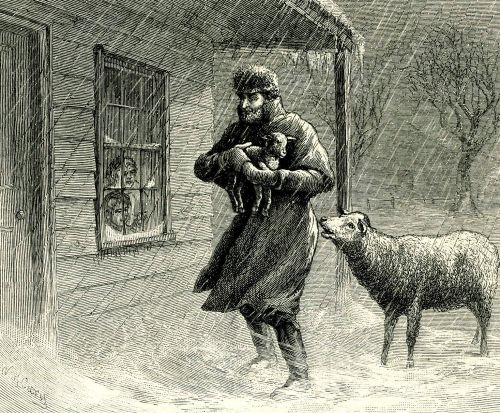
In the midst of this storm, as the children were looking out of the window, and wondering if summer ever would come, they saw their father walking from the barn with something in his arms, and followed by their old pet sheep Mana. As their father came near, the children saw that he held a dear little lamb in his arms; and when he got into the house he told them that Mana was its mother, and that it had been born out-of-doors in all the terrible storm. If he had not been led to the spot by Mana's pitiful cries just when he was, the poor lamb would have been frozen to death. As it was, the little creature was chilled through, and had to be wrapped in flannel, placed close beside the fire, and fed with warm milk before it recovered. The children took such good care of the lamb that their father gave it to them, for their own; and when at last the summer did come, in spite of the efforts of old Winter to prevent it, the "cosset" well repaid their care of him by his funny antics and pretty ways.
On that stormy afternoon, after the lamb had been made as comfortable as possible, the children gathered about the artist, and asked him so many questions about sheep, that they finally gained from him the following information.
"Sheep—that is, common domestic sheep—are certainly dull and uninteresting animals, but this is partly because we do not usually see them to advantage. Sheep are naturally mountainous animals; if left to themselves, they always prefer hills and rocky mountains to plains and low-lying pasture, and are as active in climbing as goats. At the period of sacred history, sheep were evidently not considered stupid. It was the custom to give each individual a name, to which each would answer when called. This custom still exists in Greece, and, I believe, in some other countries. A missionary tells us that once when he was travelling in Greece, in passing by a flock of sheep, he begged the shepherd to call one of them by name; he did so, and immediately the sheep left its companions and its pasture, and ran up to the shepherd with evident signs of pleasure. The shepherd told the missionary that many of the sheep were still wild, that they had not yet learned their names, but that by teaching all would learn them. Those which knew their names and would answer to them he called tame. Some years ago, pet lambs used to be quite a fashion, and there have been many poems and stories written about them. The poet Wordsworth wrote a very pretty account of a pet lamb and a mountain maiden; and all children ought to read Miss Edgeworth's story of Simple Susan and her lamb. Queen Victoria, when she was a little girl, and lived at Kensington Palace, had a pet lamb with a pink ribbon round its neck. Some children I know had one which was very tame and affectionate. When it grew up it was too rough and big for a play-fellow, and was sent to join a flock of sheep; but long afterward, when the children came past, it would leave the others to run to them."
WASHING-DAY.