THE STORY OF THE OPERA.
Reading edition
BY MRS. JOHN LILLIE.
One evening toward the close of the sixteenth century, a group of gentlemen were hurrying up the staircases and along the corridors of a house in Florence.
They were richly dressed, according to the custom of the time. But they were all students, all deeply absorbed in music, and they were on their way to the salons of one Giovanni Bardi, Conte di Vernio, for the purpose of discussing a new idea in their beloved art.
Now if we followed these gentlemen, what should we hear and see? Something very interesting, but, from our point of view to-day, very strange; for they were determined to develop opera, yet they had but the vaguest idea how it should be done.
Opera in its present form had so far been unheard of. The only idea these Italian gentlemen had of it was from the Greek lyrical dramas. You know that in ancient Athens there was a famous theatre where plays were given, accompanied by an orchestra of lyres and flutes. The chorus of the Agamemnon was sung, and some of the dialogue was given in a sort of recitative. Then, in early English times, music, or recitatives was introduced into the simple plays usually performed in the public streets. People in various countries had been gifted with some perception of the beauty of music and dialogue, but a regular opera, as I have said, was unknown.
Our Italian gentlemen discussed this idea over and over again, and some efforts were made to carry it out. One of these gentlemen, named Caccini, wrote a series of songs or "pieces," which he sang at Bardi's house one evening, accompanying himself on the lute. He had a beautiful voice, and every one was delighted.
Little by little the idea of a musical drama gathered strength, and one of the first performances we read of was at Mantua, in 1594, when a curious sort of work called L'Amfiparnasso was given. We who have seen opera in its perfection would be, I am sure, highly amused could we hear L'Amfiparnasso given just as it was then.
There were five voices, no overture, and no instrumental accompaniment of any kind. But when two singers were on the stage, the remaining three stood behind the scenes singing a sort of accompaniment. Everybody in Mantua was delighted, and L'Amfiparnasso was a great success.
What would dear old Master Vecchio, who wrote it, have said had he looked ahead nearly three hundred years, and seen the great Bayreuth Festival, where Wagner's operas were produced with such a wealth of orchestra and voices?
I think it safe to say that the first true Italian opera, on which all others have been founded, was Euridice, by Peri, and this was produced in 1600, when Henry IV. married Mary of Medicis. Several noblemen performed in it. Behind the scenes they had a sort of orchestra: a harpsichord, a chitarone,[1] a sort of viol, and a large lute. Three flutes were added to this little orchestra. I have just been reading part of the score, and it has much delicacy and spirit.
I have not space to tell you of the progress of the opera in Italy and Germany and France, but it advanced steadily, and in France, where a composer named Lulli lived in 1650, it reached a great height. Lulli had been brought from Florence as a page at the court of Louis XIV. He served the King's niece, Mademoiselle De Montpensier, and no doubt heard all the finest music in her boudoir. He it was who established the opera in France.
Among Italian composers of this early period, the man who seems to me most interesting was Alessandro Scarlatti. He made many improvements in the form of the opera, varying its monotony in very original ways.
Another famous Italian of the same period was Stradella, whose church music we hear now much more than formerly. Poor Stradella's life was a terribly sad one. He was a gentleman of great refinement, but he was not of the highest rank, so that when he fell in love with one of his pupils, whose rank was above his, there was a great deal of excitement over it in Venice. Stradella married his fair pupil, and for some years led a life of terror, as assassins pursued him. Once, we are told, three of these men, hired to kill him, followed him to the Church of St. John, in Rome, where he was to sing, and there, listening to his heavenly voice, their purpose changed. His music took away all their blood-thirsty feelings. But he was not destined to escape the vengeance of his wife's friends. In Genoa, after repeated attempts on Stradella's life, he and his wife were both cruelly stabbed to death, the assassins escaping. Stradella was only in his thirtieth year, but he had written some of the finest music in Italy.
I could tell you much of the rise and progress of opera in England, but in our short space must group a few facts about some one centre. The English seemed from very early times to delight in combining music with dialogue. They used, as I have said, to give performances in the public streets. The singers stood in large carts, around which crowds of people collected. With all their grotesqueness and absurdity there was a dignity about them which impressed their rude audiences.
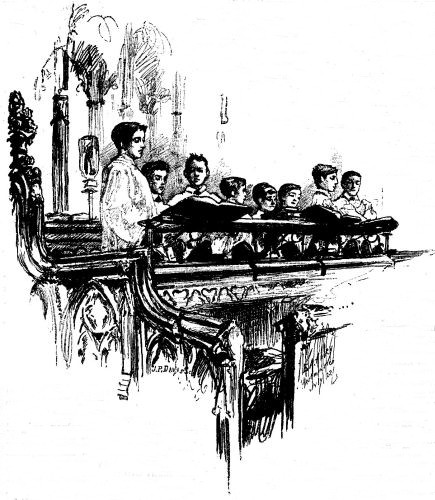
In 1658 was born in London a boy named Henry Purcell. Music seemed to grow with him. When he was very young he was put into the choir school at Westminster Abbey, and it was only the other day I was standing in the old school-room where the boy Purcell sat, and looking at a quaint old picture of him which hangs upon the wall.
The Westminster boys were taught music very fairly by old Cook and Humphries. It must have been a cheerful life. To-day the school has been enlarged and beautified, but even then it surely possessed the charm of peace, and yet great harmonies, for it stands almost in the shelter of the Abbey, and all day long the boys had the dear old cloisters to run about in, and twice a day they listened to glorious music on the organ. Purcell grew full of musical fire, and when he was eighteen he was appointed organist of the great Abbey. He wrote constantly—catches, glees, songs, and hymns, which to this day are listened to and sung with delight.
It was when Purcell was about nineteen that he one day received an invitation from a school-master to call, on musical business, at his house in Chelsea. Thither he went. He found a young ladies' school, and an energetic master who wished his pupils to perform something operatic. So Purcell wrote the music, and Tate the words, of Dido and Æneas, a little operetta, in which he himself performed, and which was so successful that henceforth he wrote chiefly for the stage.
But all the time everybody in London was singing or playing his glees and madrigals. In Westminster was a famous old tavern known as Purcell's Head, and clubs used to meet there to sing his music. Meanwhile we can fancy Milton as a youth playing his most solemn music in that quaint room of his with its faded hangings and grand organ, and at the theatre elaborate performances of The Tempest, The Indian Queen, and other plays, to which was added "Mr. Purcell's musicke."
Those were rollicking and riotous times. Purcell's sweet music seems to come in with some feeling of soothing sounds, but had the times been better, he would have done more, I am sure, in his noblest direction. Everything at court and around it was careless and reckless. Dryden, the poet, who wrote many of the plays for which Purcell furnished music, bitterly regretted when he was older that he had wasted so much time amusing an ungodly people. Purcell seems only to have thought of his music, and certainly at this date, two hundred years after his death, his sweetness and charm are as strongly felt. In 1695 he died, and his tomb is in the Abbey where his childish feet so often passed and repassed, and beneath the organ where he so often played in his most innocent and most happy years.
Opera seems from the end of the seventeenth century to have gone on gaining new force and beauty in every country, and to-day it is supposed by some critics to have attained its highest form in Wagner's music. I fear those eager Italian gentlemen who used to meet in Conte Vernio's brilliant rooms would be very much alarmed by some of the German operas of to-day, and I own that, with all love of Wagner's great music, there is a peculiar charm in the old airs of operas which people try to scoff at now. Ten minutes ago an organ-grinder stopped under my window and began droning out "Ai nostri morte," that sweet air in Verdi's Trovatore, and I felt as if it was very near the Italy of the seventeenth century. But this must not make you think that Wagner has not science and strength and the utmost beauty on his side.
WHAT THE SPRING BROUGHT TO LITTLE LAME ELSIE.