PUNCHINELLO.
Reading edition
HIS EXTRAORDINARY LIFE AND MARVELLOUS ADVENTURES.
III.
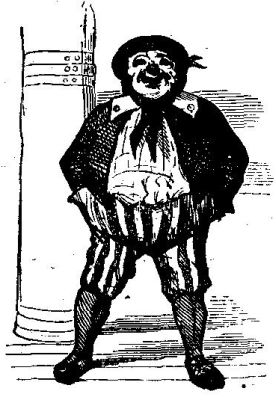
The next day, early in the morning, Punchinello came on deck to see the sun rise.
"A storm is rising," he announced.
The Captain laughed at Punchinello's prediction, and so did the crew.
But suddenly the sky became black, the waves grew larger, and the ship commenced to roll dangerously.
"I told you, sir, that you would be drowned," said Punchinello.
The Captain, furious, instead of attending to the management of his ship, thought only of revenging himself on Punchinello.
"You scoundrel!" cried he, "if I am going to be drowned, you shall be so first."
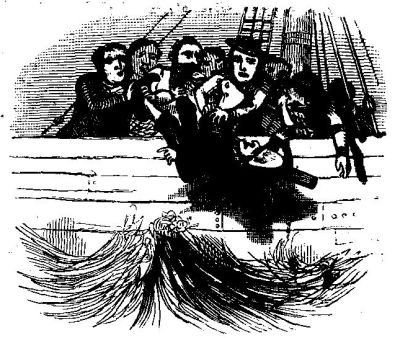
Immediately poor Punchinello was lifted up and held between the sky and the sea. But even in this terrible situation he did not lose his presence of mind.
"Mercy on you, my good people!" said he. "You will not have long to rejoice over my death, for I see some one coming who will avenge me."
All eyes were turned in the direction which Punchinello indicated. About a mile off, the fire of the cannons of a Turkish pirate ship was to be seen.
"Horror upon horrors!" screamed the Captain, "we shall all be killed." So saying, he rolled about the deck, weeping.
"As I happen to know the Turkish language perfectly," said Punchinello, "I shall be able to save you." He then withdrew to his cabin, and dressed himself like a Turk, which gave him the most extraordinary appearance you can imagine. This done, he saturated his garments with a strong and disagreeable odor that he had obtained from the juice of a sickly plant.
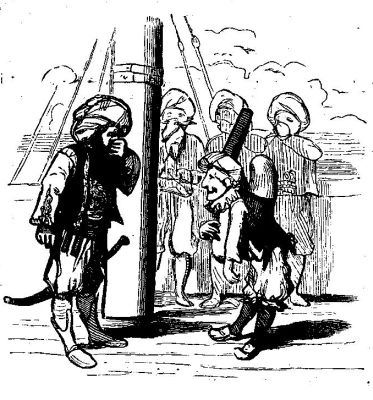
In this guise did he approach the Turkish vessel, and was hoisted on board. At the sight of this mountebank, or on account of the horrible odor, the pirates showed much surprise, and could not resist holding their noses.
"It really is nothing," said Punchinello. "Friend Pasha, I have come from that miserable Spanish ship, which I trust you will soon take possession of."
"But," interrupted the Pasha, "Brother Hunchback, what ever is this dreadful smell?"
"It is nothing, my lord," replied Punchinello. "A number of the men on the Spanish vessel are ill. The physician has said that it might be the plague. Thus we use these ill-smelling things to protect us from the disease."
"The plague!" roared the Pasha, rising hastily. "The wretch has the plague. Throw him into his boat. Let us get away as fast as we can. Friends, they have all got the plague."
The Pasha had not said this before Punchinello jumped into his boat and returned to his own quarters, where he was received with transports of delight, for the pirates had already fled, and were soon out of sight.
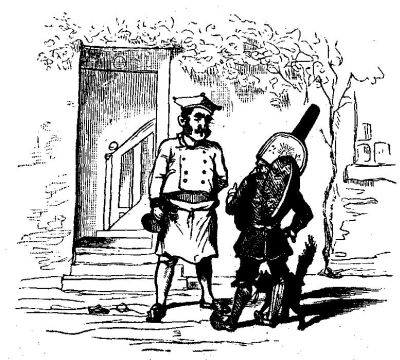
Directly he landed at Marseilles, Punchinello sought for a horse to take him to Paris. While he was purchasing his animal, a big black cat came and rubbed itself against his legs.
"That cat," said the owner of the horse, "knows the way to Paris as well as any one; and I have given him as guide to several travellers."
"Ho! ho! I shall take him with me, then, if that is the case, just to find out what a rogue you are, my fine fellow."
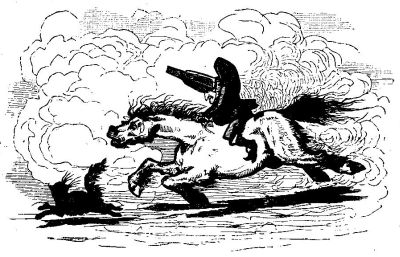
Punchinello galloped at full speed toward Paris, and was much astonished to see the big cat run on before him with marvellous rapidity. But his surprise soon changed to uneasiness when he observed that the speed of the cat was rapidly increasing, and that his horse was following it at the same rate. Both seemed to have gone mad.
"This is horrible!" cried Punchinello. "Friend Puss, good creature, are we not going to have some dinner somewhere? What is the matter with you? Whoa! Faith, my clothes are all falling off me!" But this discourse only spurred on the cat. Suddenly, when they were going at the same rate through a dark forest of chestnuts, all at once the whole cavalcade sank into the earth, and disappeared as if enchanted.
Punchinello now found himself, with his feet in the air, in the midst of about thirty persons of the most forbidding appearance possible. They were in reality thieves of the worst character.
"Lord Punchinello," said the Captain of the band, "I hope you will consent to remain with us; for if you refuse, I shall have you put in a pot and boil you alive."
"I understand that I should not be worth much boiled," said Punchinello; "therefore I am at your service, sirs."
Punchinello saw that he was a prisoner, and therefore began at once to plan how to escape. The Captain, whose name was Ronflard, departed that very evening, thus giving him an opportunity too good to be lost.
The next day he said, laughing: "Comrades, you lead a jolly life down here, but I confess that I can't help regretting the delightful amusement that always enchanted the Neapolitan Court after dinner."
"What was it?" cried the whole band at once.
"It consists," said Punchinello, "in descending a steep hill in little sledges, going one after the other, and running on rails. Nothing would be easier than to arrange the same sort of thing on the slope that I descended yesterday evening to get here."
"That is the thing to suit us exactly," cried the brigands on all sides. "Friends, to work at once and build some sledges!"
Soon all was ready. Each of the twenty brigands got into his own sledge upon the platform that was just at the top of the staircase underneath the trap-door.
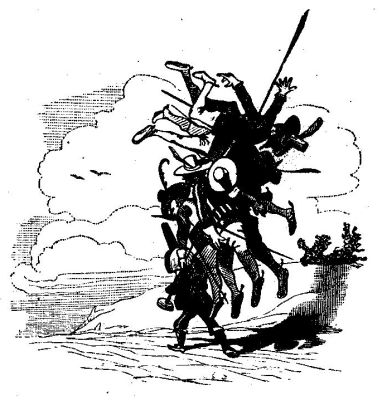
Punchinello remained at the bottom of the staircase. The brigands in their twenty sledges set off, descending the slope with terrible rapidity; but, lo and behold! as soon as they were going at full speed, Punchinello drew a huge skewer, about thirty feet long, from behind his back, and held the point toward the tops of the sledges, which were descending with immense rapidity. Horror was depicted on the faces of the brigands. Their cries were piteous. However, whether they would or no, they were obliged to fall upon the skewer. They went rolling down zigzag; the first brigand arrived like lightning, and thirty feet of steel went through his body. The others came rolling down, and were impaled, one after the other—a horrible death, but a fitting end to their guilty lives.
Punchinello then put the skewer, with his extraordinary game, on a cart, harnessed six horses to it, and arrived in less than two hours at the town of Chartres. He immediately inquired the address of the magistrate.
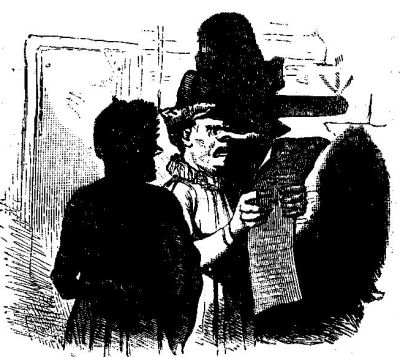
Directly Punchinello entered the low room where this personage awaited him, he was almost dazed at recognizing in the nose of this official the counterpart of the one he had seen the night before on Captain Ronflard's face. Indeed, such a nose was not to be forgotten when once seen. Its length was so great that it made its appearance, so to speak, about a quarter of an hour before its owner. It stretched straight out like a staff, or the shaft of a carriage.
Of course Punchinello understood at once that the magistrate, by a bold appropriation of two offices, united the power of a justice with his horrible trade of chief of a band of robbers. With great self-command, he pretended not to have recognized Ronflard in his magistrate's robes. The latter had the account of Punchinello's escape related to him, and, caressing his big cat, he complimented Punchinello upon his courage, and begged him to sup with him.
What passed during the meal was never quite cleared up, as Punchinello confessed that he did not know himself. Some have concluded that he must have swallowed some terrible drug. What is known for certain is that the next morning Punchinello found himself in a damp prison. He began to think over his past life, until, remembering the look of regret that his donkey had given him when he said good-by to him forever, tears fell from his eyes.
"Who is that that is complaining over there?" said a voice suddenly, quite close to Punchinello.
"It is the poor son of a fisherman," replied he, "who is deformed in front and behind. But who are you?"
"I am the Goodman Patience," replied the voice, "and my trade is to show puppets gratis to amuse poor people and little children."
"By my wig—" cried Punchinello. But he was cut short by the prison door groaning on its hinges; and the magistrate entered, followed by his black cat. By the light of a torch Ronflard read their sentence, in which they were condemned to be hanged in an hour's time.
When Punchinello wished to remonstrate, the magistrate withdrew, grinning. Punchinello, enraged, noticed the big cat that was going out after its master, and shut the door with such violence that the tail of the animal was cut clean off at the root. Immediately it was transformed into a long rope.
"Ha! ha!" cried Punchinello, "I move that we make this tail useful. I see my way to an escape."
Punchinello mounted the tail, of which he held the tuft as a bridle, whilst Patience placed himself behind.
"Good!" cried Punchinello. "One, two, three—and away to Paris!"
Punchinello had hardly time to realize that he was travelling when he was set down, with his companion, in the middle of the Champs Elysées. It was on a beautiful day in spring, about noon.
"Listen," said Patience: "I have an idea in my head. I will establish my little theatre here, and if you will appear as an actor, it can not fail to prosper. There is no question but that your wit, added to your funny appearance, will attract numbers of spectators."
"Well, perhaps so," said Punchinello; "and I confess that I thought of that myself. As I have only found envy and malice amongst the great, what better use could I make of the wit that has been given me than to employ it in amusing poor people, and little children who are always innocent and good? I am poor myself and of lowly rank. I will make them laugh, and I will bring roses to the cheeks of all the sweet little children that pass, for in so doing I shall reap a blessing."
In the course of time Punchinello made the acquaintance of Judy, and married her. She has been a great help to him in his performances, as you will all allow. If you are puzzled as to how he manages to be in so many countries and at so many different places at the same time, it is because he still retains the rope made of the cat's tail, which carries him anywhere at a moment's notice.
the end.
OUT FOR A WALK.