Chapter II
Reading edition
Mrs. Brown was not quite so bad as her word, for she did not take away Biddy's doll every night when Biddy could not give her extra pay. Of course there were many nights when Biddy could not do this, even with Charley's help. She had, in the first place, to pay for her straw, her soup, and her bread. Whenever she had earned more than enough for this, Mrs. Brown had always tried to get it away from her on some pretense or other. Biddy had a brave heart; she had never been afraid of the rough old woman, and often had her own way.
If you should use your soft little hands to do coarse and heavy work, it would not be long before they would get out of shape, and become covered with a thick skin. They might still be very good and dear little hands inside, but they would not so quickly feel the softness of mamma's cheek. All the pleasure of the sense of touch, which you would then find had been great and of many kinds, would be lost to you. So it was with Biddy's heart. She had never had any of the little pleasures, the good times, little hopes and plans, to which all children have a perfect right. Her hard, friendless, cheerless life had made the outside of Biddy's brave little heart tough, just as hard, unfit work would toughen your little hands. But the doll had made a difference to Biddy in every way. She had done all she could for her doll. She loved it. She had made it a dress from a piece of her own. She had been beaten again and again for its sake. Almost more than you would be willing to do for your doll, is it not? But it had done and was doing a thousand times more for Biddy, because Biddy had what the doll had not—life.
Mrs. Brown sometimes forgot to torment Biddy about the doll, and at other times she seemed to feel too stupid and dull to care about it. But she remembered quite often enough, and got away all Biddy's money, and gave Biddy many a scare and heart-ache about it. At last the hard-hearted old woman went too far, as cruel people are pretty sure to do in the end.
About four months had passed since Biddy first found her doll. The warm winds, the green buds, and singing-birds of spring had come, when one night Mrs. Brown took the doll away from Biddy, and told her that unless she could bring her at least two dollars by the close of the week, she should never see it again.
That night Biddy lay awake a long while thinking over what she could do. It was late in the night when she whispered to Charley that she had made up her mind, and wanted to see him somewhere in the morning, and tell him her plan. Charley answered that he would watch for her in the Bowery near a jewelry shop where they had often stopped to look at the pretty things in the window. He said he would be there about half past eight o'clock. After this was settled, Biddy fell asleep.
In the morning the children met as they had agreed, and walked slowly down the Bowery for a block or two, while Biddy told her plan to Charley.
"I can't tell ye all I've been thinkin'," said Biddy; "I feels all stirred up with thinkin', like the soup when Grumpy puts the stick in it. I never slept at all till I thinked it out as how I'd do jist one thing."
"Yis, yis," said Charley, eagerly.
"I'll find a home for Dolly an' me," said Biddy; "I'll begin an' never stop till I gits it."
"Ye'll find a home?" asked Charley. He was a good deal puzzled.
"Yis," said Biddy; "I telled ye my mind's made up. I'll look at every man as I meets, an' I'll ax the first one as I likes the looks of to take me an' try me. Some of 'em'll be wantin' a girl, sure."
Charley continued to look so astonished that Biddy explained: "'Most every one wants a girl to do chores, an' sweep, an' dust, an' make fires, an'—an' sich. I've seen lots o' girls no better nor me sweepin' in the big houses, with cloths on their heads."
"Ye know all them things?" said Charley.
"An' if I don't, can't I be teached?" said Biddy, almost angrily. This question seemed to make everything quite sure.
"Now I'm goin' to begin," said Biddy.
"BLESS ME! IF IT ISN'T PHIL KENNEDY."
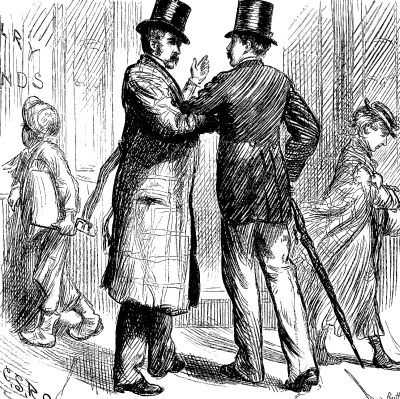
She darted away, and ran back to the place where she and Charley had met. Charley slowly followed. He held his unsold papers under his arm, and stopped by the jewelry window. Biddy had taken her stand on the corner just opposite. A gentleman with a closed umbrella in his hand, which he used as a cane, was coming down the Bowery toward them. He did not seem to notice either of the children; his head was down as if he was thinking. At the same instant another man, with his Ulster coat flying back, came swiftly from a cross street, and taking the first gentleman by the arm, said, so loud that both the children heard it: "Bless me! if it isn't Phil Kennedy! How odd this is! The first day for an age when I'm not thinking of and hunting for you, Phil, I find you."
"But I'm very busy; you really must not keep me," said the one called Phil Kennedy. He smiled as he spoke. Biddy saw the smile. She did not wait an instant; she stepped up close in front of him. "Does yer missus be wantin' a girl?"
Both men looked down at her. The man in the Ulster laughed. "Get along, you little drab!" said he, in the same loud voice as before.
Biddy did not move, or take her eyes from Phil Kennedy's face. The fingers of her hands were twisting together as on the day when she had first begged Mrs. Brown for her doll. Biddy did not know she was doing anything with her hands.
"Be off, I say!" said the man in the Ulster. He spoke very sharply this time. It was like a blow from a cane.
"Can you read?" said Phil Kennedy to Biddy. He was feeling in his vest pocket as he asked this question, and drew out a card.
"I knows 'em as can," said Biddy.
He gave her the card. "Get some one to tell you what is on it," said he, "and come to the place it says—let me see—can you come to-morrow morning about this time?"
Biddy took the card. "Will ye be there?" said Biddy.
"Yes, my little girl, I will." He smiled at her as he spoke. Biddy crossed her hands over the bag she carried, and walked away without a word.
"I see you are just the same," said the man in the Ulster. He looked vexed. "Who'd believe you'd give that thankless little beggar your card, while some of your best friends don't know where to find you!"
"Thankfulness is better than politeness," said Phil Kennedy. "She can be taught to be polite. If you had looked at her, you would have seen that she thanked me."
The two men then walked away.
Charley had not looked round at Biddy and the gentlemen once. He had looked steadily into the window, which had on it, in large letters, "Jewelry and Diamonds." His heart beat very fast; he hardly noticed the gems that flashed and sparkled in the trays and boxes. But when the men had passed on, he turned and looked up and down the street, and after a moment saw Biddy sitting on the lower steps of a wholesale store. He hurried up to her. Biddy had been crying a little, but her eyes were shining with hope. She held the card to Charley.
"I axed 'em in there," said she, "an' they telled me as it's the place where a very nice gentleman have his home, an' it's his name is on it, too; an' they axed me how ever did I gits that gentleman's card. An', oh, Charley, do ye thinks as his missus'll be wantin' me? An', oh, do ye think ye can hook away my dolly from Grumpy?"
Biddy stopped for breath. Charley looked up at the windows of the store, as if he were trying with all his might to see just how they were made; then he looked back toward the Bowery again.
"How queer ye look!" said Biddy.
Then for the first time Biddy thought of what Charley might be thinking. She rose quickly from the steps.
"Here, ye take the card," said she. "I'll mebbe lose 'em, or she'll be after gittin' it. An' ye shall go with me in the mornin'; an' if I gits a home, I'll speak for ye. Do ye mind that, Charley? They'll be after wantin' of a boy as much as a girl; an' I can give ye a fust-rate riccommend, so I can."
Biddy made him take the card, and punched him once or twice to make sure of his attention.
"Did ye look at him, Charley?" she asked as they walked along. "Did ye mind the two kind eyes of him? The minute ever he looked at me I warn't a bit afeard; an' I felt as I could work my fingers to the bone for him."
Biddy went the next day to the place written on the card Mr. Phil Kennedy had given her. She teased and coaxed Charley a long time before she could get him to go with her, for he was very bashful, and hung back all the way. While she stood at the foot of the steps, looking up to be sure about the number, Mr. Phil Kennedy himself came to the door, and called her in. He looked just as kind and smiling as on the day before, and Biddy bobbed her curly head up and down, to show him how glad she was. She was so eager that she did not think to say "Good-morning"; but she cried out, in a glad, piping voice, "Here's Charley, sir; an' the best boy ye can ever see! If ye wants a boy to take care of the furniss an' fetch the coal; an' he can run of errants faster nor me; an' he mended me doll. Charley—"
While Biddy talked she kept making little springs and jumps at Charley, who kept edging away, so that Biddy was likely to get half way down the block, when all at once Charley turned, and showed his speed by running out of sight very quickly indeed. Biddy looked as if she was going to run after him; but Mr. Phil Kennedy, who stood laughing in his doorway, called after her, and Biddy came back. He led her through the hall, into a very pleasant room. There was an open fire, a bright rug in front of it, a mocking-bird in a cage in the window, and a beautiful lady sitting in an arm-chair, with her feet on a cushion. The lady was pale; her hands were thin and white; there were crutches beside her chair; but she looked as if she were very happy; and when she smiled at Biddy, Biddy could not have told why she felt as if her heart was filling her whole body.
"Let her sit here near me, Phil," said the lady. Then, when Biddy was seated between them, they asked her a great many questions, and Biddy answered them all as well as she knew how. Both spoke so kindly, sometimes the lady and sometimes the gentleman, and seemed to care so much to know all about her, that Biddy took a new interest in her own story, and told it very well. Like the stories of thousands of other friendless children, Biddy's story was very simple. She didn't know where she was born. She had never seen her parents. She didn't know if she had any brothers or sisters; she did know she had never seen any. She had never been at school. She had never slept on a real bed only when she was in the hospital. She had had a "reel good time" in the hospital. A little girl had given her some flowers. She had a friend; his name was Charley; and if they wanted a boy to do things, he was the best boy. He had mended her doll. She wanted a home for her doll. Grumpy wouldn't let her have her doll; that was why she wanted a home. And if they would let her bring her doll, she would do all she could, and try hard to please them.
When Biddy came to the end of her story, Mr. Phil Kennedy said:
"This lady is my sister. She is the only near friend I have in the world, Biddy. If you come to live with us, we will take good care of you, and you must take good care of her. She is lame, and can only walk a very little. You must watch, and learn to save her trouble. She will teach you the things she wants to have you do, but you must not make her tell you the same things over and over again."
Biddy sat very still, and when Mr. Kennedy paused, she waited for him to speak more. He seemed to think for a few minutes very deeply, then he said:
"After you have learned what you are to do, Biddy, I shall want you to help me find some other little girl who has no friends, and needs a home just as you do, and I can perhaps find a home for her too. I have heard all you have said about Charley. There are reasons why I can not help him just at this time. But I promise you that I will remember about him, and will see what I can do for him as soon as I can. Now, Biddy"—and Mr. Kennedy smiled, with a very merry look—"what wages do you think we ought to pay you?"
Biddy did not seem to even hear this question, she was so much interested in the other things Mr. Kennedy had said; and the moment he stopped speaking she asked if she might really have her doll, and when they had satisfied her on this point, she told them Charley would bring it. Then she seemed to suddenly feel how great a change had come in her life. She jumped down from her chair, looked round the room, her breath coming quick, then at her new friends.
"Oh, it's home it'll be! An' if ye'll let me begin," she cried, "I'll try to be so good, so I will!"
[to be continued.]