BISHOP HATTO.
Reading edition
The story goes that there once lived in Germany, in a handsome, spacious palace, a selfish, fat old Bishop. His table was always spread with the choicest dainties, and he drank in abundance wine of the very best; he slept long and soundly, and looked so comfortable and happy and fat that the people whispered to each other, "How grand it must be to be a Bishop!"
One summer, in the neighborhood where the Bishop lived, the rain came down in such torrents, and continued so long, that the grain was utterly ruined, and when autumn arrived, there was none to be gathered. "What shall we do," said the poor fathers and mothers, "when the long winter comes, and we have no food to give our children?"
Winter arrived, bringing the cold winds and the snow and the frost. The little ones begged for bread, and the poor mothers were compelled to say the bread was all gone.
"Let us go to the Bishop," at last said the poor pining creatures. "Surely he will help us. He has far more food than he needs, and it is useless our starving here when he has plenty."
Very soon from his palace window the Bishop saw numbers of the poor people flocking to his gates, and he thought to himself: "So they want my corn; but they shall not have it; and the sooner they find out their mistake, the better." So he sent them all away. The next day others came. Still the Bishop refused, but still the people persevered in calling out for food at his gates.
At last, wearied with their cries, but still unmoved by their pitiable condition, the Bishop announced that on a certain day his large barn should be open for any one to enter who chose, and that when the place was full, as much food should be given them as would last all the winter.
At last the day came, and for a time forgetting their hunger, the women and children, as well as the men, both old and young, crowded up to the barn door.
The Bishop watched them, with a smile on his deceitful old face, until the place was quite full; then he fastened the door securely, and actually set fire to the barn, and burned it to the ground. As he listened to the cries of agony, he said to himself, "How much better it will be for the country when all these rats," as he called the poor sufferers, "are killed, because while they were living they only consumed the corn!"
Having done this, he went to his palace, and sat down to his dainty supper, chuckling to himself to think how cleverly he had disposed of the "rats."
The next morning, however, his face wore a different expression, when his eye fell upon the spot where the night before had hung a likeness of himself. There was the frame, but the picture had gone: it had been eaten by the rats.
At this the wicked Bishop was frightened. He thought of the poor dying people he had spoken of as rats the day before, and he turned cold and trembled. As he stood shivering, a man from the farm ran up in terror, exclaiming that the rats had eaten all the corn that had been stored in the granaries.
Scarcely had the man finished speaking when another messenger arrived, pale with fear, and bringing tidings more terrible still. He said ten thousand rats were coming fast to the palace, and told the Bishop to fly for his life, adding a prayer that his master might be forgiven for the crime he had committed the day before.
"The rats shall not find me," said Bishop Hatto, for that was his name. "I will go shut myself up in my strong tower on the Rhine. No rats can reach me there; the walls are high, and the stream around is so strong the rats would soon be washed away if they attempted to cross the water."
So off he started, crossed the Rhine, and shut himself up in his tower. He fastened every window securely, locked and barred the doors, and gave strict injunctions that no one should be allowed to leave the tower or to enter it. Hoping that all danger was over, he lay down, closed his eyes, and tried to sleep. But it was all in vain; he still shook with fear. Then, all at once, a shrill scream startled him. On opening his eyes he saw the cat on his pillow. She too was terrified, and her eyes glared, for she knew the rats were close upon them.
Up jumped the Bishop, and from his barred window he saw the black cloud of rats swiftly approaching. They had crossed the deep current, and were marching in such a direct line toward his hiding-place that they might have been taken for a well-marshalled army. Not by dozens or scores, but by thousands and thousands, the creatures were seen. Never before had there been such a sight.
"Down on his knees the Bishop fell, And faster and faster his beads did he tell, As louder and louder, drawing near, The gnawing of their teeth he could hear. "And in at the windows, and in at the door, And through the walls helter-skelter they pour, And down from the ceiling and up through the floor, From the right and the left, from behind and before, From within and without, from above and below, And all at once to the Bishop they go. "They have whetted their teeth against the stones, And now they pick the Bishop's bones. They gnawed the flesh from every limb, For they were sent to do judgment on him."
Such was the horrible fate of Bishop Hatto; and whether it be perfectly true or not, it is a striking illustration of the folly, as well as the cruelty, of selfishness.
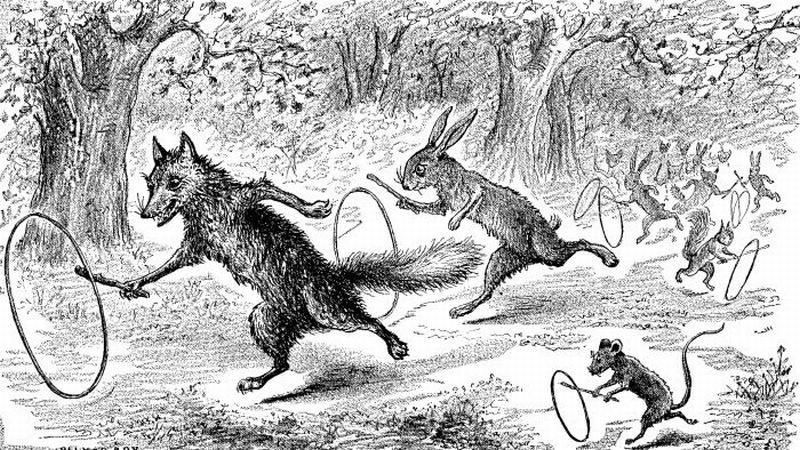
FUN IN THE WOODS.

Fulton Wells, California.
I am assistant teacher here in Little Lake district. I have a class of seven boys, among whom I am dividing the year's subscription of Young People. The "Parrot Story" I read aloud in school, and am now doing the same with the "Brave Swiss Boy." I read a chapter in the morning, and those who are tardy lose the story till they can borrow the paper. Every number is sewed, and the leaves neatly cut, and the boys are much pleased with the charming little paper and the beautiful stories. The story about the "Flower that Grew in a Cellar" left them hushed and thoughtful for several minutes afterward. The puzzles and "Wiggles" are all discussed, but none of the boys dare send answers for fear they "wouldn't be right." A great California owl flew into the school-room the other night through the top of a lowered window, and staid all day perched up over our heads, with his great soft dark eyes shut, and his chin comfortably settled in his beautiful feathers. We have made "Tombolas," and they are very funny. We are so glad you are publishing this paper; it is just what we needed.
Jennie R. Bush.
Portland, Oregon, January 21.
My brother Henry and I have just picked a bunch of willow "pussies" for our mamma.
Clara Teal.
Palmyra, Missouri.
I am six years old. I see a good many little girls write letters to Young People. I like the paper first-rate, and so does brother Will. He is a big boy thirteen years old, and can skate. We are having a very warm winter here in Missouri, and not much ice.
Gertie Courtright.
Galt, California, February 4.
The other day we had a snow-storm. It was the first time I ever saw snow. We have a large garden, and there are a great many birds in it. Last summer there was a bird's nest in the ivy, and now the little birds which were born there are coming back. We have beautiful flowers in California, but I would like to see some of the Eastern flowers. I am eight years old.
Genevieve.
Sag Harbor, Long Island.
I am ten years old, and am visiting my grandma. She lives by the sea-shore. We had a hard snow-storm the other day, and the tide came nearly up to the seats of our boat-house, and the next day it was away down to the eel-grass. My aunt teaches school in the village, and the tide was up to the railroad track, so she had to ride home. What makes the tide so high and then so low? Grandma says the day it was so high the wind was east, and the next day it was west, and it blew very hard.
Bertha A. F.
Bridgeport, Connecticut.
I could not tell you how happy Young People makes my brother and me. We can not wait for the week to go by. We haven't any pets except our little brother Maxwell, who is three years old. He is so funny and full of mischief that we would rather have him than all the other pets in the world. He talks as funny as the baby that wanted Daisy to come back, but my brother Jimmie and I can always understand every word he says, even when mamma can not. He is almost three years old.
Paul S.
Jamaica Plain, Massachusetts.
I am nine years old. I have a cat. She is three years old. There is a strange cat comes in our cellar. I gave her some milk, and she would not drink it. She runs away from me. I have a tool-box, and have been making some easels to-day.
Arthur N. B.
Scranton, Pennsylvania.
There are a great many coal mines near where I live. Six little girls, including myself, went down in one of them once with the superintendent, who explained to us how they mined coal. We girls each took a miner's pick and knocked off a piece of coal, so that we could say we had mined some ourselves. I take Young People, and I like it ever so much.
M. H. A.
Provincetown, Massachusetts.
I have a cunning little kitten, and its name is Pinafore. It will eat ice-cream as fast as I can give it to it. We have had lots of snow here, and I go out sliding 'most all the time when I am not in school.
Abbie C. Putnam.
Lewisburg, Pennsylvania.
When I read Harry P. H.'s letter about his kitten that eats peanuts, I thought I would tell you about a dog I know. His name is Sport, and he lives at my grandfather's farm, not far from here. As soon as he sees me he runs toward me, and wags his tail, and jumps up and down. He follows me everywhere. I give him corn and apples to eat, and he jumps to take them from my fingers. When he is very hungry he will always eat corn and apples. Do all dogs like such things?
W. A. Lewis.
Fort Preble, Portland, Maine.
I live in a fort by the sea-shore. Our post takes Harper's Weekly, and I read the Young People, which comes with it. We have splendid boating and fishing. We catch cod-fish, mackerel, cunners, and lobsters. We catch the lobsters in nets. I have two pet pigeons, and two kittens exactly alike. Their names are Spunk and Pluck. Spunk will run up my knee when I hold out a piece of meat.
Campbell P. Hamilton.
West Troy, New York.
I would like to know what to do with my parrot. He talks, sings, and whistles very nice, but he picks his feathers all out, and looks almost naked. I had a canary, but it died two years ago. It was almost twenty years old. Can any little boy or girl tell me what to do for my parrot?
Nellie R.
H. L. Murray.—A big, strong Newfoundland dog will be the best to harness in your little carriage. Newfoundland dogs are very wise and gentle, and, if treated kindly, are easily trained.
Charley D. M.—The trouble with your fish probably comes from the want of air in the water. If you will make a reed or elder-bush squirt-gun, closing the lower end, and making a number of small holes near the bottom, you can use it for forcing air into the tank. This will make the water "alive," and your fish will flourish. It will be well also to put two or three fresh-water crabs and snails and a little vegetation into the tank.
T. H. Knox.—An owl, or an owl's head, would make a good badge for your literary society. You can buy very pretty owls' heads under glass, arranged to wear as a scarf-pin. They are not expensive. Or if you wish something original, a small gold eagle's quill would be appropriate.
Fred C. S.—The United States government has never offered to purchase cancelled stamps.
I. U.—Sheep have front teeth, or nippers, only on the lower jaw, the upper having instead a firm fibrous pad. There are eight of these nippers in a full-grown sheep. There are six grinders, or back teeth, on each side of both the upper and lower jaws.
Edith J. P.—You will find information about gold-fish in Young People No. 6.
Zella T.—The origin of April-fools' Day is unknown. It is observed as a season of practical jokes in nearly every country. Even the Hindoos have a festival terminating on the 31st of March, during which they aim to send their friends on all manner of absurd errands, and enjoy a laugh at their disappointment. In Italy and France the victims of practical jokes of the 1st of April are called "April-fish."
B. H. T.—If you wish to keep the skin of your greyhound very soft and delicate, feed it on bread and milk, sugar, cake, crackers, and dainty food of any kind. It will eat meat fast enough, if you allow it to do so, and a little beef, cut very fine, will make it stronger and do it good. Always give it plenty of fresh water.
Sadie E. P.—The saw-fish (Pristis antiquorum) is most plentiful in tropical seas, although a few species are found in the arctic regions. Its weapon is a flat prolongation of the head, and has on either edge hard tooth-like projections. One species is found all along our coast, from New England to Florida. It has no other common name.
Gordon C.—Your theory that the peeking and the scolding noise made by a canary are simply to show its affection for its friends, and really a sign of pleasure, is very pretty, but we are not sure it is right. It is true that a canary will not often act in that way when approached by a stranger, for a new voice frightens it, and makes it shrink into a corner of its cage, but it will show a great deal of fight, and peck vigorously, when disturbed by a familiar finger. But either way, if it is loving or enraged, a canary is always the same dear downy little pet, and deserves the tenderest care and affectionate treatment.
A. H. Spear.—Peter Minuit—more correctly Minnewit—was born at Wesel, Holland, some time during the later part of the sixteenth century. He was appointed third Director-General of New Netherland in 1625—Cornelis May having been the first and William Verhulst the second—and arrived at Manhattan the following May. To him belongs the honor of having purchased Manhattan Island from the Indians, as up to this period (1626) the Dutch had possessed it only by right of occupation. Minuit opened negotiations with the native proprietors, and purchased the entire island for the Dutch West India Company "for the value of sixty guilders"—about twenty-four dollars of our present currency. He died at Fort Christiana, Delaware, in 1641.
A. L. W., Washington Territory, sends a neat "Wiggle," which we are sorry came too late to be printed.
Dorsey Coate.—Many thanks for your pretty valentine.
Mary N. C., Cuba.—The beautiful little moth which flew on your table while you were writing, and which you inclose, resembles the Deïopeïa bella, which lives on the mouse-ear of our Northern fields. The size and markings are precisely the same, but the cross-bars on the fore-wings of the Northern moth are buff, while those of its Cuban cousin are delicate pink.
Anna M. M., and Agnes and Willie, Scotland.—We are very glad to learn from your neatly written letters that little folks in Scotland derive so much pleasure from reading the "American stories in Young People."
Pretty favors are acknowledged from Frederick Helzel, Nicholas P. G., Tillie F. Weishampel, George H. F., John B. Maxwell, F. L. W., Eddie S., Randall Goodnough, E. G. B., Carrie L. Holman, Jay H. Maltby, Lollie E. W., Mamie Evans, S. G. McKnight, Bennie B. H., L. S. R., Willie B. M., T. S. March, F. V. Griffin, Alfred Opdyke, Henry R. C., J. B. Tanner, George N. M., M. H. V., Mary B. R., Florence E. I., Carrie Pelham, Flora, Ross, and Sallie, Freddie Haggerty.
Correct answers to puzzles received from Paul Sterling, G. J. D., Birdie A. Randolph, Mabel Lowell, Abby H. Vail, Laura B. Wallis, Chester Fernald, William F. B., Nena Crommelin, Amy S. Turner, Willie H. Spiller, Maggie M. Mather, Georgie M. Hollenbeck, S. V. B., Lillie M. Jones. John R. Glen, Mary M. Smith, M. Willie, J. Rector, J. M. Wolfe, N. L. Collamor, E. S. May, Harry C. M., "Phœnix," Belle F., Maud Miller, Chesly B. H., S. Birdie Dorman, Philip P. Cruger, Dorsey E. C., B. F. H., "Hartley."
No. 1.
ENIGMA.
My first is in cistern, but not in well. My second is in write, but not in spell. My third is in note, but not in bill. My fourth is in factory, not in mill. My fifth is in window, but not in door. My sixth is in ceiling, not in floor. My seventh is in wrong, but not in right. My eighth is in dark, but not in light. My ninth is in true, but not in false. My tenth is in slide, but not in waltz. My whole is a large city in the United States. W. F. C.
No. 2.
GEOGRAPHICAL DOUBLE ACROSTIC.
An island off the coast of Massachusetts. A city in Ireland. A city in Cochin China. A river in New York State. A city in Italy. One of the United States. A river in the Northwestern United States. A city in Kentucky. A lake in North America. Answer—a city in the United States, and the State of which it is the capital.
Sadie (twelve years).
No. 3.
ENIGMA.
My first is in carriage, but not in gig. My second is in false, but not in wig. My third is in laughter, but not in mirth. My fourth is in girdle, but not in girth. My fifth is in sad, but not in merry. My sixth is in pear, and also in cherry. My whole lies under-ground. C. L.
No. 4.
WORD SQUARE.
First, a firm, hard substance of dull white color. Second, elliptical. Third, an iron pin. Fourth, a girl's name.
William F. B.
No. 5.
DIAMOND PUZZLE.
A consonant. A beverage. Bright. A part of the head. A consonant.
M. L.
No. 6.
NUMERICAL CHARADE.
I am composed of 14 letters. My 5, 1, 7 is a kind of meat. My 11, 12, 6, 8 is dug from the earth. My 12, 4, 3 belongs to a boat. My 6, 14, 10, 4 is a girl's name. My 2, 9, 13, 8 is part of a bird. My whole was a great man. Fannie (10 years).
ANSWER TO PUZZLE PICTURE IN No. 14.
S-wine. S-tag; W-easel. G-oats. D-rill. B-ear. B-oar. M-ink. F-ox.
ANSWERS TO PUZZLES IN No. 15.
No. 1.
Guitar.
No. 2.
Z
PEA
ZEBRA
ART
A
No. 3.
Franklin.
No. 4.
Photogen and Nycteris.
No. 5.
GriP
RuE
AiR
NeaR
TrY
Grant, Perry.
No. 6.
FLAW
LINE
ANON
WENT